Type your keyword below

5 Most Frequently Asked Questions about Education ERP / SIS – Answered

The world of technology may seem confusing at first, but digitalization is inevitable and you need to be quick in adapting to the technology. As a technology maven, and globally recognized for our flagship product Academia, we would love to be of any assistance to you in understanding the Education ERP solution. 

Let’s start with the definition first. Education ERP or enterprise resource planning software for the education industry is an advanced software. It is an app suite that aims at handling all your tasks from a single software and brings seamlessness to your processes. It comes with an integrated SIS, or student information system that works as a backbone and centralizes all the student-related data for better working and seamless management. 

Since this generalized definition is not enough to clear all your doubts and queries, we have listed down the five most frequently asked questions on education ERP and have answered them to the best of our knowledge. If you have more queries, please feel free to connect with our consultant here. We are available 24*7 to support you in any way we can. 

1. Can a school management system or school ERP system automate all the operations and processes of a school? 

Automation is a buzzword in the tech industry, and downright amazing if you ask us. But, it is in a very nascent stage. That means yes, automation is possible but it has certain limitations. 

Tasks such as attendance management, timetable generation, fee collection, and important communication can be automated. And we believe, it is good enough. These are some of the most time-taking and repetitive activities found in the education ecosystem.

To answer your question, most administrative tasks can be automated easily. For anything that is too complex to automate, you may not find it in a pre-built tool. But you can always communicate your needs to the ERP experts and they may be able to help you with the customizations and add-ons. 

2. How to manage online learning using education ERP? 

Education ERP solutions are pretty robust and accommodating. They can be easily integrated with an LMS or any tool that you use for online learning. Also, there are some education ERP solutions that have in-built online learning features and you can run online classes on them. 

But most of the education ERP solutions would have faculty and student side features that support online assigning of the projects and submissions as well. Also, examination-related tasks can be done on education ERP solutions. 

3. How do Education ERP solutions provide error-free data, reports, and information? 

Education ERP solutions are designed to provide error-free working. They are built on modern technology that runs on various logic in the backend. Also, before the implementation, they go through intense testing and most Education ERP solutions follow the GIGO concept, and only the useful and crucial data is put to use, while other things are stored in the archive. 

4. Does implementing Education ERP mean no manual intervention? 

In the processes and functions where you have automated things, yes you don’t have to do anything. It would be an end-to-end automated process. Also, there would be some aspects of the institute that would be partially automated and would require some manual interventions. All in all, it would reduce a significant amount of workload on your employees in both conditions. 

5. Can a school ERP solution help in making decisions at various levels?

Yes, absolutely. This is the most dynamic feature of an education ERP system. You would find a host of reports that would provide you with predictive analysis on trends and you can use them to build strategies for improvement in problem areas. 

Also, these reports are generated through Machine Learning, Business Intelligence, and Artificial Intelligence, they are pretty robust and on point. If you go with an Education ERP / SIS solution such as Academia ERP there would hardly be any time when you would find any gaps in the reporting as we configure the entire product to meet your needs. 

Wrapping Up 

We hope, you have more clarity about Education ERP / Student Information System software now and that you were able to find the answer you were looking for. In case you have any more questions you can always contact us anytime, we are always happy to help you. 
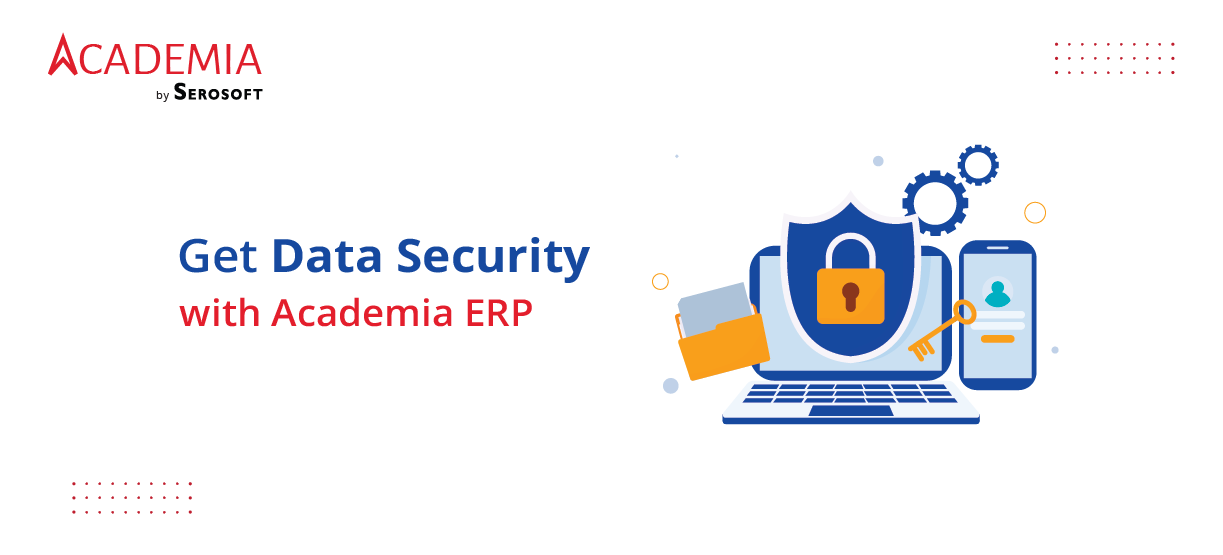
Data Security is a Concern for the Education Industry

Data privacy is a pressing issue for the education industry. But this is not something new. For any industry that is keeping its first step towards digitalization, security becomes a pressing issue and this time it is the education industry. 

How did it all start?

Now how did it start? Covid-19 has accelerated the adoption rate of technology across the globe. In a very short time, many institutes were forced to take hasty decisions and go with the available vendor without thinking much about security and the upcoming challenges pertaining to data and its mismanagement. 

Current Scenario

Now that the world is relaxing after a two-year-long harsh battle with Covid-19, it is time to rethink those choices. Now education institutes are thinking about the data that is being shared daily on online platforms by students, faculty, and school officials. This has made education institutes a primary target of cyber criminals as the proper security measures are still lacking. Frequent and high-intensity cyberattacks have become prominent in the education sector over the last two years. 

Moreover, even software that uses powerful data security regulations often becomes vulnerable to these attacks. Not always it is the fault of the product you are using. The problem may lie in the loosely integrated 3rd party software that gives cracks in your system to make a breach. The partner applications may not follow high standards of security and this may make you more prone to data theft. 

Furthermore, thousands of students use their personal devices to access the web and mobile applications and this may put the server at risk. Also, the students are at risk as the malicious code can be pushed to the devices, or phishing emails or messages may be sent easily to the students. 

Common security threats faced by EdTech companies 

In recent times, edtech companies have become a big target for cybercriminals. There have been instances of security breaches, phishing, stealing of data, and other instances. Here are some of the most frequent threats that are battled by edtech companies around the world:

  • Cloud Security Breaches: 

One of the most common threats for edtech companies is breaches in cloud-based applications. Cloud-based applications create a virtual depository of data that is very easy to access remotely. Data dissemination and analytics are also fairly easy in cloud-based applications as compared to on-premise applications. 

But at the same time, the risk of data breaches concerning the personal information of students and educators, financial operations, and other tasks associated with an institution. Cybercriminals may use this information and redirect the payments to a fictitious account that hackers control. 

  • Phishing:

Phishing needs no introduction as it is one of the most common threats. Cyber attackers mask their identity as a trusted entity and lure the users into divulging into sharing private and sensitive information such as credit card numbers, etc. Mostly cyber criminals target children as they are gullible and easy targets. 

  • Denial of Service (DoS): 

This is a new type of cybercrime, wherein the cyberattack makes sure that data or the systems that are used by the user are not accessible and are denied access. The cyberattack involves flooding the network with information and this disrupts the existing services. 

Denial of Services (DoS) in the context of edtech may result in disruption of education, delays in getting the right information for efficient administrative operations, or unavailability of knowledge resources or study material. 

  • Malware:

Malware attacks are very common. The software gets installed on the computer or server without the knowledge of the user, they come in various types and are employed to steal sensitive information of the users or commit crimes such as extortion.

  • Zoombombing:

It is fairly recent, online video conferencing platforms are interrupted by intruders. Incidents such as hate speeches against students during online classroom sessions or exposure to unwanted, harmful media during virtual classes have been reported. 

How Academia ERP is beating cyberattacks and staying compliant with global security standards? 

  • General Data Protection Regulation (GDPR): 

We are a GDPR-compliant organization. It is one of the biggest security standards for the countries in Europe, where the regulatory framework ensures we are assessing and processing the large volumes of data involving users securely and are not mishandling the data at all. We adhere to the framework very strictly and have by far never had any incidences concerning the mishandling of data or privacy breaches. 

  • Conducting Security audits: 

We timely conduct security audits and make sure there are no gaps in security with respect to our product. Furthermore, we go a step ahead and make sure the integrations that we do for our clients are not lost and do not provide any cracks through which the cybercriminals can make breaches.

  • Network and System Security

Network and system security are taken very seriously in Academia ERP. We take various measures to ensure the data and information is protected and shared through only secured channels through reliable access and network performance. Our well-designed network security solution ensures protection from a wide range of viruses, worms, trojans, spyware, adware, and ransomware. 

  • Cybersecurity awareness sessions

We are a big team of 200+ individuals, and we make sure each of our employees is adhering to the security standards and is following compliance. We regularly conduct cybersecurity awareness sessions and provide training to our employees about data protection and security protocols. 

  • Two-factor authentication & role-based access controls

Two-factor authentication and role-based access controls are implemented in the software solution. This allows us to make sure there is no unauthorized access to the system and that you face no situation where there is data leakage. 

Summing Up

Cybercrimes in the education sector are growing at a fast rate. As a decision-maker, the key to protecting yourself and other stakeholders using digital tools for administrative, academic, and non-academic operations lies in your hands.  

You can do right by choosing a reliable solution provider such as Academia Education ERP / Student Information System which adheres to the highest security standards and has by far had no instances of security breaches. We follow international standards of security and stay compliant with global regulatory frameworks. 

Know more about highly secure Education ERP called Academia ERP security by dropping a message. Also, get full-blown exposure to Academia ERP and its amazingness by requesting a live product demo

ABET Accreditation of Higher Education – All the Details

ABET (Accreditation Board for Engineering and Technology) is a US-based non-profit organization that grades engineering programs at a college to ensure professional-grade education. It is a global standard in STEM education to assure that undergraduate and postgraduate programs like computing, engineering, applied science, natural science, and software engineering provide academically sound, skill-based education.  

ABET-accredited university

ABET accreditation is a global standard and works as a magnet to attract prospects for your university. It executes the accreditation process through a network of experts that have vast industry experience. These experts evaluate and validate the institute programs to be holistic, and quality-driven. 

For this, the team of experts closely scrutinizes the programs. The process provides academicians and management of the university with a deeper understanding of the gaps in the system. The procedure includes a review of the program material, several visits to the campuses, and more. The process is well-aligned with modern education needs and standards, and thus makes ABET one of the most sought-after accreditation till now in the world for technical courses.  

What does it mean to be ABET-accredited? 

ABET sets a global standard, and getting accreditation from ABET means adding extra value to your global reputation. Being ABET accredited testifies for:

  • International quality education
  • Best practices in education 
  • Faculty and staff self-assessment process and continuous quality improvement
  • Focus on learning outcomes rather than just teaching inputs

Programs that can be ABET Accredited

  • Distance Learning Technical Programs
  • Applied and Natural Science Programs 
  • Computing Programs
  • Engineering Accreditation Commission
  • Engineering Technology Programs
  • Several Alternative Programs

Why is ABET Accreditation in Higher Education important?

ABET is globally valued. Every individual wishing to make a career in engineering and computer sciences would wish that their degree is of a global standard and also have a conviction that they are at an advantage of being part of a quality-driven, skilled-based curriculum. 

If your university is ABET accredited, you have a major edge in the market, as: 

  • It shows the compelling quality standards in the science and technology field.
  • It gives you a competitive edge in beating private and government institutes in your area.
  • It helps establish you in the global market.
  • It is a confirmation of high quality in terms of curriculum, assessment, and development.
  • It helps you in continuous improvements as ABET conducts regular reviews.
  • It ensures better student outcomes 

Note:

ABET accreditation may also help your institute to get a PE or Professional Engineer License.

ABET criteria and eligibility 

ABET promotes excellence in technical education and thus puts quality improvement at the center of all accreditation activities. The accreditation criteria is built by academic experts and technical professionals with years of experience in various industries, academic professions, and government organizations. The criteria is built to evaluate programs on three factors: 

  • Quality
  • Content 
  • Relevance

Important details of the ABET accreditation criteria

  • Eligible programs

Not every program is eligible for ABET accreditation and hence you must carefully go through the list of programs for which you apply for accreditation. Furthermore, the institute should be nationally and regionally accredited in the USA.  Also, doctoral and certificate programs are not accredited by ABET. ABET only accepts accreditation requests from degree-granting educational institutions. 

  • Minimum of one graduate is mandatory

Programs become eligible only if they have at least one graduate passed out. 

  • Program name clause

The program name should convey the objective and should not be misleading. 

  • SSR 

It is essential to submit an initial SSR before the on-site visit. The report needs to be accurate, to the point, updated, and error-free. 

ABET Accreditation Process & Timeline

ABET accreditation is a time-intensive process and can take up to 18 months. Step by step we can divide the accreditation process into: 

  • Readiness review 
  1. Collecting samples of syllabus, assignments, curriculum  
  2. It starts in October and must end by January 31st
  • Evaluation request 
  1. Assigning the assessment team 
  2. Between April and May, based on the review
  • Submission of SSR 
  1. Self-study report submission, followed by review by the assessment team
  2. Submission before July 1st
  • On-site visit
  1. Documents should be filed and ready before the on-site visit
  2. Panel interviews conducted with faculty, students, administration
  3. Usually scheduled from September until December, the on-site assessment lasts 3 days.
  • Decision-making process
  1. The review team may notify if they found any gaps during their visits 
  2. Within two-three months, formal communication starts to inform the findings
  3. Institute may be required to produce an explanation for the shortcomings within 30 days 
  4. The decision comes around July
  5. The final verdict notified to the institute by August 31st

ABET Assessment Planning

  1. Establish mission Statement
  2. Define Program Educational Objectives (PEOs) and Student Outcomes
  3. Evaluate Assessment findings 
  4. Plan Assessment design and execution
  5. Use data for decision-making

How to get ABET accredited successfully?

Here are some useful tips to get ABET accredited successfully:

  • Stick to the time frame

There is a reason why we have mentioned the months in the timeline. It is an 18-month-long process and you would get a sufficient time window to finish all the formalities and meet the expectations and standards of the assessment team. 

  • Eligibility check

Before you begin the process, it is necessary to map the eligibility criteria to your institute’s offerings. It is very common for people to apply for the accreditation of a course that doesn’t fall within the eligibility criteria. 

  • Request Application

To confirm your eligibility you are required to make a request for the same and submit the SSR, within the timeline for ensuring the process starts. 

  • ABET Review 

Based on your submission, the committee will evaluate your SSR and conduct an onsite visit to proceed with the evaluation process and give a final decision. So, make sure SSR is well-built with no errors. 

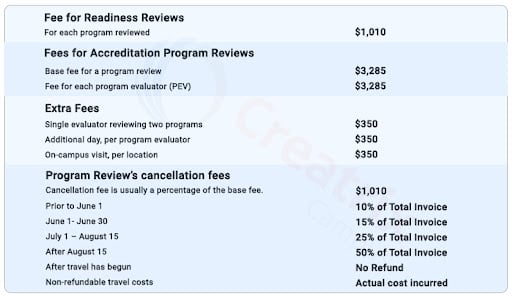
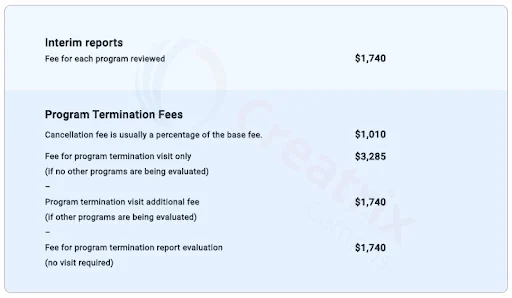
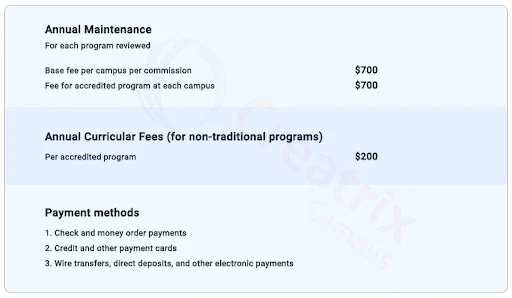
Cost of ABET Accreditation 

Based on 2021-2022:


Note: 

Fees for the programs outside the US are different, get more info on this here

Re-accreditation

Yes, re-accreditation is possible. And you need to submit RFE (Request for Evaluation) on the official website of ABET. RFE is a general formality for visits, interim visits, or interim reports. 

How does Academia ERP Solution help with ABET Accreditation?

ABET accreditation requires precision analysis of the institute on various factors. With the advanced report management system offered by Academia, you can generate a host of reports and analyze where you need to improve and how you can achieve ABET accreditation. Also, the reports help you in presenting the right data to the assessment committee at ABET in the SSR and allow you to leave no gaps unfilled. Request a live demo of Academia ERP to learn more.

Can a new-age education ERP help reduce operational costs & improve performance?

Education institutes around the world are trying hard to improve their operational capabilities. But they have a severe challenge in front of them. The more they try to solve their problems through traditional methods, the more they end up spending. In this scenario, digitalization gives high hopes. 

However, just because some tool claims to solve your problem does not mean it is a perfect solution for you. Education institutes must go out of their way and get into the nitty-gritty of the solution to accurately calculate how the product reduces operational costs and enhances performance. 

In this blog, we would chart out a plan through which you can calculate the cost reduction and ensure improved performance through the Education ERP solution. 

Also, Academia ERP understands how much ROI means to you, and we love to answer that question. Take a free demo of the product, and request our tech experts to support you in calculating the ROI on implementing Academia ERP Software at your institute – absolutely free!  Don’t miss out on this amazing opportunity. 

The need for ROI calculation  

ROI is a very important metric when it comes to calculating process transformation and business profitability. 

When it comes to the education sector, the need becomes even dire because there are limited resources and there is a very tiny budget involved. Especially when it comes to public-funded schools, colleges, and institutes, budgetary limitations are even bigger. In our vast experience, we have found careful deliberation by administrators and higher management while finding out digitalized solutions to their problems. 

But in their analysis, management is seen keeping a unidirectional approach. They see the initial cost of the set-up and the decision to digitalize their processes through education ERP takes a back seat. 

Modern education ERP solutions should be scrutinized with a futuristic approach. It is a complete suite of applications that transforms the processes and overall working of the institutes. It helps you reduce the operational cost and time significantly from various processes and allows a higher return on investment. 

Reduced reliance on papers

The world is moving towards sustainable development. We are developing global policies and digitalization sits at the center of the goals as it is bound to reduce the dependency on papers for office work and record maintenance. 

With an education ERP solution, you can completely digitalize your processes and reduce the cost associated with paperwork to a minimum. This includes reduced need to buy papers, reduced need to spend money on managing and safeguarding paper-based records, reduced time to work on a paper-driven system, and more. 

Automation 

There are a number of tasks performed on a daily basis in an education institute. This includes attendance, assigning work to students, collection of assignments, payment collections, and more. 

With digitalization, you get the power to automate most of your work, and allows you to focus on the tasks which are more critical for the functioning of the institutes. With automation, you can eliminate manual data entry, and errors, and reduce time taken to maintain the paperwork for various operations. Monitoring becomes easier, and reporting is accurate. 

Added benefits of digitalization are automated reminders, receipt creation and dispersal, accounting, ledger posting, and more. Digitalization also safeguards student information. 

Management

Vendor management is another task that is highly optimized through digitalization. It includes the use of a master vendor list and tracking vendor performance. It also helps you in identifying gaps in the supply chain. Furthermore, integrated predictive analytics can allow you to predict market change and optimize decision-making. Demand and supply forecast is highly improved as it is backed by data. 

Routine purchase reminders, better use of resources and budget with the purchase discount information and more are some of the added benefits. Education ERP solutions also, help in the management of human resources and allow you to bring more seamlessness in class and schedule management. 

Examination costs

Grading and reporting are two other aspects that are associated tasks of teachers. Conducting examinations and producing reports is a resource-intensive and time-taking process. Communication between teachers and parents is limited and there is a dire need for transparency in the process so that parents and teachers can cohesively work to improve the performance of the student. 

Using education ERP you can create a secure testing environment for the students and improve the communication between various stakeholders, especially teachers and parents. Also, instead of report cards, you can configure an official email address and electronically release the reports to the parents and students. 

Academia ERP recently integrated a QRcode-based marking system for Indus University. We helped them eliminate errors completely from the marking system and reduced the time significantly in the process, here is a full case study. 

Accuracy in statutory reporting 

Compliance and statutory reporting become difficult tasks when things are done manually. With an advanced solution such as the Academia ERP solution, you can enjoy an AI-driven report management system, so robust that it helps you score a grade ‘A’ NAAC accreditation.

The centralized data repository in education ERP serves as an easy tool to keep the information updated, provide automated reports on taxes, allows you to generate on-demand reports on several things, and make it easy for stakeholders to access information based on their role to perform tasks fast. 

Improved decision-making 

Business intelligence and reporting tools help you in bringing more transparency to the system. They give you data-backed suggestions to make optimal decisions. Technologies such as AI and ML have advanced to a great extent, they are efficient and reliable in tackling a variety of tasks, including predictive analysis. This allows decision-makers to have strong reasoning behind their decisions and also calculate the results in real-time to reinforce learning to optimize their strategy. 

Wrapping Up 

Education ERP solutions pave the way for digitalization in your institute. They are advanced solutions that can perform various tasks for your institute. As much as it is good to be excited about the changing dynamics of the institutes with digital tools, it is equally important to calculate the efficiency of the tools in reducing operational costs and time with improved performance. The mentioned points in the blog would help you factor in the same. 

As mentioned earlier, the team at Academia is highly-focused on maximizing the ROI for the institutes. And hence, we have curated an advanced calculator that takes into account specific details of your institute to provide a tentative report on the expected ROI on implementing Academia ERP. Leverage the opportunity while it lasts, and get a free report today. Contact us here.

Back to top