
Type your keyword below

Preparing Middle Eastern Universities for 2030: The Role of AI-Powered SIS Today

Overview: Are Middle Eastern Universities Ready for 2030?

Are universities in the Middle East truly prepared for 2030?
Can existing campus systems handle AI-driven governance, predictive admissions, and real-time regulatory reporting?
What technology investments today will directly align institutions with national transformation agendas like UAE Vision 2030?

These are not future-facing questions. They are immediate strategic concerns for Vice Chancellors, Registrars, CIOs, and governing boards across the region.

According to global education technology studies, over 60% of higher education leaders believe legacy systems limit institutional agility, while nearly 70% report challenges in generating real-time, decision-ready reports from fragmented data environments. 

In fast-transforming regions such as the UAE and broader GCC, this gap creates a critical risk: strategic misalignment with national digital transformation goals.

An AI-powered student information system addresses this challenge by integrating intelligent automation and unified governance into a single institutional framework. It enables universities to:

  • Automate admissions and enrollment intelligence
  • Maintain audit-ready regulatory compliance
  • Deliver real-time leadership dashboards
  • Improve student retention through predictive alerts
  • Align institutional KPIs with national policy goals

For institutions aligning with UAE Vision 2030, digital transformation is no longer optional infrastructure; it is a strategic positioning. The universities that act now will not only meet compliance expectations but lead the region in operational excellence, academic innovation, and global competitiveness.

This blog answers the critical question university leaders are asking today:
What role does an AI-powered student information system play in preparing Middle Eastern universities for 2030?

The 2030 Imperative: Why Universities Must Act Now

Across the Middle East, higher education reforms emphasize:

  • Digital governance
  • AI integration in student services
  • Data-driven policy execution
  • Global accreditation readiness
  • Knowledge economy development

In the UAE specifically, UAE Vision 2030 prioritizes smart government services, innovation ecosystems, and AI-enabled institutional frameworks. Universities are central to achieving these national ambitions.

However, many institutions still operate with:

  • Siloed academic data
  • Manual admissions tracking
  • Disconnected reporting tools
  • Reactive compliance preparation
  • Limited predictive forecasting

This operational fragmentation makes alignment with UAE Vision 2030 increasingly complex.

From Administrative Software to Strategic Intelligence Infrastructure

Traditional SIS platforms were designed to store student records. They were never built to connect departments, predict trends, automate compliance, or guide executive decisions.

A modern AI-powered student information system transforms static data into institutional intelligence.

Instead of simply capturing transactions, it enables:

  • Predictive enrollment modeling
  • Early identification of at-risk students
  • Automated regulatory reporting
  • Capacity and program optimization
  • Real-time academic performance tracking

In a policy-driven environment shaped by UAE Vision 2030, institutional foresight is as critical as operational efficiency.

Admissions at Scale: Intelligent and Predictive

The Middle East has become a global education destination. International student mobility is rising, and competition among institutions is intensifying.

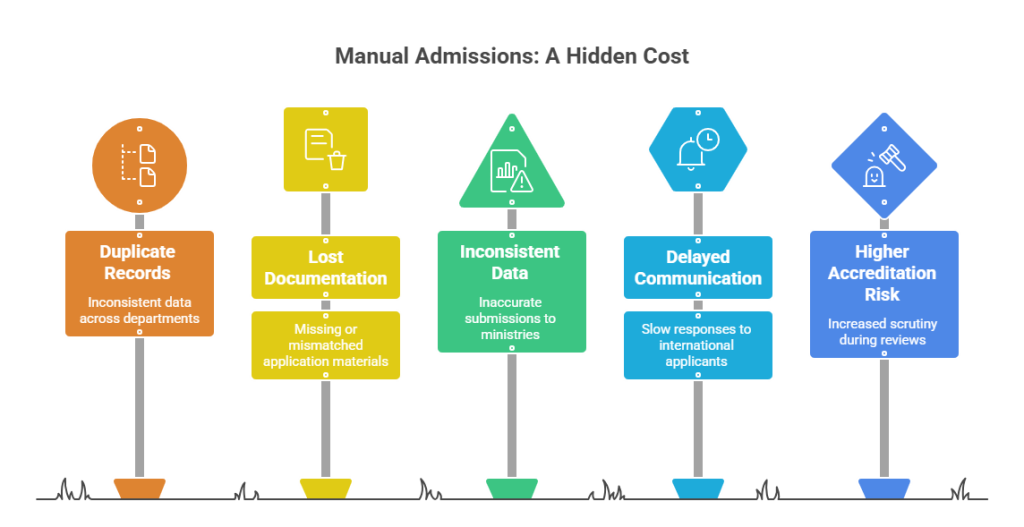
Manual admissions processes introduce delays, inconsistencies, and compliance risks.

An AI-powered student information system enables universities to:

  • Auto-screen applications based on eligibility logic
  • Predict acceptance yield and intake capacity
  • Identify incomplete submissions in real time
  • Generate admissions analytics for leadership

This level of intelligence ensures growth without administrative chaos, a necessity for institutions scaling under UAE Vision 2030.

Simplifying Compliance and Accreditation Reporting

Accreditation bodies across the Middle East require structured documentation, academic transparency, and measurable outcomes.

Yet many institutions still compile reports manually before inspections.

With an AI-powered student information system, universities can:

  • Maintain a centralized data repository
  • Generate compliance-ready reports instantly
  • Track curriculum and credit structures
  • Monitor academic progression across campuses

For universities aligning with UAE Vision 2030, proactive governance demonstrates institutional maturity and strategic credibility.

Student Experience as a Strategic Advantage

By 2030, students will expect real-time, AI-enabled digital services as a baseline experience.

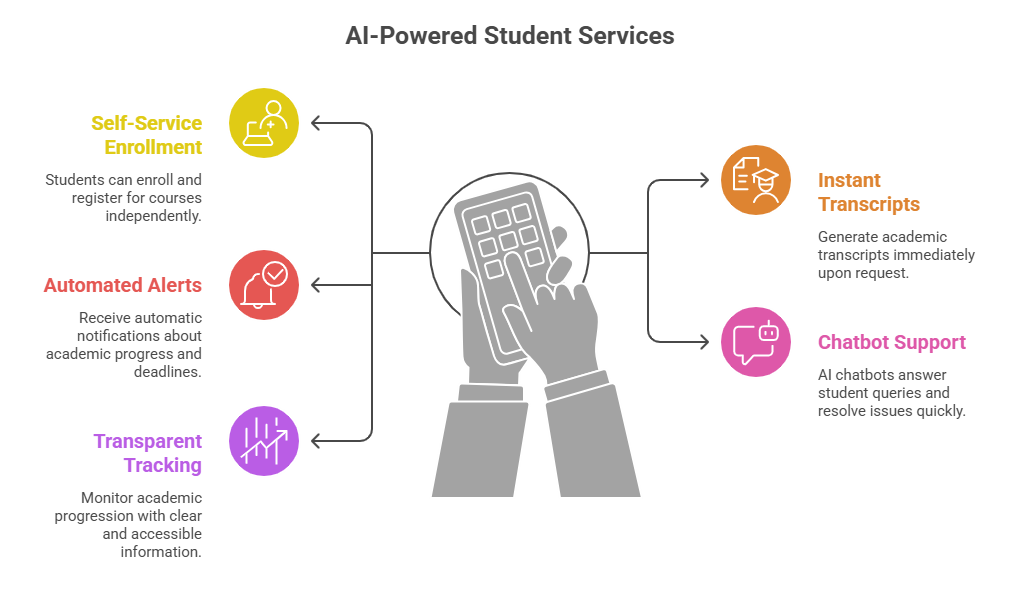
Institutions leveraging an AI-powered student information system can deliver:

Student Experience as a Strategic Advantage - visual selection

  • Self-service enrollment and course registration
  • Instant transcript generation
  • Automated academic alerts
  • AI-supported query-resolving chatbots
  • Transparent academic progression tracking

Improved student satisfaction directly influences retention, rankings, and institutional reputation, all central to the global positioning envisioned in UAE Vision 2030.

Data-Driven Leadership and Institutional Planning

University leadership teams frequently face challenges answering strategic questions such as:

  • Which programs are underperforming?
  • Do decision-makers have complete visibility across all campuses?
  • Where are compliance vulnerabilities emerging?
  • How efficiently are academic resources allocated?

An AI-powered student information system converts institutional data into predictive dashboards and actionable insights.

Rather than relying on historical reports, leadership can make forward-looking decisions supported by analytics.

This shift from reactive reporting to predictive governance strengthens alignment with UAE Vision 2030’s data-centric policy direction.

Multi-Campus and International Expansion Readiness

Many Middle Eastern universities operate across multiple campuses or international partnerships. Governance consistency becomes complex without centralized systems.

An AI-powered student information system ensures:

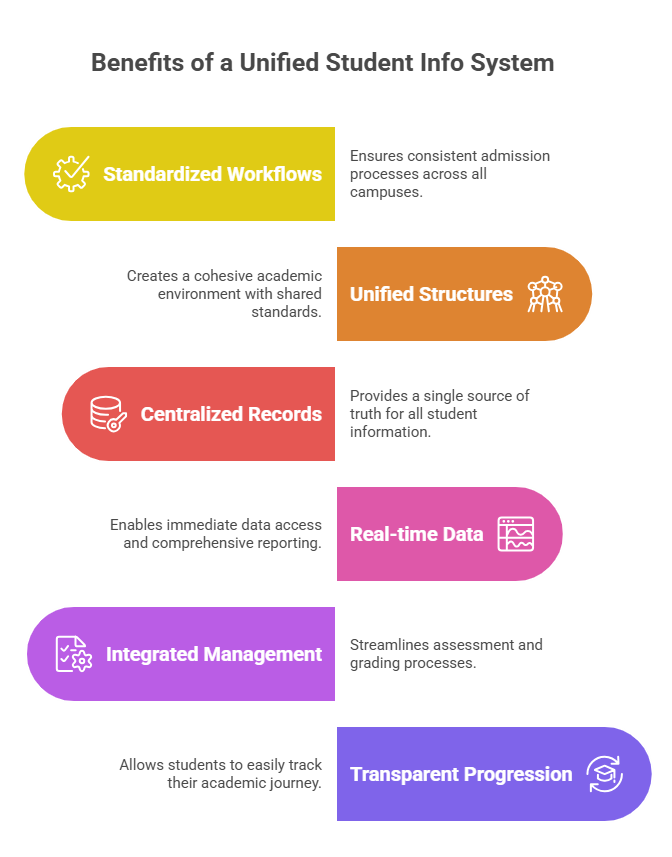
  • Uniform academic policies
  • Standardized grading and credit structures
  • Cross-campus visibility
  • Centralized compliance management

As the UAE Vision 2030 encourages global collaboration and international competitiveness, system-wide visibility becomes indispensable.

The 2030 Clock Is Ticking: Act Before the Gap Widens

Digital transformation requires:

  • Change management
  • Process reengineering
  • Data migration
  • Staff training
  • Governance restructuring

Institutions that begin implementing an AI-powered student information system today will have the operational maturity required well before 2030.

Those who delay may face rushed implementations, fragmented digital ecosystems, and strategic misalignment with UAE Vision 2030 objectives.

The Leadership Decision That Defines 2030

The future of Middle Eastern higher education will be defined by institutional intelligence, not institutional size.

An AI-powered student information system is no longer just an IT investment. It is:

  • A governance enabler
  • A compliance safeguard
  • A structured growth accelerator
  • A student experience differentiator
  • A strategic alignment framework supporting UAE Vision 2030

For institutions evaluating long-term digital strategy, platforms like Academia demonstrate how structured student lifecycle management can translate policy ambitions into measurable operational outcomes.

Universities that embed AI-driven intelligence into their core academic and administrative operations today will lead the region tomorrow.

The path to 2030 is already underway. The institutions that transform now will define what higher education in the Middle East looks like for decades to come.

Student Information System as the Single Source of Truth for Academic, Compliance, and Reporting Data

In an era where data drives decisions, institutional leaders in higher education are increasingly confronting one central question: 

How do we transform our fractured data environment into one that’s accurate, reliable, and strategically actionable? 

From registrar offices wrestling with inconsistent enrollment data, to compliance teams struggling with manual report preparation, the traditional model simply isn’t sustainable. 

What they need isn’t another isolated system; it’s a unifying platform that consolidates information into a trustworthy, single source. 

That’s where a Student Information System (SIS) becomes indispensable, not just a database, but the backbone of institutional truth and operational excellence.

As digital transformation accelerates across the sector, institutions without a unified student data platform are not just inefficient; they risk compliance errors, decision paralysis, and ultimately, diminished reputation and enrollment. 

In this context, the question shifts: 

How can a modern Student Information System empower leaders to make confident, data-backed decisions while maintaining compliance and enhancing academic outcomes? 

This blog answers that question with depth, clarity, and actionable insights.

Why Unified Student Data Matters More Than Ever

Institutions generate data at every step of the academic lifecycle, including admissions, registration, grades, attendance, student finances, and more. In traditional environments, this information resides in fragmented silos: separate spreadsheets, standalone portals, legacy systems, and departmental databases. This fragmentation leads to inconsistencies, redundancies, and conflicting figures, which one department calls “enrolled,” another calls “in progress.”

A Student Information System solves this problem at its core by serving as the single source of truth, a centralized repository where every student record, academic transaction, and compliance stat is captured once and accurately propagated across the institution’s ecosystem.  

Modern SIS architectures eliminate multiple interpretations of “truth,” giving administrators confidence that whether they’re reporting to an accrediting body or analyzing retention trends, the data is clean, consistent, and auditable. 

Academia Insight:

Research shows that integrated SIS platforms reduce administrative processing time significantly, with up to 50–70% reduction in manual reporting workflows, directly tying system automation to strategic productivity gains.


Student Information System as the Foundation of Digital Transformation

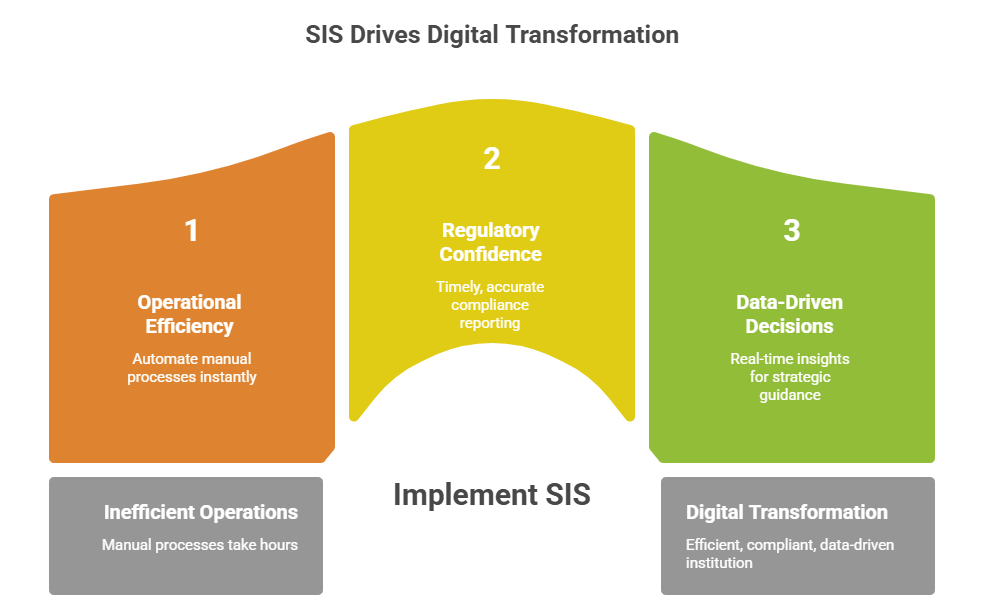
SIS as the Foundation of Digital Transformation - visual selection

Digital transformation isn’t just about buying software; it’s about changing how an institution operates. For higher education leaders, a successful transformation strategy must deliver three key outcomes:

  1. Operational Efficiency: Processes that once required hours of manual effort must become instantaneous.

  2. Regulatory Confidence: Compliance reporting must be timely, accurate, and defensible.

  3. Data-Driven Decisions: Leaders must have real-time insights that guide resource allocation, student success strategies, and risk mitigation.

An SIS delivers all three by dissolving operational friction and creating a single flow of truth from student entry to graduation. 

Fact-check with Academia:

According to market research, institutions adopting SIS platforms report significant improvements in administrative efficiency (approximately 73% of adopters) and enhanced data accuracy (about 64%). These aren’t abstract benefits; they directly influence how quickly an institution can respond to shifts in enrollment patterns, financial aid requirements, or strategic growth initiatives.

Academic Management, Beyond Record Keeping

At its heart, a Student Info System is much more than a digital filing cabinet. It’s a strategic engine for academic planning and execution. When every department, from admissions to advising, draws from the same dataset:

  • Course registration becomes frictionless with real-time prerequisites checking and conflict resolution.

  • Academic progress tracking is holistic, letting advisors predict graduation readiness instead of reacting to delays.

  • At-risk student detection moves from intuition to data-driven action, improving retention and success outcomes.

These capabilities shift academic management from reactive to proactive. Administrators aren’t scrambling to reconcile reports; they are foreseeing trends and catalyzing improvements.

Compliance and Reporting: From Burden to Competitive Advantage

Regulatory reporting is one of the least glamorous but most critical responsibilities of higher education institutions. 

Accreditation bodies and government regulators demand accurate submissions on everything from enrollment demographics to financial aid utilization. Historically, institutions have relied on labor-intensive, manual data preparation, which not only consumes time but also opens the door to human error.

A modern SIS automates this entire lifecycle: data collection, validation, aggregation, and report generation. Instead of weeks of compilation, compliance reports can be produced at the click of a button, and with traceable audit trails. 

This capability doesn’t just ensure meeting requirements; it elevates an institution’s reputation for transparency and operational maturity.

Driving the Digital Campus with Confidence

Today’s students expect seamless digital experiences, from admission to graduation. They want access to real-time schedules, grades, financial records, and support services on mobile devices. An integrated SIS delivers exactly that, eliminating the frustration of outdated portals and fragmented platforms.

Moreover, modern SIS solutions are expanding beyond record keeping into analytics and intelligent insights

Institutions can monitor KPIs such as retention trends, academic performance clusters, or resource utilization through dashboards that bring clarity to complex datasets. These insights empower leadership to make confident investments and operational adjustments without second-guessing the data foundation.

SIS as the Strategic Truth Engine

In a landscape of intensifying competition, regulatory expectations, and growing demand for operational excellence, institutions can no longer afford fragmented data systems. A Student Information System is no longer a “nice to have”; it has become the foundation of institutional integrity and modern digital transformation. Not only does an SIS consolidate academic and administrative data, but it also transforms that data into strategic clarity, operational efficiency, and compliance confidence.

When leadership can trust the numbers, when compliance is streamlined, and when decisions are backed by real-time insights, the institution moves from surviving digital disruption to leading in a digitally empowered academic world. 

Platforms like Academia are designed precisely for this shift, enabling institutions to unify their data ecosystem, strengthen governance, and operate with the confidence that every strategic move is backed by a single, reliable source of truth.

AI in Education ERP Across the Middle East: Building Future-Ready Higher Education Institutions

Higher education across the Middle East is not evolving gradually; it is accelerating.

National transformation agendas across the GCC, expanding transnational campuses, regulatory modernization, and digitally native student expectations are redefining how universities must operate. On the other hand, institutions are under pressure to be faster, more transparent, more compliant, and more student-centric.

Yet many campuses still operate on fragmented systems that have been layered over the years.

The conversation around AI in Education ERP often becomes overly futuristic, with predictive engines, algorithmic forecasting, and autonomous decision systems. But for most universities in the Middle East, the more urgent question is simpler:

Is your institution structurally ready for the future?

This is where Academia positions its AI-driven Higher Education ERP System, not as a prediction engine, but as a future-readiness platform that strengthens institutional agility, data clarity, and operational intelligence.

Why “Future-Ready” Matters More Than Just Being Predictive

Fact Check with Academia:

Global research from Gartner indicates that digital maturity, not isolated automation, is the strongest indicator of long-term institutional resilience. 

Meanwhile, McKinsey & Company notes that organizations integrating AI into workflow optimization and decision support see measurable improvements in operational speed and governance transparency.

For universities in the Middle East, future-readiness means:

  • Real-time visibility across departments 
  • Integrated campus-wide data 
  • Faster reporting for leadership 
  • Regulatory and accreditation alignment 
  • Scalable architecture for multi-campus growth 

An advanced Education ERP must therefore do more than just digitize records and storage. It must serve asact like a complete digital infrastructure, that is strong enough to support growth, audits, partnerships, and evolving academic models.

Academia’s AI-driven framework focuses on enabling institutions to respond faster, act smarter, and operate with clarity, without relying on speculative prediction engines.

Education ERP in the Middle East: From Digitization to Institutional Maturity

Many institutions in the region have already digitized processes. Admissions portals exist. Attendance is captured digitally. Examinations are system-managed.

But digitization alone does not equal transformation.

The next phase is maturity, where systems are interconnected, workflows are intelligent, and leadership has unified dashboards instead of departmental silos.

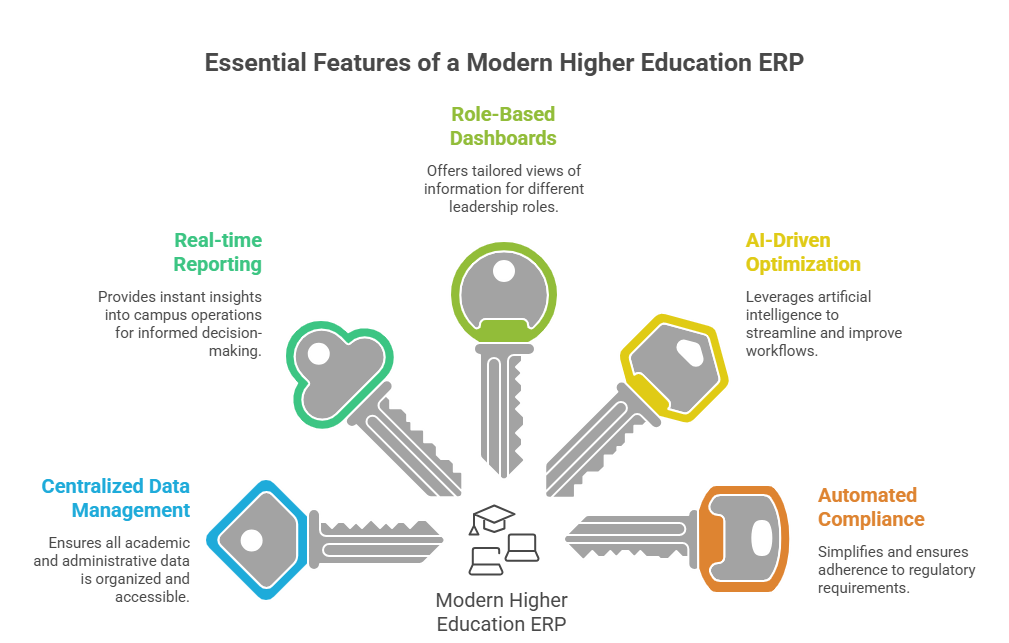
A modern Higher Education ERP System must provide:

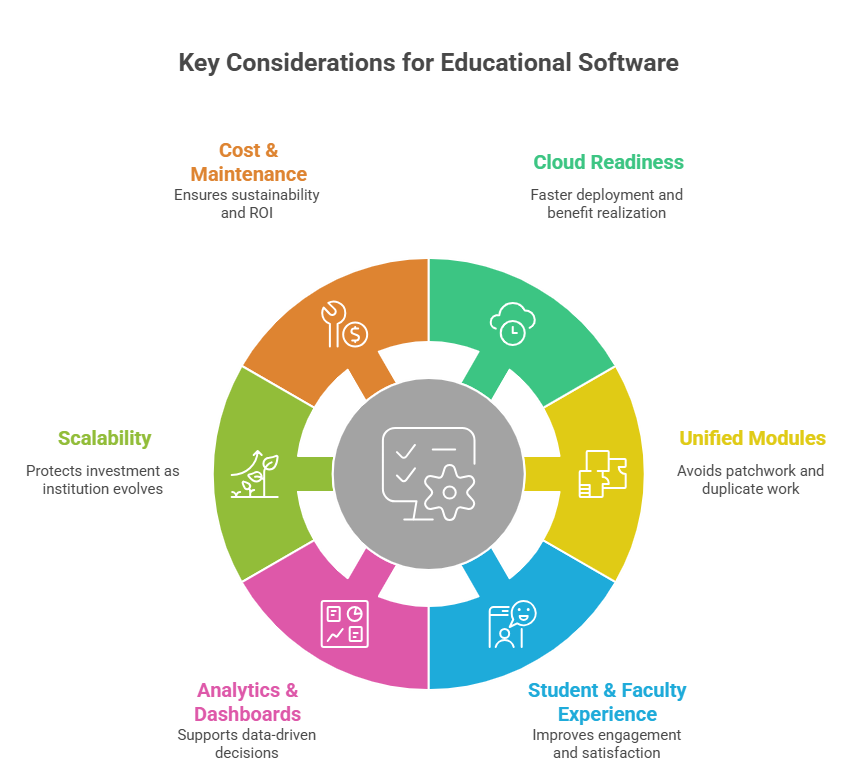
education ERP


This is the layer where Academia’s AI capabilities contribute, not by forecasting uncertain futures, but by making the present structurally strong and strategically aligned.

AI as an Enabler of Smarter Operations, Not a Buzzword

In Academia’s architecture, AI functions as an intelligent accelerator embedded within the Education ERP, enhancing how processes operate and how information flows.

For example:

  • Smart workflow routing ensures approvals move faster without manual follow-ups. 
  • Intelligent data validation reduces human errors in admissions and academic records. 
  • Dynamic dashboards consolidate multi-campus performance into one executive view. 

Academia Insight:

According to Deloitte, institutions that unify operational data and apply intelligent automation improve administrative efficiency by up to 20–30%. The advantage is not in predicting distant outcomes but in eliminating structural inefficiencies that slow leadership today.

This is where Academia differentiates itself, focusing on operational intelligence, governance readiness, and structured scalability.

Academia’s AI-powered Higher Education ERP System Making Institutions Future-Ready

Future-readiness is not abstract. It is architectural.

A robust Higher Education ERP System must provide a stable digital foundation that allows institutions to:

  • Expand to new campuses without rebuilding systems 
  • Integrate with LMS, CRM, and third-party tools seamlessly 
  • Generate audit-ready reports instantly 
  • Standardize academic governance across departments 

Academia’s AI-enabled Education ERP supports institutions by strengthening three critical pillars:

1. Unified Institutional Visibility

Leadership today cannot afford fragmented data. Academia consolidates admissions, attendance, academics, and performance metrics into structured, real-time dashboards accessible through role-based views.

What strengthens this visibility layer is AI-enabled intelligence:

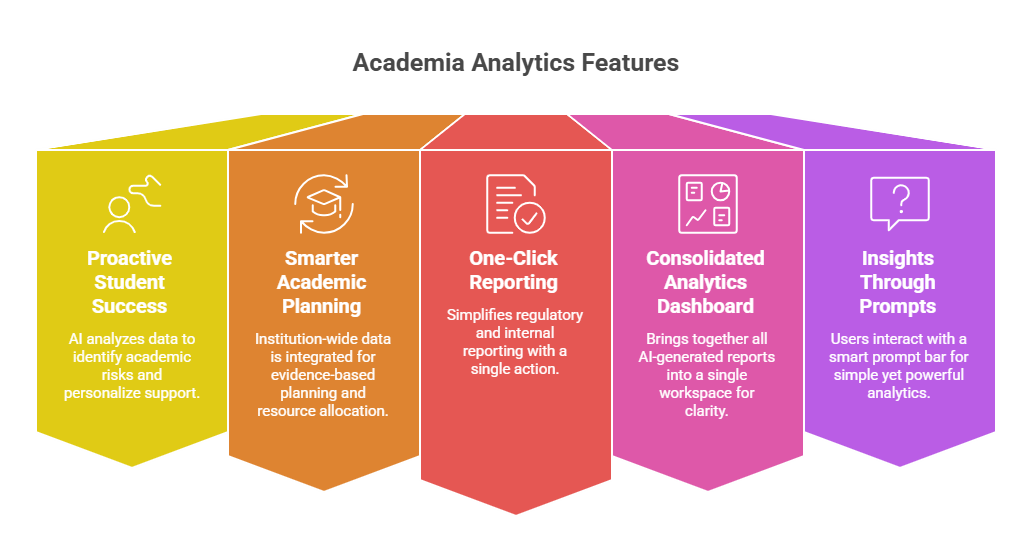
  • AI-Driven Reports & Advanced Analytics – Automatically generated, leadership-ready reports with actionable insights across departments and campuses. 

Instead of departments manually compiling spreadsheets, decision-makers gain immediate clarity through structured, system-generated intelligence inside the Education ERP.

2. Intelligent Process Optimization

Operational speed defines institutional responsiveness. Academia enhances workflows through AI-driven automation embedded within daily academic processes.

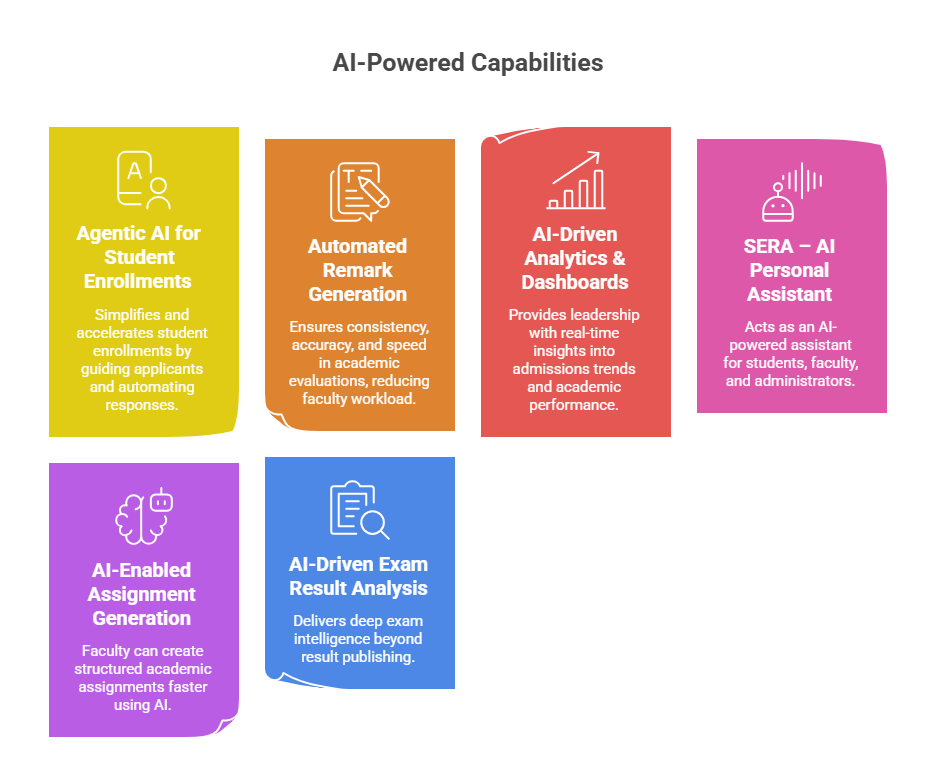
Key AI-powered capabilities include:

  • AI-Driven Remark Generation in Mark Sheets – Automatically generates contextual academic remarks, significantly reducing faculty workload and saving evaluation time. 
  • Agentic AI Self-Enrollment Chatbot – Enables prospective and current students to complete enrollment-related processes through guided AI conversations, reducing administrative dependency. 
  • SERA – AI-Enabled Personal Assistant – Provides instant query resolution for students and staff, improving engagement and reducing support bottlenecks. 
  • AI-Driven Exam Result Analysis – Generates structured performance analysis across courses, batches, and departments, enabling faster academic review cycles. 

These embedded capabilities transform the Higher Education ERP System from a transactional platform into an intelligent operational accelerator, without overcomplicating institutional workflows.

3. Scalable Multi-Campus Governance

For universities operating across cities or countries in the Middle East, governance consistency is critical.

Academia centralizes data architecture across campuses, ensuring:

  • Standardized grading frameworks 
  • Unified compliance documentation 
  • Centralized academic structures 
  • Consolidated institutional reporting 

While policies remain standardized, campuses retain operational flexibility within the same Education ERP environment.

This combination does not predict the future.
It prepares institutions to handle it confidently.

Why Future-Ready ERP Is a Leadership Decision

University boards in the Middle East are increasingly asking sharper questions:

  • Are we digitally prepared for cross-border expansion? 
  • How quickly can we generate accreditation reports? 
  • Do we have unified institutional data? 
  • Can leadership access performance metrics instantly? 

A traditional ERP answers operational questions.
A future-ready Higher Education ERP System answers governance questions.

Academia is a digital campus partner, helping institutions modernize their infrastructure with AI-driven enhancements that improve clarity, speed, and scalability.

The competitive advantage lies in readiness:

  • Readiness for regulatory change 
  • Readiness for enrollment fluctuations 
  • Readiness for multi-campus growth 
  • Readiness for digital transformation mandates 

In a region investing aggressively in higher education innovation, this readiness becomes institutional leverage.

The Emotional Reality Behind Digital Transformation

Behind every ERP migration is a leadership team balancing pressure and ambition.

Vice Chancellors want stronger rankings.
Registrars want cleaner data.
CIOs want system stability.
Academic Deans want visibility into performance.

An AI-driven Education ERP must reduce complexity, not introduce it.

Academia’s approach is grounded in strengthening the operational core so leadership can focus on strategy, partnerships, and academic excellence rather than administrative firefighting.

Future-readiness is ultimately about confidence, knowing your institutional backbone can support what comes next.

Conclusion: AI in Education ERP as a Future-Readiness Strategy

In the Middle East, higher education institutions are scaling faster than ever. The question is not whether AI belongs in your Education ERP. The question is how intelligently it is embedded.

A modern Higher Education ERP System should:

  • Strengthen governance 
  • Enhance transparency 
  • Accelerate workflows 
  • Support multi-campus growth 
  • Enable leadership clarity

Academia’s AI-driven platform is designed to do exactly that, not by predicting uncertain futures, but by building structurally resilient, digitally mature institutions prepared for change.

Because in today’s higher education landscape, the institutions that thrive are not the ones that chase futuristic trends.

They are the ones that become future-ready, strategically, and confidently.

Why Fragmented Systems Are the Biggest Risk to University Compliance

Universities across the world are asking the same critical questions: 

Why are compliance audits becoming more difficult despite having multiple systems? 

Why does regulatory reporting take weeks of manual effort?

Why do data discrepancies keep appearing across admissions, academics, and examinations?

The root cause, in most cases, is not a lack of effort or intent; it is the presence of fragmented, disconnected systems operating without a unified governance framework.

This blog examines why fragmented digital ecosystems pose one of the biggest compliance risks for universities today, and why relying on standalone tools, legacy platforms, and manual reconciliation is no longer sustainable. 

It explores how disconnected data flows weaken audit trails, increase data governance risks, and place CIOs under constant operational pressure. More importantly, it explains why modern institutions are moving toward a unified University Solution. 

If your institution is struggling with reporting accuracy, audit readiness, or system sprawl, this analysis will help you understand the risk and the strategic path forward.

The Compliance Risk CIOs Can’t Afford to Ignore

If you’re a CIO or IT leader in higher education, compliance is not an annual task. It’s a continuous obligation.

Accreditation audits.
Data protection regulations.
Funding disclosures.
Student record accuracy.
Assessment traceability.

Yet the biggest compliance risk today isn’t negligence.

It’s fragmentation.

Across universities globally, institutions operate with disconnected admissions systems, standalone LMS platforms, finance tools, examination modules, and countless spreadsheets stitched together with manual effort.

Even a single spreadsheet can be misplaced, and you lose part of your data.

Isn’t that scary? Indeed, it is. 

Before we move ahead in this blog, have a quick look at what industry figures reveal. 

Academia Insight:

According to Gartner, poor data quality costs organizations an average of $12.9 million annually. In higher education, that cost manifests as audit findings, funding risks, and reputational damage.

Fragmented systems are not just inefficient.
They are structurally non-compliant.

This is why institutions are shifting toward a unified University Solution built on an integrated architecture.

Fragmentation: The Silent Institutional Divider

Let’s break this down practically.

When systems don’t talk to each other, the information flow remains interrupted:

  • Admissions data doesn’t reconcile with academic records 
  • Attendance data differs from examination eligibility 
  • Financial records don’t align with enrollment status 
  • Regulatory reports require manual consolidation 
  • Audit trails are incomplete or unverifiable 

Compliance requires traceability, and traceability demands accessibility. 

If your institution cannot produce a full academic lifecycle trail, from application to graduation, within hours, not weeks, you are exposed.

A study by Deloitte found that organizations with siloed systems experience significantly higher reporting delays and compliance risk due to inconsistent data governance structures.

For universities, this translates to:

  • Delayed accreditation submissions 
  • Inaccurate regulatory reporting 
  • Data protection vulnerabilities 
  • Manual reconciliation errors 
  • Increased audit observations 

Fragmentation doesn’t fail loudly.
It fails slowly until audit season arrives.

The CIO’s Real Pain Point: Control Without Visibility

Most CIOs I speak with don’t lack systems.

They lack confidence in their data.

You may have:

  • A legacy student information system 
  • A separate LMS 
  • A finance tool 
  • Examination software 
  • Spreadsheets that fill the integration gaps 

But when the regulator asks for:

  • Cohort performance trends 
  • Credit compliance records 
  • Attendance-linked eligibility validation 
  • Historical grade modifications with timestamps 

Can your systems provide a unified, verifiable dataset?

Or does your team manually reconcile across platforms?

Compliance isn’t about having tools.
It’s about having a structured, governed University Solution that ensures data consistency by design.

Why Manual Reconciliation Is a Compliance Red Flag

Manual processes are still deeply embedded in universities.

Spreadsheets for grade moderation.
Email-based approvals.
Offline attendance uploads.
Manual transcript corrections.

Academia Insight:

According to IBM, the global average cost of a data breach reached $4.45 million in recent reports, with poor data governance being a key contributing factor.

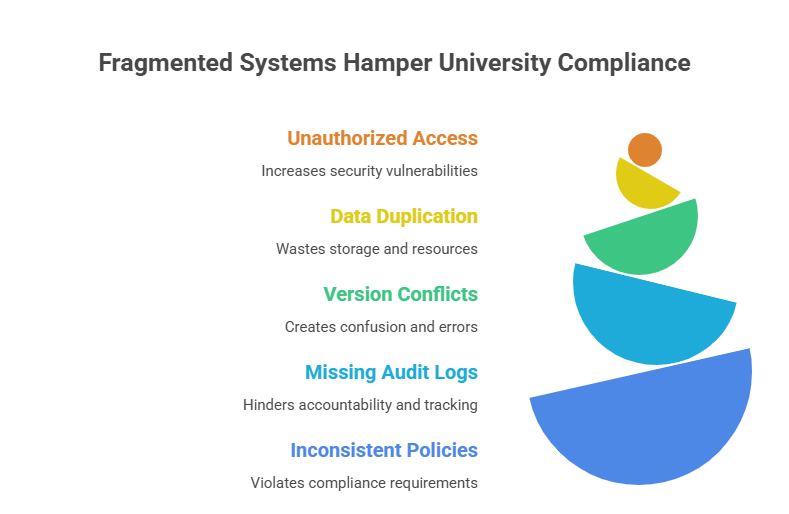
In universities, fragmented systems introduce multiple operational challenges like:

In universities, fragmented systems increase_ - visual selection

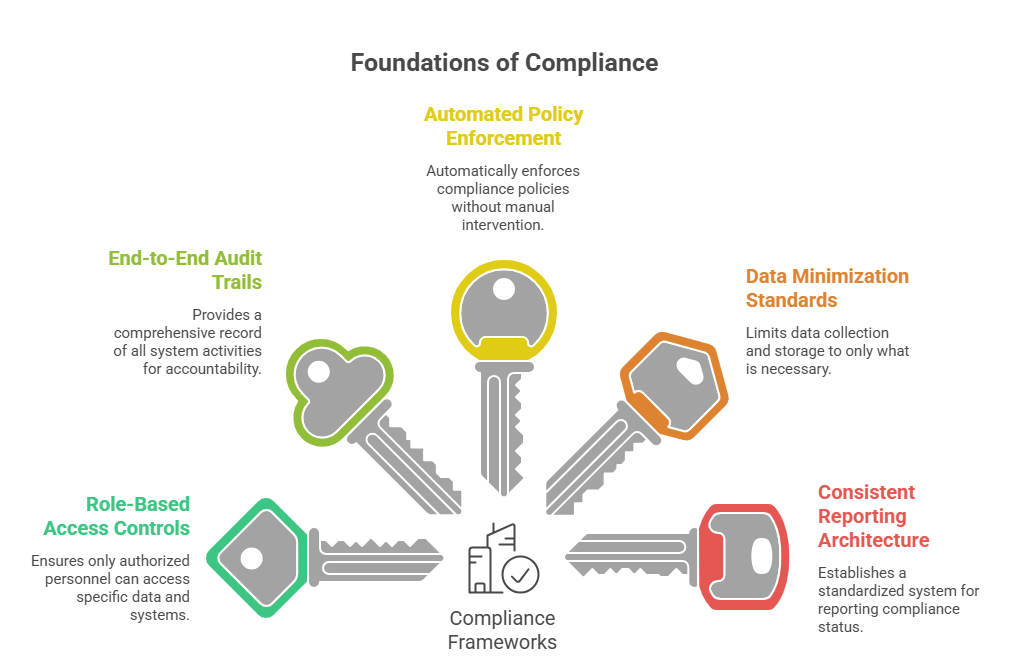
However, the key foundations of compliance frameworks are:

Compliance frameworks require_ - visual selection

Only an integrated University ERP can enforce governance at the architectural level.

The Window for Delaying ERP Migration Is Closing Fast

Many institutions delay ERP migration because:

  • “The legacy system still works.” 
  • “Integration is complex.” 
  • “Faculty resistance will be high.” 
  • “Data migration is risky.” 

But here’s the strategic reality:

Maintaining fragmented systems increases long-term operational risk exponentially.

Every year you delay modernization:

  • Technical debt compounds 
  • Integration costs rise 
  • Vendor dependencies deepen 
  • Compliance risk multiplies 

Migration is not a technology upgrade.
It is a governance reset.

What a True University Solution Should Deliver

If you are evaluating modernization, your University Solution must include:

1. Unified Data Architecture

All admissions, academics, attendance, assessments, and reporting within a single system.

2. Role-Based Governance Controls

Compliance is enforced at the permission level—not through policy documents alone.

3. Automated Academic Workflows

Digitized approvals, moderation trails, attendance validations, and progression checks.

4. Audit-Ready Reporting

Real-time dashboards replacing spreadsheet consolidation.

5. Secure Integration Framework

API-enabled integration without compromising centralized governance.

A properly designed University ERP doesn’t just connect systems.

It eliminates silos.

Strategic Question for CIOs

Ask yourself:

If a regulator conducted a surprise compliance review tomorrow, could your institution:

  • Produce accurate cross-departmental data instantly? 
  • Demonstrate complete audit trails? 
  • Show policy-enforced workflows? 
  • Prove data integrity across the academic lifecycle? 

If the answer involves manual effort, disconnected exports, or data reconciliation…

Fragmentation is already your biggest compliance risk.

Moving Toward Compliance by Design

The future of higher education IT is not system accumulation.

It is an architectural consolidation.

A unified University Solution like Academia ensures that compliance is embedded into operations, not retrofitted during audits.

For CIOs, this isn’t about modernization trends.

It’s about institutional resilience.

Because in today’s regulatory climate, fragmentation is no longer inefficiency.

It is a liability.

How Global ERP Solutions Simplify Multi-Campus Institution Management

Overview: One University, Many Campuses, One System of Intelligence

Managing a multi-campus institution is no longer about physical expansion alone. It’s about digital coordination at scale.

As universities expand across cities and countries, operational complexity increases exponentially, with fragmented data, inconsistent academic policies, delayed reporting, financial opacity, and administrative redundancies.

This is where global ERP solutions move from being an IT infrastructure to a complete operating digital infrastructure for an institution.

When implemented correctly, an advanced global ERP solution, a.k.a Education ERP platform, becomes the digital backbone that unifies governance, academic delivery, compliance, and financial oversight across distributed campuses.

This article examines, through research, operational realities and institutional case patterns, how global ERP systems simplify multi-campus management while enabling strategic scalability.

The Multi-Campus Complexity Problem

Multi-campus universities face three structural challenges:

1. Operational Fragmentation

Different campuses often operate on:

  • Separate admissions processes 
  • Disconnected finance systems 
  • Independent examination workflows 
  • Inconsistent academic structures 

Academia’s Insights:

According to the Higher Ed Innovation Index 2025, 39% of institutions identify a lack of system integration as their primary technology gap — a clear indicator that fragmented systems remain a core operational challenge in digital transformation efforts. 

Fragmentation leads to:

  • Delayed reporting cycles 
  • Redundant staffing costs 
  • Compliance risks 
  • Data inconsistencies 

2. Governance and Data Visibility Gaps

In distributed university networks, central leadership often lacks real-time visibility into:

  • Campus-wise enrollment trends 
  • Budget performance 
  • Faculty workload distribution 
  • Academic outcomes 

3. Scalability Limitations

When institutions expand internationally or open satellite campuses, legacy systems rarely scale seamlessly.

Common friction points:

  • Manual data consolidation 
  • Regional compliance variations 
  • Multi-currency financial management 
  • Diverse accreditation requirements 

Without a scalable digital architecture, growth increases complexity instead of institutional strength.

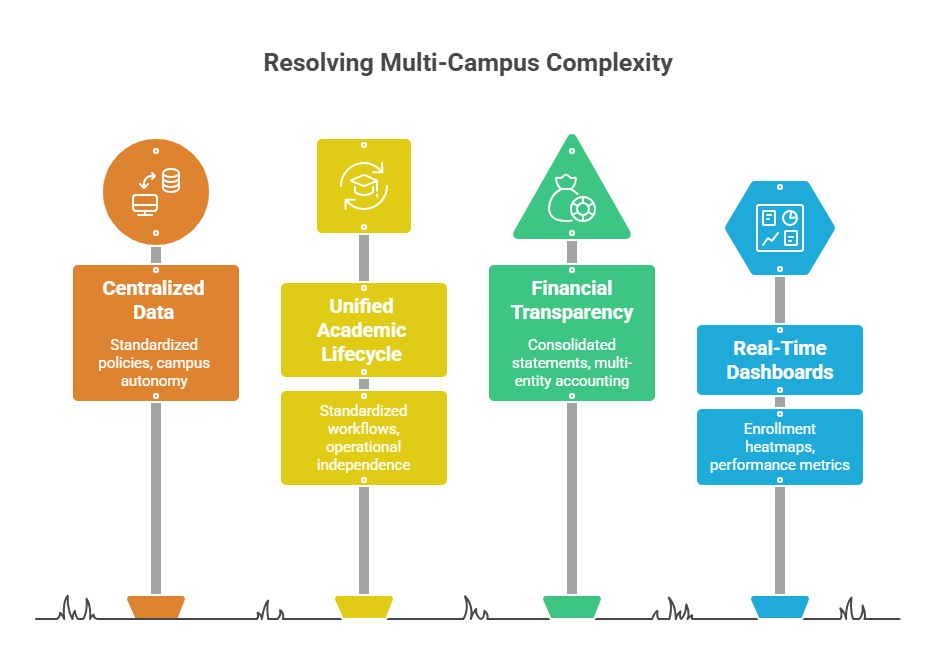
How Global ERP Solutions Resolve Multi-Campus Complexity

How Global ERP Solutions Resolve Multi-Campus Complexity - visual selection

1. Centralized Data Architecture with Local Flexibility

Modern global ERP solutions operate on a centralized database with configurable campus-level autonomy.

This enables:

  • Standardized policies across campuses 
  • Campus-specific fee structures 
  • Localized academic regulations 
  • Real-time consolidated dashboards 

Institutions maintain strategic consistency without sacrificing regional responsiveness.

2. Unified Academic Lifecycle Management

An advanced Education ERP integrates:

  • Admissions 
  • Student Information Systems (SIS) 
  • Learning Management Systems (LMS) 
  • Examinations 
  • Graduation tracking 

Rather than each campus running separate systems, the ERP standardizes workflows while preserving operational independence.

This reduces:

  • Duplicate data entry 
  • Data reconciliation errors 
  • Cross-campus student mobility issues 

3. Financial Transparency Across Campuses

Multi-campus institutions frequently struggle with financial reporting delays.

A unified ERP provides:

  • Consolidated financial statements 
  • Multi-entity accounting 
  • Automated budget tracking 
  • Inter-campus transaction transparency 

This strengthens governance, audit readiness, and board-level oversight.

4. Real-Time Executive Dashboards

Leadership teams gain:

  • Enrollment heatmaps 
  • Campus performance benchmarking 
  • Faculty productivity metrics 
  • Retention analytics 

Instead of waiting for quarterly summaries, executives can access live operational intelligence.

Research by McKinsey & Company indicates that data-driven institutions are 23% more likely to outperform peers in operational efficiency metrics.

Institutional Scenario: A Multi-Campus Expansion Case

Consider a regional university expanding from one main campus to three additional satellite campuses within five years.

Before ERP implementation:

  • Admissions data was managed locally 
  • Finance consolidation required 3–4 weeks each quarter 
  • Student transfers between campuses required manual validation 
  • Compliance reporting involved spreadsheet reconciliation 

After deploying a centralized global ERP solution:

  • Enrollment reporting became real-time 
  • Financial consolidation reduced to automated monthly dashboards 
  • Student mobility was system-enabled 
  • Accreditation reporting was generated from structured data 

The result: governance moved from operational firefighting to strategic planning.

Competitive Positioning: ERP vs. Disconnected Systems

Institutions often attempt to manage growth by layering tools:

  •  Legacy SIS for student records 
  • Separate LMS 
  • Standalone admissions software 
  • Independent platforms for attendance and exams 

This patchwork model creates integration risks and long-term maintenance costs.

Global ERP solutions offer a strategic advantage:

  • Unified student lifecycle management within one system 
  • Seamless integration with the third-party platforms 
  • Admissions seamlessly connected to student records 
  • Attendance and examinations operating within the same ecosystem

In competitive education markets, operational cohesion directly impacts student experience, brand perception, and institutional credibility.

Future Outlook: Multi-Campus Institutions as Digital Networks

The future of higher education is not campus-bound; it is network-based.

As universities adopt:

  • Hybrid learning models 
  • Cross-border programs 
  • Industry-integrated curricula 

Their infrastructure must evolve accordingly.

Education ERP systems are becoming the control layer that synchronizes academic, financial, and administrative ecosystems across geography.

Institutions that invest early in scalable digital infrastructure position themselves for:

  • Faster expansion 
  • Stronger governance 
  • Improved ranking metrics 
  • Sustainable operational growth 

Move From Complexity to Coordination with Academia

For institutions seeking to move from fragmented operations to structured, data-driven governance, an advanced Education ERP platform becomes a strategic necessity rather than a technology upgrade.

Solutions like Academia are designed specifically to support multi-campus institutions with centralized control, localized flexibility, and real-time visibility.

If your institution is navigating expansion or managing distributed campuses, you may consider exploring how a unified ERP architecture could support your long-term strategy.

You can book a free demo today to evaluate how it aligns with your institutional goals.

Student Information System Explained: Powering Institutional Growth and Success

A student information system plays a critical role in how higher education institutions manage, track, and govern student data across the entire academic lifecycle. From admissions and enrolment to academic records, assessments, and graduation, a centralized student info system ensures accuracy, consistency, and real-time access to student information. 

Institutions without a robust SIS often struggle with data duplication, manual effort, and limited visibility into student progress, which directly impacts administrative efficiency and student experience. 

When implemented as part of a broader Education ERP ecosystem, a student information system becomes the academic backbone of the institution, supporting compliance, improving decision-making, and enabling scalable growth. 

Rather than being a backend tool, SIS functions as a strategic enabler that helps institutions operate with clarity, control, and confidence in an increasingly data-driven higher education environment.


Why Do Universities Struggle to Unlock the Value of Student Data?

Every university talks about student success. Yet, behind the scenes, student data is often scattered across departments, systems, and spreadsheets, making it difficult to track progress, ensure accuracy, or support informed decisions.

This is where a student information system (SIS) becomes indispensable.

A well-implemented SIS does not just store data.
It connects the entire student lifecycle into one coherent, intelligent framework.

What Is a Student Information System, in Reality?

At its core, a student information system is the central platform that manages, tracks, and governs student-related data throughout their academic journey.

This includes:

  • Admissions and enrolment data 
  • Academic records and progression 
  • Course registrations and assessments 
  • Examination results and grading 
  • Student status, transfers, and completions 

Unlike isolated tools, an SIS ensures that every department works from the same source of truth.

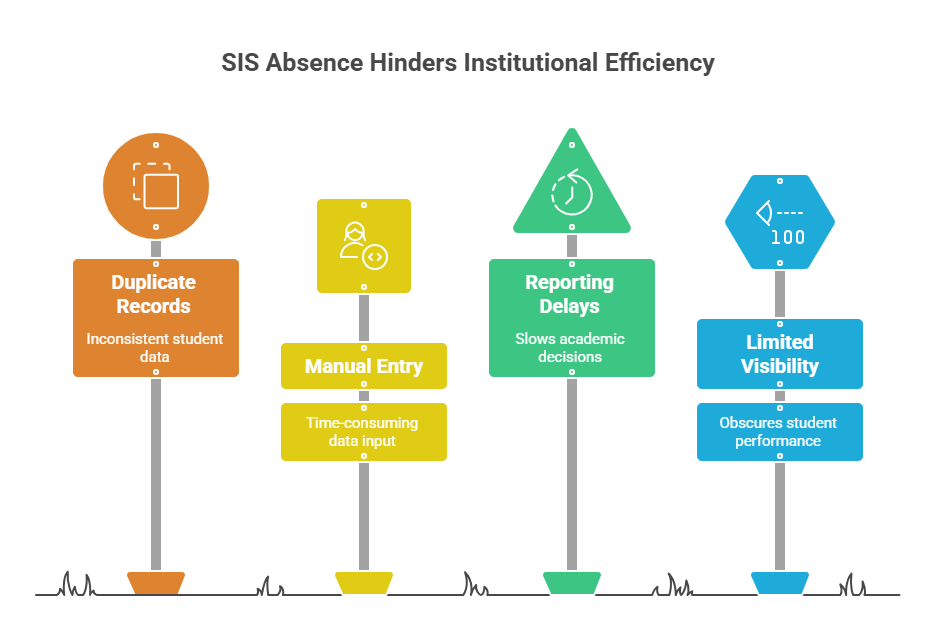
Where Institutions Fall Behind Without an SIS

Where Institutions Fall Behind Without an SIS - visual selection

Without a centralized student info system, institutions face recurring challenges:

  • Duplicate and inconsistent student records 
  • Manual data entry across departments 
  • Delays in reporting and academic decisions 
  • Limited visibility into student performance and trends 

Over time, these issues impact not just operations, but student trust and institutional reputation.

How a Student Information System Improves Administrative Efficiency

One of the strongest advantages of an SIS is the reduction of manual effort.

With automation and centralized workflows:

  • Admissions teams process applications faster 
  • Academic teams access real-time student data 
  • Examination departments reduce errors and rework 
  • Administrative staff focus less on data handling and more on academic support 

Efficiency is not just about speed; it’s about accuracy, consistency, and control.

Student Information System and Student Experience: A Direct Connection

From a student’s perspective, administrative delays feel like institutional inefficiency.

A modern student information system enables:

  • Faster admission cycles and quick updates 
  • Accurate academic records 
  • Timely exam results and transcripts 
  • Clear communication across departments 

When systems work seamlessly behind the scenes, students experience fewer bottlenecks and greater confidence in the institution.

Key Capabilities of a Future-Ready Student Information System

A modern SIS should enable institutions to:

  • Manage the complete student lifecycle seamlessly 
  • Ensure data accuracy across departments 
  • Support real-time reporting and analytics 
  • Adapt to regulatory and academic changes 
  • Scale across campuses and programs 

Anything less creates limitations that surface as the institution grows.

Why SIS Is a Leadership Decision, Not an IT One

Too often, SIS adoption is viewed as a backend system upgrade. In reality, it is a strategic leadership choice that defines how effectively an institution operates.

When leadership prioritizes SIS:

  • Decision-making becomes proactive 
  • Administrative risk reduces significantly 
  • Student satisfaction improves consistently 
  • The institution becomes future-ready 

The Strategic Advantage of Getting SIS Right

Institutions that implement the right student information system early:

  • Avoid data chaos during growth 
  • Reduce long-term operational costs 
  • Strengthen academic governance 
  • Build trust with students and regulators alike 

SIS is not about managing students; it is about enabling institutional excellence.

Student Information System: The Foundation

A Student Information System is the foundation upon which truly digital campuses are built. When aligned with a broader ERP strategy, it becomes more than an operational tool; it drives efficiency, strengthens leadership visibility, and enables sustainable institutional growth. For institutions serious about the future, an SIS is not just another feature in the tech stack; it is a strategic necessity.

This is where solutions like Academia step in, designed to simplify the entire student lifecycle while giving institutions the clarity and control they need to scale with confidence.

If your institution is rethinking how to modernize student management without adding complexity, now is the time to take the first step. 

Book a free demo today and explore how the right SIS can power your next phase of growth.

ERP-Led Digital Transformation: Why African Universities Can’t Delay Beyond 2026

By 2026, African universities must adopt ERP-led digital transformation to remain competitive and operationally resilient. 

Growing student enrolments, expanding data volumes, tighter compliance mandates, and rising expectations for digital services are exposing the limits of legacy, manual systems. 

Cloud-based Education ERP platforms enable institutions to centralize student data, automate admissions and examinations, strengthen regulatory compliance, and generate AI-driven insights for smarter decision-making. 

As AI becomes embedded in higher education and real-time governance becomes essential, delaying ERP adoption will increase operational costs, reduce student satisfaction, and widen the gap between digitally advanced institutions and those struggling to modernize.

The Question African Universities Can No Longer Avoid

Across Africa, higher education is expanding at an unprecedented pace. Student enrolments are rising, campuses are multiplying, regulatory expectations are tightening, and yet, many universities are still operating on fragmented systems, spreadsheets, and manual workflows.

The real question is no longer whether digital transformation is needed.
It is whether institutions can afford to delay it beyond 2026.

Education systems across the globe are moving toward data-driven governance, lifecycle-based student management, and automation-led efficiency. For African universities, the window to transition is narrowing fast, and Education ERP is at the center of that shift.

Why Digital Transformation Can’t Be Delayed in African Higher Education

For years, digital transformation in African universities was seen as a future goal, something to plan once enrolments stabilized or funding improved. That mindset has changed.

Today, institutions are under pressure to:

  • Manage growing and diverse student populations 
  • Maintain compliance with accreditation and regulatory bodies 
  • Improve student experience across admissions, academics, and examinations 
  • Enable leadership with real-time visibility into institutional performance 

Without an integrated system, these challenges compound, creating inefficiencies that directly impact institutional credibility and growth.

This is precisely where Higher Education ERP becomes transformational rather than tactical.

How Legacy Systems Hold Universities Back

Many African universities operate with a patchwork of disconnected tools, one for admissions, another for academics, another for examinations, and countless spreadsheets in between.

While these systems may function independently, together they create:

  • Data silos that limit leadership visibility 
  • Manual reconciliation across departments 
  • Delayed reporting and reactive decision-making 
  • Inconsistent student records across the lifecycle 

The result?
Administrative teams are overworked, leadership lacks clarity, and students experience friction at every stage of their academic journey.

Education ERP: The Backbone of Institutional Intelligence

Education ERP_ The Backbone of Institutional Intelligence - visual selection


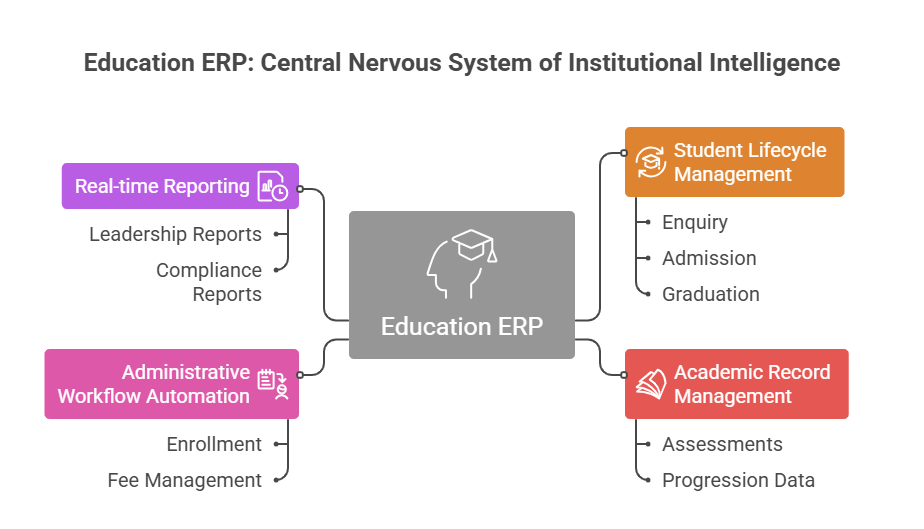
Modern Education ERP platforms are not just operational tools. They act as the
central nervous system of a university, connecting every academic and administrative function.

At a foundational level, an ERP enables institutions to:

  • Manage the complete student lifecycle, from enquiry to graduation 
  • Centralize academic records, assessments, and progression data 
  • Automate routine administrative workflows 
  • Generate real-time reports for leadership and compliance 

But more importantly, ERP shifts universities from operational firefighting to strategic planning.

Why 2026 Is a Critical Inflection Point

Several forces are converging to make 2026 a decisive year for African higher education:

  • Student expectations are changing
    Students now expect digital-first interactions, online admissions, real-time academic updates, and transparent communication. 
  • Regulatory oversight is increasing
    Accreditation bodies and governments are demanding accurate, auditable, and timely data. 
  • Multi-campus expansion is accelerating
    Managing multiple campuses without a centralized ERP leads to duplication, inconsistency, and loss of control. 
  • Leadership decisions must be faster and data-backed
    Institutions can no longer rely on delayed reports or assumptions. 

Universities that delay ERP adoption risk falling into a cycle of inefficiency that becomes harder and more expensive to break.

How ERP-Led Transformation Improves Student Experience

One of the most overlooked benefits of Education ERP is its direct impact on student experience.

With ERP-led processes:

  • Admissions become faster and more transparent 
  • Academic records remain consistent across departments 
  • Examination and results processing are accurate and timely 
  •  Students experience faster fee submissions and academic services 

When administrative friction is removed, students engage more deeply with academics, and institutional trust increases.

From Operational Control to Strategic Leadership

ERP adoption is not an IT initiative. It is a leadership decision.

University leadership teams gain:

  • A single source of truth for institutional data 
  • Dashboards that reflect real-time academic and operational health 
  • Predictive insights to plan enrolments, programs, and capacity 
  • The ability to scale without losing control 

This is why globally progressive universities treat Higher Education ERP as a long-term strategic asset, not a short-term software purchase.

The Cost of Waiting Is Higher Than the Cost of Change

Many institutions hesitate due to perceived complexity or implementation effort. But the real risk lies in continuing with systems that no longer scale.

Delaying ERP adoption leads to:

  • Rising administrative costs 
  • Increased dependency on manual effort 
  • Poor student satisfaction 
  • Reduced institutional agility 

By contrast, ERP-led digital transformation creates compounding benefits year after year.

Is your institution leading the digital shift—or chasing it?

For African universities, 2026 is the year of the Great Divide. Institutions leveraging Education ERPs are already seeing the rewards: seamless enrollments, flawless compliance, and a reputation for excellence. Those still anchored to legacy systems are feeling the strain.

Digital transformation isn’t just a tech upgrade; it’s your institution’s new foundation for credibility.

With Academia, you unify the entire student journey into one clear, data-driven picture. Stop managing paperwork and start leading growth.

One System, Many Campuses: How a Student Info System Helps Universities Scale Without Losing Control

The Growth Question Every Expanding University Must Answer

Your university just opened its third campus.

Admissions are growing.
International partnerships are increasing.
Student mobility is expanding.

But your data?

Scattered across spreadsheets.
Stored in disconnected systems.
Managed differently at every campus.

Are you scaling or slowly losing control?

Across the Middle East, higher education institutions are expanding faster than ever. From Riyadh to Dubai, Doha to Muscat, multi-campus growth is no longer optional — it is strategic.

But growth without operational structure introduces complexity.

This is where a centralized student info system, often referred to as an education management system, becomes the backbone of sustainable expansion.

The Hidden Complexity of Multi-Campus Expansion

Opening a new campus is not just about infrastructure. It introduces operational risk.

Without a unified student info system, institutions face:

  • Disconnected admission workflows
  • Inconsistent grading structures
  • Duplicate student data
  • Manual cross-campus reporting
  • Compliance misalignment across the Middle East regions
  • Limited leadership visibility

Over time, these inconsistencies create fragmentation.

And fragmentation creates risk.

For institutions operating across multiple Middle East countries, compliance, accreditation, and audit readiness are non-negotiable. A decentralized structure increases reporting errors, slows decision-making, and impacts student satisfaction.

A modern education management system eliminates this risk by centralizing governance while preserving campus flexibility.

What Is a Modern Student Info System?

A student info system is not just a student record database.

It is a centralized academic and administrative command layer that connects:

  • Admissions
  • Academic management
  • Assessments
  • Student progression
  • Compliance reporting
  • Finance integration
  • Cross-campus data visibility

When implemented across multiple campuses, it ensures one institutional structure with controlled flexibility.

Instead of operating in silos, campuses operate in alignment.

Leadership gains real-time insight across every location.

Why a Unified Student Info System Is the Backbone of Multi-Campus Success - visual selection

Why Multi-Campus Universities Need a Student Info System

1. Centralized Academic Governance

Programs can be standardized across campuses while allowing localized adaptations.

This ensures:

  • Curriculum consistency
  • Unified grading policies
  • Structured academic calendars
  • Controlled progression rules

Your academic identity remains intact even as you expand geographically.

2. Real-Time Institutional Visibility

Without consolidated data, leadership relies on delayed reports.

With a centralized student info system, leaders can:

  • Monitor enrollment trends across campuses
  • Track program performance regionally
  • Identify capacity gaps
  • Analyze retention patterns
  • Forecast academic demand

This transforms decision-making from reactive to predictive.

3. Cross-Border Compliance Built-In

Middle East institutions often operate across multiple regulatory frameworks.

A robust education management system enables:

  • Structured regulatory reporting
  • Automated compliance documentation
  • Secure data governance
  • Audit-ready documentation at all times

Instead of scrambling during inspections, institutions remain continuously prepared.
Compliance becomes embedded, not reactive.

4. Seamless Student Mobility

Modern students expect flexibility.

  • They transfer campuses.
  • They enroll in hybrid programs.
  • They pursue cross-campus electives.

Without a centralized student info system, this mobility becomes complex and error-prone.

With the right system:

  • Student records move seamlessly
  • Academic histories remain intact
  • Cross-campus scheduling is simplified
  • Graduation tracking remains accurate

The experience feels integrated — not fragmented.

And in competitive higher education markets like the Middle East, experience drives reputation.

The Operational Impact: Reducing Administrative Overload

As institutions expand, administrative teams often carry the burden of complexity.

Multiple systems result in:

  • Re-entered student data
  • Manual report consolidation
  • Email-based approval tracking
  • Disconnected departmental databases

A centralized education management system automates high-volume processes and eliminates duplication. Teams focus less on reconciliation and more on strategic academic support.

Scaling Without Losing Institutional Identity

One of the biggest concerns during expansion is losing academic consistency.

When campuses operate on different systems:

  • Assessment structures drift
  • Curriculum mapping varies
  • Academic policies fragment

A unified student info system ensures institutional alignment across:

  • Grading frameworks
  • Curriculum design
  • Academic policies
  • Student progression rules

Standardization at the core.
Flexibility at the edges.

That balance defines sustainable multi-campus growth.

Leadership Checklist: Is Your Institution Ready to Scale?

If your university operates multiple campuses, ask:

  • Can leadership view live enrollment across all campuses in one dashboard?
  • Are academic structures consistent across regions?
  • Is compliance reporting automated?
  • Can students transfer campuses without manual intervention?
  • Is there one centralized source of academic truth?

If the answer is no to even one, your expansion may be outpacing your systems.

From Expansion to Sustainable Growth

Opening campuses is growth. Managing them with control is sustainability.

A future-focused student info system ensures expansion does not compromise:

  • Governance
  • Data security
  • Academic consistency
  • Leadership visibility
  • Student experience

Meanwhile, a modern education management system aligns every department: admissions, academics, compliance, and administration — under one structured framework.

Together, they transform operational complexity into coordinated institutional strength.

The Middle East’s higher education sector is expanding rapidly.

New campuses will open.
International partnerships will grow.
Student expectations will rise.
The real question is not whether to expand.

Is your institution equipped with a centralized student info system and education management system capable of managing that expansion without losing control?

One system.
Many campuses.
Complete operational command.

Institutions that scale with structure lead the future of higher education.

Academia’s student info system is built to support multi-campus institutions across the Middle East with visibility, governance, and confidence.

Book your free demo today and see how Academia enables structured, sustainable growth.

HEMIS, DHET & POPIA: Why a Compliance-First Student Information System Is Non-Negotiable in South Africa

When compliance fails, it’s not just data at risk; it’s your institution’s credibility

Running a higher education institution in South Africa today is a bit like managing air traffic during peak season. Thousands of data points move simultaneously, student enrolments, funding claims, graduation records, personal information, and every single one must land safely, accurately, and on time.

Now imagine relying on spreadsheets, disconnected tools, or an outdated education management system to manage this complexity.

One missed HEMIS submission.
One POPIA lapse.
One inconsistency in DHET reporting.

The consequences? Funding delays, audit red flags, reputational damage, and in some cases, regulatory penalties that institutions simply cannot afford.

This is why a compliance-first Student Information System is no longer a “nice to have” in South Africa. It’s foundational to institutional survival, credibility, and growth.

Understanding South Africa’s higher education compliance landscape

South African institutions operate under one of the most tightly regulated higher-education frameworks globally. At the centre of this ecosystem sit three critical pillars:

1. DHET: The regulatory backbone

The Department of Higher Education and Training (DHET) governs policy, funding allocation, reporting standards, and institutional accountability. Every registered public and private institution must submit accurate, timely, and verifiable data to remain compliant.

DHET doesn’t just ask whether data is submitted; it scrutinises how reliable that data is.

2. HEMIS: Where funding meets data accuracy

The Higher Education Management Information System (HEMIS) is the primary mechanism through which institutions report student, staff, qualification, and graduation data to DHET.

HEMIS data directly influences:

  • Government subsidies and grants

  • Institutional performance evaluations

  • National planning and skills forecasting

Inaccurate or inconsistent HEMIS submissions can result in:

  • Reduced or delayed funding

  • Audit escalations

  • Requests for resubmission or correction

Without a structured Student Information System, HEMIS reporting becomes a high-risk manual exercise.

3. POPIA: Protecting student data is a legal obligation

With the enforcement of the Protection of Personal Information Act (POPIA), institutions are now legally responsible for how student and staff data is collected, stored, processed, and shared.

This includes:

  • Academic records

  • Identity documents

  • Contact details

  • Financial and admission data

POPIA compliance is not optional, and breaches can lead to serious legal and reputational consequences.

The Hidden Compliance Gaps in Traditional Education Management Systems

Compliance-Gaps-in-Traditional-Education-Management-Systems
 

Many South African institutions still rely on:

  • Legacy SIS platforms built before POPIA

  • Multiple disconnected tools for admissions, exams, and reporting

  • Manual data consolidation for HEMIS submissions

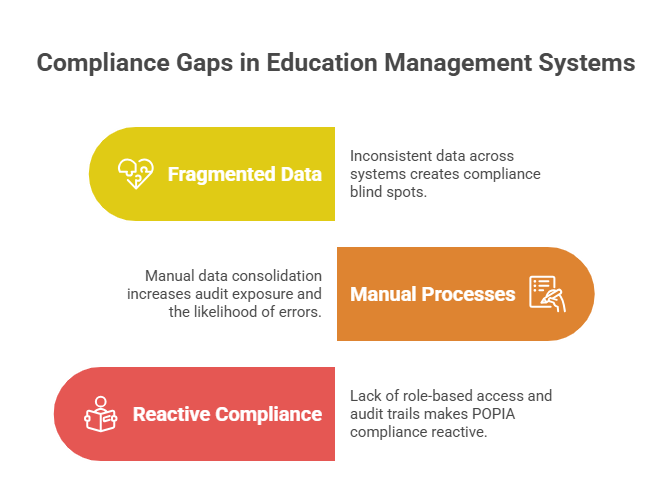
This creates three major risks:

1. Fragmented data = compliance blind spots

When data lives across systems, consistency breaks down. One mismatch between departments can invalidate an entire HEMIS submission.

2. Manual processes increase audit exposure

Manual uploads, spreadsheets, and human interventions significantly increase the likelihood of errors, especially during high-pressure submission cycles.

3. POPIA compliance becomes reactive, not proactive

Without role-based access, encryption, and audit trails, institutions struggle to demonstrate POPIA compliance during audits or investigations.

What “compliance-first” really means in a Student Information System

A compliance-first Student Information System is not built around features; it’s built around regulatory responsibility.

Here’s what that looks like in practice:

Built-in HEMIS alignment from day one

A modern SIS should:

  • Capture HEMIS-required data at the source

  • Validate data formats automatically

  • Map academic structures exactly as per DHET guidelines

This ensures reporting accuracy without last-minute firefighting.

POPIA-ready data governance

A compliance-first system embeds:

  • Role-based access controls

  • Data encryption and secure hosting

  • Full audit trails for every data interaction

This allows institutions to confidently demonstrate POPIA adherence, not just claim it.

DHET-aligned reporting workflows

Instead of pulling data together at the end of the academic cycle, a strong education management system:

  • Maintains real-time compliance readiness

  • Generates DHET-aligned reports

  • Reduces dependency on manual verification

Compliance becomes continuous, not seasonal.

Why South African institutions are rethinking SIS decisions

Across South Africa, higher education leaders are asking a more strategic question:

“Does our current Student Information System protect us, or expose us?”

Institutions upgrading their SIS are typically driven by:

  • Increasing DHET scrutiny

  • Growing POPIA enforcement

  • Pressure to justify funding with clean data

  • The need for audit-ready systems year-round

A compliance-first approach shifts the narrative from damage control to institutional confidence.

Compliance is no longer an IT concern; it’s a leadership priority

Vice-Chancellors, Registrars, CIOs, and Compliance Officers now share a common reality:
Regulatory data integrity impacts funding, reputation, and long-term sustainability.

A future-ready Student Information System:

  • Reduces administrative risks & efforts

  • Strengthens regulatory trust

  • Enables leadership to focus on academic excellence, not audits

In South Africa’s evolving regulatory environment, institutions that treat compliance as a system design principle, not an afterthought, will lead with confidence.

Final thoughts: Why compliance-first SIS is non-negotiable

HEMIS accuracy determines funding.
DHET compliance protects institutional standing.
POPIA safeguards trust.

Trying to manage all three through disconnected or legacy systems is no longer viable in South Africa’s increasingly audit-driven higher education landscape.

This is where a compliance-first Student Information System makes the difference.

Academia’s Student Information System is designed with South African institutions in mind, aligning seamlessly with HEMIS reporting requirements, supporting DHET-aligned data structures, and embedding POPIA-ready data governance into everyday operations. Compliance isn’t handled at the end of the cycle; it’s built into the way data is captured, managed, and reported from day one.

Book your free compliance-focused demo of Academia SIS today and see how your institution can stay audit-ready, funding-secure, and future-ready, without the operational strain.

From Administration to Pedagogy: Rethinking Student Information Systems in the Middle East

In an era where higher education is rapidly evolving, Middle Eastern universities and colleges are facing an urgent reality: traditional administrative systems can no longer keep up with the pace of academic transformation. 

As institutions strive to deliver better learning outcomes, support diverse student populations, and comply with regional accreditation requirements, the role of a student information system has shifted from administrative convenience to pedagogical necessity.

Globally, the student information system market is expanding rapidly. According to industry research, nearly half of institutions worldwide are investing in SIS platforms to streamline processes and strengthen academic decision-making. 

In the Middle East and Africa region, nearly 44% of institutions are already adopting SIS platforms to support student administration and performance monitoring, reflecting a growing commitment to digital education transformation.

Yet despite this growth, many campuses in the Middle East still rely on fragmented or legacy systems that were not designed with pedagogy, student experience, or data-driven decision-making in mind.

The Growing Demand for Pedagogical Support in Higher Education Technology

The Middle East is experiencing a surge in higher education enrollment. Countries such as the UAE and Saudi Arabia are expanding university capacity and attracting international students, creating richly diverse learning environments. 

Modern pedagogical approaches in this context cannot be sustained with disconnected, manual, or homegrown administrative systems.

A robust student information system is no longer just a tool for enrollment or scheduling; it must support the entire academic lifecycle. From admissions and course planning to assessment, progression, and learner analytics, SIS platforms must provide a unified view of each student’s journey. This alignment of administrative processes and pedagogy is essential for modern academic leadership.

Unlike standalone systems, integrated SIS platforms offer faculty and administrators real-time access to student data, enabling timely academic interventions and personalized learning support. When this data is siloed, buried in spreadsheets or disparate local systems, opportunities for enhancing student success are lost.

However, when data flows seamlessly within an ERP framework, institutions benefit from centralized governance, improved operational efficiency, and consistent reporting, all while enabling educators to focus on what matters most: teaching and learning.

Challenges Middle Eastern Institutions Face Today

Even as digital education gains momentum, several challenges persist across the region:

1. Fragmented Academic Workflows

Many universities still use separate solutions for admissions, student records, attendance, and grading. This not only creates duplication of effort but also impedes faculty and advisors from gaining a comprehensive view of student progress.

2. Limited Analytics for Pedagogical Decisions

While data is collected at multiple touchpoints, it often remains unused or inaccessible. Without analytics connected to teaching practice, such as performance trends or early warning signals, institutions miss critical opportunities to improve learning outcomes.

3. Inefficient Reporting and Compliance

Regional accreditation bodies and national educational authorities require regular reporting of academic metrics. Institutions using fragmented or manual systems struggle to generate reliable compliance reports, leading to administrative bottlenecks.

4. Scalability and Integration Issues

As institutions grow and adopt more digital tools, legacy systems often fail to integrate effectively. This becomes especially problematic when trying to link LMS platforms, research systems, and campus services into a coherent technology ecosystem.

Research shows that while cloud adoption is increasing, with 54% of SIS implementations in the Middle East and Africa being cloud-based, many institutions still wrestle with integration challenges due to legacy infrastructures.

How Modern SIS Platforms Support Pedagogy and Performance

The shift toward digital pedagogy in the Middle East calls for SIS platforms that do more than automate administrative tasks. Here’s how modern SIS platforms are enabling academic success:

Centralized Student Data for Informed Decisions

By capturing every student interaction, from attendance to assessments, in a single system, institutions can generate insights that support tailored academic strategies.

Real-Time Analytics for Student Support

Analytics tools embedded within SIS platforms allow faculty and advisors to identify performance gaps early, track progression, and recommend interventions before students fall behind.

Seamless Integration with Learning Ecosystems

Integration with LMS and communication tools ensures that course delivery, student engagement, and academic records are all connected. This holistic view is pivotal for effective pedagogy and personalized learning pathways.

Support for Accreditation and Reporting

Automated report generation aligned with regional compliance needs reduces administrative effort and improves data reliability, an increasingly important capability as education authorities in the Middle East tighten quality assurance standards.

As the global education ERP market grows — projected to expand from USD 24.24 billion in 2025 toward USD 46.58 billion by 2030 — institutions that embrace integrated digital platforms are better positioned to navigate the complexity of modern higher education.

The Middle East Opportunity: Bridging Strategy and Implementation

For Middle Eastern institutions, the move from legacy solutions to modern SIS/Education ERP platforms is both a strategic priority and a pedagogical imperative. To truly support learner success, these platforms must:

  • Enable data-driven teaching decisions
  • Support personalized learning journeys
  • Provide compliance-ready reporting
  • Integrate seamlessly with existing digital tools

This transformation is not just about technology adoption; it’s about reimagining how academic institutions operate in a digital age where student outcomes, faculty effectiveness, and institutional agility are key drivers of global competitiveness.

Conclusion: From Administrative Tools to Academic Enablers

In the Middle East, the growing demand for robust and integrated student information systems reflects a deeper shift toward improving academic quality, operational efficiency, and student success. 

As education ecosystems evolve, institutions that invest in platforms designed to support pedagogy, not just paperwork, will be better positioned to lead in the years ahead.

The conversation is no longer about whether to adopt a student information system, but about choosing the right one. Platforms like Academia, built with academic continuity and scalability at their core, demonstrate how technology can empower educators, enable seamless institutional experiences, and support every student’s journey, from enrolment through graduation, without disrupting the essence of teaching and learning.

See how institutions across the Middle East are enabling pedagogy through modern SIS platforms. Book a demo to learn more.

Back to top