

Anjali Gupta
Estd. Reading Time : 4 Min.
25th Sep, 2026
Share On:
India’s higher-education system is expanding rapidly, changing the way universities manage students and administration. NITI Aayog’s 2025 report notes that State Public Universities serve more than 3.25 crore students, making efficient digital administration increasingly important.
At this scale, the challenge is not simply collecting applications. It is managing what happens after a student clicks Submit. Information may move through admissions, document verification, registration, fees, academic departments and student records. When staff repeatedly copy the same information between spreadsheets, emails and systems, universities may digitise individual tasks without actually automating the student journey.
A connected approach can change that. Information captured during application can become the foundation of the student’s institutional record, reducing unnecessary re-entry and helping departments work with consistent information.
The bigger question is therefore:
Can information collected during admission remain useful throughout the student’s academic journey?
Imagine a student applying to an Indian university.
They provide their name, contact details, qualifications, programme preference and documents. The application is submitted. Then the information starts moving between teams.
Admissions verifies the documents. An offer may be generated. Once accepted, registration begins. Finance needs payment information, while the academic department needs programme details.
If every department recreates the same information, the university effectively creates multiple versions of the same student’s record.
For example, if a student’s programme is already captured during admission, registration staff should not need to manually copy it from an email or spreadsheet.
The application should become the beginning of the student record, not the end of a separate admissions process.
NITI Aayog’s 2025 report describes State Public Universities as serving more than 3.25 crore students and notes that there are 495 State Public Universities, based on January 2025 UGC data.
Consider a university processing 10,000 applications.
The workload isn’t limited to 10,000 forms. Each application can involve documents, eligibility checks, communications and status changes. Students who enrol then generate additional activities around registration, fees, programmes and academic records.
The administrative challenge therefore grows with both the number of students and the number of times their information has to be checked, transferred and updated.
That is where automation becomes valuable.
A connected student journey can follow:
Application → Verification → Admission → Registration → Student Record → Academic Journey
The key is that information moves forward rather than being recreated at every stage.
Consider a student who submits a graduation certificate during admission. Once appropriately verified, the registration team should not need to repeatedly request the same document simply because the student has entered another administrative stage.
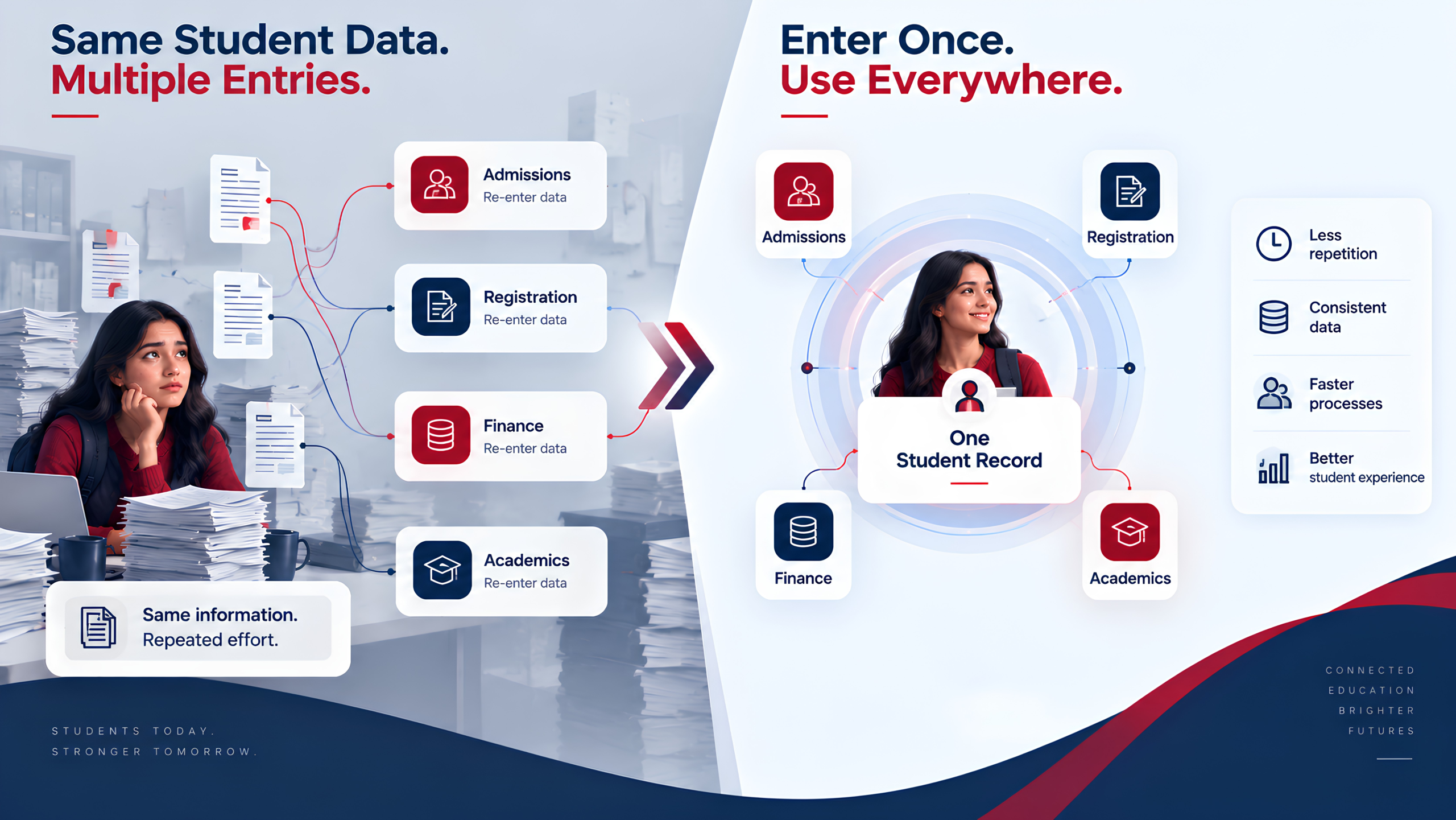
The same principle can apply to programme information, contact details and other relevant data.
Automation does not mean eliminating human verification. It means stopping people from performing the same administrative action repeatedly when the information already exists.
The strongest automation opportunities are usually activities that are repetitive, rules-based and predictable.
During admissions, universities can automate application collection, document workflows, eligibility checks, application-status updates, shortlisting and routine communications.
After admission, automation can continue through student onboarding, programme allocation, registration, approvals and fee-related workflows. The resulting information can then support the student’s academic record instead of being entered again into separate departmental systems.
The distinction is important:
Digitisation puts a process online. Automation makes the process move.
An online form that still requires five teams to manually transfer its information is digital, but it is not necessarily an automated workflow.
One practical approach is the Data Re-Entry Test.
Take one student record and follow it from application to registration. Check basic information such as the student’s name, programme, qualification, contact details, documents and fee information.
Then ask:
How many times is the same information manually entered?
If the journey looks like:
Application Portal → Excel → Admissions Office → Registration Office → Student Database
there is an obvious opportunity to reduce duplication.
A more connected process could be:
Application → Verified Student Record → Registration
The goal isn’t to remove every human interaction. It is to identify where employees are spending time moving information instead of using it.
NITI Aayog’s Expanding Quality Higher Education through States and State Public Universities report recommends digital platforms for areas including admissions, student management, pedagogy and examinations. Its medium-term roadmap also discusses digital platforms covering admissions, registration, fee payment, academic records and course management.
This moves the conversation beyond simply creating an online application form.
For universities, the more useful question becomes:
Can information captured during admission continue to support registration, fees and academic records?
If it cannot, an institution may simply be adding another digital silo.
UNESCO’s Report on Digital Transformation in Higher Education in South Asia examines India and other South Asian countries across areas such as organisational digital culture, knowledge management, innovation and digital partnerships. It also highlights challenges around infrastructure, digital skills and policy alignment.
This creates an important distinction.
A university can have an online admissions portal, separate fee software, a student portal and a digital examination platform and still have disconnected processes.
A student may complete the entire application digitally while employees continue transferring information manually.
Digital transformation is not simply replacing paper. It is making information and workflows work together.
A practical example comes from CECOS College London.
According to Academia’s published case study, the institution implemented digital workflows across areas including admissions, document management, attendance, fees and academic processes. The case study reports a 70% increase in productivity for student attendance marking after the process was digitised.
This is an institution-specific result, not an industry-wide benchmark.
Its importance lies in the principle: even one repetitive administrative activity can create measurable operational impact when it becomes digital and connected.
For universities, that means meaningful improvement does not always require automating the most complicated process first. It can begin with a task performed thousands of times during an academic year.
The National Institute of Securities Markets (NISM), India, offers another relevant example.
Academia’s published case study describes NISM’s earlier use of multiple standalone tools across areas including admissions and fees, creating delays, redundancies and limited visibility between departments.
After moving these workflows into an integrated environment, several processes could respond automatically.
Consider a student changing programmes.
In a disconnected process, staff may need to identify the old programme, locate the associated invoice, cancel or modify it and then create the financial information for the new programme.
The NISM case study describes a workflow where a programme change could trigger cancellation of the previous invoice and generation of the applicable new invoice.
This demonstrates a more important concept than simply saying “automation saves time.”
Good automation responds to change.
The value comes from the system understanding that one administrative action can affect another.
Automation should not mean removing people from decisions requiring judgement.
Routine activities such as document reminders, notifications, standard validations, status updates and recurring reports are suitable for automation because they follow predictable rules.
Complex admission appeals, unusual student circumstances, policy interpretation and academic decisions still require appropriate human involvement.
For example, a system can identify that an applicant has not submitted a required document and send a reminder automatically. But deciding how to handle an exceptional applicant should remain with authorised university personnel.
Automate the repetition. Keep humans where judgement matters.
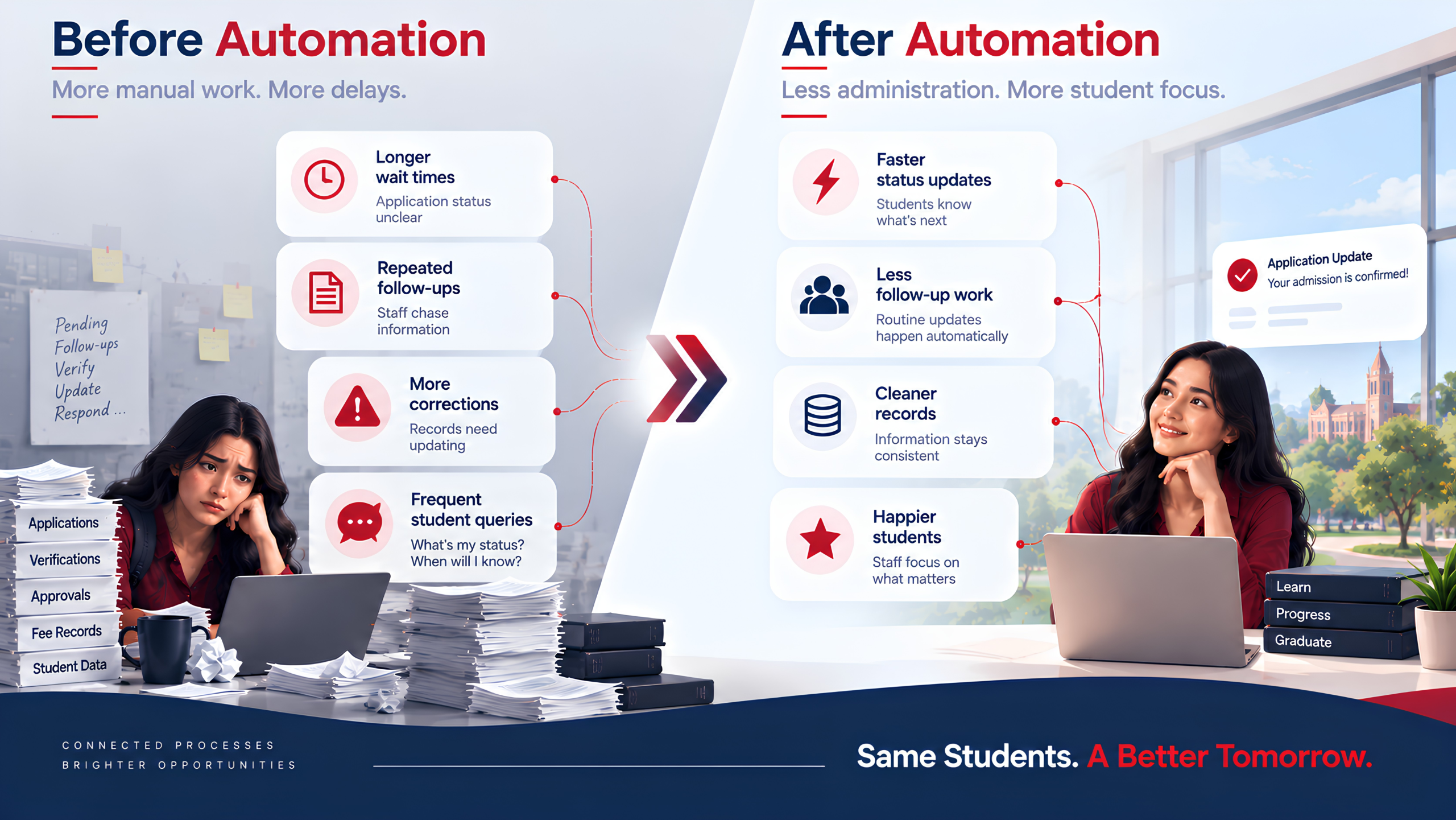
How Can Universities Measure Whether Admissions Automation Is Working?
Launching a new portal isn’t enough to demonstrate transformation.
Universities should measure what actually changes after implementation.
Application processing time: How long does it take from submission to decision?
Data re-entry: How many times does staff manually enter the same information?
Registration turnaround: How quickly can an admitted student become fully registered?
Record corrections: How often does staff need to correct inconsistent information?
Student enquiries: How many queries are caused by unclear application or registration status?
Staff workload: How much time is spent on repetitive administration?
These measures turn automation from a technology project into an operational improvement programme.
The right Student Information System should not simply offer a long list of modules. Universities should examine whether those modules actually work together.
A suitable system should support admissions, document management, registration, centralised student records, fees, academic management, reporting, role-based access and integration with other institutional systems.
Most importantly, test the system with a real scenario.
Imagine a student submits an application, receives an offer, accepts it, completes registration, pays fees and later changes a programme.
Then ask:
How many times does staff need to manually enter or update the student’s information?
That question can reveal more about a system’s practical value than a feature checklist.
India’s higher-education ecosystem is becoming increasingly digital. But the next step is not simply putting more forms online.
It is connecting what happens after the form is submitted.
A student’s journey should move from:
Application → Verification → Admission → Registration → Student Record → Academic Journey
without repeatedly recreating the same information.
For universities managing large student populations, this can mean less repetitive administration, more consistent records and a clearer experience for students and staff.
The objective is therefore bigger than automating admissions.
It is about turning the initial application into a reliable digital foundation for the student’s academic journey.
Universities can automate application collection, document workflows, eligibility checks, application-status updates, shortlisting, offer-letter generation and routine student communications through a connected admissions system.
Registration can connect with admissions, programme allocation, course registration, fees and student records so that information already captured during admission does not have to be repeatedly entered.
It maintains centralised student information and allows authorised departments to use that information across admissions, registration, academics and fees.
When application information becomes part of the central student record, authorised departments can access and reuse it instead of recreating the same information in separate systems.
Universities should evaluate whether the system connects admissions, registration, student records, fees, academics and reporting rather than assessing individual features in isolation.
Yes. Routine, rules-based activities can be automated while complex cases, appeals, exceptional circumstances and academic decisions remain with appropriate university staff.

Experience Academia – Your partner in transforming campus operations, a trusted all-in-one ERP/SIS solution.
Get the latest insights, trends, and updates delivered straight to your inbox!