
Type your keyword below

Driving Educational Campuses In Modern Way And Why You Need It

One of the most serious issues with endeavouring to add innovation to your school lies in attempting to comprehend what sorts of programming are out there and how they can help.

Without this understanding, it can be difficult to defeat some of your school’s or area’s difficulties.

One essential — however critical — factor that keeps school authorities oblivious about what’s out there is that there’s a great deal of befuddling wording twirling around in the “EdTech” space. (For some, “EdTech” itself is a case of simply such a befuddling term; it’s shorthand for “Instructive Technology.”)

There are numerous terms to filter through. Some are simple language words alluding to digest thoughts, while others are authentic names for normal and imperative programming.

Keeping in mind the end goal to kick you off, how about we take a glance at a moderately direct EdTech term that is basic to K-12 business forms however that can infrequently appear to be confused to EdTech newcomers — ERP.

What is ERP Software?

ERP remains for Enterprise Resource Planning.

Put basically, ERP programming (now and again just called an Enterprise Resource Planner, or, “an ERP”) is programming that oversees business forms for an organization, association, or, for your situation, a school/region.

So how do ERPs “oversee business forms?”

The way it works is that ERPs include different “applications,” or apparatuses, that cooperate flawlessly to interface divisions and bring the information from those different offices together into one database. Whatever errand you have to finish — be it ordering a nitty gritty year-end report or basically keeping an eye on the status of your Accounts Receivable — ERPs put all the data you require comfortable fingertips.

Why Your K-12 School District Needs ERP Software

To comprehend the advantages of utilizing a decent ERP programming, we should take a glance at the framework’s principle capacities as they identify with K-12 school locale.

Robotization:

Robotization is perhaps the most supportive capacity of ERP programming.

ERPs are intended to take numerous undertakings and do them for you, particularly assignments that you do (consistently, week, month, or year).

A case of frequently repeating work that a K-12 monetary administration ERP could improve the situation you would assemble a report of the cash your school area spent a month ago. The ERP consequently pulls particular information from among every one of the applications inside the framework with the goal that you don’t need to look for the data you require. Great ERPs even enable you to arrange the normal reports with the goal that they indicate precisely the data you need them to in precisely the way you need it appeared.

Along these lines, as should be obvious, ERP programming spares you time through robotization, which thus (since we as a whole know “time is cash”) will help your region’s money related primary concern, as well.

Reconciliation:

Another capacity of ERP programming is reconciliation.

Reconciliation fundamentally just alludes to one bit of programming’s capacity to “talk” to another bit of programming. At the point when the product from at least two separate divisions (say, your school area’s Financial Accounting office and its HR office) work firmly together by sharing information, your whole locale turns out to be more proficient and more compelling.

By utilizing ERP programming to consequently share data amongst HR and Accounting, for instance, representatives never again need to enter numbers physically into PCs more than once (if by any stretch of the imagination). Such sharing altogether eliminates information passage mistakes.

In addition, great ERP implementation arrangements keep up your information continuously, which means when you enter data into the framework, every associated office promptly start working from the refreshed information.

By enhancing the exactness of your information, you’ll have the capacity to approach each choice you make in your part with more prominent certainty.

Association:

ERP programming likewise encourages your whole locale to remain composed, not simply from division to office as we examined under “Incorporation,” yet in addition inside every individual office.

Clearly, programming when all is said in done will help your specialization to abstain from depending on scattered papers, sticky notes, and just requesting that your associates make sure to accomplish something. In any case, a great ERP goes significantly further.

As said above, ERPs involve various applications, or “applications” (basically devices), and each application imparts data to all the rest. Along these lines, for instance, if you somehow managed to add a seller record to your framework in one place, the ERP at that point would consequently add that merchant to all significant applications (Accounts Payable, Accounts Receivable, General Ledger, and so forth.).

Along these lines, ERPs keep all your data sorted out, both generally speaking and inside the individual applications, which encourages your specialization to end up more proficient.

The Best ERP Software

At last, the fundamental advantage you get from an excellent ERP programming framework (rather than bland ERP programming) is that it will be planned particularly for your necessities as a K-12 school region. All things considered, you would prefer not to work around programming settings that were worked for a retail business or a non-benefit association.

In addition, however, the best ERP programming frameworks to consider are those that are flexible. Along these lines, past just being outlined for the most part for K-12 school areas, the best ERPs will enable you to arrange the alternatives in a way that works as indicated by your particular needs as an extraordinarily singular K-12 school region.

When you’re ready to set up your product for your school area’s extraordinary needs, you basically are setting up your region for progress.

Truth be told, the capacity to tweak and arrange is such a critical element with regards to ERPs that we at Serosoft Solutions have composed the greater part of our ERPs so they can be designed however bodes well for every one of our customers.

At that point, we took this arrangement between ERP programming and the remarkable needs of individual schools above and beyond.

We’ve fabricated a few distinctive ERP programming frameworks so as to all the more fittingly serve diverse kinds of school areas in light of elements, for example, school/region size, area, and that’s just the beginning.

Academia 6-Step Effective ERP Implementation Process

An Education ERP implementation involves installing the software, moving your data over to the institute’s system, configuring your users & the processes, also the training of the users on the software. Choosing the right partner for implementing your ERP system is almost as important as selecting the right software in the first place.

Academia-6-Step-Effective-ERP-Implementation-Process

Things You Need To Know Before ERP Implementation!

Is it accurate to say that you are looking forward to purchase an ERP framework for your school, college or training foundation? On the off chance that you are a thinking to be an ERP client, you should setup specific trapsat that point to make the most out of it. To enable you to make the most of your ERP, here are 7 fascinating tips for appropriate execution that would doubtlessly work wonders for your school, college or training organization:

Things you need to know before successful education ERP implementation!

APPROPRIATE TRAINING:

A standout amongst the most essential strides to an effective usage is legitimate preparation of your educator’s and their will to identify & utilize ERP programming. You, your instructors and different staffs must know how to utilize it to reap its advantages. Along these lines, ensure you and your staff gets prepared legitimately and continue getting training occasionally. The scholarly community gives undeniable preparing support with video instructional exercises to keep you generally prepared in the most recent and most prominent developments.

SPECIALIZED ISSUES:

The following test coordinates every single specialized necessity to the new ERP programming and picking the best conveyance model to interface the two together. What we mean by this is: will it be an on premise arrangement, a cloud arrangement, or a mixture one?

To battle this, build up a venture that covers each progression of the execution procedure. The task design sets a course of events for everything from equipment prerequisites, asset controls, information changes and information section to approving the system. Setting up a task design is shrewd in light of the fact that it goes about as an execution guide that covers the means for continuing through the outline period of the ERP framework. The scholarly world offers extensive variety of offerings according to client’s prerequisites which isn’t just restricted to facilitating yet in addition as far as evaluating. To know more, please click here.

GET THE LATEST TECH:

It’s extremely significant to be all around familiar with the most recent student management system drifts in the instruction division before deciding to settle with a system as technology experiences systematic periodic up gradation. Better research and better downplaying about patterns will help you in getting the college management system that suits your establishment the most.

UTILIZE ‘CARROT & STICK’ STRATEGY:

‘Carrot and Stick’ system can be utilized to enhance the utilization of ERP programming among your educators and different stakeholders. Reward those staff members who makes fruitful use of the school administration framework all the time.

GROUP WORKING:

You can make a group with the best representatives including the best instructors, different staff and assign them the power and specialist to ensure that the task is done well and on time.

Legitimate execution of education management software is an important errand and requires appropriate time administration to yield the best out of it. We at Academia are engaging instructive organizations of fluctuated sizes and tasks to center around conveying brilliant training and hardly any reasoning or agonizing over the regulatory procedure. Executing Academia empowers instructive establishments to deal with their whole regulatory errands and aids monotonous asset escalated exercises through consistent mechanization. With 10 years of rich experience, we’ve planned the engineering of Academia such that it meets the remarkable and fluctuating needs of schools, colleges and training organizations. To know progressively and take a free voyage through our system, click here.

Why User Experience Matters in ERP Selection

User Experience or Customer Experience is essential in today’s age and world. Many organization is optimizing their user experience to meet customer expectations. Failing to optimize the user experience can harm your business and you may not be able to achieve expected results.

Education management system i.e. Educational ERP’s plays an important role in the overall process beginning from admissions, the inquiry goes via examination, transport, hostel to completion and alumni, etc. These functions are the core functions of an educational institution and therefore these require everyday updating and hence it is important for an education ERP to be user-friendly.

But the campus/college management system many times attract a bad reputation for not being particularly user-friendly. Densely packed interfaces, disturbing workflows, and the need for users to navigate endless screens to complete transactions result in confusion and frustration. Improving user engagement is key.

To ensure high user engagement it is important to have a deep understanding of user’s behavior, similarly, for enterprise applications, it’s also necessary to have an insight into their roles in their professional setting and the ease of use that the system can provide to them on a daily basis. Enterprise applications can also look to provide its users with a fresh, clutter-free User Interface which breaks away from the mundane settings and allows the user to interact with the system in an intuitive way.

The rapidly changing industry demands that stress is laid on end-to-end customer experience. This is important because the end-to-end experience covers all aspects such as how easy it is to learn the product, perform on the product, and also how the vendor responds to any customer issues and problems. All these factors matter a lot in the enterprise IT business as the usage of the product is constant and thus the support needs to be spot on as well. With new dimensions and new technologies kicking in the industry, user experience and purchase patterns have really changed and matured over time. The advent and use of cloud technology prove to be sizeable leverage for customers in technology purchasing decisions.

How to build better customer experience capabilities

  • What your customer feels: Know about the customer’s feelings if they are delighted or frustrated with the product or maybe the services provided. You will have to stand strong against your competitors in the industry and keep addressing any or all of the issues that are reported by your customers. Improving the end-user experience should always be thought of at first while decision making.
  • Find the right way out: As suggested that during the decision making the customers and their experience should be thought of first, therefore you should always fall in line with the alignment of the critical issues that are reported and competitive situations. You will have to continuously work upon it to bring in cent percent results.
  • Create a plan of action: Design a super awesome customer experience system by creating a closed feedback loop of current customers. The continuous effort of improving the end-to-end system and fixing all the issues will create customer loyalty and lower down the rate of losing customers which will ultimately result in overall benefits.
  • Change the mindset: Instill a business culture and create systems based on customer experience. Most companies in the IT industry follow a trend of promising a good user experience that is never backed up by an actual one, these will find it difficult to improvise. But the market is all set to roll now and these types of companies will not be able to cope up in the long run without perusing change.
  • Be patient: Recognize that it’s a long journey. Commit to bringing your customer experience in line with your promises.

To have an amazing user experience of our world-class education ERP, book a free demo now:

Training and Education: Important Elements For Successful ERP Implementation

With the rising EdTech trends and their positive outcomes, educational institutions worldwide are adapting technologies like ERP/SIS that can enhance overall functionality bringing efficient management in the institution. 

What is an ERP system and how can it help educational institutions?

An ERP system is software that can automate all academic and administrative processes. It can manage and streamline all the day-to-day activities such as enquiry, admission, fee & finances, examinations, and many more. 

It helps educational institutions with institution management driving all of the operations from a single platform. It is the true digital transformation of the institution. 

Institutions must choose good ERP software that can effectively meet the expected extent. After selecting a robust ERP system comes the implementation process, there are various factors associated with smooth implementation of the education ERP system.

Let’s move further to discuss the important elements for successful ERP implementation in an institution!

Elements for Successful ERP Implementation

  • Get a better understanding of ERP

ERP is a broader concept and a software solution that can automate all the activities and tasks within an institution. It is necessary to get a deeper understanding with elite training for all the stakeholders who are associated with the use of the system. 

The higher authorities need to check the overall functionalities of the software to confirm whether it can cater to their daily activities and processes. Institutions can also create a panel to check the efficacy of the product to make its work better and improved.

  • Analyze Problems/Requirements

An ERP system can replace outdated techniques entirely through digitalization. So to make it productive, it is a must that institutions should analyze the product efficiency and check the usage and problems with each department. 

The best practice to evaluate this is to create sample data from all the departments and check the accuracy of the system in various aspects i.e., some enquiries, some exam-related data, and more. After checking the accuracy of the system, you need to ask for its solution from the vendor in the best possible way.

  • Check the Needs for Customization

Every educational institution owns different types of rules and regulations. It is a must that the ERP system you choose must provide customization according to the requirements. The software you choose must be a system that can fit the existing processes of the institute with a flair for automation. 

Academia ERP provides solutions to each problem, it renders customization according to the institution, various integrations, anonymous assessment, and multi-Centre functionality to name a few.

  • Test all the Modules

As discussed above, the higher authorities need to create a panel for sample data modeling from all the departments and test each module with the ERP software. Test results are generated live and presented among the ERP team and the panel to find out real-time solutions to the problems. 

After solving the major problems, all the stakeholders in an institution need to use the system to see if they are comfortable with its functionalities and are helpful to the institution in its role.

  • ERP Implementation

After analyzing the system in all aspects, the ERP experts process the implementation of the ERP.

The process starts with transferring all the data from all the departments from manual papers and files or legacy systems. The complete process needs time and involves expert teams from both ends. 

After successful implementation, the ERP experts hand over the complete system to the educational institutions. 

  • Support

As its most important function, an ERP system automates all the operations of an institution, but for this, not just successful implementation can help; it requires effective use by the organization and continuous support from the ERP team. They need to provide maintenance and help at regular intervals. 

For this, Academia ERP has a designated customer support team with experts to resolve any issues instantly along with 24/7 availability. It also releases regular sprint updates to deliver all the updated features and functionalities of all the modules.

Conclusion

With the rising competition and expansion in the education sector, it is the right time for educational institutions to choose a very good technology like an ERP system that can boost productivity in all aspects. 

Again, it is crucial to select a robust ERP system that provides complete automation along with smooth and efficient implementation, support, and end-user satisfaction. 

If your institution is looking for one, Academia ERP can become the best option, as it is a robust platform used and loved by more than 320+ education institutions across the globe. Here, the team of experts believes in overall efficiency while rendering the software, right from the first interaction to the implementation process and customer support!

Request your demo now to learn more about the award-winning ERP solution! 

What institutions need to know before selecting an ERP solution

There are thousands of enterprise resource planning solutions available in the market today. But which is the right one? The answer lies in these three biggest factors. Read the blog to reveal the factors you must consider in a vendor before you make a buy decision. 

  • A process review and analysis for ERP.

Start by analyzing your current processes. Include your pain points and strengths. Mention the areas in which you need improvement and also what you are expecting from the software. Include the corresponding needs of various departments present in the organization as well. 

You can share this document with potential software vendors and ask them to demonstrate their products. This would help you cut the chase and directly dive into features and functionalities that are absolutely necessary for you to have in a product. Also, document your experience of the product during the demo. 

  • Evaluate the technical fit of the education ERP solution.

Would you be required to improve the current digital infrastructure in your institute? Would you require an internal IT support team? Is the product aligned with your current infrastructure? These are some of the most important questions to ask as an education ERP software cannot work if you don’t have laptops, computers, or smartphones to use the product on. 

  • Cost is important to discuss.

It is a common sales strategy to downplay the cost and risk associated with purchasing the software. Thus, it becomes necessary that you talk about the overall cost of the product, including implementations, hardware upgrades, maintenance, software upgrades, security, network, storage, etc., during your discussions with the vendor. 

And this is it 

If a vendor stands correct on these 3 factors and your relevant expectations, you have found your Education ERP software provider

The key to finding the right vendor is in knowing what your organization needs and sticking to it. You will find tens of good features and functionalities in the product but they may not be right for your institute. 

Also, ask your colleagues, employees, and other contacts if they recommend any education ERP software. Conduct research on the internet and hire the right vendor only after they provide you with clear answers about the product upgrades, feature upgrades, maintenance, product management, and security of the product. 

Lastly, the right vendor is the one that shows promise and interest in maintaining a long-term relationship. It would ensure they support you all throughout your organization lifecycle. 

ERP Solutions with Cloud Servers

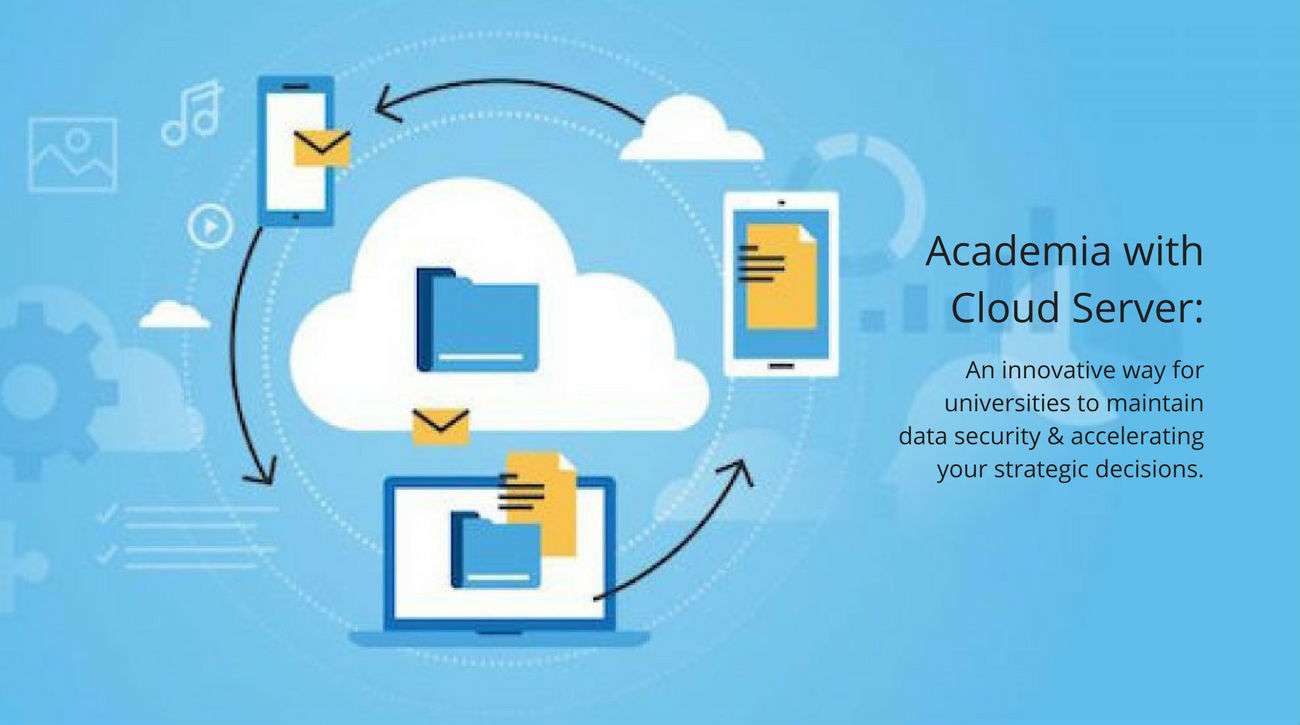
Cloud ERP systems are advanced enterprise resource planning software that run on a vendor’s cloud platform as opposed to being hosted to an on-premise network. Organizations can access cloud-hosted applications over a browser using any device. 

Since cloud ERP is gaining huge popularity, it is time that education leaders and authorities learn more about the efficiency of cloud-based ERP solutions. And make better decisions, depending on their needs and available resources, between on-premise or a cloud-based education ERP solution. 

Cloud-hosted Education ERP software

One of the biggest differences between on-premise and cloud-based solutions is in the access to applications. Since cloud-based software is hosted on the vendor’s cloud, an organization has to access the app over the internet. Hence making internet connection a very important key in the organization’s functioning. But this is a benefit in disguise. You see, since the apps are managed and maintained by the vendor, cloud-based apps have very few downsides and maintenance costs. These are two of the biggest disadvantages experienced by organizations using on-premise solutions. 

Cost Comparison

On-premises software are either bought or leased by organizations. The package includes enterprise-grade servers, networking, and storage to physically run and house the software and associated data for the functioning of the software. 

Organizations are required to pay an additional cost for maintenance, troubleshooting, supplementary software, updates, and customizations. Antivirus and security software and storage & server backups make up a hefty overhead expense. 

Since cloud-based ERP solutions are managed by the vendor, they are liable for application maintenance, data storage, underlying operations, servers, physical data center infrastructure, and installing security updates and feature upgrades. 

Hence, although an on-premise solution appears to be an economically viable solution at first, the hidden charges and overhead expenses make it a very expensive solution. This makes cloud-based ERP solutions a better option functionally and economically. 

Benefits of choosing Cloud ERP software

Added benefits of choosing Cloud ERP Software are:

  1. No upfront infrastructure and operating costs
  2. Faster implementation with ready-to-use software
  3. Access the applications over web browsers using any device and from any location
  4. Easily scalable and supports your needs throughout the business lifecycle
  5. Highly configurable software makes it easy to make quick customizations to the functioning of the software without the need for IT support
  6. Regular upgrades in the software allow you to access modern technology and stay up-to-date with technology.

Wrapping Up

Cloud-based education ERP is the need of the time. They are highly secure and scalable. Plus, if you are thinking about reducing the operational cost in your institute there cannot be a better option. 

Learn more about Academia ERP, a cloud-based education ERP software with 30+ modules to manage and monitor your business. Connect with our education ERP experts today. 

Back to top