Type your keyword below

Top 10 Chain Of schools in India

Education plays a crucial role in shaping the future of a nation. In India, several educational institutions have emerged as pioneers in providing quality education. This blog presents a curated list of the best chain of schools in India, evaluated based on several key parameters. Additionally, we will explore how technology, along with the implementation of an Academic Enterprise Resource Planning (ERP) system, has helped educational institutes excel in their endeavors.

Listed below are the top 10 Chains of schools in India on the basis of their Year of establishment, number & quality of students, and number of schools in the chain.

1. The Ryan International Group of Institutions in Mumbai.

It was established in 1976 and currently operates 137 schools across India. These schools are affiliated with various boards such as CBSE, CISCE, IB, CAIE, and state boards. With an aggregate enrollment of 270,000 students and a faculty of 16,000, the Ryan International Group has a presence in 40 cities across 16 states. This school chain, promoted by Dr. Augustine and Mrs. Grace Pinto, has gained recognition for its commitment to providing quality English-medium education beyond metropolitan areas, extending to tier-II, III, and IV cities. In 2018, the group was honored with the World’s 100 Greatest Brands 2018 award.

2. Podar Education Network, headquartered in Mumba.

It was established in 1927. It comprises 124 schools and 350 preschools, making it a prominent name in preprimary and higher school education in India. Affiliated with CBSE, CISCE, IB, state boards, and Cambridge International, the Podar Education Network has an aggregate enrollment of 150,000 students and a faculty of 6,800. Seth Anandilal Podar founded the Podar Group of Schools, and under the chairmanship of Dr. Pavan Podar, the network has achieved success by focusing on well-trained teachers equipped with the latest digital technologies and a contemporary education approach that prepares students for the challenges of the modern world.

3. Billabong High International Schools, Mumbai.

It started in the year 2000 and has since grown to encompass 30 schools in 21 cities across India. With affiliations to CISCE, CBSE, and Cambridge International, these schools prioritize creating an engaging curriculum that fosters joyful learning experiences for students. Billabong High International Schools emphasize a holistic approach by integrating sports and performing arts into their curriculum. Their dedication to providing an integrated, multi-disciplinary education helps develop students’ creativity, critical thinking, and practical skills. In 2016, the schools were recognized with the Best School Brand award by the Economic Times.

4. The VIBGYOR Group, Mumbai.

It was established in 2004 and operates 33 schools across nine cities in India. Affiliated with CBSE, CISCE, and Cambridge International, the VIBGYOR schools have an aggregate enrollment of 48,000 students and a faculty of 6,000. Founded by Rustom P. Kerawalla, these schools have gained a reputation for setting new benchmarks in quality education. The VIBGYOR schools are known for their unique integrated curriculum, which encompasses classroom learning, sports, performing arts, and extracurricular activities to ensure the overall development of students.

5. The Presidency Group, Bangalore.

It was established in 1976 and currently operates seven schools across two cities. Affiliated with CBSE and CISCE, the Presidency Group has an aggregate enrollment of 15,000 students and a faculty of 1,100. Founded by Dr. Nissar Ahmed, the Presidency Group is highly regarded as one of the top schools in Bangalore. The distinguishing feature of Presidency schools is their meticulously designed curriculum, which incorporates thematic and integrated pedagogies to foster critical thinking and the application of knowledge. Values and life-skills education plays a significant role in preparing learners to face the challenges of the modern era.

6. The Maharishi Vidya Mandir Schools, based in Bhopal.

It was established in 1991 and currently operates in 156 schools across 126 cities in India. These schools are affiliated with CBSE and state boards. With an aggregate enrollment of 102,500 students and a faculty of 6,500, the Maharishi Vidya Mandir Schools were conceptualized to honor the wisdom and teachings of Maharishi Mahesh Yogi. The schools offer an academically rigorous curriculum prescribed by CBSE and state boards, complemented by the Maharishi Consciousness pedagogy. This unique approach combines Vedic education with Maharishi Technology, including practices like transcendental meditation and Siddhi programs that aim to unlock students’ full creative potential.


7. The Kendriya Vidyalayas, headquartered in Delhi

This chain was established in 1962 and currently comprises 1,204 schools spread across 29 states and seven Union territories in India. These schools are affiliated with CBSE and primarily cater to the children of Central government employees in transferable jobs. Managed by the Kendriya Vidyalaya Sangathan, an autonomous body under the Union HRD ministry’s jurisdiction, the Kendriya Vidyalayas offer heavily subsidized fees and are known for their outstanding examination results. In 2019, the Kendriya Vidyalayas achieved a national pass percentage of 99.47% in the CBSE class X exams, surpassing all other CBSE-affiliated schools, including private ones.


8. The Vidya Bharati Schools, located in Lucknow

Were established in 1952 and currently operate a network of 13,067 schools across 29 states in India. These schools have an aggregate enrollment of 3.4 million students and a faculty of 150,190. The Vidya Bharati Schools focus on educating students about Hindutva, patriotism, and Indian values and culture, in addition to following the standard curriculum. The schools provide specially written texts about Indian culture and customs, and all students are required to learn moral education, physical education (including martial arts), music, Sanskrit, and Vedic math.


9. The DAV Schools

This group was founded in 1886, have grown to become the largest non-governmental educational society in India. With over 900 schools, the DAV Schools have an aggregate enrollment of 2 million students and a faculty of 50,000. The schools follow Swami Dayanand Saraswati’s ideals and offer education primarily in English, along with compulsory education in Hindi, Sanskrit, or a regional language. In 2013, the Associated Chambers of Commerce and Industry of India (ASSOCHAM) awarded the DAV Schools with the Best Chain of Schools in India accolade.

10. The Delhi Public School Society

This group was established in 1941, comprises 205 schools in India and 11 abroad. As a non-profit, non-proprietary, private educational organization, the Delhi Public School Society enjoys a reputation as one of the most respected and trusted education societies in India. Founded by Pinkesh Barjatiya, the society began as Church High School and has since embraced innovation in its learning programs. The faculty at Delhi Public Schools focuses on revolutionizing education through ideas and practices that align with new-age educational trends and global associations. Society places a primary emphasis on meaningful and joyful learning experiences for students.

It is worth noting that this list does not encompass all popular school chains in India, as there are many others making significant contributions to the education system. Technological advancements have played a crucial role in the growth and expansion of these institutions.

How Academia ERP Helps Chain of Schools:

Introduction:

In the 21st century, technology has revolutionized the education sector, empowering institutions and chains of institutions to provide an enhanced learning experience. Additionally, the implementation of an Academic ERP/School Management System (SMS) has streamlined administrative processes, leading to improved efficiency. Here are a few ways technology and Academia ERP contributes to the success of educational institutes with multiple branches:


1. Centralized Data Management:

Implementing an Academia ERP system in a chain of schools offers the advantage of centralized data management. With all information stored in a single platform, schools can easily access and update student records, academic performance, attendance, timetables, and more. This eliminates data redundancy and inconsistency while enabling accurate reporting and analysis. Centralization also improves stakeholder communication and collaboration, empowering teachers, administrators, and parents to access relevant information and facilitate seamless interactions. Overall, Academia ERP streamlines data management enhances decision-making, and promotes a cohesive educational ecosystem within the chain of schools.

2. Enhanced Teaching and Learning:

Technology enables interactive teaching methods, multimedia-based learning, and virtual classrooms, making education more engaging and effective. Students can access online resources, collaborate with peers, and benefit from personalized learning experiences.

3. Efficient Administration:

Academia ERP systems automate administrative tasks such as attendance management, fee collection, timetable scheduling, and examination management. This reduces manual work, minimizes errors, and improves overall operational efficiency.

4. Seamless Communication:

Technology facilitates seamless communication between teachers, students, and parents. Online platforms, email, and messaging systems enable quick and effective information sharing, progress tracking, and parent-teacher collaboration.

5. Data Management and Analysis:

Academia ERP systems store and manage vast amounts of data, allowing institutes to analyze student performance, identify areas of improvement, and make data-driven decisions. This enhances the overall academic quality and enables personalized interventions.

6. Parent Engagement:

Technology platforms enable parents to stay connected with their child’s education journey. Parents can access real-time updates on attendance, grades, assignments, and school announcements, fostering a strong parent-school partnership.

Conclusion:

The listed chain of schools in India, considering parameters such as year of establishment, number of schools, number of students, infrastructure, board affiliation, tuition fees, and student quality, showcase a commitment to providing quality education and holistic development. Moreover, the integration of technology and the implementation of an Academia School Management System (SMS) have propelled educational institutes toward excellence by enhancing teaching and learning, streamlining administrative processes, and promoting effective communication. With continuous advancements in technology, the future of education holds immense potential for further growth and innovation.

Importance of College ERP for Stakeholders

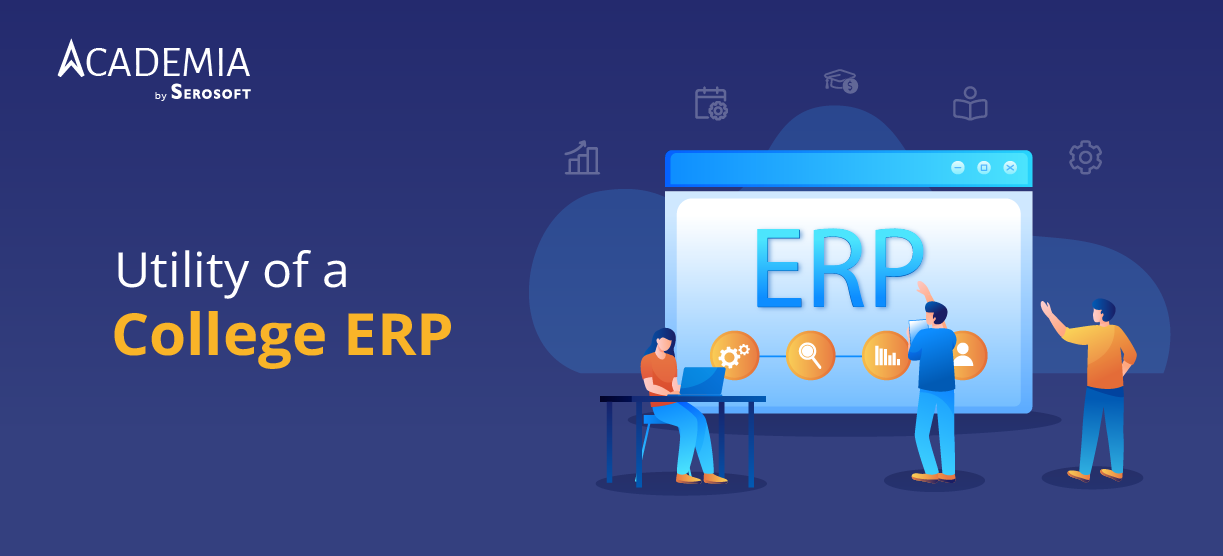
In the past decade, technology has become an integral part of many industries/businesses, and educational institutions are never an exception. Nowadays, with the increasing scope of technology, universities, higher education, and schools are incorporating quick decision-making into their current system. Institutions that are seeking a smart school or college management system need to opt for tools and software that can help faculty members, administrators, and other staff to master their tasks with more accuracy and efficiency.
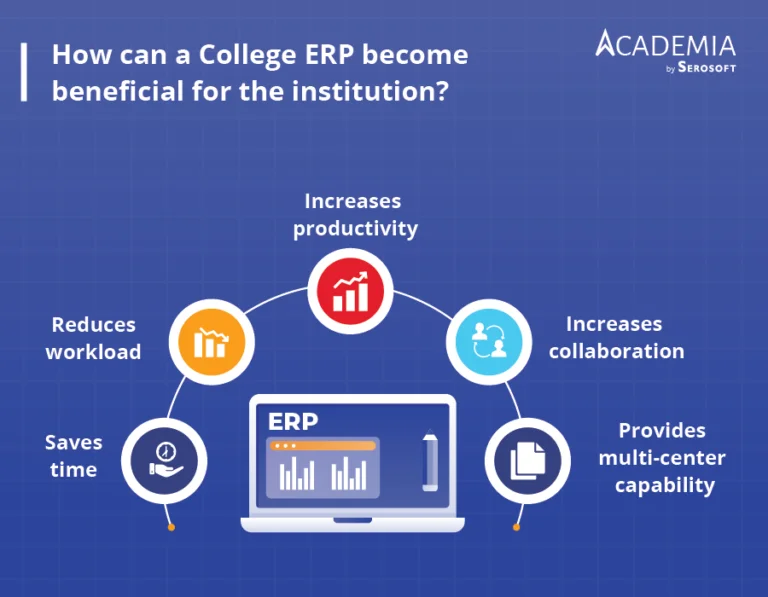


  • Capability to manage academic & administrative tasks 

The current scenario of educational institutions involves a bundle of academic and administrative tasks. Right from admission enquiry to the alumni of the student, the administrators, faculty members, guest lecturers, and researchers find it difficult to manage all the operations manually. 

To this, a college ERP software can be the best solution, it can provide administrators and faculty members manage all the operations efficiently using just one single software. It can avail faculty members to manage all the important objectives in just a few minutes of tasks. 

  • Remote admission process 

Admission season is considered one of the busiest yet most important seasons in any educational institution. In completing this process, the staff, administrators, and faculty members get frustrated with the manual interventions in the institutions. In today’s scenario, institutions must choose technologies like college ERP software that can become a savior and help in managing all the admission-related activities remotely, quickly, and accurately. It also enhances productivity and boosts faculty morale in positive ways.

  • Efficient examination management

The examination time is also one of the hectic periods for educational institutions. It includes a bulk of tasks like question paper generation, hall ticket distribution, examination sheet checking, result, and more. So in the paced world, institutions must opt for good software that can help in automating the complete examination process and help in validating a fruitful examination season for students, faculty members, and ultimately for the institution.



  • Synchronized attendance management 

Attendance is also a crucial element of administrative processes in an institution. An effective attendance system brings success for students and also for the institute. Institutions that are still following manual processes always find attendance management a confusing and hectic process. It also creates a wall between the faculty and parents as faculty members are not always able to share the exact attendance details of students in an institution. 

An automated attendance system brings efficiency to the institution, improves student performance, and ensures trust between parents and faculty. Automation of attendance processes using biometric integration or directly through the portal can help institutions bring efficiency in different ways. 

  • Accurate financial aid 

Managing financial aid in universities, colleges, and schools is a difficult task for administrators, faculty members, and even for students if done manually. There are multiple fee structures, various departments, and of course a huge number of students. 

Meanwhile, institutions can make the complete finance process easy, flexible, and transparent. It gives a true platform and connects the entire process for just one or multiple campuses simplifying all the fee-related and financial operations of the institute. 

  • Student lifecycle management

A student is considered the most important stakeholder of any educational entity. Almost all of the tasks in the institution are connected to students. Faculty members always find it difficult to manage and organize students using the manual intervention. A school or college ERP software can attract students, track their interests, and nurture them accordingly. It also can help institutions engage students in real prospects and provide faculty and parents with real-time analytics for student tracking and enhancement. 

  • Data & information management

Educational institutions involve a huge amount of student data for managing school affairs systematically. In manual intervention, it becomes crucial for faculty members to manage data in papers, files, and documents. 

Automation through a robust ERP/SIS can help institutions streamline the complete processes and manage student data. It also helps to store, organize, and manage all the data in a centralized manner that can be easily accessed, edited, and updated from anywhere and anytime by faculty and parents according to the authority. 

  • A hybrid method of learning 

In today’s advanced and technological world, it is important for educational institutions to opt for a hybrid method of learning. A combination of both online and offline methods in the classroom using new technologies like artificial intelligence, virtual reality, augmented reality and more can help institutions ease student learning and teaching process. 

Conclusion 

A college ERP can be the best solution for educational institutions, it can provide robust management for every stakeholder, especially faculty members and students. Hope you like the article, still having doubts? Let’s discuss this now! 

Capability to manage academic & administrative tasks 

The current scenario of educational institutions involves a bundle of academic and administrative tasks. Right from admission enquiry to the alumni of the student, the administrators, faculty members, guest lecturers, and researchers find it difficult to manage all the operations manually. 

To this, a college ERP software can be the best solution, it can provide administrators and faculty members manage all the operations efficiently using just one single software. It can avail faculty members to manage all the important objectives in just a few minutes of tasks. 
5 Ways Technology Can Help Save Costs for Academic Institutes

The growth of educational resources and online courses being offered today are a clear indication of the shift to technology and how it’s changing the landscape of the education industry. 

Every year there is an increasing number of students opting out of attending schools and colleges physically. With many study options available, a lot of which are online and comparatively cheaper, technology is playing a huge role in making education accessible and cheaper than ever before. Even long-distance or work-based learning, as well as apprenticeships, are becoming available online, which reduces the total cost of education by permitting interns to live at home and learn and earn. 

Today, when the world has been ravaged by COVID19 in an unprecedented way, education is one field that has managed to deliver, without any hiccups. Educational institutions all over the world have quickly moved all their teaching online and are making sure that students are gathering every bit of knowledge and learning that they would have, on campus. 

While online education may be the need of the hour right now, technology has always proved to be a gainful investment for educational institutions, one of which is saving on costs. 

Let us explore 5 ways in which technology can help save costs for educational institutions. 

1. Using the cloud instead of the copier

Educational institutions have seen the enormous potential of the cloud and more and more schools and colleges are moving over every year. A market research report had predicted a 26% annual growth in cloud computing in schools through 2021. Needless to say, with the ongoing pandemic the numbers would inflate too much more than that. 

Cloud technology has plenty of instant benefits to academic institutions like –

  • It does away with the need to buy expensive printed textbooks, which become outdated quickly. Using digital content allows easy regular updating as and when necessary, which also saves cost substantially for the school. 
  • It minimizes the requirements for expensive hardware like servers, which call for ongoing server room cooling, maintenance and a huge amount of space. 
  • It reduces the use of toner and copy paper, along with saving the time spent on making copies every week, while also reducing carbon footprints. 
  • If there is ever a loss or a need to track down a paper trail, a cloud system will give easy access and swiftly recover data.

2. Taking advantage of the VoIP over the traditional PBX

Switching over to the VoIP phone system has helped schools and institutions to cut down costs by lowering phone bills and having access to new automation features to further boost productivity. 

VoIP providers often offer free internal calls making it possible for teachers, administrators, and anyone with a phone connected to the phone system to call each other without any charges. Larger schools and institutions can save a substantial amount by using a VoIP phone system since all the frequent calls made within a school system are considered in-network and will be free of charge.

A VoIP system is cheaper to maintain than a PBX system. It can be installed quickly with adding and removing of phones done simply. A hosted VoIP system comes with free 24/7 support staff. 

3. Opting for the digital platform over manual  

In this age of technology, it is a challenge for educators to constantly keep the learning environment engaging and relevant. It is important for them to keep the communications and information flow of the school community completely smooth and secure.

While it may seem migrating to a digital platform would require huge budgets, truth is, it is the crucial factor that can actually cut costs, boost productivity and save time which is otherwise wasted on administrative tasks. With digitization, teachers and administrators do not have to spend time with old machines, including outdated computers, printers and slow networks; and could use their time for more productive work. Teachers have the advantage of using technology to produce more creative learning opportunities for students. On the other hand, students get accustomed to technology at an early age and learn valuable skills which will sustain them for life. 

4. Using special-purpose applications for better efficiency

Educational institutions have started to see the utility of application that can help them manage a lot of departments better. Since educators know they have the responsibility of building the careers and lives of a whole new generation, they understand there is no scope for mistakes. Switching over to digital helps to make sure there are no errors in statistics and work flows smoothly as programmed. They are moving to the use of specifically created applications to better manage food services, school buses, utilities like electricity and cooling/heating, textbooks, etc.

Besides the smooth functioning and management of various departments with the use of various applications, educational institutions are also saving money by eliminating the need of human intervention and physical work.

5. Availing digital documents over physical material

One important aspect of knowledge is, it needs constant updating. Going digital helps to quickly and efficiently update new material online with adaptable changes. Content changes and delivery, digitally, lowers the cost of printing the new material and also gets rid of the reliance on physical printed content and copy.

While education institutions wake up to the importance of technology and seek to empower themselves with the latest, it is the SIS (Student Information System) that has proved to be the groundbreaker with the advantage to connect, teach and manage better. One of the most important roles technology plays is to handle evolving requirements and efficiently manage multiple modes of communication. 

Academia SIS has been specifically developed to suit the current and future needs of growing higher education institutions. It is a unique multifeatured solution for Group Institutions, Business Universities, Colleges, Schools, etc. and automates the complete student life cycle.

Undeniably, the best technology solution to successfully lower costs while providing an edge by enhancing connectivity among students, teachers and parents.

For the education institutions, while adopting technology helps to cut down costs, it also works for students as the expenses go down considerably with online course materials and other associated expenses. Hence, a win-win for all. 

Back to top