Type your keyword below

5 Common Higher Education ERP Implementation Mistakes To Avoid

Technology is playing a key role in today’s era. Every segment and industry is shifting to opt for technologies that can upgrade and help them in being the competition. Looking in the education sector, it is now important for educational institutions to opt for technologies like ERP/SIS that can eventually help them in associating and operating the day-to-day operations of the institute. A better and robust ERP system can eventually help educational institutions to manage all the administrative and academic operations of the institute.

But educational institutions must select a good ERP platform that can help institutions in attaining growth along with fulfilling all the requirements. Even after selecting a very good ERP, institutions sometimes make mistakes that should be avoided while implementing an ERP system in the institute.

Let’s take a look at a recent interview of an ERP specialist taken by an educational media interviewer. In this, he asked about the common mistakes that can be avoided by institutions while having an ERP implementation.

Question 1

How can the institution prepare itself for digital transformation?

Answer by ERP Specialist: 

Digital transformation is considered the new need for educational institutions, it helps in streamlining and managing all the academic and administrative operations. But in my opinion, there is a proper process that institutions need to understand before thinking to opt for digital transformation. Different educational institutions today are at different stages of digital transformation, hence, they all need customized paths to achieve 100% digital transformation. These stages or situations can be majorly classified into 3 major categories:

  • Situation 1:

Manual Interventions in the institution

I think there are more than thousands of institutions that are still working using the manual process in their institutions. I do not regret the point that manual intervention can also help institutions to grow but the fact is its slow growth and which in today’s time is considered as no or less growth. Let’s take the example of the admission process of an institution using the manual process. It starts from a long queue for the admission form and ends with a lot of documentation from both ends for enrollment, right? It becomes a hectic, long, and confusing process for students, faculty, and staff. So it is the right time for institutions that are still operating with manual processes to understand and choose to move towards automation of each process in the institution.

  • Situation 2 

Semi-Automation

In my opinion, there are various higher education and K12 institutions that have opted for semi-automation. Semi-automation is considered as the situation in which institutions opt for individual software to automate some of the processes of the institution like the Learning Management System (LMS) to enhance the learning experience of students, Tally to audit databases, and various others. I think this eases out the work but initially, it increases the chances of more confusion among the administrator and faculty as multiple software increases the need for multiple hands to operate and track each data.

Institutions must opt for an ERP along with some of this software, as it helps in storing and tracking all the data from one single software that can be used by any of the administrators, faculty, or staff members. A good ERP system also avails interoperability of other software along with the ERP. It manages all the operations from admission to the alumni and the student giving easier and more efficient access to everyone available in the institute.

  • Situation 3 

Having an inefficient ERP System
Once I visited a higher education institution, they already had an ERP system that they were using to operate several tasks like admission, fee, examination, and many others, but to my surprise, I found that they have witnessed the same growth even after using the ERP system for their academic and administrative operations. Then I checked with each team who was operating the system what was the issue, it amazed me more when I found the real issue was the ERP itself. It was hard to understand for a normal faculty or student, it was not easy to operate, and it does not even have a mobile app to provide easier access to students.

So as per my experience, it is most important for educational institutions to choose an ERP system that provides them with complete functionalities, no or very less code language, proper training, systematic implementation, and all other important functionalities that a good, robust, and flexible ERP should have.

So this way, institutions have to analyze their position before seeking digital transformation in their institution.


Question 2

Interviewer: 

What is the training process that institutions should opt for while implementing an ERP system?  

Answer by ERP Specialist: 

Hmm, the answer to this is also quite interesting, because various institutions opt for an ERP system but fail to seek a proper training process for administrators and faculty which leads to the unsuccessful implementation of the ERP system. Institutions must choose a perfect ERP system leading to proper training from the implementation team of the ERP vendor company. 

An institution must check every detail before seeking for implementation of the ERP software, the training and implementation team will include these steps:

  • Firstly, the ERP implementation team should visit each campus of the institution to analyze the current working process and the needs of the staff and administrators. 
  • After understanding the needs and working process of the institute, the institute must focus on initiating the training process of the administrators and staff who are going to operate the software in the future. 
  • As the last step, the training and implementation team must check that everyone in the institute is comfortable with using the software and is initiating all the processes like the admission process and all the other processes effectively using the software. 

Question 3

Interviewer:

Is change management important or should it be avoided? 

Answer by ERP Specialist:

I think this is high time for educational institutions to opt for change, and a good ERP system can help them in initiating this process. Although institutions must opt for the proper change management process before initiating any kind of new implementation in the organization. 

Now, if you are thinking about what change management is and why it is important, let me help you understand it properly. Change management is an art, that requires a careful balance between faculty, processes, and technology in the context of an educational institution. It needs continuous judgment, evolution, and strategic decisions at each end, and the first one to implement is choosing a good and best ERP software. In my opinion, Academia ERP is one of the best, most flexible, and scalable ERP software that provides the best technology adoption to institutions who even are far away from advanced technologies in their institute.

Question 4

Interviewer:

Is inadequate budget can also be a problem while implementing an ERP system? 

Answer by ERP Specialist:

There is nothing like an inadequate budget, if a higher education institution focuses on bringing advancement and growth they can manage any circumstance. I mean, educational institutions need to understand that an ERP system is a step that can help them in achieving new goals along with more opportunities, it leads to systematic management of all the academic and administrative tasks in the institute. 

Institutions who are having a tight budget must choose a very good and reasonable ERP system that can provide them with bringing automation and digital transformation to their institution. Here it is also important that institutions must find a good ERP system, as in search of a reasonable software compromising the success that a good ERP software can provide can also become a mistake for an institution’s growth.

Question 5

Interviewer: 

What is the common mistake that most institutions make while having an ERP implementation?

Answer by ERP Specialist: 

Educational institutions need to understand that successful ERP implementation can help the overall educational institution with streamlining workflow, optimizing costs, and the systematic arrangement of all the academic and administrative tasks. But institutions must avoid these common mistakes:

  • Not able to explain proper requirements to ERP vendor
  • Not taking into account the end-users that are individual department heads
  • Implementing the ERP software just after one initial discussion
  • Not having regular maintenance

Last Conversation:

Interviewer: I hope this knowledge given to you will help educational institutions when they focus on striving for digital transformation in their institution. Any recommendations that you wanna give to our readers while selecting an ERP software vendor. 

Answer by ERP Specialist:

Yes, of course, I would suggest institutions opt for a good, scalable, robust, and flexible ERP system in their institute, they must need to be very careful while selecting the ERP software. I would recommend checking with Academia, it is one of the best and award-winning software that provides one of the best institutional management in all prospects avoiding all the major mistakes we have talked about in this session. 

How a College Management System can Benefit an Institution

A college management system is a cloud-based software that helps in managing the entire administrative and management processes in a higher educational institution. All of it is digital, automated and data-driven. Some of the notable things that a college management system handles include student enrollment, pre, and post-admission processes, students, faculty, exam schedules, assignments, logistics, and library of the institution.  

In this constantly evolving landscape of education and technology, a college management system offers an institution a competitive edge as well as ensures rapid advancement and success. 

Here are some key benefits of the college management software.

Complete Automation

Of the variety of tasks that constitute college management, most are manual and require physical collation of papers, data, information and so on. However, switching to a college management system helps in removing all these time-consuming and at times trivial tasks to ensure that there are better resource planning and management. In fact, Academia ERP offers 360-degree automation covering all aspects of administration.

Recommended reading: 7 Key Benefits of a Student Management System

Reduced manual intervention also minimizes errors in data and allows the faculty and management more time for other initiatives. Automation allows you to generate several reports from time to time as well on a real-time basis.  

Data Security

Data privacy is a legit concern in today’s world where all our information is stored online. Educational data security can be a challenge for both principals and administrators considering the probable risk of data corruption and loss.

Academia, being a cloud-based ERP, offers a one-stop solution for all these issues. It also offers data access to the respective users only based on rights and authority given to him/her by the concerned administrator.

For instance, a student can use the portal to access only limited data concerning his/her academics, while the teacher can oversee more details, thus filtering it appropriately and eliminating any possibility of data misplacement or manipulation.

Seamless Communication

In addition to learning, a college offers a range of opportunities to students in the form of activities and events. And to facilitate their update and reach to the thousands of students, using a college management system is the most convenient approach.

Recommended reading: 5 Technologies that. are Remodeling Higher Education

Even within the academic framework, students are easily and digitally able to access all the details regarding their curriculum along with information on assignments, assessments, and attendance.

An additional advantage is that all of this can be accessed remotely by both students and teachers through their portals on a mobile application. 

Comprehensive Reporting and Analysis

Every college has a myriad of information about their departments and students but not many are able to drive it for impactful insights. This, in turn, affects the decision-making and hampers the growth of the school. 

An important advantage of the college management system software is that it offers data in the form of statistics that can be analyzed quickly for relevant conclusions. The data is also updated on a real-time basis and is error-free thus eliminating any room for inaccuracy.

Recommended reading: Top Functionalities of an Education ERP Software

The reporting can be used to include almost all the divisions in a college including student and faculty performance, attendance records, logistics and accommodation, events and activities, and so on.

Check out how Academia College Management System offers all of this and more with a free demo now!

Image source: freepik.com

Is cloud-based Education ERP safe for your institute?

This is the most common question that is asked by decision makers of education institutions, especially in higher education. Higher education institutions data is subjected to a data breach or data theft as it has all kinds of data from financial records, endless student records from all the years, important research papers, patents, and many more.

Let’s know what are the threats that are hovering over your data

  • Malware
  • Phishing
  • Obsolete/outdated technology
  • Unawareness towards the volubility of data
  • Human error

There many more in the line as threats are evolving with the technology as well.

What is the role of cloud-based education ERP?

Cloud-based Education ERP is a software solution for educational institutions for reorganizing institutions, standardizing business practices and alignment of technology to manage complete data management. It stores all the data on cloud by three types of services i.e. SaaS (Software-as-a-Service), On-premises and Hybrid.

Education ERP aka Student Information System fast-tracks the academic operations via automation and increase the productivity of the institutions.

Leaving all your data on a cloud-based Education ERP might feel risky as sometimes it tough to understand its functionalities. It should be noted that the cloud is a highly secure platform to store & manage your data but the security is a shared responsibility of vendors and institutions.

Here is how the cloud offers the security of data-

You get the control of all the data from the single platform

People who are fans of a cloud-based data management system, they love the control they have over their data. The admin can offer the privilege to any user with customizable access to functions to handle various departments. Cloud gives you the facility of encryption, multiple authentications, and access management via a single platform.

You get rid of human interventions in data management

The institutions which use their own server or they control the data physically. If you understand the processing of education world you know that the data created by institutions are endless and it is next to impossible to keep all the data with complete safety and immune to damage.

Many people have access to an on-campus data server. No matter how many types of securities (CCTV, multiple checkpoints for an identity check, etc. ) you install in to enter the data room; it is always prone to data breach and one humane mistake can cause the whole management system to halt causing loss of data, time and money.

The plus point with most cloud providers is that they back up the data to multiple locations that cease the chance of data loss. Moreover, the recovery of data from the cloud is quite easy and it minimizes the human error to zero.

Additional benefits of cloud-based Education ERP

24x7x365 connectivity and uptime of the system for the end user to make full use of the software.

Cloud-hosted server management is taken care of by experts and you need not worry about hiring server administrators and IT team to do so.

Server upkeep, maintenance, upgrades, patches are all taken care of by the Cloud Service provider.

Cloud-hosted servers configuration can be changed on demand as compared to fixed configurations for on-premise servers, giving endless flexibility with hardware configurations in case required in cloud hosting.

Managed backup services are better in Cloud hosting, which can give suitable disaster recovery options in case the servers fail due to hardware reasons.

Conclusion

Leaving all your important data to new technology can be overwhelming, but if you understand the technology thoroughly it can benefit you and your institute amazingly. Cloud-based Education ERP can reorganize and standardize administrative operations of educational institutions.

Do you know cloud-based solutions can give a high-value disaster recovery solution for data of your institute?

Learn more about the amazing benefits of cloud-based ERP solution by our experts. Schedule a free demo now.


Why ERP Software Became a Compelling Necessity for Education System?

Obviously, it had to be. In this growing world and on the edge of the internet, automation is more of a necessity than a luxury. Its pretty much clear that imparting of education has also evolved in a matter of years, definitely for better. Ease of communication, the speed of the internet, and automation provided by ERP have been a big part of this. Let’s discuss further over it that how these essentials elements are helping create a difference in the world and specifically in education sector all over the world.

why erp-how education erp benefits-how to choose erp for your institute-best factors of ERPManagement has always been a complex task. Technology can improve institutional management to help deliver a better learning experience to students. The perfect ERP solution can simplify and improvise the process. Here are some ways in which one might benefit and a look at some of the potential challenges.

1. Centralization

One of the best factors of ERP is that it will help you create centralization of the information of overall institute or university. Access to data of overall institute at one single place brings inefficiency. Institutes have started shifting towards this kind of management systems. Education ERP software makes it possible to maintain and share all the stored data across various departments easily. Information can also be updated in real time by faculties, students, or institute staff members, and can be accessed from anywhere. In addition to that, information can be managed more securely with an enterprise software since it allows institutes to provide controlled access to stored information person to person according to their designations. Education ERPs can also help you centralize the management of data for resources like your institute’s library, accounting etc.

2. Resource Management

Managing resources for institutes and universities is a big task to be handled which can be easily done by ERP solutions. It can allow you to track all the utilities available in the institute and therefore keep a real-time overview on it. Most institutes report that by using Educations ERPs the functionality of task gets optimizes. Not only this, but the automated generated reports give a clear and transparent view of resources and hence will help in management really well.

3. Simplified Accessibility

A common platform for all students and faculties to share assignments, task etc and submission as well. Declaration of results can also be done through this platform which helps in the ease of mobile access. It can further make tasks such as student admission, fee payment, course enrolments and registrations faster and less cumbersome. A side bonus is that by eliminating a lot of the paperwork that is involved, institutes are cutting down on mailing costs. And finally, many educational ERP software support online payments making an institution’s accounting more organized and streamlined.

However, it is difficult for institutes to transform their manual processes to complete automation but honestly, that is what is needed for an institute to succeed as of now. These ERPs are definitely a big and thoughtful investment but surely should be chosen.
Get a free demo by clicking here ERP Software Demo.

Top 10 issues around school management and how to solve them easily with ERP

We all are aware of the fact that technology is here to stay and transform. But when it comes to answering how specific it is in solving the challenges unique to you and your institute, you may find yourself wondering. 

Answering the same questions for you, here is how education ERP solutions such as Academia ERP solve some of the biggest challenges of a school. For any further information, do feel free to connect with our technology experts. We are sure you would love what you see in the live demo. 

Common challenges in School Management:

  • Paper-bound processes

Let’s just say, that you are trusting your employees to care for every single paper that is running across various departments and save it for further reference – you have too much faith in people and you are bound to see some serious mismanagement. 

The world is moving at the speed of light, people are loving digital operations. Needless to say, your employees need to access the information fast, speed up every single operation and maintain pristine records of everything that is happening in your school. And this would happen when you have a digital system in place. A software that would automate repetitive processes, and track every piece of information for you in seconds. 

  • Student/parent experience

The negative experiences of students and parents may be bad for your school’s reputation. Students and parents do not love to stand in a queue for hours for meager things such as getting a form or paying their fees, or asking for some information. 

You can simplify all this with an education ERP that would send out forms to their mobile or web apps, and provide seamless communication through SMS or push notifications on their devices. Reminder emails and notifications would eliminate the need for a person to roam from classroom to classroom to inform people about the ongoing activities in a school. 

  • Admissions and Enrollment 

It would not surprise you if we say, you are losing out on a large volume of applications each year just because you don’t have a system to manage the enquiries. In a competitive environment such as now, you should not give any chance to your competitors to thrive on your shortcomings. 

With an efficient education ERP you can fill these small gaps in your processes and ensure applicants are getting the right information and have all the aid they require throughout the admission process. Admissions and enrollment process thus can be digitalized through education ERP and shoot up your admission rates by several folds. 

  • Course Management

Designing a course curriculum is an every-year activity and a process that is time-consuming and labor-intensive. With the course management system, you can accomplish this task much easier and in a very short period of time. Also, regulations around curriculum and knowledge resources have become very strict. The regulatory bodies want to ensure students have access to quality education. 

Hence, course management activities such as creating a curriculum, and managing resources, assignments, and examinations should be in line with these policies and regulations. An education ERP would offer you the ease to support the goal of graduating students having near-zero instances of shortcomings in course management. 

  • Teacher Evaluation

Not only is it important to evaluate student performance but teachers too should regularly be evaluated based on student performance and success. Since generating reports on performance for a big number of teachers in your institute is difficult, go for an education ERP. The software comes with a number of reports that gives you granular reports on every teacher’s performance.

  • Communication and Collaboration

Not many institutes pay much attention to this challenge but this is maybe one nail that is stopping you to attain a top speed in your operations. Lack of communication between various departments, and lack of communication between students-teachers / student-teachers-parents can result in operational gaps. Seamless flow of information in real-time thus increases collaboration between departments and ensures higher experience for your all stakeholders. 

  • Classroom management strategy

Schools are not only responsible for academic education but they are responsible for building a good character in a person. Infusing qualities such as punctuality, honesty, discipline, and more are the primary goals for schools. Hence, a classroom management strategy that ensures close monitoring of students’ behavior and participation in the classroom is important. With an education ERP, you can get a robust discipline tracking and behavior management system for making this process more effective and streamlined. 

  • Student Monitoring

Teachers are struggling to monitor student activities, this includes attendance, leave, discipline, assignments and so much more. School administrators build students’ results based on these reports. The more effective the monitoring system is the more closely it would analyze a student based on these aspects and hence, provide a more clear report on a student. 

Automating and streamlining student attendance, assignment collection, and behavior management would give administrators a real-time status of any student’s activity and allows them to build performance improvement strategies. Since education ERP software offers you all these tools, it is very practical to have one for your institute. 

  • Revenue Management

Tracking every transaction in your institute with a paper-bound system is not going to ensure the best revenue management. The robust education ERP system allows you to get real-time updates on every transaction and offers online payments securely. This means, you now have a hawkeye over every monetary transaction happening in your organization on implementing education ERP. 

  • Forecasting the academic achievements

Statistics and data have transformed the world. It gives you the ability to peek into the future and change its course with effective strategies in the present. A predictive analytics tool is one of the biggest benefits you get from implementing education ERP. 

A product such as Academia SIS/ ERP comes with an AI-based data analytics toolset that provides predictive analytics on the academic performance of the students. Hence, you can know the outcome of a student’s performance before it has appeared in an exam and work on their weaknesses to alter the results. This gives you one added benefit and a sharper edge in the market to guarantee top-notch academic results. 

Concluding

Education ERP for Schools aims are automating all your processes while acting as a centralized database to support all the departments and their operations. Features such as real-time information access, remote access, remote functionality, predictive analytics, reporting, and resource management allow you to streamline processes and ensure faster operations. 

ERP Solutions with Cloud Servers

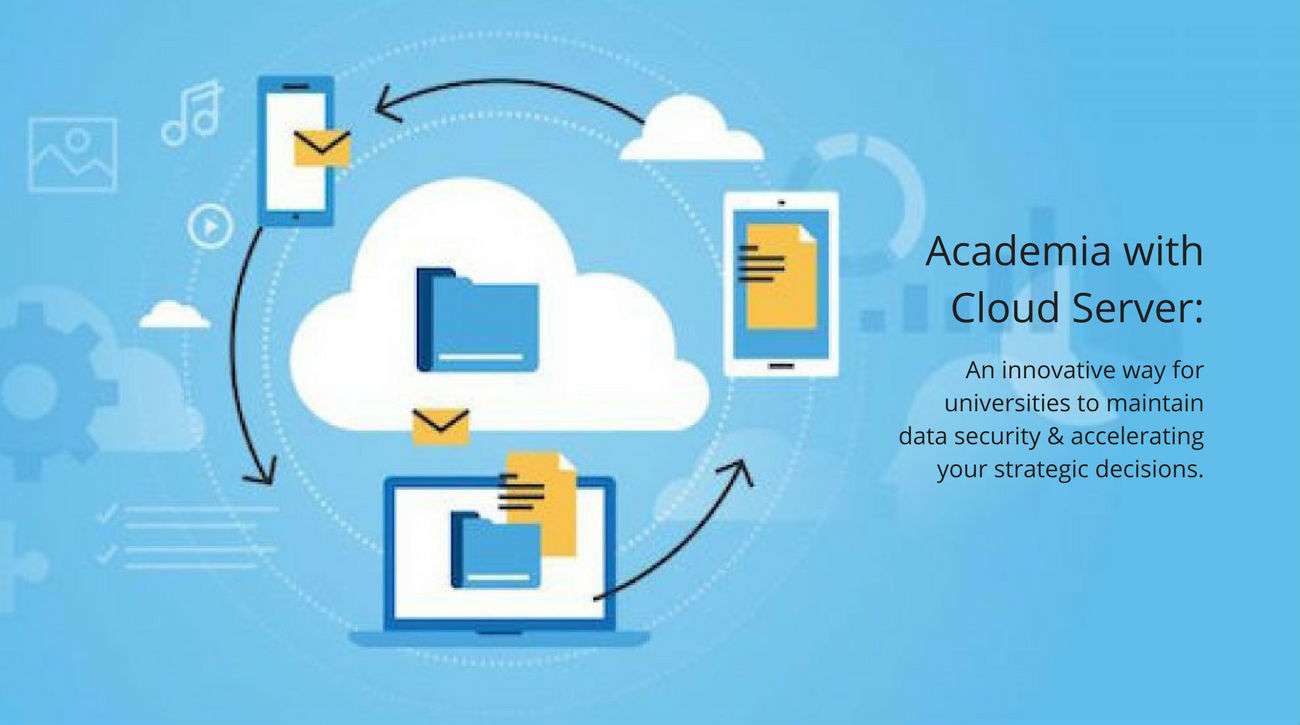
Cloud ERP systems are advanced enterprise resource planning software that run on a vendor’s cloud platform as opposed to being hosted to an on-premise network. Organizations can access cloud-hosted applications over a browser using any device. 

Since cloud ERP is gaining huge popularity, it is time that education leaders and authorities learn more about the efficiency of cloud-based ERP solutions. And make better decisions, depending on their needs and available resources, between on-premise or a cloud-based education ERP solution. 

Cloud-hosted Education ERP software

One of the biggest differences between on-premise and cloud-based solutions is in the access to applications. Since cloud-based software is hosted on the vendor’s cloud, an organization has to access the app over the internet. Hence making internet connection a very important key in the organization’s functioning. But this is a benefit in disguise. You see, since the apps are managed and maintained by the vendor, cloud-based apps have very few downsides and maintenance costs. These are two of the biggest disadvantages experienced by organizations using on-premise solutions. 

Cost Comparison

On-premises software are either bought or leased by organizations. The package includes enterprise-grade servers, networking, and storage to physically run and house the software and associated data for the functioning of the software. 

Organizations are required to pay an additional cost for maintenance, troubleshooting, supplementary software, updates, and customizations. Antivirus and security software and storage & server backups make up a hefty overhead expense. 

Since cloud-based ERP solutions are managed by the vendor, they are liable for application maintenance, data storage, underlying operations, servers, physical data center infrastructure, and installing security updates and feature upgrades. 

Hence, although an on-premise solution appears to be an economically viable solution at first, the hidden charges and overhead expenses make it a very expensive solution. This makes cloud-based ERP solutions a better option functionally and economically. 

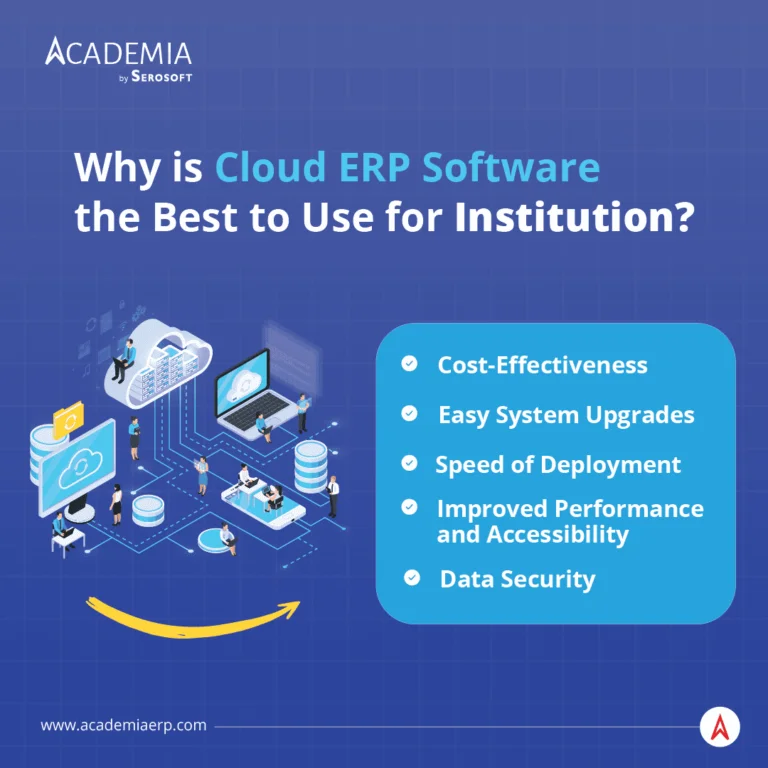
Benefits of choosing Cloud ERP software

Added benefits of choosing Cloud ERP Software are:

  1. No upfront infrastructure and operating costs
  2. Faster implementation with ready-to-use software
  3. Access the applications over web browsers using any device and from any location
  4. Easily scalable and supports your needs throughout the business lifecycle
  5. Highly configurable software makes it easy to make quick customizations to the functioning of the software without the need for IT support
  6. Regular upgrades in the software allow you to access modern technology and stay up-to-date with technology.

Wrapping Up

Cloud-based education ERP is the need of the time. They are highly secure and scalable. Plus, if you are thinking about reducing the operational cost in your institute there cannot be a better option. 

Learn more about Academia ERP, a cloud-based education ERP software with 30+ modules to manage and monitor your business. Connect with our education ERP experts today. 

Back to top