
Type your keyword below

Revolutionizing Campus Operations: Why Your Institution Needs a University ERP Today

In today’s rapidly evolving educational landscape, universities and higher education institutions are facing new challenges, including rising student expectations and the complexities of managing academic and administrative processes efficiently. If your university is still relying on spreadsheets or legacy software, it’s time for an upgrade. Enter the game-changer: university ERP (Enterprise Resource Planning) systems.

What is a University ERP and Why It Matters

A University ERP is a centralized software platform designed to manage and automate key academic and administrative processes, such as admissions, academics, finance, HR, the student lifecycle, and alumni relations, all within one integrated system. It eliminates data silos, reduces manual tasks, and streamlines communication between departments.

🎯 Quick Insight: Institutions using a robust University ERP report up to 40% improvement in operational efficiency and faster decision-making.

Top Challenges in Higher Education That a University ERP Solves

• Disconnected Systems: Manual data entry across multiple departments leads to errors and inefficiencies.

• Scattered Communication: Without integration, staff and students struggle with miscommunication.

• Limited Visibility: Decision-makers lack real-time access to institutional data.

✅ With a University ERP, You Can:

• Centralize your data

• Automate administrative workflows

• Provide real-time analytics and reporting

• Improve student engagement and experience

Key Features You Should Look For in a University ERP

When choosing the right ERP for your university, look for these essential features:

1. Student Information System (SIS)

Track student performance, attendance, grading, and fee payments all in one place.

2. Admission Management

Simplify online applications, manage document submissions, and enable merit-based evaluations.

3. Finance & HR Modules

Automate payroll, budgeting, and financial reporting with complete transparency.

4. Learning Management System (LMS) Integration

Seamlessly connect academic resources, courses, and digital content with your ERP.

5. Mobile & Cloud Access

Give students, faculty, and staff anytime, anywhere access to critical information.

Real Benefits: How ERP Empowers Universities

Let’s look at the tangible impact a University ERP can have:

• 📉 Reduced Operational Costs: Save up to 30% in administrative overheads.

• ⏳ Time Savings: Eliminate redundant tasks and focus on strategic growth.

• 📊 Data-Driven Decisions: Access real-time dashboards for better academic planning.

• 🌐 Enhanced Student Experience: Enable faster communication and smoother services.

💡 “The right ERP turns your university into a smart campus—efficient, responsive, and future-ready.”

Who Should Consider a University ERP?

Whether you’re a growing private university, a public institution with multiple campuses, or a niche higher-ed provider, if you handle thousands of student records and face operational bottlenecks, you need an ERP.

• University administrators are looking for better control and compliance

• IT managers aiming to replace outdated systems

• Academic heads who want real-time visibility into student performance

Making the Switch: How to Implement a University ERP

Transitioning to a new ERP system may seem daunting, but the right partner simplifies it:

1. Needs Assessment: Define your pain points and goals.

2. Vendor Selection: Choose a provider with proven expertise in higher education.

3. Customization & Training: Ensure the ERP is tailored to your specific workflows.

4. Data Migration: Carefully plan and execute data transfer.

5. Go Live & Support: Launch with minimal disruption and ongoing assistance.

Why Academia by Serosoft is a Smart Choice

If you’re looking for a solution that’s trusted, scalable, and tailored for educational excellence, Academia ERP by Serosoft offers exactly that. Built for universities, colleges, and higher education institutions, it combines powerful modules with a user-friendly interface and excellent customer support.

📌 Standout Features of Academia:

• End-to-end digital campus transformation

• AI-powered insights and BI dashboards

• Robust student lifecycle management

• ISO and GDPR compliant for data security


Final Thoughts: Take the Leap Towards Smarter Education

Your institution’s success in the digital age hinges on how well you manage your internal processes and student engagement. A University ERP isn’t just a tech upgrade—it’s a strategic move that fuels academic excellence, compliance, and institutional growth.

5 Reasons Why ERP In Education Is the Need of the Hour

Education technology is paving the way for the digital development of several institutes. Students are the most important part of this chain. 

Catching the pace of students and their tech-savvy parents is now a crucial aspect of the education industry. Quality education, modern infrastructure, and a digitized management system are some of the crucial aspects they look for in education institutions.

Following this trend, the education management system or education ERP is now becoming the need of the hour. It helps streamline and integrate the complete administration processes of institutes.

What is ERP in Education?

ERP in education, usually known as a Student Information System (SIS) is an enterprise software solution to manage the complete student life cycle. It is also integrated with multiple software programs to manage departments of educational institutions.

With the help of Education ERP, it is possible to manage complete admission processes, enable online payments, monitor student records, handle human resource management, and much more.

Check this out to know more in detail about education ERP.

Here are 5 reasons why Education ERP is the need of the hour for the education sector.

1.   Prompt decision making

Imagine you have access to all the information about your business, and you can see whatever you want whenever you want. How helpful that can be!

Now you can take decisions faster, solve product, service, or employee issues more efficiently and track your business data at the click of a button. 

Just like business enterprises, educational institutes including schools and colleges also have many processes that include not only managing students and classrooms but also all sorts of administrative activities. 

With Education Management Software, the heads of institutes can take decisions quicker than with manual reports. A key feature such as generating thousands of reports with a display of data can help an institute scale rapidly and effectively. 

2.   Integrated management

If you are from the accounting department and you want to know if a student has submitted the hostel registration fee at the time of admission, you would ideally send an email or dial a number to check with the corresponding authority for details.

Ever wondered how much time gets lost in this simple process, especially while tracking thousands of students and their records?

Whichever department you are from, this software offers you the privilege to access information, you can check all details and more without any hassle, helping the staff utilize time better.

Not just the administration, but the faculty too is able to save time in attendance records management, exam and result executions, which ultimately helps them focus more on their teaching.

3. Smooth processes

This is one of the most important benefits of ERP in education. With multiple integrations of software systems, it becomes easy to regulate all the processes on a single platform.

ERP impacts all the functions across departments and removes manual intervention as much as possible. This, in turn, makes the execution of processes smooth, leading to increased efficiency and greater control of the system.

It gives the admin the power to connect and maintain data in the most efficient and effective way. Moreover, it also helps in improving communication and ensuring transparency.

4.   Increased communication

An education institution consists of three important pillars i.e. students, teachers, and parents. To run it successfully, it is important to enable strong communication between all three of them. This helps them stay updated on the activities as well as understand their expectations from the institute.

Student Management System helps institutes execute this. With a portal that has students, teachers, and parents together, the information becomes easily accessible and shareable.

Teachers can distribute assignments and check an individual’s performance via their portal anytime they want. They can also keep records on attendance, and overall performance and help students perform better wherever they lack.

Students, on the other hand, can stay updated with events, attendance, fee details, and other circulars. Similarly, the portal can help parents access their child’s progress from time to time.   

5.   More transparency and trust

It is a fact that fair communication brings transparency among people leading to an increase in trust. If employees and other stakeholders are updated with the information on a real-time basis and informed regularly, it builds their trust and respect towards an organization. 

The same goes for educational institutions. With the help of ERP, it can easily update teachers, students, and parents with relevant information. Automatic information on exams, events, circulars, assignments, and more increases the productivity of the institute.

What is your reason to use ERP in your institute?

Want to know more about ERP? Talk to us now! 

University ERP- Bridging The Gap Among Students, Faculties, & Parents

Communication is power, it creates a better relationship, builds trust and avoids disposal of improper information.

Even in education industry communication is very important. We are aware of the importance of connectivity and synchronization between faculties and students. But there are many more dimensions to cover to fill this communication gap.

It is prevalent that parents want to be involved in their children’s lives especially when it comes to academic performance. They want to be aware of how their kids are being taught, how they are performing, is there any behavior that needs to intervene, etc.

Not only between parents and student but communication also plays an important role between faculties and students. If a student is updated with all the lessons, assignment details, faculty’s availability and other related information; his awareness will increase and he will perform better. Same goes for faculty.

Here comes the need for a proper system that can enhance the connectivity among all the stakeholders of an institute.

What is University ERP?

University ERP is a software programme that manages all the academic processes within a university campus. It is also known with various names around the globe e.g. University Management System, Campus Management Software or Student Information System.

It manages complete student life cycle from inquiry to graduation till placement. A University Management System streamlines all academic operations with the help of many advanced features.

How a University ERP is connecting students, faculty, and parents?

A University ERP or University Management System such as Academia SIS provides an exclusive portal for parents, faculty, and students. These portals help them to see all the information they require.

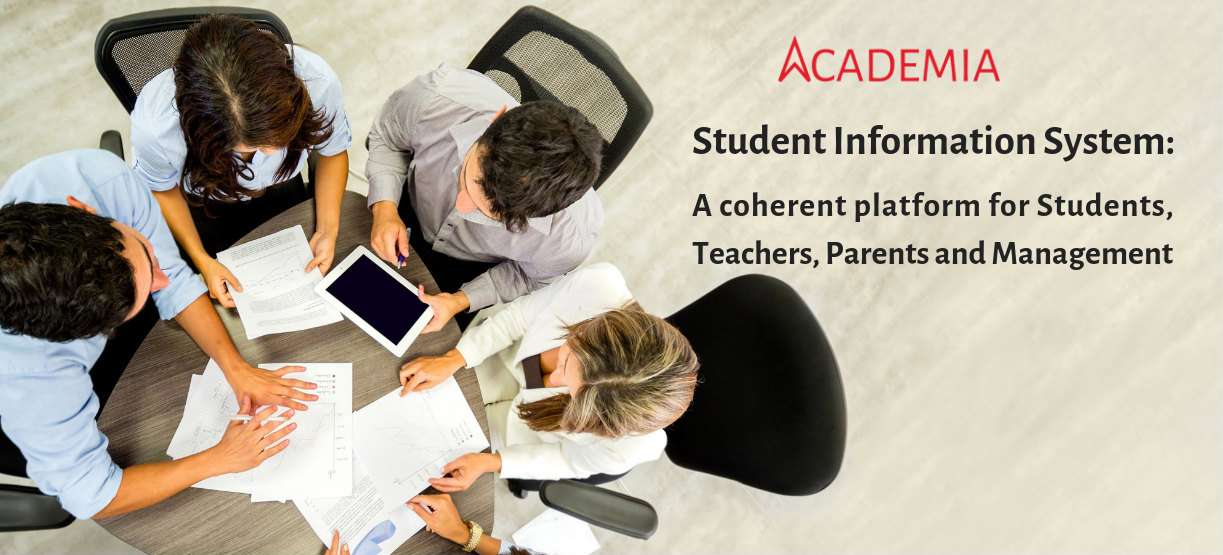
University Management System Software- Academia SISWith the help of Parents Portal, parents can check the details of their children such as marks obtained, lessons taught, absentees, outstanding payments, disciplinary actions, etc. They can also track which faculty is running behind in his/her lesson plan and which one is performing better.

If parents stay aware of the performance of their children, they can take the required actions. Moreover, students perform better if their parents are aware of their academic activity.

If there are any inadequacies in performance or any other areas, parents can play their role to correct it.

Faculty with the help of Employee Portal can give assignments, homework to every student; individually or in a group which gives them the power to keep an eye on every student.

What are the benefits of University ERP?

In the olden days when our parents in college, their parents weren’t getting any academic or non-academic performance report of their children, only the mark sheet. Now the time has changed. With the help of Education ERP, parents can be aware of everything their children’s activity from beginning to end, which builds a meaningful and strong relationship among students, parents, and institutions.

Education ERP is the future

It is well known that Education Technology is going to replace all traditional and manual academic processes in the future. University ERP or Student Information System (SIS) brings the parents and institution on the same page, that ultimately leads to a healthy and successful student life cycle.

Is your university ready for an advanced management system? Take the first step and book a free demo now!!!

Student Information System: Empowering Institutions

The Student Information System is an ecological system that helps the institutes get rid of distributed data. This all is in single software which includes initial documentation from inquiry management, and student registration, till students get passed out of the college / University. This software will help you in running all day-to-day college activities without difficulty. College can easily send alerts or different sorts of information via SMS or email to parents and students. Information generated includes results, attendance records, assignments, notices related to different cultural activities, seminars, corporate events, Placements, etc…

 Student Management System helps in many ways such as:

  1. Authentic time reports: Long ago manual reports technology was used in institutions. These days, the management can do the whole lot on ERP, which in itself is an inbuilt mechanism for generating reports. Many styles of actual time assessment can be generated from such software in the form of different excel reports.
  2. Paperlessness: Automation of process leads to reduced usage of paper which ultimately helps in saving time and money.
  3. Data Security: SIS provides a high level of data security in terms of protecting data from unauthorized access and data corruption throughout its life cycle.
  4. Improved quality of interaction: With the help of SIS interaction between Students – Faculty, Student – Management, Management – Parents, Intra college Faculties, Administrator became more transparent.
  5. Growing productivity: The proper use of ERP software program will boom the productivity of University / Colleges to a large volume.

Hence, the Student Information Software is a boon to the education industry. With limited and constrained options to satisfy the current generation, let us start working towards a better tomorrow with the ease of SIS in a click away

6 Steps To Perform Student Enrollment Management In Higher Ed

Enrollment management refers to the ability of institutions of higher education to exert more systematic influence over the number and characteristics of new students, as well as influence the persistence of students to continue their enrollment from the time of their matriculation to their graduation. The emergence of enrollment management as a new administrative structure within institutions of higher education originated in North America, but it has also been employed in Europe, Africa, and Asia.

The Concept

Enrollment management can be viewed as a synergistic organizational concept that can be used to link several administrative functions within a college or university in order to optimize institutional enrollment goals. Examples of this approach can be found among the financial strategies of many college campuses, where important linkages have emerged between senior enrollment managers and chief financial administrators. Both private and public colleges use some of their tuition income to fund campus-based scholarships for students. Tuition revenue accounts for millions of dollars, and campus-based financial aid has become a large expenditure at most four-year institutions. Enrollment management efforts have therefore become closely linked to budgeting and campus financial planning. Successful enrollment management strategies and practices must also consider the growing importance of university and college rankings. For many institutions of higher education, enrollment management has come to involve a combination of student enrollment strategy, budgeting strategy, and institutional positioning strategy.

Roadmap

1.  Set goals for enrollments

Setting up realistic goals and working in that very same direction to achieve them is the first necessity of systematic enrollment management for an institute. It is a crucial step since it involves market analysis and calculation of the expected rate of growth.

2.  Resource requirements

To identify the need for the required resources according to the set goals is the next step in the roadmap for enrollment management.

3.  Campaigning and recruiting plan

It is important to create a target focused marketing plan for move in the right direction and reach the set goals. The right kind marketing mix may help you get to the right target audience which would ultimately help us meet enrollment management goals.

4.  A strong follow-up on your marketing and recruitment activities

Tracking your activities is a must in the process of enrollment management to get the results. Following steps can be followed to keep on a regular check on these activities:

1) Identify which metrics to track.
2) Know how to track the metrics you identified.
3) Guide your decisions with the data you collect.
4) Monitor the effect of your efforts and adjusting accordingly.

Having a solid set of marketing and recruitment metrics you can track allows you to benchmark your efforts from year to year and make crucial decisions on allocating resources and strategies.

5.  Systematic communications within the process to develop and implement the right strategy.

With the seemingly chaotic mix of print, e-mail, Web, and social media, there may not seem to be much “flow” with recruitment communications. As with student qualification, though, building a communications flow remains a bountiful recruitment strategy if it is handled strategically.

First, you still must think through the communications at various enrollment stages—inquiry, applicant, admit, deposit. Regardless of where a student enters the flow, progressing them to the next enrollment stage remains the goal.

Second, focus your electronic communications wisely. Having a Web site that engages students is paramount. You want to invite communication in addition to delivering information. Give students opportunities to provide their e-mail addresses or even opt in to text messaging. Do the same with social media but be careful not to go overboard. You are better covering fewer social media outlets well rather than spreading yourself too thin.

Finally, get parents and guardians involved in the flow. According to our E-Expectations research, 60 percent are involved with the college research process. Target them with communications and make them ambassadors for your campus.

6.  Award financial aid so students get what they need and expect to enroll

The ability to afford a college education has emerged as the biggest roadblock to attending college. Perhaps nothing will turn away a prospective student faster than a feeling that they cannot afford your institution. You must address this concern immediately and accurately.

6 Steps to a Successful ERP Implementation

1. System Preparation:

At first, the standard version of Academia is installed on a centralized server with standard features and functionality upon collecting Institute’s basic data. Serosoft’s Team provides master data templates for the modules to be functional. Client needs to fill their master data in these templates and upload it to the software. Client’s team can then access the system as it gets ready for first use.

2. Gap analysis:

At the second stage, implementation team visits the institute and have one on one discussion with stake holders to map the actual performance of the software with the desired. This process of Gap Analysis is carried out to be sure to map to the most relevant processes being followed in the Institute. This mapping is done keeping in mind the best match of the processes and system’s capabilities.

3. Detailed deployment plan:

Based on understanding and feedback, we prepare a consolidated Configuration Analysis report which contains information on processes to be mapped to the designated modules. Mutual consent on the plan is taken before moving to step four.

4. Configuration, testing & deployment:

The software is configured as per the detailed configuration analysis report. Once the system is configured and deployed then the implementation team performs an integrity check on the system to ensure a proper unrestricted working.

5. Training & hand holding:

Training of all the required users is important to let the system run smoothly in the institution. We deliver training based on a ‘Train the Trainer’ approach to the designated coordinators from the Institute’s steering committee by holding centralized training workshops for functional representatives of the Institute.

6. Maintenance & enhancement:

After the completion of installation, we provide a comprehensive support to the institute. We use a state of the art support ticketing system, which allows clients to raise queries relating to the software, which gets resolved in stipulated TAT by our support team. On top of this all clients being covered under the comprehensive AMC program receives system upgrades in every three months.

Back to top