Type your keyword below

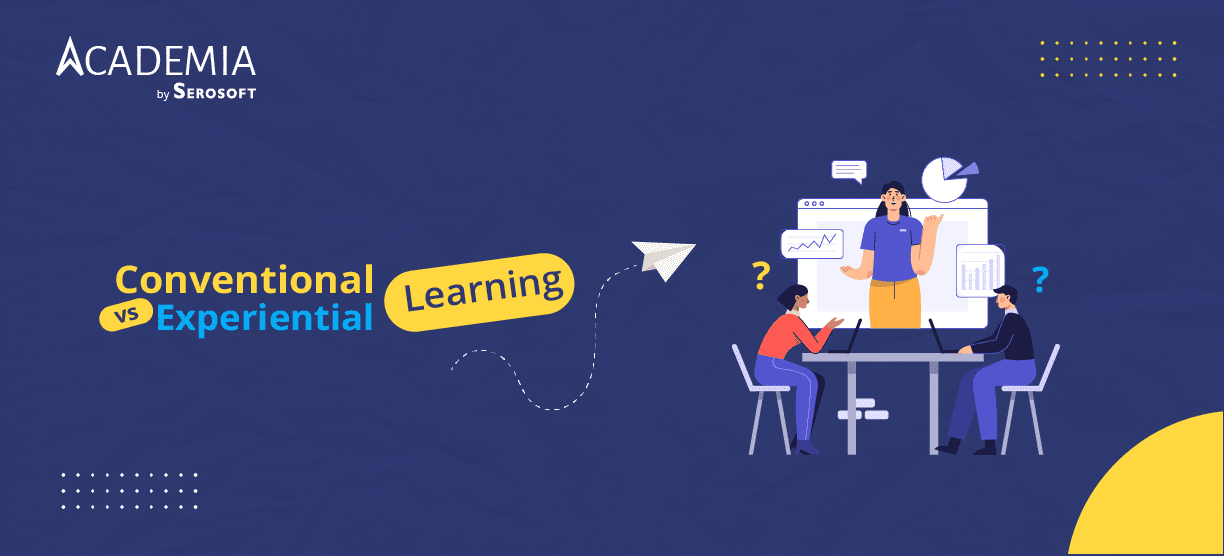
Experiential Learning vs Conventional Learning. Which works better and why?

The concept of experiential learning has been frequently introduced lately. Nowadays, more and more schools have begun to accept this growing trend. The idea is quite simple and bypasses the typical learning process through experience or a “reflex to do”.

How does this work?

The process starts with a person performing a specific action and then sees the effect of the action in a situation. 

The second step is to understand these effects if the same measures were taken and predicted under the same circumstances. 

The third step is to understand the general principle under which the particular instance resides. When this general principle is understood, the final step is the application of the action under new circumstances.

The world is your class

It can be argued in favor of experiential learning that concepts that are difficult to understand in the classroom can be more easily accepted through real experiences. 

Studies have shown that learning in the real world can be more effective as students adapt to the real world through careful observation and generalization. With this learning experience, you can:

  1. Gain valuable experience in the field
  2. Study and learn more globally and locally
  3. Understand the importance of real-life experiences
  4. Actively participate in a dynamic environment

Conventional VS Experiential

Today, schools and organizations involved in the education sector use a variety of methods that they believe will contribute to overall development. However, there is a clear distinction in the way these procedures are carried out. 

Some are more concerned with the concept of experiential learning and individual development compared to traditional methods designed to develop each individual’s ability to meet measurable standards or the standards of an organization.

Read also: 5 Benefits of Adaptive Learning in Edification

Nevertheless, there are many differences between conventional learning and experience:

Conventional learning Experience learning
Includes direct training or teaching Includes modern ways of learning & teaching using advanced tools & software
Involves restrictions with a pre-decided frame of learning Flexible with a variety of learning patterns and techniques
Focus on just institutional growth Focus on the overall development of students along with institutional growth
Knowledge transfer from existing books and resources by faculty to students   Students and faculty can experience the lessons taught to them using artificial intelligence, virtual reality, and more.
Ex. Classroom teaching, conferences, presentations. Ex. Use of technological tools & software for enhanced growth of teaching & learning

Conclusion:

It is not surprising that the vast majority of education and training is still conventional and not experiential. This can sometimes be understandable, as the needs of an organization can be anticipated according to individual needs, both in terms of training and in terms of subsequent work. Here it can be argued that society is a little ignorant and “broken” in this regard.

It is difficult to deny the benefits of experiential learning. As, it can effectively address the personal development needs of young and old learners and improve self-esteem, self-responsibility, and maturity which are difficult to achieve with conventional and normative teaching methods.

To know more about the Student Information System, click here.
5 Benefits of School ERP Software in Examination Management

Examination time is not only scary for students but also for all teachers and other staff members. It requires a lot of arrangements from room allocations, staff allocations, examination centers, assessment schemes to exam execution and exam results.

With limited staff capacity, the process of conducting examinations can become more cumbersome if student numbers are high.

The examination process usually consists of three stages: Pre-Examination Stage, Execution Stage, and Post Examination Stage. Schools need to have a set of planning and a proper strategy to execute examinations successfully, on time, and declare results so that the next session can start on time.

An education technology such as School Management System is designed to manage complete administrative processes within the school campus. It can take care of all three tiers of examination with one platform.

But first, let’s understand a little bit about this educational technology.

What is School ERP?

School ERP is an enterprise solution for school management. It comes in the cloud-based and on-premises software application. In cloud-based solutions schools can save and access all the information on the web and use it anywhere, anytime with any device with the internet.

This software solution manages the complete student life cycle from admission to the last year of schools including examinations. It automates and streamlines all academic and non-academic information. You not only save time in every single process but also you can save operational cost and thereby can increase return on investment in the long run.

School Examination Software can help you to manage examination in the following ways:

Pre-Examination Stage

1. Assistance in Pre-Examination Setting

Pre-examination involves arrangements of examination center, designing grading schemes, assessment schemes, staff allocations, room allocation, and student allocation. This software helps you to manage every detail with a few clicks. You can enter the information as per your requirement.

No need to arrange different papers and planning for the arrangement. And the best part is you can always access anytime you want. Also, you can give access to other staff members to make any changes if one staff member is not available. In this way, you’ll be able to save time and all the pre-examination processes will be arranged on time.

Exam Execution Stage

2. Streamlined Exam Execution

This is the most important part of the examination. No matter how better is your planning there is always some glitch is ready to knock you down. But with School Examination Software you can avoid this. This software can assist you in managing detention, exam attendance, and whatnot. You can also assign remarks to students individually with this. Managing marks entry and course grade is also easy and quicker by the software.

3. Customized Grading System

School ERP for examination provides you the sophistication of a customized grading system. Suppose parents of your students demand both grades-based and marks-based evaluation results. After the setup (according to you marking the range of your school) you can easily convert marks to grades and grades to marks.

Teachers can also manage the assessment status, whether it is pending or completed. Anyone who has access to the school examination system can check the same to check the status of result processing.

Some advanced School Exam Management System also provides the Relative Marking feature as per the requirement of schools. This feature allows you to make marks moderation due to any reason to generate a justified and relevant result for your students and your school.

Post- Examination Stage

4. Well informed evaluation and better result distribution

With all the features provided above, it is obvious that the evaluations and results of the examination will be error-free. If in any case any student asks for re-evaluation and you have to recalculate the result, this can also be done with the Recalculation Feature of the school examination software.

Moreover, no more paper mark sheet and printing cost for the result announcement. You can easily distribute the result to every student’s portal. He/She will be able to check his/her marks and remarks by teachers for every single subject on a real-time basis.

5. Varied and customized report for records

An examination doesn’t end with results. Schools need to maintain records for pre-examination reports, Assessment reports, credit-based reports, and examination reports. They also have to keep a record of exam papers for future reference for teachers and students.

School Management System helps you to manage all these reports with complete details. All these reports will be on the web server but you can always download these reports individually or in bulk smoothly.

See also: Academia ERP – Automated Examination Module

Bottom line

When exams end successfully with flawless results and records, it makes happy not only students but also teachers. The ERP helps schools to run all the above processes smoothly, effectively, and in a time-bound manner.

An examination is one of the many complex processes of school administration. Schools or any level of education institution need technology aid to run the process in an effective way so that teachers and other members can focus their time and energy on delivering quality education and generating a great future for the nation.

There are many things a School ERP can ease your way towards managing your school. Want to learn more? Give a try to free demonstration from our School ERP experts.

You just need to fill our demo request form to get a free demo of school examination software.

How Generation-Z will remodel the map of Education

The Millenials have ruled the world but the future belongs to Generation Z. This generation is the next generation of higher education students, presently attending schools. In education, the survey states that around 93% of this generation students consider technology in the classroom essential to nurture their creativity and prepare them for their future career.

Not just technology this generation believes in social learning which is not limited to geographical borders. Online learning that is available at any time, anywhere is their must-have facility. They expect on-demand services that can help them to focus them in the right direction in their career. This generation is not just limited to Instagram and Facebook story sharing but more focused and career-driven. Most of them already involved in one or another type of business or startup and therefore they need an educational institution that can add value in their skills, that can act as a catalyst for their career. And Generation Z won’t settle for less.

What is the role of an educational institution toward generation Z?

Gen Z is the generation that is not a passive learner, they are the answer finder or if they don’t find the answer they will create the answer for the curious mind. They have an ample amount of resources to enhance their knowledge, the generation where 4G and 5G internet is delivering 24*7*365 access to all over the world.

So, how educational institutions will exist in this digital generation?

There is no doubt that any technology or any amount of internet can’t replace the human touch of education and teachers but to stay “relevant” for Gen Z, education institutions need to pace up with the digital world. 

Educational institutions need to increase their digital presence not only in the learning area but also in administrative management. These students are realistic, they believe in transparency and connectivity. Any institute without technologically advanced management system will lose the interest of Gen Z students. For proper management of student technology like SaaS, Student Information System with cutting edge technology is now the necessity for higher education institutions to maintain the admissions retentions of students. 

Coming to learning management system colleges and University are already on their way to increase their digital presence with online courses, video lectures, podcasts, and 24*7 teacher availability via portals. Artificial Intelligence, Virtual Reality, Augmented Reality, Machine Learning will rule the education sector for Generation G.

Educational Institutions have to show this generation that how their education process can make them stronger, more skilled and future-ready. 

How to meet the expectation of Gen Z?

This is the generation that is passing through the tragical events such as 9/11, 2008 financial recession, terrorism, and whatnot. Gen Z doesn’t live in a fantasy of the ideal world, they live in reality and they understand it. Emerging technology and self-reliance to get learning haven’t lost their faith in the education institutions and educator. In a recent survey by Deloitte The Deloitte Global Millennial Survey 2019, Gen Z has put the onus on educators for preparing workers for Industry 4.0 i.e. industries with smart factories with advanced connectivity and where whole work can be visualized to aid in decision making. 

That means the next generation of students is already putting their money on education sectors and educators, rest must be done by the educational institution. 

Now it’s the responsibility of the institution to make themselves ready to meet the expectation of the Gen Z by diving into active digital transformation, automation of the administrative system, by shifting towards a more practical approach of education and last but not the least delivering the world-class student service to help Gen Z to succeed in their future.

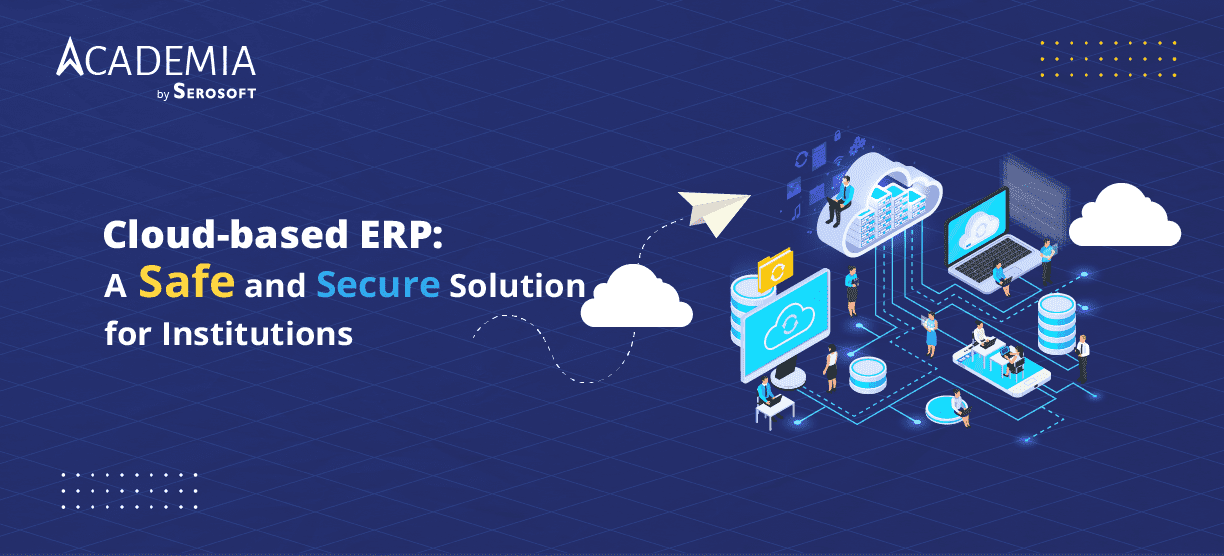
Is cloud-based Education ERP safe for your institute?

This is the most common question that is asked by decision makers of education institutions, especially in higher education. Higher education institutions data is subjected to a data breach or data theft as it has all kinds of data from financial records, endless student records from all the years, important research papers, patents, and many more.

Let’s know what are the threats that are hovering over your data

  • Malware
  • Phishing
  • Obsolete/outdated technology
  • Unawareness towards the volubility of data
  • Human error

There many more in the line as threats are evolving with the technology as well.

What is the role of cloud-based education ERP?

Cloud-based Education ERP is a software solution for educational institutions for reorganizing institutions, standardizing business practices and alignment of technology to manage complete data management. It stores all the data on cloud by three types of services i.e. SaaS (Software-as-a-Service), On-premises and Hybrid.

Education ERP aka Student Information System fast-tracks the academic operations via automation and increase the productivity of the institutions.

Leaving all your data on a cloud-based Education ERP might feel risky as sometimes it tough to understand its functionalities. It should be noted that the cloud is a highly secure platform to store & manage your data but the security is a shared responsibility of vendors and institutions.

Here is how the cloud offers the security of data-

You get the control of all the data from the single platform

People who are fans of a cloud-based data management system, they love the control they have over their data. The admin can offer the privilege to any user with customizable access to functions to handle various departments. Cloud gives you the facility of encryption, multiple authentications, and access management via a single platform.

You get rid of human interventions in data management

The institutions which use their own server or they control the data physically. If you understand the processing of education world you know that the data created by institutions are endless and it is next to impossible to keep all the data with complete safety and immune to damage.

Many people have access to an on-campus data server. No matter how many types of securities (CCTV, multiple checkpoints for an identity check, etc. ) you install in to enter the data room; it is always prone to data breach and one humane mistake can cause the whole management system to halt causing loss of data, time and money.

The plus point with most cloud providers is that they back up the data to multiple locations that cease the chance of data loss. Moreover, the recovery of data from the cloud is quite easy and it minimizes the human error to zero.

Additional benefits of cloud-based Education ERP

24x7x365 connectivity and uptime of the system for the end user to make full use of the software.

Cloud-hosted server management is taken care of by experts and you need not worry about hiring server administrators and IT team to do so.

Server upkeep, maintenance, upgrades, patches are all taken care of by the Cloud Service provider.

Cloud-hosted servers configuration can be changed on demand as compared to fixed configurations for on-premise servers, giving endless flexibility with hardware configurations in case required in cloud hosting.

Managed backup services are better in Cloud hosting, which can give suitable disaster recovery options in case the servers fail due to hardware reasons.

Conclusion

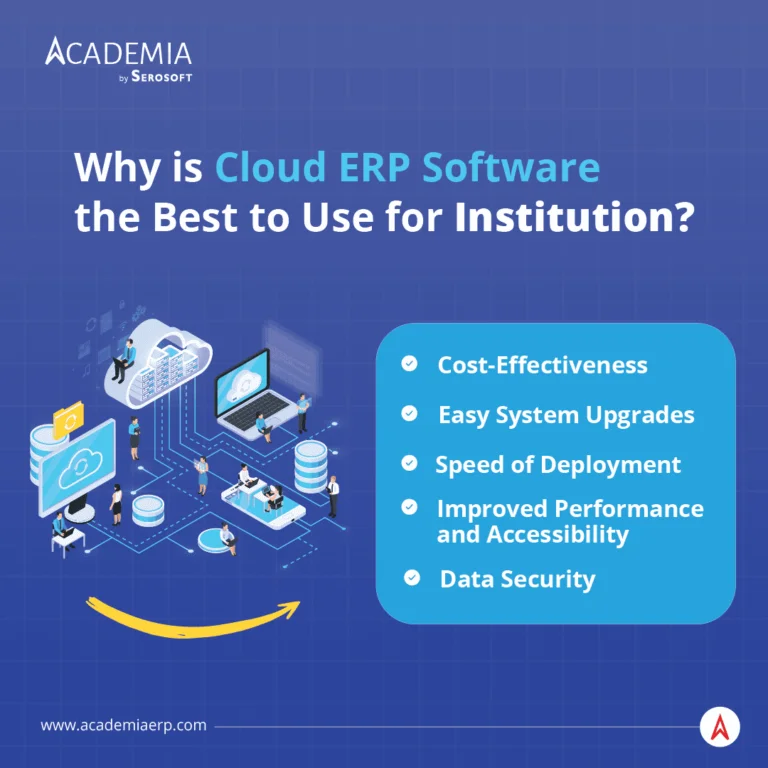
Leaving all your important data to new technology can be overwhelming, but if you understand the technology thoroughly it can benefit you and your institute amazingly. Cloud-based Education ERP can reorganize and standardize administrative operations of educational institutions.

Do you know cloud-based solutions can give a high-value disaster recovery solution for data of your institute?

Learn more about the amazing benefits of cloud-based ERP solution by our experts. Schedule a free demo now.


4 Undeniable Reasons Why Educational Institutions Should Use ERP Software

Being a part of the education industry, I need not tell you how much the meaning of education has changed over the years. It is no longer about providing education for sake of a system or law. It is about having more accountability toward building the future of the country by shaping these young minds. Equity and accessibility have become an integral part of the goal. Governments around the world have already started prepping to meet these new goals in a couple of years. 

Even though, the goals have changed the challenges have remained the same. In fact, after covid-19, they have elevated. The resources are meager and in some poor countries, educating children is not even on the list of priorities for people. They are battling to keep their families fed and are asking children to take up odd jobs. As an education organization, you too must have seen a dipping admissions rate, late arrival of government aid, and most of all students having lowered engagement in the classroom. How are you are prepping to battle them? 

One of the solutions is — Education ERP. 

What is Education ERP Software? 

Education ERP software is advanced software that helps in automating the operations in an institute and serves as a database for multiple applications put in use for the digital governance of an institute. 

4 undeniable reasons you must invest in Education ERP software

  • Reduces cost 

A report by OECD suggests that global funding for the education industry can go down by 11%. This means you must be prepared to reduce the cost of operations and spend only on the things that are absolutely necessary. 

But do you even know where you are spending currently? I know your answer. Manual processing is not only costly, but it is highly opaque. There is no transparency in the transactions and hence you may not be able to fully consolidate where you are spending currently. 

To fight that, use an ERP solution. It is an enterprise-level resource management tool that provides you with financial management and automates most tasks to reduce operational costs. 

  • Paperless operations 

This is the most cliched reason to invest in technologies but, imagine the amount of money you save by going paperless. Paper-bound operations are slow and they are very difficult to manage. They lower the productivity of the staff and you lose out on good opportunities to stay profitable in the current economic climate. Hence, switching to paperless operations is best, and ERP does it all for you. 

  • Reports and Analytics. 

Compliance agencies and regulatory bodies are prepping for changing their norms of accreditation. They need to see more accountability in administrative and academic staff toward quality education. They are demanding reports on various aspects of a student lifecycle and to stay on top of it you need — first, a database that centralizes information in one place, and second a tool that consolidates data to provide you accurate reports. 

You no longer cannot depend on the academic and non-academic staff for these reports, given you are short on resources and you have to reduce your operation cost so hiring more people is out of the question. Hence, an education ERP is a long-term solution. The data analytics feature helps you generate various reports and stay in line with compliance. 

  • Data security and management

Data security has become a central concern for education institutes. During covid-19 many institutes chose to go with the available option in the market without testing the security of the product. As a result, many students and parents are complaining of data leakage and are concerned about the security of the student in an online learning environment. 

This has led to institutes taking harsh measures and going with tools that offer higher security in the ecosystem. An education ERP solution such as Academia ERP can help you navigate through this challenge easily. We are a highly secure platform that uses various security measures to prevent any breaches.

Wrapping Up 

These were the 4 reasons to invest in education ERP software. If you need to know more about the features and functionalities, please fill out this form to request a free demo. Our technology experts would connect with you shortly. 

5 Significant Impact Of Artificial Intelligence In Education That You Should Know

It’s the 21st century, the century of continuous change and advancement. Everyone is equipped with gadgets; it can be mobile, VR Box, Fitness Band, etc. Moreover, every day, you find new updates or even an advanced version of gadgets. Technology acceptance has become very natural in the last few decades.

Amidst all these technological revolutions, Artificial Intelligence is the most admired technology in every sector. Now, it is not limited to Sci-Fi movies or novels. The reason why AI is the most attractive tech is its human-like experience. In 2016 social humanoid robot, Sophia was launched, it got trendy among tech giants and all around the world due to its human-like appearance and behavior compared to previous robotic variants.

Artificial Intelligence has entered in every sector i.e. finance, retail, law, marketing & advertising, and the health sector. It is paving its wave in the education sector also. The moment the education sector get fully equipped with AI, it will change the face of education entirely.

Let’s check out how Artificial Intelligence is going to impact the education sector.

Student Assistance

Artificial Intelligence can understand the weakness and strength of every single student. It can analyze the pace of learning and latent skills of students that will help teachers, parents to guide students in productive learning. Next generation students will have the AI companion that will know everything about them from personal to professional.

Teacher Assistance

As AI can understand students and their capability, it is going to help teachers to work accordingly. AI can also help the teachers to guide them on the rate of lecture delivering, the right time for assessments, what type of assessment is required for a particular topic, which topic is beneficial for students which are redundant, etc. Teachers can use AI for better understanding of topics and its level of difficulties towards students. That will increase the quality of education and level of students. With the use of Artificial Intelligence, educators can outsource their targets quickly and achieve results set for each and individual performance of a student.

Personalized Learning

It is one of the best benefits of AI in the education sector. We all know there are various types of students, and every teacher has a different way of teaching methods. It is very difficult for teachers and students to meet the exact expectations.

There are students with different needs and some with extraordinary capabilities. In this era of ample information, it is imperative that every student gets the same access to education and learning. AI can adapt to the individual learning related requirements of students and teachers. That will reduce the meaningless and unproductive work of teachers and will help the institution to increase the efficiency of education.

Automation of Grading

At present, artificial intelligence is already able to automate grading system in multiple choice questions (MCQ) in education institutions. Can you believe how much time teachers will be able to save from the automation of the grading process?
With the continuous advancement in the AI algorithm, sooner it’ll be able to automate standard and dynamic grading system according to the needs of institutions.

Global access to education

Artificial intelligence is one advanced tool that can bring the global classroom for students in every corner of the world. AI can fill the gap of communication between teachers and students. Students with different language or with visual or hearing impairments can understand teachers with the help of real-time subtitles. Presentation Translator is a is free-plugin for PowerPoint that does so.

AI will also help students to connect on the global level for brainstorming. It will increase the spreadability of knowledge among students.

Many other educational technologies are transforming the education sector and easing the life of students, teachers, and institutions.

Here they are https://www.linkedin.com/pulse/5-edtech-trends-dominate-2020-mandira-shah/

To get a deep dive into education automation, click here to book a free demo.

Back to top