Type your keyword below

7 Emerging Technologies that are Reshaping Education

In the field of education, emerging technologies are revolutionizing the learning process for students by enhancing the way students, teachers and institutions work. Technology has changed the world and cutting-edge technologies  are reshaping education in innovative and unimaginable ways. Students are getting the opportunities and unique experiences they need and deserve as emerging technologies promise to deliver exciting new resources for learners.

Let us take a closer look at the seven emerging technologies that are earmarked to make major waves and reshape education.

1. Augmented Reality & Virtual Reality

Mixed Reality and Simulations are pathbreaking experiences for learners and teachers too. AR, considered as one of the best emerging technologies in the world, can be used by educators in innovative ways to make lessons interesting and interactive. AR is useful in overlaying interactive digital elements to give real time experience and for promoting skills like creativity, critical thinking analysis and problem solving. AR promises to help learners capture their dreams and imaginations and take learning to the next level.

Virtual Reality, the next big thing in education, enhances student learning and engagement by cutting across all barriers and immersing students in what they are learning and helping them to process information better.

learning and helping them to process information better.

2. Artificial Intelligence

Artificial Intelligence (AI) in education is already transforming the way curricula are implemented in schools, with innovations that would have been impossible a few years back. AI applications have made the academic world more convenient and personalized. One of the key impacts of AI from kindergarten to graduate school is the different levels of individualized learning with adaptive learning programs, games and software, where students can work at their own pace.

AI aims to reshape education by supporting the sharing of first-person perspectives which will be useful for students research. From artificially generated content to image recognition and smart tagging systems, AI is also automating basic activities like grading homework and tests as it takes up a lot of time for teachers. While human grading may not be fully replaced, AI can help in providing detailed analysis of student performance in exams, and help in grading to a certain extent.

AI has resulted in automation of administrative jobs, saving time for educators.

3. 5G Technology

5G is the fifth generation of wireless technology which promises high speed and low latency wireless technology. 5G is meant to change the way educational institutions interact with much quicker downloads and increased efficiency and expanding the scope of connected devices and technology within the classroom.

Some universities have started implementing IoT integration for higher education where lectures and discussions on specialized topics can be conducted through virtual reality experiences. Seamless connectivity will bring in better engagement which will be a big boon for international students, along with faster downloads of files and resources and more powerful networks. 

Interestingly, 5G was supposed to be launched in India in 2020 and would have been extremely beneficial for students learning from home during the COVID-19 pandemic. However, things didn’t go as planned and the launch has been pushed to mid 2021.

4. Internet of Things

The Internet of Things (IoT) has tremendous potential to create smarter and connected schools and is already impacting the education sector by making learning simpler, faster and safer. IoT can save energy and lighting, and sensors across the campus can track traffic and the strategic positioning of security features like lighting would help students and visitors too.. IoT can help break the usual barriers to education like language, location or certain disabilities, besides helping everyone with bottom-line solutions.

5. Adaptive Learning

The Adaptive learning technology provides learning activities to students, based on their needs and learning style and behavior. It helps students with unique learning paths that are based entirely on their interests and learning ability. 

It can play a huge role in the educational system as it uses computer algorithms to orchestrate the interaction with the learner. Although this technology originated from AI, it actively caters with individualized resources and top learning activities to take care of the special needs of a learner.

6. Learning Analytics

When it comes to the process of learning for students, it needs efficient tracking and analyzing to understand results better. This is essential to bring about improvement which is a very important factor in education to improve the learning experience of every student. The learning analytics technology helps teachers to better record the learning rate and behavior of students so that teachers can provide targeted improvements to courses.

7. Blockchain

The Blockchain technology which has changed every industry dynamically, can prove to be very useful in the education sector as well. It is especially useful to collaborate around distributed information in a database. Blockchain can help in examination management, verifying student credentials, verifying certificates, managing life-long learning records etc. Besides effective analyzing and tracking, it can help teachers provide targeted improvement for courses and help students deliver enhanced results.
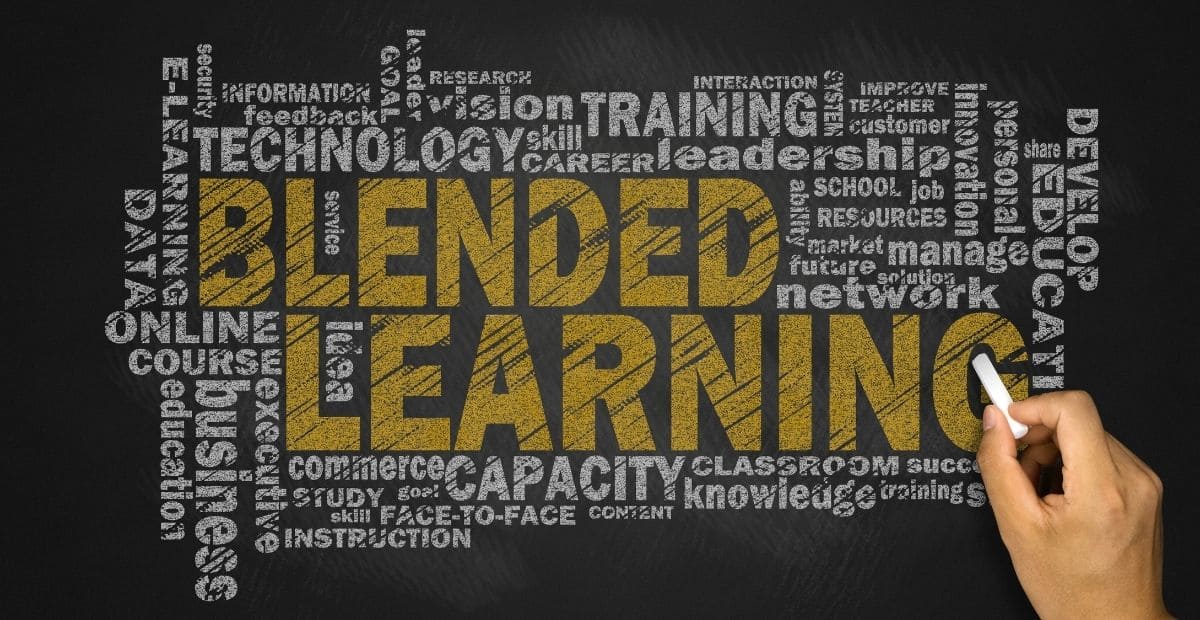

Blended Learning in the Education Sector: The Need of the Hour

Today the educational landscape is changing. The pandemic has opened the gate to think beyond the traditional learning & teaching methods. Teachers are adapting to new technologies as digital transformation becomes more convenient and necessary than ever before.

With the imminent reopening of schools and higher education institutions are planning to use a mixture of online learning and traditional teaching where students will come to schools for a few days a week. Hence, the concept of blended learning is leaping in the education world.

Even before the advent of the internet, correspondence education, and independent learning through distance education programs were prevalent. As digital platforms have become more accessible to purchase and implement, there has been more inclination towards mixing conventional and modern learning that could benefit students.

If it weren’t for technology, it wouldn’t be possible for educators to keep the education running even for a short period. Traditional teaching, online learning, online classes, and hybrid classes are all mediums for knowledge transfer and enable students to master in given subjects. These terms are becoming a part of 21st-century learning when talking about education, and blended learning is one popular concept among educators.

What is blended learning? 

There has been much confusion to find the meaning of blended learning. You can find many definitions for it. To sum up all the definitions of B-Learning, it is “enhancing teaching with the help of digital platforms and online educational content.”

Blended learning is one form of hybrid learning that uses multiple digital resources to expand the classroom approach. Hybrid learning does it in two-parts, separate sessions of face-to-face instruction and online sessions. In blended learning, both systems are integrated along with digital modalities to create a coherent and yet varied learning environment.

What is the difference between blended learning & hybrid learning?

Most of the time blended learning and hybrid learning are used interchangeably. It is similar if we see the broad spectrum but there is a subtle difference between them. Hybrid learning is a holistic approach that focuses mainly on enhancing learning experiences for students. As the name suggests, it is the combination of various methods of learning methods whether it is offline, online, distance learning, etc. It replaced most of the physical communication between teachers and students with online interactions. Whereas blended learning is an explicit combination of offline and online approaches of instructions. It is a perfect blend of online instruction and offline communication among learners & instructors.

What are the types of blended learning?

Blended learning has many types according to the usage and techniques such as; Remote Blended Learning, Flipped Classroom, Mastery-Based Blended Learning. But it is broadly classified into two categories, as synchronous learning and asynchronous learning.

In synchronous learning, groups of people connect with coaches/ instructors, and real-time discussion is similar to offline classes. It provides a sense of community and encourages them in more collaborative learning. Whereas in asynchronous learning, educational content is delivered to students. It is more like a distance learning program. It is more flexible and allows students to learn according to their pace. 

What is the objective of blended learning?

There is no doubt that technology aids learning, fuels the ultimate objective of education i.e., Knowledge Transfer and supports learners in a holistic learning environment. Blended learning is a combination of traditional and modern approaches that become convenient for teachers to adapt to new technologies with the conventional method’s backup. 

Blended learning enhances access to education and maximizes flexibility. A blended learning model meets students wherever they are by delivering content in a self-directed, digital format.


What are the methods of blended learning?

As it is all about flexibility, blended learning comes with numbers that educators are using nowadays.

One of the most famous ones is known as a flipped classroom. A flipped classroom is a teaching method that works in reverse i.e., from students to teachers. It is where teachers have questions that they share with students in advance. The responses from students help capture where the teachers will need to focus their guidance in a discussion. This way, they can target instructions in a way that is most effective for learners.

For example, a teacher might provide students with a discussion topic or question before class and ask for feedback via email or perhaps a shared online document. The teacher reviews the responses before class and uses that information to more intentionally direct the live discussion. Here student input comes first, with the activity coming second, the opposite to traditional learning, where the instructor will first facilitate discussion and then solicit feedback in response.

Just-in-time learning is another method. This is where teachers use class time for active learning and remove passive activities that students could do on their own, such as reviewing the syllabus.

It could also involve video tutorials and digital activities targeted for students to complete at their own pace. It allows teachers to focus classroom time entirely to hone in on confusion or lead group work or other collaborative activities.

Implementing more robust coaching and advising models are also an essential strategy for blended learning. Personalized, face-to-face support meets students’ expectations and allows to build rapport between instructors & learners intentionally. It creates a sense of accountability driven by the customized nature of the instructor-learner relationship.

What are the advantages and disadvantages of blended learning?

A significant benefit of blended learning is flexibility for students; the ability to control the pace. It also creates space for reflective thought for students. Digital resources are generally readily available unless there are budget issues.

But some fundamental issues create obstacles for penetration of blended learning. Unfortunately, ready access to high-speed internet isn’t a given for everyone, even for families with the internet in their home. Similarly, parents with a full-time job might need to prioritize it using the bandwidth. Moreover, having several siblings in the house who all need to stream video for school assignments at the same time, and a mobile hotspot won’t be sufficient.

One way to combat this is to incorporate blended learning activities that don’t just involve bumping someone in front of a screen but encouraging experiential learning or offline, more reflective, or independent tasks.

How Education ERP facilitates blended learning?

Education ERP is a management information system for educational institutions that helps educators to manage all administrative tasks through a single platform. It also improves communication among all the stakeholders thereby enhancing the overall student experience.

Solutions such as Academia ERP are integrated with a learning management system that enables institutions to facilitate education digitally. It also aids communication between teachers & students beyond campuses that makes learning more student-centric that is the ultimate goal of blended learning. 

In concluding note

Due to the outbreak of the pandemic, education leaders are bound to implement technology in educational institutions. The new normal of the post-COVID world of education will be inbuilt with EdTech to maintain institutional continuity. Ultimately, all learning methods are designed so that teachers can focus on the vital component of their role; student-focused education. That’s what learners need the most. Providing the content is laying the foundation, but working with learners to enhance their knowledge with that content is the key.

Blended learning allows teachers and students to work more cohesively by using all available resources in multiple ways to enhance learning and ultimately to help students find the method of learning that benefits them the most.

Back to top