
Type your keyword below

Academia ERP: A Standout Solution with No Comparable Alternatives

Decoding the Uniqueness of Academia ERP / Student Information System – a unique solution with unparalleled features, setting it apart as the leading choice in the market. Discover the difference today.

When it comes to education management systems, the market offers a plethora of options. While exploring alternatives is always a prudent decision, it’s worth mentioning that when it comes to the perfect blend of functionality, scalability, and reliability, there may be no true substitute for Academia ERP. Amidst the wide array of choices, there is one name that stands out: Academia ERP/Student Information System. Renowned for its comprehensive features and unmatched performance, Academia ERP/SIS has set the standard for efficient university/college management. So, let’s embark on this journey to discover why the best alternatives to Academia ERP can only be Academia ERP and nothing else.

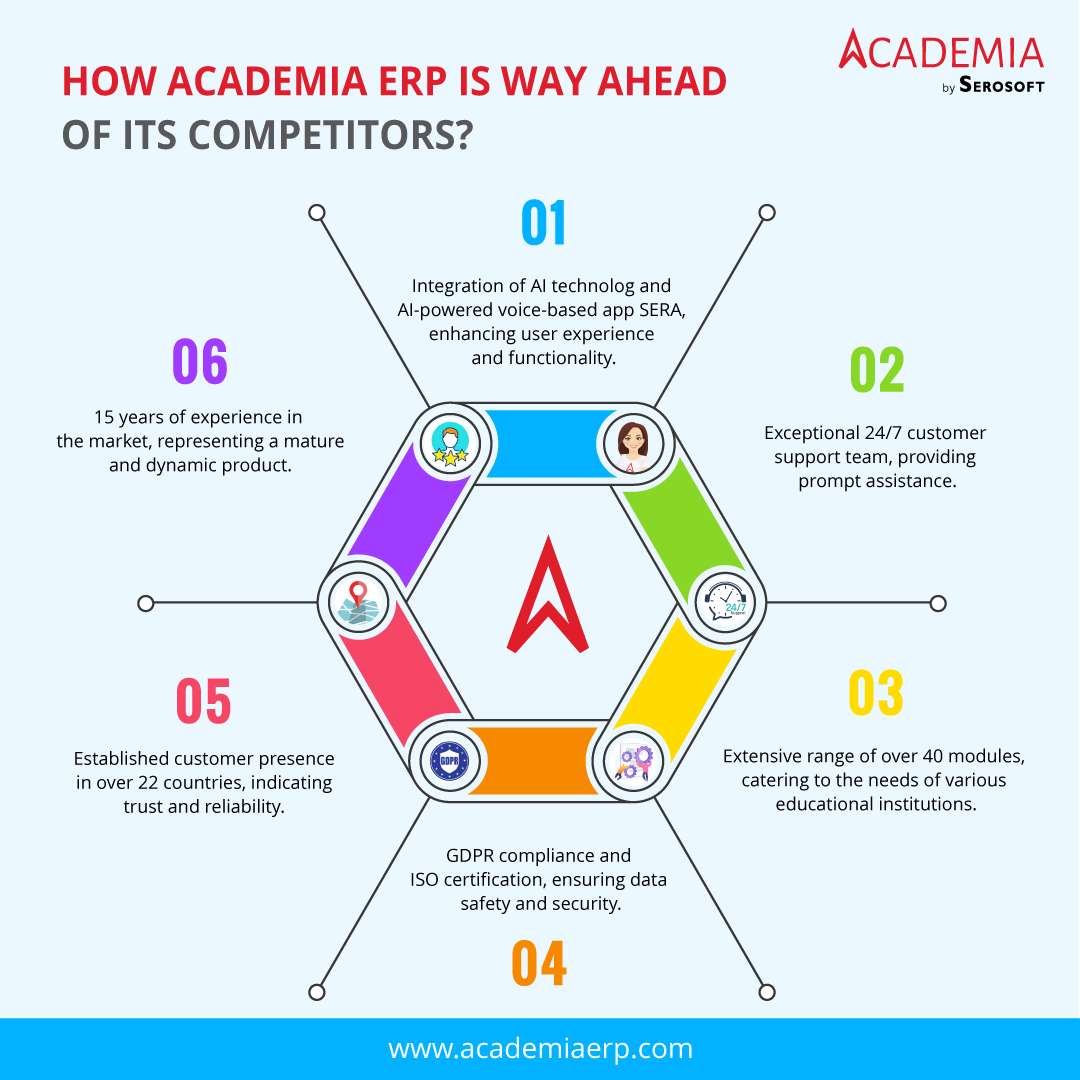
    • AI integrated with AI-powered voice-based app SERA: Academia ERP utilizes artificial intelligence (AI) technology and integrates it with an AI-powered voice-based app called SERA. This integration enhances the functionality and usability of the software, allowing users to interact with the system using voice commands and receive AI-driven responses.
    • 40 plus modules to automate various sizes of campuses & Multiple Locations: Academia ERP offers over 40 modules designed to automate and streamline operations across campuses of varying sizes and multiple locations. These modules cover a wide range of functions, including admissions, student management, faculty management, finance, library management, examination management, and more.
    • GDPR compliance and ISO certification to ensure data safety: Academia ERP is compliant with the General Data Protection Regulation (GDPR), a set of data protection and privacy regulations in the European Union. It also holds ISO certification, ensuring that data security and privacy measures are in place to safeguard sensitive information.
    • Customer presence in more than 22 countries and trusted by 350 plus customers: Academia ERP has established a strong customer base in more than 22 countries. It is trusted by over 350 customers, which demonstrates its reliability and effectiveness in meeting the needs of educational institutions worldwide.
    • 15 yrs mature yet dynamic product: Academia ERP is a mature and dynamic product that has been in the market for 15 years. Its longevity indicates its stability and continuous development, adapting to the evolving needs of educational institutions over time yet we keep on upgrading ourselves with upcoming technologies and now we are AI-enabled with voice-based apps and NLP integration.
    • Best – 24* 7 customer support team like no other education ERP: The ERP solution boasts a highly efficient and dedicated 24/7 customer support team, setting it apart from competitors. This ensures that customers receive prompt assistance and resolves any issues or queries they may have, contributing to a positive user experience.
    • Recognized and awarded by many stalwarts nationally and internationally: Academia ERP has garnered recognition and awards from reputable organizations and industry leaders both nationally and internationally. These accolades validate the quality and excellence of the product and its impact on the education sector.

Awards
Check out our full list of awards and recognition: https://www.academiaerp.com/awards-accolades/

Tailored Education ERP Solutions for SME Institutions, Higher Ed and K12

Academia ERP solution offers tailored solutions to meet the specific requirements of SME institutions, higher education institutions, and K-12 institutions. This customization ensures that the software addresses the unique needs and challenges faced by different institutions of different sizes in the educational sectors. We have separate K12 and Higher Ed plans like – Pro, Premium & Enterprise as per the customers’ requirements. These plans are for

K12, Private & Public: Preschools, Primary Schools, Secondary Schools, Independent Schools, Charter Schools, Junior Colleges, Multi-Academy Trusts (MATs), School Districts, and Chains of Schools.

Higher Ed, Private & Public: Tertiary Institutions, Universities, Colleges,, Training Organizations, and Groups of Institutions.

From Implementation to Success: Global Institutions that Flourished with Academia ERP

Here are some real-life case studies and client testimonials showcasing how educational institutions worldwide have benefited from implementing the software.

Here is the link for more client testimonials.

These examples demonstrate the positive impact of Academia ERP on the efficiency and effectiveness of educational operations.

Why/How Academia ERP is Way Ahead of its Competitors?
Academia ERP, a product from Serosoft stands out from its competitors due to several key highlights, including:
Academia ERP, a product from Serosoft stands out from its competitors due to several key highlights, including:


How Academia ERP is Bound to stay ahead in the Future:

Academia ERP is the best Student Information System (SIS) in 2023 and is expected to maintain its leading position as the best Student Information System (SIS) in 2024 in the education ERP market by:

  • Continuously integrating advanced technologies to enhance functionality and stay at the forefront of innovation.
  • Adapting to changing regulations and compliance requirements, ensuring data safety and security.
  • Expanding its customer base and global presence through effective marketing and customer satisfaction.
  • Anticipating and addressing emerging challenges and needs in the education sector.
  • Leveraging the expertise and leadership of Serosoft, the company behind Academia ERP, to drive innovation and strategic growth.

Top Reviews/Ratings are one of the top reasons why you can not find Academia ERP alternatives anywhere.

[vc_row row_content_width=”grid” css=”.vc_custom_1690179790775{padding-top: 50px !important;padding-bottom: 70px !important;background-image: url(https://www.academiaerp.com/wp-content/uploads/2021/05/bg-4.jpg?id=11006) !important;background-position: center !important;background-repeat: no-repeat !important;background-size: contain !important;}” el_id=”reviews”][vc_column width=”1/5″][vc_empty_space height=”50px”][/vc_column][vc_column width=”3/5″][vc_column_text][/vc_column_text][mkdf_section_title type=”standard” title_tag=”” disable_break_words=”no” title=”Check Out Academia ERP Customer Reviews” title_color=”#ffffff”][vc_row_inner el_class=”gartner-sec-inr”][vc_column_inner width=”1/2″][vc_custom_heading text=”G2 Reviews” font_container=”tag:h3|text_align:center|color:%23ffffff” google_fonts=”font_family:Suwannaphum%3Aregular|font_style:400%20regular%3A400%3Anormal”][vc_raw_html el_class=”center_text” el_id=”Gartner_review”]JTIwJTIwJTIwJTIwJTNDY2VudGVyJTNFJTBBJTIwJTIwJTIwJTIwJTIwJTIwJTIwJTIwJTNDZGl2JTIwc3R5bGUlM0QlMjJiYWNrZ3JvdW5kJTNBJTIwJTIzZmZmZmZmJTNCJTIwdGV4dC1hbGlnbiUzQWNlbnRlciUzQiUyMG1hcmdpbi10b3AlM0EyNXB4JTNCJTIwaGVpZ2h0JTNBNDg1cHglM0IlMjB3aWR0aCUzQTMwMnB4JTNCJTIwYm9yZGVyJTNBJTIwc29saWQlMjAxcHglMjAlMjNjY2MlM0IlM0IlMjIlM0UlMEElMjAlMjAlMjAlMjAlMjAlMjAlMjAlMjAlMjAlMjAlMjAlMjAlM0NkaXYlMjBpZCUzRCUyMmcyLXdpZGctYWNhZGVtaWEtZXJwLWJ5LXNlcm9zb2Z0LTEwMjkxMzYlMjIlM0UlMEElMEElMjAlMjAlMjAlMjAlMjAlMjAlMjAlMjAlMjAlMjAlMjAlMjAlM0MlMkZkaXYlM0UlMEElMjAlMjAlMjAlMjAlMjAlMjAlMjAlMjAlMjAlMjAlMjAlMjAlM0NhJTIwb25tb3VzZW92ZXIlM0QlMjJ0aGlzLnN0eWxlLnRleHREZWNvcmF0aW9uJTNEJTI3dW5kZXJsaW5lJTI3JTNCJTIyJTIwb25tb3VzZW91dCUzRCUyMnRoaXMuc3R5bGUudGV4dERlY29yYXRpb24lM0QlMjdub25lJTI3JTNCJTIyJTIwaHJlZiUzRCUyMmh0dHBzJTNBJTJGJTJGd3d3LmcyLmNvbSUyRnByb2R1Y3RzJTJGYWNhZGVtaWEtZXJwLWJ5LXNlcm9zb2Z0JTJGcmV2aWV3cyUzRnV0bV9jYW1wYWlnbiUzRHdpZGdldF9lbWJlZCUyNmFtcCUzQnV0bV9tZWRpdW0lM0RyaWJsZXRzJTI2YW1wJTNCdXRtX3NvdXJjZSUzRHJlYWRfbW9yZSUyMiUyMHN0eWxlJTNEJTIyZGlzcGxheSUzQSUyMGJsb2NrJTNCJTIwJTIwYm90dG9tJTNBJTIwNnB4JTNCJTIwbGVmdCUzQSUyMDAlM0IlMjBjb2xvciUzQSUyMCUyMzMzMyUzQiUyMGZvbnQtc2l6ZSUzQSUyMDEwcHglM0IlMjBmb250LXdlaWdodCUzQSUyMDYwMCUzQiUyMHdpZHRoJTNBJTIwMjIwcHglM0IlMjB0ZXh0LWFsaWduJTNBJTIwY2VudGVyJTNCJTIyJTNFJTIwUmVhZCUyMG1vcmUlMjBhY2FkZW1pYS1lcnAtYnktc2Vyb3NvZnQlMjByZXZpZXdzJTIwJTNDJTJGYSUzRSUwQSUyMCUyMCUyMCUyMCUyMCUyMCUyMCUyMCUzQyUyRmRpdiUzRSUwQSUyMCUyMCUyMCUyMCUzQyUyRmNlbnRlciUzRSUwQSUyMCUyMCUyMCUyMCUzQ3NjcmlwdCUzRSUwQSUyMCUyMCUyMCUyMCUyMCUyMCUyMCUyMCUyOGZ1bmN0aW9uJTI4dyUyOSUyMCU3QiUwQSUyMCUyMCUyMCUyMCUyMCUyMCUyMCUyMCUyMCUyMCUyMCUyMHcuX2cybG9hZCUyMCUzRCUyMHRydWUlM0IlMEElMEElMjAlMjAlMjAlMjAlMjAlMjAlMjAlMjAlMjAlMjAlMjAlMjBmdW5jdGlvbiUyMHAlMjhpJTJDJTIwcyUyOSUyMCU3QiUwQSUyMCUyMCUyMCUyMCUyMCUyMCUyMCUyMCUyMCUyMCUyMCUyMCUyMCUyMCUyMCUyMGklMjAlM0QlMjBkb2N1bWVudC5nZXRFbGVtZW50QnlJZCUyOCUyMmcyLXdpZGctYWNhZGVtaWEtZXJwLWJ5LXNlcm9zb2Z0LTEwMjkxMzYlMjIlMjklM0IlMEElMjAlMjAlMjAlMjAlMjAlMjAlMjAlMjAlMjAlMjAlMjAlMjAlMjAlMjAlMjAlMjBzJTIwJTNEJTIwJTIyaHR0cHMlM0ElMkYlMkZ3d3cuZzIuY29tJTJGcHJvZHVjdHMlMkZ3aWRnZXQuZW1iZWQlM0ZpZCUzRDEwMjkxMzYlMjZhbXAlM0JtYXglM0Q0JTI2YW1wJTNCcHJvZHVjdF9pZCUzRGFjYWRlbWlhLWVycC1ieS1zZXJvc29mdCUyNmFtcCUzQnZlcnNpb24lM0QyJTI2YW1wJTNCd2lkJTNEMTY1NjA2Nzc0OSUyNnRleHRfc3R5bGUlM0QlMjIlM0IlMEElMjAlMjAlMjAlMjAlMjAlMjAlMjAlMjAlMjAlMjAlMjAlMjAlMjAlMjAlMjAlMjBpLmlubmVySFRNTCUyMCUzRCUyMCUyMiUzQ2lmcmFtZSUyMHNyYyUzRCUyNyUyMiUyMCUyQiUyMHMlMjAlMkIlMjAlMjIlMjd3aWR0aCUzRCUyNzEwMCUyNSUyNyUyMGhlaWdodCUzRCUyNzQwMHB4JTI3JTIwZnJhbWVCb3JkZXIlM0QwJTIwc2Nyb2xsaW5nJTNEJTI3bm8lMjclM0UlM0MlMkZpZnJhbWUlM0UlMjIlM0IlMEElMjAlMjAlMjAlMjAlMjAlMjAlMjAlMjAlMjAlMjAlMjAlMjAlMjAlMjAlMjAlMjB3Ll9nMmxvYWQlMjAlM0QlMjB0cnVlJTNCJTBBJTIwJTIwJTIwJTIwJTIwJTIwJTIwJTIwJTIwJTIwJTIwJTIwJTdEJTBBJTIwJTIwJTIwJTIwJTIwJTIwJTIwJTIwJTIwJTIwJTIwJTIwaWYlMjAlMjh3Ll9nMmxvYWQlMjklMjBwJTI4JTI5JTNCJTBBJTIwJTIwJTIwJTIwJTIwJTIwJTIwJTIwJTIwJTIwJTIwJTIwdy5hZGRFdmVudExpc3RlbmVyJTIwJTNGJTIwdy5hZGRFdmVudExpc3RlbmVyJTI4JTIybG9hZCUyMiUyQyUyMHAlMkMlMjBmYWxzZSUyOSUyMCUzQSUyMHcuYXR0YWNoRXZlbnQlMjglMjJvbmxvYWQlMjIlMkMlMjBwJTI5JTNCJTBBJTIwJTIwJTIwJTIwJTIwJTIwJTIwJTIwJTdEJTI4d2luZG93JTI5JTI5JTNCJTBBJTIwJTIwJTIwJTIwJTNDJTJGc2NyaXB0JTNFJTBB[/vc_raw_html][/vc_column_inner][vc_column_inner width=”1/2″][vc_custom_heading text=”Gartner Peer Insights” font_container=”tag:h3|text_align:center|color:%23ffffff” google_fonts=”font_family:Suwannaphum%3Aregular|font_style:400%20regular%3A400%3Anormal”][vc_raw_html]JTNDZGl2JTIwaWQlM0QlMjJnYXJ0bmVyLWNvbnRhaW5lciUyMiUyMHN0eWxlJTNEJTIydGV4dC1hbGlnbiUzQWNlbnRlciUzQiUyMG1hcmdpbi10b3AlM0EyNXB4JTNCJTIyJTNFJTNDJTJGZGl2JTNFJTBBJTNDc2NyaXB0JTIwdHlwZSUzRCUyMnRleHQlMkZqYXZhc2NyaXB0JTIyJTIwc3JjJTNEJTIyaHR0cHMlM0ElMkYlMkZ3d3cuZ2FydG5lci5jb20lMkZyZXZpZXdzJTJGcHVibGljJTJGV2lkZ2V0JTJGanMlMkZ3aWRnZXQuanMlMjIlM0UlMEElM0MlMkZzY3JpcHQlM0UlMEElM0NzY3JpcHQlMjB0eXBlJTNEJTIydGV4dCUyRmphdmFzY3JpcHQlMjIlM0UlMEElMDlHYXJ0bmVyUElfV2lkZ2V0JTI4JTdCJTBBJTA5JTA5c2l6ZSUzQSUyMCUyMmxhcmdlJTIyJTJDJTBBJTA5JTA5dGhlbWUlM0ElMjAlMjJsaWdodCUyMiUyQyUwQSUwOSUwOXNvdXJjaW5nTGluayUzQSUyMCUyMmh0dHBzJTNBJTJGJTJGZ3Ruci5pbyUyRjd6bmlMTXQ3cSUyMiUyQyUwQSUwOSUwOXdpZGdldF9pZCUzQSUyMCUyMk5XTmtaR1kwTWpJdE5qVTVOUzAwTlRoaUxXSTROalF0TUdZeFpEWmxOalJtTWpNMyUyMiUyQyUwQSUwOSUwOXZlcnNpb24lM0ElMjAlMjIyJTIyJTJDJTBBJTA5JTA5Y29udGFpbmVyJTNBJTIwZG9jdW1lbnQucXVlcnlTZWxlY3RvciUyOCUyMiUyM2dhcnRuZXItY29udGFpbmVyJTIyJTI5JTBBJTA5JTdEJTI5JTBBJTNDJTJGc2NyaXB0JTNF[/vc_raw_html][/vc_column_inner][/vc_row_inner][/vc_column][vc_column width=”1/5″][vc_empty_space height=”50px”][/vc_column][/vc_row]

Top Rated Academia ERP/Student Information System: Read G2 Reviews and Gartner Reviews

Conclusion

After exploring various alternatives in the market, eventually, it will be evident that selecting the right Student Information system is crucial for the seamless functioning of an institution. While there are numerous options available, Academia ERP truly shines as a comprehensive, value-for-money, and secure solution. What sets Academia apart is not just its extensive features, but also its exceptional post-sales support – a rare find in the market. When considering factors such as functionality, scalability, reliability, and customer service, Academia ERP emerges as the clear winner. So, while it’s important to explore the market on various parameters, it’s highly likely that Academia will prove to be the optimal choice, providing you with the most comprehensive, reliable, and supported education management system available for universities, colleges, training institutes, or schools.


 

The 4 Key Drivers for Choosing a Cloud ERP Platform: Unlocking Business Success

In today’s rapidly evolving business landscape, companies are increasingly turning to cloud-based Enterprise Resource Planning (ERP) platforms to streamline their operations, boost productivity, and drive growth. Cloud ERP offers numerous advantages over traditional on-premise systems, providing scalability, flexibility, and accessibility like never before. However, with a wide range of options available, it’s crucial to understand the key drivers that can help you make an informed decision. In this blog post, we will explore the four essential factors that should guide your selection process for a cloud ERP platform.

  • Scalability for Future Growth:

One of the primary reasons for adopting a cloud ERP platform is its scalability. As your business expands, your ERP system must be able to accommodate growing data volumes, increasing user demands, and evolving business processes. Cloud ERP offers unparalleled scalability, allowing you to seamlessly scale your resources up or down based on your needs. Whether you’re adding new departments, expanding into new markets, or experiencing seasonal spikes in demand, a cloud-based solution ensures your ERP system can grow alongside your business, without costly hardware upgrades or disruptions to your operations.

  • Flexibility and Customization:

Every business has unique requirements, and a cloud ERP platform should adapt to your specific needs. Look for a solution that offers a high degree of flexibility and customization options. Cloud ERP platforms typically provide a modular approach, enabling you to select and integrate the functionalities that align with your business processes. This flexibility allows you to tailor the ERP system to match your workflows, ensuring efficient operations across departments. Additionally, a cloud-based solution enables easy integration with other software applications, such as CRM systems or third-party tools, further enhancing your business efficiency.

  • Accessibility and Collaboration:

In today’s globalized and remote work environment, accessibility and collaboration are critical factors in choosing a cloud ERP platform. With a cloud-based solution, your employees can access the system anytime, anywhere, using any device with an internet connection. This level of accessibility empowers your workforce to collaborate seamlessly across locations and time zones. Whether it’s a sales representative checking inventory levels on the go or a project manager reviewing real-time financial data from a different office, cloud ERP breaks down barriers and enables efficient collaboration, driving productivity and informed decision-making.

  • Data Security and Reliability:

When it comes to your business data, security is paramount. Cloud ERP providers invest heavily in robust security measures to protect your sensitive information. Reputable cloud ERP platforms utilize industry-standard encryption protocols, data backup mechanisms, and advanced authentication processes to ensure the confidentiality, integrity, and availability of your data. Moreover, they employ redundant infrastructure and disaster recovery systems, minimizing the risk of data loss or system downtime. By choosing a reputable cloud ERP provider, you can have peace of mind knowing that your critical business data is secure and always accessible, allowing you to focus on your core business activities.

Conclusion:

Selecting the right cloud ERP platform is a strategic decision that can significantly impact your business’s success. You can check for Microsoft Azure partners, one of the best Cloud providers, for example, Academia ERP is one of the premier Microsoft Azure partners and pioneers in cloud hosting in the education sector. By considering the four key drivers discussed in this blog post-scalability, flexibility, accessibility, and data security – you can make an informed choice that aligns with your business goals and empowers your organization to thrive in a rapidly changing business environment. A cloud-based ERP solution provides the foundation for enhanced efficiency, streamlined processes, and improved collaboration, allowing you to stay ahead of the competition and achieve sustainable growth. Embrace the power of the cloud, unlock your business’s full potential, and embark on a successful digital transformation journey with a robust and reliable cloud ERP platform. Request Demo now and learn more.

Transforming Education Management with AI: A New Era Begins

In the rapidly evolving landscape of education, technological advancements have played a pivotal role in reshaping the way institutions operate. One such revolutionary development is the integration of Artificial Intelligence (AI) into education management systems. AI has emerged as a game-changer, transforming traditional education management approaches and ushering in a new era of efficiency, innovation, and improved outcomes. In this blog, we will explore the transformative power of AI in education management through education ERP, highlighting its impressive benefits and the promising future it holds.

Enhancing Student-Faculty Engagement

AI technologies have opened up new avenues for communication and collaboration between students, faculty, and administrators. User-friendly portals and mobile apps empower students to access course materials, submit assignments, and interact with peers and instructors seamlessly. These platforms facilitate real-time feedback and personalized learning experiences, catering to individual student needs. Additionally, AI-driven chatbots can provide instant support, answering common queries and providing guidance, creating a more engaging and supportive academic community.

Streamlining Administrative Workflows

One of the critical challenges in education management is the burden of administrative tasks. Manual processes for tasks such as registration, data entry, and document processing consume valuable time and resources. However, with AI-powered systems, administrative workflows can be streamlined and automated, freeing up precious time for staff to focus on more strategic initiatives. By leveraging AI algorithms and machine learning, these systems can handle repetitive tasks, allowing administrators to allocate their energy toward providing a better learning environment and enhancing the educational experience for students.

Optimizing Resource Allocation

Effective resource allocation is crucial for educational institutions to operate efficiently and optimize outcomes. AI plays a significant role in this aspect by providing powerful data analytics and reporting capabilities. With AI, institutions can gain valuable insights into student performance, enrollment trends, and resource utilization. These insights enable data-driven decision-making, allowing administrators to identify areas of improvement and allocate resources strategically. By leveraging AI-driven predictions and forecasting models, institutions can proactively address challenges, minimize wastage, and maximize the utilization of their resources, ultimately enhancing the overall effectiveness of their educational programs.

Personalized Learning Experiences

Every student is unique, with varying learning styles and preferences. AI can facilitate personalized learning experiences tailored to individual needs. By analyzing student data and patterns, AI algorithms can identify strengths, weaknesses, and learning gaps. Based on this analysis, personalized recommendations and adaptive learning paths can be generated, providing students with targeted support and resources to optimize their academic journey. This personalized approach promotes student engagement, and motivation, and ultimately leads to improved learning outcomes.

Fostering Innovation and Future-Ready Skills

The integration of AI in education management fosters innovation and equips students with the skills needed for the future. AI-powered systems enable educators to create interactive and immersive learning environments. Virtual reality (VR) and augmented reality (AR) technologies enhance experiential learning, allowing students to explore complex concepts in a hands-on and engaging manner. Additionally, AI facilitates the teaching of computational thinking, problem-solving, and data analysis skills, which are increasingly vital in today’s digital age. By embracing AI, educational institutions can prepare students to thrive in a technology-driven world and empower them to become future leaders and innovators.

Conclusion

As we venture into a new era of education management through education ERP, AI stands at the forefront, offering transformative solutions and boundless opportunities. AI is reshaping the educational landscape for the better by streamlining administrative workflows, enhancing student-faculty engagement, optimizing resource allocation, enabling personalized learning experiences, and fostering innovation. Embracing AI in education management is not just a trend; it is a necessity to adapt to the evolving needs of students and ensure their success in an increasingly competitive world. The future is bright, and as educational institutions embrace AI, they embark on a journey

As we embark on this new journey of education management, it is crucial to choose the right AI-powered solution to maximize the benefits and opportunities it presents. In this regard, Academia ERP / Student Information System emerges as the prime choice for institutions seeking to capitalize on AI development in education management. 

We have not only integrated AI with the help of the secured platform of Azure AI but also fine-tuned it by training the AI on the kind of outputs expected by the institutions. With its comprehensive suite of modules, intuitive interface, and robust features, Academia ERP offers a transformative solution that streamlines administrative workflows, enhances student-faculty engagement, optimizes resource allocation, enables personalized learning experiences, and fosters innovation. By embracing Academia ERP, educational institutions can position themselves at the forefront of the AI revolution, ensuring they provide a cutting-edge educational experience that equips students with the skills and tools needed for future success. With Academia ERP, the promise of a new era in education management, powered by AI, can be fully realized.

Leveraging Technology for Enhanced Enrollment and Student Success

In today’s digital era, technology has revolutionized almost every aspect of our lives, and education is no exception. With the increasing demand for higher education, educational institutions are constantly seeking innovative ways to improve enrollment rates and enhance student success. Technology, with its myriad of applications, has emerged as a powerful tool for achieving these goals. In this blog, we will explore the various ways technology can be harnessed to improve enrollment and student success, while subtly highlighting the benefits of utilizing an Academic Enterprise Resource Planning (ERP) system.

Streamlining Enrollment Processes: Traditionally, the enrollment process has been plagued with paperwork, long queues, and administrative delays. However, technology has transformed this cumbersome process into a seamless and efficient experience. Online application systems and portals enable prospective students to complete their applications conveniently from anywhere, eliminating the need for physical presence. Automated systems for document submission, fee payment, and course selection reduce errors and save time for both students and staff. By streamlining enrollment procedures, technology ensures a smoother transition for students, enhancing their overall experience and increasing enrollment rates.

Enhancing Communication and Collaboration: Clear and effective communication plays a pivotal role in fostering student success. Technology facilitates instant communication channels, such as emails, discussion forums, and messaging platforms, connecting students, faculty, and administrative staff. These platforms enable students to seek clarification, discuss assignments, and collaborate on projects, regardless of geographical barriers. Moreover, virtual classrooms and webinars provide opportunities for interactive learning, where students can engage in real-time discussions with professors and peers. By enhancing communication and collaboration, technology creates a supportive learning environment that fosters student success.

Personalized Learning and Adaptive Assessment: Every student is unique, with individual strengths, weaknesses, and learning styles. Technology allows for personalized learning experiences tailored to each student’s needs. Learning management systems (LMS) offer adaptive learning modules, where students can progress at their own pace and receive targeted feedback. Intelligent algorithms can identify knowledge gaps and provide customized recommendations to help students improve. Furthermore, digital platforms offer self-paced learning resources, such as interactive tutorials and multimedia content, allowing students to revisit concepts and grasp them thoroughly. By embracing technology, educational institutions can empower students to take charge of their learning journey, leading to improved academic outcomes.

Data Analytics for Proactive Support: Data analytics has emerged as a powerful tool to analyze student performance, identify early warning signs, and provide timely support. By leveraging technology, educational institutions can collect and analyze vast amounts of data, including attendance records, grades, and student engagement metrics. This data can be used to predict student success and identify students who may be at risk of academic or personal challenges. Early intervention measures can then be implemented to provide proactive support, such as counseling, tutoring, or mentorship programs. Through data-driven insights, technology assists in creating a nurturing environment that enables students to overcome obstacles and achieve their full potential.

Academic ERP, An Optimal Solution: While numerous technological solutions exist to improve enrollment and student success, an Academic ERP system stands out as a comprehensive option. An Academic ERP integrates various functions, such as admissions, registration, academic management, and student services, into a unified platform. It facilitates seamless data flow across departments, ensuring efficient processes and enhanced communication. By utilizing an Academic ERP, educational institutions can streamline their operations, improve decision-making, and provide a holistic experience for students. It offers a centralized hub for student data, allowing administrators to gain valuable insights and take proactive measures to support student success.

Conclusion: Technology has become an indispensable tool in enhancing enrollment rates and fostering student success in higher education. From streamlining enrollment processes to personalized learning, adaptive assessment, and data analytics, technology offers numerous avenues for improvement. Among the various technological solutions, the Academic ERP system emerges as a powerful and comprehensive option, enabling educational institutions to optimize their operations and support student success. By embracing technology and adopting innovative solutions like  Academic ERP, educational institutions can pave the way for a brighter and more successful future for their students.

Fostering Engineering Excellence: The Essential Role of the Engineering Council South Africa (ECSA)

The allure and intricacy of engineering lie in its capacity to surmount real-world predicaments, shape society, and propel innovation. However, without adept and skilled engineers, this potential remains untapped. In South Africa, Engineering Council South Africa (ECSA) assumes a pivotal role in guaranteeing the competence of engineers and regulating the engineering profession. From establishing unwavering standards to advocating for the profession, ECSA’s contributions have indelibly shaped the engineering landscape in South Africa.

This blog delves into the instrumental role of ECSA in ensuring the competence of engineers in South Africa and sheds light on the myriad benefits of ECSA accreditation for both engineers and engineering programs.

The Significance of Ensuring Engineering Competence

Engineering, as a complex and ever-evolving field, demands specialized knowledge, technical prowess, and creative thinking to navigate intricate challenges. The work of engineers often carries wide-ranging implications for society, encompassing the design of bridges and highways, the development of sustainable energy solutions, and the creation of innovative medical technologies. Hence, it is of paramount importance to ensure that engineers possess the requisite competence to execute their work with utmost safety, efficacy, and efficiency.

The assurance of engineering competence holds multifaceted significance. Firstly, it guarantees that engineering projects adhere to the highest standards of quality, safety, and efficiency throughout their design, implementation, and maintenance. This is indispensable in safeguarding the public, the environment, and the economy from the perils and costs associated with substandard engineering endeavors.

Secondly, ensuring the competence of engineers fosters innovation and propels the emergence of cutting-edge technologies. By nurturing a highly proficient engineering workforce, South Africa can forge ahead as a vanguard of technological advancements and pioneer innovative solutions to the challenges confronting the nation.

Lastly, upholding engineering competence cultivates public trust and confidence in the engineering profession. This is a critical aspect in attracting the most brilliant minds to the field and maintaining the profession’s reputation and standing as a vital catalyst for economic growth and societal development.

Read our case studies – False Bay College, Muizenberg, South Africa:


False Bay College, Muizenberg, South Africa

A Brief Overview of Engineering Council South Africa (ECSA)

Established in 2000 under the Engineering Profession Act (EPA), the Engineering Council of South Africa (ECSA) operates as a statutory body. ECSA’s responsibility lies in regulating the engineering profession in South Africa and ensuring that engineering professionals meet the requisite competence and ethical standards to practice in the country.

The core mandate of ECSA encompasses the registration of engineering professionals, accreditation of engineering programs offered by tertiary institutions in South Africa, the establishment of competency standards, development and administration of professional examinations, and advocacy for the interests of the engineering profession.

Through its regulatory endeavors, ECSA ensures that the engineering profession in South Africa operates in the best interest of the public, with engineering professionals upholding the highest standards of competence, ethics, and professionalism. ECSA has also played a pivotal role in promoting the engineering profession within South Africa by supporting initiatives aimed at encouraging more students to pursue engineering studies and raising awareness about the discipline’s significance to the country’s economy and development.

ECSA Registration Categories

Engineering Council South Africa (ECSA) offers a range of registration categories based on an individual’s education, training, and experience. The following registration categories are available:

  1. Candidate Engineering Technician (CAT): This category caters to individuals who have completed a National Diploma in Engineering or an equivalent qualification and are actively working toward fulfilling the practical training and experience requirements for registration as a Professional Engineering Technician (PrEngTech).
  2. Professional Engineering Technician (PrEngTech): This category is designated for individuals who have fulfilled the requirements of a National Diploma in Engineering or an equivalent qualification, along with the completion of the practical training and experience prerequisites. PrEngTechs possess the ability to work independently or as part of a team and are authorized to endorse certain engineering work.
  3. Candidate Engineer (CE): Individuals who have obtained a Bachelor’s degree in Engineering or an equivalent qualification and are progressing towards fulfilling the practical training and experience requirements for registration as a Professional Engineer (PrEng) fall under this category.
  4. Professional Engineer (PrEng): This category encompasses individuals who have attained a Bachelor’s degree in Engineering or an equivalent qualification and have met the practical training and experience requirements. PrEngs possess the competence to work independently or as part of a team and are authorized to endorse certain engineering work.
  5. Candidate Engineering Technologist (CET): Individuals who have successfully completed a National Diploma in Engineering Technology or an equivalent qualification and are in the process of fulfilling the practical training and experience requirements for registration as a Professional Engineering Technologist (PrEngTech) belong to this category.
  6. Professional Engineering Technologist (PrEngTech): This category caters to individuals who have fulfilled the requirements of a National Diploma in Engineering Technology or an equivalent qualification, in addition to the completion of the practical training and experience prerequisites. PrEngTechs possess the ability to work independently or as part of a team and are authorized to endorse certain engineering work.
  7. Candidate Professional Natural Scientist (CPNS): Individuals who have completed a Bachelor’s degree or a higher qualification in Natural Sciences or an equivalent field and are actively working toward fulfilling the practical training and experience requirements for registration as a Professional Natural Scientist (PrNatSci) fall into this category.
  8. Professional Natural Scientist (PrNatSci): This category encompasses individuals who have obtained a Bachelor’s degree or a higher qualification in Natural Sciences or an equivalent field and have met the practical training and experience requirements. PrNatScis possess the competence to work independently or as part of a team and are authorized to endorse certain natural science work.

It is important to note that each registration category has specific requirements pertaining to education, training, and experience, as well as distinct levels of responsibility and authority. The diagram below illustrates the hierarchical structure of ECSA registration categories, with higher-level categories necessitating more extensive education, training, and experience.

Qualifications for ECSA Registration

To qualify for ECSA registration, an individual must fulfill the following criteria:

  1. Possess a recognized engineering qualification: This entails possessing a degree, diploma, or certificate from a recognized engineering institution.
  2. Have a minimum of three years of relevant post-qualification engineering work experience: The experience must be pertinent to the type of engineering work for which registration is sought.
  3. Demonstrate competence in the relevant engineering field: Individuals must exhibit the essential technical skills, knowledge, and expertise required to practice as an engineer in their chosen field.
  4. Adhere to the ECSA Code of Conduct: Individuals must commit to abiding by the ECSA Code of Conduct, which stipulates ethical and professional standards for engineers in South Africa.
  5. Pass the ECSA Professional Competency Evaluation (PCE): The PCE is a comprehensive written and oral examination designed to evaluate an individual’s professional competence in their specific engineering field.
  6. Pay the applicable registration fees: Individuals must fulfill the registration fee obligations as determined by ECSA.

The Role of Engineering Council South Africa in Regulating the Engineering Profession

Engineering Council South Africa (ECSA) assumes a crucial role in regulating the engineering profession in South Africa. Its responsibilities include:

  1. Registering engineering professionals and ensuring compliance with qualification and experience standards.
  2. Establishing competency standards for engineering professionals.
  3. Accrediting engineering programs offered by tertiary institutions in South Africa.
  4. Investigating and disciplining engineering professionals who violate ethical or professional standards.
  5. Promoting the engineering profession and advocating for its interests.
  6. Developing and administering professional examinations.
  7. Providing guidance and advice on matters pertaining to the engineering profession.

The Significance of ECSA Accreditation

ECSA accreditation holds significant benefits for engineers and engineering programs in South Africa. These advantages include:

  • Recognition of Competency and Credibility: ECSA accreditation enhances an engineer’s professional standing and credibility in the engineering field, thereby bolstering career prospects and opening doors to professional development opportunities.
  • Mandatory Requirement for Practice: ECSA registration is a prerequisite for practicing engineering in South Africa, and achieving registration through ECSA accreditation verifies that an engineer satisfies the necessary educational, training, and experience requirements.
  • Networking Opportunities: ECSA accreditation facilitates networking with other professionals in the engineering domain, fostering professional growth and development.
  • National and International Recognition: ECSA accreditation holds both national and international recognition, broadening career possibilities beyond South Africa and demonstrating a commitment to professional excellence.

Challenges Faced by ECSA and the Engineering Profession in South Africa

ECSA and the engineering profession encounter several challenges in South Africa, including:

  • Skills Shortages: The scarcity of engineers in South Africa is exacerbated by inadequate investments in education and training, impeding ECSA’s ability to regulate the profession effectively.
  • Transformation: There is a need for greater diversity and representation within the engineering profession, necessitating increased efforts to attract and retain underrepresented groups.
  • Recognition of Foreign Qualifications: Foreign engineering qualifications lack recognition in South Africa, creating obstacles for international engineers seeking to practice in the country.
  • Technological Advancements: The rapid pace of technological advancements necessitates continuous skill and knowledge updates for engineers and engineering programs, posing challenges for both parties.
  • Economic Constraints: Economic limitations restrict investments in education and training, adversely impacting the quality and availability of engineering programs and professional development opportunities.

Addressing these challenges requires a coordinated effort involving ECSA, engineering programs, employers, and policymakers to maintain a competitive, relevant, and accessible engineering profession in South Africa.

In Conclusion

In conclusion, ECSA plays a vital role in ensuring the competence of engineers and the quality of engineering programs in South Africa. Through its accreditation process, ECSA ensures that engineers possess the necessary skills and knowledge to address the country’s engineering needs. Thus, engineers and engineering programs in South Africa should strive for ECSA accreditation.

At Academia ERP, we recognize the significance of accreditation management and offer software solutions designed to streamline the accreditation process, enhancing the efficiency of engineering programs seeking ECSA accreditation. Our software alleviates the administrative burden by ensuring compliance with accreditation requirements, allowing institutions to concentrate on delivering high-quality engineering programs.

We urge South African institutions to support ECSA’s mission and leverage our accreditation management software to ensure their engineering programs meet the highest standards. Contact our team today to embark on the ECSA accreditation process and embark on a path of excellence.

Maximizing QS Star Ratings with Academia ERP: The Ultimate Solution for Effective Reporting and Improvement.

The QS star rating system has become a globally recognized benchmark for evaluating the quality and performance of universities and educational institutions. These ratings are crucial for attracting international students, fostering academic collaborations, and improving institutional reputation. To ensure accurate reporting and enhance their QS star ratings, educational institutions can turn to Academia ERP-a robust and comprehensive solution. In this blog, we will explore the critical parameters of QS star ratings and how Academia ERP can effectively support institutions in reporting and improving their ratings.

QS Star Ratings with Academia ERP

I. Academic Reputation:

1. Faculty Quality: Academia ERP enables institutions to track and manage faculty credentials, expertise, and achievements, fostering a solid academic reputation. Through the Faculty Profile section of our ERP, this parameter is easy to report and analyze.

2. Research Output: The system facilitates efficient monitoring and reporting of research publications, citations, and collaborations, highlighting the institution’s research impact. Academia ERP can easily report this data via employee profile- research details. We manage the entire research info of each faculty member with micro information like the number of publications, references received, grants, start and end time, and resources, making the report of this comprehensive parameter as easy as a few clicks.

II. Internationalization:

  1. Student Diversity: Academia ERP streamlines the management of international student recruitment and enrollment, promoting cultural diversity on campus—an essential factor in achieving higher QS star ratings.
  2. Collaborations: The ERP system facilitates partnerships with international institutions, enabling seamless collaboration and fostering a global academic environment.III. Learning Environment:1. Student-Faculty Ratio: Academia ERP provides institutions with data-driven insights to optimize student-faculty ratios, ensuring an optimal learning environment that meets QS rating criteria.2. Student Support: The ERP system enhances student support services, including academic advising, mentoring, and career guidance, contributing to a positive learning environment.IV. Teaching Quality:

    1. Pedagogical Innovations: Academia ERP supports implementing of innovative teaching methods and technologies, helping institutions showcase their commitment to delivering high-quality education.

    2.Student Feedback: The system enables the collection and analysis of student feedback, empowering institutions to identify improvement areas and promptly address concerns.

    V. Facilities and Resources:

    1. Infrastructure Management: Academia ERP streamlines the management of campus facilities, ensuring they meet the required standards set by QS star rating criteria.

    2. Library and Technology: The system facilitates efficient tracking of library resources, digital infrastructure, and access to cutting-edge technologies, contributing to a superior academic experience. Academia also enables seamless Integration with International library management systems like Koha for easy reporting to this parameter.

    VI. Graduate Employability:

    1.Career Services: Academia ERP equips institutions with tools for effective career services, including internships and job placements- with a dedicated placement module and alumni networks, increasing graduate employability rates and positively impacting QS star ratings.

    2. Industry Collaborations: The ERP system enables institutions to forge strong ties with industries, fostering practical exposure and enhancing employability prospects for graduates.

    VII. Social Responsibility:

    1. Sustainability Initiatives: Academia ERP helps institutions manage and report on sustainability initiatives such as energy conservation, waste management, and community outreach, demonstrating social responsibility and aligning with QS star rating requirements. Also, it turns your organization paperless, contributing directly to this parameter.

    2.Ethical Governance: The system supports transparent governance practices, including financial management, compliance, and ethics, enhancing institutional credibility.

    Conclusion: In today’s competitive global educational landscape, QS star ratings are crucial in attracting students and improving institutional reputation. With Academia ERP, educational institutions can effectively report and strengthen their QS star ratings across various parameters, ranging from academic standing and internationalization to teaching quality and social responsibility. By leveraging the comprehensive features of Academia ERP, institutions can streamline their operations, enhance their performance, and achieve higher QS star ratings, thereby elevating their global standing in education.

Admission Boost: Empowering Schools with an Innovative Enrollment Management System

In the ever-evolving landscape of education, schools need efficient and streamlined processes to manage their day-to-day operations. One critical aspect of school management is the admission process, which can be complex and time-consuming. To overcome the challenges of this process, Admission Management System (AMS) comes to the rescue. In this blog, we will explore the top seven benefits of an Admission Management System and highlight how Academia ERP- an Admission Management Software, can be the best solution for schools.

1. Simplified Application Process:

An Admission Management System simplifies the application process for both prospective students and the school administration. With an online portal, students can submit their applications and required documents conveniently from anywhere. The system organizes the entire process from campaign management to enquiry management, and student enrollment management, and stores all the information securely, reducing the manual effort of handling physical paperwork and chances of human error.

2. Enhanced Efficiency:

Academia ERP, as an integrated School Management System, offers seamless data flow and automation. It eliminates redundant tasks like manual data entry and allows administrators to focus on more important aspects of the admission process. By centralizing all admission-related data, the system minimizes errors and saves valuable time for staff.

1. Improved Communication:

An Admission Management System improves communication between the school, applicants, and parents. It enables instant notifications and updates, keeping all parties informed about important dates, interview schedules, and admission results. With Academia ERP’s comprehensive communication features, schools can effectively engage with applicants and provide timely assistance when needed.

2. Streamlined Document Management:

Managing and organizing a vast amount of documents is a daunting task for any educational institution. An Admission Management System offers a centralized repository for storing and managing all applicant documents securely. This eliminates the risk of misplacing or losing important papers, ensuring a smooth document retrieval process.

3. Efficient Selection Process:

 The admission selection pocess involves reviewing applications, conducting interviews, and shortlisting candidates. With an Admission Management System, schools can streamline and automate this process. The system can generate customized interview schedules, track candidate evaluation, and provide a holistic view of applicant profiles, making it easier for administrators to make informed decisions.

4. Real-time Analytics and Reporting:

Academia ERP provides powerful analytics and reporting capabilities that enable schools to gain valuable insights into their admission process. Administrators can generate comprehensive reports on application trends, conversion rates, and demographic analysis. These insights help schools refine their admission strategies and make data-driven decisions for future enrollment cycles.

5. Enhanced Data Security and Privacy:

Maintaining data security and privacy is of utmost importance, especially when dealing with sensitive applicant information. An Admission Management System ensures data protection by implementing robust security measures, access controls, and regular backups. With Academia ERP, schools can comply with data protection regulations and safeguard applicant data from unauthorized access.

Conclusion

The benefits of an Admission Management System for schools are numerous, ranging from simplified application processes to enhanced data security. Academia ERP / School Management System (SMS) emerges as the best solution, offering a comprehensive suite of features that streamline the admission process and improve overall efficiency. By leveraging such a system, educational institutions can optimize their admission workflows, enhance communication, and make informed decisions, ultimately providing a seamless experience for applicants and ensuring the smooth functioning of their admission process.

Celebrating Success: Academia ERP’s Triumph in #G2SummerBadges2023


We are brimming with joy as we share our success story of the recently concluded #G2SummerBadges2023. The event showcased the users’ enduring faith in our product, Academia ERP, affirming its position as a top choice in the educational management sector.

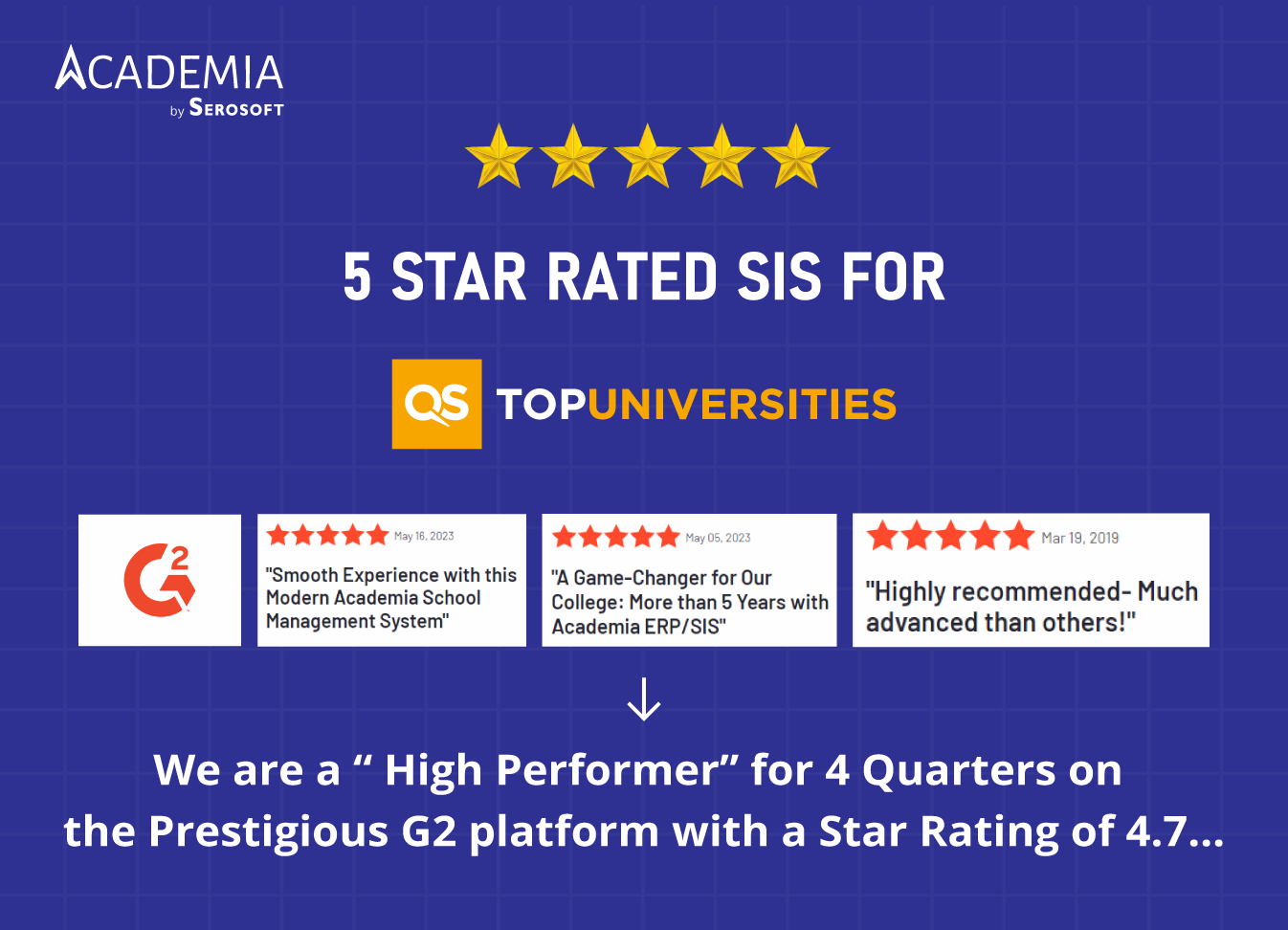
Thanks to the persistent faith and endorsement of our patrons, Academia ERP has scaled new heights in performance and customer satisfaction. Our users’ testimonies, expressed through exceptional reviews, a remarkable rating of 4.7 out of 5, and a collection of more than 25+ G2 badges, stand as a testament to our commitment to excellence.

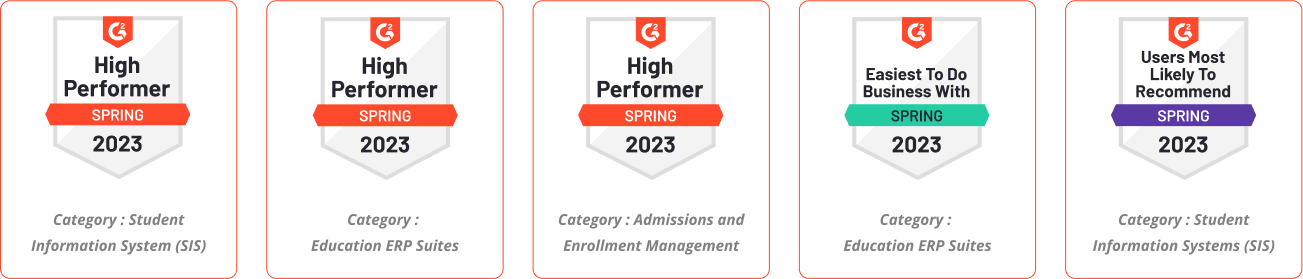
In an unbroken record of quality, Academia ERP has earned the prestigious “High Performer Badge” for four consecutive quarters (2022-2023). This underlines our unwavering focus on providing unparalleled service and user experience. The summer of 2023 brought us further cause for celebration with 19 additional badges to our ever-growing collection:

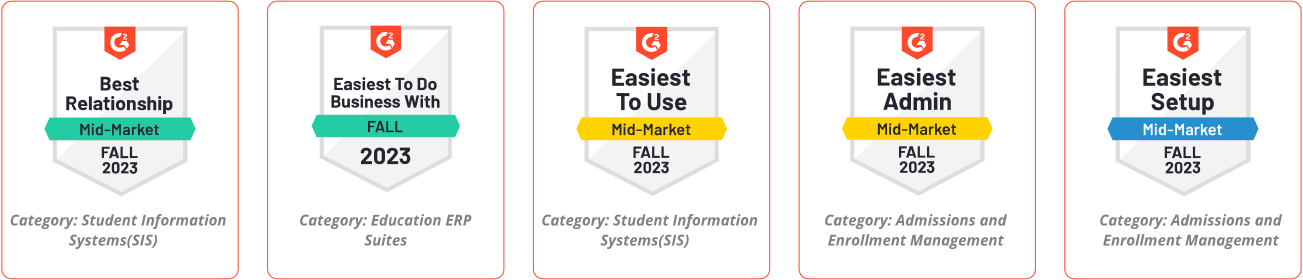
  • The Student Information Systems (SIS) Category awarded us 8 badges, recognizing our Best Usability, Best Relationship, Easiest Admin, Easiest to Use, Leader, Users Most Likely To Recommend, and High Performer features.
  • In the Education ERP Suites Category, Academia ERP was adorned with 4 badges, signifying us as a High Performer, Leader, Best Relationship holder, and the Easiest To Do Business with.
  • The Admissions and Enrollment Management Category bestowed upon us 5 badges for Easiest Setup, Easiest Admin, High Performer, High Performer Mid-Market, and Best Meets Requirements.
  • Finally, the School Management Category honored us with 2 badges, Best Support, and High Performer badges.

At the heart of Academia ERP is our customer-first approach. We strive to embed this ethos in every initiative, every upgrade, and every interaction with our users. The G2 badges we have earned over time are symbols of our users’ satisfaction and reflect our unyielding dedication to providing an unparalleled experience.

Few of our earned badges in the last quarters:

Academia ERP Triumphs with G2 Spring 2023 Badges!


Academia Earned G2 Spring 2023 Badges


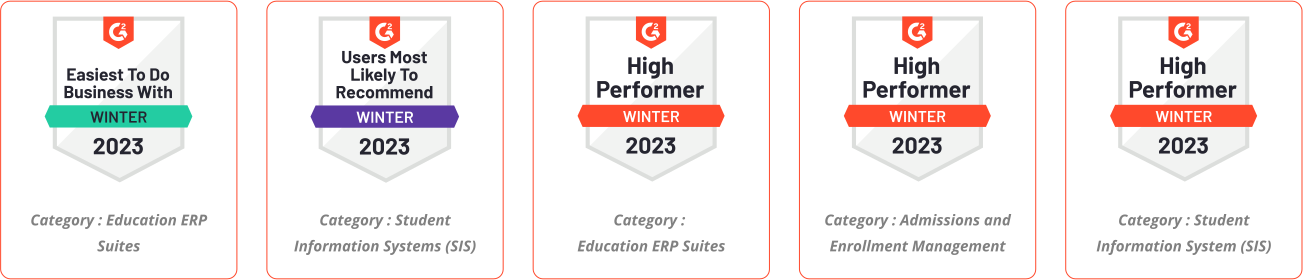
#1 Rated “Users Most Likely To Recommend” Education ERP
Academia ERP has been awarded three new badges in Winter 2023 by G2.


G2 Badges 2023 Academia ERP


We wish to extend our heartfelt gratitude to all our users who have been a part of our incredible journey so far. We remain committed to innovating, improving, and rising to every challenge that comes our way. Here’s to a future filled with more accomplishments and shared success.

Users Love Academia ERP on G2 – A User-Centric Revolution in Education ERP Solutions

Academia ERP has emerged as a leading provider of comprehensive education ERP solutions, revolutionizing the way educational institutions manage their administrative tasks and empower their students and staff. With a strong focus on user-centricity, Academia ERP has garnered rave reviews and accolades on G2, a renowned software review platform. Let’s delve into why users are falling in love with Academia ERP and why it stands out from the competition.

We are thrilled to showcase the impressive rating of 4.5 and an array of badges earned by Academia ERP on G2. These badges are a testament to our commitment to excellence and the satisfaction of our users. From “High Performer” to “Users Love Us,” these badges validate the exceptional value Academia ERP brings to educational institutions worldwide.

Glowing Reviews from Our Valued Users:

Our users have spoken, and their reviews speak volumes about the impact Academia ERP has on their institutions.

“Academia ERP Is agile and customizable and very user-friendly. The project team is always willing to listen to our concerns and review the system/processes accordingly” 

Marc C, Acting Deputy Principal, False Bay TVET College -, Public college in Cape Town, South Africa

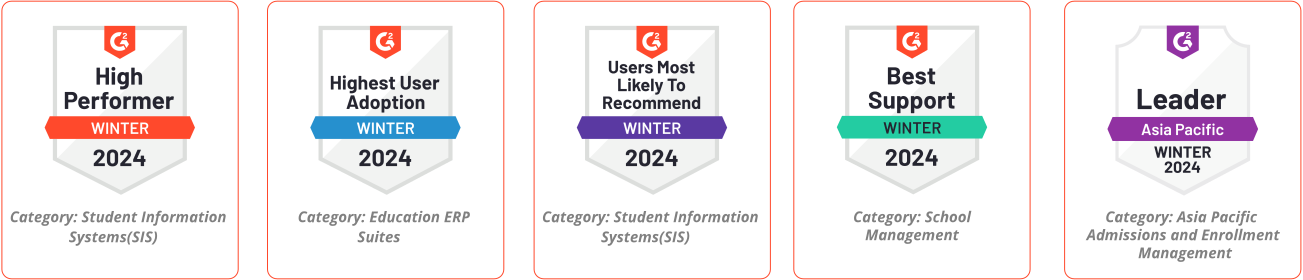
Winter 2024: It Snowed 26 G2 Badges!

Fall 2023 G2 Badges: Earning Your Trust in Service & Performance

Academia ERP Triumphs with G2 Spring 2023 Badges!


#1 Rated “Users Most Likely To Recommend” Education ERP

We are excited to share that Academia ERP has been awarded three new badges in Winter 2023 by G2.


G2 Badges 2023 Academia ERP

Academia ERP’s Latest Accomplishment: Triumphs with 19 #G2SummerBadges2023

Secured the prestigious ‘High Performer Badge’ from G2, consistently for four consecutive quarters.


Related Posts :

Ultimate Guide to NIRF Rankings: Leveraging the Power of Academia ERP for Academic Excellence

Education Institutions in India strive to maintain their competitive edge and showcase their academic prowess. One significant measure of an institution’s performance and quality is the National Institutional Ranking Framework (NIRF) rankings. NIRF ranking provides a comprehensive evaluation of higher education institutions in India, encompassing various aspects such as teaching, learning resources, research, graduation outcomes, outreach, and inclusivity. In this blog post, we will explore everything one needs to know about NIRF rankings, like eligibility criteria, ranking parameters, and ways to excel them. We will also explore how Academia ERP can be your best companion in navigating the path to successful NIRF rankings and academic excellence.

Registration & Eligibility

The National Institutional Ranking Framework (NIRF) was approved by the Ministry of Human Resource Development (MHRD) and launched by the Honourable Minister of Human Resource Development on 29th September 2015. This framework outlines a methodology to rank institutions across India. The Institutes are ranked in two categories:

  • Common overall rank and 
  • Discipline-specific rank like in the field of engineering, Management, etc.

To participate in the NIRF rankings, an institution must fulfill certain eligibility criteria and should first be registered. Registration is a pre-requisite for institutions desirous of getting themselves ranked on the parameters defined by NIRF. Only the following institutes can register for overall NIRF rankings:

  1. Institutions will be eligible for ranking consideration only if they have successfully graduated at least three cohorts of students in certain programs. If none of the programs an institution offers meet this requirement, the institution will not be permitted to register for ranking.
  2. Open Universities and Affiliating Universities, whether approved or funded by the State or Centre, are generally excluded from the ranking process. However, if these universities possess their own teaching or research campus, they are welcome to participate by providing data exclusively related to their physical campuses. Information regarding their role as open or affiliating universities cannot be included in the submitted data.
  3. To be eligible, institutions must either have a minimum total of 1000 enrolled students (based on approved intake) or be centrally funded institutions/universities of the Government of India with a highly focused institute that concentrates on a single discipline and has limited student intake.
  4. Lastly, the institution must offer both undergraduate (UG) and postgraduate (PG) courses.

Discipline-specific rankings are published solely for those fields in which a substantial number of institutions voluntarily participate in the ranking process. The selection of institutions for these rankings includes prominent establishments within the respective discipline, based on their satisfactory ranking scores. The ultimate determination of the rankings within a specific discipline is made by NIRF, which carefully evaluates the provided data. Once registered you have to perform on the following parameters to achieve good ranks in your respective category or overall whichever is suitable, let’s explore the same in detail.

Ranking Parameters: 

Teaching, Learning & Resources (TLR)

The Teaching, Learning & Resources (TLR) component holds a significant 30% weightage in NIRF rankings. It comprises several sub-parameters, each carrying a specific weightage, and follows the following formulae for calculation:

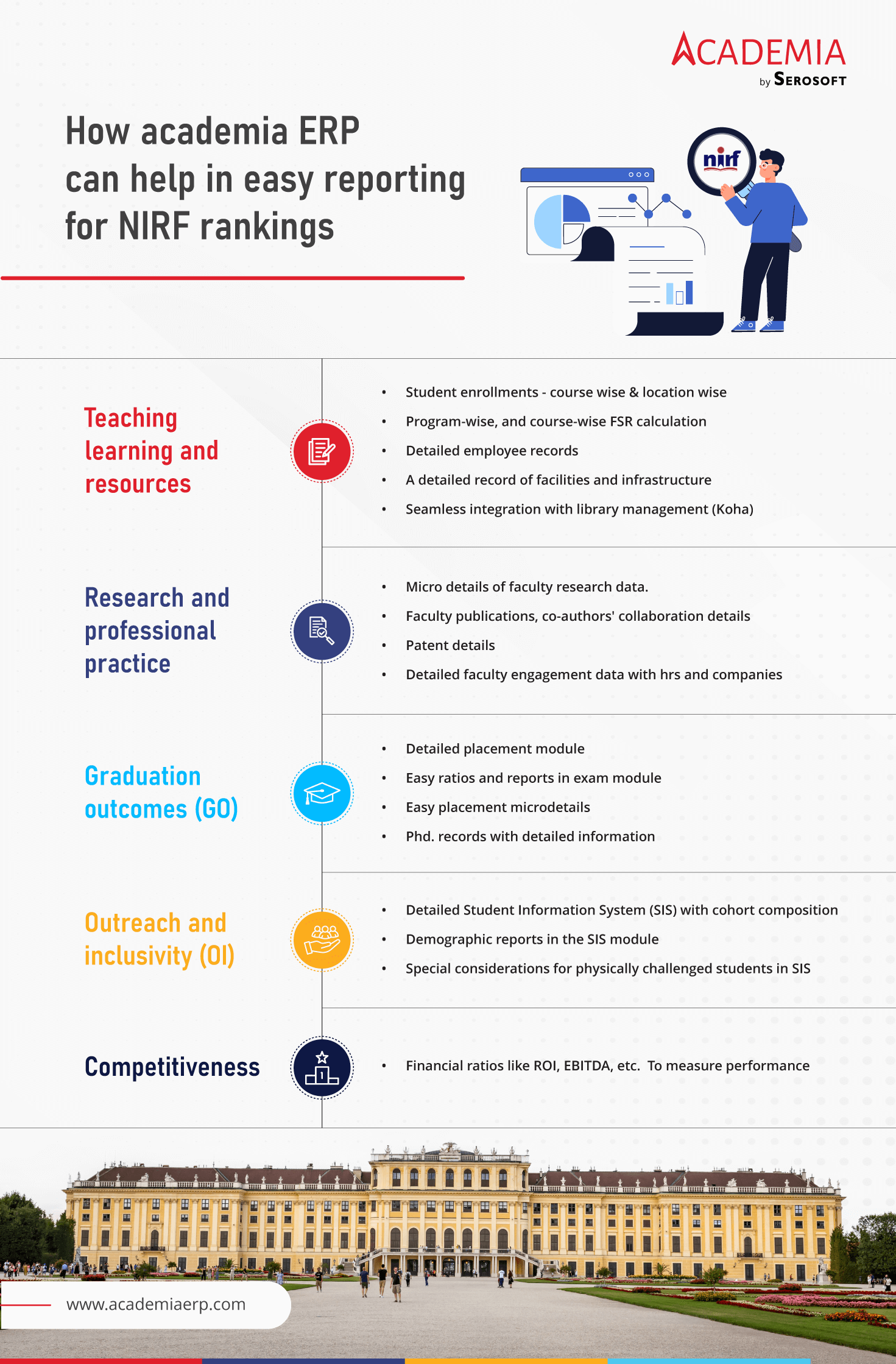
  1. Student Strength including Doctoral Students (SS): This parameter evaluates the total number of students enrolled in the institution, including both undergraduate and postgraduate programs,  NIRF also takes into account the presence of doctoral students, reflecting the institution’s focus on research and advanced studies. This is already an inbuilt report in Academia ERP reflecting the total number of student enrollments in different courses and academy locations.
  2. Faculty-Student Ratio with emphasis on permanent faculty (FSR): The FSR parameter measures the number of faculty members in proportion to the student population. Institutions with a higher number of permanent faculty members tend to score better in this category. AcademiaERP can calculate FSR program-wise, and course-wise and can easily assist in reporting on this parameter.
  3. The combined metric for Faculty with Ph.D. (or equivalent) and Experience (FQE): FQE considers the educational qualifications and experience of the faculty members. Institutions with highly qualified and experienced faculty are awarded higher scores. AcademiaERP effectively maintains the complete records including qualifications details of faculty members under the employee profile section and thus makes this segment reporting a cakewalk.
  4. Financial Resources and their Utilization (FRU): FRU evaluates the financial strength and efficient utilization of resources by the institution. It assesses factors such as infrastructure, library facilities, and investment in research and development. Academia provides a detailed record of facilities and infrastructure in terms of rooms, equipment, and also library management integration with KOHA.

Research and Professional Practice (RP)

The RP component focuses on the research output and professional practice of the institution, contributing to its overall ranking, it has a weightage of 30 percent in the NIRF rank calculation.


  1. The combined metric for Publications (PU): PU measures the number of research publications produced by faculty members. Institutions with a higher number of quality research papers are recognized for their contribution to knowledge dissemination. This data can be easily reported by Academia ERP via employee profile- research details, we manage the entire research info of each and every faculty member with micro details like the number of publications, references received, grants, start and end time, resources, making the reporting of this comprehensive parameter as easy as a few clicks.
  2. The combined metric for Quality of Publications (QP): While PU reflects the quantity, QP emphasizes the quality of research publications. Parameters such as citation impact and international collaborations play a vital role in determining the QP score. As mentioned that Academia ERP will have detailed faculty records in terms of research, we can easily report where the papers were published, who were the co-authors, and what was done in collaboration with which entities.
  3. IPR and Patents: Published and Granted (IPR): This parameter acknowledges the institution’s efforts in innovation and intellectual property rights. The number of patents filed, published, and granted are considered an indicator of the institution’s research capabilities. AcademiaERP could be the go-to solution for any requirement related to employees’ research details and we have special arrangements for recording Patents applied and granted too.
  4. The Footprint of Projects and Professional Practice (FPPP): FPPP evaluates the institution’s engagement in various projects and its involvement with industries and professional bodies. Collaborative projects and consultancy services contribute to a higher score in this category. AcademiaERP has inbuilt features that reflect the entire details of faculty’s engagements in terms of – Training, seminars, both corporate & industrial no. of hours taken or attended, etc. Hence reporting on this parameter could be very smooth for you.

Graduation Outcomes (GO)

The GO component gauges the employability and success of students after completing their education in the institution.This collective parameter has a weightage of 20 percent in the complete ranking process.

  1. The combined metric for Placement, Higher Studies, and Entrepreneurship (GPHE): GPHE evaluates the percentage of students who secure placements, pursue higher studies, or venture into entrepreneurship. Institutions with excellent graduate outcomes receive higher scores in this parameter. Academia ERP has an entire module that is dedicated to the placement, we have features reflecting all the details reflecting integrities of the placement scenario of the college.
  2. Metric for University Examinations (GUE): GUE considers the performance of students in university examinations. The pass percentage and average scores play a crucial role in determining the GUE score. Academia ERP offers a dedicated and comprehensive Examination module and this ratio can be easily evaluated and a report can be generated handy.
  3. Median Salary (GMS): GMS reflects the median salary earned by graduates from the institution. Higher salaries indicate the employability and value of the institution’s education. As mentioned earlier, the Placement module of Academia ERP can seamlessly produce this information as we maintain the record of all placement microdetails.
  4. Metric for Graduating Students Admitted into Top Universities (GTOP): GTOP recognizes the number of students admitted to top universities for further studies. Institutions with a significant number of students pursuing higher education in prestigious institutions receive higher scores. Academia ERP has an alumni record feature that can facilitate this requirement when needed.
  5. Metric for Number of Ph.D. Students Graduated (GPHD): GPHD measures the institution’s contribution to doctoral education. The number of Ph.D. students who successfully complete their programs indicates the institution’s research and academic capabilities. Academia ERP offers a Ph.D. section where the complete features exist related to thesis management, under the examination module. We can smoothly curate this data from the same.

Outreach and Inclusivity (OI)

The OI component evaluates the institution’s efforts in promoting diversity, inclusivity, and social responsibility. NIRF rankings give a 10 percent weightage to these parameters in the calculation of the ranks.

  1. Percentage of Students from Other States/Countries (Region Diversity RD): RD recognizes institutions that attract students from different states or countries, promoting cultural diversity and the exchange of ideas.
  2. We can see the composition of the cohort through Academia ERP’s world-class Student Information System – it has a section of the demographic report which readily reflects this report. As mentioned in the screenshot below.
  3. Percentage of Women (Women Diversity WD): WD acknowledges institutions that create an inclusive environment and provide equal opportunities for women in education. In Academia ERP’s Student Information system, the demographics reports can reflect this parameter in just one click.
  4. Economically and Socially Challenged Students (ESCS): ESCS considers the percentage of students from economically and socially disadvantaged backgrounds. Institutions that prioritize inclusivity and bridge educational gaps receive higher scores. Academia’s SIS- reports can give details about special-abled students and students coming from socially backward sections, and scholarship students to readily provide the data for this report.
  5. Facilities for Physically Challenged Students (PCS): PCS assesses the infrastructure and facilities provided by the institution to support physically challenged students. Institutions that ensure accessibility and inclusivity receive higher scores. Academia ERP provides special considerations for physically challenged students like allotting only ground floor rooms to them etc.


NIRF


Peer Perception

The Peer Perception component captures the opinions and feedback from various stakeholders regarding the institution’s academic reputation.

  1. Peer Perception: Employers and Research Investors (PREMP): PREMP measures the perception of employers and research investors regarding the institution’s graduates and research capabilities. Positive feedback indicates the institution’s industry relevance and employability.
  2. Peer Perception: Academic Peers (PRACD): PRACD reflects the perception of academic peers regarding the institution’s academic and research standards. Esteemed opinions from fellow academicians enhance the institution’s reputation. Academia ERP provides seamless integration with lime service to share feedback forms from peers and hence this data could be very handy too with us.

Public Perception 

The Public Perception component evaluates the institution’s image and visibility among the general public. This category of the parameter has 10% weightage.

  1. Public Perception (PRPUB) – PRPUB measures the general public’s perception of the institution, considering factors such as public awareness, reputation, and brand value. Positive perception contributes to a higher score in this category.

Competitiveness

The Competitiveness component compares an institution’s performance with other participating institutions in the NIRF rankings.

  1. Competitiveness (PRCMP): PRCMP evaluates an institution’s performance relative to other institutions. It considers the institution’s ranking position, improvement over time, and competition in the higher education landscape. Academia ERP can provide the details for the Financial year with ratios like  ROI, EBITDA, etc to measure your performance contributing to easy reporting.

Integrating NIRF Parameters with Academia ERP

As institutions strive to enhance their NIRF rankings, they can leverage the capabilities of Academia ERP software to streamline and simplify the reporting process. Academia ERP offers comprehensive modules that cover various aspects of an institution’s functioning, including student information, faculty management, research publications, alumni data, and infrastructure management.

By integrating NIRF parameters within the ERP system, institutions can easily collect, collate, and analyze data required for reporting. The software can generate customized reports that align with the specific requirements of NIRF rankings, saving time and effort for institutions. Furthermore, Academia ERP enables institutions to track and monitor their performance in real-time, identify areas for improvement, and implement strategic measures to enhance their scores in different NIRF parameters.


Conclusion

NIRF rankings provide a holistic evaluation of higher education institutions, encompassing teaching, research, graduation outcomes, outreach, and perception. Institutions aspiring to improve their rankings can leverage the power of Academia ERP to streamline their data collection, reporting, and analysis processes. Academia not only offers all this but has the potential to offer much more as we customize at many levels as per the Institute’s requirements. By focusing on the different parameters and using technology to their advantage, institutions can unlock excellence, foster continuous improvement, and establish their position among the top-ranking institutions in India’s educational landscape.

Back to top