
Type your keyword below

Student Delight – Success Mantra for an Educational Institution

University, School, College, or Training Institute includes thousands of students, multiple campuses, and programs as their main stakeholders. Along with all these, parents, the secondary clients, who may not be affected directly but are a useful asset to spread positive word of mouth. Like every other company, an educational institution would also want their clients to feel delighted and a good brand name to be established in the community. 

Students are considered the biggest stakeholders of any educational institution and in today’s times, institutions must opt for digital transformation that can help strive day to day needs. 

It is high time to decipher the old manual interventions. We can start by finding what a student wants. His needs and wants can be – Good quality of education and exposure, smooth transition and flow of all processes during the complete student life cycle, and finally a good job offer

Automation and streamlining of all the processes with the respect to students can address this concern. A student information system can be the best solution to it. Let’s discuss how it can help educational institutions in the best way. 

A Student Information System can ease out student life cycle in the following ways:

  • Easy Teaching and Learning 

In modern times, students only want to focus on their education instead of getting engaged in other administrative and academic activities. A student information system can help them with inefficient learning, providing an easier version of study from faculty and other modes. Easy accessibility to study material anywhere and anytime using the portal or mobile application. 

  • Simple Process for Assignment Management 

Assignments also play an important role in any student’s progress, and it becomes quite difficult to manage the completely hectic process of approval, submission, and a lot of others in manual intervention. A highly configured SIS makes the whole assignment process easy and convenient. It provides faculty with a lot of different assignments to students and it even helps students to submit the assignments on the given deadline. The best part is notifying students and faculty members of the due dates. 

  • Flexible Attendance Process 

Attendance tracking is also one of the major elements in any educational institution which becomes a bit difficult and lengthy to analyze in a manual process. A Student Information System provides systematic attendance management with biometric integration and a system through which attendance tracking is easy for faculty members, students, and even parents. 

  • Quick Fee and Payment processing 

The fee and payment process is one of the most important methods of any institution, there are multiple fee structures, various departments, and n-numbers of students; it becomes difficult to manage it manually. It’s an art to keep track of everything and be able to access the exact details whenever there is a need. A student information system helps in managing each fee-related transaction and manages all the tasks effectively and efficiently making it a simple, convenient, and easy process. It avails e-payments from their portals, quick, and easy.  

  • Easy result Generation and announcement 

Students always get anxious on their result declaration day, it even becomes difficult when they need to stand in a long queue to check their results. An SIS having the best examination management system provides the completion of all the examination-related tasks from hall ticket distribution to result in declaration using the portal and message notifications. 

  • Grievance Management 

There are multitudes of tasks associated with different stakeholders like faculty, staff, admin, and students. There are various situations in which students find something dissatisfied with the given studies, and academic and administrative tasks. So institutions must adopt technologies like SIS like Grievance Management System that can help students submit their grievances, complaints, dissatisfaction, feedback, and any other related query. 

  • Administration Management

An education institution involves various administrative tasks like a library, hostel, transport, and many more. Manual intervention of these tasks takes huge time, long queues, long involvement, and more. Automation of these tasks through a Student Information System provides a systematic flow of information providing all the information accessible through a single system to faculty, students, parents, and higher authorities. 

  • Placements

Placement is the only term that students worry about the most, they always want a university or institution that can help them in finding a job and getting perfectly placed there. A Student Information System helps educational institutions and students apply and find a job. 

  • Upcoming Events Information

Students always find it difficult to remember the time, dates, and initial details for any event. Notifications on the notice board and regular manual circulation are not enough to keep the exact information in the brain. It eases it out, a student information system helps educational institutions by providing easy notifications to students as and when needed through the mobile application and the portal easing out all the things for modern students.  

Conclusion 

So which method are you ever using to delight your students? A Student Information System can become a perfect choice for your institution that not only will delight your students but also become a success mantra bringing more systematic, efficient, and effective management to the institution. Want to know more? Let’s discuss it now! Just Request Demo and one of our experts will get back to you in a while.  

How To Choose The Right Training Management System For Your Institute

Training institutes in the past decade have been noticed to be evolving with a greater pace. These institutes have also become more streamlined along with time. Management of training institutions is also as important as school management or university management.

There are many advanced automation software packages that help in management of training institution from prospecting of student to completion along with record maintenance of employees, batches, students, etc. Processes such as enquiries, ad campaigns, applications, admin management etc. can also be managed with such type of software.

Academia ERP is one of the more evolved training management system that helps simplify and automate any training institute’s functions. It helps in streamlining various day to day functions which are too time consuming and clerical in nature, but with Academia these can be managed in an efficient manner. Software packages like Academia TMS are also capable to automate much of the tedious process, like report generation which helps in better decision making and affects overall productivity.

How to choose a right ERP solution for management of your Training Institute:

1. Know the requirements of your institution:

It is fore most important to know& understand the need of the institute which depends on the no. of students, no. of batches, fee structure, departments and other specifications if any required. This could help to sort the 1st level Training Management System (TMS) for your institution.

2. Selection Process:

Once your requirements are listed, according to that you can research the market and create list of TMS packages for your institute. There must be plenty software packages that may fit in the criteria.

3. Carefully sort the option and short list these accordingly:

From all the options available, it may not be necessary that all suit your requirement, features, reports and other needs. On the basis of aforesaid mentioned shortlist, the software and take them to further level. Once these are shortlisted it can be sent to the top management for better assessment.

4. Close evaluation by the top management:

Demonstrations of the shortlisted Training Management Software can be taken by the top-level management and further decisions can be taken based on multiple factors, for example the UI, the flow of the processes, interface and customization etc.

5. Undergo Review of the Software:

Once every other little detail has been identified and managed, the last thing to assess is the review of the software chosen. Get to know about the support, the teams offer to its past clients, the service and software ratings etc. if everything matches your expectation you can finally freeze your decision on the considered TMS.

6. Implementation:

The final step is to understand the process and timeline of the implementation process if it suits you or not.


Role of an ERP in Making Educational Institutions Future-Ready

The challenges faced by modern-day institutes are very different from the challenges faced by the education institute a decade ago. The world never shut down as it did 3 years ago and COVID-19 put the education sector in a challenging position to continue its duties of providing knowledge and skills to the world. 

This led to a rise of education technologies and institutes no matter the size and type of adopted the specific technologies built for the education industry. Gradually but eventually, the education sector understood the importance of going tech-borne. They got a chance to explore technology to combat their long-existing issues and challenges and how they can be future-ready. 

Today, they are reinventing themselves with technology and are using software to automate their academic and administrative operations to focus on their core responsibilities. They are using data to take student-centric decisions. They are reducing their dependency on human resources and the list of the wonders goes on and on. 

Role of ERP in making education institutes future-ready

  • Improved accessibility 

Data is the fuel on which every industry is thriving. Simply put, you can see a massive difference in your staff productivity just by improving the accessibility of data. Using insights they can take faster decisions for improved student experience and higher retention. It provides ease in operations and improves interdepartmental functioning while reducing dependency on human resources. 

  • Adopting varied teaching methods

Programs and course management are one of the most difficult tasks. Especially, if you are using a variety of different teaching and learning methods. Using an ERP solution would help you in mapping the objectives and outcomes of the teaching methodology to improve lesson planning, timetable management, resource allocation, examination, student performance tracking, and syllabus tracking. 

Using ERP helps you manage programs and courses better and other entailing operations to ensure a better learning experience for students and ease of teaching for your academic staff. So, if you are thinking about implementing Student-centered Learning, Outcome-based Education, Choice-based Credit System, Personalized Learning, or any other modern education approach, go for education ERP. 

  • Student Lifecycle Management

Systematic academic and administrative management through traditional methods was a time-consuming and laborious process. But with software solutions, you can do it much more efficiently. 

Enterprise Resource Planning Solutions for education institutes help you increase transparency in operations and improve decisioning by providing you with data-backed insights. It also helps you in managing student records electronically and provides you with access to information anytime and anywhere. 

The data is updated in real-time and is centralized to be accessed as per admin-defined access authorization for optimal usage. This reduces the chances of errors, chaos, and confusion leading to improved student lifecycle management. 

  • Unrestricted growth

If you are considering expansion then technology is a must. Most institutes that run their operations traditionally fail to replicate the quality of education and services to parents and students in the academies that are far from their central administration office locations. 

A lot of cases emerge of ignorance and lack of accountability, effecting the reputation of the institute. But modern education ERP offer multi-premise institute management where a central administration team can manage, monitor and administer the operations and processes of all the academies in different locations from a single dashboard. 

This gives you more control over the quality and ensures a greater transparency in operations. This also reports reporting at all levels. 

  • Improved ROI

ROI is probably the biggest metric for any industry to understand the profitability of an institute. With modern education ERP, you can reduce the operational cost of an institute by several times and improve profitability through better management.

Reduced manual intervention, paperless operations, increased enrollment rate, improved resource planning and management and so much more, the list of things that can contribute to a higher ROI is huge. 

How can Academia ERP make your institution future-ready?

Academia ERP is a leading education ERP. It is helping more than 320+ institutions across 22 countries in the world. It includes all the modules that can trigger automation in extreme ways. It includes a robust portal and mobile application that helps all the stakeholders to manage their tasks and operations from anywhere and anytime. With all these, it has a rich analytical system that records and analyzes a huge amount of data with 24/7 assistance from the team for educational institutions. 

More than 400+ institutions are future-ready and are on the path to achieving growth day by day along with technological advancements with us.  Are you ready to be counted in? If yes, reach out to us today, and one of our experts from the team will coordinate with you for further assistance. 

Why is an ERP required for a 21st Century Institution?

In this modern age where everything has been boomed up too much, so is the education. Today, everyone wants to aim for higher education and seek to be a part of the biggest educational centre. This has increased the number of education gainers to an incredibly bigger number. There are millions of education centres across the globe. Educationalists not only hold a single institution but there are various chain of institutions which impart excellent education. Hence, managing the institutions has become a tough row to hoe than before giving rise to the need of ERP in this sector.

ERP has become the first choice of the modern educational institutes due to many reasons. They want campus management software which can help them to focus more on education and taking away all the other administration and student related tasks from them. Today, with increasing number of students, subjects, educational accessories and teachers, it becomes next to impossible for education centres to manually handle them efficiently. Thus, it becomes necessarily important for institutions to incorporate ERP system which can adequately take care of these task.

Also, the present age generation focuses on the automation. They need everything done digitally, and so is the education. Parents today, look for an educational institute which is fully automated. They believe in imparting education to their wards through smart classes. They want a system where they can deposit the fees online, check for the result online, contact the teachers online and even keep a watch on their child online. In short, they require a system which can be handled with ease. So, in order to attract the parents and be the part of the race, educational centres must possess ERP system.

ERP systems have various benefits over tradition management systems:

1. Increases efficiency through:

  • Faster information flow
  • Responsive decision making
  • Reduced errors
  • Minimal duplication of work

2. Improved Quality of Interaction among Stakeholders:

  • Student-Teacher
  • Student-Institute
  • Intra Institute-Teacher Administrators
  • Institute-Parents

3. Substantial Savings Leading to High ROI:

  • Manpower
  • Time

Looking at the above benefits, we can clearly indicate that ERP systems are surely the present day need. They not only increase the efficiency of the institution but also provides a clear relationship between the students, parents and the institution. And not only this, automated system has become the brand building material for educational institutes. So, be ahead of the competition and implement India’s best ERP system, Academia in your institute now.

Academia is India’s No.1 Campus Management Software from Serosoft which enables comprehensive, innovative and integrated process automation of core processes and functions of an educational enterprise.

ERP Solutions with Cloud Servers

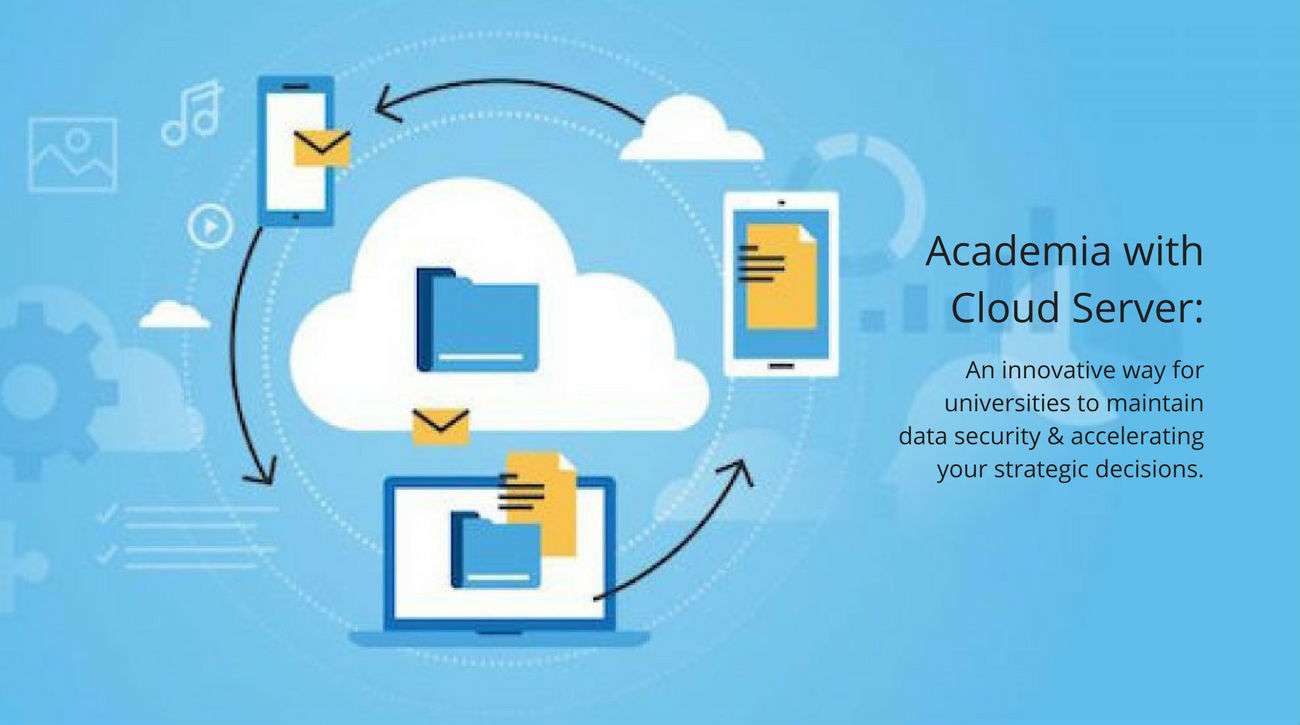
Cloud ERP systems are advanced enterprise resource planning software that run on a vendor’s cloud platform as opposed to being hosted to an on-premise network. Organizations can access cloud-hosted applications over a browser using any device. 

Since cloud ERP is gaining huge popularity, it is time that education leaders and authorities learn more about the efficiency of cloud-based ERP solutions. And make better decisions, depending on their needs and available resources, between on-premise or a cloud-based education ERP solution. 

Cloud-hosted Education ERP software

One of the biggest differences between on-premise and cloud-based solutions is in the access to applications. Since cloud-based software is hosted on the vendor’s cloud, an organization has to access the app over the internet. Hence making internet connection a very important key in the organization’s functioning. But this is a benefit in disguise. You see, since the apps are managed and maintained by the vendor, cloud-based apps have very few downsides and maintenance costs. These are two of the biggest disadvantages experienced by organizations using on-premise solutions. 

Cost Comparison

On-premises software are either bought or leased by organizations. The package includes enterprise-grade servers, networking, and storage to physically run and house the software and associated data for the functioning of the software. 

Organizations are required to pay an additional cost for maintenance, troubleshooting, supplementary software, updates, and customizations. Antivirus and security software and storage & server backups make up a hefty overhead expense. 

Since cloud-based ERP solutions are managed by the vendor, they are liable for application maintenance, data storage, underlying operations, servers, physical data center infrastructure, and installing security updates and feature upgrades. 

Hence, although an on-premise solution appears to be an economically viable solution at first, the hidden charges and overhead expenses make it a very expensive solution. This makes cloud-based ERP solutions a better option functionally and economically. 

Benefits of choosing Cloud ERP software

Added benefits of choosing Cloud ERP Software are:

  1. No upfront infrastructure and operating costs
  2. Faster implementation with ready-to-use software
  3. Access the applications over web browsers using any device and from any location
  4. Easily scalable and supports your needs throughout the business lifecycle
  5. Highly configurable software makes it easy to make quick customizations to the functioning of the software without the need for IT support
  6. Regular upgrades in the software allow you to access modern technology and stay up-to-date with technology.

Wrapping Up

Cloud-based education ERP is the need of the time. They are highly secure and scalable. Plus, if you are thinking about reducing the operational cost in your institute there cannot be a better option. 

Learn more about Academia ERP, a cloud-based education ERP software with 30+ modules to manage and monitor your business. Connect with our education ERP experts today. 

Back to top