Type your keyword below

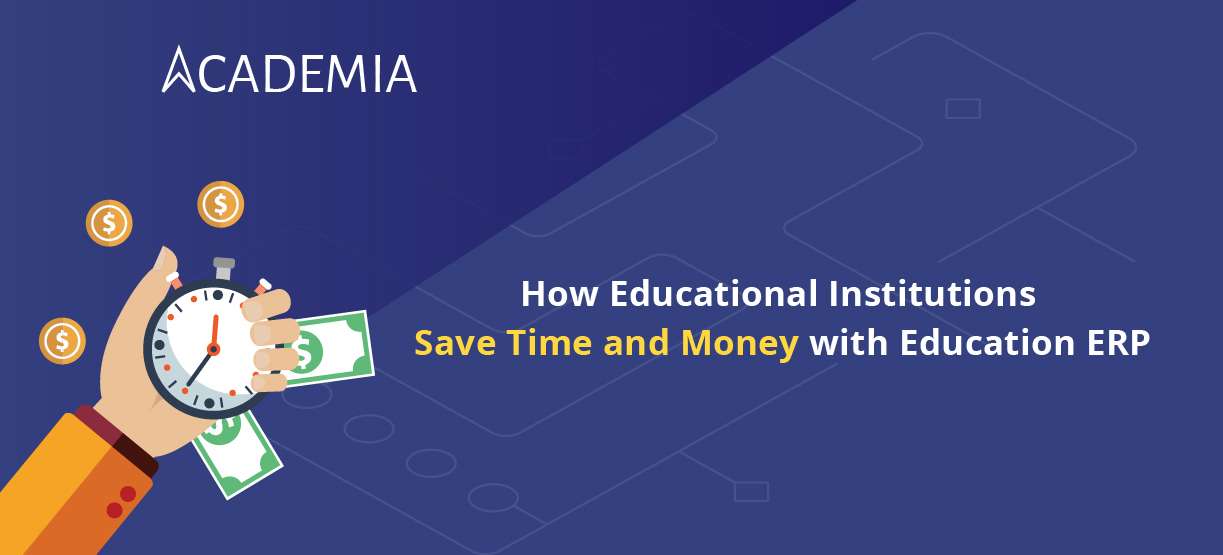
How Educational Institutions Save Time and Money with Automation

An age that swears by ambition and competition, the 21st century has also offered us varied tools to ensure that the fight is fierce! The digital revolution (also known as the 3rd Industrial Revolution ) is helping us make the best use of time & money in creating a better as well as a faster world. In the last 4 to 5 years, it has significantly penetrated the education industry too. Various EdTech solutions such as the Student Information System, Learning Management System, etc are playing an important role in efficiently managing the campus administration.

The main reason for this software becoming a favorite of the education industry is that they help in effective resource management to subsequently ensure student success.

Education ERP: An intelligent way of managing your institute

Here are the 5 ways automation can help in saving time and money:

Prompt Decision Making

If you are heading an institution or a particular department, decision-making is certainly a part of your daily calendar. It takes a huge amount of time to go through stacks of files that have data and references for you to arrive at a conclusion.

What if you can access all these details at the touch of a button without having to go through the pile for papers? Wouldn’t it’ll save you precious time?

 

Education ERP gives you the power to access all the details whenever you want. Student records (class-wise, course wise, year wise), employee records, ongoing courses and much more. It provides neat reports that help you in the quick analysis, which ultimately results in faster decision making.

Reduced stationery costs

According to an article on Edutopia, around $25,000/year is spent on paper alone by a school with a capacity of 100 teachers in the US. Not to forget other costs including printing and stationery.  

The education industry relies heavily on paper and stationery. While it can’t end it completely, it can definitely be minimized. With Education ERP such as Academia SIS, institutes can save up to 22% in printing and mailing costs. Being a cloud-based system, you can share documents with students, parents, and teachers on their portal or email address to save paper costs. Hard copies are redundant as all the data is securely saved on the cloud. This is an effective way to save a lot more than you can imagine.

Recommended reading: Technology in schools: What are the opportunities and challenges?

Reduction in academic reporting time

Education ERP has an integrated excel sheet tool, with this you can upload and download all the data, anytime you want. It saves your time in manual inputs to make academic reports. All data entered can be converted into excel sheets as and when needed.

For example, if you are running a campaign for admission, you can track enquiry, create data sheets in real-time and share them with other staff members. Not just this, you can also check the expense reports, target achieved and so on.

Faster turnaround time

When you are able to make decisions faster and save time in mundane administrative tasks the turnaround time of management processes is automatically shorter, helping you do more with less.

Digital transformation with ERP reduces paperwork, streamlines processes and makes work simpler that in turn speeds up the overall management. The information flow becomes smooth, transparent and it keeps everyone from multiple departments in the loop that aids in faster and more efficient task performance. Moreover, it also minimizes errors and removes data duplicity to get rid of rework in the process.

Automation resulting in High ROI

The primary focus of an educational institution is to offer quality education with world-class management, however, the quality and credibility of an institution do not depend only upon its faculty, but also its capital. 

Recommended reading: How a Student Information System Can Ease Your Pain

For any organization, the return on investment is a crucial factor to run any institution. It depicts the success of the entity. The education industry spends millions of dollars on quality education. 

An efficient solution to control and manage your capital is with the digital transformation of your institute. Using technology for your day to day tasks can seem expensive in the beginning, but in the long run, it helps in achieving high ROI.

Know more about how ERP System can help in ROI

Are you a smart educator who wants to use technology to save time and money in management? Try a free demo now!

Image source: freepik.com

5 Mistakes Institutions Are Doing While Choosing Education ERP

When it comes to choosing an Education ERP solution for an institution, decision-makers and administration do multiple mistakes. It is assumed that educators are the decision-maker when selecting an EdTech for an institute, but it’s not like that. Upper management, administration, and educators all are responsible to make a decision for any advancement in their institution.

As they are representative of the institute they are supposed to make effective decisions and set an example for their followers. But it is not always the case. After analyzing various decision-makers of institutes, we realize that there are various mistakes they are making while selecting an Education Technology Solution (Software).

Below are the five such mistakes institutions are making which should be taken care of:

Ignoring the needs of the institution

There are different pain areas for different institutions. Some institutions are able to manage their fee and bill payments some are not. Some institutes provide transportation services for students and employees some do not. There are various kinds of needs for institutions and according to them, there are many EdTech solutions available in the market.

Due to competition and ignorance toward the needs of their institution, they get distracted by multiple options of technology in the market. It is the responsibility of administration and decision-makers to consult with teachers, and discuss with students about the actual need of the institution so that they can avoid waste of time and money on implementing the wrong technology.

Adopting an EdTech that they don’t comprehendInstitutions mistakes when choosing education erp software

The main purpose of implementing an EdTech in schools of higher education institutions is to increase overall efficiency in the management processes. This can be achieved if users understand what they are using.

Many times decision-makers in institutes end up buying technology that they don’t understand completely and the whole purpose of using the solution goes haywire.

Therefore, it is important for institutions they make sure that teachers, students, and other staff members understand what technology they are going to use before buying it.

Not having a proper strategy for technology usage

Technology implementation should be done with a proper plan. Users should know what could be done with the technology in hand. It is the responsibility of the administration department to make a technological model and share it with every other employee, what function is acceptable and what is not. To make the most of technology, it is important to have a strategy for technology usage.

Not preparing educators and other staff

This is the most common mistake that institutions are making while choosing EdTech solutions for their institute. Educators, students, and other management staff are the important user of any technology update in an institute. In spite of that institutes usually, ignore this fact and pre-assume that they will be able to use any technology easily. It is very important to prepare and train educators and other members before making any technological changes within an institution.

Not getting proper training

Education ERP solution providers usually offer implementation and product training. They also provide customer support later on for any query. It is the utmost priority of an institute to have thorough training on the product after the purchase and before implementation.

Without comprehensive training, there will be no output of the product. The administration department of institutes should have a team member from all other departments for the training so that the technology can be used easily and efficiently.

Bottom Line

When choosing an Education ERP for schools or higher education, it is crucial to do a proper analysis of technology, available choices, research of the market, and the status of the institution.

It is obvious to get distracted by the multiple options available and the hype of competition. The main objective should always be kept in mind that you are choosing an EdTech solution to make academic processes streamline, fast and cost-effective not complex and confusing.

Do you know the implementation of an Education ERP can help you to save up to 50% on the operating cost of your institution?

Interested to know more? Then schedule your free demo with us.

How Education Is Being Impacted In The Era Of Automation?

It is not hidden that automation is spreading multidimensionally. We are living on the cusp of automation; robots, artificial intelligence, machine learning, bionic hands, etc are not new. Of course, any advancement or new features still makes us wonder about the capability of science but we are very much aware of its existence in our world.

Why automation?

This era requires a more advanced, efficient, and skilled processing system all around. There is no place for lazy, unproductive work quality no matter what kind of work you are involved with. Business, retail, education, customer service, banking sector, cleaning, etc. everything is running towards advancement.

Time management, productivity, and efficiency have become key principles in the workforce. All these elements for better functionality are being accomplished by technological advancement i.e. Automation.

Being a part of an education domain, my concern moves toward the education sector.

What is automation in education?

NO, I am not talking about a bionic or robotic teacher to deal with students. It will take a few more years to reach there. I am talking about automation in the processing system, in management which is already here.

A study in the US higher education system by a professor at California University found that administrators grew from 3800 to 12,183 between 1974 and 2008 i.e. 221% increase while faculty grew by just 10%. You can have an idea that a huge amount of money is being spent on operational management.

The main goal of the education sector is to attract and educate more students more efficiently yet much of the spending and focus is being given to the administration department.

In this time of automation, there are technologies that ready to streamline and manage administrative tasks effectively. In spite of spending extra money, institutions can arm their staff with these technologies for efficient, productive, smooth academic processes. This would liberate resources for the activities that will directly affect the main objectives – Student and Educators.

Impact of Automation On Education

There are many levels in which automation can impact education altogether. Institutes that are updated with technology such as Education ERP, reshaping the productivity of administrative processes, increasing connectivity between students and teachers, improving the working efficiency of educators and being more creative.

On Teachers

An Education ERP such as Student Management System helps teachers to manage their work in a more integrated and aligned way. This EdTech comes with potential features: record attendance in real-time with the flexibility of time, assignment allotment, grading, and scheduling time table or session diary. These features save a lot of time that free teachers to focus on delivering knowledge which is their main purpose.

On Student

Students in the current time spectrum are more tech-savvy and they are eager to learn more and more. Students are affected most by automation. They get feedback, remark from their educators on a real-time basis, avail all the documents in one platform, upload documents without standing in a long line. With the implementation of automation, they are able to develop a better and meaningful relationship with their educators as both are saving time from tedious academic work.

On Academic Administrative Processes

If you were ever a part of an education system whether in school, higher education, or training institute, you must have a rough idea of how an education institution runs – With tonnes of academic processes. Academic administrative processes perform many back-office tasks like; keeping attendance and document records of each student from each year, maintaining new admission, resolving inquiries, managing bills, payments, payroll of employees and so on. It is the responsibility of the admin department to run things smoothly and effectively. Automation is helping to achieve the overall goal of this department. Everything can be controlled and managed with potential Education ERP software. Automation helping staff members to be more creative and innovative which will help the education institute in the long run.

On Concluding Note

Automation is making the workforce productive in various industries but there is a lot to cover in the Education Industry. As it is one of the most important areas of our social cycle, it needs to be updated with the current EdTech and ready for future possibilities. Many institutions are already availing benefits from automation. It is the responsibility of the government, influencers, decision-makers of the education industry to take a step towards empowering the education system with automation. Moreover, it is the responsibility of us to make it fully functional.

Are you ready to take responsibility to empower the education management system?

A free demo can help you to start. Schedule a free demo now!!!

Intelligent School – Transforming Education System

Smartphones, Smart TVs, Smartwatches and Intelligent schools: The demand for intelligent products is at a high level. People living in this “Intelligent” age can easily show how smart devices have dramatically improved their lives.

But is there anyone who can answer how efficient is an intelligent school system? Does an intelligent school influences the development of children? Or is it just another trick to score better than traditional schools?

Let us try and answer all your questions here so you can decide why it’s imperative to introduce smart classes in schools.

Let’s start with the million dollar question: What is an Intelligent School?

Intelligent school is a technology-based teaching-learning facility that prepares Multimedia tools such as movies, photos, audio, slides, etc. to make the learning process more effective. Unlike traditional schools, the curriculum and guidelines are not rigid, and teachers can use a variety of multimedia tools to improve their learning.

The definition of intelligent schools seems to be simple. However, the impact of introducing smart classes in schools should be considered. Most of today’s smart schools use advanced technologies to transfer the traditional school curriculum. In other words, these schools follow the traditional curriculum and only use new technologies to disseminate information. On the contrary, some educational institutions use intelligent education systems to change education processes completely and overcome the traditional education system.

Intelligent school goals – that makes a difference!

intelligent school-school-management-system Academia

Today’s goals determine the actions of tomorrow. That’s why the goals of Intelligent school are future-oriented and better aligned with the era of information and communication technology (ICT). Intelligent school system focus on the holistic development (physical, mental, emotional and psychological) of the students. It has been proven that there are no two identical persons. How can we achieve miraculous results if all students are treated equally? Intelligent schools are designed to recognize and enhance an individual’s ability to excel in the area of their choice. One of the key objectives of intelligent school systems is to promote students’ participation. In doing so, students must overcome their fears as they learn to express their opinions that prepare them for the outside world.

Intelligent School Blocks

Student Management System

To become an intelligent school, the first step is a student management system. This system automates many of your institution’s processes and allows you to focus on teaching and sharing knowledge.

Curriculum

The intelligent classroom program in schools is designed for the complete development of students. It is uniquely designed to integrate the knowledge and skills necessary for balanced and inclusive development.

Education

It gives freedom and flexibility to plan lessons unlike the traditional education system and combines learning strategies for a more effective transfer of knowledge.

Evaluation

Evaluation in an educational system is as important as the teaching-learning process. The rating in intelligent classes is continuous and integral. Accurate feedback is another important element of the evaluation in the ICT education system.

Teaching methods

Teaching methods in intelligent schools are student-centered. Teachers can use a variety of multimedia tools to develop student’s skills and talents. Teachers can even record their lessons and place them in a central network so students can consult them when needed.

After extensive discussions about Intelligent schools, it is easy to conclude that the intelligent school system is brilliant and should be introduced in schools to enable more effective student learning and development. It is true that creating intelligent schools in India is a challenge, but every step taken in this direction will make our education system and country stronger and superior!!!

Modern trends of education and technology in a sustainable future

Stemming from one of the pillars of the United Nations 2030 Agenda for Sustainable Development, quality education has taken a central stage. The agenda talks about equitable quality education that promotes lifelong learning opportunities along with inclusiveness. The overall goal is to connect the general trends affecting education in the information age. 

But why do you think sustainable development is talking so much about quality education? Shouldn’t it focus on the environment and the relationship between human development and its effect on nature? Well, after long research it was established that sustainable development cannot survive without social and cultural reforms and education plays an important role in building newer perspectives. Hence, sustainability cannot thrive without needling itself in the fabric of education. 

But to execute a change on a global scale is challenging. Education is one of the oldest industries and since digitalization has not fully penetrated into the working of education institutes it requires a major shift in the focus. As a result, the entire world is changing its policies. 

Furthermore, lifelong learning is centrally aligned with the concept. This global reform aims at being more agile in its approach. This global thought leadership has brought in trends of changes that we would like to discuss today.  

  • Information Technology 

Communication, connectivity, collaboration, transparency, and so many other things are amiss still in many educational organizations. The reason is their dependency on redundant methods of administration, management, and execution of academic activities. To counter that, education technologies are hustling to make technology and solutions cheaper. 

With a major focus on making technology user-friendly, technology partners are researching the industry to understand the digital literacy of the population in focus. Solutions for all the stakeholders in the ecosystem – Students, Faculty, Administrators, and Parents are available easily in the market. 

Edtech, digital learning, learning management systems, ERP, and other trending technologies have become an integral part of many institutes. Artificial Intelligence, Augmented Reality, Machine Learning, BigData, and Business Intelligence are being used to improve knowledge retention, student experience, student retention, and better student outcomes. Directly and indirectly, institutes are enjoying ample benefits from these technologies. 

But most of all global policymakers are aiming at digitalization because it gives them an opportunity to bring the world together and propagate the best practices for achieving sustainability goals. 

  • Change in aims and objectives

From implicit to explicit, the focus on skills has increased massively. It is not just a benefit for the students that are immediately “hire-ready” on passing their exams but it is in the interest of the world too. The more skill-based education is provided to the students along with their responsibilities to a sustainable future, the better outcomes are going to be achieved in the near future and future. 

Policymakers are ensuring professional responsibilities along with creative, strategic, and analytical thinking are taught to the students to build a better future. They want people to think of things in terms of the world, not just individual gains and losses. Promoting the participation of youngsters in achieving these goals is ensured through increased access to knowledge, availability of knowledge material in contemporary formats, and increasing collaboration and open communications through free forums and communities.

  • Education sustainability

Till now we have talked about the use of education to achieve sustainability goals. Now we should talk about educational sustainabilities. Educational ecologies are frameworks that are brought in place to promote education sustainability. It is a major shift in the current education curriculum. The ecologies provide an in-depth change in the content to improve the context of learning and align it with global goals. 

Furthermore, these ecologies are not just focused on classroom education at schools and universities, it also aims to penetrate training institutes and alternative education sources. Leaving no stone unturned, policymakers are focusing on all the prominent media and the changing infrastructure of the schools, colleges, universities, and training institutes to digital. 

Wrapping Up 

Education plays a crucial role in the lives of people. It nurtures inclusiveness and promotes shared goals that the world focuses to meet. When we talk about sustainable development, a lot of changes have to be done, not only in terms of policy and processes but also in terms of social, economic, and cultural reforms. To attain this education has changed drastically. And thus modern trends have been introduced to drive the education industry towards meeting better goals. 

Impact Of Globalization In The Indian Education Sector

Education is the backbone of any nation. It helps the population develop itself and attain skills to represent the nation in a global job market. This is a very big reason why nations around the world make large investments in the education sector. Apart from its apparent role in improving the financial status of people, education has a multi-faceted approach to transforming the lives of people. 

Indian Education System

The education ecosystem of India has come a long way from gurukuls to modern educational institutes. We can definitely say that globalization has a big role to play in it. For centuries globalization has led to the progress of the world. It has changed the way we travel, trade, migrate, spread information and cultural norms, disseminate knowledge, and more. 


Needless to say, the Indian education system we see today is an amalgamation of decades and decades of globalization. Today, the Indian education system is composed of three components — Primary education, Secondary education, and Higher education. 

In the current scenario as well, the Indian education system is changing with the impact of globalization, liberalization, and privatization. This exchange is helping it become competitive and evolve in all spheres. This includes conquering the three biggest challenges of the Indian education system — expansion, excellence, and inclusion. Also, globalization has led to a shift in focus from traditional and cultural education to more emphasis on scientific and technological education. 

Impact of Globalization on Indian Education

It is an undeniable fact that countries that were emerging from poverty and weak economic structure had a great reliance on the private sector for providing education. This has led to some degree of commercialization of the education sector, thus making it an industry. 

With this, globalization is giving way to a free market philosophy, and that too explicitly. Commercialization of the sector has led to a spike in specialized institutes offering skill-based education. In view of globalization, many universities and colleges have started to up their education offerings – beating government institutions. This did increase the interest of students to study in private institutes. However, once the institutions start self-financing, there are no breaks or government provisions available to benchmark the prices they are putting on the courses. Meanwhile, the government struggles to keep up the quality of education and make education affordable. 

In this disparity, education becomes more accessible to the top layer of society, ignoring the need to uplift the social and economic status of people from all walks of life. As the job market becomes more narrow and precise about the skills it entertains, the polarization between the elite and non-elite becomes more and more apparent. 

Growing competition for seats

Meanwhile, there are entry barriers for the non-elite in the private institutions imposed due to the price factor; the number of available elite institutes adds up to another. There are very few globally accredited or recognized institutions, and hence there is very high competition among students for each seat. This has resulted in students looking for education opportunities abroad. 

Furthermore, universities and institutions abroad see India as a great market opportunity. They are likely to bank up the long-standing issues in the education sector and want to partner with Indian universities to increase their profits. 

Other challenges 

One of the biggest problems with the education sector in India is the mindset itself. The nation seems to still work on the principle of producing workers and industrial laborers. In short, they do not focus on knowledge workers but rather are happy with their image of being service providers. For India to combat the race of globalization, they need to change its viewpoint and make some informed decisions about changing its curriculum. They must keep evolving their curriculum to match the market. 

Some of the other challenges imposed by the globalization of education are: 

  • Faculty shortage
  • Quality of education 
  • Incentive structure

Talk to our education ERP product experts

Outcome Based Education

Significance of Campus Management System in Education

Growth and expansion in the technology domain are positively impacting the education industry. It is allowing colleges to become more sensitive toward the needs of the student and increase their outreach to improve profitability. 

In this blog, we would be discussing the role of college/campus management software and why you must consider getting one for your university. 

Campus management system

Rather than seeing tech adaptation as a choice, it is important to make it mandatory. The reason is the low efficiency, and opaqueness found in the system. Education being one of the oldest sectors, it is still governed in the traditional ways, meanwhile, other industries are thriving through technological innovations. After COVID-19, the perception towards technology has changed and now more and more institutes are adapting to it. 

Campus management software is an advanced technology toolset that allows you to digitally transform your college. It allows the monitoring and management of all internal and external tasks digitally through web and mobile applications. 

This allows you to improve transparency in the operations and improve efficiency across the college. Similarly, we cannot ignore the ease it brings to the lives of students and faculty. With dedicated web and mobile applications, they can perform academic and non-academic tasks easily. 

Significance of Campus Management Software in a College

A campus management system vigorously transforms all the operations and processes in your college. The main objective of Campus ERP software is to make operations speedy and bring down operational costs significantly. 

The software is loaded with features and functionalities that bring automation and transparency to all operations, be it – admissions, attendance, examinations, resource management, fees and receipt management, or even student record management. 

Some of the most significant features of the software solution are: 

  • A centralized database of student information

This allows easy sharing of student information in academic and administrative departments to perform various operations. The efficient database gives real-time updates if there is any change in the information and boosts decision-making. 

  • User-friendly and needs the least training

Although technology is usually confused as something complicated, these advanced technology tools are highly user-friendly. The modern solutions guide a user throughout the application and communicate to them at every point with in-app notifications to uncomplicate digital operations. 

Also, AI-driven chatbots, multi-language tools, and other solutions help a user shorten the learning curve and familiarize themselves with the software faster.

  • No communication gaps

Communication gaps between parents and teachers are huge. People cannot wait for a monthly or bi-monthly meeting to know the progress of their children. With parent mobile applications and dedicated parent web portals, there can be direct and faster communication between the two stakeholders. 

Also, communication is omnichannel. Meaning, you can communicate through SMS, in-app chat options, emails, etc. 

  • Profits and higher return on investment

Besides providing you with qualitative results, the software solution is a proven solution to reduce the cost of operations. This helps you in gaining more profit and improved return on investments. 

Concluding

College ERP software is one of the best things to happen to universities. Given the challenges after COVID-19, you can easily plan for countermeasures and execute profitable strategies to revive your business in the market. 

Education Is Wisdom And Wisdom Is Required To Modernize Education

Education is one of the greatest needs of the day. An upgraded and student-friendly curriculum which is also closely connected with the practical needs of the day is indispensable for the survival of the fittest.

The scenario of education has broadened in the past few years. Now…..it is no longer confined to the four walls of the classroom or for that matter four walls of the school itself. The education has evolved from the primitive times beyond leaps and bounds. From the era of Gurukul to the current era of international schools, education has gone through different phases of revolution. When we talk in the context of India, the transformation is quite evident. We earlier had only state-boards, ICSE and CBSE boards. Gradually the idea of public schools set in. The Gurukul evolved into day cum boarding schools where students experienced overall and holistic development. Globalization entered into the education industry as well. Foreign exchange programs, the Cambridge board, and the International Baccalaureate bridged the gap that existed on account of cultural differences. Education is another term for integration, an integration of thoughts, morals, cultures, and passions thereby making the world a better place to live in.

Education Modernization through ERP

Change as they say is the law of nature and henceforth this law is equally applicable to academics and education. It is for this reason that it has changed significantly with the change in time. The idea of education is not to make the students book smart thereby enabling them to earn a living but to make them street smart thereby preparing them to fit for life.

In the thoughts of Robert Frost, “vocation and avocation must be combined”. Vocation refers to the job and avocation is the hobby. The present-day education system intends to do the same. It enables the student to identify their latent potentials and passion for which they have a flair culminating them to integrate those passions into professions, which is what we call vocational education.

Being educated and being literate are two different things, although literacy being a part of education. When one gets literate, he safeguards himself, whereas when one gets educated, he safeguards others thriving in the same society. Education is a dynamic phenomenon where stagnation must never set in if we want to evolve over time. Modernization and up gradation are two accompaniments of education without which the academics would perish.

The success of any major phenomenon is evaluated in terms of the quality of output it generates. The same happens in education too. The number of students that have been successful in their endeavors has been consistently on a rise. So many new avenues of professions have been generated. One major branch for say engineering has emerged into so many branches further and the same has happened with other professions too. This is what we call specialization and it has created a buffet of professions where one makes his own choice. This is how education has helped and fostered the young generation to make wise choices. Education is wisdom and wisdom is required to modernize education.

Why ERP Software Became a Compelling Necessity for Education System?

Obviously, it had to be. In this growing world and on the edge of the internet, automation is more of a necessity than a luxury. Its pretty much clear that imparting of education has also evolved in a matter of years, definitely for better. Ease of communication, the speed of the internet, and automation provided by ERP have been a big part of this. Let’s discuss further over it that how these essentials elements are helping create a difference in the world and specifically in education sector all over the world.

why erp-how education erp benefits-how to choose erp for your institute-best factors of ERPManagement has always been a complex task. Technology can improve institutional management to help deliver a better learning experience to students. The perfect ERP solution can simplify and improvise the process. Here are some ways in which one might benefit and a look at some of the potential challenges.

1. Centralization

One of the best factors of ERP is that it will help you create centralization of the information of overall institute or university. Access to data of overall institute at one single place brings inefficiency. Institutes have started shifting towards this kind of management systems. Education ERP software makes it possible to maintain and share all the stored data across various departments easily. Information can also be updated in real time by faculties, students, or institute staff members, and can be accessed from anywhere. In addition to that, information can be managed more securely with an enterprise software since it allows institutes to provide controlled access to stored information person to person according to their designations. Education ERPs can also help you centralize the management of data for resources like your institute’s library, accounting etc.

2. Resource Management

Managing resources for institutes and universities is a big task to be handled which can be easily done by ERP solutions. It can allow you to track all the utilities available in the institute and therefore keep a real-time overview on it. Most institutes report that by using Educations ERPs the functionality of task gets optimizes. Not only this, but the automated generated reports give a clear and transparent view of resources and hence will help in management really well.

3. Simplified Accessibility

A common platform for all students and faculties to share assignments, task etc and submission as well. Declaration of results can also be done through this platform which helps in the ease of mobile access. It can further make tasks such as student admission, fee payment, course enrolments and registrations faster and less cumbersome. A side bonus is that by eliminating a lot of the paperwork that is involved, institutes are cutting down on mailing costs. And finally, many educational ERP software support online payments making an institution’s accounting more organized and streamlined.

However, it is difficult for institutes to transform their manual processes to complete automation but honestly, that is what is needed for an institute to succeed as of now. These ERPs are definitely a big and thoughtful investment but surely should be chosen.
Get a free demo by clicking here ERP Software Demo.

How ERP Software Streamlines Admission Process for Schools and Higher Education Institutions?

Admissions of any educational institution involve various processes that become difficult for faculties and administrators and meanwhile for the students as well who remain standing in a long queue to complete the admission requirements. 

Institutions must take a technological curve to maintain a smooth and systematic admission process, an education ERP can help in eliminating the manual interventions and making the complete systematic, simple, and error-free process bringing complete automation in the institution. 

What is an Admission Process Software?

The admission process software is a that helps educational institutions to student’s admission process easily and efficiently. It manages student admission form collection, collects documents, and shortlists student’s to complete the process online. 

There is a huge increase in the number of students taking admission in schools and higher education institutions, causing huge pressure on the academic and administrative staff. They need to manage and arrange the complete admission process manually. It also becomes difficult not to manage the process simply erasing all the errors in between, and thus it is becoming extremely necessary for educational institutions to opt for the higher education admission process and school admission software. 

An education process software helps in the automation of the complete academic and administrative structure to complete operations and functionality. The main objective of doing so is to provide support to the administration and students by accessing faster, transparent, and easy records to use whenever and wherever required. 

Challenges in the manual admission process

  • The hectic process at the administrator and staff end

The manual admission process involves various departments, documents, approvals, signatures, and a lot more. It involves a lot of pending approvals which causes delays in the admission procedure. Taking each student’s query, filling out the admission form, looking at fee submission, generating enrollment numbers and several other processes makes it a hectic process for the administrators and staff as well.

  • Chances of malfunctioning and errors

Various processes in the admission process need to be managed properly, sometimes the passing of papers from one department to another creates malfunctioning, chances of error, and cheating that directly affects the student admission and retention rates. 

  • Difficulty in managing fee operations 

The fee is considered as one of the most important segments of the educational institution and fee management gets more difficult at the time of admission as it involves various things and transactions, a single mistake in recording a fee transaction can lead to multiple errors and problems.  

  • Chaos and misunderstanding among staff

As discussed above, the admission process involves multiple tasks which in manual interventions creates chaos and misunderstanding among staff and administrators leading to a lack of interest for the institution among new faculties and students. 

How can admission process software help education institutions?

  • Automated software 

An automated ERP admission software is a system that helps in processing all the tasks simply and effectively minimizing the time of all the admission processing. There is no time barrier, school admission software provides 24/7 access to everyone that is faculty, staff, and students as per their needs. They can access any information anytime from anywhere according to their comfort, this eliminates the hectic schedule of the manual admission process. 

  • Helps in converting potential admission inquiries

The main aim of having automation and opting the independent college admission software and school admissions software is to simplify all the operations related to admission and minimizing the enrollment of new students along with retaining and qualifying deserving candidates. A good admission ERP helps institutions to provide the right insights into overall admission inquiries, how it has been progressing, and seats are confirmed.

An ERP admission software provides you with seamless automation, designed to capture maximum student data that can surely help institutions to convert potential admission inquiries effectively. 

  • Avoids hectic admission process 

As discussed above, the admission process is considered one of the most important tasks in educational institutions, it needs to be managed systematically and easily but the manual process creates a lot of chaos and confusion among staff and administrators. An automated admission process software helps educational institutions to avoid hectic schedules at each end by eliminating long queues for admissions,  making easy fee payments and transactions, an easy enrollment management process, and all other things that remain manageable easily and efficiently making a smooth, flexible, and error-free admission process. 

  • Mobile app and portal 

Mobile apps have already become an inevitable part of our lives, and therefore it plays an important role in every segment. It becomes quite easy and convenient for individuals to perform any task using a mobile app. A flexible and easy admission ERP software provides a mobile app and portal that makes the admission process complete, easy, convenient, and comfortable. The students, parents, faculty, and staff can access all the operations related to admissions, form generation, form submission, fee payments, and all other operations from anywhere and anytime. 

  • Reduces paperwork 

Till now, you may have understood that an ERP admission software focuses to direct the complete admission process to automation, it leads to complete and systematic arrangement of all the operations in one single system reducing unnecessary paperwork and documentation of all the operations leading to eco-friendly surroundings and ease of work. 

  • Provides efficiency 

An efficient ERP admission software automates all the operations in the institute focusing on fast, easy, systematic, and accurate operations that lead to growth and opportunities in every prospect.

Why choose Academia ERP software for streamlining the admission process in your School or Higher Education Institute?

So what are you thinking about having an admission process software? Isn’t it helpful? Of Course, but you must choose a very good, flexible, and robust software like Academia, that can help to streamline the admission process in your higher education institute or school providing clear and systematic admission operations in your institution. 

Wrapping up 

Hope you like this blog and get help in understanding how ERP admission software can help both colleges and K12 institutions, so what are you waiting for contact us now or simply Request Demo to streamline the complete admission process in your institution. 

Back to top