
Academia Higher-Ed Executive Roundtable in Uzbekistan | 14 October 2026 — Shaping the Future of Higher Education Together

X

Type your keyword below

University Management Systems: Scaling Institutional Excellence

What Is a University Management System — and Why Does It Matter?

Running a university today is not just an academic exercise. It is a complex operational undertaking that involves thousands of students, hundreds of staff members, multiple regulatory bodies, and an ever-growing volume of data that needs to be accurate, accessible, and actionable at any given moment.

A university management system (UMS) is the digital backbone that holds all of this together. At its core, it is an integrated software platform that manages every stage of the student lifecycle, from the moment a prospective student submits an application to the day they walk across the graduation stage and beyond into alumni engagement. It connects academic processes, administrative functions, financial operations, and compliance reporting into a single, unified ecosystem.

For institutional leaders, the value of a university management system goes far beyond administrative convenience. It is a governance tool, a strategic asset, and increasingly, a competitive differentiator. Institutions that operate on modern, integrated platforms make faster decisions, serve students better, and maintain stronger regulatory standing than those still relying on fragmented, manual processes.

The question for most campus leaders is no longer whether to adopt a UMS — it is how to choose the right one, implement it effectively, and extract maximum value from it over time.
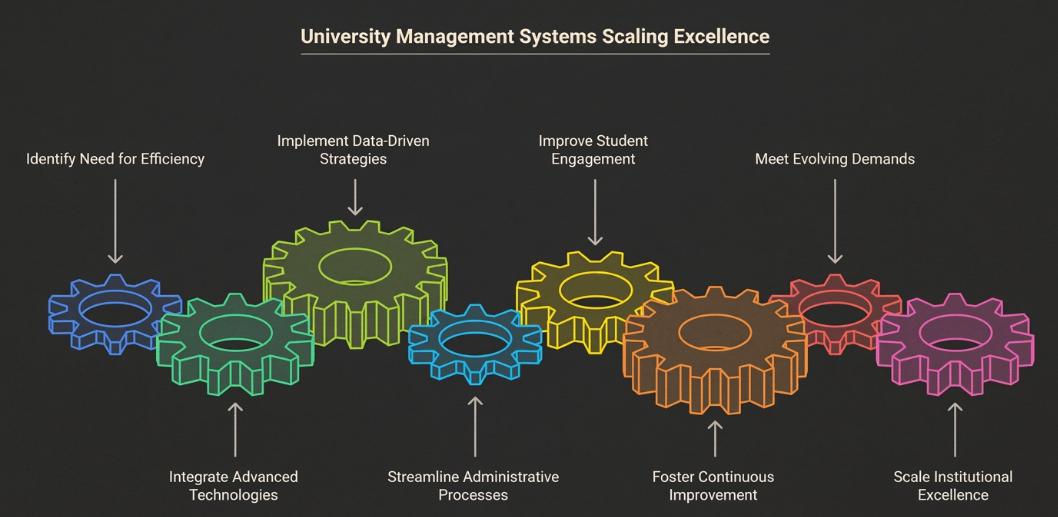
University Management System

Why Are Traditional Systems Failing Higher Education Institutions Today?

Many universities and colleges across the world, particularly in emerging markets, still operate on legacy systems that were built for a different era. Some rely on spreadsheets, disconnected databases, or partially digitised workflows that require significant manual intervention to function.

The problems with these approaches are well documented.

  • Data lives in silos. 
  • The admissions office does not have real-time visibility into financial records. 
  • The examination department operates independently of the academic registry. 
  • Student support teams cannot easily identify who is at risk because no single system connects attendance data and academic performance. 
  • Fee payment status in one view.

Reporting becomes a crisis event rather than a routine output. When regulatory bodies request institutional data, teams scramble to compile information from multiple sources, clean inconsistencies, and manually format submissions, a process that takes weeks and is prone to error.

Financial leakage goes undetected. Without integrated fee management and scholarship tracking, institutions lose revenue they cannot account for and carry liabilities they cannot easily quantify.

Students experience unnecessary friction. When simple tasks like accessing transcripts, checking results, or confirming fee balances require a physical visit to multiple offices, the student experience suffers, and so does institutional reputation.

A modern university management system resolves each of these pain points not by adding more tools, but by replacing the fragmentation with a single, coherent platform designed for how higher education actually works.

What Should a University Management System Actually Do?

Not all UMS software is created equal. When evaluating platforms, institutional leaders should look beyond feature checklists and assess whether the system can genuinely support the full scope of higher education management. Here is what a comprehensive university management system should cover:

Student Lifecycle Management: From online application and enrolment through course registration, academic progression, results processing, and graduation, the system should manage every student touchpoint without requiring parallel manual processes.

Academic Administration: Timetable generation, faculty workload management, curriculum mapping, and examination scheduling should all be handled within the platform. Automation here saves hundreds of administrative hours each semester.

Financial Management: Fee collection, scholarship disbursement, payment reconciliation, and financial reporting should be fully integrated. Mobile payment compatibility is increasingly essential, particularly across markets where mobile money is the primary transaction channel.

Regulatory Compliance and Reporting: The system should be pre-configured to meet the reporting requirements of relevant national bodies, whether that is accreditation commissions, examination councils, or vocational training authorities. Compliance should be an automatic output of daily operations, not a separate manual exercise.

Learning Management Integration: A university management system that integrates with platforms like Moodle creates a seamless academic environment where student records, course materials, assessments, and results exist within a connected ecosystem rather than parallel silos.

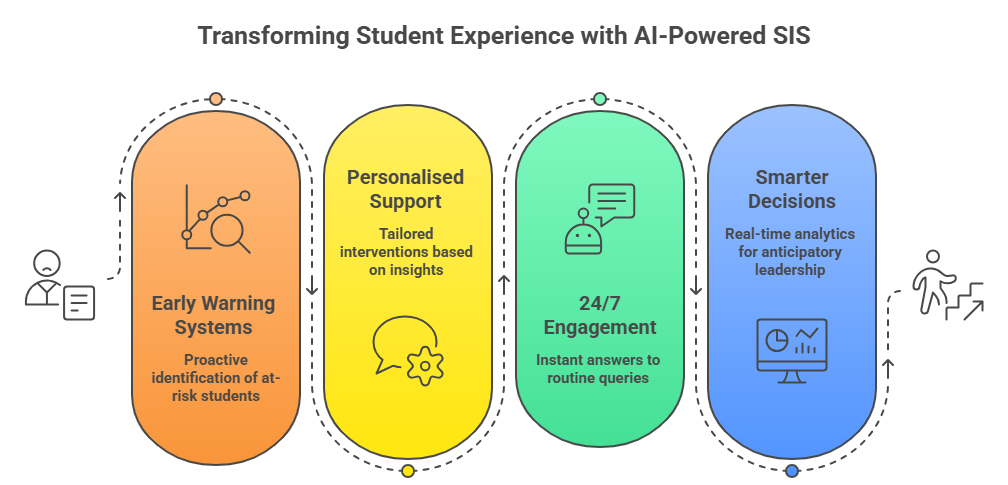
Analytics and Early Warning Systems: AI-powered dashboards that monitor student attendance, performance trends, and engagement patterns allow institutions to identify at-risk students early and intervene before disengagement becomes dropout.

Self-Service Portals: Students and faculty should be able to access what they need, results, fee statements, timetables, and leave applications, through mobile-first interfaces without requiring office visits or staff intervention.

How Does a University Management System Support Regulatory Compliance?

Compliance is one of the most pressing challenges in higher education management, particularly as regulatory frameworks become more rigorous and the penalties for non-compliance, funding cuts, accreditation suspension, and reputational damage become more consequential.

A well-implemented university management system addresses compliance at multiple levels.

At the data level, it ensures that institutional records are accurate, consistently structured, and maintained in real time. There are no end-of-semester data reconciliation exercises because the data is always current.

At the reporting level, it automates the generation of regulatory submissions. Whether an institution needs to report enrolment figures, examination results, staff credentials, or financial audits to a national body, the system produces these reports as a standard output — formatted correctly, on time, and without requiring a dedicated team to compile them manually.

At the governance level, role-based access controls ensure that sensitive institutional data is only accessible to authorised personnel. Audit trails record every action taken within the system, creating a defensible record of institutional decision-making that regulators increasingly expect to see.

For institutions operating across multiple campuses or delivering programmes through partner institutions, a university management system also provides the centralised oversight needed to maintain consistent standards and compliance across the entire network.

When Is the Right Time to Invest in UMS Software?

This is a question institutional leaders often delay answering, sometimes until a compliance failure, a financial audit finding, or a significant student experience crisis forces the issue.

In reality, the right time to invest in UMS software is before the pain becomes acute. 

There are several signals that indicate an institution has outgrown its current systems,

WHEN:

  • Compliance reporting takes weeks of manual effort rather than days — your system is already a liability.
  • Student complaints about administrative inefficiency are recurring — the gap between expectations and capability is widening.
  • Financial reconciliation is manual and leadership lacks real-time fee visibility — revenue risk is already present.
  • Faculty are spending valuable time on tasks a system should handle — you are paying premium salaries for administrative work.
  • Planning to scale without the right systems in place means building growth on an unstable foundation.

Growth and compliance pressure are the two most common catalysts for UMS investment. The institutions that time this investment well gain a significant operational and reputational advantage over those that wait.

How Does AI Change What a University Management System Can Deliver?

The integration of artificial intelligence into UMS software has fundamentally shifted what is possible in higher education management. This is not about replacing human judgment; it is about giving institutional leaders and academic staff access to insights and automation that were previously unavailable or prohibitively expensive.

Predictive Student Analytics AI-powered systems can analyse patterns across attendance records, assessment performance, financial status, and engagement data to generate early warning alerts for students who are at risk of falling behind or dropping out. This allows student support teams to intervene at the moment it matters most, rather than after the fact.

Intelligent Timetabling Generating a conflict-free timetable for a large institution, accounting for room capacity, faculty availability, student group sizes, and programme requirements, is an extraordinarily complex optimisation problem. AI-driven timetabling reduces this from a weeks-long manual exercise to an automated process that produces better outcomes in a fraction of the time.

Automated Administrative Workflows Routine processes — application screening, document verification, fee reminder communications, results notifications — can be handled through intelligent automation, freeing administrative staff to focus on higher-value work that requires human judgement and relationship management.

Conversational AI for Student Support AI chatbots integrated within the university management system can handle high volumes of routine student queries — about deadlines, results, fee balances, registration requirements — around the clock, reducing the pressure on student services teams while improving response times.

Institutional Intelligence for Leadership Live dashboards powered by AI give Vice-Chancellors, Registrars, and Deans a real-time view of institutional performance across every dimension — enrolment trends, financial health, academic outcomes, compliance status, enabling evidence-based decisions rather than intuition-based ones.

What Does Successful UMS Implementation Look Like?

The technology is only part of the story. Many UMS implementations underdeliver not because the software is inadequate, but because the implementation process does not account for the human, organisational, and contextual factors that determine whether a new system gets adopted or resisted.

Successful higher education management transformation through a UMS typically follows a structured approach:

Deep Process Mapping Before Configuration: Before any system is configured, implementation partners should conduct thorough mapping of existing institutional workflows — understanding how things actually work today, not just how they are supposed to work on paper. This prevents the common failure mode of digitising broken processes rather than improving them.

Local Regulatory Alignment: The system must be configured to reflect the specific requirements of the institution’s regulatory environment. A university in one country operates under different compliance obligations than one in another. A generic global configuration is rarely sufficient.

Phased Rollout with Clear Milestones: Attempting to replace every system at once is a high-risk strategy. Phased implementation, starting with the highest-impact modules and expanding over time, allows the institution to build confidence, identify issues early, and maintain operational continuity throughout the transition.

Internal Champion Development: Building a cadre of trained Super Users within the institution is one of the most reliable predictors of long-term adoption success. These individuals become the internal point of expertise for their colleagues, reducing dependence on external support and accelerating the embedding of new ways of working.

Ongoing Support and Continuous Improvement: The relationship with a UMS provider should not end at go-live. Responsive local support, regular system updates, and a collaborative approach to evolving the system as institutional needs change are essential to sustaining the value of the investment over time.

How Do Different Types of Institutions Benefit from a University Management System?

Higher education is not monolithic. A research-intensive university has different operational priorities than a technical college or a vocational training institution. A university management system that serves all of these contexts well must be flexible enough to accommodate significant variation in how institutions are structured and how they operate.

Universities and Degree-Awarding Institutions: For large universities, the priority is typically integration, connecting academic, financial, and administrative functions that have historically operated independently. The ability to support multiple faculties, departments, and campuses from a single platform is critical, as is robust analytics capability for institutional research and planning.

Colleges and Polytechnics: Mid-sized institutions often prioritise ease of use and cost-effectiveness alongside capability. They need UMS software that can be implemented and maintained without large dedicated IT teams, while still delivering the compliance reporting and student management functionality that regulatory bodies require.

TVET and Vocational Institutions: Technical and vocational institutions have unique requirements around competency-based progression, industry partnerships, and practical assessment tracking. A university management system serving this sector must accommodate these structures rather than forcing vocational education into frameworks designed for traditional degree programmes.

In each context, the underlying principle is the same: the system should reflect and support how the institution actually works, rather than requiring the institution to reshape itself around the system’s limitations.

Where Is Higher Education Management Heading — and What Should Institutions Prepare For?

The trajectory of higher education management is being shaped by several converging forces that institutional leaders need to understand and prepare for.

Internationalisation is accelerating. More institutions are forming partnerships with overseas universities, accepting international students, and delivering programmes across borders. A university management system must support multi-currency transactions, multilingual interfaces, and compliance with multiple national regulatory frameworks simultaneously.

Student expectations are rising. Students increasingly expect the same quality of digital experience from their university that they receive from consumer apps and services. Clunky, office-dependent administrative processes are no longer acceptable to a generation that expects immediate, mobile-accessible service.

Data governance is becoming more rigorous. As governments and regulatory bodies develop more sophisticated frameworks for institutional data governance, universities that have invested in proper UMS infrastructure will be well-positioned to comply. Those still operating on fragmented legacy systems will face increasing difficulty meeting these requirements.

AI-driven personalisation is emerging as a differentiator. The next frontier in higher education management is not just efficiency — it is personalisation at scale. Institutions that can use AI to tailor academic support, communication, and progression pathways to individual students will achieve better outcomes and stronger retention rates.

The institutions that invest in the right university management system today are not just solving today’s problems. They are building the operational foundation for a more competitive, more responsive, and more student-centred institution in the decade ahead.

Frequently Asked Questions

Q1. Can a university management system integrate with the tools our institution already uses, or will we need to replace everything?

Most modern UMS software is designed with integration in mind. Leading platforms like Academia can connect with existing learning management systems like Moodle, local payment gateways, biometric attendance hardware, and financial accounting tools through standard APIs. A reputable implementation partner will map your existing technology landscape before recommending a configuration, ensuring that existing investments are protected wherever possible and replaced only where the current tool is genuinely inadequate.

Q2. How long does a typical UMS implementation take, and how disruptive is the transition period?

Implementation timelines vary significantly depending on institutional size, the complexity of existing workflows, and the scope of modules being deployed. A focused initial rollout for a mid-sized institution can go live within three to six months. Larger, multi-campus deployments with extensive integration requirements may take twelve to eighteen months for full implementation. Disruption is manageable when the implementation follows a phased approach with parallel running during transition, strong internal communication, and adequate training before each phase goes live.

Q3. What is the typical return on investment that institutions see after implementing UMS software?

ROI from a university management system manifests in both quantifiable and qualitative forms. Quantifiable returns include reduced administrative headcount requirements, faster fee collection and reduced revenue leakage, lower examination processing costs, and reduced compliance risk exposure. Qualitative returns include improved student satisfaction scores, stronger institutional reputation, better staff morale as manual burden reduces, and more confident leadership decision-making. Institutions that implement comprehensively and adopt widely consistently report operational efficiency improvements in the range of 25 to 40 percent within the first two years.

Q4. How do we ensure that staff actually adopt the new system rather than reverting to old habits?

Adoption is a change management challenge as much as a training challenge. The most effective approaches combine structured training with internal Super User programmes, visible leadership endorsement of the new system, a clear transition timeline after which old processes are formally retired, and accessible ongoing support for staff who encounter difficulties. Involving key staff members in the configuration and testing phases — so they have ownership over how the system works — also significantly improves adoption rates. Systems that are genuinely easier to use than the processes they replace rarely face sustained resistance.

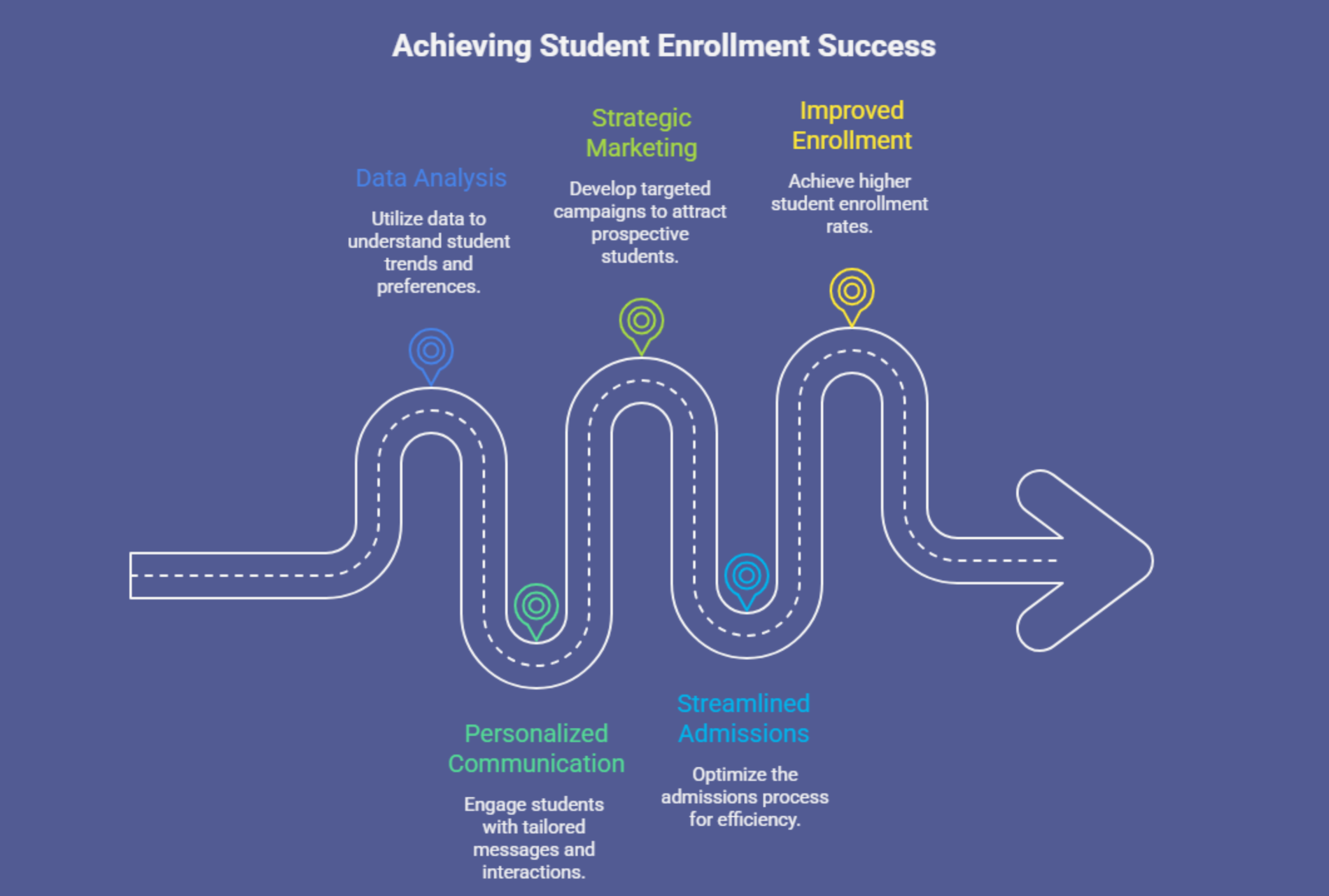
Mastering Student Admissions & Enrollment: The Ultimate Guide for Higher Ed

Student admissions and enrollment are the lifeblood of every higher education institution. They are not simply administrative processes; they are the first and most defining experience a student has with your institution. Get it right, and you convert prospects into enrolled students, and enrolled students into loyal alumni. Get it wrong, and you lose them, permanently, to a competitor who made the process easier.

This pillar page covers everything higher education leaders, enrollment managers, registrars, and admissions officers need to know: from the strategic frameworks that drive enrollment growth, to the technology, compliance requirements, and best practices that underpin a modern, high-performing admissions operation.

What Is Student Admissions & Enrollment — and Why Does the Distinction Matter?

These two terms are often used interchangeably, but they represent distinct phases of the student journey.

Admissions refers to the process of evaluating, selecting, and offering a place to a prospective student. It encompasses everything from the first marketing touchpoint, an enquiry, a campus visit, an open day, through application, evaluation, offer, and acceptance.

Enrollment (or enrolment) refers to the formal process of a student registering for courses, paying fees, completing documentation, and becoming an active, recorded member of the institution.

Understanding the difference matters because the failure points are different. Many institutions have strong admissions pipelines but poor enrollment conversion; students accept offers but never complete registration. Others have smooth enrollment processes but weak top-of-funnel admissions. Diagnosing which stage is underperforming requires treating them separately.

According to the National Student Clearinghouse Research Center, undergraduate enrollment in the US declined by over 1 million students between 2019 and 2022, before beginning a gradual recovery. The lesson: enrollment is not a passive outcome of admissions — it requires active, intentional management at every step.

Why Student Enrollment Management Has Become a Strategic Priority

For decades, enrollment was considered an administrative function. Today, it sits at the top of institutional strategy for a simple reason: it determines revenue, reputation, and survival.

Revenue dependency is stark. In most private colleges and universities, tuition fees represent 60–80% of total institutional revenue. A 5% drop in enrollment can translate into millions in lost income, enough to eliminate programmes, freeze hiring, or trigger accreditation scrutiny.

Beyond revenue, enrollment numbers feed directly into:

  • Institutional rankings — most major ranking methodologies factor in selectivity, retention, and graduation rates
  • Accreditation standing — bodies such as AACCUP, PACUCOA, ABET, and regional accreditors scrutinise enrollment trends as indicators of institutional health
  • Government funding — in many countries, public university subsidies are tied directly to enrolled student headcount and programme mix

A 2023 EAB research report found that 75% of higher education leaders cited enrollment management as their top institutional priority, above fundraising, research output, and infrastructure investment. This shift reflects a sector-wide reckoning with demographic change, competition, and the rising expectations of prospective students.

How the Modern Student Admissions Journey Has Changed

The admissions journey now looks almost unrecognisable compared to a decade ago. Three forces have fundamentally reshaped it.

1. The Digital-First Prospective Student

Today’s prospective students- predominantly Gen Z- conduct the overwhelming majority of their institution research online before making any contact. According to Google’s Education Insights report, 80% of prospective students begin their college search on a search engine, and 70% use mobile devices as their primary research tool.

This means institutions that lack a strong digital presence, fast-loading mobile portals, and responsive online application systems are invisible to a large portion of their prospective market, before the admissions process even begins.

2. The Rise of Personalisation Expectations

Students no longer accept generic communications. Research has found that 72% of prospective students expect personalised engagement from institutions, tailored content, individualised follow-up, and communications that reflect their specific academic interests and stage in the decision-making process.

Institutions that deploy personalised CRM-driven outreach consistently outperform those using mass email campaigns on every key metric: open rates, application conversion, and yield.

3. Shortened Decision Windows

Prospective students are making decisions faster and with more information than ever before. The average consideration-to-application window has compressed significantly. Institutions that fail to follow up on enquiries within 24–48 hours lose a substantial share of their prospective pipeline to competitors who respond faster.

A National Association for College Admission Counseling (NACAC) study found that institutions with same-day or next-day enquiry response protocols converted 35% more enquiries into applications than those responding within five or more days.

What Makes a High-Performing Admissions Process?

There is no single formula, but high-performing admissions operations across the world consistently share the following characteristics.

Clear, Frictionless Application Experience

Every additional step in an application form is a drop-off point. The best admissions processes are designed from the student’s perspective, minimising redundancy, enabling document uploads, saving progress, and providing real-time status updates. Institutions that have migrated to fully digital, mobile-responsive application portals report measurable improvements in completion rates.

Proactive Lead Nurturing Through CRM

Enquiry-to-application conversion is not automatic. It requires deliberate, sequenced communication: acknowledgement of enquiry, programme information, financial aid guidance, campus event invitations, and personalised follow-up from an admissions counsellor. A well-configured CRM system automates the sequencing while preserving the human touch.

Data-Driven Decision Making

High-performing admissions teams track and act on metrics at every stage of the funnel: enquiries generated, application starts, application completions, offers made, offers accepted, deposits paid, and enrolled. Without this visibility, resource allocation is guesswork.

Yield Management Strategy

Yield, the percentage of admitted students who enrol, is where many institutions lose ground. Strategies that protect yield include: early offer decisions, merit scholarship announcements, personalised admitted student events, and peer-to-peer connection programmes. Institutions with formal yield management programmes achieve 8–12% higher enrollment rates than those without.

How Admissions Technology Is Transforming Enrollment Outcomes

Technology is no longer a support tool in admissions- it is a core strategic asset. The right technology stack directly determines how many students you enrol, how efficiently, and at what cost per enrolled student.

Student Information Systems (SIS)

The SIS is the operational backbone of the entire enrollment lifecycle. A modern SIS connects admissions data, financial records, academic registration, and compliance reporting into a single, unified system. Without this integration, institutions rely on manual data transfer between disconnected systems, a source of delays, errors, and regulatory risk.

According to Gartner, institutions that deploy integrated SIS platforms reduce administrative processing time by an average of 40% and report measurably lower data error rates across enrollment records.

CRM Integration

A CRM integrated with the SIS enables admissions teams to track every prospect interaction — from first enquiry to enrolled student — in a single view. This eliminates the common problem of duplicated outreach, missed follow-ups, and lost leads caused by siloed data.

AI-Powered Predictive Analytics

The frontier of admissions technology is predictive. AI models trained on historical enrollment data can now identify, with meaningful accuracy, which enquiries are most likely to convert, which admitted students are at risk of not enrolling, and which financial aid packages are most likely to influence yield. Institutions deploying these tools are moving from reactive to proactive enrollment management.

Automated Document Verification

Document processing- transcripts, identification, financial records, eligibility certificates- is one of the highest-volume, most error-prone elements of enrollment. Automated verification systems reduce processing time from days to hours while significantly lowering the rate of compliance errors.

Where Do Institutions Most Commonly Lose Prospective Students?

Understanding dropout points in the admissions funnel is essential to improving conversion. Research consistently identifies the same five high-loss moments.

At initial enquiry: Slow or impersonal response. Prospective students who do not receive a meaningful response within 48 hours show dramatically lower conversion to application.

At application start: A confusing, lengthy, or technically problematic application form. Every extra field and every technical error reduces completion rates.

At application completion: Required documents that are hard to obtain or submit. Unclear instructions. No progress-saving capability.

At offer acceptance: Lack of financial clarity. Students who do not receive clear, early information about total cost of attendance — including scholarships and aid — are significantly more likely to accept offers from institutions that provide this information first.

At enrollment completion: Friction in the final registration, fee payment, and timetable allocation steps. Students who experience confusion or delays at this stage are at heightened risk of deferring or withdrawing entirely.

Mapping your institution’s funnel against these five points and measuring drop-off rates at each is the first step to a data-driven enrollment improvement strategy.

Why Compliance and Data Integrity Are Non-Negotiable in Enrollment

Enrollment data is not just an operational record; it is a regulatory, financial, and reputational asset.

Regulatory compliance: Accreditation bodies, government ministries, and funding agencies require accurate, auditable enrollment data. CHED in the Philippines, the UGC in India, HESA in the UK, and their counterparts globally all mandate specific enrollment reporting, and errors carry serious consequences.

Financial compliance: Enrollment data directly determines fee billing, scholarship allocation, government grant claims, and financial aid disbursement. Inaccurate enrollment records create billing errors, audit findings, and in some cases, the obligation to repay government funding.

Student privacy: Data protection legislation- including GDPR in Europe, the Philippine Data Privacy Act (Republic Act 10173), FERPA in the US, and equivalent frameworks across Asia- places strict obligations on how student enrollment data is collected, stored, processed, and shared.

Accreditation risk: Multiple accreditation bodies have placed institutions on probationary status or withdrawn accreditation entirely following findings of inadequate or inaccurate enrollment record management. The reputational damage of such findings is long-lasting and difficult to reverse.

A modern SIS with built-in compliance mapping, audit trails, and role-based data access controls is the most reliable way to protect an institution from these risks.

How to Measure Enrollment Success: The KPIs That Matter

Enrollment management without measurement is institutional guesswork. The following KPIs provide a complete picture of admissions and enrollment performance.

Enquiry-to-Application Rate: What percentage of enquiries convert to submitted applications? Benchmarks vary by institution type, but a rate below 20% typically signals problems in the nurturing or application experience.

Application-to-Offer Rate: What percentage of applications result in offers? This reflects admissions selectivity and processing efficiency.

Offer-to-Acceptance Rate: What percentage of offered students accept? This is your headline yield metric and the most sensitive indicator of your value proposition relative to competitors.

Acceptance-to-Enrollment Rate: What percentage of accepted students complete enrollment? A gap here reveals friction in the final stages of the process.

Cost Per Enrolled Student: The total admissions and marketing spend divided by the number of enrolled students. This metric reveals the efficiency of your entire enrollment operation and is a key ROI indicator for leadership.

First-Year Retention Rate: The percentage of enrolled students who return for their second year. Though technically a post-enrollment metric, it is deeply shaped by the admissions experience- students who felt misled during admissions are significantly more likely to drop out.

What Role Does Financial Aid Play in Enrollment Decisions?

Financial aid is one of the most powerful and least efficiently deployed enrollment tools available to institutions. Prospective students consistently rank cost and financial support among their top three decision factors, yet many institutions deploy financial aid reactively rather than strategically.

Merit-based aid — scholarships awarded on academic achievement, functions primarily as a yield tool. Awarding merit scholarships earlier in the admissions cycle than competitors is a proven tactic for protecting yield among high-achieving students.

Need-based aid — grants and bursaries tied to demonstrated financial need broadens access and builds institutional diversity. Institutions with generous and clearly communicated need-based aid programmes consistently report higher enrollment among first-generation and lower-income student populations.

Strategic discounting, offering tuition reductions or institutional grants to specific student segments, is increasingly common among private institutions facing enrollment pressure. The key is modelling the net tuition revenue impact carefully: aggressive discounting that fills seats but collapses net revenue is a short-term fix with long-term financial consequences.

Where Is Higher Education Admissions Heading? Key Trends for 2026 and Beyond

AI-Driven Personalisation at Scale: AI is enabling institutions to deliver genuinely personalised admissions experiences to thousands of prospective students simultaneously, personalised content, personalised financial aid modelling, personalised outreach timing- at a cost and scale that was previously impossible.

Holistic Admissions Models: Beyond grades and test scores, institutions are increasingly evaluating character, resilience, community contribution, and co-curricular achievement. This shift requires admissions processes and systems flexible enough to capture and evaluate non-standard data.

Competency-Based and Micro-Credential Pathways: As lifelong learning becomes the norm, admissions processes must accommodate non-traditional entrants, working professionals, micro-credential holders, and credit transfer students. This requires far greater flexibility in how prior learning is evaluated and recognised.

Real-Time Enrollment Analytics: Institutional leaders increasingly expect real-time enrollment dashboards, live visibility into pipeline health, conversion rates, and projected enrollment by programme, rather than periodic reports. This requires SIS platforms capable of delivering live data to leadership without manual reporting.

Chatbot and Conversational AI in Admissions: AI-powered chatbots are now handling a significant share of routine admissions enquiries, programme information, application status, and deadline reminders, freeing admissions staff for higher-value human interactions. Institutions deploying these tools report measurable improvements in response times and applicant satisfaction.

Ready to Transform Your Admissions and Enrollment Operations?

Managing the entire student lifecycle- from first enquiry to alumni- requires more than spreadsheets, siloed systems, or manual workflows. It requires a purpose-built, intelligent platform that connects every stage of admissions and enrollment into a single, unified experience.

Academia by Serosoft is a globally recognised Student Information System used by higher education institutions across Asia, Africa, and the Middle East to manage admissions, enrollment, academic records, financial aid, compliance reporting, and the complete student lifecycle — all in one platform.

If your institution is ready to eliminate administrative friction, protect enrollment revenue, and give your admissions team the tools to convert more prospects into enrolled students, a conversation with the Academia team is a practical next step.

Book a Free Demo → See how Academia handles the full admissions and enrollment lifecycle — from enquiry to enrollment and beyond.

For more resources on higher education management, student information systems, and enrollment strategy, visit www.academiaerp.com

Frequently Asked Questions

Q. How should higher education institutions handle enrollment for non-traditional students such as working professionals and transfer applicants?

Non-traditional applicants, working professionals, credit transfer students, and micro-credential holders require a fundamentally different enrollment pathway than school leavers, with flexible prior learning assessment, accelerated document verification, and part-time or modular registration options. Institutions that apply a single, rigid admissions process to all applicant types see significantly higher drop-off among this segment. Building dedicated enrollment tracks with streamlined credit recognition and flexible intake windows is increasingly a competitive differentiator, particularly as lifelong learning and workforce upskilling continue to drive adult learner enrolments globally.

Q. What is yield management in college admissions, and how does it differ from general enrollment strategy?

Yield management specifically focuses on converting admitted students into enrolled ones. Effective yield tactics include early merit scholarship announcements timed ahead of competitors, personalised admitted-student events, peer-to-peer connection programmes that reduce pre-enrolment anxiety, and proactive financial counselling for students still weighing offers. Unlike top-of-funnel marketing spend, yield management is high-ROI because the institution has already invested in recruiting these students; losing them at this stage is doubly costly.

Q. What are the risks of aggressive tuition discounting as an enrollment strategy for private colleges?

While offering institutional grants and tuition reductions can fill seats in the short term, aggressive discounting without careful financial modelling risks collapsing net tuition revenue, the actual income retained after aid is disbursed, to unsustainable levels. Private institutions have increasingly found themselves in a cycle where discount rates rise each cycle to stay competitive, while net revenue per student continues to fall, straining operating budgets and programme viability. A sound approach pairs discounting with predictive aid modelling to identify the minimum aid level needed to influence a student’s decision, rather than applying blanket reductions across an entire admitted cohort.

Q. How does a Student Information System (SIS) improve admissions and enrollment outcomes?

A modern SIS connects admissions data, financial records, academic registration, and compliance reporting into one unified platform- eliminating the manual data transfers between siloed systems that cause delays, errors, and regulatory risk. According to Gartner, institutions using integrated SIS platforms reduce administrative processing time by an average of 40% and report measurably lower data error rates. When integrated with a CRM, an SIS also enables admissions teams to track every prospect interaction from first enquiry to enrolled student in a single view, directly improving conversion and compliance.

Campus Management Systems: The Definitive Guide for Modern Universities

If you have landed here, chances are you are either evaluating a campus management system for your institution, trying to make sense of what the term actually means, or wondering whether your current setup is holding you back. Either way, you are in the right place.

This guide covers everything, what a campus management system is, why universities are prioritising it, how it works in practice, what to look for when choosing one, and where the whole space is heading. No fluff, no sales pitch. Just everything you need to know, in one place.

What Is a Campus Management System — and What Does It Actually Do?

A campus management system (CMS) is a unified software platform that connects every administrative and academic function of a university or college onto a single system. Think of it as the operational nervous system of your institution — the platform through which students are admitted, enrolled, taught, assessed, billed, supported, and eventually graduated.

When people search what is CMS in the context of higher education, they often expect a simple definition. But the honest answer is that a campus management system is less a single tool and more an ecosystem — one that replaces the patchwork of disconnected spreadsheets, siloed databases, and legacy software that most institutions have accumulated over decades.

At its core, a campus management system handles:

  • Student lifecycle management — from the first enquiry through alumni engagement
  • Academic administration — timetabling, course registration, attendance, and assessments
  • Finance and fee management — invoicing, payments, scholarships, and reconciliation
  • Faculty and HR coordination — workloads, assignments, and performance tracking
  • Compliance and accreditation reporting — audit-ready data for regulatory bodies
  • Student self-service — portals and mobile apps where students manage their own journey

The short version: if it touches a student or an administrator at your institution, a campus management system is probably involved.

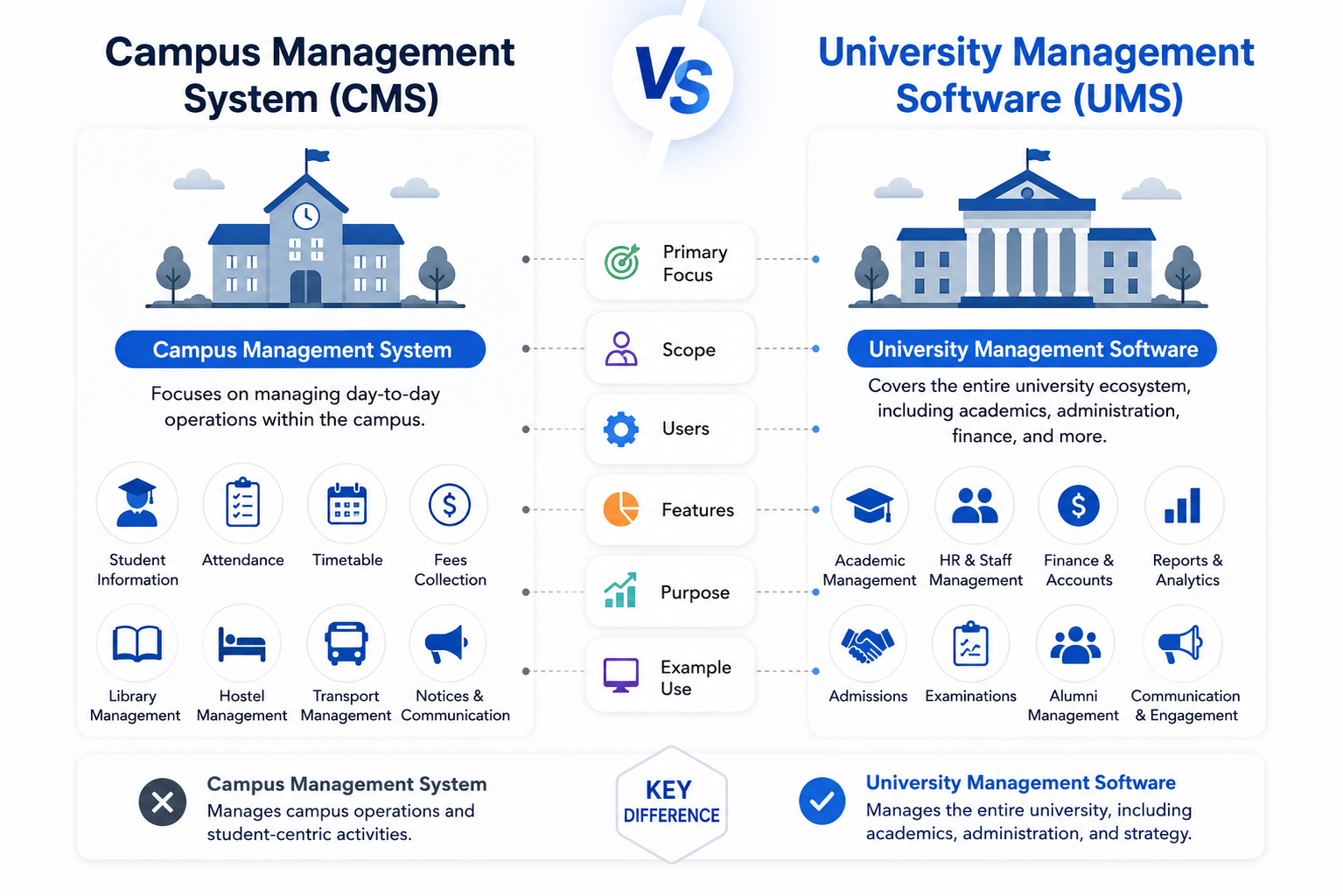
What Is the Difference Between a Campus Management System and University Management Software?


CMS Vs UMS

This comes up a lot, and the confusion is understandable. University management software is the broader umbrella — it refers to any software used to manage university operations, which could include HR platforms, finance tools, or standalone LMS platforms. A campus management system, on the other hand, is specifically designed to integrate all of these functions into one cohesive platform built around the student lifecycle.

Think of university management software as the category and a campus management system as the gold standard within it — the version where everything is connected, data flows without friction, and your team is not spending half their day copying information from one system to another.

Why Do Universities Need a Campus Management System in the First Place?

Here is the honest truth: most universities do not realise how much their current setup is costing them until they see what a properly integrated system looks like.

The typical higher education institution runs on a combination of legacy systems, purchased at different points in time, from different vendors, solving different problems — none of which were designed to talk to each other. Admissions runs on one platform. Finance on another. The library, HR, and examination systems are all separate. Data has to be manually transferred, reports have to be manually compiled, and errors are almost guaranteed.

The consequences are real and recurring:

For students, it means slow enrollment, confusing fee processes, results that take weeks, and the general feeling that the institution does not have its act together — which directly impacts satisfaction, retention, and word-of-mouth.

For administrators, it means hours spent on tasks that should take minutes: chasing documents, reconciling records across systems, and assembling compliance reports from five different spreadsheets.

For leadership, it means making strategic decisions on stale, incomplete data — because by the time the report reaches the Vice Chancellor’s desk, the numbers are already two weeks old.

A campus management system solves all three problems simultaneously, which is why adoption among forward-thinking institutions has accelerated sharply over the last five years.

How Does a Campus Management System Actually Work?

The best way to understand how a campus management system works is to follow a student through it.

A prospective student discovers your institution online and fills out an enquiry form. That enquiry is captured instantly in the CMS, which triggers an automated acknowledgement, logs the lead source, and places the student into a nurturing sequence managed by the admissions team. No lead falls through the cracks. No follow-up is missed.

The student applies. Documents are uploaded, verified, and tracked within the same platform. The admissions team reviews the application, makes an offer, and the student accepts — all within one system. The moment the offer is accepted, the student record is created once and flows automatically into the finance module for fee assignment, the academic module for course registration, and the student portal for self-service access.

Throughout the semester, faculty mark attendance digitally, upload grades, and flag students who may need academic support — all within the same platform. The finance team sees payments in real time. The timetabling module has already built the semester schedule, detected conflicts, and optimised room allocations.

At the end of the year, examination results are processed, transcripts generated, and accreditation reports compiled — automatically, from the same data that has been accumulating all year. Nothing is entered twice. Nothing is lost between systems.

That is what a functioning campus management system looks like in practice.

What Are the Core Modules Every Campus Management System Should Have?

Not all campus management systems are built equal. When evaluating university management software, these are the modules that matter — and the questions to ask about each.

Admissions and CRM Does the system manage the complete prospect journey — from enquiry through enrollment — with integrated CRM functionality, automated communications, and real-time conversion tracking? Weak admissions modules are one of the biggest revenue leakages in higher education.

Student Information and Records This is the foundation everything else is built on. Every student’s academic record — courses, grades, attendance, progression, personal data — should live here as a single source of truth. If this module is unreliable, nothing else in the system will be either.

Fee and Finance Management Can the system handle your full fee structure — multiple programmes, scholarships, instalment plans, external sponsorships, and multi-currency if needed? Does it reconcile automatically, or does your finance team still have to do it manually?

Timetabling and Scheduling Building a semester timetable manually is an exercise in organised chaos. A good CMS automates this — factoring in faculty availability, room capacity, student group sizes, and institutional constraints, then detecting conflicts before they become problems.

Examinations and Assessments From hall allocation and result entry to grade processing and transcript generation, the examination module should handle the full cycle. For institutions running outcomes-based education (OBE) frameworks, it must also map results to learning outcomes at course and programme level.

Faculty and HR Management Teaching assignments, workload tracking, research commitments, and performance data — all in one place. When this module is integrated with the rest of the CMS, leadership gains real visibility into faculty utilisation and can make evidence-based decisions on hiring and expansion.

Student Portal and Mobile App This is what your students actually see. The quality of this interface — how intuitive it is, how fast it loads, whether it works on mobile — is, for many students, their primary experience of your institution’s digital maturity. Do not underestimate it.

Accreditation and Compliance Reporting Increasingly, this is the module that separates serious platforms from the rest. Automated evidence collection, pre-built report templates aligned to regional accreditation bodies, and audit-ready documentation trails mean that compliance becomes a continuous operational output rather than a six-week crisis before every review cycle.

When Is the Right Time for a University to Invest in a Campus Management System?

Earlier than most institutions think — and almost certainly before a crisis forces the decision.

The typical trigger for a campus management system investment is a breaking point: an accreditation audit that reveals data gaps, an enrollment cycle that collapses under the weight of manual processes, or a finance reconciliation that takes three weeks and still has errors. By that point, the cost of delay has already been paid in staff burnout, reputational damage, and lost students.

The more constructive signals to watch for:

When compliance reporting is consuming disproportionate staff time. If your quality assurance team spends weeks assembling accreditation evidence that a modern system would generate in hours, your institution is subsidising inefficiency at scale.

When student complaints about administrative processes are recurring. Slow enrollment, unreliable result notifications, payment friction, and inaccessible services are symptoms — not isolated incidents. They are signals that your systems were not built for the experience today’s students expect.

When leadership cannot access reliable real-time data. If a Vice Chancellor has to wait for a manually compiled report to understand enrollment trends or financial performance, strategic decisions are being made on yesterday’s information.

When expansion is on the horizon. New campuses, new programmes, or international affiliations will expose every weakness in your existing infrastructure. Implementing a campus management system before expansion is always more efficient than doing so during it.

When your current system cannot keep up with regulatory changes. If every policy update from the Ministry or accreditation body requires a workaround, your platform has reached its ceiling.

How Do You Choose the Right Campus Management System for Your Institution?

This is where institutions most commonly go wrong — evaluating systems on features alone without considering the factors that actually determine long-term success.

Regional compliance capability. Does the platform have pre-built workflows aligned to the specific accreditation bodies relevant to your institution — whether NAAC, UGC, AICTE, ABET, NAQAAE, or regional QA frameworks? Generic compliance modules that require heavy customisation to meet local standards will create ongoing cost and risk.

True localisation — not just translation. Real localisation means support for local academic calendars, local payment gateways, tax frameworks, and regulatory reporting formats. A system built for one region and retrofitted for another rarely delivers on this dimension.

Integration openness. No campus management system operates in isolation. It must integrate cleanly with your LMS, HR systems, government reporting portals, payment gateways, and identity management systems through well-documented APIs. Ask every vendor for a detailed integration architecture — not a slide deck.

Scalability under real conditions. A platform that performs well with 3,000 students but degrades at 12,000 is not a long-term investment. Ask for performance benchmarks from institutions of comparable size and complexity.

Implementation track record. The best software delivered badly still fails. Evaluate the vendor’s implementation methodology, their experience with comparable institutions, their approach to change management and training, and the quality of post-go-live support. References matter here more than demos.

AI and analytics maturity. Leading campus management systems are now embedding AI across their functionality — predictive student risk alerts, automated scheduling, natural language reporting interfaces, and real-time dashboards. These are rapidly becoming baseline expectations rather than differentiating features.

Where Is Campus Management Technology Heading — and What Should Universities Be Preparing For?

The campus management system of 2026 looks fundamentally different from what institutions were implementing five years ago. Three shifts are defining where the space is heading.

AI is moving from a feature to a foundation. Early-alert systems that identify at-risk students weeks before they disengage, scheduling algorithms that optimise thousands of variables simultaneously, and accreditation reporting that assembles itself throughout the academic year rather than in a pre-audit scramble — these are no longer aspirational. They are operational realities at leading institutions today.

The student experience is becoming the competitive battleground. Institutions that offer seamless digital experiences — mobile-first portals, real-time notifications, self-service everything — are converting more prospective students and retaining more enrolled ones. Those that do not are losing ground to competitors who have figured this out. The campus management system is the infrastructure that makes the student experience possible.

Real-time institutional intelligence is replacing periodic reporting. Vice Chancellors and governing boards increasingly expect live enrollment dashboards, real-time financial performance visibility, and predictive analytics — not summary reports compiled two weeks after the fact. The campus management systems that deliver this level of institutional intelligence are becoming the standard against which all others are measured.

What Makes Academia by Serosoft Different in the Campus Management System Space?

Academia by Serosoft is a purpose-built campus management system trusted by 400+ institutions across Asia, Africa, and the Middle East — recognised by Gartner and awarded by the Financial Times as a high-growth company in the education technology space.

Built on a cloud-native, AI-ready architecture, Academia covers the complete student lifecycle — CRM-driven admissions, enrollment, academic management, fee processing, examinations, accreditation reporting, and alumni engagement — in a single unified platform that scales from boutique specialist colleges to multi-campus national universities without performance compromise.

Where regional compliance matters most, Academia delivers natively: pre-built reporting aligned to NAAC, UGC, AICTE, and equivalent frameworks, outcomes-based education mapping, local payment gateway integration, and bilingual interfaces across every module.

And where the future of campus management is being shaped — by AI, predictive analytics, and real-time institutional intelligence — Academia is already there.

Ready to see what a modern campus management system looks like in practice? Book a free demo at academiaerp.com — and see how institutions like yours are transforming their operations, one module at a time.

The Future of Education ERP: A Comprehensive Overview for Universities

Higher education has never been more complex to manage. Institutions today are navigating rising student expectations, tightening regulatory requirements, multi-campus operations, and the pressure to do more with fewer resources. 

The administrative backbone holding all of this together is, increasingly, an Education ERP.

But what exactly is an Education ERP? How does it differ from a generic ERP? Which campus management modules actually matter? And when does an institution know it is ready to make the shift?

This guide answers all of that comprehensively, plainly, and without the sales noise.

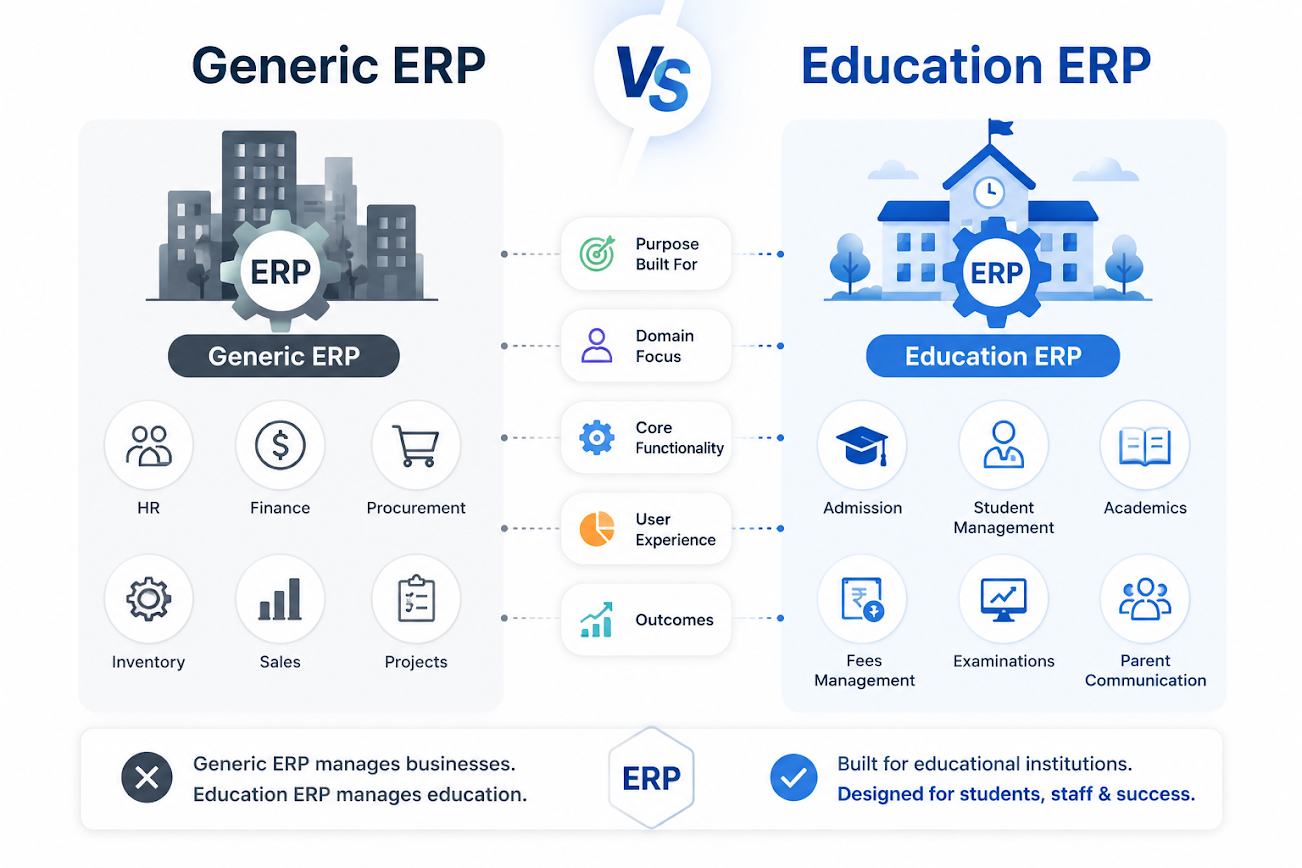
What Is an Education ERP — and How Is It Different from a Generic ERP?


Generic ERP vs Education ERP

An Education ERP (Enterprise Resource Planning system built specifically for educational institutions) is a unified software platform that connects every administrative and academic function of a university or college onto a single system. Unlike a generic ERP, designed primarily for manufacturing or retail businesses, an Education ERP is built around the rhythms, structures, and compliance requirements unique to academia.

Where a standard ERP tracks inventory and production cycles, an Education ERP tracks student lifecycles: from the moment a prospective student submits an enquiry, through admissions, enrolment, academic progression, fee management, examinations, and ultimately graduation and alumni engagement.

The distinction matters enormously in practice. A generic ERP retrofitted for education creates workarounds, patched integrations, manual reporting layers, and frustrated staff who spend more time managing the system than doing their actual jobs. 

A purpose-built Education ERP, by contrast, speaks the language of higher education natively: credit hours, learning outcomes, accreditation cycles, faculty workloads, and semester timetables.

Why Universities Are Moving Toward Integrated Education ERP Platforms

For years, universities operated through a patchwork of disconnected systems, a separate system for admissions, another for finance, another for student records, and yet another for the library or HR. Each system worked in isolation. Data lived in silos. Reports required manual compilation across multiple sources, and errors were inevitable.

The case for integrated Education ERP platforms comes down to four pressures that have converged simultaneously across the global higher education sector:

Regulatory complexity is increasing. Accreditation bodies in every region, whether NAQAAE in Egypt, OAAAQA in Oman, CAA in the UAE, NAAC in India, or regional QA frameworks across Southeast Asia, are demanding more granular, more frequent, and more auditable evidence of institutional quality. Manual compliance is no longer viable at scale.

Student expectations have shifted permanently. The generation now entering universities has grown up with seamless digital experiences. They expect to register, pay fees, access results, communicate with advisors, and manage their academic journey from a mobile device. Institutions that cannot deliver this lose prospective students to those that can.

Institutional scale is growing. Multi-campus universities, internationally affiliated institutions, and universities offering blended and online programmes cannot be managed through spreadsheets and disconnected databases. The operational complexity demands a unified platform.

Data-driven leadership is now a baseline expectation. Vice Chancellors and governing boards increasingly expect real-time dashboards, predictive analytics, and evidence-based reporting- not summary spreadsheets compiled two weeks after the fact.

An integrated Education ERP addresses all four pressures simultaneously, which is why adoption rates among higher education institutions globally have accelerated sharply over the last five years.

How Does an Education ERP Work in Practice?

At its core, an Education ERP functions as a central data repository and workflow engine. Every department, admissions, finance, academics, examinations, HR, hostel management, and library, operates within the same platform, feeding data into and drawing data from the same underlying database.

Here is how that plays out across a typical academic year:

A prospective student submits an online application. The admissions module captures the lead, tracks document submissions, triggers automated communications, and moves the application through review stages. Once admitted, the student record is created once and flows automatically into the finance module for fee assignment, the academic module for course registration, and the student portal for self-service access.

Throughout the semester, faculty mark attendance digitally, upload grades, and flag at-risk students, all within the same platform. The finance team reconciles fee payments in real time. The timetabling module has already optimised room allocations and class schedules based on faculty availability and student registrations.

At the end of the semester, examination results are processed, transcripts generated, and regulatory reports compiled, automatically from the same data that has been accumulating all year.

This is the operational reality of a functioning Education ERP. Nothing is entered twice. Nothing falls through the cracks between systems. And when a regulatory audit arrives, the evidence trail is already there.

What Are the Core Campus Management Modules in an Education ERP?

The specific campus management modules within an Education ERP will vary by vendor and institutional context, but the following represent the core functional areas that any serious platform must cover:

Admissions and CRM: This module manages the complete prospective student journey, from initial enquiry through application, document collection, offer, acceptance, and enrolment. Integrated CRM functionality enables institutions to track lead sources, automate follow-up communications, and analyse conversion rates across programmes and geographies.

Student Information and Records Management: The foundational campus management module, housing the complete academic record of every student: personal data, programme enrolment, course registrations, attendance, grades, academic standing, and progression history. This is the single source of truth that all other modules draw from.

Finance and Fee Management: Covers the full financial relationship between student and institution: fee structure configuration, invoice generation, payment processing, scholarship and sponsorship management, financial aid tracking, and reconciliation reporting. For institutions operating across multiple currencies or jurisdictions, this module must handle VAT, tax compliance, and multi-entity accounting.

Timetabling and Scheduling: Automates the extraordinarily complex task of building a semester timetable- matching faculty availability, room capacity, student group sizes, lab requirements, and institutional constraints. Conflict detection, room utilisation reporting, and real-time schedule updates are table-stakes features in a modern Education ERP.

Examinations and Assessments: Manages the end-to-end examination process: scheduling, hall allocation, result entry, grade processing, moderation workflows, and transcript generation. For institutions with outcomes-based education (OBE) frameworks, this module must also map assessment results to learning outcomes at both the course and programme levels.

Faculty and HR Management Tracks faculty workloads, teaching assignments, research commitments, and performance data. When integrated with the broader Education ERP, this module enables real-time visibility into faculty utilisation and helps leadership make evidence-based decisions about hiring and programme expansion.

Learning Management Integration: A modern Education ERP does not replace an LMS — it integrates with one. Single sign-on, grade synchronisation, attendance tracking, and content delivery should flow seamlessly between the ERP and learning platforms such as Moodle, Canvas, or Blackboard.

Accreditation and Quality Assurance Reporting: Increasingly, this is the module that differentiates serious Education ERP platforms from the rest. Automated collection of accreditation evidence, pre-built report templates aligned to regional regulatory frameworks, and audit-ready documentation trails mean that compliance becomes an ongoing operational output rather than a periodic crisis.

Student Portal and Mobile Application: The student-facing layer of the ERP- where students register for courses, view timetables, check results, pay fees, communicate with advisors, and access institutional services. The quality of this interface is, for many students, their primary experience of the institution’s digital maturity.

Alumni and Career Services: Often overlooked in early ERP implementations, this module manages the post-graduation relationship- tracking alumni employment outcomes, managing job placement services, and supporting institutional accreditation reporting that requires graduate employment data.

When Should an Institution Invest in an Education ERP?

The honest answer is: earlier than most institutions think. The typical trigger for an ERP investment is a crisis — an accreditation audit that reveals data gaps, a failed semester timetable, or a finance reconciliation that takes weeks. By that point, the cost of delay has already been paid in staff burnout, reputational risk, and missed opportunities.

There are, however, more constructive signals that indicate an institution is ready — and overdue — for an Education ERP:

When compliance reporting consumes disproportionate staff time: If your quality assurance team spends weeks assembling accreditation evidence that a modern system would generate in hours, the institution is subsidising inefficiency at scale.

When student complaints about administrative processes are recurring: Slow enrolment, unreliable result notifications, payment difficulties, and inaccessible services are symptoms of systems that were not built for the experience students now expect.

When institutional leadership cannot access reliable real-time data: If a Vice Chancellor must wait for a manually compiled report to understand enrolment trends or financial performance, the institution is making strategic decisions with stale information.

When expansion is planned: New campuses, new programmes, or internationalisation strategies will expose every weakness in existing systems. Implementing an Education ERP before expansion is always more efficient than doing so during it.

When the current system cannot accommodate regulatory changes: If every policy update from the Ministry or accreditation body requires a workaround in the existing system, the platform has reached its functional ceiling.

How to Evaluate an Education ERP: What to Look For

Choosing an Education ERP is a long-term institutional commitment. The evaluation criteria should reflect that:

Regional compliance capability. Does the platform have pre-built templates and workflows aligned to the specific accreditation bodies and ministry reporting requirements relevant to your institution? Generic compliance modules that require heavy customisation to meet local standards will create ongoing cost and risk.

Localisation depth. Beyond language translation, true localisation means support for local calendars (Hijri/Gregorian where relevant), local payment gateways, tax frameworks, and culturally appropriate user experience design. An ERP built for one region and retrofitted for another rarely delivers well on this dimension.

Scalability without performance degradation. A platform that performs well with 2,000 students but slows significantly at 10,000 is not a long-term solution. Ask vendors for performance benchmarks across institutions of different sizes.

Integration openness. No Education ERP is an island. The platform must integrate cleanly with existing institutional systems — LMS platforms, HR systems, government reporting portals, payment gateways, and identity management systems — through well-documented APIs.

AI and analytics maturity. The most capable Education ERP platforms are now embedding AI across their functionality: predictive student risk alerts, automated report generation, intelligent scheduling, and natural language query interfaces for non-technical users. These are no longer differentiating features — they are becoming baseline expectations.

Implementation methodology. The best software delivered badly still fails. Evaluate the vendor’s implementation track record in comparable institutions, their approach to change management and training, and the quality of post-implementation support.

Data residency and security. For institutions in jurisdictions with data sovereignty requirements, cloud hosting arrangements are not a technical footnote — they are a compliance obligation. Confirm where student data will be physically stored and processed.

Why Data and AI Are Reshaping What Education ERP Means

The definition of an Education ERP is expanding. Five years ago, the primary value proposition was integration- replacing silos with a unified platform. Today, the frontier is intelligence.

AI is being embedded across campus management modules in ways that are genuinely transforming institutional operations. Early-alert systems analyse attendance patterns, grade trajectories, and engagement signals to identify at-risk students weeks before they disengage — enabling proactive intervention rather than reactive support. Scheduling algorithms consider thousands of variables simultaneously to produce optimised timetables that would take human schedulers days to approximate. Natural language interfaces allow administrators to query institutional data conversationally, without requiring technical expertise.

Accreditation reporting- historically the most time-consuming administrative burden in higher education- is beginning to automate entirely. Platforms that continuously collect and organise compliance evidence throughout the academic year can generate audit-ready reports at the press of a button, rather than requiring six weeks of manual assembly before every review cycle.

The institutions that will lead their sectors over the next decade are those that treat their Education ERP not as a record-keeping utility but as an intelligence platform- one that surfaces insights, automates routine decisions, and frees human expertise for the work that genuinely requires it.

Where Does an Education ERP Fit Within a University’s Broader Digital Strategy?

An Education ERP is not a standalone technology investment- it is the operational core around which a broader digital ecosystem is built. When implemented well, it becomes the system of record that feeds every other institutional platform with reliable, consistent data.

The student portal draws from it. The finance dashboards report through it. The accreditation system pulls evidence from it. The HR system syncs faculty data with it. The LMS exchanges grades and attendance with it.

This centrality means that the choice of Education ERP is, effectively, a choice about the data architecture of the entire institution. Institutions that get this decision right — choosing a platform with genuine integration openness, genuine localisation depth, and a genuine commitment to ongoing development — find that their entire digital ecosystem becomes more capable over time.

Those who choose poorly find the opposite: a system that constrains every other technology decision and creates more integration work than it eliminates.

How Academia by Serosoft Delivers on What a Modern Education ERP Promises

Recognised by Gartner and awarded by the Financial Times as a high-growth company, Academia by Serosoft is a purpose-built Education ERP serving 400+ institutions across the globe — with deep implementation expertise across the Middle East, South Asia, and beyond.

Academia’s campus management modules cover the complete student lifecycle — from CRM-driven admissions through to alumni management — built on a cloud-native, AI-ready architecture that scales from boutique specialist colleges to multi-campus national universities without performance degradation.

Where Education ERP compliance matters most, Academia delivers natively: pre-built reporting templates aligned to regional accreditation bodies, outcomes-based education mapping tools, Hijri and Gregorian calendar support, local payment gateway integration, and bilingual Arabic-English interfaces across every module.

And where the future of Education ERP is being shaped — by AI, by predictive analytics, and by automated intelligence — Academia is already there: with intelligent student risk alerts, automated report generation, AI-assisted scheduling, and real-time institutional dashboards that give leadership the visibility they need, when they need it.

For institutions ready to move from fragmented systems to a unified, intelligent Education ERP, Academia is built precisely for that journey.

Explore Academia: www.academiaerp.com Request Demo: academiaerp.com/request-demo/ Enquiries: [email protected]

Frequently Asked Questions:

Q. How long does it typically take to implement an Education ERP, and what are the most common causes of delays?

Implementation timelines generally range from three to twelve months, depending on institutional size and modules deployed. The most common causes of delays are organisational rather than technical, incomplete data migration, unclear internal ownership, and department-level resistance to change.

Q. What is the realistic return on investment (ROI) of an Education ERP for a mid-sized university?

ROI is realised across three dimensions: staff time recovered from manual reporting, revenue protected through better enrollment conversion and accurate fee collection, and compliance costs avoided through automated accreditation evidence gathering. A mid-sized institution can typically recover the equivalent of four to eight administrative roles in productive capacity within the first two academic years, alongside reduced billing errors and faster audit preparati

Q. Should universities choose a cloud-based or on-premise Education ERP, and what factors should drive that decision?

The decision hinges on data sovereignty requirements, internal IT capacity, and long-term cost structure. Cloud-based ERPs offer lower upfront costs and remote accessibility but require confidence in the vendor’s data residency arrangements. On-premise deployments offer full data control but demand significant internal IT resources for maintenance and security. For most institutions without a mature IT department, a cloud-native ERP with documented data residency certifications is the lower-risk path.

Q. How does an Education ERP support faculty adoption, and what change management strategies actually work?

Faculty adoption is consistently the most underestimated challenge in ERP implementation, since faculty are heavy daily users of attendance, grading, and timetabling modules yet are rarely involved in procurement decisions. Strategies that work include involving faculty representatives early in system configuration, delivering role-specific training, and identifying departmental champions for peer-level support. Institutions that treat faculty onboarding as an afterthought see low adoption rates and data quality problems that undermine the ERP’s core value.

The Complete Guide to Student Information Systems (SIS) for Higher Education

Why Higher Education Institutions Can No Longer Afford to Ignore Student Data 

Higher education runs on data. Every admission, every exam, every fee transaction, every attendance record- it all needs to be captured, organised, and made useful. And yet, thousands of institutions today are still managing this through spreadsheets, disconnected tools, and manual registers.

The result? Missed fee records, duplicate student entries, delayed compliance reports, and administrative teams burning hours on tasks that should take minutes.

A student information system (SIS) is the solution. It is the single platform that brings every piece of student data together, from the day a prospect enquires, to the day an alumnus graduates, and makes it accessible, accurate, and actionable.

This guide covers everything you need to know about what a student information system is, what it does, why it matters for higher education, and how to choose the right one for your institution.

Industry Insight: 

The global student information system market was valued at USD 11.40 billion in 2024 and is projected to reach USD 29.87 billion by 2033, growing at a CAGR of 11.3% (Straits Research, 2024). This sustained growth reflects the mounting institutional urgency to replace fragmented, manual systems with unified, data-driven platforms. For higher education leaders, this is not a technology trend — it is a structural shift in how institutions are expected to operate. 

What Is a Student Information System (SIS)?

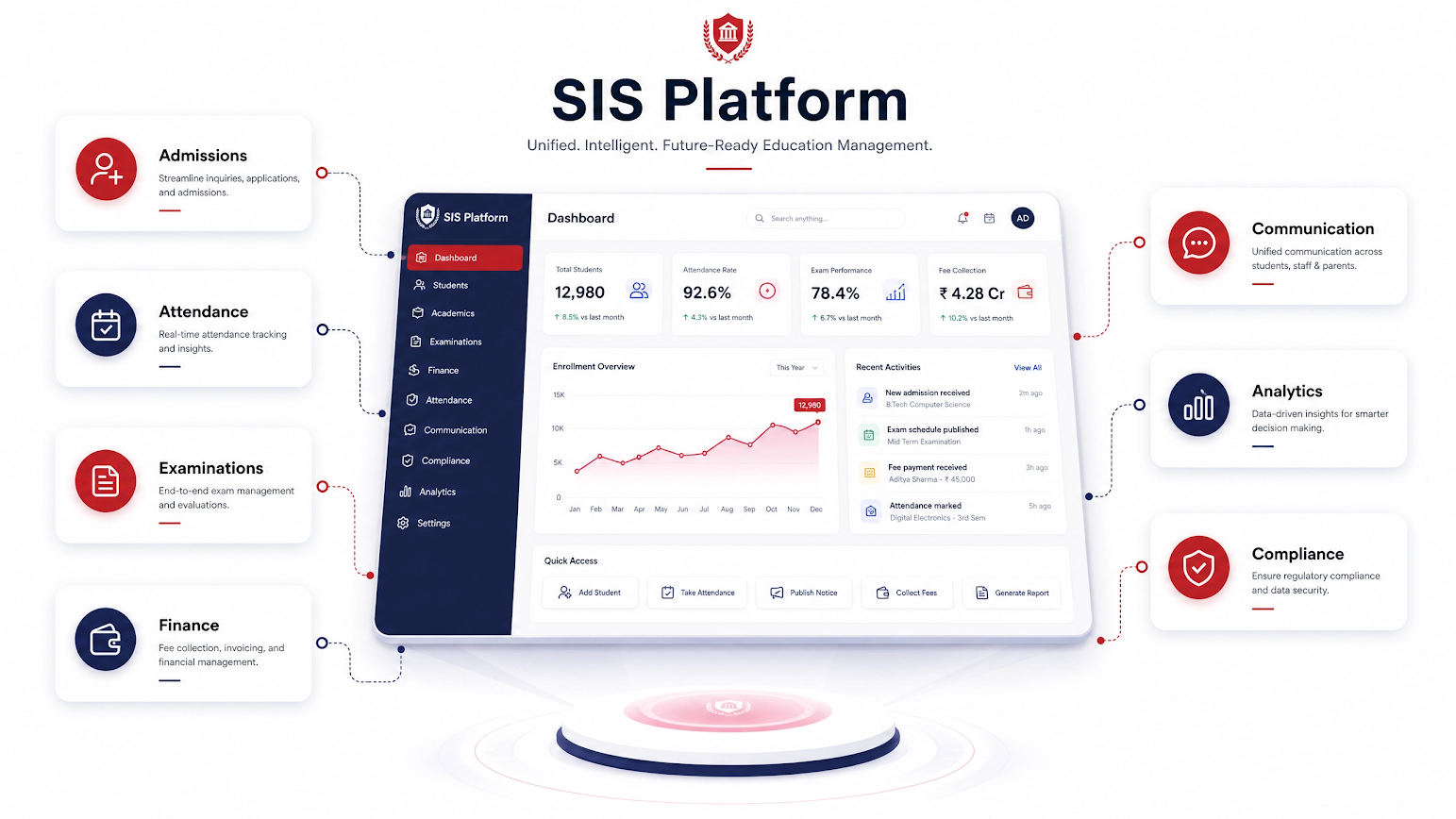
SIS

A student information system is a centralised digital platform that manages all student-related data and processes across an institution’s lifecycle. It covers admissions, enrolment, attendance, academics, examinations, fee management, communication, compliance, and more, all through a single unified interface.

Think of it as your institution’s single source of truth. When a student’s enrolment status changes, every department- admissions, finance, academics, examinations- sees the update instantly. No manual syncing. No version conflicts. No information gaps.

A student information system is not just a record-keeping tool. It is the operational backbone of a modern higher education institution.

The terms SIS software, student ERP, and student management system are often used interchangeably. While there are technical nuances, they all refer to integrated platforms that manage the full student lifecycle within a university or college environment.

How Does a Student Information System Work?

A modern SIS functions like a nervous system for your institution. Every department connects to it. Every action- enrolling a student, marking attendance, processing a fee payment- is logged in real time. And every stakeholder, from the registrar to the vice chancellor, accesses the same live data.

Here is how the core modules work together:

Admissions Management: Online applications, document uploads, merit-based shortlisting, and offer letter generation — all without a single paper form. Enquiries are tracked. Follow-ups are automated. Conversion rates are measurable.

Enrolment and Student Records: Once admitted, a student’s complete profile is created — personal details, academic history, programme details, and documents. This profile becomes the foundation for every downstream process.

Attendance Tracking: Real-time attendance marking, automated alerts when thresholds are crossed, and monthly reports per student and class — all running automatically in the background.

Fee Management: Fee structure creation, instalment scheduling, online payment collection, automated reminders, and defaulter reports. Your finance team stops chasing payments manually and starts managing by exception.

Examination and Results Management: Timetable scheduling, exam coordination, marks entry, automated marksheet generation, and performance analytics. Result processing that used to take weeks can happen in hours.

Communication Hub: SMS, email, and app-based notifications to students, parents, and staff, triggered automatically based on events or thresholds. No third-party tools required.

Compliance and Reporting: Whether you need NAAC, UGC, NEP 2020, GDPR, or regional accreditation reports, a modern SIS generates them automatically, built into the workflow, not bolted on afterwards.

Expert Perspective: 

A 2025 analysis by EdTech Digest found that legacy system integration remains one of the most significant technical challenges facing universities pursuing digital transformation. The 2024 CDW Cloud Computing Report reinforced this, revealing that 88% of higher education institutions have already migrated more than a quarter of their applications to the cloud — and nearly one in eight report that the benefits of cloud adoption have met or exceeded expectations. For institutions still running critical student operations on on-premise or disconnected systems, the competitive disadvantage is no longer theoretical. It is measurable. 

What Is SIS in Higher Education Specifically?

In higher education, a student information system carries additional complexity. Universities and colleges deal with larger student volumes, diverse programme structures, multi-campus operations, credit systems, regulatory frameworks, and research administration, all simultaneously.

What is SIS expected to handle in this context? Far more than basic record-keeping:

  • Multi-campus, multi-department data consolidation
  • Credit transfer and cross-programme enrolment management
  • Outcome-Based Education (OBE) tracking and reporting
  • Accreditation readiness across national and international frameworks
  • Integration with LMS, HR, finance, and library systems
  • Real-time executive dashboards for institutional leadership
  • Alumni tracking and engagement management

For universities operating in competitive environments, competing on enrolment, rankings, and student experience, a robust student information system is not optional. It is foundational infrastructure.

According to EDUCAUSE research, over 70% of university leaders identify legacy systems and data fragmentation as primary barriers to institutional agility.

What Are the Key Features of Modern SIS Software?

Not all SIS software is created equal. Here is what separates a genuinely modern platform from a glorified database:

  • Unified Data Architecture: All departments- admissions, academics, finance, examinations, compliance- work from one shared data model. No silos. No duplicate records. No manual reconciliation across systems.

  • Real-Time Dashboards for Leadership: Institutional leaders need live data, not last week’s reports. A modern SIS surfaces enrolment trends, student performance patterns, financial forecasts, and compliance status in real time — without anyone compiling a spreadsheet.

  • Automated Workflows: Repetitive tasks — fee reminders, attendance alerts, report generation, result processing — run automatically. This frees your administrative staff to focus on work that actually requires human judgment.

  • Student and Parent Self-Service Portals: Today’s students and parents expect digital access. A dedicated portal and mobile app lets them check results, view attendance, download fee receipts, access timetables, and communicate with the institution — without calling your admin desk.

  • Configurable Compliance Reporting: Regulatory requirements vary by country and accreditation body. A well-built SIS accommodates your specific compliance framework — generating audit-ready reports without manual data assembly.

  • Seamless Integrations: A modern SIS integrates with your existing ecosystem — LMS platforms, finance and ERP systems, HR software, biometric devices, and payment gateways — through open APIs and pre-built connectors.

  • Role-Based Access Control: Different stakeholders need different levels of access. Faculty see academic data. Finance sees fee records. Leadership sees institution-wide analytics. Role-based permissions keep data secure and governance clean.

  • AI-Powered Intelligence: The most impactful AI features in a modern SIS are not flashy announcements. They are quiet, operational improvements, early warnings for at-risk students, automated marksheet remarks, intelligent admissions triage, and predictive enrolment analytics.

Why Should Your Institution Invest in a Student Information System?

The question institutions should be asking is not whether to invest in a student information system — it is how much it is costing to keep running without one.

Here are the tangible benefits institutions report after implementing modern SIS software:

Operational Efficiency: Administrative teams spend significantly less time on data entry, report generation, and manual follow-ups. Tasks that previously took hours are reduced to minutes. Institutions using unified SIS platforms report up to 40% reduction in reporting preparation time.

Improved Fee Collection: Automated reminders, online payment options, and real-time defaulter tracking improve fee collection rates. Finance teams shift from chasing payments to managing exceptions.

Higher Student Retention: Early warning systems flag at-risk students — based on attendance patterns, assignment submissions, and academic performance — before problems escalate. One university using AI-driven analytics reduced dropout rates by 18% within a single year.

Better Parent and Student Experience: Self-service portals and mobile apps give students and parents real-time access to the information they need. Fewer inbound calls to your admin desk. Higher satisfaction scores. A genuine competitive edge during admissions season.

Compliance Readiness: Regulatory reporting goes from a weeks-long scramble to an automated output. Your institution stays audit-ready — without the administrative fatigue that typically accompanies compliance cycles.

Data-Driven Leadership: When institutional leaders have live access to enrolment trends, financial position, and academic performance, they make better decisions — faster. Delayed, disconnected reports are replaced by real-time institutional intelligence.

Scalability: A well-architected SIS grows with your institution. Whether you expand programmes, add campuses, or grow student numbers, the platform scales without requiring a system change midway.

When Does Your Institution Actually Need a New SIS?

Many institutions know their current system is not working — but delay the decision. Here are five clear signals that it is time to act:

  • Your staff spends more than two hours daily on data entry or report generation
  • Parent complaints about fee discrepancies or delayed communication are frequent
  • You cannot pull live enrolment or fee data without asking someone to compile it manually
  • Your admissions, academics, finance, and compliance teams operate on separate systems that do not talk to each other
  • Every new academic year feels like starting from scratch because data migration is a nightmare

If two or more of these sound familiar, you are already overdue. The cost of inaction, in staff hours lost, revenue missed, compliance risk, and student attrition, typically exceeds the cost of migration by a significant margin.

How Do You Choose the Right SIS Software?

The market is crowded. Here is what actually matters when evaluating SIS software for higher education:

Is it cloud-based and scalable? On-premise systems tie you to infrastructure costs, IT overhead, and manual updates. A cloud-based student information system delivers automatic updates, remote access, and secure data backup — without added cost.

How configurable is it? Your institution has its own fee structures, grading patterns, programme designs, and workflows. The platform should be configurable to your processes — not the other way around.

What does implementation look like? A great product with poor implementation support is still a problem. Ask every vendor for a clear onboarding timeline, dedicated support contacts, and evidence of successful migrations from legacy systems. The biggest SIS implementation failure point is not technology — it is adoption.

Can it integrate with your existing ecosystem? Your SIS should connect cleanly with your LMS, finance systems, HR platforms, and payment gateways. Evaluate integration depth through open APIs, not just a list of pre-built connectors.

Does it have AI built in — not bolted on? AI capabilities embedded natively into the platform — early warning systems, automated communications, predictive analytics — deliver far more value than AI added as an afterthought.

Is the vendor a partner, not just a product provider? Institutions that successfully modernise their student information system share one common factor: they chose a vendor present during implementation, who adapted the rollout to their operational needs. Look for real case studies and real client references, not just product demos.

How Is AI Changing the Role of Student Information Systems?

86% of students already use AI tools in their daily academic lives. Yet most institutions still run administrative systems that operate as if AI does not exist. The gap between student expectations and institutional capability has never been wider.

AI within a modern student information system is not about replacing people. It is about strengthening the decisions people make. Here is what embedded AI actually delivers:

  • Personal AI assistants for students — answering queries about schedules, deadlines, grades, and fees instantly, without queuing at the admin desk
  • Automated marksheet remarks — reducing faculty time during result processing by up to 70%, while providing students with tailored, actionable feedback
  • AI-driven email automation — personalised communications triggered by student behaviour; one institution reported 40% improvement in email open rates after implementation
  • Predictive at-risk identification — flagging students showing early signs of disengagement based on patterns across attendance, grades, and submission history
  • Intelligent admissions triage — routing applications, surfacing strong candidates, and automating routine follow-ups so admissions teams focus on high-value interactions
  • AI-generated institutional reports — complex analytics produced in seconds, not weeks, giving leadership timely insight for strategic decisions

Institutions that integrate AI into their SIS software gain measurable advantages in student retention, administrative efficiency, and data-driven decision-making. Those that delay are operating with a growing competitive disadvantage.

How Does Academia SIS Address All of This?

Academia is a Gartner®-recognised student information system trusted by 400+ institutions across 32 countries. Built specifically for the demands of modern higher education, from large universities managing multi-campus operations to growing institutions replacing legacy systems.

End-to-End Student Lifecycle Coverage: Academia covers every stage — from first enquiry and online application through admissions, enrolment, academics, examinations, fee management, compliance reporting, and alumni engagement. No gap in the student journey requires a separate tool.

AI Built Into the Core: AI capabilities in Academia are embedded into core workflows — automated remarks generation, intelligent email communication, early student success alerts, and AI-powered admissions automation — working in the background without manual activation.

Real-Time Leadership Intelligence: Institutional leaders get live dashboards covering enrolment trends, financial performance, academic outcomes, and compliance status — without waiting for anyone to compile a report.

Configurable for Your Institution: Academia adapts to your fee structures, grading patterns, programme designs, and regulatory requirements. Whether you operate under NEP 2020, NAAC, UGC, OFSTED, or regional accreditation frameworks, the platform is configured to match your governance model.

Proven Implementation Methodology: Academia’s implementation approach is built around minimal disruption. Critical modules are deployed early. The rollout adapts to immediate operational needs. Dedicated support is present on the ground — not just available via ticket.

Global Reach, Local Understanding: With institutional clients across Africa, Asia, the Middle East, Europe, and the Americas, Academia brings global capability with deep contextual understanding of regional education frameworks and compliance environments.

Institutions using Academia report up to 40% reduction in administrative workload, significantly improved fee collection, and measurable gains in student retention — typically within the first academic year.

Quick Answers: Common Questions About Student Information Systems

What is SIS? 

SIS stands for Student Information System — a centralised platform that manages all student data and institutional processes from admissions through alumni.

How long does SIS implementation take? 

For most institutions, a cloud-based student information system can be operational within a few months. Modern platforms are designed for rapid onboarding with minimal IT dependency.

What is the difference between SIS and LMS? 

An LMS manages course content and online learning. A student information system manages administrative data, enrolment, fees, attendance, grades, and compliance. They are complementary systems that integrate with each other.

Is a student information system expensive? 

Less than the operational cost you are already paying without one. Most SIS platforms offer flexible pricing based on institution size, and the ROI — in saved staff hours, improved fee collection, and reduced attrition — typically shows within the first semester.

Can a SIS handle multiple campuses? 

Yes. Modern SIS software is built for multi-campus, multi-department operations with consolidated reporting and role-based access across locations.

The Bottom Line

Running a higher education institution in 2026 without a proper student information system is like navigating a city without maps. Possible, perhaps. But painfully inefficient, full of wrong turns, and increasingly costly.

Institutions that are winning in enrolment, retention, parent satisfaction, compliance, and operational efficiency have made a decision to replace guesswork with data and chaos with systems.

Whether you are evaluating your first SIS, considering a migration from a legacy platform, or assessing how AI is reshaping your administrative infrastructure, the core question remains the same:

Is your current system helping you lead your institution, or just helping you cope?

If the answer is the latter, it is time to change that.

Ready to see Academia in action? Book a free demo and discover how a unified, AI-powered student information system can transform your institution’s operations. academiaerp.com/request-demo

How an AI-Powered SIS Transforms Student Engagement & Success

Student dropout rates are rising. Support queues are longer than ever. And institutions are under pressure to do more with less.

The answer many institutions are turning to is not more staff or bigger budgets. It is smarter technology, specifically, an AI-powered SIS (Student Information System) that does not just store data, but acts on it.

Here is what that actually looks like in practice.

What Is an AI-Powered SIS?

A Student Information System manages the core operations of an institution — admissions, enrolment, grades, attendance, fee management, and student records. It brings structure, accuracy, and efficiency to processes that would otherwise be fragmented across spreadsheets and manual workflows.

An AI-powered SIS does all of that, and goes several steps further.

Where legacy, records-only systems stop at storing and retrieving data, an AI-powered SIS analyses patterns within that data, predicts outcomes, and triggers actions — automatically. It connects academic performance, attendance behaviour, financial status, and engagement signals to build a real-time picture of every student.

The result is a system that does not wait for a problem to be reported. It identifies it before anyone has to.

Why Student Engagement Is Harder Than It Looks

Engagement is not just about students showing up to class. It is about whether they feel supported, seen, and capable of succeeding.

Research from UNESCO (2023) found that nearly 40% of students in Sub-Saharan Africa who disengage academically do so silently, without ever raising a concern to staff. By the time the institution notices, re-engagement is significantly harder.

The gap is not intention. It is visibility. Institutions simply do not have the real-time insight to catch disengagement early enough to act.

This is precisely where AI in education changes the game.

How an AI-Powered SIS Transforms the Student Experience

AI powered SIS

1. Early Warning Systems That Actually Work

AI-powered SIS platforms use student success analytics to flag at-risk students weeks — sometimes months- before a formal concern is raised. These systems analyse patterns such as:

  • Declining assignment submission rates
  • Drop in attendance frequency
  • Reduced logins to learning platforms
  • Late fee payments combined with academic dips

When multiple signals converge, the system alerts the relevant adviser or support team automatically. No manual monitoring required.

A study published in the Journal of Learning Analytics (2022) found that institutions using predictive analytics reduced student dropout rates by up to 22% within two academic years.

2. Personalised Support at Scale

One adviser cannot meaningfully support 400 students simultaneously. An AI-powered SIS can.

By surfacing personalised insights — this student needs a check-in, this cohort is underperforming in a specific module, this student has missed three consecutive sessions — the system allows advisers to prioritise their time with precision.

Support becomes proactive, not reactive. And students feel it.

3. 24/7 Engagement Without 24/7 Staff

AI within a modern SIS can handle routine student interactions around the clock — answering queries about deadlines, fee balances, academic progress, and enrolment status — without human intervention.

This matters enormously in African institutions where student-to-staff ratios are often high, and support resources are stretched. Students get answers immediately. Staff focus on what requires human judgment.

4. Smarter Decisions Through Student Success Analytics

Leadership teams often make decisions based on end-of-semester data — by which point it is too late to course-correct.

Student success analytics built into an AI-powered SIS delivers live dashboards showing enrolment trends, engagement rates, at-risk cohorts, and predicted outcomes in real time. This shifts institutional decision-making from retrospective to anticipatory.

As McKinsey’s 2023 Future of Education report noted, institutions that adopt data-driven student support models see measurable improvements in both retention and graduate outcomes compared to those relying on traditional reporting cycles.

5. Seamless Communication Across the Student Journey

From the moment a prospective student enquires to the day they graduate, an AI-powered SIS keeps communication consistent, timely, and relevant. Automated nudges, milestone reminders, progress updates, and personalised messages ensure no student falls through the cracks simply because no one remembered to follow up.

What This Means for African Institutions Specifically

Africa’s higher education landscape faces distinct challenges — growing enrolment numbers, resource constraints, diverse student populations with varying levels of prior preparation, and increasing pressure from students who expect digital-first experiences.

An AI-powered SIS does not require institutions to hire more people to meet these expectations. It requires them to use the data they already have — intelligently.

Institutions across East, West, and Southern Africa are already implementing these systems. The early results are consistent: stronger retention, faster response times, and students who feel genuinely supported.

The Shift Worth Making

AI in education is not about replacing the human relationships that define a great institution. It is about removing the friction, the blind spots, and the delays that prevent those relationships from forming in the first place.

An AI-powered SIS gives every student the experience of being known — not just enrolled.

That is not a future aspiration. For institutions willing to make the shift, it is available right now.

We invite you to see this vision in action; Academia by Serosoft is currently opening select slots for leadership teams to book a personalised demo and explore how these frameworks can be tailored to your institutional goals. 

Frequently Asked Questions

Q1: What is the difference between a traditional SIS and an AI-powered SIS?

A traditional SIS stores and manages student records, grades, attendance, enrolment, and fees. An AI-powered SIS goes further by analysing patterns within that data, predicting student behaviour, and automatically triggering actions such as early intervention alerts or personalised communications. The key difference is that a traditional SIS tells you what happened. An AI-powered SIS tells you what is likely to happen next, and helps you act before it does.

Q2: How do student success analytics help reduce dropout rates?

Student success analytics work by continuously monitoring a range of engagement and performance signals, attendance, submission rates, platform logins, financial stress indicators, and identifying when a student’s pattern deviates from what is expected. When multiple risk signals appear together, the system flags the student for outreach. This allows institutions to intervene early, when re-engagement is far more likely to succeed. Studies have shown this approach can reduce dropout rates by over 20% within two academic years.

Q3: Is an AI-powered SIS suitable for institutions with limited technical infrastructure?

Yes. Modern AI-powered SIS platforms are increasingly designed for cloud-based deployment, which reduces the need for significant on-site technical infrastructure. Implementation is typically supported by the vendor, and staff training is built into the onboarding process. For African institutions specifically, solutions like Academia ERP are built with regional infrastructure realities in mind, making adoption more accessible than many leaders assume.

5 Must-Have Features of a Future-Ready Student Information System

If your SIS isn’t built for what’s coming next, it’s already holding you back

Overview: What People Are Asking About SIS Features Right Now

What is a Student Information System, and what should it do?
A Student Information System (SIS) is a centralized platform that manages the complete student journey, from the first inquiry to alumni records. But not all SIS platforms are built equal. The right SIS features determine whether your institution runs on autopilot or on spreadsheets.

What makes a SIS “future-ready”?
A future-ready SIS goes beyond storing student records. It automates workflows, supports student lifecycle management end-to-end, enables real-time reporting, and integrates seamlessly with the tools your institution already uses. A modern SIS should make your staff faster, your leadership smarter, and your students more satisfied.

Why do SIS features matter for institutional growth?
Because the wrong SIS, or an outdated one, quietly costs you. Missed fee follow-ups, manual attendance registers, delayed result processing, disconnected parent communication — these are not small inefficiencies. They compound. The right SIS features eliminate these gaps before they become problems.

How do I know if my current SIS is falling behind?
If your staff is still exporting data from Excel to generate reports, if parents are calling the front desk for information available in a portal, or if admissions still involve physical files, your SIS is not modern. And in a competitive education landscape, that gap is widening every year.

Quick Summary: 5 Must-Have SIS Features at a Glance

SIS Features

Why Your Institution Needs to Rethink What a SIS Should Do

Most institutions adopt an SIS to solve an immediate problem, usually admissions overload or attendance chaos. But the institutions that grow fastest are the ones that treat their SIS as a strategic asset, not just a database.

“The shift we are seeing is from SIS as a record-keeping tool to SIS as an operational intelligence platform,” said Dr. Amelia Grant, Head of Education Technology Strategy at the Global Institute for Learning Innovation, 2024.

A modern SIS should not just store what happened. It should help you act on what is happening right now. That is what separates SIS features built for yesterday from the ones built for where education is going.

According to a 2024 EDUCAUSE report, 68% of institutions that upgraded to a modern SIS reported measurable improvements in student retention within the first academic year.

Let us break down the five features your SIS cannot afford to be missing.

Feature 1: What Smart Admissions and Enrollment Management Looks Like

The admissions process is the first experience a student and parent have with your institution. If it is slow, confusing, or paper-heavy, you are losing prospective students before they even walk through the door.

A future-ready SIS handles the full admissions workflow digitally, from online inquiry capture and automated follow-up to document verification, fee payment, and joining confirmation. Every step is tracked. Nothing falls through the cracks.

What to look for in this SIS feature:

  • Online application forms with custom fields per programme
  • Automated status updates to applicants via SMS and email
  • Document checklist and verification workflows
  • Seat allotment and waitlist management
  • Direct integration with fee collection at the point of admission

Institutions with strong admissions SIS features consistently report shorter conversion cycles and higher enrollment rates, because speed and clarity win families over.

Feature 2: How Real-Time Attendance Tracking Changes Student Outcomes

Attendance is not just a compliance checkbox. It is one of the strongest early indicators of student performance, dropout risk, and parental engagement. Yet most institutions still manage it manually, or worse, in disconnected spreadsheets.

A modern SIS makes attendance real-time, automatic, and actionable. Staff mark it digitally. Parents receive instant alerts when their child is absent. Leadership can pull attendance analytics by class, department, or date range in seconds.

What to look for in this SIS feature:

  • Mobile and desktop attendance marking for faculty
  • Automated SMS/email alerts to parents on absence
  • Biometric or RFID integration options
  • Attendance analytics with drill-down by student, subject, or period
  • Threshold alerts triggering academic review workflows

A 2023 study by McKinsey & Company found that institutions with real-time parent communication tools, including automated attendance alerts, saw a 22% improvement in student engagement scores compared to those using manual systems.

This is one of the most visible SIS features for parents, and in an era where parent satisfaction drives referrals and reputation, it matters enormously.

Feature 3: Why Integrated Fee Management Is Non-Negotiable

Fee collection sounds straightforward until it isn’t. Late payments, partial collections, manual receipts, reconciliation errors, and defaulter follow-ups can consume hours of admin time every single week. Multiply that across terms and campuses, and it becomes a serious operational drain.

A future-ready SIS automates the entire fee lifecycle. Fee structures are configured once. Invoices are generated automatically. Reminders go out without anyone lifting a finger. Payments are recorded in real time. And finance gets a clean, reconciled view without chasing anyone.

What to look for in this SIS feature:

  • Flexible fee structure configuration by class, category, and concession type
  • Automated fee reminders via SMS, email, and parent portal
  • Online payment gateway integration
  • Real-time receipt generation and ledger updates
  • Defaulter tracking with escalation workflows
  • Fee analytics dashboards for finance and leadership

This is the SIS feature that pays for itself fastest, because even a modest reduction in payment delays and manual reconciliation errors delivers immediate, measurable ROI.

Feature 4: What Academic Records and Exam Management Should Actually Look Like

Report cards, mark sheets, transcripts, examination schedules, result processing — these are the outputs your institution is ultimately judged on. If your SIS cannot handle them cleanly, accurately, and at scale, you are creating unnecessary risk and workload.

A modern SIS centralizes the full academic record — from continuous assessment marks to final board results — and manages examination workflows end-to-end, with zero dependence on manual entry or physical files.

What to look for in this SIS feature:

  • Customizable grading schemes and report card formats
  • Internal and external exam scheduling
  • Online mark entry by faculty with approval workflows
  • Automated result processing and rank generation
  • Digital transcript generation with verification capability
  • Academic performance analytics per student, class, and subject

Strong academic record SIS features also support institutions pursuing NAAC, NBA, or other accreditations, where structured, auditable academic data is non-negotiable.

Feature 5: How End-to-End Student Lifecycle Management Sets Leading Institutions Apart

This is the feature that separates a basic SIS from a truly future-ready one. Student lifecycle management means your system tracks and supports every meaningful touchpoint in a student’s journey, from the first inquiry all the way through to alumni engagement.

Most SIS platforms handle parts of this well. A modern SIS handles all of it, in one place, with a connected data trail that gives every stakeholder, faculty, counsellors, finance, leadership — a complete view of each student.

What student lifecycle management covers in a modern SIS:

  • Pre-admission: inquiry, counselling, and application tracking
  • Admission: enrollment, orientation, and document management
  • Academic years: attendance, assessment, fee, and progression tracking
  • Support: counselling flags, scholarship management, disciplinary records
  • Exit: graduation clearance, transcript issuance, alumni tagging
  • Post-exit: alumni engagement, placement tracking, referral networks

According to the International Education Leadership Forum’s 2024 report, institutions that implemented full student lifecycle management within their SIS saw a 35% improvement in student retention and a 28% increase in alumni engagement, directly impacting long-term institutional reputation and revenue.

When every team works from the same connected student record, decisions get faster, interventions get earlier, and student outcomes get better.

How to Know If Your Current SIS Has These Features — Or Is Faking Them

Not every SIS that claims to be modern actually delivers on these SIS features. Here are the questions to ask any vendor:

  • Is student lifecycle management built into the core platform, or bolted on as an add-on?
  • Can I see real-time dashboards without exporting data?
  • Does your modern SIS support multiple fee structures, concessions, and online payments natively?
  • How long does implementation take, and what does training look like?
  • Is parent communication built in, or do I need a third-party tool?

The answers will tell you very quickly whether you are looking at a future-ready platform or a legacy system with a fresh coat of paint.

How Academia Delivers Every One of These SIS Features — Out of the Box

Academia is a modern SIS built specifically for schools and colleges that want the full picture,  not a patchwork of tools.

Every feature covered in this blog, smart admissions, real-time attendance, integrated fee management, academic records, and end-to-end student lifecycle management, is live, connected, and ready to use within Academia from day one. There are no expensive add-ons. No months of configuration. No IT team required to make it work.

Institutions using Academia have reported faster admission cycles, significant reductions in fee defaults, real-time visibility for leadership, and the kind of parent satisfaction scores that drive word-of-mouth growth.

If you are evaluating SIS features and want to see what a genuinely future-ready modern SIS looks like in practice, not in a brochure, we would love to show you.

Book a free demo with Academia today and see exactly how these SIS features work for an institution like yours.

Back to top