
Academia Higher-Ed Executive Roundtable in Uzbekistan | 14 October 2026 — Shaping the Future of Higher Education Together

X

Type your keyword below

What Is a Cloud-Based Student Information System and Why Are Universities Switching to It?

Consider it’s the first week of admissions season, and thousands of student applications are flowing in. Faculty members are preparing schedules. Finance teams are handling fee payments. Administrators are responding to endless requests from students and parents.

Now imagine trying to manage all of this using disconnected systems, spreadsheets, emails, and software hosted on servers sitting in a campus data room.

For many institutions, this is still a reality.

As universities grow, the complexity of managing student data grows with them. What worked for 2,000 students often struggles when the institution reaches 20,000 or 50,000 students. Delays increase. Errors become common. Reporting takes longer. Decision-making becomes reactive rather than strategic.

This is why institutions around the world are moving toward cloud-based Student Information Systems (SIS).

But what exactly is a cloud-based SIS, and why has it become a critical technology investment for modern higher education?

The answer matters more than most institutions realise.

What Is a Cloud-Based Student Information System?

A cloud-based Student Information System is a centralised digital platform that manages student data, academic processes, administrative operations, and institutional workflows through secure cloud infrastructure.

Unlike traditional on-premise systems that require universities to maintain physical servers and IT infrastructure, cloud-based SIS solutions are hosted and managed in the cloud. Users can access the platform securely from anywhere using an internet connection.

A modern cloud-based SIS supports the entire student lifecycle, including:

  • Admissions and enrollment
  • Student records management
  • Course registration
  • Attendance management
  • Academic planning
  • Examinations and grading
  • Financial operations
  • Student services
  • Faculty management
  • Analytics and reporting

In simple terms, it becomes the Central platform of the institution.

A Day in the Life of a Modern University

Consider a student.

She applies online, uploads documents, pays her application fee, receives admission confirmation, registers for courses, checks attendance, views grades, requests transcripts, and eventually graduates.

Behind every one of these interactions are multiple departments working together.

Admissions reviews applications. Finance verifies payments. Academic departments manage course registrations. Faculty record attendance and grades. Student services handle support requests.

When these departments operate on separate systems, information becomes fragmented.

When they operate on a unified cloud-based SIS like Academia, all stakeholders work from the same source of truth.

The result is faster processes, fewer errors, and a significantly better student experience.

How Does a Cloud-Based Student Information System Work?
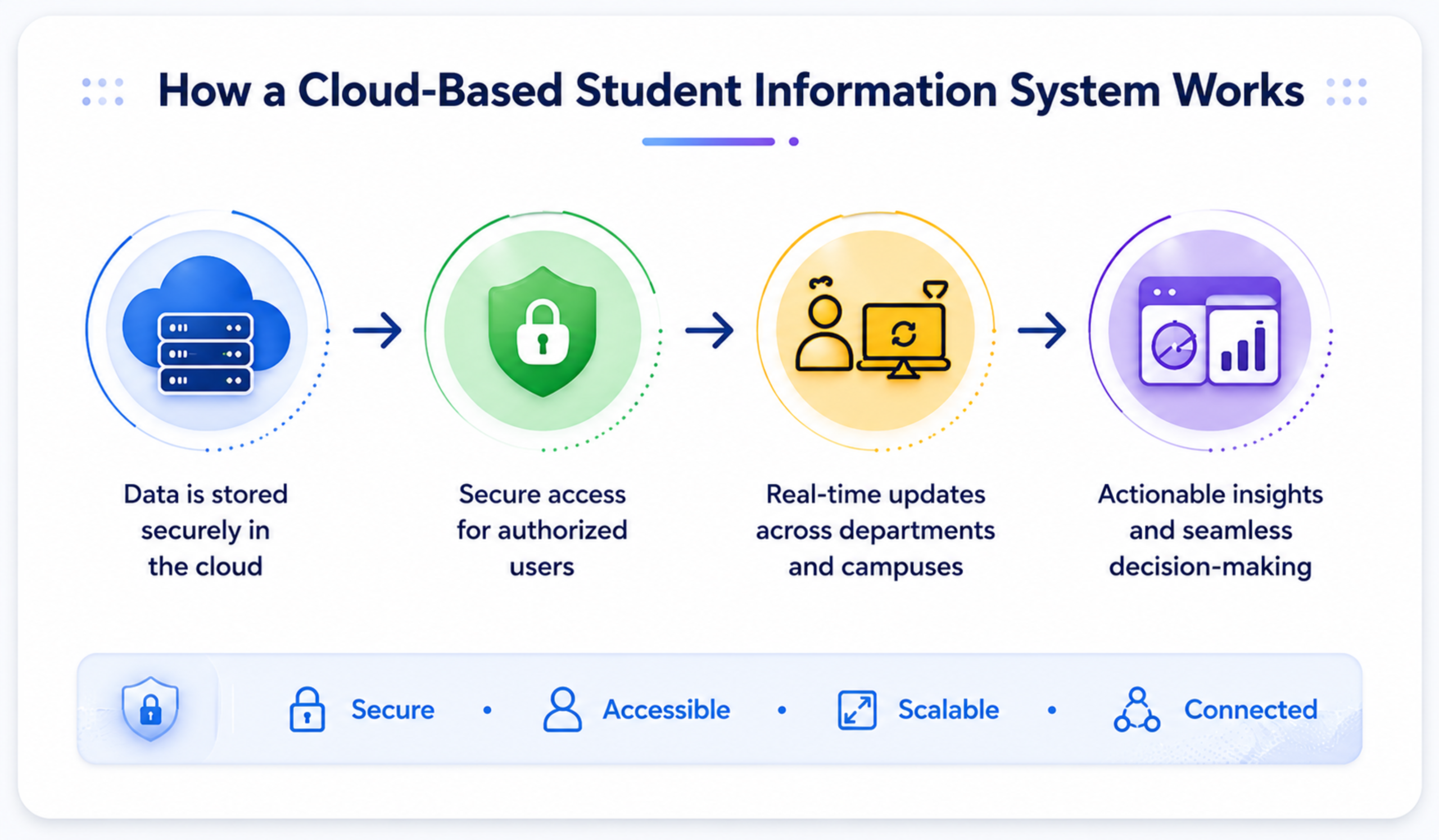
Cloud-Based Student Information System

A cloud-based SIS stores institutional data on secure cloud servers rather than local campus infrastructure.

Authorised users can access information through web browsers or mobile devices.

For example:

  • Admissions teams can track applications in real time.
  • Faculty can submit attendance and grades digitally.
  • Students can access academic records anytime.
  • Finance teams can monitor payments instantly.
  • Leadership can view dashboards and institutional insights.

Because data updates in real time, everyone works with the most current information available.

This eliminates duplicate records, manual reconciliations, and reporting delays.

7 Benefits of a Cloud-Based Student Information System

1. Access Anywhere, Anytime

University operations no longer stop when staff leave campus.

Whether administrators are travelling, faculty are teaching remotely, or students are studying abroad, a cloud-based SIS ensures secure access from anywhere.

This flexibility has become essential in today’s hybrid learning environment.

2. Improved Student Experience

Students increasingly expect digital experiences similar to online banking, e-commerce, and social media platforms.

They want instant access to:

  • Academic records
  • Fee information
  • Attendance data
  • Examination results
  • Support services

A cloud-based SIS delivers these experiences through self-service portals and mobile access.

3. Reduced IT Burden

Traditional systems require institutions to maintain servers, upgrades, backups, and security infrastructure.

Cloud-based platforms shift much of this responsibility to the technology provider.

This allows university IT teams to focus on innovation rather than maintenance.

4. Real-Time Decision Making

Institutional leaders need answers quickly.

Questions such as:

  • Which programs have the highest enrollment?
  • Where are application drop-offs occurring?
  • Which students may be at risk academically?
  • How is fee collection performing?

A cloud-based SIS provides real-time dashboards and analytics that support faster, data-driven decisions.

5. Better Scalability

Growth should be exciting, not stressful.

Whether an institution serves 5,000 students or 100,000 students, cloud infrastructure can scale to support increasing demand without major hardware investments.

6. Enhanced Data Security

Student data is one of a university’s most valuable assets.

Modern cloud-based SIS platforms provide:

  • Role-based access controls
  • Data encryption
  • Automated backups
  • Disaster recovery mechanisms
  • Compliance support

This often results in stronger security than many institutions can achieve independently.

7. Seamless Integration Across Departments

Perhaps the greatest advantage is institutional alignment.

Admissions, academics, finance, examinations, HR, and student services operate on a single platform.

Instead of departments working in silos, everyone works together using shared information.

The Hidden Cost of Legacy Student Information Systems

Many universities delay modernisation because their existing system still “works.”

However, the real cost often remains invisible.

Consider the impact of:

  • Manual data entry
  • Duplicate records
  • Reporting delays
  • Spreadsheet dependency
  • System downtime
  • Poor student experiences
  • Limited scalability

Over time, these inefficiencies lead to high operational and financial costs.

The question is no longer whether institutions can afford to modernise.

It is whether they can afford not to.

For institutions ready to make that transition, choosing the right technology partner becomes just as important as choosing the right technology. That’s where Academia comes in. 

How Academia Helps Universities Thrive in the Cloud

Academia by Serosoft is a comprehensive cloud-based Student Information System designed specifically for higher education institutions.

Rather than focusing on isolated processes, Academia connects the entire student journey on a unified platform.

With Academia by Serosoft, institutions can manage:

Admissions and Enrollment

Automate application management, document verification, communication workflows, and enrollment processes.

Student Lifecycle Management

Track and support students from their first inquiry through graduation and alumni engagement.

Academic Administration

Manage curriculum structures, course registrations, attendance, assessments, examinations, and grading from a single platform.

Finance and Fee Management

Streamline billing, fee collection, financial reporting, and student account management.

Student Services

Deliver faster support through self-service portals and digital workflows.

AI-Powered Insights

Transform institutional data into actionable intelligence that supports strategic planning and student success initiatives.

By bringing every function together, Academia by Serosoft helps institutions operate more efficiently while delivering exceptional experiences for students, faculty, and staff.

Managing 50,000 Students on One Platform
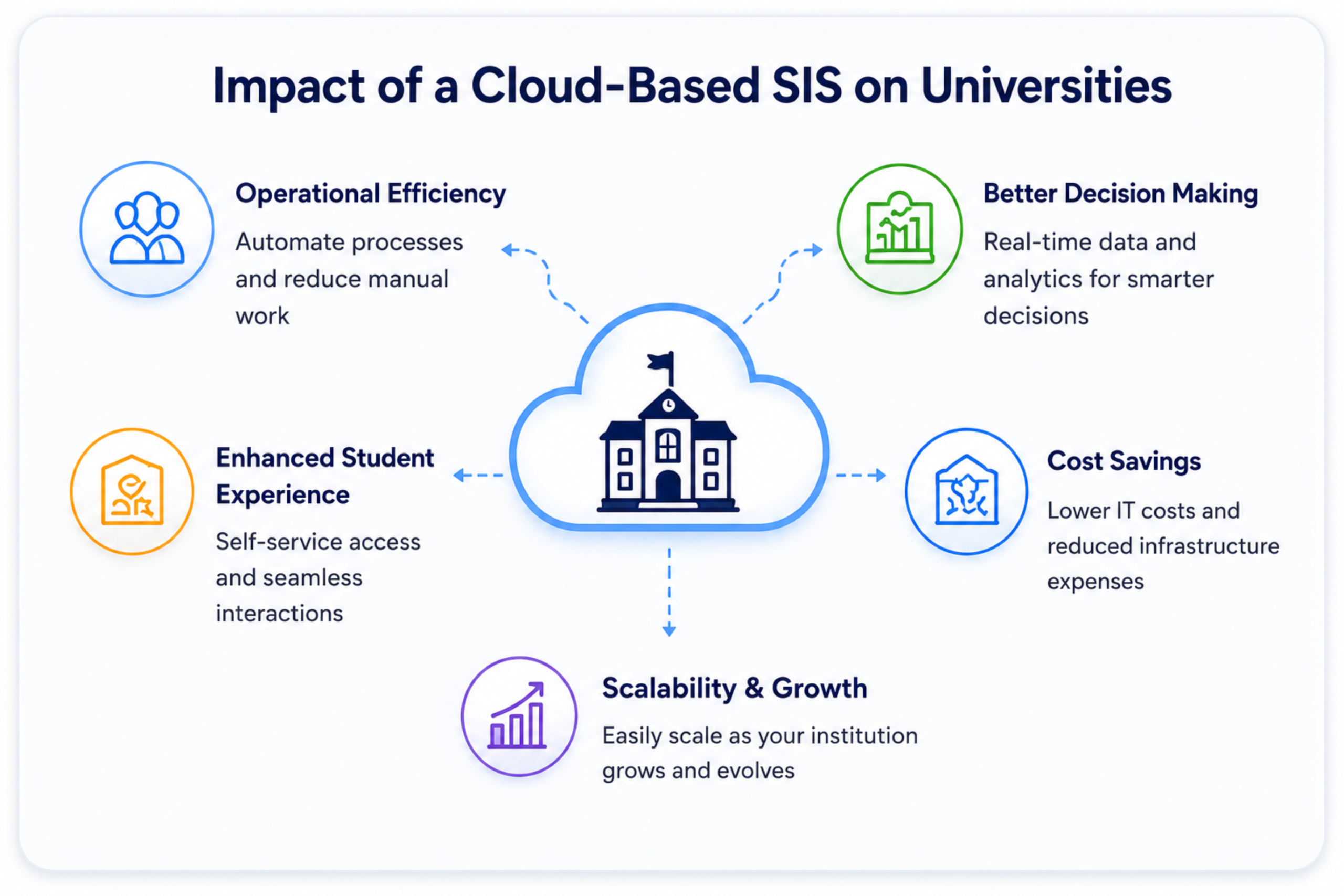
Managing 50,000 Students on One Platform

Imagine a university with more than 50,000 students spread across multiple campuses.

Without a unified cloud-based system, every department might maintain its own records and processes.

Generating a simple enrollment report could require data collection from several teams.

Within Academia, enrollment data, financial information, academic records, attendance, and student engagement metrics exist within a single ecosystem.

Leadership gains visibility.

Faculty gain efficiency.

Students gain convenience.

The entire institution becomes more connected.

Future-Proofing Higher Education with Academia

Higher education is evolving rapidly.

Student expectations are rising. Competition is increasing. Data volumes continue to grow. Institutional leaders need greater visibility and agility than ever before.

A cloud-based Student Information System is no longer simply an operational tool. It has become a strategic platform for institutional growth, student success, and digital transformation.

Universities that embrace modern cloud technologies position themselves to innovate faster, serve students better, and make smarter decisions.

And with Academia, they can do it all from one connected platform.

Frequently Asked Questions About Cloud-Based Student Information Systems

Is a cloud-based Student Information System secure?

Yes. Modern cloud-based SIS platforms typically offer advanced security features, including encryption, access controls, automated backups, and disaster recovery capabilities.

Can a cloud-based SIS support large universities?

Absolutely. Cloud infrastructure is designed to scale efficiently, making it suitable for institutions of all sizes.

How does a cloud-based SIS improve student success?

By centralising data and providing real-time insights, institutions can identify challenges earlier, improve engagement, and deliver more personalised student support.

What should universities look for in a cloud-based SIS?

Key considerations include scalability, security, integration capabilities, analytics, student experience features, and vendor expertise in higher education.

Can a cloud-based Student Information System integrate with other university software?

Yes. A modern cloud-based Student Information System is designed to integrate with a university’s existing technology ecosystem, including Learning Management Systems (LMS), finance and accounting software, HR systems, library management systems, payment gateways, CRM platforms, and third-party applications. These integrations help eliminate data silos, reduce manual work, and ensure information flows seamlessly across departments.

Can a Modern SIS Manage Multiple Campuses from One Platform?

As higher education institutions expand through regional campuses, international branches, and online learning centres, managing operations across multiple locations becomes increasingly complex.

Many universities still rely on separate systems for different campuses, resulting in fragmented student records, inconsistent processes, limited visibility, and inefficient reporting. What should be a connected institution often becomes a collection of disconnected campuses operating independently.

This is where a modern student information system becomes essential. Designed to centralise data, streamline operations, and improve collaboration, today’s SIS platforms help universities manage multiple campuses through a single digital ecosystem.

But can one platform truly support the needs of multiple campuses while maintaining flexibility for each location?

The answer is yes, provided the platform is built to support centralised governance, campus-level autonomy, and institution-wide visibility.

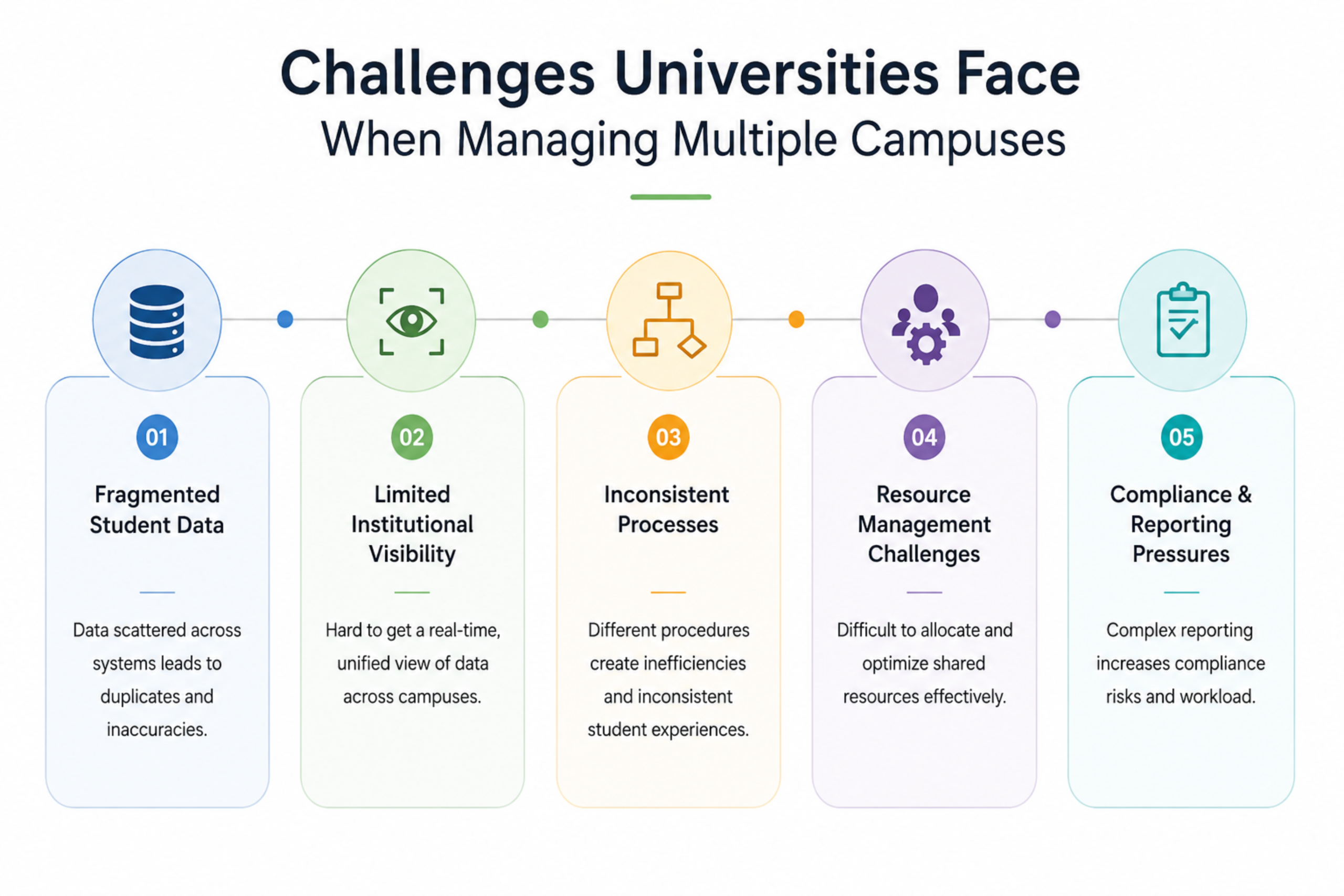
Challenges Universities Face When Managing Multiple Campuses

Managing multiple campuses introduces operational challenges that can affect efficiency, decision-making, and the student experience.

Fragmented Student Data

Students often transfer between campuses, enrol in shared programs, or participate in cross-campus learning initiatives. When campuses operate on separate systems, maintaining accurate records becomes difficult, leading to duplicate data and administrative delays.

Limited Institutional Visibility

University leaders need a consolidated view of admissions, enrollment, attendance, finances, and academic performance. When data is spread across multiple platforms, generating reliable reports becomes time-consuming and often inaccurate.

Inconsistent Processes

Different campuses frequently adopt different procedures for admissions, registration, examinations, and student services. This creates inefficiencies and can lead to inconsistent experiences for students.

Resource Management Challenges

Faculty, classrooms, laboratories, and research facilities are often shared across locations. Without centralised visibility, institutions may struggle to allocate resources effectively.

Compliance and Reporting Pressures

Accreditation and regulatory reporting require accurate institution-wide data. Gathering information from multiple systems increases complexity and compliance risks.

What Makes a Modern Student Information System Different?

A modern student information system goes beyond record management. It acts as a unified digital foundation that connects students, faculty, administrators, and leadership across every campus.

Unlike legacy systems that operate in silos, modern SIS platforms centralise information, automate workflows, and provide real-time visibility across the institution. Solutions such as Academia by Serosoft are designed to help universities manage multiple campuses through a connected ecosystem rather than separate systems.

Key capabilities include:

  • Centralised student records
  • Multi-campus administration
  • Real-time reporting and analytics
  • Workflow automation
  • Role-based access control
  • Integrated academic management
  • Cross-campus collaboration
  • Unified communication channels

This approach allows universities to standardise operations without sacrificing campus-level flexibility.

How a Modern Student Information System Supports Multi-Campus Management

Unified Student Records Across All Campuses

A student’s academic journey should remain connected regardless of where they study.

A modern SIS creates a single source of truth for admissions data, academic records, attendance history, examination results, financial information, and student engagement activities.

For institutions operating across multiple campuses, Academia by Serosoft helps maintain a unified student profile throughout the student lifecycle. Whether students transfer campuses or participate in cross-campus programs, their information remains accurate and accessible to authorised users.

Centralised Administration with Campus-Level Control

Multi-campus universities require centralised oversight without limiting the independence of individual campuses.

A modern SIS allows institutions to configure campus-specific workflows, academic structures, and permissions while providing leadership with institution-wide visibility through centralised dashboards.

Academia supports this balance by enabling universities to maintain operational consistency while allowing campuses to manage their unique requirements and processes.

Standardised Processes Across Locations

Different procedures across campuses often lead to inefficiencies and inconsistent service delivery.

A modern student information system standardises critical functions such as:

  • Admissions
  • Registration
  • Attendance tracking
  • Examination management
  • Student services
  • Academic progression monitoring

With configurable workflows and automation, Academia helps institutions create consistent processes that improve efficiency while accommodating campus-specific needs.

Real-Time Reporting and Analytics

University leaders need timely access to accurate information.

A modern SIS provides real-time insights into:

  • Admissions performance
  • Enrollment trends
  • Student retention
  • Attendance patterns
  • Academic outcomes
  • Faculty workload

By consolidating data from across the institution, Academia by Serosoft gives leadership teams a comprehensive view of campus performance, enabling faster and more informed decision-making.

Better Resource Allocation

Managing shared resources across campuses can be difficult without complete visibility.

A unified platform helps institutions optimise the utilisation of faculty, classrooms, laboratories, and academic resources. With centralised access to resource data, universities can reduce scheduling conflicts, improve planning, and maximise operational efficiency.

Academia supports effective resource management by bringing campus-wide information into a single ecosystem.

The Role of a Campus Management System in Multi-Campus Operations

While a student information system serves as the foundation for student data management, a modern campus management system extends digital transformation across the institution.

It connects:

  • Academic administration
  • Student lifecycle management
  • Faculty management
  • Finance operations
  • Examination processes
  • Communication workflows
  • Student support services

By integrating these functions, institutions can eliminate data silos, streamline operations, and improve collaboration between campuses.

As a comprehensive campus management system, Academia by Serosoft brings these capabilities together on a single platform, helping universities create a seamless experience for students, faculty, administrators, and leadership teams.

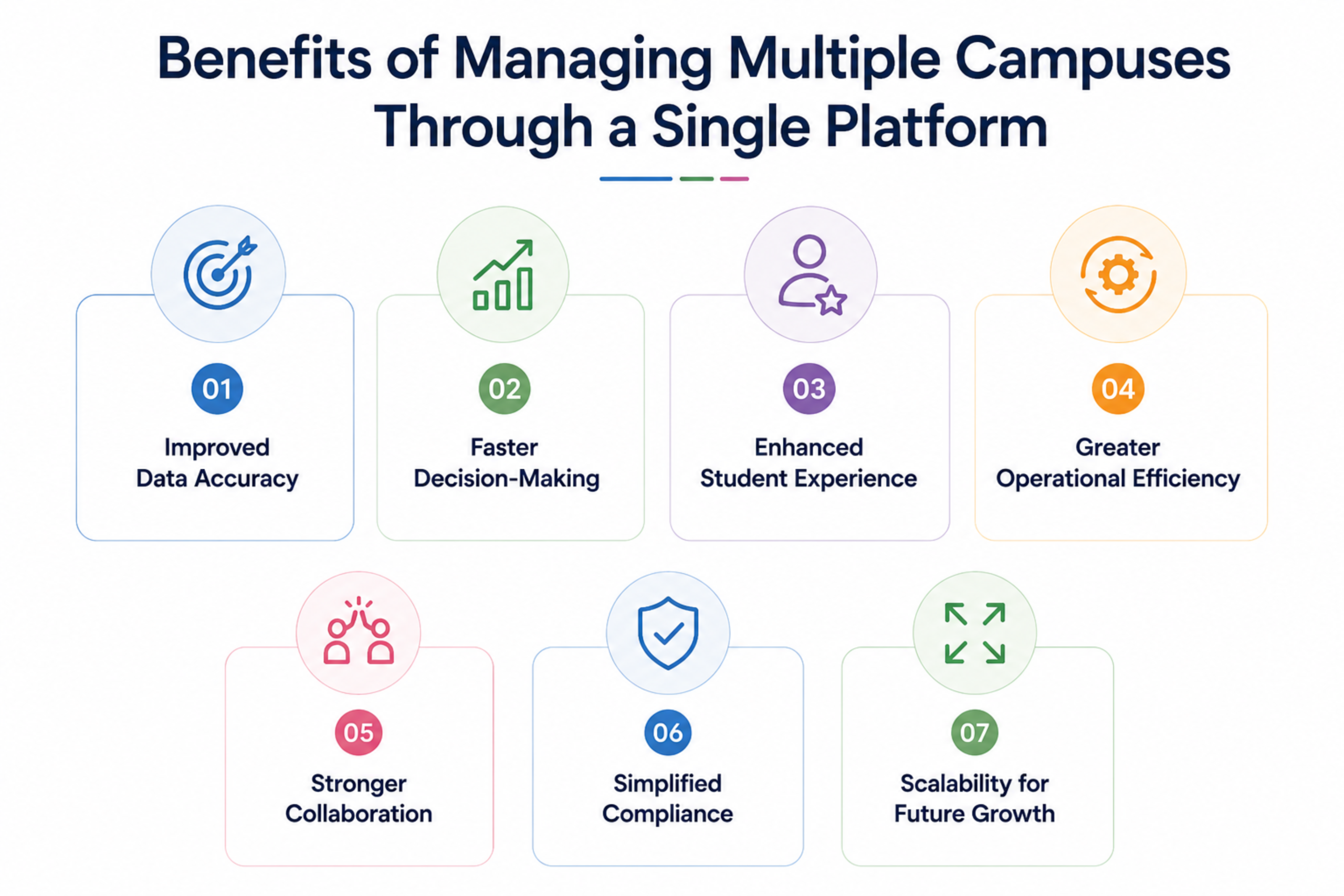
Benefits of Managing Multiple Campuses Through a Single Platform

Universities that implement a unified student information system gain several advantages:

Improved Data Accuracy

A centralised database reduces duplicate records and ensures information remains consistent across campuses.

Faster Decision-Making

Real-time access to institution-wide data helps leadership teams make informed decisions without waiting for manually compiled reports.

Enhanced Student Experience

Students receive consistent services and access to information regardless of campus location.

Greater Operational Efficiency

Automation reduces administrative workload and streamlines routine processes.

Stronger Collaboration

Departments and campuses can work together more effectively when information is accessible through a single platform.

Simplified Compliance

Centralised reporting makes accreditation and regulatory requirements easier to manage.

The Future of Multi-Campus University Management

The future of higher education is increasingly connected and data-driven. Universities are expanding beyond traditional campuses through online learning, international partnerships, and hybrid education models.

As institutions continue to grow, managing operations through disconnected systems will become increasingly difficult. Modern student information systems will play a critical role in helping universities centralise data, automate processes, and improve institutional agility.

Technologies such as artificial intelligence, predictive analytics, and workflow automation will further enhance decision-making and operational efficiency. Platforms like Academia by Serosoft are already supporting this transformation by providing universities with the digital infrastructure needed to scale while maintaining visibility and control across campuses.

Institutions that embrace integrated technology today will be better positioned to improve student success, support innovation, and achieve long-term growth.

Conclusion

Yes, a modern student information system can effectively manage multiple campuses from a single platform.

By centralising student data, standardising processes, improving visibility, and supporting collaboration, universities can overcome the challenges associated with multi-campus operations while delivering a consistent experience for students and staff.

When combined with the capabilities of a robust campus management system, institutions gain the flexibility to support individual campuses while maintaining institution-wide oversight.

Solutions such as Academia by Serosoft demonstrate how universities can simplify administration, strengthen decision-making, and create a connected digital ecosystem that supports growth across every campus.

Frequently Asked Questions (FAQs)

1. Can a student information system manage multiple campuses?

Yes. Modern student information systems are designed to manage multiple campuses through a single platform while supporting campus-specific configurations and workflows.

2. Why do universities need a centralised SIS?

A centralised SIS eliminates data silos, improves reporting accuracy, standardises processes, and provides institution-wide visibility.

3. How does a student information system improve student experience?

It ensures students have seamless access to records, services, and communications regardless of campus location.

4. What is the difference between a student information system and a campus management system?

A student information system focuses on student data and academic administration, while a campus management system connects broader institutional functions such as finance, faculty management, examinations, and student services.

5. How does Academia by Serosoft support multi-campus institutions?

Academia provides centralised data management, workflow automation, real-time analytics, and integrated campus operations through a single platform.

6. What are the biggest challenges of managing multiple campuses?

Common challenges include fragmented student records, inconsistent processes, limited visibility, resource allocation issues, and compliance complexities.

7. What features should universities look for in a multi-campus SIS?

Key features include centralised data management, automation, real-time reporting, scalability, role-based access controls, and integration capabilities.

AI Student Retention: Reducing Dropouts in Higher Education

Student retention has become one of the most critical priorities for higher education institutions worldwide. Rising student expectations, increasing competition, changing enrollment patterns, and growing financial pressures have made retention a key indicator of institutional success. Yet many universities continue to rely on reactive approaches that identify at-risk students only after problems have escalated.

Artificial Intelligence (AI) is transforming this landscape by enabling institutions to predict student challenges, personalise support services, and intervene before students disengage. When integrated with modern student information system software, AI empowers universities to move from reactive retention strategies to proactive student success initiatives. This article explores the challenges affecting student retention, how AI addresses them, the role of SIS platforms in enabling data-driven decision-making, and the steps institutions can take to build an effective AI-powered retention strategy.

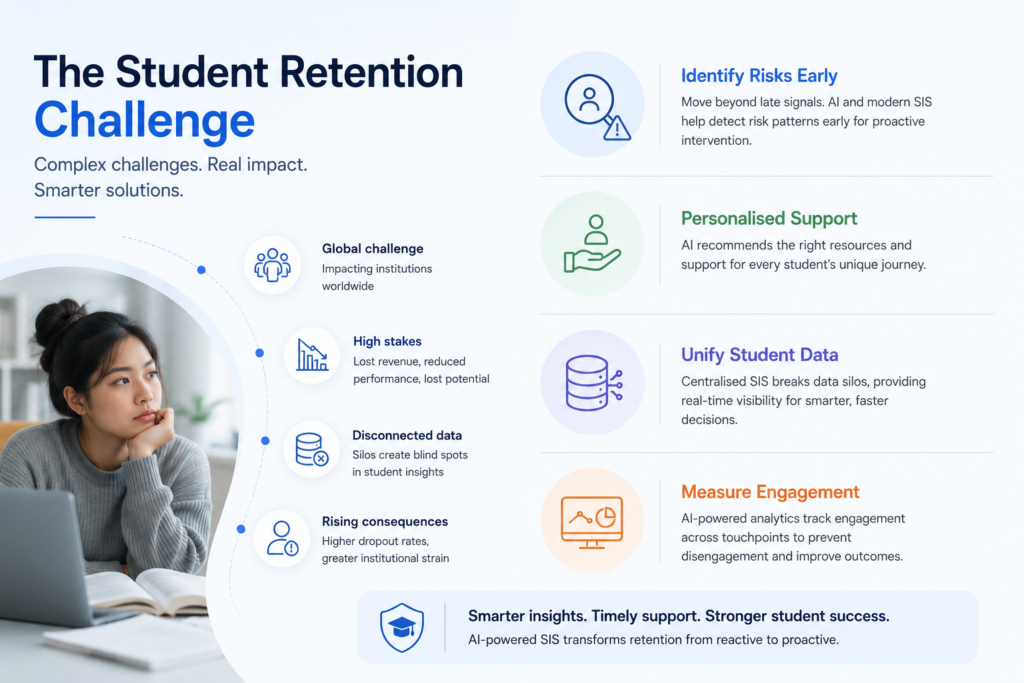
The Growing Student Retention Challenge

Student attrition is a global concern affecting institutions across North America, Europe, Asia-Pacific, the Middle East, and Africa. Every student who leaves before completing their program represents lost tuition revenue, reduced institutional performance, and unrealised student potential.

Many universities struggle to identify warning signs early enough because student data often exists across disconnected systems. Academic performance, attendance, financial records, engagement metrics, and support services may be tracked separately, making it difficult to gain a complete view of student progress.

Without a centralised student information system software, institutions often face:

  • Delayed identification of at-risk students
  • Inconsistent intervention strategies
  • Limited visibility into student engagement
  • Higher dropout rates
  • Increased administrative workload
  • Poor student experience

As student populations become more diverse and expectations continue to evolve, traditional retention methods are no longer sufficient.

 Student Retention Challenge

Identifying At-Risk Students Before It’s Too Late

Many institutions depend on lagging indicators such as attendance reports, semester grades, and faculty observations to identify at-risk students. While valuable, these indicators often reveal problems only after a student has already experienced academic, financial, or engagement challenges. AI-powered retention strategies, integrated with modern student information system software, help universities move beyond reactive interventions by identifying risk patterns early and enabling proactive support that improves student success and retention. 

Delivering Personalised Student Support at Scale

Every student faces different obstacles, from academic difficulties to financial concerns and career uncertainty. Traditional support models often apply the same intervention to every student, limiting effectiveness. AI helps institutions create personalised success pathways by analysing data stored within a centralised SIS and recommending targeted resources such as tutoring, mentoring, financial aid support, or wellness services. This personalised approach strengthens engagement and increases the likelihood of student persistence.

Managing Fragmented Student Data

Student information is often spread across admissions, academics, finance, and support departments, making it difficult to gain a complete picture of student progress. A centralised student information system eliminates these silos by bringing all student data into a single platform. When combined with AI, institutions gain actionable insights, real-time visibility, and the ability to make informed retention decisions faster.

Measuring Student Engagement Effectively

Student engagement is one of the strongest indicators of retention, yet many institutions struggle to measure it accurately. AI-powered analytics integrated with student management software can monitor attendance, online learning activity, advisor interactions, and campus involvement to identify declining engagement levels. This enables student success teams to take proactive action before disengagement turns into attrition.

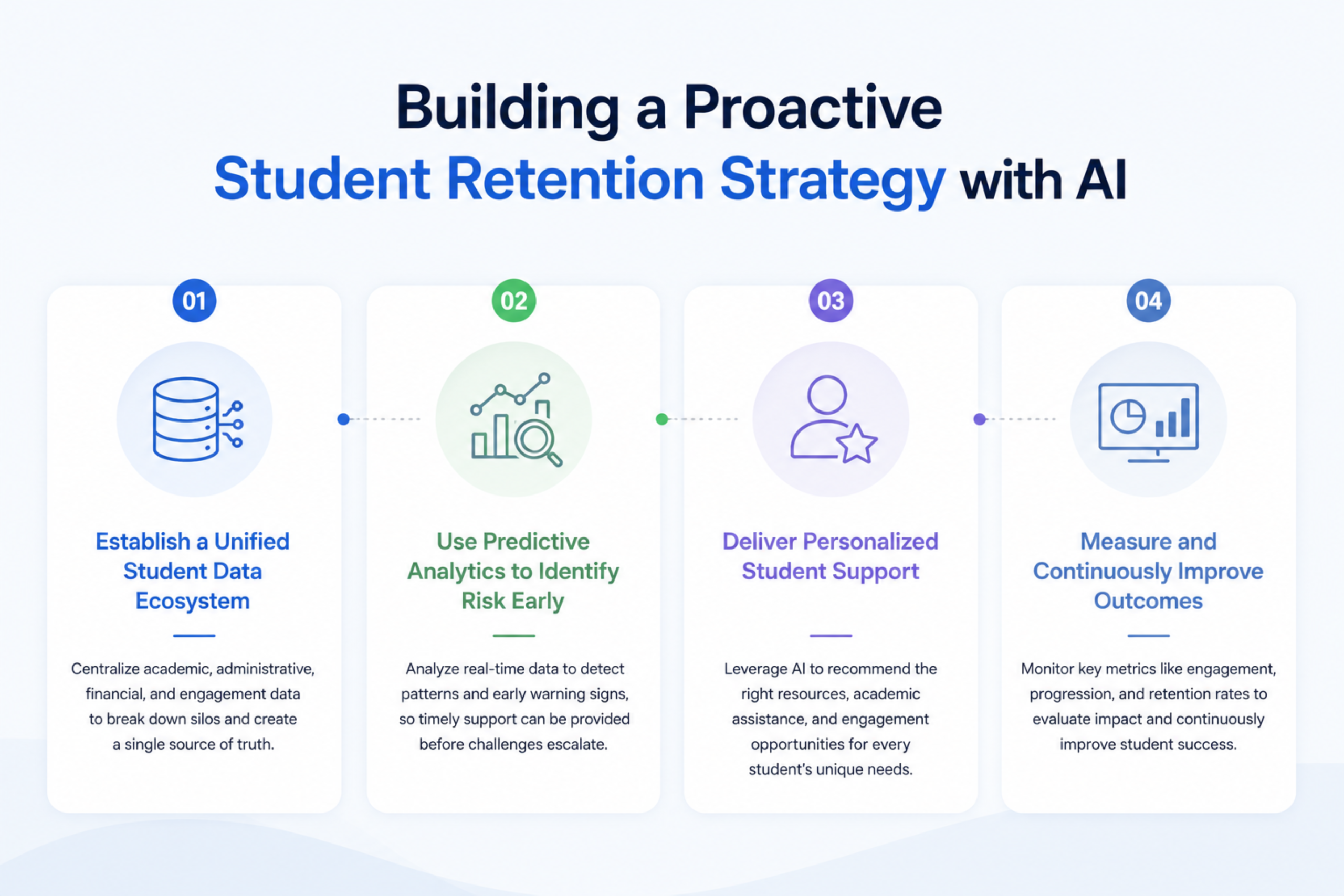
Building a Proactive Student Retention Strategy with AI

Building a Proactive Student Retention Strategy with AI

In today’s competitive higher education landscape, improving retention requires more than periodic reviews and manual interventions. Institutions need a proactive strategy built on real-time visibility, predictive insights, and personalised student support. AI enables universities to continuously monitor student engagement, identify emerging risks, and recommend timely interventions. When combined with a robust student information system, institutions can create a connected ecosystem where academic, administrative, and student support teams work from the same data foundation. This not only improves retention outcomes but also enhances the overall student experience and institutional performance.

Establish a Unified Student Data Ecosystem

Effective student retention begins with a complete view of the student journey. A modern SIS centralises academic, administrative, financial, and engagement data, enabling institutions to break down silos and make informed decisions based on a single source of truth.

Use Predictive Analytics to Identify Risk Early

AI-powered predictive analytics helps institutions move beyond reactive interventions by identifying patterns that may indicate retention risks. By analysing data in real time, universities can detect early warning signs and provide timely support before challenges impact student success.

Deliver Personalised Student Support

Every student has unique needs and goals. AI enables institutions to deliver personalised support by recommending relevant resources, academic assistance, and engagement opportunities based on individual student profiles, helping improve both satisfaction and retention.

Measure and Continuously Improve Outcomes

Student retention strategies should evolve with changing student needs. By continuously monitoring key performance indicators such as engagement, progression, and retention rates, institutions can evaluate the effectiveness of their initiatives and make data-driven improvements over time.

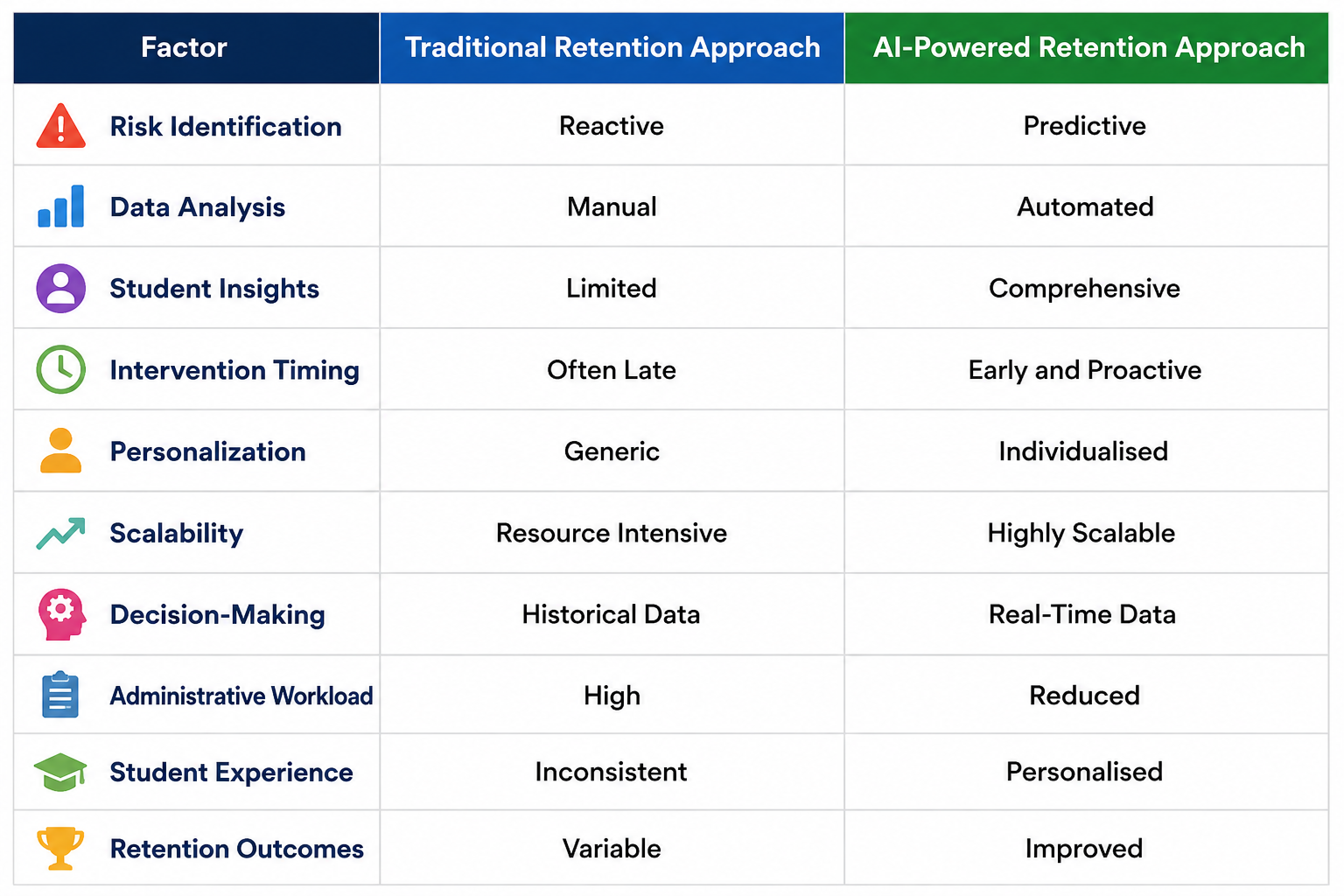
Traditional Retention vs AI-Powered Retention

Traditional Retention vs AI-Powered Retention

Why AI and SIS Work Better Together

AI alone cannot solve retention challenges.

The quality of predictions depends on the quality of data available.

A modern student information system provides the foundation AI requires to generate meaningful insights.

Institutions that combine AI capabilities with an integrated SIS can:

  • Improve student engagement
  • Increase retention rates
  • Enhance operational efficiency
  • Strengthen student support services
  • Improve institutional outcomes

Advanced student management software solutions such as Academia by Serosoft enable institutions to centralise data, automate workflows, and create a connected student experience that supports long-term success.

Conclusion

Student retention is no longer just a student affairs challenge; it is a strategic institutional priority. As higher education becomes increasingly data-driven, universities must adopt technologies that help them identify risks early, personalise student support, and improve decision-making.

AI is transforming retention by providing predictive insights and proactive intervention capabilities. However, its success depends on having a strong data foundation powered by a modern student information system.

Institutions that leverage AI alongside an integrated SIS and comprehensive student management software are better positioned to improve retention, enhance student success, and achieve sustainable growth.

Talk to an Expert

Discover how Academia by Serosoft helps institutions leverage AI-ready SIS to improve student retention, streamline operations, and deliver exceptional student experiences.

Frequently Asked Questions

What is AI student retention?

AI student retention refers to the use of artificial intelligence technologies to identify at-risk students, predict potential dropouts, and recommend interventions that improve student success and persistence.

How does a student information system software support retention?

Student information system software centralises student data, enabling institutions to track academic performance, engagement, attendance, and other factors that influence retention outcomes.

What role does SIS play in predictive analytics?

An SIS provides the structured data required for predictive models to identify retention risks and generate actionable insights for student success teams.

Can AI improve graduation rates?

Yes. By identifying challenges early and enabling personalised support, AI can help institutions improve retention, progression, and graduation outcomes.

What are the benefits of AI-powered student management software?

AI-enabled student management software offers predictive analytics, automated alerts, personalised interventions, improved reporting, and enhanced student engagement.

Is AI student retention suitable for universities of all sizes?

Yes. Institutions of all sizes can use AI and modern student information system solutions to improve retention strategies and support student success initiatives.

Why is data centralisation important for retention?

Centralised data provides a complete view of each student’s journey, allowing institutions to make informed decisions and deliver timely interventions.

How AI-Powered SIS Improves Institutional Intelligence

Universities Have More Data Than Ever. The Challenge Is Making Sense of It.

Every interaction within a university generates data.

Applications submitted during admissions, attendance records captured in classrooms, assessments completed online, fee transactions, student support requests, academic progression reports, and alumni engagement activities each process contributes to an ever-expanding pool of institutional information.

Over the past decade, higher education institutions have invested significantly in digital transformation initiatives. As a result, universities now possess more operational and academic data than at any point in their history.

Yet access to data does not automatically translate into better decisions.

Many institutions still struggle to answer fundamental questions quickly:

  • Which programs are experiencing declining enrolment?
  • Which students may require intervention before academic performance drops?
  • Where are revenue leakages occurring?
  • Which operational processes are creating delays?
  • What trends should leadership be monitoring right now?

The challenge facing universities today is no longer data collection. It is data interpretation.

Institutions need the ability to convert vast amounts of information into actionable intelligence that supports faster decisions, improved efficiency, and stronger student outcomes.

This shift is driving growing interest in AI-powered Student Information Systems (SIS).

Why Traditional Student Information Systems Are No Longer Enough

For many years, Student Information Systems primarily served as digital record repositories.

They stored student information, maintained academic records, tracked attendance, managed examinations, and supported administrative workflows.

While these capabilities remain essential, modern universities now operate in an environment that demands much more.

Institutional leaders are expected to manage:

  • Increasing student populations
  • Multiple campuses and learning formats
  • Evolving accreditation requirements
  • Greater accountability for student outcomes
  • Rising expectations for personalised student experiences
  • More complex financial and operational planning

In this environment, simply storing information is not enough.

The value of a modern SIS lies not in how much data it contains, but in how effectively it helps institutions understand what that data means and what actions should follow.

This is where artificial intelligence is fundamentally changing the role of student information systems.

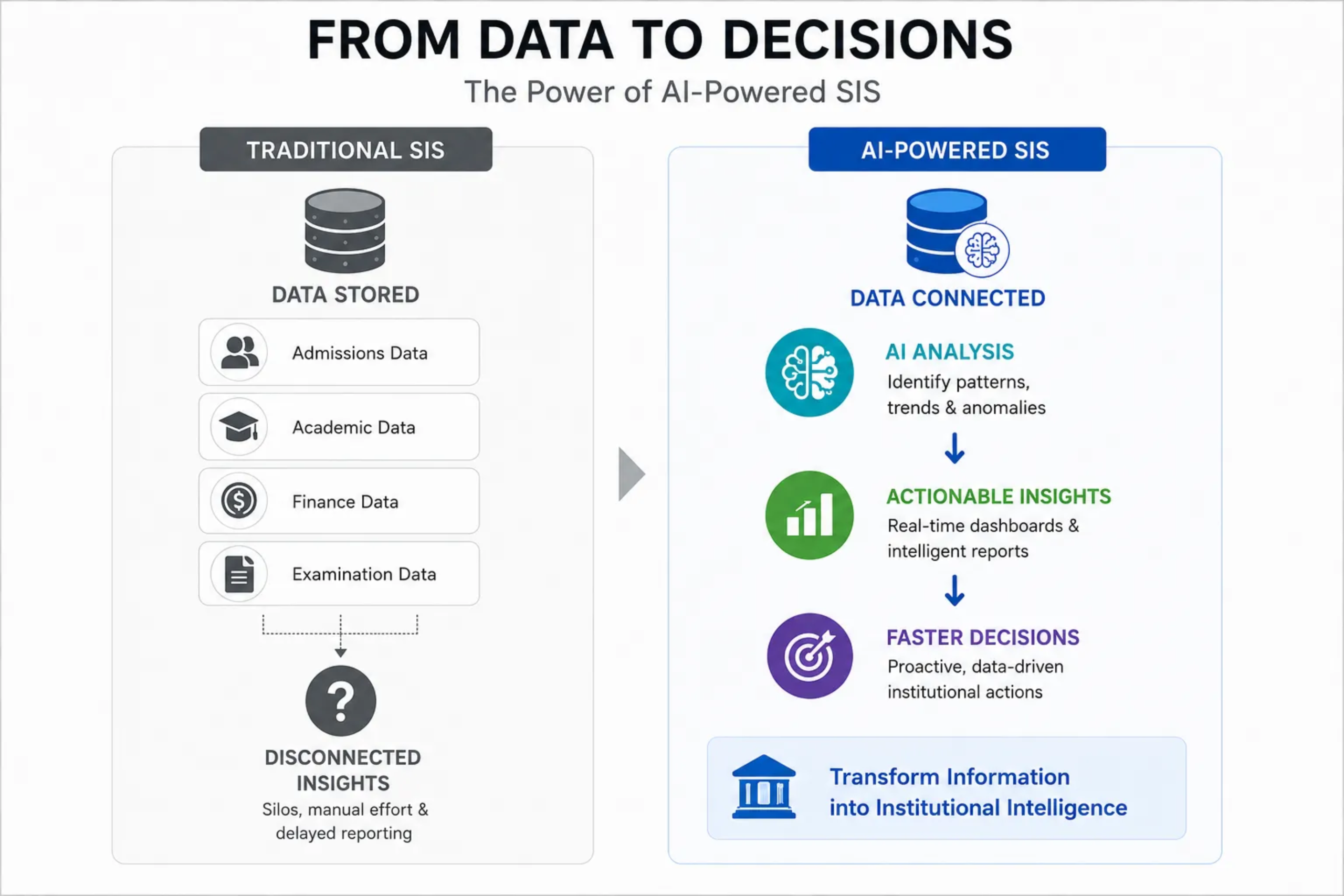
From Data Management to Institutional Intelligence

Data Management to Institutional Intelligence

An AI-powered SIS extends beyond administrative record-keeping.

Rather than acting solely as a system of storage, it functions as a system of intelligence.

By analysing information across departments, identifying patterns, generating insights, and automating routine analysis, AI helps institutions move from reactive decision-making to proactive management.

Instead of asking teams to manually collect information from multiple systems, an AI-powered SIS continuously transforms institutional data into meaningful insights.

This evolution enables universities to shift their focus from managing information to managing outcomes.

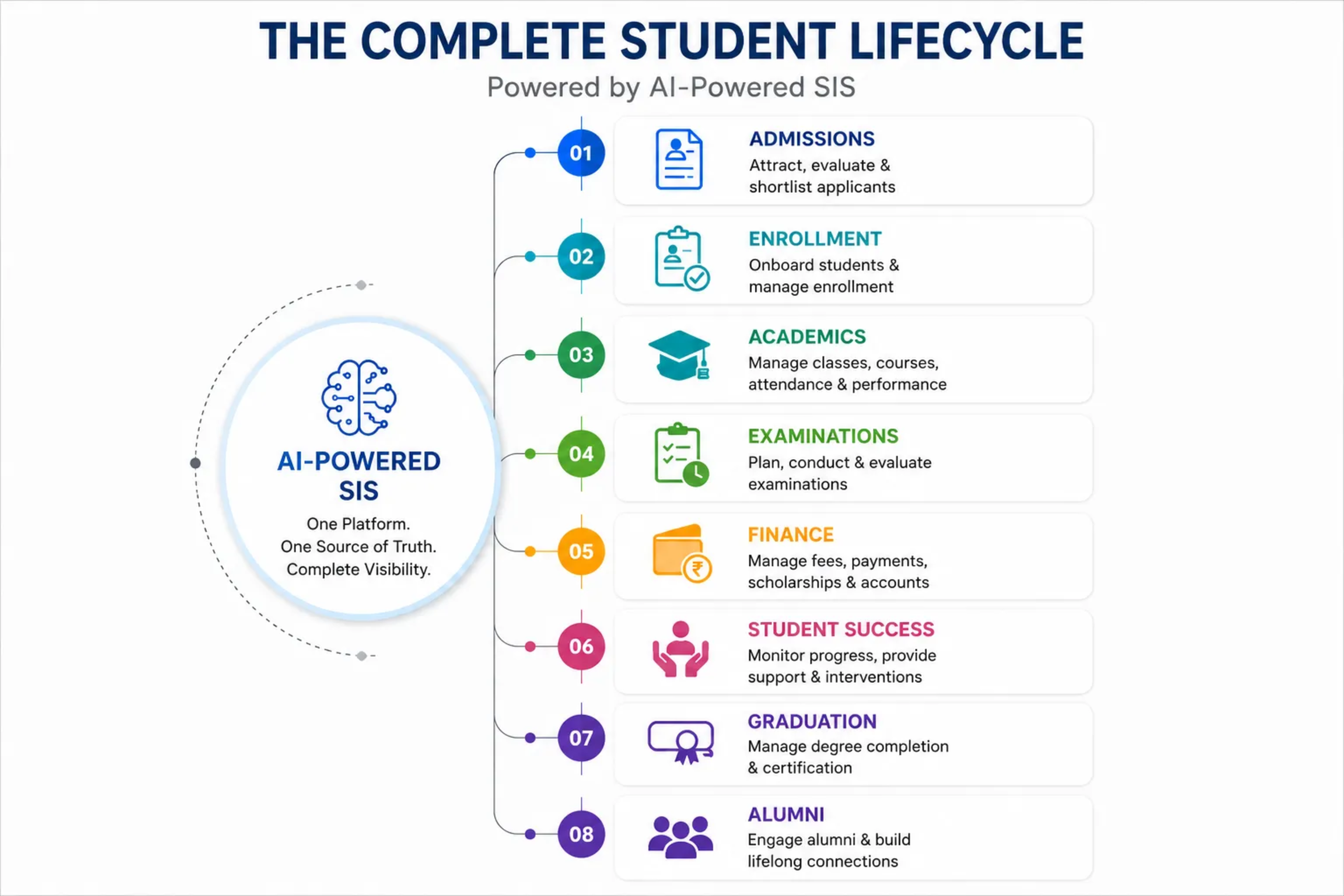
How AI-Powered SIS Supports the Complete Student Lifecycle

One of the most significant advantages of an AI-powered SIS is its ability to connect data across the entire student journey.

Rather than operating as separate administrative functions, admissions, academics, finance, examinations, student services, and institutional planning become part of a unified ecosystem.

Admissions and Enrollment Intelligence

Admissions teams often handle large volumes of applications while attempting to forecast enrollment trends and optimise recruitment strategies.

AI-powered systems can analyse application patterns, identify enrollment trends, monitor conversion rates, and provide visibility into applicant pipelines.

This allows institutions to make more informed enrollment decisions while improving operational efficiency during admission cycles.

Academic Performance and Student Success

Universities have access to large amounts of student performance data, but identifying meaningful patterns manually is difficult at scale.

AI enables institutions to analyse attendance, assessment performance, engagement indicators, and progression trends to gain deeper visibility into student success.

Rather than relying solely on retrospective reports, institutions can identify emerging patterns earlier and make more informed decisions regarding academic support strategies.

Financial Visibility and Planning

Financial management requires continuous monitoring of fee collection, payment patterns, scholarships, receivables, and institutional revenue streams.

AI-powered reporting allows finance teams to access real-time visibility into key financial indicators, helping institutions improve planning, forecasting, and operational control.

Examinations and Academic Administration

Examinations and Academic Administration

Examination management generates substantial operational complexity, particularly in large institutions.

AI-enabled systems help administrators monitor examination workflows, analyse academic outcomes, identify trends across programs, and improve visibility into institutional performance metrics.

Compliance and Accreditation Readiness

Accreditation bodies and regulatory agencies increasingly require evidence-based reporting.

Rather than gathering information from multiple departments during audit periods, institutions can maintain continuously organised records supported by intelligent reporting capabilities.

This creates a stronger foundation for compliance management while improving data accuracy and transparency.

The Growing Importance of AI-Powered Reporting

Among all applications of AI in higher education administration, reporting and analytics are emerging as some of the most transformative.

Universities often possess the information needed to make better decisions. The challenge lies in accessing that information quickly.

Traditional reporting processes frequently involve:

  • Extracting data from multiple systems
  • Consolidating spreadsheets
  • Validating information manually
  • Preparing reports for different stakeholders
  • Repeating the process whenever updated insights are required

This approach consumes significant administrative effort and often delays decision-making.

AI-powered reporting changes this dynamic.

Instead of spending hours compiling information, administrators can generate insights through natural-language queries, access real-time dashboards, and explore institutional trends instantly.

The result is not simply faster reporting; it is faster institutional learning.

Leadership teams gain the ability to identify opportunities, respond to challenges, and make strategic decisions with greater confidence.

Why Universities Are Investing in AI-Powered SIS Platforms

The most forward-looking institutions view AI not as a technology initiative but as a strategic capability.

Universities that effectively leverage institutional data are better positioned to:

  • Improve student outcomes
  • Strengthen operational efficiency
  • Enhance resource utilisation
  • Support evidence-based planning
  • Improve institutional agility
  • Deliver better student experiences

As higher education becomes increasingly competitive and data-driven, the ability to transform information into actionable intelligence is becoming a critical differentiator.

AI-powered SIS platforms provide the infrastructure needed to support this transition.

How Academia by Serosoft Is Advancing AI-Powered Higher Education Management

As universities seek to unlock greater value from institutional data, Academia by Serosoft is helping institutions move beyond traditional administration toward intelligent campus management.

Academia integrates AI-driven capabilities directly into its Student Information System, enabling universities to access meaningful insights across the complete student lifecycle from admissions and enrollment to academics, finance, examinations, compliance, and student success initiatives.

The platform offers more than 800 standard reports and dashboards alongside over 400 AI-powered reports designed to help institutions analyse operational and academic performance more efficiently.

Using natural-language prompts, administrators can generate reports, explore trends, and access institutional insights without extensive manual data preparation.

By bringing together data from multiple functions within a unified ecosystem, Academia enables universities to gain a comprehensive view of institutional performance while reducing the effort traditionally associated with reporting and analysis.

The result is a more informed, responsive, and data-driven approach to higher education management.

The Future of Student Information Systems

The next generation of Student Information Systems will not be defined by how effectively they store information.

They will be defined by how effectively they help institutions understand, predict, and act.

As artificial intelligence continues to evolve, universities will increasingly rely on systems capable of delivering real-time insights, supporting strategic planning, and enabling proactive decision-making across the student lifecycle.

The institutions that succeed in the coming decade will not necessarily be those with the most data.

They will be the ones that know how to use it.

Conclusion

Higher education is entering an era where institutional success depends on the ability to transform information into action.

While universities have made significant progress in digitising operations, the next stage of transformation requires more than data management. It requires institutional intelligence.

An AI-powered Student Information System helps universities connect data across the student lifecycle, generate meaningful insights, improve decision-making, and create more efficient operations.

By combining comprehensive student lifecycle management with AI-powered reporting and analytics, solutions like Academia by Serosoft are helping institutions move from managing information to managing outcomes, creating smarter, more agile, and future-ready campuses.

Frequently Asked Questions

1. What is an AI-powered Student Information System (SIS)?

An AI-powered Student Information System combines traditional student management capabilities with artificial intelligence to help institutions analyse data, generate insights, automate processes, and support faster decision-making. Unlike conventional SIS platforms that primarily store information, AI-powered systems help universities derive meaningful intelligence from their data.

2. How is an AI-powered SIS different from a traditional SIS?

A traditional SIS focuses on managing student records, academic information, examinations, and administrative processes. An AI-powered SIS goes a step further by identifying trends, generating intelligent reports, supporting predictive analytics, and helping institutions make proactive decisions based on real-time data.

3. Why are universities investing in AI-powered SIS platforms?

Universities are generating increasing volumes of academic, operational, and financial data. AI-powered SIS platforms help institutions transform this data into actionable insights, enabling better planning, improved resource utilisation, enhanced student support, and more informed decision-making across the campus ecosystem.

4. How does an AI-powered SIS support the student lifecycle?

An AI-powered SIS provides visibility across the complete student lifecycle, from admissions and enrollment to academics, examinations, finance, student support, graduation, and alumni engagement. By connecting data across these functions, institutions gain a holistic view of student and institutional performance.

5. What role does AI play in institutional reporting and analytics?

AI helps universities generate reports faster by automatically analysing large volumes of institutional data. Administrators can access dashboards, identify trends, monitor key performance indicators, and generate insights using natural-language queries, reducing reliance on manual data compilation and analysis.

6. Can an AI-powered SIS help improve student success initiatives?

Yes. AI-powered systems can analyse attendance patterns, academic performance, engagement metrics, and progression data to help institutions identify trends and gain deeper visibility into student outcomes. These insights support more informed interventions and student success strategies.

7. How does Academia by Serosoft leverage AI within its SIS platform?

Academia by Serosoft integrates AI-powered reporting, analytics, and decision-support capabilities within its SIS ecosystem. With over 800 standard reports and dashboards and 400+ AI-powered reports, institutions can access meaningful insights across admissions, academics, finance, examinations, compliance, and student success functions.

8. What are the long-term benefits of implementing an AI-powered SIS?

Implementing an AI-powered SIS can help institutions improve operational efficiency, strengthen data-driven decision-making, enhance reporting accuracy, support compliance requirements, optimise resource allocation, and create a more connected and future-ready campus environment.

How are leading universities using AI reports inside their SIS to reduce administrative workload?

Over 60% of higher education administrators report spending more than half their workday on tasks that add zero academic value.

That is not a staffing problem. That is a system problem. And AI in education technology is finally giving institutions the tools to solve it at scale.

Universities across India, the UK, the US, and Southeast Asia are embedding artificial intelligence directly into their Student Information Systems (SIS) and Enterprise Resource Planning (ERP) platforms. The result: fewer manual errors, faster workflows, and administrative staff who actually have time to support students instead of drowning in data entry.

The opportunity is significant. According to Academia SIS, workflow automation can help institutions reduce routine administrative effort by 25–40%. The question is no longer whether AI belongs in your SIS. The question is how fast your institution can move.

How Does AI in SIS Reduce Administrative Workload Across Campus Functions?


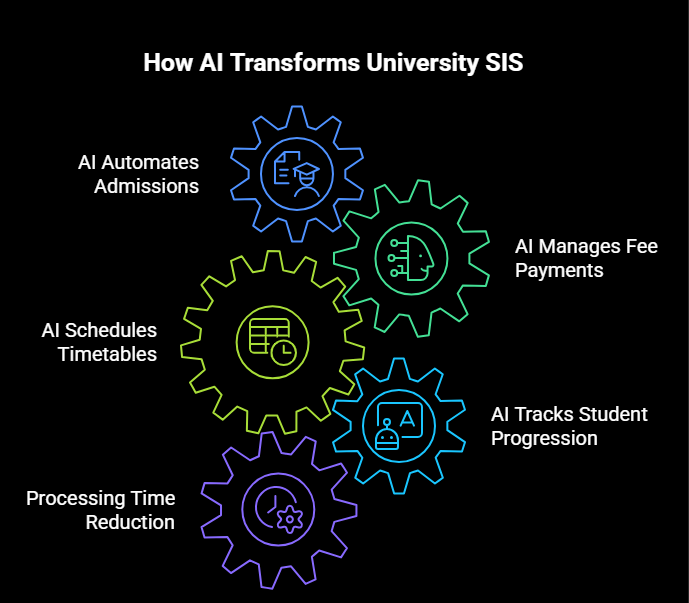
Academia by Serosoft automates key administrative processes across admissions, fee management, timetable administration, student lifecycle management, notifications, approvals, and data validation. 

When AI is embedded into the SIS layer, it handles pattern-heavy tasks that previously required dedicated staff teams. Registrar offices, for instance, can automate grade sheet generation, attendance tracking alerts, and transcript requests without a single manual touchpoint. Academic heads receive real-time dashboards instead of waiting three days for compiled reports.

The shift is structural, not cosmetic. Recent research shows that AI is particularly effective at automating repetitive, rules-based administrative tasks. In higher education, AI-powered automation is increasingly being applied to admissions processing, document management, scheduling, student services, and other operational workflows, helping institutions improve efficiency and reduce administrative workload. 

Consider what this means for a mid-sized university managing 15,000 students:

  • Admission processing, which took 12 staff members and 3 weeks, now runs in 4 days with 2 staff overseers
  • Fee defaulter identification that required manual ledger reviews now triggers automated alerts
  • Timetable conflicts that caused semester-start chaos are resolved through AI-driven scheduling logic
  • Student progression tracking across departments is centralised and updated in real time

Every function above sits inside the SIS. And every function above benefits directly from AI in education technology applied at the right integration point.

What Role Does AI in ERP Play in Unifying Finance, Administrative and Academic Management?


AI in ERP connects previously siloed finance, administrative, and academic data into a unified decision-making layer, giving Vice Chancellors and IT Heads a single source of operational truth rather than a patchwork of disconnected reports.

Most universities operate with separate systems for finance, procurement, and student records. The manual reconciliation between these systems creates bottleneck after bottleneck. AI in ERP eliminates this by building intelligent bridges between data sources, flagging anomalies, and generating predictive insights.

A Finance Controller no longer needs to reconcile fee collection against student enrollment status manually. The ERP does it, flags exceptions, and logs audit trails automatically. According to Deloitte’s 2024 Global Higher Education Outlook, institutions that modernised their ERP with AI capabilities reduced finance reconciliation cycles by an average of 35%.

The future of edtech in administrative management runs through this integration. Standalone SIS and ERP tools will become obsolete as AI-powered unified platforms take over. Institutions that act now will set the benchmark; those that delay will spend the next decade playing catch-up.

Why Are Registrars and Academic Heads Prioritising AI-Powered Reporting?

Registrars and academic heads are prioritising AI-powered reporting because manual data compilation creates decision lag. In competitive higher education environments, delayed insights translate directly into missed accreditation opportunities and weaker student outcomes.

Traditional reporting in most universities works like this: a department head requests a report, an administrative officer pulls data from three systems, compiles it in a spreadsheet, and delivers it 48 to 72 hours later. By then, the moment for action has often passed.

AI-powered reporting built into the SIS changes this cycle entirely:

  • Reports generate on demand using natural language queries
  • Historical trend analysis runs in seconds, not days
  • Accreditation readiness reports populate automatically from live data
  • Anomaly detection flags outlier student performance before it becomes a dropout statistic

UNESCO’s 2023 Global Education Monitoring Report highlighted that institutions leveraging real-time data analytics in academic administration improved student retention rates by up to 18% compared to those relying on periodic manual reporting.

For Registrars managing compliance and academic heads overseeing curriculum outcomes, this is not a luxury. It is a competitive and regulatory necessity. AI in education technology makes it operationally achievable.

How Should University IT Heads Evaluate AI Readiness in Their Current SIS and ERP Stack?


University IT Heads

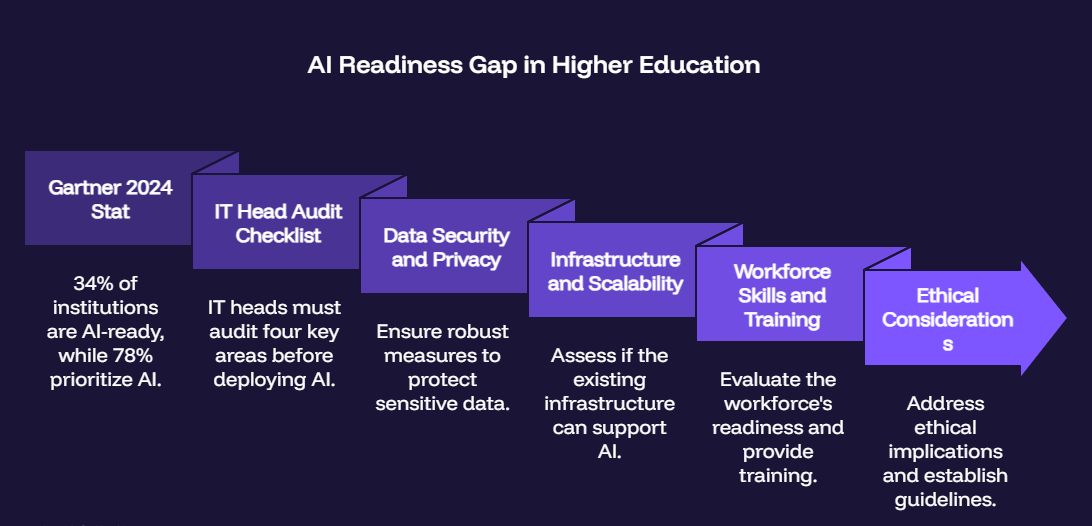
University IT heads should evaluate AI readiness by auditing data integrity, API infrastructure, and workflow automation capacity within their existing SIS and ERP platforms before committing to any AI deployment roadmap.

AI is only as good as the data it learns from. A university with fragmented, inconsistently formatted student records across departments will not get clean AI outputs. IT heads must prioritise:

  • Data normalisation: Are student records, financial data, and academic records stored in consistent, machine-readable formats?
  • Integration depth: Can the SIS and ERP communicate via open APIs, or are they locked in proprietary silos?
  • Workflow mapping: Have administrative processes been documented well enough to identify which steps can be automated?
  • Change management: Are administrative staff prepared for a shift from manual execution to oversight roles?

According to Gartner’s 2024 Higher Education CIO Survey, only 34% of university IT departments rated their current infrastructure as “AI-ready,” despite 78% naming AI adoption as a top-three strategic priority for the next two years.

This gap is exactly where the future of edtech is being contested. Institutions that invest in foundational data infrastructure now will be positioned to deploy advanced AI capabilities in SIS and ERP environments within 18 to 24 months. Those that do not will face expensive remediation cycles later.

Conclusion

The administrative burden weighing down universities is not inevitable. It is a product of outdated systems operating without intelligent support. AI in education technology has moved from proof-of-concept to operational reality, and the institutions leading this shift share one common thread: they have embedded AI into the core of their SIS and ERP platforms, not bolted it on as an afterthought.

Academia SIS is a purpose-built higher education management platform designed for exactly this transformation. From AI-powered SIS modules that automate enrollment, attendance, and examination workflows to ERP capabilities that unify finance, HR, and academic operations, Academia gives institutions in India and across Asia the infrastructure to reduce administrative workload measurably and scale with confidence.

If your institution is ready to move from reactive administration to intelligent, data-driven operations, the next step is a conversation.

Book a free demo with Academia today and see how AI in education technology can transform your administrative efficiency within one semester.

See AI in SIS and ERP in action. Leading universities are using AI in education technology to cut workload, improve reporting accuracy, and free their teams for higher-value work. Book your free demo with Academia and discover what the future of edtech looks like when it runs on intelligent infrastructure built for higher education.

FAQ’S

Q: What is AI in education technology and how does it apply to university administration?

Answer: AI in education technology refers to the use of artificial intelligence tools embedded within academic platforms like SIS and ERP systems to automate administrative tasks, generate predictive insights, and support data-driven decision-making. For universities, this means faster enrollment processing, real-time reporting, and reduced manual workload across departments.

Q: How do universities implement AI in SIS without disrupting existing workflows?

Answer: Successful implementation of AI in SIS typically follows a phased approach: data audit and normalisation first, followed by workflow mapping, then module-by-module AI integration. Universities in India and Southeast Asia have found that piloting AI in high-volume functions like admissions or fee management first builds institutional confidence before broader rollout.

Q: What is the ROI of deploying AI in ERP for higher education institutions?

Answer: Institutions deploying AI in ERP report measurable ROI within 12 to 18 months, primarily through reduced staff hours on reconciliation tasks, lower error rates in financial reporting, and faster audit cycles. Deloitte’s 2024 data suggests a 35% average reduction in finance processing time, translating directly into administrative cost savings and redeployment of staff toward student-facing functions.

Q: Is AI in education technology a long-term strategy or a short-term trend?

Answer: AI in education technology is a structural shift, not a trend. The future of edtech is built on intelligent, integrated platforms that continuously learn from institutional data. Regulatory bodies, accreditation agencies, and student expectations are all moving toward data-transparent, outcome-driven administration, making AI adoption a long-term strategic imperative for any university aiming to remain competitive through 2030 and beyond.

Back to top