Type your keyword below

Embracing Intelligent Learning Systems: Shaping the Future of Education

Introduction 

The education landscape is continuously evolving, and one of the most significant driving forces behind this change is the adoption of intelligent learning systems. These advanced technologies are transforming how educational institutions operate, enhancing the learning experience for students and educators alike. In this article, we will explore the key features of smart learning and how it is revolutionizing the future of education. 

  1. Personalized Learning Experiences 

Smart learning systems utilize artificial intelligence (AI) and data analytics to create customized learning paths for individual students. By analyzing a student’s performance, learning style, and preferences, these systems can tailor educational content and pace to optimize learning outcomes. This level of personalization caters to learners’ diverse needs, helping them overcome challenges and reach their full potential. 

  1. Collaborative and Interactive Learning 

Intelligent learning platforms promote collaboration and interaction among students and educators. Through cloud-based tools, students can work together on projects, share resources, and engage in discussions with their peers. Simultaneously, educators can provide real-time feedback and guidance, fostering a more dynamic and engaging learning environment. 

  1. Accessible Education 

Smart learning technologies are breaking down barriers to education by offering increased accessibility. Online courses, virtual classrooms, and digital resources allow students from all corners of the globe to access quality education, regardless of their geographical location or financial constraints. This democratization of education opens up new opportunities for students who might otherwise have limited access to learning. 

  1. Data-Driven Decision Making 

Educational institutions can harness the power of data analytics to make informed decisions. By analyzing student performance, engagement, and progress data, administrators and educators can identify areas for improvement and implement targeted interventions. This data-driven approach leads to more effective resource allocation, ultimately improving the quality of education. 

  1. Lifelong Learning 

Smart learning systems promote a culture of continuous learning and professional development. By providing access to a vast array of resources and learning opportunities, these platforms encourage individuals to engage in lifelong learning, helping them stay relevant in an ever-changing world. 

  1. Environmental Sustainability 

Adopting intelligent learning technologies can contribute to a more sustainable future by reducing the environmental impact of traditional educational institutions. Digital resources and online learning platforms reduce the need for physical learning materials, such as textbooks and paper, decreasing waste and resource consumption. 

Conclusion 

Intelligent learning systems are revolutionizing how we approach education, offering personalized, collaborative, and accessible learning experiences. By harnessing the power of data analytics and embracing lifelong learning, educational institutions can better prepare students for the challenges and opportunities of the 21st century. As we continue to explore and develop these innovative technologies, we can expect to see even more exciting transformations in the future of education. 

Selecting the Ideal CIO for Your Educational Institution

Introduction 

The role of the Chief Information Officer (CIO) in today’s universities and colleges is increasingly important. With the rapid advancements in technology and the growing reliance on digital platforms, it is crucial to find the right CIO to help steer the educational institution towards a successful future. This article will guide choosing the ideal CIO for your university or college. 

Define the CIO’s Role and Responsibilities 

Before searching for a suitable CIO, it is essential to understand the position’s responsibilities and functions clearly. Some key duties may include managing the institution’s information technology (IT) infrastructure, formulating strategic IT plans, and ensuring effective data management. By clearly defining the role, you can create a more targeted search for the perfect candidate. 

Assess the Institution’s Needs and Goals 

You need to determine your specific needs and objectives to find the best fit for your institution. This includes identifying your institution’s technological challenges, the desired outcomes of implementing new technologies, and any budgetary constraints. Understanding these factors will enable you to create a detailed candidate profile to help streamline recruitment. 

Focus on Relevant Experience and Skills 

When evaluating potential candidates, prioritize those with a proven track record of success in IT management, preferably within the education sector. Look for individuals who have experience in strategic planning, project management, and team leadership. Strong communication skills and working collaboratively with various stakeholders are also essential. 

Evaluate Cultural Fit 

An effective CIO should be able to adapt to and thrive within your institution’s culture. During interviews, assess the candidate’s values, work style, and approach to problem-solving. Determine whether they can build strong relationships with faculty, staff, and students and whether their leadership style aligns with your institution’s ethos. 

Engage the Right Stakeholders 

Involving key stakeholders in the hiring process is critical to ensure that the selected CIO has the support necessary for success. This may include faculty members, administrative staff, and student representatives. Engaging these stakeholders will give you valuable insights into the candidate’s suitability for the role. 

Offer Competitive Compensation 

To attract top talent, your institution must offer an attractive compensation package. Research industry standards for CIO salaries and benefits in higher education and consider offering additional incentives such as performance bonuses or professional development opportunities. 

Conduct Thorough Reference Checks 

Before making a final decision, verifying the candidate’s work history and accomplishments is crucial by conducting thorough reference checks. Speak with former colleagues, supervisors, and subordinates to gain a holistic understanding of the candidate’s professional capabilities and work ethic. 

Conclusion 

Hiring the right CIO for your educational institution is complex and vital. By following the guidelines outlined above, you will be better equipped to find a candidate with the necessary skills, experience, and cultural fit to lead your institution’s IT strategy and drive technological innovation. 

Crucial Aspects to Evaluate When Transitioning to a New Student Information System

Introduction: 

In today’s digital age, educational institutions increasingly rely on Student Information Systems (SIS) to manage and streamline their administrative and academic processes. However, transitioning to a new SIS can be complex and challenging. This article outlines the key factors to consider when switching to a new Student Information System, ensuring a smooth and successful transition. 

Assessing Your Institution’s Needs 

Before choosing a new SIS, you must thoroughly evaluate your institution’s unique requirements. Identify the specific features and functionalities that will address your current challenges and streamline your processes. Understanding your needs will enable you to select an SIS that aligns with your institution’s goals and objectives.

Data Migration and Integration 

Data migration is crucial to switching to a new SIS, as it involves transferring critical information from the old system to the new one. Ensure the new SIS supports seamless data migration and integrates with your existing software and tools to avoid data loss or discrepancies. 

Scalability and Customization 

As your institution grows and evolves, your SIS should be able to adapt and accommodate those changes. Opt for a scalable system, allowing you to add new features and functionalities as needed. The SIS should also provide customization options, enabling you to tailor the system to your institution’s unique requirements. 

User-Friendliness and Training 

A new SIS should be user-friendly and intuitive, making it easy for staff, students, and parents to navigate and use the system. Before committing to a new SIS, ensure that the vendor offers comprehensive training and support to facilitate a smooth transition and maximize user adoption. 

Security and Privacy 

Protecting sensitive student information is of paramount importance. When choosing a new SIS, prioritize systems with robust security measures, including data encryption, secure access controls, and regular system updates. Additionally, 

Ensure that the SIS complies with relevant data privacy regulations and standards. 

Cost and Return on Investment 

While cost is an important factor to consider, it’s crucial to look beyond the initial price tag and evaluate the new SIS’s long-term return on investment (ROI). Consider the system’s potential to streamline processes, save time, and improve efficiency, which can ultimately lead to cost savings and a higher ROI. 

Conclusion: 

Switching to a new Student Information System is a significant undertaking that requires careful planning and consideration. By assessing your institution’s needs, prioritizing data migration and integration, ensuring scalability and customization, focusing on user-friendliness and training, and evaluating security and privacy measures, you can make a well-informed decision that leads to a successful transition. Keeping these critical aspects in mind will enable your institution to harness the full potential of a new SIS and pave the way for enhanced efficiency and growth. 

The application of AI in Higher Education

Artificial intelligence (AI) is revolutionizing higher education by providing innovative solutions to enhance the learning experience, improve academic outcomes, and streamline administrative processes. AI technologies, such as Natural Language Processing, Machine Learning, and Deep Learning, can automate repetitive tasks, provide personalized learning experiences, and support data-driven decision-making. In this blog, we will explore how AI is transforming higher education. 

Personalized Learning 

One of the most significant advantages of AI in higher education is its ability to personalize the learning experience for each student. AI can analyze student data through machine learning algorithms, including their learning styles, strengths, and weaknesses, and recommend customized learning paths that match their needs. AI-powered learning platforms can adapt to each student’s pace, provide targeted feedback, and recommend additional resources based on their progress. 

For instance, AI-powered adaptive learning platforms like CogBooks and Knewton can analyze student performance data in real-time, identify knowledge gaps, and provide personalized recommendations for study materials, exercises, and assessments. This methodology has been shown to significantly improve student engagement, retention, and academic outcomes. 

Automated Administrative Processes 

AI can also streamline administrative processes and reduce the administrative burden on faculty and staff. AI-powered chatbots automation can handle routine inquiries, such as enrollment procedures, course schedules, and grading policies, freeing up staff time to focus on more complex tasks. 

Chatbots can also provide real-time support to students, answering their questions and guiding them through the learning process. 

AI can also automate administrative tasks such as course scheduling, grading, and plagiarism detection. For example, Turnitin uses AI-powered algorithms to scan student papers for plagiarism and provide instructors with an originality report. 

This saves instructors time and ensures academic integrity by identifying and addressing potential instances of plagiarism. Improved Student Retention 

AI can also help identify students at risk of dropping out and provide targeted interventions to improve their retention rates. By analyzing data such as attendance, grades, and engagement levels, AI can identify students needing additional support and provide personalized recommendations to improve their academic outcomes. This approach can help institutions improve their student retention rates and reduce the costs associated with student attrition. 

For example, Georgia State University has implemented an AI-powered predictive analytics system that analyzes student data and identifies students at risk of dropping out. 

The system provides personalized interventions such as tutoring, mentoring, and financial aid counseling to support these students and improve their retention rates. 

As a result, the university has seen a significant improvement in graduation rates and reduced student loan defaults. Conclusion 

AI has the potential to transform higher education by providing personalized learning experiences, automating administrative processes, and improving student retention rates. However, it is important to recognize that AI does not replace human instructors and advisors. Rather, AI should be seen as a tool to support and enhance the work of faculty and staff, allowing them to focus on high-value tasks such as mentoring, research, and curriculum development. By adopting AI technologies, higher education institutions can create a more effective and efficient learning environment that benefits students and faculty.  

Take a step towards automation and digitalization for your higher ed institution by taking a live demo of the Academia ERP/Student Information System. You can also check our higher ed plans and choose the best-suited one for your institution’s requirements. 

College ERP | Phish-resistant MFA System: New Thing On the Security Block

In the last year, 64% of higher education organizations have fallen prey to ransomware virus attacks. Not only technology has evolved in leaps and bounds but also cyber security threats. They are more advanced and continue to threaten the education niche. Facts indicate the contemporary response mechanisms and security protocols may not be enough to protect you from these advanced cyberattacks. 

One such widely trusted method of security — MFA or Multi-factor Authentication to is not the surest pathway toward data security any more. The primary reason for that is human errors. Hence, data security specialists and technology mavens prepare to take humans out of the equation as much as possible when it comes to handing the key to security. Phish-resistant multi-factor authentication is one such attempt.

Why MFA is not the ultimate tool for security?

Multi-factor authentication is an added layer of security to access accounts, devices, data, and systems. It has become one of the most common yet, reliable solutions to ensure security in modern software systems. Leaving traditional usernames and passwords behind. 

But eventually, cyberattackers found a way around MFA. New types of cyber attacks such as social engineering, eavesdropping, man-in-the-middle attacks, weak verification between components, weak default configuration settings, physical attacks like copying of fingerprints, and more emerged. 

New Type of Cyberattack Doing Round in the Education Industry

Social engineering is a new type of cyberattack that is doing rounds in the education industry. Social engineering of which has been very successful in helping cyber attackers to get through the MFA barrier. 

This is done through an MFA fatigue attack. An attacker steals the login credentials and inundates a targeted victim with MFA push notification sent via text, phone, or email. The attacker hopes the victim would accept the request or it directly calls the targeted victim impersonating someone from IT and get the authentication code. This coerces the user to accept the MFA request. 

So, MFA itself is not a weak method of security assurance, but human nature, and gullibility or lack of knowledge of technology lead to people falling prey to these attacks. 

Switching to Phish-resistant MFA 

Since, vigilance and awareness cannot be completely trusted with the security of the data, experts have created a better security feature. This is Phish-resistant MFA. The new technology is immune to attackers intercepting or tricking users into revealing information. It is similar to traditional MFA only it does not use people to authenticate the access but hardware and devices to validate who you are. 

Phish-resistant MFA removes the concept of OTPs, instead, the authentication is almost entirely done between your device and website. Access to unauthorized or unrecognizable devices thus is evaded. 

Setting up Phish-Resistant MFA for your university

Talk to your ERP vendor about FIDO/WebAuthn and PKI-based MFA. Get more details about both and decide what is the best option for you. Think about which implementation phase is most important for your institute. Look at the type of resources you want to protect and identify which users are more likely to be targets of an attack. 

One step closer to data security 

Technology would continue to evolve and so would cyber attacks. The best protection is to stay abreast with modern technology trends and new methods of securing data in your institute. 

As phishing continues to threaten higher education institutes, think about implementing Phish-resistant MFA. Moreover, educate the stakeholders in your institute about data security and commonly used phishing methods. Teach them methods to identify phishing attacks and update your systems as needed. Also, go with Cloud ERP solutions for the education industry rather than on-premise solutions. 

National Curriculum Framework (NCF 2005) | Transforming Future

Navigate through the intricacies of the National Curriculum Framework 2005 (NCF) and introduce more quality in education with technology-driven solutions. Learn how ERP can help the government, semi-government and private schools in India come in line with NCF 2005, and ensure the overall development of a student in the K-12 segment.

What is National Curriculum Framework (NCF 2005)

National Curriculum Framework is an initiative that tends to change the approach of schools to education in the K-12 segment by replacing the traditional text-book centric strategy to focus on learning outcomes that drive the curriculum for courses. 

The policy defines clear outcomes expected to be achieved by a student at the end of their course. It introduces Outcome-based Education or Standard-based Education reform design in the schools of India. 

Characteristics of National Curriculum Framework (NCF 2005)

  • Promotes 360-degree development of a student, including — academic, emotional, and physical. 
  • Promotes intellectual development of a student by providing varied opportunities. 
  • Promotes a conducive learning environment to ensure quality education and encourages participation across various activities. 
  • Promotes creative thinking and skill development by facilitating different activities and provides liberty of expression to individuals within the class. 
  • Promotes multicultural attributes to ensure no student is discriminated against based on caste, religion, or social status. 

Objectives of National Curriculum Framework

The National Curriculum Framework of 2005 focuses on quality, accessibility, and equity. 

  • Introduction of new concepts in the curriculum without increasing the syllabus.
  • Making quality education accessible to students without any discrimination. 
  • Curricular practices should be in alignment with secularism, social justice, and quality. 
  • Strengthening the national education ecosystem in society. 

Guiding Principle of National Curriculum Framework

NCF 2005 brings some major reforms into the curriculum. It is more centralized to the need of the time and does not encourage just textbook knowledge. It brings more flexibility in curriculum development and encourages institutes to open new paradigms to the students. It promotes skill development and skill alignment in accordance with the global job market. 

  • Connecting learning with real-life examples outside education.
  • Ensuring different learning approaches rather than rote methods.
  • Enhancement of curriculum to offer knowledge and experience beyond textbooks.
  • Improvement of the examination method
  • Enhancing overriding identity informed by concerns within the democratic polity of the country. 

Challenges in implementing National Curriculum Framework 2005 in Institutes

The National Curriculum Framework works on the principle that it sees a child as a natural learner who learns from his own experience. However, the ground reality hits it hard. Many schools in India still operate on the traditional methods of teaching putting the child under a lot of pressure to attain good marks in examinations rather than developing intellectual and creative skillsets. This results in a classroom scenario where the child becomes a passive learner and only works on memorization of facts and information to produce good results in examination. 

Furthermore, institutes face a major challenge in embodying NCF 2005 due to the following reasons: 

  • Lack of Supervisory Staff: 

Introducing Outcome-based Education is a real challenge in the Indian education system because of the severe crunch in the supervisory staff. Objective-based learning takes more than just the teaching staff. A lot of people are involved in the process of defining the program objectives and course outcomes and analyzing the performance of the students to mark if the objectives are achieved. This multi-layered system thus requires supervisory staff. (Learn more about OBE in this informative blog)

  • Increased Workload on Teachers

Lack of technology and extreme dependence on traditional methods of teaching, and administration has led to a never-ending workload on teachers. This is a possible reason for reduced productivity and performance in teachers and time and time again it has popped as a critical issue in front of government authorities in India. 

Furthermore, National Curriculum Framework emphasizes providing a diverse learning environment to a child to evoke the natural learner in itself. But lack of infrastructure does not provide much for the child and hampers the learning process as the environment is not conducive to learning.

  • Less Emphasis on Co-scholastic Activities

The emphasis on emotional and creative development in NCF cannot be fully realized without co-scholastic activities. In a study by The News, 70% of principals approved of co-scholastic activities in the school and confirmed its effects such as improved self-confidence, self-control, sportsmanship, solidarity, teamwork, competitiveness, and health. 

The same study also indicates that half of the schools lacked the infrastructure to provide co-scholastic activities in a school. Averagely, 60% of the total time in a school is spent on academic subjects. 

  • Over Emphasis on Numbers

In school, there is a dominance of the number system, schools do not have any concern with learning rather their main concern is to produce scores which further helps institutes to get more admissions. Parents tend to pressure children to get more marks in the examination rather than in learning and development. This is in contrast with the objectives of NCF. 

How Academia ERP helps in the successful implementation of NCF 2005

Academia ERP is a 35+ module School Management System. It helps you in streamlining operations and improves staff productivity by several folds. The unique attributes of the product include automation of institute tasks, improved multi-level reporting, and high configurability. Here are a few ways in which it can help you implement NCF successfully in your institute. 

  • OBE Module 

Academia ERP comes with an in-built OBE module that helps you in managing your curriculum for Outcome-based Education better. Using the software you can define program objectives, course outcomes, perform assessments, do CO-PO mapping, and more. It is a feature-rich module that supports all operations pertaining to outcome-based education in an institute. 

  • Reduced dependency on human resources

The product can handle thousands of operations at the same time and brings automation to processes. It means, your staff does not have to worry about the time-intensive manual operations to administer your institute. Rather they can focus on providing quality education and participate in a variety of activities to make OBE successful in the institute. 

  • Program & Course Management

Program and course management is another great module in the product where it allows administrators to track syllabus, manage student attendance, track student performance, collect assignments, allocate resources to students/classes/departments, and do a variety of other tasks. It is a highly efficient tool that helps teachers to lesson planning, digitally manage day-to-day academic activities, and more. 

  • Timetable Management

Time management becomes necessary when it comes to the successful implementation of OBE. Since NCF emphasizes on 360-degree development of a child, it means allocating resources to provide a varied and conditioned learning environment to students on regular basis to ensure intellectual and creative development of a student. 

Timetable management thus provides administrative a digital tool to manage teachers, resources, and co-scholastic activities for each class and department error-free. This helps in periodizing the sessions and efficiently managing them in case of the unavailability of resources and teachers to provide substitutes and ensure an unhindered learning experience. 

Wrapping Up 

NCF is a revolution in the education sector of India. However, for it to successfully transform the sector there need to be some fundamental changes in the way things function and process. This includes better management of courses and curriculum, improved infrastructure, periodic student performance tracking, better student handholding, provision of resources for making learning more conducive and varied, and more. 

If you are interested in learning more about NCF and how Academia ERP can help you in the successful implementation of it in your school speak with our technical expert

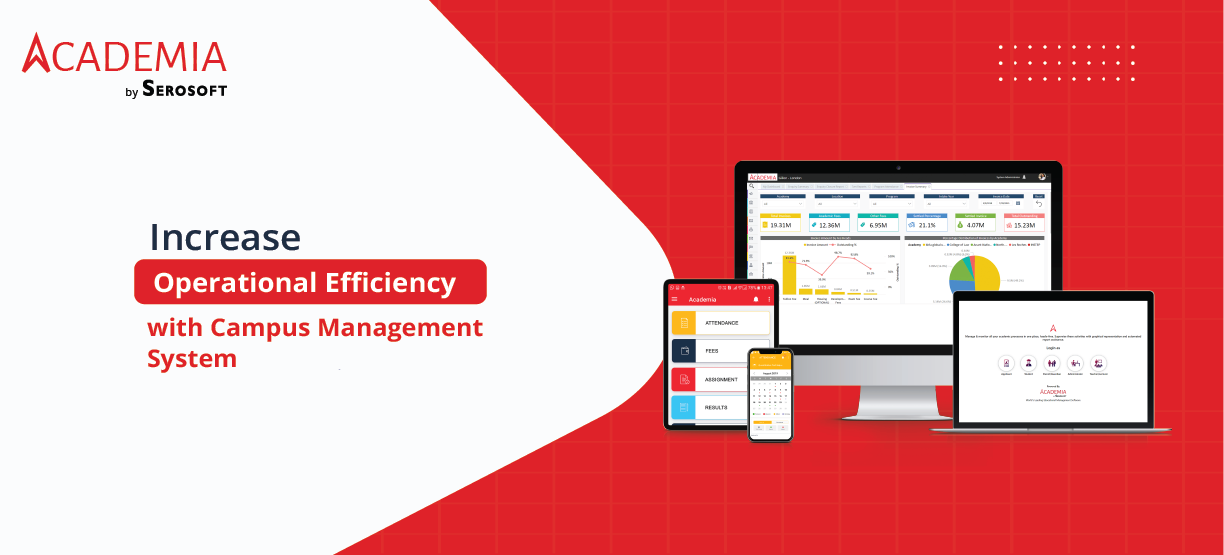
Campus Management System: How to Increase Educational Institution Efficiency?

The competition among higher education institutes is increasing day by day. Colleges and universities are at each other’s throats to capture the attention of the best minds and engage them to become a student in their institutes. However, engaging an applicant and retaining them all throughout the student lifecycle would take more than a sprawling campus and a large population of existing students. 

Modern-day students are tech-savvy and they prioritize experience over everything else. It is important that you cater to them a top-notch learning environment based on data-backed decisioning, rather than take actions based on a shallow understanding of the needs of the students. 

Unfortunately, this cannot be fully realized with the traditional methods of operations. Technology-driven solutions can help you increase accountability in your academic and administrative staff and provide solutions to improve departmental functioning. If you are aiming to have quality lead generation from your enrollment campaigns and want to continue high student retention, you need Campus ERP that supports efficient student lifecycle management and other institute operations digitally. 

Centralized Campus Management System for Colleges

Centralized Campus Management System is a cloud-based education ERP solution for institutes of all types and sizes. It supports multi-premise institute management, and interoperability. It enables automation and improves operational efficiency and multi-level reporting. Simply put, the software helps you in the central management of the college and departments while supporting the functions of all stakeholders. 

Using a campus management system for admission management, examination management, student information management, employee information management, timetable management, resource planning, and management, fee & finance management, and more. It helps you in digitalizing administrative tasks and improves student management. 


Advanced Campus Management By Academia ERP – Centrally Manage Colleges, Group of Institutes, and Universities. 

– Student Lifecycle Management

– Student Information Management

– Campus Administration

– 100% Automation of all operations


6 ways in which Campus ERP improves operational efficiency

  • Organize Administrative Work

College staff has responsibilities of carrying out several duties simultaneously. This automatically affects their productivity and impacts the quality of operations. Moreover, there is a lot of dependency between departments which causes a lag in operations. There are several repetitive tasks that are needed to be done on daily basis. This eats up a lot of productive time and stops the staff to focus on their core responsibilities. 

Campus management software helps in automating most operations in an institute. The centralized database keeps a log of operations and provides real-time data for improved reporting at all levels. Furthermore, it comes with in-built features and functionalities to manage seasonal activities such as admissions, examinations, financial reporting, and account management, etc. 

Using the software can help optimize administrative processes and boost decision-making. It also increases the usability of data as modern ERP systems support interoperability between software systems creating a unified ecosystem for improved functioning. From record creation to management to automating operations and monitoring, a Campus ERP solution can improve the administrative capabilities of a college or university by several folds.

  • Automated Admission Process

Admissions are one of the most important phases in an academic year. However, they are highly mismanaged due to inadequate planning, and poor execution. It is prone to human errors and procedural delays. Irrespective of the years of experience and expertise administrative staff displays, it is normal to encounter challenges in seamlessly managing and executing admissions. 

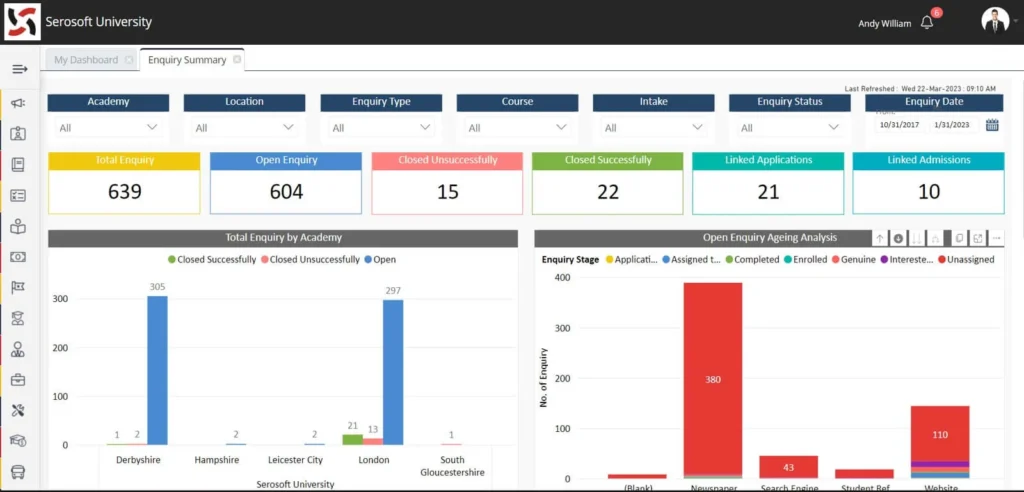
Campus ERP solution comes with built-in enquiry management software that captures and allocates enquiries automatically from multiple sources. It makes enquiry management easy and provides features to digitally manage the admission process for individual students. The in-built error-detection and conflict system reduces the chances of human errors and ensures accuracy in data management. 

The system also improves communication between prospects, applicants, and administrative staff. This is done through its efficient omnichannel communication toolkit. It allows you to interact and communicate crucial information to applicants over calls, SMS, emails, WhatsApp, etc. The system also sends out automated updates when there is any change in their application status.

The in-built filter system improves student selection. The system maps student applications with course enrollment criteria. On detecting any conflict between the application and the terms & conditions for enrollment it automatically rejects the applicant and reduces the workload of employees. 

  • Student Management

Student information management systems are becoming very popular in the higher education segment. It helps you centrally manage a data repository containing, personal, financial, and academic information of the students. Centralization of information increases the usability of data by several folds. The system also comes with an auto-update feature that streamlines the examination schedule, student marks, subject schedules, curriculum details, and individual reports. 

Besides, the student management module within the system integrated with the ERP solution enables easy access to the college administration and teaching staff. In addition, the students and their parents can check the details as well. 

  • Examination Management & Execution

A college can efficiently manage and execute online and offline examinations through campus management systems. The software system comes with a plethora of features and functionalities for pre-examination, examination, and post-examination management and execution. The software can also be integrated with a learning management system where the data gets automatically synced between the two systems reducing the task of the administrative team. Apart from that, you can publish results online over the student portal. 

  • Online Fee Payment

Financial management with campus ERP becomes fairly easy. You can integrate the software with 3rd party payment gateway and enable online fee payments. Using it you can start accepting fee payments through debit/credit cards, e-wallets, UPI, net banking, etc.

Furthermore, the software provides you with real-time data on fee records, and pending payments and also sends out alerts to parents and students. It also automatically calculates the late fee as per the configuration. The number of reports that come in-built into the software also provides daily, weekly, and monthly reports on fee collection and other financial records making reporting easy. 

  • Staff Management

The program and course module help in the allocation of academic staff to the classes and assures error-free management of the timetable. The software comes with an in-built, staff, teacher, and infrastructure conflict system that allows you to prepare timetables more accurately. This provides you with higher transparency in the operations and you don’t have to worry about the non-availability of staff, teachers, substitutes, or infrastructure. 

Wrapping Up

Campus management systems can benefit you in a number of ways. Digital transformation is the key to improved management of your college and ensuring your staff is at the top of the game to offer the best experience to your students. Increased efficiency, productivity, and improved experience – learn more about the Academia campus management system and how it can benefit your college to have higher profitability. Academia ERP can help you with Campus ERP Implementation faster than others, connect with us.

How Education ERP can help Colleges Combat Enrollment Crisis?

Colleges and universities are combating declining enrollment rates and precarious financial situations. As the institutes struggle to devise strategies that are suitable for dealing with this looming demographic cliff, one thing is well understood — legacy software needs to go out and new-age modern systems need to come in. 

Learn how in the age of declining enrollment rates, higher education institutes can find solace and definite solution in modern systems such as Education ERP to maximize enrollment and ROI. 

Education ERP for improved Student Recruitment & Retention

One of the best ways to avert the situation is by effectively managing the admission phase in your college or university. Attract the right students, engage them throughout the admission phase, support them throughout the academic year, and retain them. And investing in a modern ERP specifically designed for higher education institutes can help you in this course. 

Modern ERP can help Recruit Right Student To Your Campus

An ERP for higher education comes with an in-built Human Capital Management System and Finance Management System that is centrally mapped with the student database. The modern systems are also equipped with rich analytics features and help colleges and universities to gain insights into the type of program that is most preferred by the student population. Using this, an institute is able to plan more seats in these programs, offer a more wholesome curriculum, invest in more resources, and higher better faculty to attract students. This can be a great pull for the students and can help an institute to increase enrollment in the programs that are most profitable. This can be a very impactful recruitment strategy. 

Modern ERP can help institutes attract Students that are a right fit

A student needs to be academically as well as culturally attached to the college or university to apply and enroll itself. Hence, modern ERP solutions can help an institute to reach out and attract students that are a right fit for their campus. 

Tools such as personalized messaging, push notifications, multi-media messaging, and automated responses for faster query resolution can work wonders in attracting and engaging students. 

Also, modern software is equipped with a Scholarship Management tool that can help you in segregating deserving candidates from the thousands of applications and provide financial assistance and aid to the right students. With modern ERP built for colleges and universities, you can simplify scholarship distribution, reimbursement, and other financially complicated processes. This would further help you retain your students better and provide a channel for you to have a sustainable revenue stream. 

Modern ERP can help attract new students

One of the latest trends seen in the education industry is that of the growing number of non-traditional, older-generation students. 

The older students tend to be more inclined towards learning and are more career focuses. They usually have responsibilities such as full-time jobs or families to look after and hence they usually go to colleges and universities that provides flexible degree and credentialing programs that can help them gain high-paying career. 

ERP for higher education can enable students to effectively offer hybrid learning options alongside competency-based education programs, micro-credentialing and badging programs. The types of education that provide the fastest pathway to employment for these learners can serve profitable for your institute. 

Modern ERP for retaining existing students 

Engaging applicants is not a 100% assurance of a sustainable revenue stream. You need to constantly keep students engaged to combat the enrollment crisis. It is important that you retain students and increase your attrition rate. According to a study by Education Data, 40% of students that enroll in an undergrad program drop out and these dropout rates are higher for non-traditional students. 

ERP for higher education can help you devise and execute a student retention strategy. Using in-built data analytics and predictive modeling you can identify students at risk and provide institutions with the tools necessary to intervene early. 

Through early intervention, you can engage a student and avert the situation in which a student drops out.  

Wrapping Up 

Modern ERP gives campuses many tools to help attract and retain students. But it also helps institutes to manage their processes and operations better and ensure a better experience of their students not just academically but overall. Modern ERP enables students to better engage, advise and empower the learners. It supports small to big operations and frees up your staff and faculty to solely focus on the growth of students and assist them throughout the student lifecycle. 

It promotes transparent communication and improves decision-making through data. It provides better options to personalize education and manage programs and courses. Modern Education ERP solutions built for colleges and universities are very successful in attracting, engaging and retaining students.

Student Information Systems reduce the amount of time spent on mundane tasks. How does that work?

Many education institutes have adopted new ways of teaching and learning, powered by modern technology. But what about student record management? Here is how the student information system reduces the management of administrative and academic records and can increase the productivity of staff by 70% (Read CECOS Collge, London Case study). 

What is a student information management system? 

A Student Information Management System or Student Information System (SIS) is a software application used for collecting and managing student data. SIS serves as a centralized data repository to support key academic and administrative processes organization-wide by providing access to real-time information to the departments. 

Continuous improvements in technology and the availability of high-end resources have boosted the functional capabilities of SIS. It is now used to automate a number of daily tasks and increases employee productivity by several folds. Since it is an electronically managed and maintained database, access to information is very fast, and economically viable than traditional sources. 

It can be used for any educational organization, be it a school, college, university, or training institute. Institutes can manage student data throughout the student lifecycle using SIS.  

Important Features and Functionalities in a Student Information System (SIS)

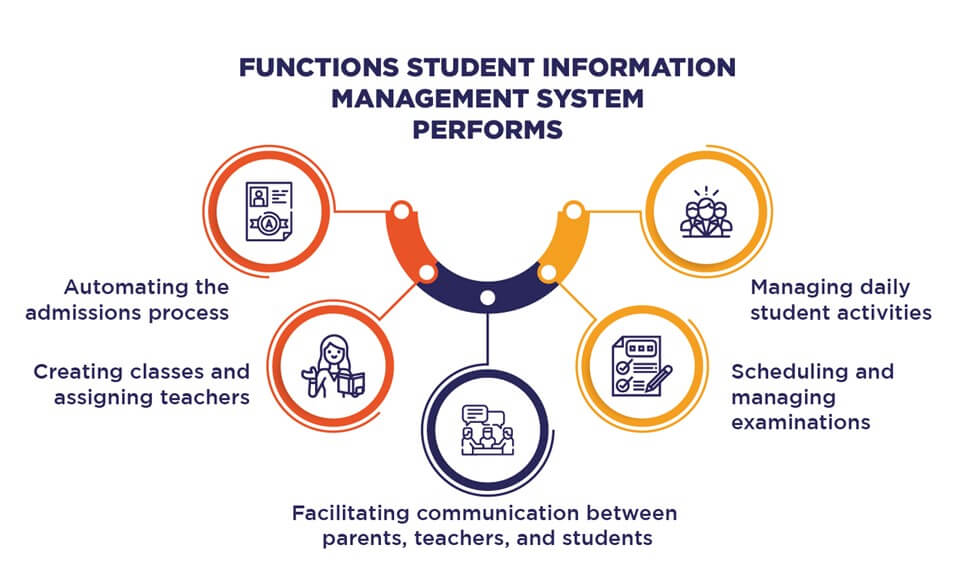
  • Automating Admission Process

With the help of this system, the admissions team and admins can automate a variety of operations in the admissions process. Once the data is stored of an applicant in the system, the information can be used for — applicant engagement, tracking the admission process, queries, and communicating messages on a large and individual scale. The system can also be used to send acceptance or rejection letters to the students and communicate any other important information.

  • Programs & Courses Management and Assigning Teachers

Easily create classes, assign teachers, manage courses, do lesson planning, etc., digitally. Student information systems are usually packaged within ERP software for education institutes. This means, not only do you get the features to manage student information but the information stored within SIS can be securely shared across various in-built modules and power digital operations using ERP in full capacity. 

The student information system records the course enrollment information and subject choices. Using this admins can digitally manage teachers, timetables, classes, resources, etc. 

You can also use the software to configure optional subject choices, program paths, course paths, fee structure, examination structure, grading method, and other related elements. 

  • Managing Daily Student Activities

Education ERP solution maps all sorts of academic, financial, and administrative records to the student ID in the student information system. This means a faculty or the administrator can pull student records for attendance, examination, health, fee, discipline, and more anytime as authorized by the super admin. 

This provides a better opportunity to manage the student lifecycle, and make decisions that are best for the student’s success. The student information system software eliminates the manual work of administrative and academic staff. 

Not only, does the software serve as a tool to manage and record the student data of a variety of things, but it also tracks the communication between staff and students, notices released to the student, actions are taken to discipline the student, and more. 

  • Scheduling and managing examination

Examination management and execution becomes very easy. The software provides specific tools and functionalities to manage and execute the examination phase with utmost success. Right from examination notification to form-fills to exam execution and result publication, the software provides all the necessary tools and functionalities to manage the examination phase successfully over a digital platform. 

  • Timetable Management and Lesson Planning

The system makes it easy for an administrator to track and check the available teachers on particular data and most importantly, whether the course syllabus for a subject is completed on time or not.

It helps an administrator adjust their human resource for optimal functioning with fewer resources. It also allows it to check the calendar, manage timetables for multiple classes,  manage national holidays, and schedule tests and exams as per the available information. 

  • Facilitating Communication between Parents, Teachers, and Students

Student Information Management System can facilitate communication between parents, teachers, and students. Since, the system stores all the contact information of all three stakeholders in an online database, it can be used to share important information, notifications, and news to them regarding ongoing and upcoming school activities. Parents can check the student’s progress and performance in real-time and request to connect with teachers to participate and involve in their ward’s education.

Conclusion

From the above list, you can see that student information system software is highly efficient in pivoting the regular and tedious everyday academic activities and automating these processes end-to-end. It can help you free up your resources and utilize them for more important tasks and operations in the institute. It improves efficiency and transparency in the operations and eliminates the common problems faced by teachers, staff, and students to bring more meaning to the operations.

So, what are you waiting for? Contact our ERP expert today to learn more about Academia SIS (Student Information System) and reap the above-mentioned benefits. 

Academia ERP for Pre-Admission Management from Start to Finish

Are you searching for pre-admission software that allows you to record all inquiries before admission starts? If it is a yes, you are in luck. 

Academia ERP is a digital transformation solution for schools, colleges, universities, and training institutes. The efficient software comes with 35+ modules, including pre-admissions and admissions. 

The pre-admission module in Academia ERP helps you streamline admission enquires and manage them on the go. The product offers you high-end functional capabilities to manage all the activities of the admission phase and improves your enrollment rate and applicant experience through a plethora of available features. It also makes reporting incredibly easy. Here is everything you need to know about the pre-admission software/module of Academia ERP. 

  • Enquiry Form Set-up

The pre-admission module in Academia ERP allows students to apply for admissions through your website. Admins can add custom form fields to the application form to suit your institute’s needs. 

Admin can access applications received from various custom applications and inquiry forms in a centralized location. Admin can also take various actions pertaining to applications and use the custom application fields to track or search any particular applicant or enquirer. 

  • Campaign Management

If you use multiple platforms to run ads for admissions, campaign management is a highly valued feature in the Academia ERP pre-admission module. The feature allows you to assign the ad responsibilities to people, add ad budget, manage its spending and track its result.

You can use the feature for digital and traditional both platforms. The tool helps you identify what are the most profitable channels for your institute and not waste your money on the platforms which are nonyielding. Hence, it is not only a good tool in the kitty to manage campaigns but also to track the finances and the results of your ad campaigns. 

  1. Enquiry Management

With built-in CRM capabilities inquiry management feature of Academia ERP can help you in end-to-end management of all your enquires. It allows admins to assign applications/inquiries to people in the department, track progress, edit, or view the form in detail and generate several reports. 

Admins can see how many enquires were converted to applications and admissions, from what channels these inquiries come, what was the experience of the enquirer with the institute, and other factors. It also includes omnichannel communication — allowing you to send emails, push notifications, WhatsApp messages, SMS, etc., to enquirers to respond to their queries or share any crucial information. 

  • Dashboards & Reports

The system consolidates the data present in a centralized database to provide you with accurate reports and visually-stunning graphical representations. The tool makes automatic reports without any manual intervention when prompted. Since highly configurable, you can customize the reports easily as well. Create reports on campaigns, inquiries, follow-ups, appointments, conversions, etc., easily using the tool. 

Wrapping Up

Admission phase in any education organization consists of two segments. First, pre-admissions, which is more or less preparedness of any institute to capture as many applicants as they can and attract good candidates to study in their institute. And second, the admission execution. Academia ERP consists of both these qualities in one single software along with 35+ other modules. Learn more about the product and know how we can help you undergo digital transformation. 

Back to top