Type your keyword below

How Education Management Systems Are Revolutionizing Student Learning Experience

The new generation of students is different, having a modern approach for everything, they demand a quick, easier, and better way of performing any operations. So for this, it is high time for educational institutions to adopt modern techniques and ways that can help in optimizing a better student learning experience. What do you think about an education management system? Do you know why student experience is important for institutions? How can it help institutions in managing all the operations in a more systematic way that can lead to revolutionizing the whole student learning experience? Let’s discuss all these points in this blog. 

First of all, let’s discuss why student experience is important! 

Why is student experience important?

Students in any educational institution needed to be considered as a priority, for this, institutions can adopt modern tools and techniques like an education management system to provide seamless learning experience automating and streamlining all the academic and administrative operations in the institution like enrollment, records, teaching, homework and assignment, library management and a lot more. Isn’t it interesting?

How is the Education Management System helping to Improve the Student Learning Experience?

  • 24/7 Access

The education management system provides easy 24/7 access to everyone, students can check and submit their assignments anytime, can access their fee details along with receipt generation at the time, important mails, library, and whatnot! They can operate any feature anytime according to their flexibility and requirements. 

It results in saving time and efforts of students that can be consumed in other productive activities. 

  • Offer Centralized Access 

In an educational institution, multiple things need to be managed at different ends. Various tasks need to be managed at each end by administrators, staff, and students. Right from admission to alumni, there remains a bundle of works. Having an education management system, institutions can provide required access to every individual on the same platform eliminating extra time, effort, and chances of errors.

Easy and Convenient!

  • Analytics and Reporting 

Students often in institutions complain about a lack of timely feedback, exact analytics, and reporting of tasks that hinder their learning experience. With manual interventions, students often have to wait for things like feedback, approval, and even their performance reports.  

An education ERP helps institutions to generate all the reports along with real analytics on the time. It helps students in staying motivated and encouraged towards their end goal i.e., their studies. It also helps faculty to get a clear picture and in-depth understanding of a student’s learning curve.

How easy! 

  • Customization of Learning Experience 

It is the best feature that institutions can initiate using an ERP system, it provides real-time access to customize the learning experiences for students. Faculty can create customized homework and assignments, can provide assessment details, can discuss passages to discuss queries with students, can use podcasts to improve their learning skills and a lot more. 

So isn’t this customization that can generate more ideas and techniques to learn and attain institutional objectives? 

  • Reduced Paperwork 

Any educational institution involves a lot of data and paperwork. Hopefully, you will also agree that more paperwork and managing those papers and documents is the hardest and messiest thing, not only for students but also for faculty and other staff, right? An education ERP can help institutions to improve the student experience and faculty experience by exchanging papers and documents with computerized processes and management. 

An effective ERP manages all the documents, right admission forms, examinations papers, result paper, and all other documents can be created and sent using the mobile app and portal which reduces the time, efforts, wastage of paper, and of course easiest access. 

What do you say? Easy enough! 

  • Encourages Continuous Learning 

As discussed, an educational institution involves lots of necessary tasks like fees, examination documentation, and many others. All these occupy a lot of time for students in manual processes. So having an education management system, institutions can provide students with a mobile app that can simplify and automate all important operations like fee submission, examination timetable, entrance card, results declaration, and all other things, they will also get notifications like when is the next slot for fee submission. A mobile app associated with an ERP helps in encouraging continuous learning reducing the excessive time from other administrative tasks. 

Relief from other tasks means the right to focus on studies, right? 

  • Effortless Communication 

Effortless communication between students and faculty is the most important element in any educational institution, it needs to be efficient for the smooth functioning of the institution and to provide a revolutionizing student experience. An ERP software helps educational institutions to achieve this objective effectively providing platforms like mobile apps and portals for operating all the operations and communicating thoroughly as and when required. 

Easy communication breaks all hurdles! right? 

Academia – A revolutionizing ERP software for educational institutions

Various ERP vendors provide good ERP software for educational institutions, but institutions must focus on having a platform that focuses on the 360-degree development of the institute. Academia Education Management System helps institutions to indulge in the digital world making everything smooth and easier for students and faculty along with providing a 360-degree development of the institution. 

Also check:

Top 13 Reasons Institutions Should Use Student Database Management Software

Conclusion

Hope you liked the blog and it helped you in understanding how to improve the student experience at university, and how it can help transform the overall atmosphere of your institution along with providing a revolutionizing student learning experience. What do you think, is it relevant for your institution? Get your queries clear with us, request your demo now! 

 

Importance of Education Management Information System

In this modern era, educational institutions need to use various technological tools that can help them in managing and running their institution properly, but with the technological advancements, educational institutions need to opt for a system or software that can help them connect all the operations in a single system having access to all the operations. An education management system is a new-age software for institutions that can help them in managing all the vital operations easily and efficiently becoming the backbone of modern institutions. 

There is a huge landscape for educational institutions in today’s time in which they need to set their footprints. Now working on just spreadsheets, Microsoft Excel, Microsoft Word, and tools like this make your institutions slow and far away from top technology and trends. So having an education management information system can help institutions make all the decisions quicker along with providing systematic, simple, and efficient work bringing complete automation in every way.


Let’s discuss some of the key elements that can help you understand why an education management system is beneficial for your institution:

Understanding the Importance of an Education Management System:

  • Admission & inquiry management 

It is one of the crucial segments for education institutions to increase the potential strength of students along with retaining the existing one. Education institutions should need to choose a method that can help them rely on admission & inquiry management strategically. 

Education management software helps institutions in the best way. It creates a smooth path to solve all the inquiries related to admission focusing to turn them into real-time students for a long time. Along with this, it helps in managing academic goals by engaging the current students of the institution. 

  • Student management 

A student lifecycle is the only thing in any institution which needs to be better and better from any angle, whether it is admission, attendance, or examination. To become a successful institution, an institution should focus on student-centric management that can lead towards their engagement, interest, and of course their growth. 

An education management information system most importantly works focusing on the initial growth of students, making all the academic and administrative operations simple, systematic, flexible, and robust in every way. It provides a student mobile application and portal in which they can easily track their progress along with submitting assignments, checking their timetable, checking their results, and whatnot. All of these save their time providing them more time to focus on their studies and in-person growth. 

  • Library management 

The library is one of the most important segments of the institution. Students can get any of the important books whenever they require it, but asking the librarian “how it goes managing the records of the library manually?” is not so interesting as they find it very hectic to keep a record of each book and ask the student to return those books on time. 

So what do you think is the best way to make it easy and smooth on both ends that is students and librarians?

The best answer to this is library management using an education management system! 

It can most efficiently solve all the problems providing students and teaches an authority to browse the available books online from anywhere and anytime. Most importantly it provides easier management to the librarian helping in keeping and tracking the records of each book associated with each student. It even can allow penalties on the students who do any kind of damage to the books after the allotted time.

  • Student-teacher collaboration and communication

Student-teacher collaboration and communication is the most important thing in any educational institution, it needs to be crystal clear from every angle. Students, parents, and faculties need to collaborate and communicate properly to manage things in a better and more organized manner. 

An education management information system provides proper and easy management of academic and non-academic activities of the students. It provides a platform through which parents can contact the faculty anytime along with providing their feedback in the most effective way. 

  • Fee management 

Fee collection is one of the most important and primary sources of income for educational institutions, but having manual intervention fee management in most of institutions remains a hectic, messy, and time-consuming process. 

An education management system provides institutions with complete automation of the complete fee management process, it automates the fee collection and receipt generation process along with sending alerts to parents and students regarding the fee due dates. It also erases the lengthy procedure of queuing at the fee counter just to pay the fee making all ends – parents, teachers, and faculty happy and satisfied. 

  • Examination management 

The examination is undoubtedly the most important and busiest time for educational institutions, in the examination period, the faculties need to be systematic and proper in each way. Examination processes require very seamless functioning which in manual operations includes multiple stages starting from exam admins, staff, teachers, exam center managers, and a lot more people get associated just to make the exam process proper and efficient making the overall process long, time-consuming, hectic, and difficult for all. 

The education management system software provides complete automation of all the processes by scheduling online examinations and publishing results making it quick and worthwhile for faculty, students, and admin staff. 

Academia Education Management Information System for Modern Age Institutions 

Various ERP vendors in the market provide educational ERP systems for institutions, but institutions need to choose the best ERP or education management information system that can help them in making everything systematic along with targeting increased revenue generation. 

Academia is one of the award-winning education EMIS providers for universities, colleges, schools, and training institutes. It focuses on fulfilling all the comprehensive and customized needs of the institution along with targeting complete digital transformation automating all the academic and administrative tasks in the institution. 

Also, check – How Education Management Systems Are Revolutionizing Student Learning Experience?

Closing Notes

So, it seems interesting? What do you think about it? An education management information system is worthwhile and helpful for educational institutions that can initiate a new and bright perspective. Let’s connect for a while to discuss more. Request your Demo now.  

5 Amazing Benefits of Online Institute Management in Education Sector

The time has changed. The working style around the globe is changing, it isn’t limited to office premises anymore. With the changing dynamics of other working sectors, education is also following the same path.

It is noticeable that learning methods have also changed in the last few years. Video tutorials, online content, e-books, social media groups, global connectivity among students, teachers; all of this has expanded the horizon of education, its resources and distribution.

Along with learning management, institute management is also changing. Colleges, universities, and other higher educational institutions are adopting online student management (Education ERP) to manage their day to day tasks. It helps institutions to integrate all administrative processes in a single platform, brings seamless workflow, and ultimately enhances stakeholders’ satisfaction.

Considering the current scenario of the Corona pandemic, institutions have to manage their paperwork and other academic tasks remotely. They are using different platforms to deliver notifications and updates, which is quite tedious and time-consuming.

However, with the help of online institute management, it has been easier for institutions to maintain institutional continuity. Let’s see what benefits educational institutions can get with online education management software:

Reduced Costs

Educational institutions are full of paper works. They also need communication mediums to contact the student, their parents, teachers, and other staff members on a daily basis. For that, they need to partner with the third party to regulate these processes that increase the overheads. And that too fails sometimes.

With online institute management such as Education ERP, colleges and universities can reduce their stationary and communication costs along with other administrative expenses. It not only makes these processes more swift but it also simplifies maintenance of data and reports.

Academia Student Management System provides an internal messaging system to deliver notifications to students, teachers, or parents or to all of them with a single platform. Know how it works.

Institutional continuity

Many institutions have suffered a great deal of loss in the closures of educational institutions due to the COVID-19 pandemic. It has impacted students, teachers, and staff on varied levels. Due to internet connectivity, social platforms, and SMS & Email services, educators could only inform each other with the current status but the institutional continuity was compromised. As remote working became the only way to keep the business running, some educational institutions were not able to bring that on.

Here comes the role of online management. With the help of it, institutions can regulate most of their curriculum online. Assignment submission, fee payment, student marksheet distribution, syllabus management, and its distribution and much more can be done with automation in education.

Better Connectivity

Communication is the key to running a successful organization, and it would be ignorant if we overlook its role in the education sector. Proper communication is very important not only between teachers and students but also among all the stakeholders.

By bringing digital transformation in education management, the connectivity increases by many folds. Learning goes beyond the campuses. It provides exclusive portals for everyone where they can not only get the recent updates but can also manage their details and records. With Faculty and Student apps, it becomes super convenient to manage the day to day task, wherever whenever.

See how INIFD Indore getting the benefits of Academia ERP to increase communication.

Work alignment

College, university, or school all of them have various departments. Admin, admission, programs and courses, fee, transportation, hostel, logistics, and many more. Sometimes it becomes so scattered and tedious to manage records from all these departments and maintain the work alignment.

An education ERP helps to maintain these departments in one single platform. It simplifies the workflow brings alignment and increases productivity.

Error-free processes

To err is human!

Humans are prone to make mistakes, and there is nothing wrong with it but being an education leader, you can’t take the risk. One error can cause a series of chaos and that reduces the space for development.

Unlike humans, technology doesn’t make errors on its own. With a tool, we can not only make our work flawless but we can also save a lot of time. An online student information system like Academia ERP has many features that are designed to help teachers, students, parents, and management and allow them to manage their work efficiently.

The ultimate benefit

The most important thing that attracts educators to shift into a digital platform is convenience. It empowers all the associated members to operate their tasks whenever they want and from whichever device they choose. It breaks the limitation of growth and efficiency. It gives educators and management to think beyond bundles of paperwork.

How Education ERP is Changing Dynamics of the Education Management

The education sector is in the advent of complete digital transformation. From online education management to MOOC (Massive open online course), e-learning, flip classroom; it is going to have a paradigm technology shift in the coming future.

Among all the education technologies, Education ERP is one that is playing a significant role in institution management. According to a study, Education ERP is going to grow 3X by 2028 with the increase of CAGR (Compound annual growth) 10.9%.

In today’s rapidly evolving electronics market, educational institutions are using education ERP solutions for managing, planning, controlling and delivering data effectively.

In this article, we’ll see how Education ERP is changing education management.

1. Digitization of complete administrative processes

An education management system integrates all the academic processes in one place and makes it easier to manage the day to day tasks. It helps to automate the entire administrative processes from admission to course completion.

It is an online student management system that makes workflow seamless, easy and efficient. It centralizes all the departments and allows staff members to communicate better and helps them to exchange information in a hassle-free manner.

2. High data storage with disaster recovery

This is one of the most prominent benefits of a web-based education management system. It is obvious that educational institutions generate a huge amount of documentation. To store and manage these documents manually is a tedious task that is also prone to physical damage.

With cloud-based campus ERP, institutes can easily store endless documents on the web with no worry about data storage capacity. Moreover, with the disaster recovery solution, you can back up the data on a remote offsite server, keep it safe from any kind of damage and recover it without any data loss.

3. Student management beyond campus boundary

What if student management is not limited to school/college timing?

An education management system is a solution that increases the connectivity between teachers and students. Students can check assignments via their portals, submit documents whenever needed, access their details, check their results, submit their fees online and do much more. Teachers with Teacher Portal, can check, remark, upload assignments work, download them for evaluation, track students’ academic records, etc.

Not only this, with the parent portal, parents can also keep track of their child’s academic activities, such as attendance details, results, remark from teachers, their achievements, etc.

4. Student-centric education management

The main objective of an educational institution is student development, giving them proper time for their complete improvement. However, due to the increasing number of academic processes, teachers and staff members have lots in their plates, therefore, it becomes difficult for them to focus on students.

Thanks to the education management system like Academia ERP, it takes the load off of trivial academic operations from teachers and allows them to invest their time in students and develop their teaching approach.

It helps institutes to build a student-centric ecosystem, which enhances student performances, improves the productivity of academic management, strengthens the credibility and thereby helps the institute to grow.

Education ERP: A tool to accelerate the growth of educational institutions

Institutions are shifting to digital transformation and implementing education ERP for managing, planning, tracking and controlling its regular task from beginning to end is the fundamental step toward that development. It is helping institutes to bring better management, efficiency, and cost-saving. It is enhancing the student experience, employee engagement, and changing the dynamics of education towards exponential growth.

Academia education management system helping more than 200 institutes worldwide to reach their higher potential. What are you waiting for?

Take the step toward a better future for your institute, shift to automation with Academia. Book a FREE demo now!

9 Benefits of Technology and Its Effect in Adapting the Education System of Present Generation

Education is not limited to blackboard nowadays. With the advent of the digital revolution in the 21st century, every organization every department is moving towards digitization.

Technology has made many tedious tasks into more streamlined and smooth work. In education also technology is playing many roles to make education more modern, more aware, informed and updated. There are many software and programmes which are making the education system more collaborative and synchronized. Academia ERP is one of the leading education management programs that is making handling and managing many education systems easier and efficient.

There are many benefits of using technology in the education system in the present generation. I am listing here the top 9 benefits of the technology in the education system.

1. More Resourceful education

Previously there were limited resources to gain knowledge about a particular topic. And if anyone wanted to dig deep in any topic he/she had to go through thousands of books, paper, research work to gather the information.

Today it is not like that; Whether you are a grad student or primary school student or teacher, you can get tonnes of information within seconds for the topic you want to know. Education has become more resourceful with the help of technology.

2. Tedious tasks have become easy

Keeping the record of student attendance, fees, homework, examination, and everything required tedious manual work of hours. It was time-consuming and hectic. With technology like Academia ERP, it has become easier than ever. Keeping the record of everything is simple, smooth and systematic. An Education management system i.e. Academia will ease out your processes and make institutional life simple.

Academia- leading-edge education management software” has already started working on AI chatbot which will help the institute with auto-generated answers for the queries of the users and make system effectively efficient.

3. Fresh Information

With technology student and teachers, both get the newly updated information. The world is changing a lot and there are new researches, new invention going on every day. If you want to move with the world you have to keep up with this. Technology helps the education system to move with the world. They can find fresh information about every topic they want.

4. More collaboration in the classroom

New tech always attracts everyone. With new technology and gadgets, it has made the classroom more collaborative. The students and teachers can connect in a more effective manner that increases the exchange of knowledge easier.

5. More experiments than theory

Experiments make the learning foundation strong, this is a fact. When student experiment the topic they learn it increase the comprehensive understanding of the student.

With the use of technology understanding and skills of students and teachers both have reached a new level.

Through an ERP solution i.e. Academia, Teacher & student can interact more easily and effectively.

6. No more burden of heavy books

Different book for a different subject, different notebooks for different homework.

Not anymore!!

With the use of technology, hard copies of books are becoming obsolete. They take more space and difficult to handle many books at a time.

Internet and mobile/laptop/tab has helped the student and teachers to reduce the burden of all these papers and books.

7. Technology is a necessary life skill today

Use technology is not a fashion now it is a necessity. It is a life skill to stay forward in the world, to be updated in the world.

If you are aware of how to and where to look to get certain information you are already ahead of 50% in your work.

An education system with technology is a complete structure for student and teachers and management.

8. Technology has changed the relationship between teachers and student

Teachers and student relationships are changing and it is more simplified now. They connect more effectively. The exchange of information is better, effective and comprehensive.

9. Full participation and more fun way of learning

Online poll and feedback of assignment have made the student participate more in the learning. Data analytics and education software have made the teachers/professors find out where the students are lacking so that they can change the classroom program accordingly.

Technology has made education more fun and interesting. As the interaction and knowledge are not limited to simple blackboard drawing. Students are learning in with more focus and with more efforts.

On concluding note:

The education system is what changes the future of the world and technology is helping to make this change in more faster, more efficient and more powerful ways. Present generation very aware of its needs and requirement. There are more Elon Musk, Mark Zuckerberg ready to roll the world. Technology in education is a system is benefiting this generation to reach new goals.

For the bottom line, Academia is the right solution to overcome challenges and success in managing your institute. We provide systems with the right cost that fits your pocket and benefits you enormously once implemented. Academia Provides the best support in the industry. (Look at the client testimonials, how: https://www.academiaerp.com/clients/). We provide training programmes off site and on site as per the institute’s requirements.

Transforming Education In The VUCA (Volatile, Uncertain, Complex And Ambiguous) World

Education! The utmost need and undoubtedly one of the most important pillars of civilization for its evolution, existence, survival and proliferation. The way education is imparted in the millennial era is at the peak of its transformation period where education is no more the transfer of knowledge among a group of students by a teacher. The pace at which the technological intervention has made the difference in the other industries the objective is to embrace and adopt the technology in the most efficient and effective manner.

Across the globe, the educational institutions are now transforming on a large scale hence becoming more and more advanced therefore there is a surge in productivity with a new addition in the resources and their access to different segments resulting in the generation and flow of information encompassing every single aspect of the Education System, Students Information system involving various stakeholders like Management, Teachers, Parents, and Students.

Top 10 Technologies Impacting Higher Education Institutions

Since the current world is highly volatile, uncertain, complex, and Ambiguous; the aim is to fill the gaps which exist in the current information flow system and make it more and more effective and transparent so that every stakeholder is absolutely aware of the progress and development taking place resulting in 360 degrees development of the education system.


education in the VUCA World - erp software for educational instituteThis can be done by improving the methodology by which the communication is done between the various stakeholders and incorporation of an Education ERP, or Student Information System in an educational organization is a must. This can be a trendsetter in the way the educational ecosystem operates right from the Admission enquiry of a student to follow a complete life cycle like admission, class allocation, Fees and Payments, Attendance Management, exams and reporting, Grading and Ranks and exist of a student resulting him/her to be alumni.
One of the greatest advantages of an ERP is the degree of extensively at which the data can be extrapolated and the spectrum at which it influences the Decision Making. The usage of an ERP results in a complete restructuring of an institution with a streamlined flow of information thus giving them benefits like:-

  • Technology advancement.
  • Increase in Daily Productivity.
  • Increased ROI.
  • Better and efficient communication between the departments across the locations.
  • Smart and automated classrooms.
  • Collaborated and calculated decision making.
  • Combining education with Learning and technology.
  • Improved Engagements.
  • Reduced Work Load.

Therefore it is evident that with the help of an Education ERP; Management, Teachers, Students, and Parents gets uninterrupted access to the vital Information at their Fingertips resulting in bypassing any chances of miscommunication or other issues.

In the end, the objective of an educational ERP is to provide an efficient and user-friendly product so that different needs of different users at various levels can be catered in the most effective manner and thus contribute to developing a positive a long-lasting impact on the Education System.

Want to find out how Academia Education Management System can help your institution to bring effective methodology and better communication among all stakeholders? Talk to our experts for a free demo.

Modern trends of education and technology in a sustainable future

Stemming from one of the pillars of the United Nations 2030 Agenda for Sustainable Development, quality education has taken a central stage. The agenda talks about equitable quality education that promotes lifelong learning opportunities along with inclusiveness. The overall goal is to connect the general trends affecting education in the information age. 

But why do you think sustainable development is talking so much about quality education? Shouldn’t it focus on the environment and the relationship between human development and its effect on nature? Well, after long research it was established that sustainable development cannot survive without social and cultural reforms and education plays an important role in building newer perspectives. Hence, sustainability cannot thrive without needling itself in the fabric of education. 

But to execute a change on a global scale is challenging. Education is one of the oldest industries and since digitalization has not fully penetrated into the working of education institutes it requires a major shift in the focus. As a result, the entire world is changing its policies. 

Furthermore, lifelong learning is centrally aligned with the concept. This global reform aims at being more agile in its approach. This global thought leadership has brought in trends of changes that we would like to discuss today.  

  • Information Technology 

Communication, connectivity, collaboration, transparency, and so many other things are amiss still in many educational organizations. The reason is their dependency on redundant methods of administration, management, and execution of academic activities. To counter that, education technologies are hustling to make technology and solutions cheaper. 

With a major focus on making technology user-friendly, technology partners are researching the industry to understand the digital literacy of the population in focus. Solutions for all the stakeholders in the ecosystem – Students, Faculty, Administrators, and Parents are available easily in the market. 

Edtech, digital learning, learning management systems, ERP, and other trending technologies have become an integral part of many institutes. Artificial Intelligence, Augmented Reality, Machine Learning, BigData, and Business Intelligence are being used to improve knowledge retention, student experience, student retention, and better student outcomes. Directly and indirectly, institutes are enjoying ample benefits from these technologies. 

But most of all global policymakers are aiming at digitalization because it gives them an opportunity to bring the world together and propagate the best practices for achieving sustainability goals. 

  • Change in aims and objectives

From implicit to explicit, the focus on skills has increased massively. It is not just a benefit for the students that are immediately “hire-ready” on passing their exams but it is in the interest of the world too. The more skill-based education is provided to the students along with their responsibilities to a sustainable future, the better outcomes are going to be achieved in the near future and future. 

Policymakers are ensuring professional responsibilities along with creative, strategic, and analytical thinking are taught to the students to build a better future. They want people to think of things in terms of the world, not just individual gains and losses. Promoting the participation of youngsters in achieving these goals is ensured through increased access to knowledge, availability of knowledge material in contemporary formats, and increasing collaboration and open communications through free forums and communities.

  • Education sustainability

Till now we have talked about the use of education to achieve sustainability goals. Now we should talk about educational sustainabilities. Educational ecologies are frameworks that are brought in place to promote education sustainability. It is a major shift in the current education curriculum. The ecologies provide an in-depth change in the content to improve the context of learning and align it with global goals. 

Furthermore, these ecologies are not just focused on classroom education at schools and universities, it also aims to penetrate training institutes and alternative education sources. Leaving no stone unturned, policymakers are focusing on all the prominent media and the changing infrastructure of the schools, colleges, universities, and training institutes to digital. 

Wrapping Up 

Education plays a crucial role in the lives of people. It nurtures inclusiveness and promotes shared goals that the world focuses to meet. When we talk about sustainable development, a lot of changes have to be done, not only in terms of policy and processes but also in terms of social, economic, and cultural reforms. To attain this education has changed drastically. And thus modern trends have been introduced to drive the education industry towards meeting better goals. 

Modern Technological Tools That can Improve Classroom Experience

Educational institutions in today’s time need a power booster that can essentially help them in shaping complete institutional operations effectively along with making the classroom experience enhanced and better. Educational institutions need to maintain their level by choosing a modern classroom technology that can help in increasing the experience of the classroom making them more modern and technologically upgraded.  

Various technologies can help institutions to meet all the technical aspects of having smooth, consistent, and transparent management in the institution. There are various designed tools for educational institutions that can help teachers, staff, and students in day-to-day tasks like daily attendance, timetable management, managing academic and administrative tasks like and most importantly in enhancing the student and modern classroom technology.

Let’s discuss some of the points that can help institutions attain classroom technology trends: 

  • Virtual Reality and its effects on modern learning

Virtual reality is one of the most important and basic uses of modern technology in classroom teaching, it provides a next-level experience for higher education classrooms giving a lot of potential for immersive learning. 

Education relies on appropriate learning activities in a simulated environment, it provides a safe, interactive, and engaging, it helps in expanding properly. 

Virtual reality helps faculty to teach students, providing them experience destinations from across the world in the same classroom. This leads to enhancing students’ learning providing them a different experience from any aspect. 

  • Audiovisual presentation for better understanding

Old were the days when manual interventions of teaching and learning in institutions led to improper understanding among students and faculty. In the modern world, various technologies promote the audio-visual presentation of lessons through which students can understand more properly and learn accordingly. 

  • Tech-upgraded digitally smart blackboard to enhance learning

Blackboards are considered as one of the oldest and best ways of teaching and learning in any educational institution. But with the enhanced technology in this sector and uses of modern technology in classroom teaching blackboards are also now digitally smart and are helpful in modern education. Teachers can operate a whiteboard, allowing a person to write on them with real or digital markers. 

  • An efficient and robust ERP for completing academic and administrative operations 

ERP for higher education institutions is one of the best technological tools that increase the experience for modern classroom technology, an efficient and robust ERP manages all the academic and administrative tasks like examinations management, fee management, admission management, library management, and all other tasks removing manual interventions of the institutions by bringing automation and digital transformation in best ways. Institutions must choose a very good ERP solution like Academia. It is one of the best ERP/SIS solutions that focuses on improving the overall experience of the institution and the classroom in the best way. 

  • Artificial intelligence to let the students aware of the modern world

Artificial intelligence (AI) is considered a key driver of growth and innovation across every sector and the education sector is one of them. While AI-powered solutions have been in the Edtech space for some time, it helps in the learning and teaching experience of students in the best prospects, evolving better benefits for students and faculty. AI ultimately automates and streamlines the education process, providing access to the right courses, improving communication skills, it also gives a deep impact on their educational journey. 

  • Effects of Cross-lifecycle CRM on the modern classroom

Educational institutions often hold a false perception about CRM that it can only manage transactions between different departments, Gartner says “Student cross-life-cycle CRM is a deployment that creates a campuswide, 360-degree view of students across their entire life cycle in the institution”. A CRM can be considered as one of the most advanced technological tools that can help educational institutions manage and enhance student life experience in the best way.

What Gartner report states about Top Technology Trends Impacting Higher Education?

In this extremely competitive world, educational institutions must opt for technological tools that can enhance the learning experience of students along with classroom technology trends. According to Gartner, higher education CIOs should weigh recommendations in light of these trends as they shape their IT strategy and priorities. Check this blog on Top Technology Trends Impacting Higher Education in 2021 to know what Gartner has to say about this. 

Download Exclusive Gartner Reports Brought to You by Serosoft (Academia):

Gartner research reportConclusion

So, what do you think about making your institution’s classrooms tech-friendly and more advanced? Do you already have some of the above tools executed in your institution? Let’s discuss more! Contact us now! 

Education Is Wisdom And Wisdom Is Required To Modernize Education

Education is one of the greatest needs of the day. An upgraded and student-friendly curriculum which is also closely connected with the practical needs of the day is indispensable for the survival of the fittest.

The scenario of education has broadened in the past few years. Now…..it is no longer confined to the four walls of the classroom or for that matter four walls of the school itself. The education has evolved from the primitive times beyond leaps and bounds. From the era of Gurukul to the current era of international schools, education has gone through different phases of revolution. When we talk in the context of India, the transformation is quite evident. We earlier had only state-boards, ICSE and CBSE boards. Gradually the idea of public schools set in. The Gurukul evolved into day cum boarding schools where students experienced overall and holistic development. Globalization entered into the education industry as well. Foreign exchange programs, the Cambridge board, and the International Baccalaureate bridged the gap that existed on account of cultural differences. Education is another term for integration, an integration of thoughts, morals, cultures, and passions thereby making the world a better place to live in.

Education Modernization through ERP

Change as they say is the law of nature and henceforth this law is equally applicable to academics and education. It is for this reason that it has changed significantly with the change in time. The idea of education is not to make the students book smart thereby enabling them to earn a living but to make them street smart thereby preparing them to fit for life.

In the thoughts of Robert Frost, “vocation and avocation must be combined”. Vocation refers to the job and avocation is the hobby. The present-day education system intends to do the same. It enables the student to identify their latent potentials and passion for which they have a flair culminating them to integrate those passions into professions, which is what we call vocational education.

Being educated and being literate are two different things, although literacy being a part of education. When one gets literate, he safeguards himself, whereas when one gets educated, he safeguards others thriving in the same society. Education is a dynamic phenomenon where stagnation must never set in if we want to evolve over time. Modernization and up gradation are two accompaniments of education without which the academics would perish.

The success of any major phenomenon is evaluated in terms of the quality of output it generates. The same happens in education too. The number of students that have been successful in their endeavors has been consistently on a rise. So many new avenues of professions have been generated. One major branch for say engineering has emerged into so many branches further and the same has happened with other professions too. This is what we call specialization and it has created a buffet of professions where one makes his own choice. This is how education has helped and fostered the young generation to make wise choices. Education is wisdom and wisdom is required to modernize education.

Are You Looking For Right Education ERP?

Buying an ERP is still being the biggest problem for organizations and especially for education institutes. There’re only a few good options available in the market for education ERP. It is important to take the right decision since buying an ERP is a very time consuming and expensive decision that would last for a really long time. And making mistake in such a decision is irreversible.

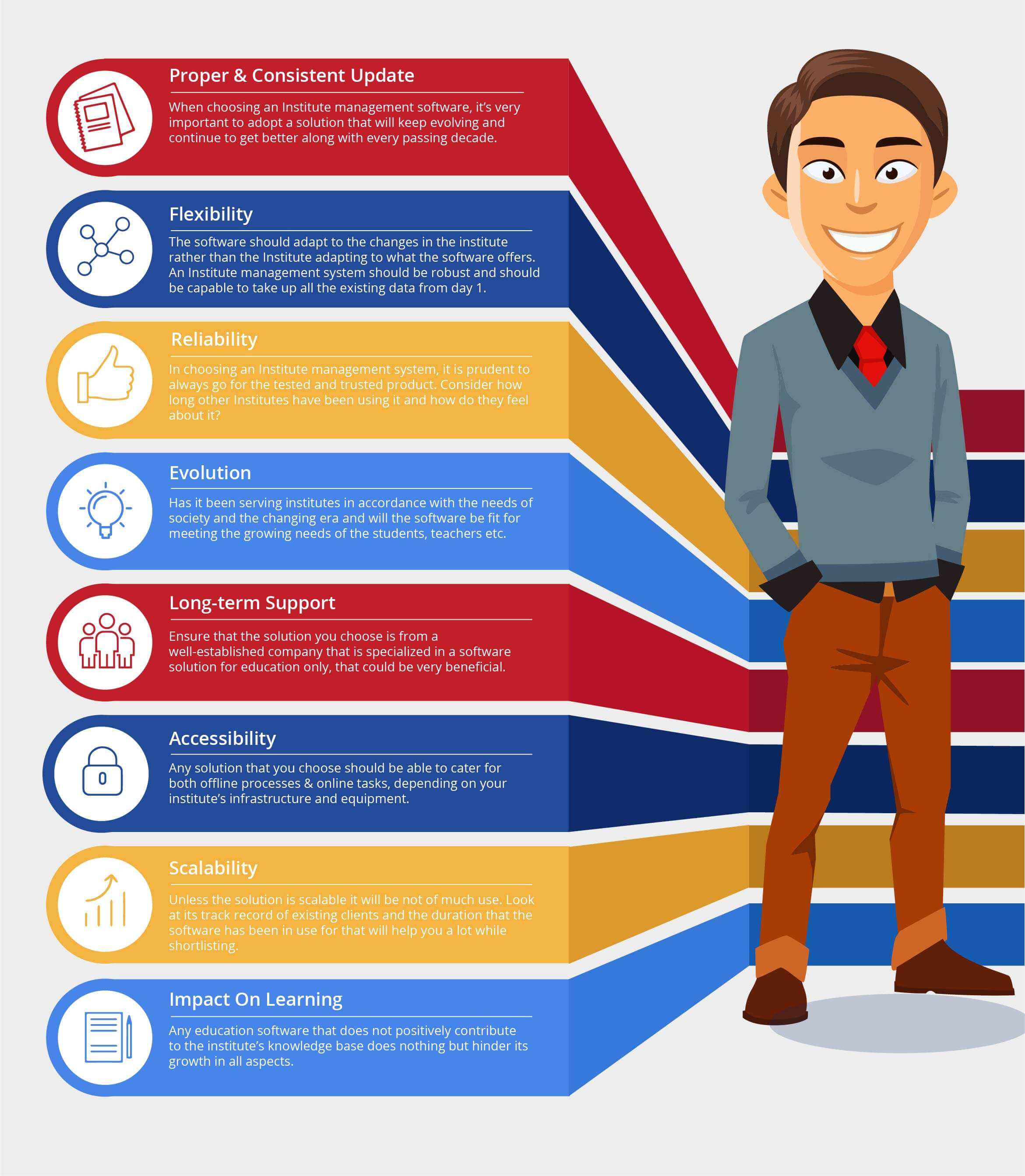
Consider these important factors while buying an ERP solution for your Institute:

  • Proper & Consistent Update: When choosing an Institute management software, it’s very important to adopt a solution that will keep evolving and continue to get better along with every passing decade.
  • Flexibility: The software should adapt to the changes in the institute rather than the Institute adapting to what the software offers. An Institute management system should be robust and should be capable to take up all the existing data from day 1.
  • Reliability: In choosing an institute management system, it is sensible to always go for the tested and trusted product. Consider how long other Institutes have been using it and how do they feel about it?.
  • Evolution: Has it been serving institutes in accordance with the needs of society and the changing era and will the software be fit for meeting the growing needs of the students, teachers, etc.
  • Long-term Support: Ensure that the solution you choose is from a well-established company that is specialized in a software solution for education only, which could be very beneficial.
  • Accessibility: Any solution that you choose should be able to cater to both offline processes& online tasks, depending on your institute’s infrastructure and equipment.
  • Scalability: Unless the solution is scalable it will be unusable or rather say not of much use. Look at its track record of existing clients and the duration that the software has been in use for that will help you a lot while shortlisting.
  • Impact on Learning: Any education software that does not positively contribute to the institute’s knowledge base does nothing but hinder its growth in all aspects.

Are You Looking For Right Education ERP- Read here some important factors while buying an ERP solution for your Institute-Academia ERP

Back to top