
Academia Higher-Ed Executive Roundtable in Uzbekistan | 14 October 2026 — Shaping the Future of Higher Education Together

X

Type your keyword below

Why Enrolment and Student Records Management Remain a Challenge for Philippine Universities?

Enrolment is one of the most important administrative processes in a university. It brings admissions, academics, finance, student services, and the registrar together around one outcome: getting students successfully enrolled and keeping their records accurate throughout their academic journey.

For Philippine universities, however, that process is becoming increasingly complex.

CHED’s 2025 statistics list 2,334 higher education institutions for AY 2024–25, covering private institutions, state universities and colleges, local universities and colleges, and other government institutions.

As institutions manage growing student populations, multiple programmes, digital services, and increasingly complex academic structures, the volume of student information also grows.

This raises an important question:

Why do enrolment and student records remain a challenge even when universities are already using digital systems?

The answer often comes down to one issue: Connectedness.

Why Is Enrolment Still Difficult for Philippine Universities?

Enrolment is not a single transaction.

A student’s journey may involve application, document verification, admission, registration, payment, course selection, academic advising, and student services. Later, the same record may need to support programme changes, examinations, graduation, and requests for official documents.

When different departments manage these activities through separate systems, spreadsheets, forms, or manual workflows, information can become fragmented.

The result is more than administrative inconvenience. It can affect data accuracy, reporting, staff productivity, and the student experience.

The World Bank’s work on digital transformation in the Philippines similarly highlights the importance of digital infrastructure, data, digital skills, and digitally enabled services in improving institutional efficiency.

What Are the Biggest Enrolment and Student Records Challenges?

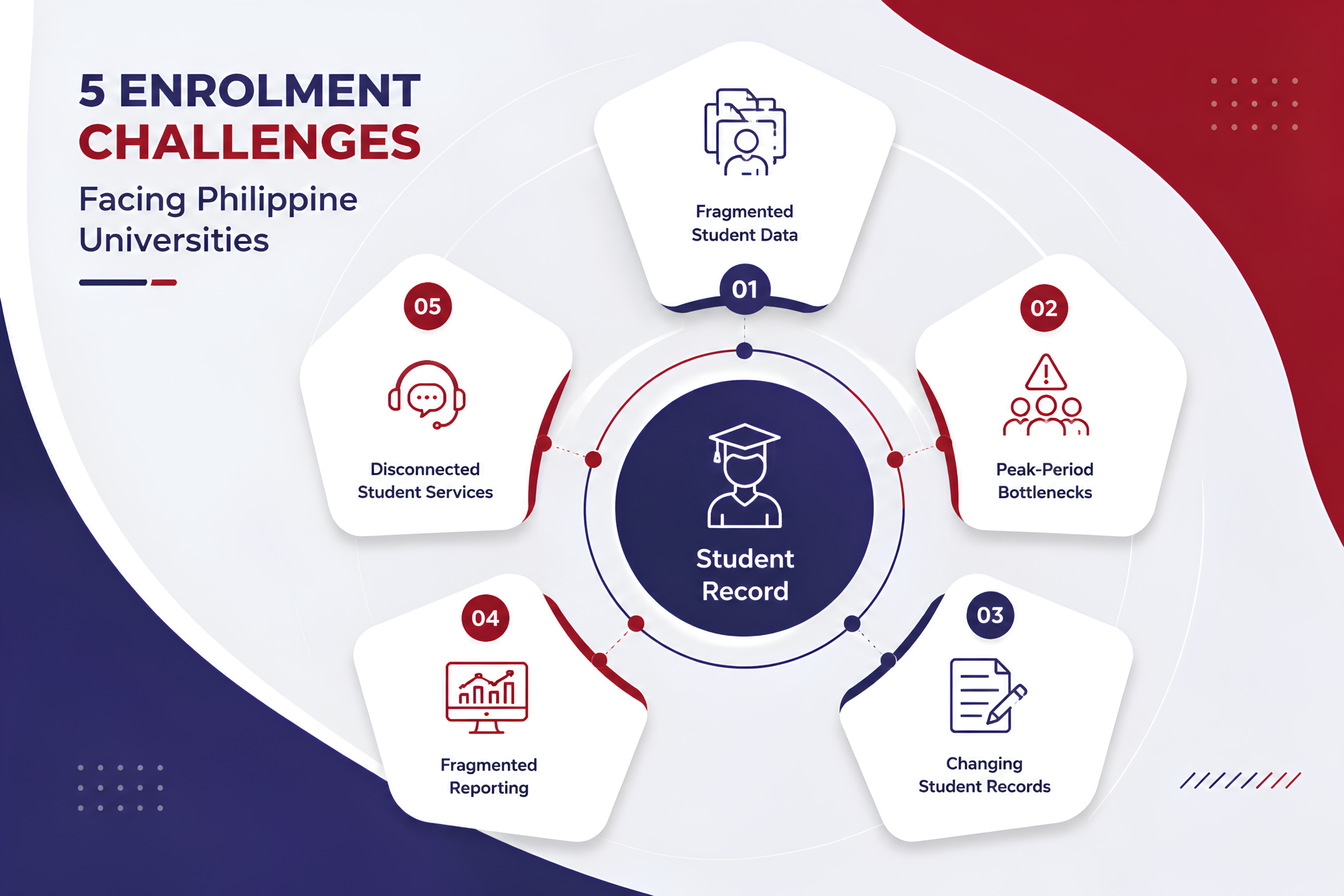
1. Fragmented student data creates duplicate work

Admissions, the registrar, finance, and academic departments may each need access to student information. When these systems are not connected, staff may repeatedly enter, export, verify, or reconcile the same data.

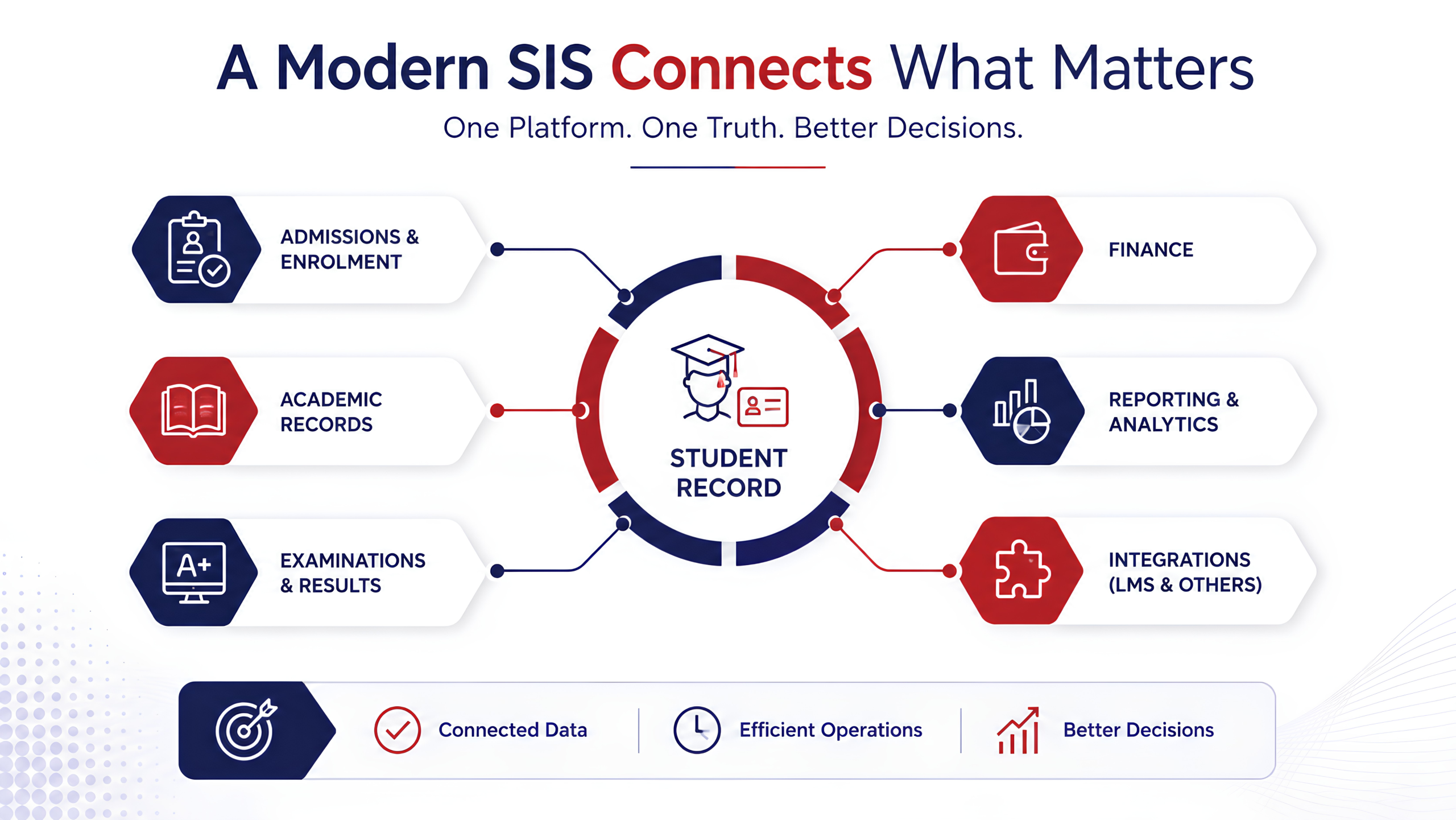
The solution: A centralised student record should act as a reliable source of information, while integrations allow relevant data to move between connected systems.

The objective is not simply to store more data. It is to make sure authorised teams are working with consistent, up-to-date information.

2. Peak enrolment periods expose inefficient workflows
 

Enrollment Challenges

During enrolment, staff may be handling document verification, approvals, payments, registration issues, and student queries at the same time.

Manual approvals and email-based processes can quickly create bottlenecks.

The solution: Universities can automate repeatable workflows such as approvals, notifications, document checks, and status updates. Staff can then focus on exceptions and student support rather than repeatedly moving information between departments.

3. Student records keep changing

A student’s record does not stop changing after enrolment.

Programme shifts, subject changes, academic standing, scholarships, leaves of absence, and personal-information updates can all affect the record.

When updates are made separately, inconsistencies become more likely.

The solution: Universities need lifecycle-based record management, where relevant changes are reflected across the processes and departments that depend on them.

4. Reporting becomes harder when data is fragmented

University leaders need answers about enrolment trends, programme demand, student progression, finances, and academic performance.

But if information is spread across multiple databases, staff may have to export spreadsheets, clean data, check discrepancies, and manually prepare reports.

This is where data modernisation becomes important. EDUCAUSE’s 2025 QuickPoll found that 68% of respondents were in the process of modernising their institutional data environment, while only 1% considered their institution fully modernised. The report also identifies fragmented and siloed data environments as a major barrier.

The solution: Move towards connected institutional data and real-time dashboards so that reporting becomes less about collecting information and more about understanding it.

5. Student services become slower when systems are disconnected

Students increasingly expect to submit applications, access records, make payments, and request documents digitally.

If they have to visit different offices or repeatedly submit information that the university already has, the problem is no longer just administrative.

It becomes a student experience issue.

The solution: A modern SIS should provide student self-service capabilities while connecting the information behind those services.

How Can Universities Build a More Efficient Enrolment Process?

Fixing enrolment challenges does not always require completely changing every system a university uses. The first step is to identify where information gets stuck, where staff repeat the same work, and where students have to wait for a process that could be automated.

A more connected enrolment environment can bring together admissions, document verification, registration, payments, academic records, and student communication within a coordinated workflow.

The impact can be significant. Academia’s analysis of AI in higher education notes that more than 60% of higher education administrators spend over half of their workday on tasks with no direct academic value, while workflow automation can potentially reduce routine administrative effort by 25–40%.

For Philippine universities, the opportunity is to redirect that administrative effort towards work that requires judgement, advising, and direct student support.

What Does a Connected Enrolment Process Look Like?

A well-designed SIS should allow information captured during one stage of the student journey to support the next stage without unnecessary re-entry.

For example, once an applicant is admitted, relevant information should be available for enrolment and academic processes. Once enrolment is completed, the same student record can support course registration, fees, academic tracking, and future student services.

This creates a more consistent flow of information while reducing the need for staff to manually reconcile records.


Enrolment Challenge What a Modern SIS Can Do
Repeated data entry Reuse verified student information
Manual approvals Automate rule-based workflows
Delayed status updates Trigger real-time notifications
Scattered records Maintain a centralised student profile
Slow reporting Provide dashboards and AI-powered reports
High student-query volumes Enable digital self-service
Difficult record tracking Maintain structured, auditable information

The objective is not to automate everything.

It is to automate the repetitive parts while keeping people responsible for decisions that require human judgement.

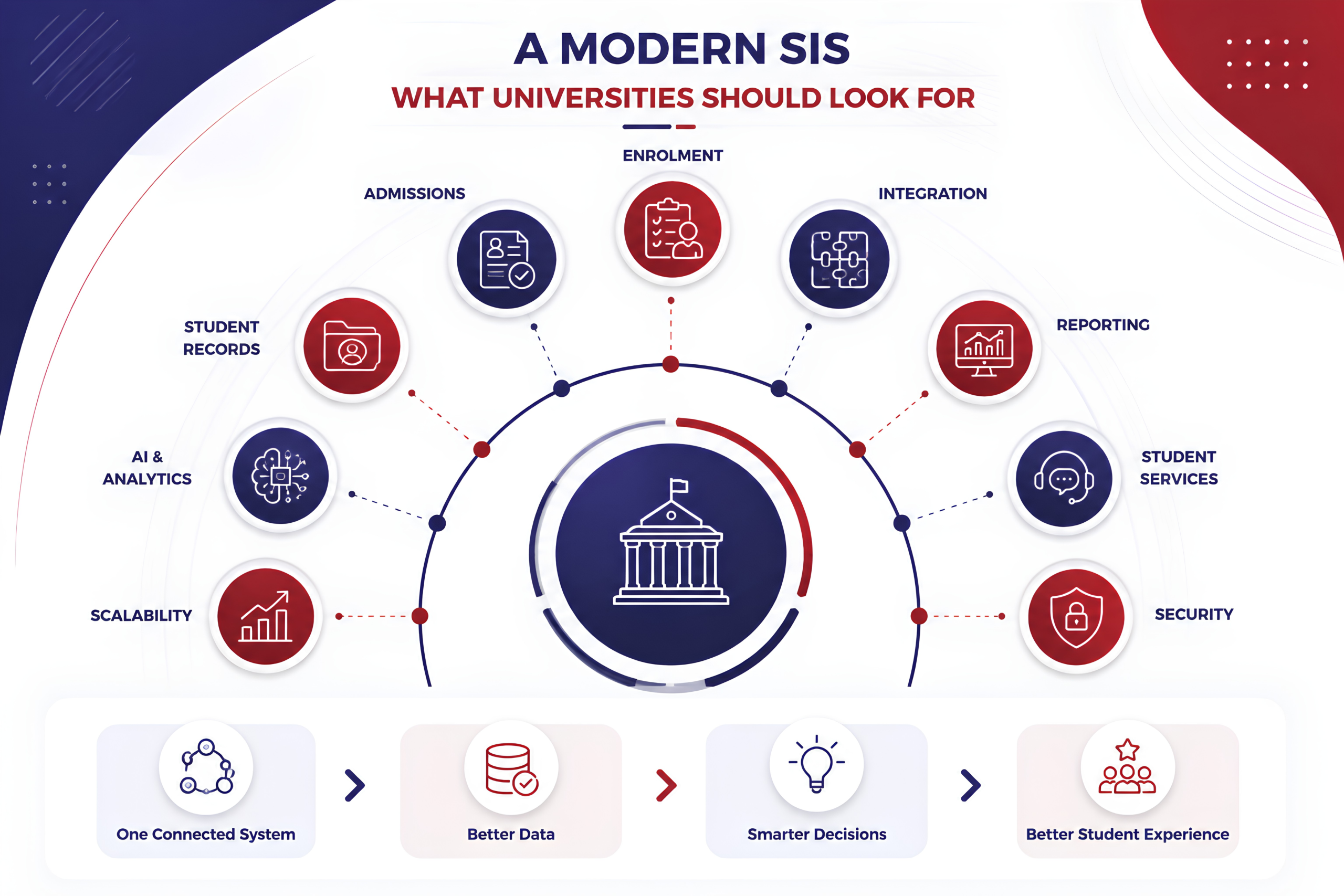
What Should a Modern SIS Provide?


Capability What Philippine Universities Should Look For
Student records Centralised and continuously updated information
Enrolment Automated and configurable workflows
Admissions Seamless applicant-to-student transition
Integration Connectivity with LMS, finance, payments and other systems
Reporting Real-time dashboards and analytics
Student services Digital self-service and request tracking
Security Role-based access and auditability
Scalability Support for growing programmes and campuses
AI Practical automation and intelligent insights


 Philippine Universities

A modern SIS should therefore connect people, processes, and information, rather than simply digitising individual forms.

Can AI Improve Enrolment and Student Records Management?

AI is becoming another consideration for higher education technology.

UNESCO’s 2025 survey found that 19% of responding higher education institutions already had a formal AI policy, while another 42% were developing guidance. One in four respondents had already encountered ethical issues related to AI.

For enrolment and student records, AI can support areas such as document processing, student queries, workflow automation, analytics, and reporting.

But universities should not ask only:

“Does the SIS have AI?”

They should ask:

“Can AI work securely with our institutional data and support useful decisions?”

That makes data quality, governance, security, and human oversight just as important as the AI capability itself.

Is Your University Ready for a More Connected SIS?

A quick assessment can help identify where modernisation may be needed:

  • One reliable student record
  • Integrated admissions and enrolment
  • Automated approval workflows
  • Digital document submission
  • Student self-service
  • Connected finance and enrolment information
  • Real-time reporting
  • Role-based access
  • Audit trails
  • Integration with existing systems
  • Scalable architecture
  • AI and analytics capabilities

If several of these are missing, adding another standalone application may not solve the underlying problem.

The priority may be connecting the student lifecycle itself.

How Can Academia Help Philippine Universities?

Academia by Serosoft is an AI-powered Student Information System designed to manage the higher education lifecycle from prospecting and admissions through academics, student services, graduation, and alumni engagement.

Academia currently reports 400+ institutions across 32 countries and 1M+ learners and educators benefiting. Its SIS provides centralised student data, real-time tracking, role-based access, interoperability, analytics, and configurable workflows.

For enrolment and records management, this connected approach can help universities reduce repeated data entry, improve information visibility, automate administrative workflows, and give students more convenient digital access to services.

Academia also provides AI-powered analytics and reporting, including 400+ AI-powered reports, alongside a broader library of institutional reports and dashboards.

The value is not simply having more technology.

It is having technology that allows admissions, enrolment, academics, finance, student services, and records to work from connected institutional information.

What Is the Future of Enrolment Management for Philippine Universities?

Digital transformation in the Philippines is moving beyond basic digitisation. The World Bank identifies digital data infrastructure and digitally enabled services as important components of the country’s broader transformation agenda.

For universities, the same principle applies.

The future of enrolment is not another online form.

It is a connected environment where student information can move securely through the right workflows, staff can access reliable data, and students can complete more services without unnecessary administrative friction.

For Philippine universities, the question is therefore no longer:

“Do we have a system for enrolment?”

It is:

“Can our SIS give us a reliable, connected view of the student throughout the entire lifecycle?”

That is the shift from simply managing enrolment to building a more connected, data-driven, and student-centric university.

Is Your University’s Enrolment Process Truly Connected?

When admissions, registration, finance, academics, and student services operate in silos, even a digital process can create unnecessary work.

See how Academia by Serosoft connects the student lifecycle through unified records, automated workflows, digital self-service, and AI-powered insights, helping Philippine universities make enrolment simpler, faster, and more connected.

Request Demo | Talk to an SIS Expert

Frequently Asked Questions

Why is enrolment management challenging for Philippine universities?

Enrolment involves multiple departments, approvals, payments, academic requirements, and student records. When these processes rely on disconnected systems or manual workflows, delays and data inconsistencies can occur.

How can universities improve student records management?

Universities can centralise student information, integrate departmental systems, automate workflows, establish role-based access, and provide digital self-service for common student requests.

Can an SIS reduce manual work during enrolment?

Yes. Workflow automation can support approvals, notifications, document processing, registration, and other repeatable tasks, reducing the amount of manual coordination required from staff.

Why is integrated data important for universities?

Integrated data gives departments a more consistent view of student information and helps leadership access reliable information for reporting, planning, and decision-making.

Should Philippine universities consider an AI-powered SIS?

AI can add value through automation, analytics, document processing, and student support. However, universities should evaluate AI alongside security, governance, integration, data quality, and scalability.

What should universities consider when choosing an SIS?

They should evaluate student lifecycle coverage, integration, workflow automation, reporting, security, scalability, self-service, configurability, and AI capabilities, not just the number of modules.

How Can UAE Universities and Higher Institutions Choose the Right Student Information System in 2026?

Choosing a Student Information System (SIS) is no longer simply an IT decision for UAE universities. It affects how institutions manage admissions, academics, student services, data, reporting, and decision-making.

As universities modernise their digital infrastructure and explore AI, one question is becoming increasingly important:

Is your current SIS ready for the next generation of higher education?

A legacy SIS may still manage student records effectively. But modern universities increasingly need connected data, intelligent workflows, real-time analytics, cloud scalability, AI capabilities, and better digital experiences.

So, what should UAE universities look for in an SIS in 2026, and when does it make sense to move beyond a legacy platform?

Why Do UAE Universities Need a Student Information System? 

A Student Information System is a central platform that manages student, academic, and administrative information throughout the student lifecycle.

A comprehensive SIS can support:

  • Admissions and applications
  • Enrolment
  • Student records
  • Programme and curriculum management
  • Course registration
  • Attendance
  • Examinations and assessments
  • Fees and payments
  • Student services
  • Graduation and alumni
  • Institutional reporting and analytics

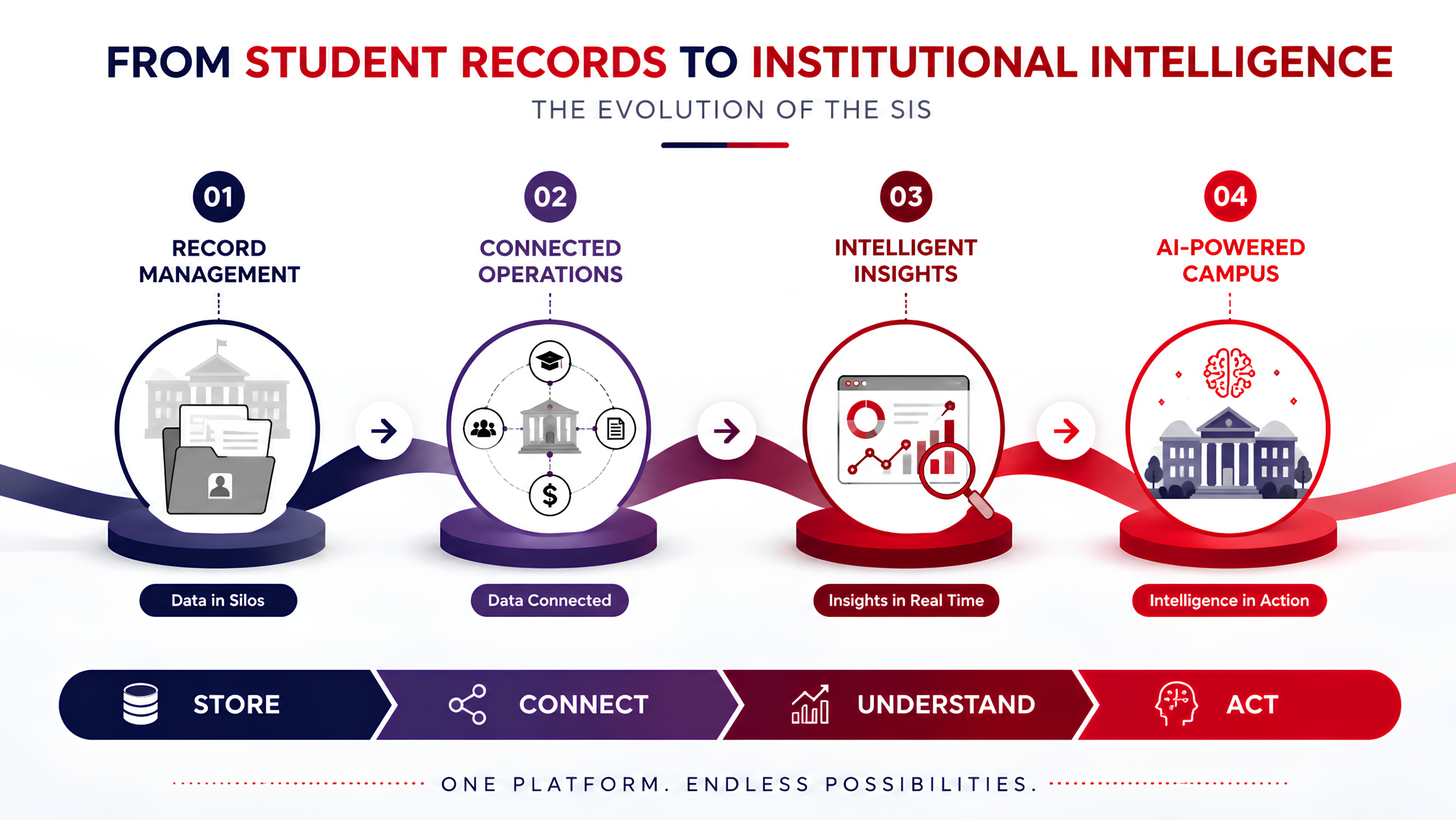
The role of an SIS, however, is changing.

Traditional systems were primarily designed to store and process information. Modern SIS platforms increasingly need to connect information, automate processes, generate insights, and support institutional decision-making.

Why Are UAE Universities Reconsidering Legacy SIS Platforms?

Legacy SIS platforms can continue to perform core administrative functions, but fragmented data, manual workflows, and difficult integrations can limit institutional digital transformation.

A university may have separate systems for admissions, finance, academics, LMS, HR, and student services. When these systems operate in silos, staff may rely on spreadsheets, manual exports, duplicate data entry, and reconciliation.

The result is a fundamental problem:

The university has data, but not necessarily a unified view of the institution.

What does higher education research say about data modernisation?

EDUCAUSE’s 2025 QuickPoll found that 68% of respondents were in the process of data modernisation, while only 1% felt their institution had fully modernised its data management and strategy. Overall, 92% were either discussing modernisation or already had some systems modernised.

The leading drivers included operational efficiency (58%), student success and retention (46%), and data visualisation and decision support (43%). Siloed data was identified as a challenge by 51% of respondents.

For UAE universities, the implication is clear: an SIS should be evaluated not only on what it manages, but on how effectively it connects and uses institutional data.

What Is the Difference Between a Legacy SIS and an AI-Powered SIS?

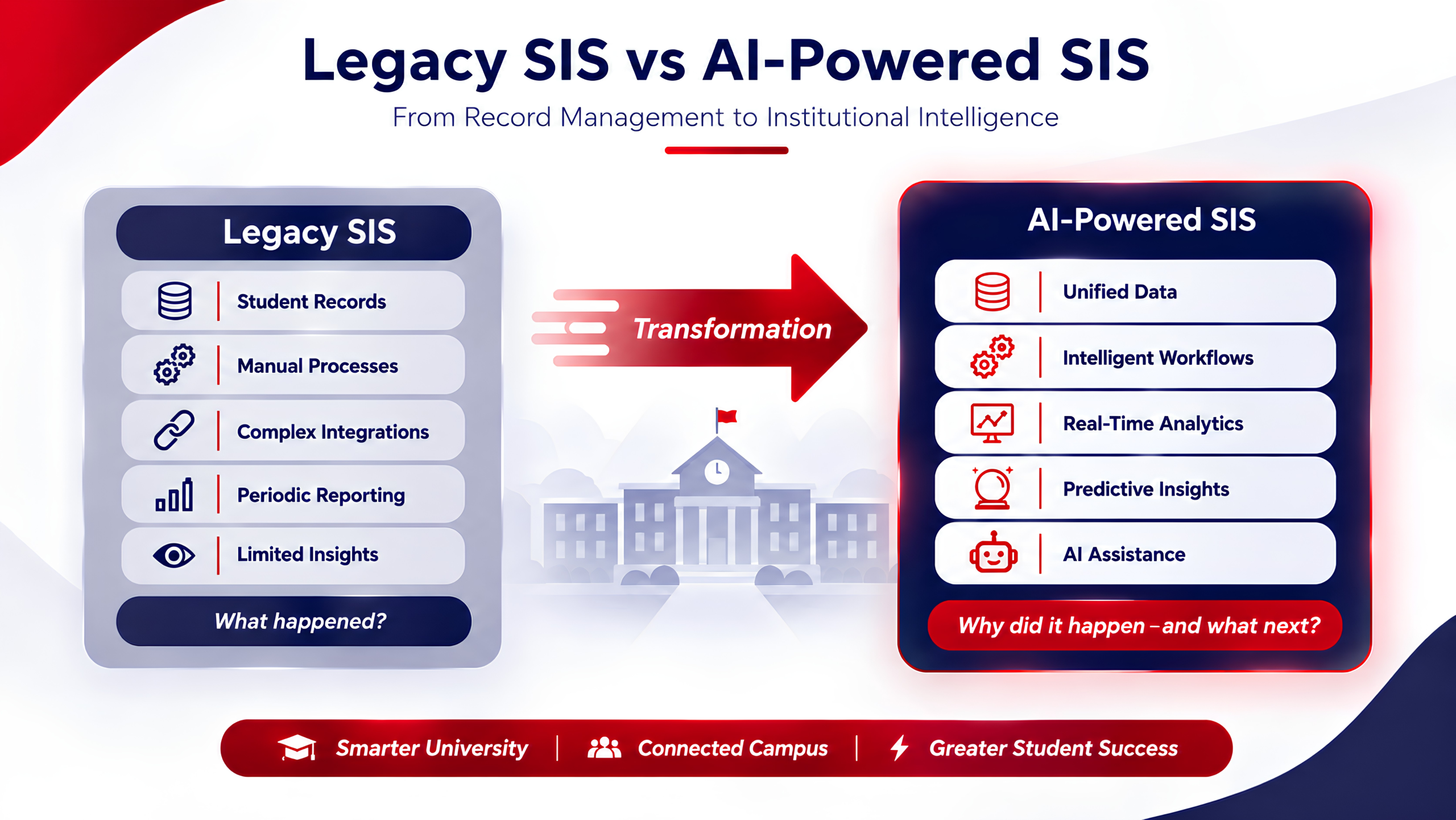
A legacy SIS primarily manages records and processes, while an AI-powered SIS extends those capabilities with automation, analytics, intelligent assistance, and predictive insights.


Legacy SIS and an AI-Powered SIS?


Capability Legacy SIS AI-Powered SIS
Student records ✓ ✓
Admissions ✓ ✓
Academic management ✓ ✓
Examinations ✓ ✓
Finance ✓ ✓
Workflow automation Limited Advanced
Real-time analytics Limited ✓
Predictive insights Limited ✓
AI assistance Limited/add-on Integrated
Integrations Often complex API-enabled
Cloud scalability Varies ✓

The real comparison is therefore not simply old technology versus new technology.

It is:

Record management versus institutional intelligence.

Why Is AI Becoming Important When Choosing a University SIS?

AI is becoming an important SIS consideration because universities are increasingly using AI across teaching, research, administration, and student services.

UNESCO’s 2025 global survey received 400 responses from UNESCO Chairs and UNITWIN Networks across 90 countries. It found that 19% of institutions already had a formal AI policy and another 42% were developing AI guidance, meaning 61% had either established or were developing institutional guidance.

The survey also found that 90% of respondents were using AI tools professionally, while nearly half were experimenting with AI in teaching. One in four reported that their university had already encountered ethical issues related to AI.


University SIS

This makes AI governance part of SIS evaluation.

Universities should ask:

“Does this SIS have AI?”

But also:

“Can AI operate securely and responsibly using governed institutional data?”

Can AI Really Improve University Decision-Making?

Yes. AI-powered analytics can help universities move from periodic reporting towards faster, data-informed decision-making.

Consider enrolment management. A traditional report may show that enrolment is below target. Understanding why may require separate analysis of applications, offers, acceptance rates, programme demand, fees, and historical trends.

A connected SIS can bring these information sources together and make institutional patterns easier to identify.

Academia’s published analysis reports that institutions using AI-powered analytics can achieve up to 30–40% improvement in decision-making speed, while automation across admissions, examinations, and reporting can reduce manual workload by nearly 50%.

The larger opportunity is moving from:

“What happened?”

to:

“Why did it happen, and what should we do next?”

How Can a Modern SIS Reduce Administrative Workload?

A modern SIS can reduce routine administrative work by automating repetitive processes and connecting workflows across departments.

Potential areas include:

  • Application processing
  • Document reminders
  • Approval workflows
  • Fee notifications
  • Attendance alerts
  • Examination processes
  • Report generation
  • Data validation
  • Student service requests

Academia’s published analysis states that more than 60% of higher education administrators spend more than half their workday on tasks that add zero academic value. It also estimates that workflow automation can reduce routine administrative effort by 25–40%. The value of automation is therefore not simply fewer manual steps.

It is giving staff more time for work that requires human judgement and student interaction.

What Should UAE Universities Look for in an SIS in 2026?

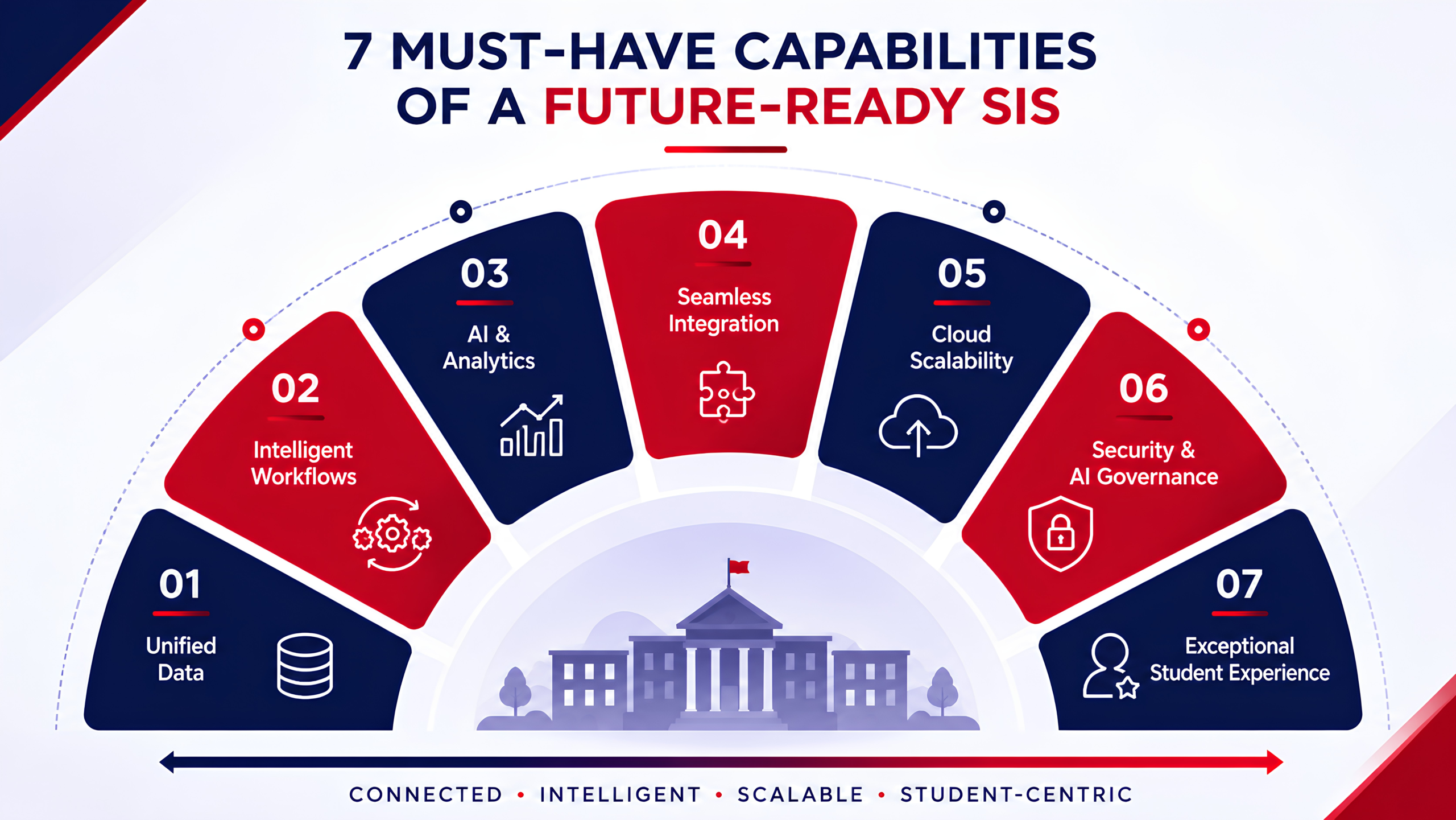
UAE universities should evaluate an SIS across data, automation, AI, integration, scalability, security, and student experience.

1. Unified Institutional Data

A trusted source of student and academic information should replace disconnected records wherever possible.

2. Intelligent Workflow Automation

Admissions, academics, finance, examinations, and student services should support configurable workflows.

3. AI and Analytics

Look for real-time dashboards, predictive analytics, AI-powered reporting, and intelligent assistance, not simply an AI label.

4. Integration

The SIS should connect with LMS, finance, HR, CRM, payment gateways, identity systems, and other institutional applications.


Integration

5. Scalability

The platform should support growing enrolment, new programmes, multiple campuses, and changing institutional requirements.

6. Security and AI Governance

Universities should assess permissions, privacy, audit trails, security controls, and responsible AI practices.

7. Student Experience

Students should be able to apply, register, view academic information, make payments, submit requests, and receive notifications through connected digital channels.

Is a Legacy SIS Always a Bad Choice?

No. A legacy SIS is not automatically a bad system simply because it is older.

The real question is whether it can support the university’s future requirements.

University leaders should ask:

  • Can our SIS integrate easily?
  • Is institutional data unified?
  • How much reporting remains manual?
  • Can workflows be automated?
  • Can leadership access real-time information?
  • Can students complete services digitally?
  • Can the platform support AI responsibly?
  • Can it scale across campuses?
  • Does the vendor roadmap support our digital strategy?

If several answers are no, modernisation or replacement deserves serious consideration.

How Does Academia Support the Shift From Legacy SIS to AI-Powered SIS?

Academia by Serosoft positions its platform as an AI-powered Student Information System designed specifically for higher education, combining student lifecycle management with workflow automation, analytics, integrations, and AI capabilities.

Academia supports areas including admissions, academics, examinations, fees, student services, graduation, alumni management, and institutional reporting. Its AI capabilities include SERA AI, AI-driven analytics, intelligent workflows, and AI-supported academic and operational insights.

For a university evaluating legacy SIS replacement, the important question is not simply how many modules a platform has.

It is whether the platform can connect:

Unified Data + Intelligent Workflows + Institutional Intelligence

What Is the Future of Student Information Systems in UAE Higher Education?

The future of SIS is moving from digital record management towards intelligent institutional operations.

The next generation of platforms will increasingly help universities connect data, automate repetitive tasks, identify patterns, support students, and make decisions faster.

EDUCAUSE’s research shows that higher education institutions are already actively modernising their data environments, while UNESCO’s research shows that institutional AI guidance is becoming increasingly common.

For UAE universities, the strategic question is therefore no longer simply:

“Do we need an SIS?”

It is:

“Is our SIS ready for an AI-driven, data-connected university?”

Conclusion

The best Student Information System for a UAE university in 2026 is not necessarily the platform with the longest feature list.

It is the platform that best connects students, data, processes, systems, and decisions.

Legacy SIS platforms can continue to perform essential functions. But as universities modernise their data infrastructure and adopt AI, they increasingly need platforms that provide automation, interoperability, analytics, scalability, and responsible AI capabilities.

The evidence points towards a broader transformation: 68% of EDUCAUSE respondents were in the process of data modernisation, while only 1% considered their institution fully modernised. UNESCO also found that 61% either had an institutional AI policy or were developing AI guidance.

For UAE universities, the question is simple:

Is your current SIS helping you build the university of tomorrow or simply managing the university of today?

Ready to Build a Future-Ready Digital Campus?

Whether you’re replacing a legacy system, modernising your existing SIS, or planning your university’s next phase of digital transformation, the right technology foundation can make all the difference.

Discover how Academia by Serosoft helps universities implement AI-powered Student Information Systems that streamline operations, improve institutional visibility, connect the complete student lifecycle, and support smarter decision-making.

Request Demo | Speak with an SIS Expert

Frequently Asked Questions

What is the best Student Information System for UAE universities in 2026?

The best SIS depends on each university’s requirements. Institutions should evaluate student lifecycle coverage, integration, AI, analytics, scalability, security, configurability, and student experience.

Why should UAE universities consider replacing a legacy SIS?

Universities may need to modernise when legacy technology creates fragmented data, manual workflows, difficult integrations, slow reporting, limited scalability, or inadequate AI readiness.

Is AI important when selecting an SIS?

Yes. Universities should evaluate practical AI capabilities alongside data governance, security, permissions, transparency, and human oversight.

Can a modern SIS integrate with existing university systems?

Yes. Modern SIS platforms can integrate with LMS, finance, HR, CRM, payment, identity, and other institutional systems through APIs and integration frameworks.

How can Academia support UAE universities?

Academia by Serosoft provides an AI-powered higher education SIS combining student lifecycle management, workflow automation, analytics, integrations, and AI-enabled capabilities.

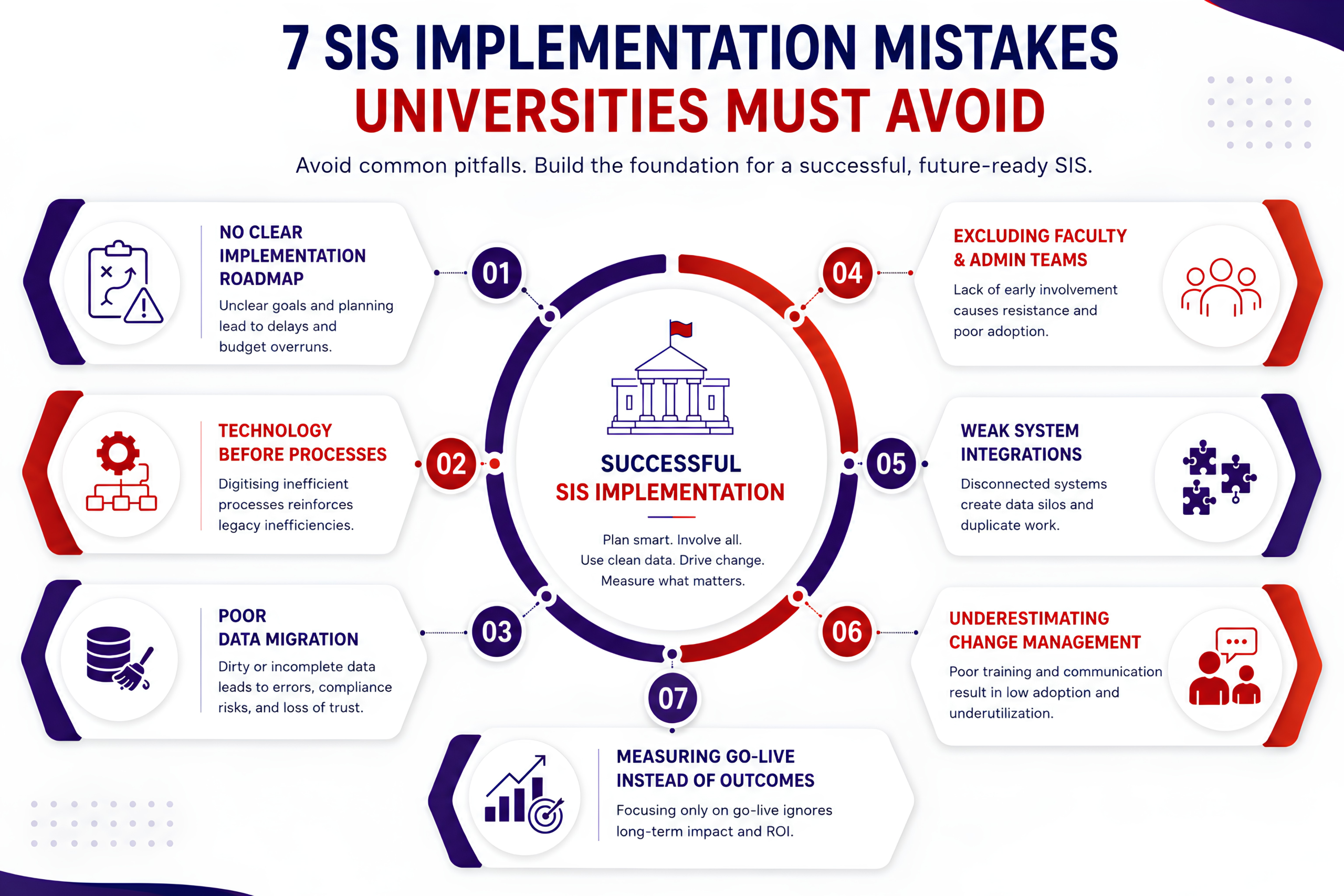
7 Student Information System Implementation Mistakes Universities Must Avoid (2026 Guide)

Implementing a Student Information System (SIS) is one of the most significant digital transformation initiatives a university can undertake. A well-executed implementation connects admissions, academics, examinations, finance, student services, and institutional reporting into one unified platform, improving operational efficiency and enhancing the student experience.

However, technology alone doesn’t guarantee success. Many SIS implementations face delays, budget overruns, low user adoption, or fail to deliver the expected outcomes due to avoidable planning and execution mistakes.

In this guide, we’ll explore the seven most common Student Information System implementation mistakes universities make, why they occur, and how institutional leaders, IT teams, and student administration professionals can avoid them. Whether you’re replacing a legacy system or implementing a cloud-based SIS for the first time, these best practices will help lay the foundation for a successful and future-ready implementation.

Why Do Student Information System Implementations Fail?

Student Information System implementations typically fail due to poor planning, disconnected stakeholders, weak data governance, and inadequate change management, not because of technology limitations.

An SIS touches nearly every department within a university. If institutional goals, workflows, and responsibilities aren’t aligned before implementation begins, delays, budget overruns, and low user adoption become far more likely. Successful implementations start with a clear roadmap, cross-functional collaboration, and well-defined success metrics.

According to the Higher Ed Innovation Index 2025 by Transact + CBORD, 49% of higher education institutions are accelerating technology investments, while 44% identify implementation as their biggest digital transformation challenge.

These findings reinforce an important reality: selecting the right technology is only the first step. Long-term success depends on how effectively institutions plan, implement, and manage change.

What Happens When Universities Skip Implementation Planning?

Universities that begin SIS implementation without a clear roadmap are more likely to experience delays, budget overruns, and scope changes.

Implementation planning should define institutional objectives, project governance, timelines, responsibilities, and measurable outcomes before configuration begins. Without this foundation, departments often work in silos, priorities become unclear, and implementation decisions become reactive instead of strategic.

Before launching an SIS project, universities should answer:

  • What institutional challenges should the SIS solve?
  • Which departments will own implementation?
  • What KPIs will measure success?
  • How will risks and project milestones be managed?

A structured implementation roadmap reduces uncertainty and creates accountability throughout the project lifecycle.

Why Is Choosing Technology Before Defining Processes a Costly Mistake?

A Student Information System should improve institutional processes, not simply digitise inefficient ones.

Many universities focus on software capabilities before reviewing how work is actually performed. As a result, outdated workflows, duplicate approvals, and manual processes are transferred into the new system, limiting its impact.

Before configuring an SIS, institutions should simplify workflows, eliminate redundant tasks, standardise approvals, and identify opportunities for automation. Optimising processes first ensures the technology supports institutional goals rather than reinforcing legacy inefficiencies.

Why Is Choosing Technology Before Defining Processes a Costly Mistake?

How Does Poor Data Migration Affect Student Information System Success?

Clean, accurate data is essential for a successful SIS implementation. Migrating duplicate, outdated, or incomplete records can lead to reporting errors, compliance risks, and reduced confidence in the new system.

Rather than transferring legacy data as-is, universities should:

  • Remove duplicate records.
  • Standardise data formats.
  • Validate programme and student information.
  • Archive outdated records.
  • Establish clear data governance policies.

Reliable data enables better reporting, stronger decision-making, and a smoother transition to the new platform.

An EDUCAUSE QuickPoll (2025) found that 68% of higher education institutions are actively modernising their data systems, yet only 1% believe they have fully modernised their data management strategy. Additionally, 51% cited siloed institutional data as a major challenge, highlighting why data quality and governance should be prioritised before implementing a new Student Information System.

Why Should Universities Involve Faculty and Administrative Teams Early?

A Student Information System implementation succeeds when it has institution-wide ownership, not just IT support. Universities that exclude faculty, admissions, finance, registrar, or student services teams from the implementation process often face resistance, poor adoption, and workflows that fail to meet operational needs.

Every department interacts with the SIS differently. Involving key stakeholders early helps identify functional requirements, resolve process gaps, and build confidence before go-live.

To encourage collaboration, universities should establish a cross-functional implementation team that includes academic leadership, admissions, registrar, finance, student services, and IT. Early engagement reduces rework, improves adoption, and ensures the system supports institutional goals from day one.

Can a Student Information System Succeed Without Integrations?

No. A modern Student Information System delivers the greatest value when it integrates seamlessly with the university’s digital ecosystem.

An SIS should exchange data with platforms such as Learning Management Systems (LMS), finance and ERP software, HR systems, payment gateways, library solutions, and communication tools. Without these integrations, universities often struggle with duplicate data entry, inconsistent records, and fragmented reporting.

Before implementation, institutions should identify:

  • Systems requiring integration
  • Data exchange requirements
  • API and interoperability needs
  • Security and compliance considerations

A connected technology ecosystem enables better collaboration, improves data accuracy, and provides leadership with a single source of institutional truth.

Based on Academia’s experience working with higher education institutions, universities that align academic, administrative, and technology teams before implementation are better positioned to reduce project risks, improve user adoption, and achieve faster time-to-value. Implementation becomes significantly smoother when people, processes, and technology evolve together.

Why Do Many Universities Underestimate Change Management?

Even the best Student Information System cannot succeed if users don’t adopt it.

Many institutions invest heavily in technology but overlook communication, training, and user readiness. As a result, staff continue using manual processes, adoption slows, and the expected benefits of the implementation are never fully realised.

Successful universities support change by:

  • Communicating project goals early
  • Delivering role-based training
  • Appointing departmental champions
  • Providing ongoing post-implementation support

Treating implementation as a continuous improvement initiative, not a one-time deployment, helps maximise long-term success.

How Can Universities Measure the Success of an SIS Implementation?

A successful implementation is measured by business outcomes, not just a successful go-live.

Universities should define measurable KPIs before implementation begins to evaluate long-term impact.


KPI Expected Outcome
Admissions processing time Faster application processing
Manual data entry Reduced administrative workload
Data accuracy Improved reporting quality
User adoption Higher staff utilisation
Executive reporting Faster access to institutional insights

Monitoring these metrics helps universities continuously optimise processes and maximise their return on investment.

What Should Universities Do Before Selecting an SIS?

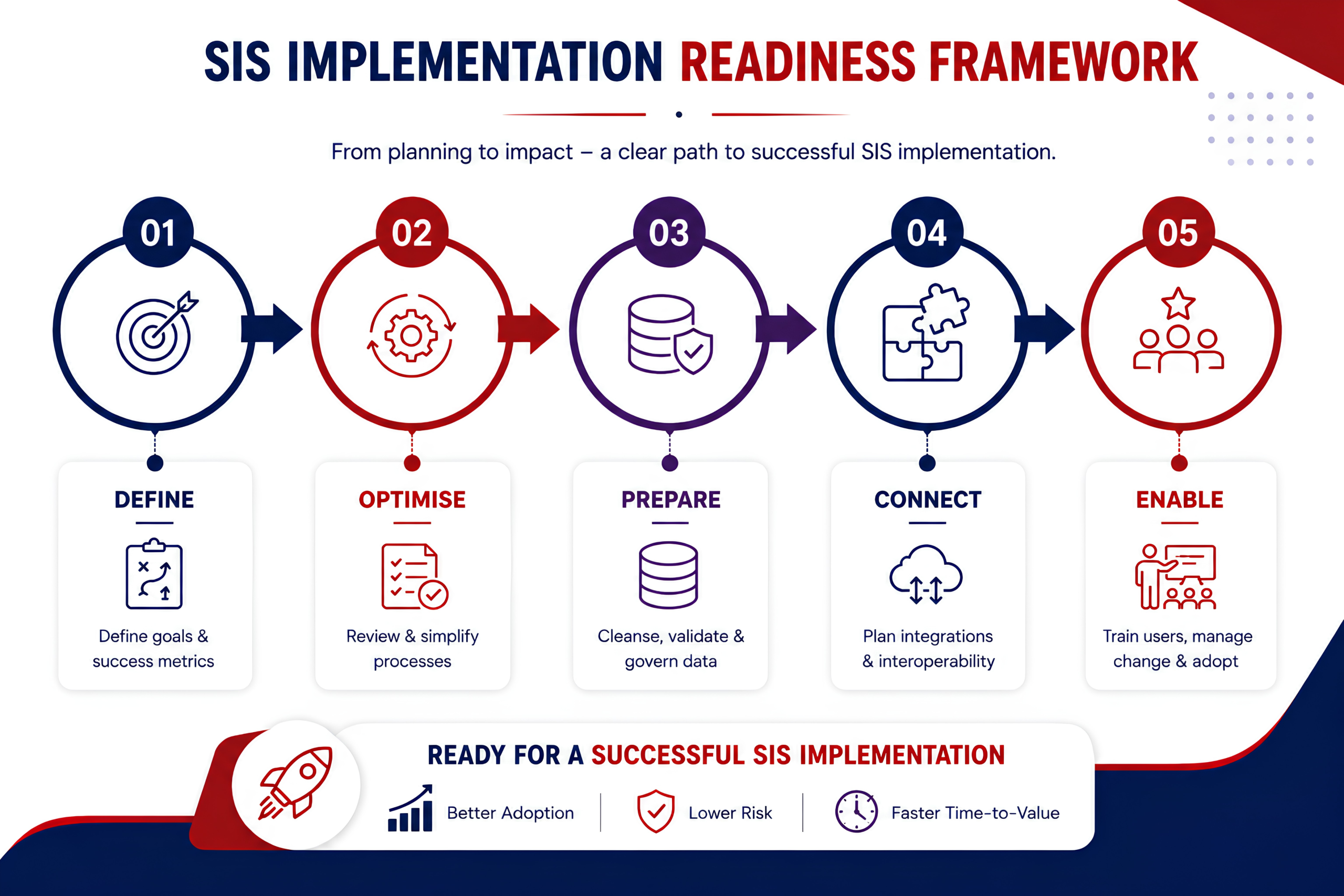
Before evaluating vendors, universities should assess their implementation readiness. Completing the following checklist helps reduce implementation risks and ensures the institution is prepared for long-term success.

SIS Implementation Readiness Checklist

✔ Define institutional goals and success metrics.

✔ Review and optimise existing business processes.

✔ Assess data quality and migration readiness.

✔ Identify integration requirements.

✔ Establish project governance and ownership.

✔ Develop a change management and training plan.

✔ Define KPIs to measure implementation success.

Universities that complete these steps before selecting an SIS are more likely to achieve a smoother implementation, stronger user adoption, and greater long-term value from their investment.

How Does Academia Help Universities Deliver Successful SIS Implementations?

A successful Student Information System implementation requires more than software; it requires higher education expertise, proven implementation practices, and a long-term digital transformation strategy.

Academia by Serosoft is an AI-powered Student Information System built exclusively for higher education. It supports the complete student lifecycle from admissions and enrolment to academics, examinations, finance, graduation, and alumni management through a unified cloud platform.

With configurable workflows, seamless integrations, AI-powered analytics, and real-time executive dashboards, Academia helps universities modernise operations, improve decision-making, and create connected digital campuses that are ready to scale.


Student Information System implementation

Universities are increasingly looking beyond automation. The next generation of Student Information Systems is expected to provide predictive insights, workflow intelligence, and real-time analytics that support faster, data-driven decision-making. Institutions that combine automation with AI-powered insights will be better positioned to improve operational efficiency, student success, and institutional agility.

What Will Successful Student Information System Implementations Look Like in the AI Era?

The future of Student Information Systems lies in intelligence, not just digitisation.

AI-powered SIS platforms are enabling universities to move beyond managing records to proactively improving institutional performance. By combining automation with predictive analytics, institutions can identify enrollment trends, support at-risk students, automate repetitive processes, and provide leadership with real-time operational insights.

Future-ready universities will prioritise Student Information Systems that are scalable, connected, AI-enabled, and capable of adapting to evolving student and institutional needs.

Conclusion

A successful Student Information System implementation is built on strategic planning, stakeholder collaboration, quality data, and continuous improvement, not technology alone. Universities that avoid these seven common implementation mistakes are better equipped to reduce project risks, improve adoption, and maximise the long-term value of their investment.

As higher education continues to evolve, institutions need Student Information Systems that not only streamline operations but also enable smarter, data-driven decision-making. Choosing the right implementation approach today creates a stronger foundation for tomorrow’s digital campus.

Ready to Build a Future-Ready Digital Campus?

Whether you’re replacing a legacy system or planning your first Student Information System implementation, the right strategy can make all the difference.

Discover how Academia by Serosoft helps universities implement AI-powered Student Information Systems that streamline operations, improve institutional visibility, and support the complete student lifecycle.

Request Demo | Speak with an SIS Expert

Frequently Asked Questions

What is Student Information System implementation?

Student Information System implementation is the process of planning, configuring, integrating, migrating data, and deploying an SIS to manage student information and academic operations across a university.

What is the biggest reason SIS implementations fail?

Poor planning, disconnected stakeholders, weak data governance, and inadequate change management are the most common reasons universities struggle during implementation.

Can an SIS integrate with existing university software?

Yes. Modern Student Information Systems integrate with Learning Management Systems (LMS), ERP, finance, HR, payment, and communication platforms to create a connected digital ecosystem.

How can universities ensure a successful SIS implementation?

Universities should establish clear objectives, optimise processes, involve stakeholders early, prioritise data quality, plan integrations, invest in user training, and measure success using defined KPIs.

Why Enrolment and Student Records Management Remain a Challenge for Ghana Universities

Ghana’s higher education sector is becoming more digitally complex. Universities must manage admissions, enrolment, registration, academic records, examinations, fees, transcripts and reporting across increasingly diverse student populations and academic structures. In 2024, Ghana recorded 693,307 tertiary students, compared with 711,695 in 2023, while enrolment in public universities stood at 389,763, down from 422,583 in the 2022/2023 academic year.

The challenge, therefore, is not simply about increasing student numbers. It is about managing large volumes of student information accurately, consistently and efficiently across the entire student lifecycle. When admissions, registration, academics, examinations, and student records operate through disconnected processes, universities can face duplicate data, manual reconciliation, delayed services, and limited institutional visibility.

From Academia’s perspective, the real opportunity is to move from fragmented student administration towards a connected digital environment. Academia’s Ghana-specific SIS offering identifies disconnected student records, manual admissions and clearance, paper-based transcript and results management, spreadsheet-dependent accreditation documentation and delays in GTEC reporting as key areas where institutions can benefit from modernisation.

Why Is Enrolment and Student Records Management Difficult for Ghana Universities?

Enrolment and student records are at the centre of almost every university process.

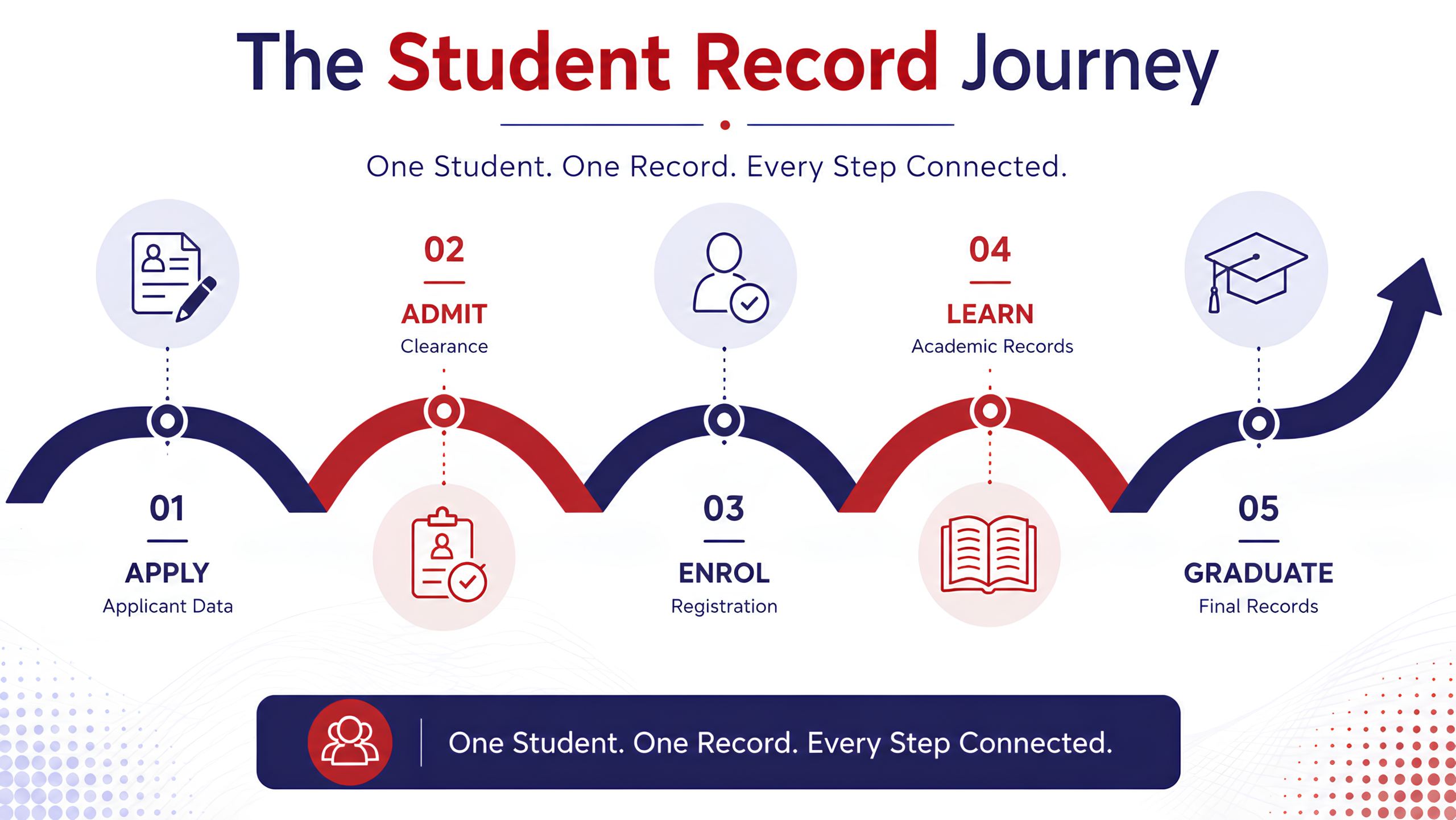
A student’s information may begin with an application, move through admission and clearance, continue into registration and course selection, and eventually feed examinations, academic progression, finance, graduation and alumni records.

When these stages are not connected, the same information may be entered, verified or updated multiple times.

This creates several challenges:

  • Duplicate or inconsistent student records
  • Manual admission and registration processes
  • Delays in updating academic information
  • Difficulty retrieving historical records
  • Spreadsheet-dependent reporting
  • Limited visibility across faculties and campuses
  • Greater administrative workload

A 2020 study of records management practices at Ghana Communication Technology University found challenges including inadequate staffing, insufficient storage facilities, limited training and the absence of a formal records-management policy.

These challenges show that student records management is not only a technology issue. It involves processes, people, policies and systems working together.

How Do Fragmented Systems Affect Student Enrolment in Ghanaian Universities? 

The enrolment process involves much more than accepting an application.

Universities must verify applicant information, confirm admission decisions, complete clearance, register students, assign programmes and courses, collect relevant financial information and maintain an accurate academic record.

If each stage relies on separate tools or manual intervention, the process becomes difficult to control.

For example, information captured during admission may need to be transferred into another system for registration. Changes to student details may then need to be communicated manually to academic or finance teams.

The result is a human integration layer: staff spend time moving, checking and reconciling information instead of focusing on higher-value institutional work.

According to Academia, fragmented student records across faculties and satellite campuses and manual admission screening and clearance are among the structural inefficiencies Ghanaian institutions can face.

A connected SIS can instead create a single flow from applicant → admitted student → enrolled student → active learner → graduate.

Student record journey

Why Is Accurate Student Records Management Important for Ghanaian Universities? 

Student records are more than administrative information.

They support academic decisions, student services, institutional reporting, accreditation and long-term institutional planning.

The University of Cape Coast, for example, describes its Student Records Section as responsible for registrations, assessments, graduations and academic data management, while supporting students, faculty, staff and alumni. Its online student information system is implemented in collaboration with the university’s MIS function and faculty and departmental registration and examination officers.

This illustrates how closely student records are connected to wider university operations.

Accurate records help institutions answer basic but important questions:

  • How many students are enrolled?
  • Which programmes are they studying?
  • Have they completed registration?
  • What courses are they taking?
  • What is their academic progression?
  • Which students are eligible to graduate?
  • Can accurate information be produced for institutional reporting?

When answers depend on manually combining information from multiple sources, institutional decision-making becomes slower and more difficult.

How Does Student Records Management Affect GTEC Reporting and Compliance in Ghanaian Universities? 

For Ghanaian universities, student information also supports the wider regulatory environment.

The Ghana Tertiary Education Commission (GTEC) regulates tertiary education and is increasingly using digital systems to strengthen institutional oversight. In 2026, GTEC reported that it had deployed AMIS for accreditation, CEMS for credential evaluation and CAPS for centralised applications, describing these systems as part of a move towards a more digitised regulatory environment.

GTEC also currently regulates 321 accredited institutions and 3,507 accredited programmes nationwide.

This makes reliable institutional data increasingly important.

If student, programme and academic information is fragmented internally, producing accurate reports and documentation can become a time-consuming exercise.

From Academia’s perspective, a modern Student Information System should centralise student records, programme information, academic workflows and reporting so that institutions can access consistent data when required. Its Ghana offering specifically highlights delays in GTEC reporting and programme accreditation submissions as areas where connected systems can help.

How Does Data Protection Affect Student Records Management in Ghanaian Universities? 

Universities manage highly sensitive personal information.

Student records can include names, identification details, contact information, academic performance, financial information and other personal data.

Ghana’s Data Protection Commission oversees implementation of the Data Protection Act, 2012 (Act 843), which establishes requirements around the lawful processing and protection of personal data.

For universities, this means student information management should consider more than accessibility.

Institutions need appropriate controls around:

  • Who can access student information
  • What information different users can view
  • How records are updated
  • How changes are tracked
  • How information is stored
  • How data is shared between systems
  • How records are protected over time

A modern SIS can help establish these controls within the workflows where student information is created and used.

What Should Ghanaian Universities Look for in a Modern Student Information System? 

Universities evaluating their next SIS should look beyond individual features.

The more important question is whether the system can connect the complete student lifecycle.

1. Connected Enrolment and Admissions

Admissions, clearance and enrolment should operate as connected processes rather than separate administrative tasks.

2. Centralised Student Records

Universities should have a reliable institutional source of student information that authorised users can access when needed.


Modern SIS

3. Integrated Academic Records

Registration, course selection, assessments, examinations, results and progression should connect with the student’s core record.

4. Multi-Campus and Faculty Visibility

As institutions operate across faculties, departments and campuses, leadership needs consistent visibility without manually consolidating information.

5. Reporting and Analytics

A modern SIS should make institutional information easier to analyse, helping university leaders move from manually prepared reports towards faster, data-informed decisions.

6. Integration With Existing Systems

Universities do not necessarily need to replace every technology platform they already use. The SIS should be able to exchange information with LMS, finance and other third-party systems.

Academia states that its Ghana platform integrates with LMS platforms, finance systems and third-party tools, enabling secure data exchange without disrupting existing infrastructure.

How Can Academia Help Ghanaian Universities Improve Enrolment and Student Records Management? 

Academia by Serosoft approaches student information management as a connected student lifecycle rather than a collection of separate administrative functions.

Its Ghana-specific SIS offering is designed to address challenges including fragmented student records, manual admissions and clearance, paper-based transcript and results management, spreadsheet-dependent accreditation documentation and limited real-time institutional visibility.

The platform brings together admissions, student management, programmes and courses, examinations, fees, documents, analytics and reporting within a broader education management ecosystem. Academia’s Africa platform also highlights automated workflows, real-time insights and coordination across departments and campuses.

Academia has also previously supported Ghana Technology University College with an ERP implementation covering admissions and other university operations, with the institution highlighting easier access to student records and automated admissions processes.

For Ghanaian universities, the objective is not simply to replace paper or spreadsheets with software. It is to create a more reliable digital foundation for enrolment, student records and institutional decision-making.

What Is the Future of Enrolment and Student Records Management for Ghanaian Universities? 

Ghana’s higher education sector is already moving towards greater digitalisation. GTEC’s deployment of AMIS, CEMS and CAPS demonstrates that digital systems are becoming increasingly important to how the tertiary education ecosystem operates.

For universities, this creates a clear opportunity.

The next generation of enrolment and student records management should be built around connected data, automated workflows, secure access and real-time institutional visibility.

The goal is not simply to process more students.

It is to manage every student record accurately throughout the academic journey while giving administrators, faculty and leadership the information they need when they need it.

The key question for Ghanaian universities is therefore no longer:

“How do we manage more student records?”

It is:

“How do we create a connected system that keeps student information accurate, accessible and useful throughout the entire student lifecycle?”

Is Your University Ready to Modernise Student Records Management? 

Explore how Academia by Serosoft can help your university connect admissions, enrolment, academics, examinations, student records and reporting within one scalable digital environment.

Book a personalised Academia SIS demo.

Frequently Asked Questions

1. Why is student records management challenging for Ghana universities?

Student records can become difficult to manage when admissions, registration, academics, examinations and finance rely on disconnected systems, spreadsheets or manual processes. This can create duplication, inconsistent information and limited institutional visibility.

2. How can an SIS improve student enrolment?

A modern SIS can connect admissions, clearance, registration and student records, reducing repeated data entry and helping universities maintain more consistent information throughout the enrolment process.

3. Why are accurate student records important?

Accurate records support academic administration, examinations, graduation, student services, institutional reporting, accreditation and strategic decision-making.

4. Can a modern SIS integrate with existing university systems?

Yes. A modern SIS should integrate with systems such as LMS and finance platforms rather than requiring universities to replace every existing application. Academia states that its Ghana solution supports integration with LMS, finance and third-party tools.

5. How does Academia support Ghanaian universities?

Academia’s Ghana-specific SIS is designed to address fragmented student records, manual admissions and clearance, paper-based transcript and results processes, accreditation documentation and institutional reporting challenges.

6. Is student data security important when choosing an SIS?

Yes. Universities process significant amounts of personal information and should evaluate access controls, data protection, auditability, secure storage and information-sharing practices when selecting an SIS.

Best Student Information Systems for UAE Universities (2026): Academia vs Legacy SIS

For UAE universities, choosing a Student Information System (SIS) in 2026 is no longer simply about managing student records.

It is about whether the institution can deliver a connected student journey, make faster decisions, reduce administrative dependency, integrate systems and prepare for an increasingly AI-driven higher education environment.

That shift is already visible across the UAE. The Ministry of Higher Education and Scientific Research (MoHESR) is actively redesigning higher education services around digital integration, data, AI and simpler student journeys. Its 2026 digital transformation programme includes reducing repetitive procedures, improving data reliability and integrating services across government and higher education systems.

At the same time, MoHESR has launched the Higher Education Institutions Indicators Compass, giving UAE institutions centralised dashboards for performance monitoring, data quality and evidence-based decision-making.

This raises an important question for university leaders:

Can your current SIS support the UAE university you are trying to build, or is it only managing the university you have today?

Why Do UAE Universities Need to Rethink Their SIS in 2026? 

A traditional Student Information System manages records, registration, grades and reports. Today’s UAE universities also manage multiple programmes, international students, digital services, finance, LMS and CRM platforms, alongside growing expectations around data and AI.

When systems do not communicate, staff become the integration layer. Data is moved manually, reports are reconciled, and spreadsheets fill information gaps.

According to Academia, one of the recurring challenges higher education institutions face is not the absence of individual systems, but the gaps between them. When those gaps remain, administrative teams spend time connecting information instead of using it to improve decisions and student outcomes.

The question is whether core technology can support the next stage of transformation.

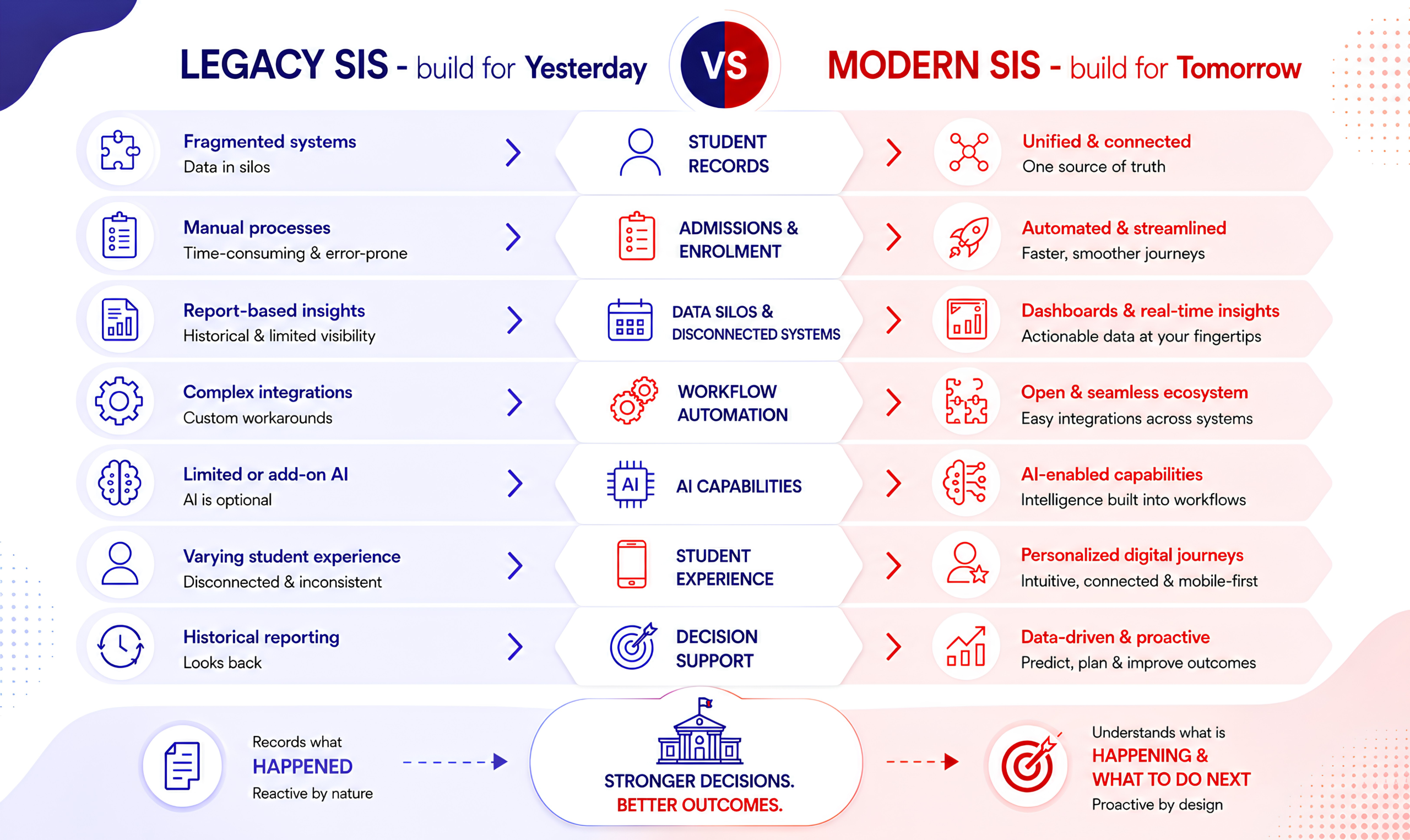
What Is the Difference Between a Legacy SIS and a Modern SIS? 

A legacy SIS can still perform important functions. The question is what happens around it.


Capability Legacy SIS Modern SIS
Student records Strong Strong
Admissions & enrolment Supported Connected and automated
Academic management Supported Integrated across lifecycle
Workflow automation Often limited Configurable workflows
Analytics Report-based Dashboards and real-time insights
Integrations Complex workarounds Connected ecosystem
AI Limited or add-on AI-enabled capabilities
Student self-service Varies Connected digital journeys
Decision support Historical Data-driven and proactive

A legacy SIS is often designed to record what happened. A modern Student Information System should help institutions understand what is happening, why it is happening and what to do next.

Legacy SIS vs Modern SIS


1. Why Is Fragmented Data a Problem for University Leadership? 

Admissions may hold one version of a student’s information, academics another, finance separate records and the LMS additional learning data. When leadership needs a complete picture, teams have to bring those pieces together.

This slows reporting and creates inconsistencies. MoHESR’s automated data integration with 54 higher education institutions in 2025 further demonstrates the UAE’s move towards connected higher education data.

What UAE universities should ask:
Can our SIS provide a reliable view of the student lifecycle without requiring teams to manually reconcile information?

2. What Do Students Expect From UAE Universities Today? 

Students increasingly expect university services to work like other digital services. They think in outcomes: apply, register, pay, check timetables and results, raise requests and get answers.

If every step requires a different portal, repeated information or manual follow-up, the technology may be digital, but the experience remains fragmented.

Student experience is therefore a core SIS consideration. MoHESR also focuses on reducing repetitive procedures and creating seamless digital services.

3. How Does Manual Reporting Affect University Decision-Making? 

University leaders need timely answers to questions such as:

  • Which programmes are attracting demand?
  • Where are applications dropping off?
  • What is the current enrolment position?
  • Which students may need support?
  • Where are outstanding fees concentrated?
  • Which processes create the highest service workload?

A modern SIS should make this information easier to access.

If your SIS requires extensive manual work before leadership can trust the numbers, the problem is bigger than reporting. It is an institutional data problem.

4. Why Are UAE Universities Prioritising AI in Their SIS? 

The AI conversation is moving beyond “Does the system have AI?”

The more important question is:

Can AI work effectively on trusted institutional data?

In June 2026, the Ministry of Education launched the NOVA project to advance AI-driven institutional transformation, reinforcing the importance of data and AI in education administration.

A modern SIS should provide a foundation for faster reporting, intelligent analytics, automated workflows, pattern identification, proactive student support and AI-assisted decisions.

Academia by Serosoft approaches this through an AI-powered SIS ecosystem, including SERA AI and AI-powered analytics.

Is Academia Better Than a Legacy SIS for UAE Universities? 

The answer depends on the university.

If an existing SIS is stable, integrated, scalable and AI-ready, replacement may not be necessary.

Evaluate alternatives if:

  • Teams spend too much time reconciling data.
  • Reports require spreadsheets and manual consolidation.
  • Integrations are expensive or difficult to maintain.
  • Students navigate disconnected systems.
  • Workflows depend heavily on email and manual approvals.
  • Leadership lacks real-time visibility.
  • The SIS roadmap is not keeping pace with AI.
  • New programmes or campuses require significant technical effort.

These issues affect operational efficiency, student experience and scalability.

What Should UAE Universities Look for in a Modern SIS?

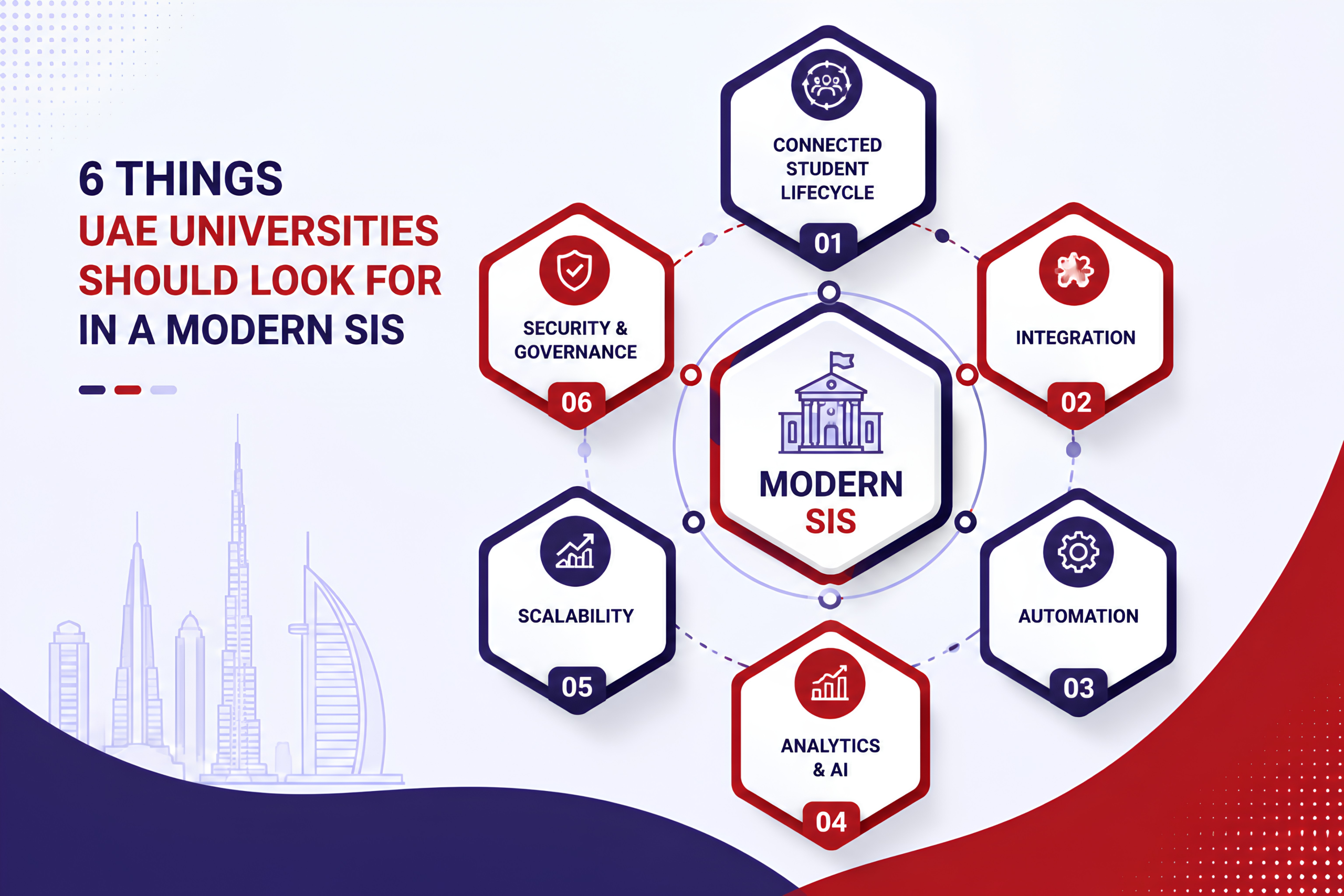
Before shortlisting vendors, evaluate six areas:

1. Connected Student Lifecycle

Admissions, academics, examinations, finance, student services and graduation should work as one ecosystem.

2. Integration

Connect LMS, CRM, finance, payments, identity and other platforms rather than creating another silo.

3. Automation

Ask which processes can be automated and how easily workflows can change.


UAE SIS

4. Analytics and AI

Evaluate whether institutional data becomes actionable insight, not just static reports.

5. Scalability

Support changing enrolment, programmes, campuses and operational requirements without technology bottlenecks.

6. Security and Governance

Assess security, role-based access, auditability, data governance and responsible AI from day one.

Why Should UAE Universities Consider Academia as Their SIS? 

Academia by Serosoft is built for higher education, bringing student lifecycle management, academic operations, workflows, analytics and AI capabilities into a connected SIS environment.

According to Academia, the strongest SIS outcomes come when institutions move beyond digitising individual processes and instead connect the complete student lifecycle. This approach helps universities reduce manual intervention, improve visibility and create a more consistent experience across admissions, academics, finance and student services.

Rather than replacing one database with another, the goal is to create a technology foundation where data moves more effectively, processes require less manual work, students face fewer barriers and leadership gains better visibility.

That is the difference between modernising software and modernising university operations.

What Should UAE Universities Consider When Choosing an SIS in 2026? 

The best SIS is not the one with the longest feature list. It is the one that fits the institution’s strategy.

For UAE universities, that direction increasingly includes connected digital services, reliable data, AI-enabled operations, streamlined student journeys and faster evidence-based decisions.

The UAE’s higher education ecosystem is already moving towards stronger data integration, simpler services and AI-enabled transformation. That makes the SIS decision more strategic than ever.

The question is no longer: “Does our SIS work?”

The better question is: “Is our SIS helping us become the university we want to be?”

What Can a Modern SIS Offer UAE Universities? 

If your university is evaluating a legacy SIS or exploring an AI-powered alternative, now is the time to assess options.

See how Academia can help your university connect the student lifecycle, automate operations and turn institutional data into better decisions.

Request a personalised demo for your UAE institution.

A demo can help your team compare Academia with your existing SIS and identify high-impact automation opportunities.

Frequently Asked Questions

What is the best Student Information System for UAE universities in 2026?

There is no single best SIS for every institution. Evaluate integration, scalability, automation, analytics, AI, security and long-term transformation needs.

Should a UAE university replace its legacy SIS?

Not necessarily. Replacement becomes worth considering when the existing system creates fragmented data, manual processes, limited integrations, poor reporting visibility or difficulty adopting AI.

Why is AI important in a university SIS?

AI can support faster analysis, intelligent workflows and proactive decisions. As UAE education emphasises AI and data, AI readiness is becoming an important SIS criterion.

Can Academia integrate with existing university systems?

Academia is designed as a connected higher education platform. Universities should assess its integration with LMS, CRM, finance, payments and other platforms.

What should universities ask SIS vendors during a demo?

Ask vendors to demonstrate real workflows: how an applicant becomes an enrolled student, how data moves between departments, how reports are generated, how workflows are automated and how integrations work.

How Modern SIS Platforms Help Switzerland Universities Future-Proof Campus Operations

Switzerland has earned a global reputation for educational excellence. Home to world-class universities, cutting-edge research institutions, and internationally diverse campuses, it continues to attract students and faculty from across the globe.

But behind every successful university lies a challenge that isn’t always visible.

Administrative teams are juggling increasing student expectations, complex compliance requirements, hybrid learning environments, international mobility programmes, and the rapid emergence of Artificial Intelligence (AI). While the academic landscape has evolved dramatically, many institutions are still relying on legacy systems that were never designed for today’s demands.

Switzerland’s higher education system is also shaped by its participation in the Bologna Process, enabling seamless student mobility and academic recognition across Europe. Through swissuniversities, institutions collaborate on research, quality assurance, and digital innovation, making connected, interoperable technology more important than ever.

The question isn’t whether Swiss universities should embrace digital transformation; it’s whether their Student Information System (SIS) is ready to support the next decade of higher education.

A modern SIS is no longer just a platform for storing student records. It has become the digital backbone of the university, connecting departments, automating operations, enabling data-driven decisions, and creating seamless experiences for students, faculty, and administrators alike.

This article explores how modern SIS platforms are helping Swiss universities build campuses that are smarter, more agile, and ready for whatever comes next.

Why Future-Proofing Matters More Than Ever

Imagine a student applying online, submitting documents digitally, receiving instant updates, registering for courses through a mobile app, paying fees online, tracking academic progress in real time, and graduating without ever filling out a paper form.

Now imagine delivering that experience while faculty, finance teams, admissions officers, and university leadership all work from the same accurate, real-time data.

That’s what future-ready campus operations look like.

Unfortunately, many universities still operate with disconnected systems where admissions, academics, finance, examinations, and student services function independently. The result is duplicate data entry, delayed decision-making, inconsistent reporting, and frustrating student experiences.

For Swiss universities striving to maintain their global reputation, these inefficiencies can become barriers to innovation.

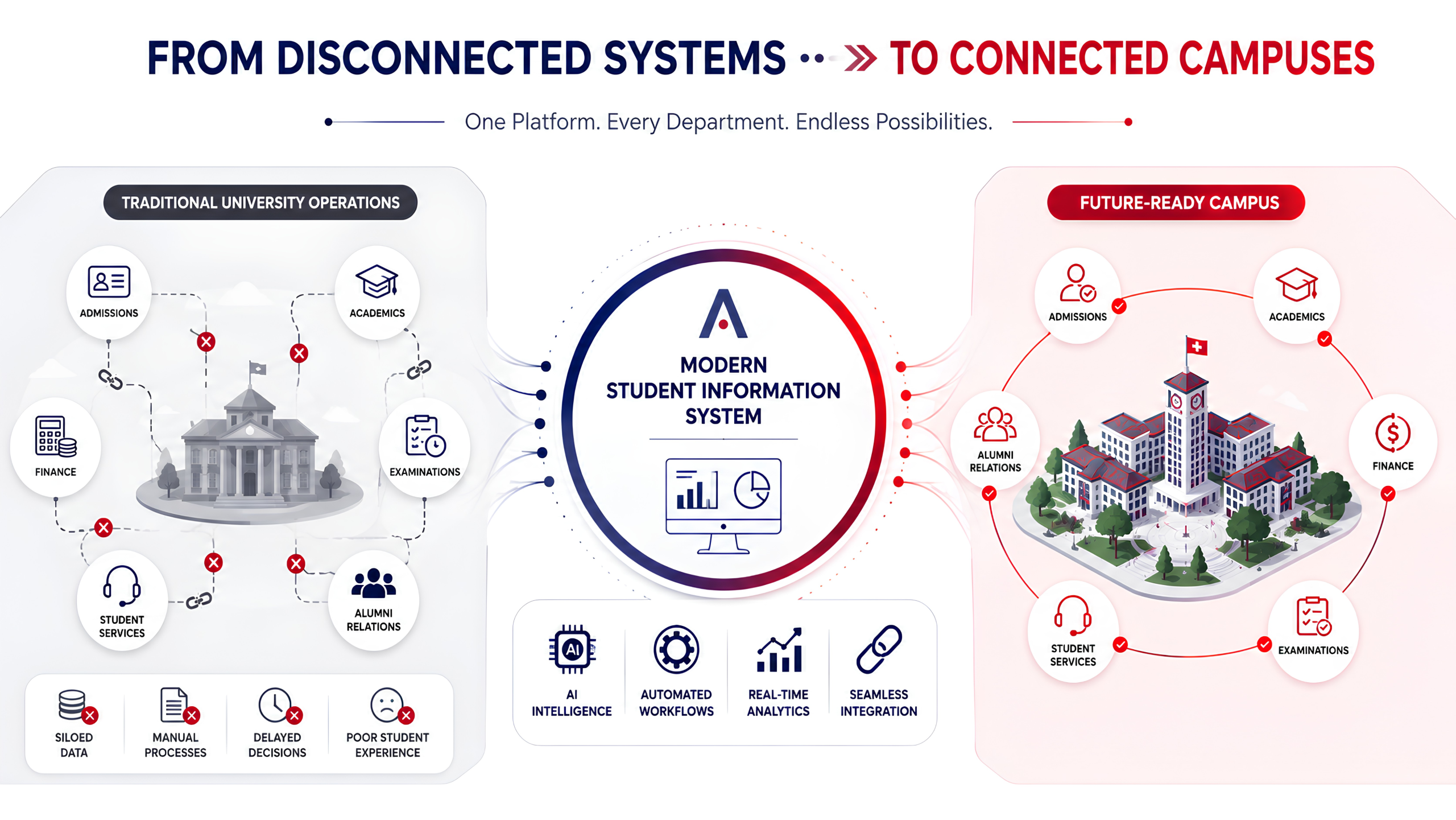
A modern Student Information System changes this by connecting the entire institution into one intelligent ecosystem.

Legacy Systems vs. Modern SIS Platforms

Modernisation isn’t about replacing software because it’s old. It’s about removing operational bottlenecks that slow universities down.


Legacy SIS Modern SIS
Department-wise data silos Unified institutional database
Manual approvals Automated workflows
Static reports Real-time dashboards
Difficult integrations Open API architecture
Reactive planning Predictive analytics
High maintenance costs Cloud-based scalability

Instead of departments working independently, a modern SIS enables the entire institution to operate as one connected campus.

Legacy Systems vs. Modern SIS Platforms

5 Ways Modern SIS Platforms Are Future-Proofing Swiss Universities 

One Connected Campus, One Source of Truth

Every student’s journey touches multiple departments from admissions and academics to finance, examinations, student services, and eventually alumni relations. Yet in many universities, these departments still operate on disconnected systems, creating duplicate records, inconsistent information, and unnecessary administrative effort.

A modern Student Information System changes this by bringing every department onto a single platform. Instead of maintaining multiple versions of student data, everyone works from one centralised source of truth. This not only improves collaboration between teams but also ensures that students receive faster, more consistent services throughout their academic journey. When admissions, finance, academics, and administration are connected, universities spend less time reconciling data and more time delivering value to students.

Better Data Leads to Better Decisions

Running a university requires making hundreds of strategic decisions every semester. Which academic programme is seeing the highest demand? Where are students struggling? Which departments need additional resources? Without reliable data, these decisions often rely on assumptions instead of evidence.

According to the EDUCAUSE Horizon Report 2025: Teaching and Learning Edition, AI, learning analytics, and data-informed leadership are among the biggest forces shaping the future of higher education. The report highlights that institutions investing in connected digital ecosystems are better positioned to improve student outcomes and institutional performance.

Modern SIS platforms transform raw institutional data into real-time dashboards, giving university leaders instant visibility into admissions, enrollment, attendance, academic performance, finances, and other key performance indicators. From our experience supporting higher education institutions across 32+ countries, we’ve seen that universities with unified data consistently make faster and more confident decisions because everyone is working from the same trusted information.

Automating Work So People Can Focus on Students

University staff don’t join higher education to spend their days processing paperwork.

Yet countless hours are still consumed by repetitive administrative tasks such as:

  • Admissions processing
  • Course registration
  • Attendance management
  • Fee collection
  • Examination workflows
  • Transcript requests
  • Graduation approvals

These activities are essential, but they shouldn’t require unnecessary manual effort.

Modern SIS platforms automate these routine processes, reducing administrative burden while improving speed and accuracy.

The importance of intelligent automation extends beyond higher education. According to the Gartner Top Strategic Technology Trends 2025 report, AI-enabled automation and intelligent applications are helping organisations become more adaptive, resilient, and operationally efficient.

Universities are no exception.

However, automation alone isn’t enough.

One of the biggest lessons we’ve learned from partnering with higher education institutions globally is that AI only performs as well as the data behind it. When student information is scattered across disconnected systems, predictive analytics become unreliable. A unified SIS creates the clean, connected data foundation needed for AI-powered reporting, intelligent workflows, and proactive decision-making.

Supporting International Growth Without Adding Complexity

Switzerland continues to attract students from across Europe and around the world.As a participant in the Bologna Process, universities must support student mobility, ECTS credit transfers, exchange programmes, and collaboration with international partner institutions. These expectations require digital systems that can manage complex academic structures without adding administrative burden. 

Managing this diverse student population requires far more than digital admissions.

Universities must accommodate:

  • Multiple academic calendars
  • International admissions
  • Student exchange programs
  • Credit transfer processes
  • Multiple languages
  • Multi-campus operations

Trying to manage these processes across disconnected systems quickly becomes complex.

Modern SIS platforms are designed to support internationalisation through configurable workflows, centralised data, and flexible academic structures.

This allows institutions to expand globally without increasing administrative complexity.

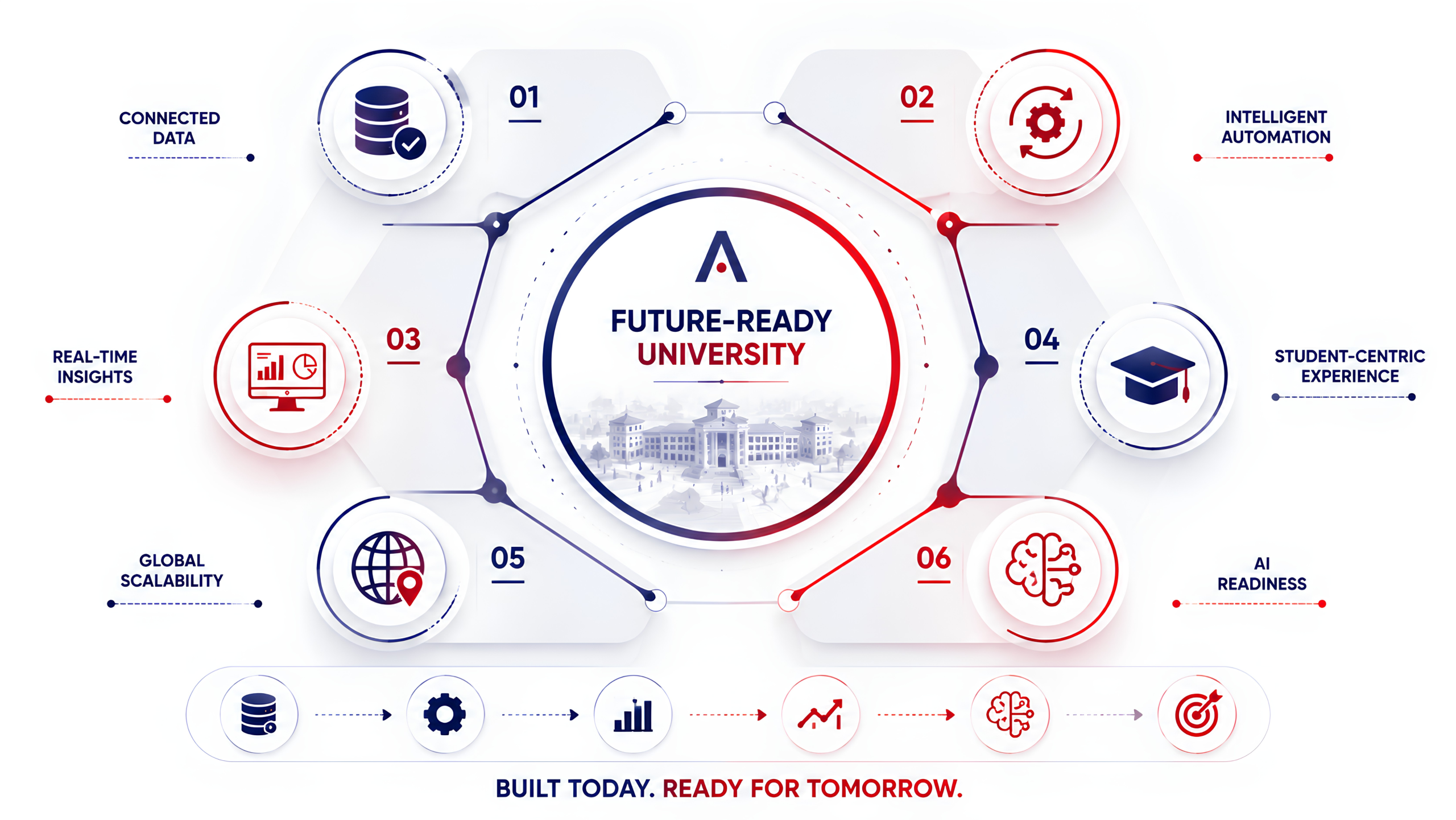
Building the Foundation for AI-Ready Universities

Artificial Intelligence is no longer a future trend; it is rapidly becoming part of everyday university operations. From predicting enrollment trends and identifying at-risk students to generating intelligent reports and supporting strategic planning, AI has the potential to transform how universities operate.

But AI is only as effective as the data behind it.

Think of AI as a high-performance engine. Even the most advanced engine cannot deliver results without quality fuel. Similarly, predictive analytics and intelligent automation require accurate, structured, and connected institutional data.

Building the Foundation for AI-Ready Universities

A modern Student Information System provides this foundation by bringing together information from across the university into a single, trusted platform. Instead of simply digitising existing processes, universities gain the ability to anticipate challenges, uncover opportunities, and make smarter decisions before problems arise. Future-proofing isn’t about preparing for AI someday; it’s about building the digital infrastructure that enables AI to create value today.

What Should Swiss Universities Look for in a Modern SIS?

Selecting an SIS is one of the most strategic technology decisions a university can make.

Beyond features, institutions should evaluate whether the platform can support long-term institutional growth.


Capability Why It Matters
Cloud-native architecture Scalable, secure, and always up to date
AI-powered dashboards Faster institutional decision-making
Workflow automation Reduces manual administration
Open APIs Integrates with LMS, ERP, Finance, HR, and CRM systems
Mobile-first experience Better engagement for students and faculty
Configurable workflows Adapts to institutional policies
Enterprise-grade security Supports GDPR and nFADP, ensuring secure, compliant management of sensitive student data.

The right SIS should continue evolving alongside the university, not require replacement every few years.

Building Future-Ready Universities with Academia

Digital transformation succeeds when technology adapts to the institution, not the other way around.

Academia by Serosoft is an AI-powered Student Information System trusted by higher education institutions across 32+ countries, helping universities modernise operations while delivering better experiences for students, faculty, and administrators.

With Academia, institutions can:

  • Manage the complete student lifecycle on a single platform
  • Automate admissions, examinations, finance, attendance, and academic workflows
  • Gain real-time visibility through AI-powered dashboards and analytics
  • Integrate seamlessly with LMS, ERP, HR, Finance, and third-party applications
  • Improve collaboration across departments with a unified data ecosystem
  • Scale confidently with a secure, cloud-native architecture built for modern higher education

Rather than solving isolated operational challenges, Academia helps universities create a connected digital ecosystem that supports continuous innovation and long-term institutional growth.

Final Thoughts

Switzerland has always been at the forefront of educational excellence. Maintaining that position in the years ahead will depend not only on outstanding teaching and research but also on the digital infrastructure that powers every campus experience.

A modern Student Information System is no longer just an operational tool.

It is the foundation for smarter decision-making, streamlined administration, AI readiness, and exceptional student experiences.

The universities that invest in connected, intelligent campus operations today will be the ones leading the future of higher education tomorrow.

Because future-proofing isn’t about preparing for change.

It’s about building a university that’s ready for whatever comes next.

Frequently Asked Questions (FAQs)

1. What is a modern Student Information System (SIS)?

A modern Student Information System (SIS) is a cloud-based platform that manages the complete student lifecycle from admissions and enrollment to examinations, finance, graduation, and alumni while providing automation, analytics, and AI-powered insights.

2. Why should Swiss universities invest in a modern SIS?

A modern SIS helps universities streamline administrative processes, improve student experiences, support internationalisation, enable data-driven decision-making, and create a strong foundation for AI-powered campus operations.

3. Can a modern SIS integrate with existing university systems?

Yes. Modern SIS platforms support API-based integrations with Learning Management Systems (LMS), ERP solutions, HR software, finance systems, CRM platforms, and other third-party applications, allowing institutions to build a connected digital ecosystem.

4. How does Academia help universities future-proof campus operations?

Academia by Serosoft provides an AI-powered, cloud-native Student Information System that unifies admissions, academics, finance, examinations, and student services on a single platform. This enables universities to automate workflows, gain real-time insights, and scale confidently as their needs evolve.

5. Why do universities across 32+ countries choose Academia?

Universities choose Academia because it is purpose-built for higher education. With AI-powered dashboards, configurable workflows, enterprise-grade security, seamless integrations, and end-to-end student lifecycle management, Academia helps institutions accelerate digital transformation while delivering better experiences for students, faculty, and administrators.

Back to top