Type your keyword below

Adaptive Learning and Education ERP

Technology has a way to transform the lives of people it connects. Many positive, some negative – but our sense is technology largely means good, and technology means providing tailor-made solutions to the problems faced by all industries and their biggest stakeholders. 

Talking of personalized learning in the education ecosystem, we cannot ignore the role of technology – especially in achieving adaptive learning. By definition, adaptive learning means devising educational methods using AI-driven algorithms in a digital learning environment. It enhances interaction with the learner and delivers personalized learning experiences through highly customized resources. This includes innovative learning activities, the use of modern technology, and continuous improvements in practices to reach the ultimate goal. 

In this particular piece of content, we would try to unravel the path that has helped achieve adaptive learning and discuss several steps taken by technology experts for the benefit of education organizations. 

Adaptive Learning, Adaptive Hypermedia,  and Identifying the Learning Style of Students 

  • Adaptive Learning 

Easier said than done, there are many pieces of research from renowned educational theorists on adaptive learning. Formally starting from identifying the learning styles of students and mapping the teaching styles with it, today technology is making this task easier and also digitally possible.  

Adaptive learning is a fascinating concept. Time and time again research has surfaced proving that every individual has a different learning style. Teaching styles must differ based on these findings. For the concept to work successfully and give positive results, it demands academicians to go beyond just measuring knowledge retention in terms of marks and grades. It requires teachers to closely analyze various aspects of a student’s personality and build a deep analysis of their individual learning patterns. 

But how do they do it? Is there a definite process to do it? Or do they give you a list of characteristics that must be analyzed to understand the learning behavior of a student? For years, teachers just went round and round orbiting around this concept. Meaning, that even though they had the motivation, they lacked the resources. 

With time, scales tipped towards technology. Adaptive learning was made possible with Adaptive Hypermedia and we are where we are today – successfully providing personalized learning to students. 

  • Adaptive Hypermedia 

Over time technology evolved and started penetrating various industries. Educational institutes in the west started using various types of media other than books to bring more variety into their teaching styles. This entire chain of change gave birth to the term hypermedia.

More research surfaced and people found adaptive learning with hypermedia is easier to provide individualized learning experiences to the students. According to Peter Brusilovsky, individualized instructions influenced the behavior of the education community. For which he aggressively proposed the use of hypermedia. He supported analyzing learners based on their profiles or records. He also highlighted the importance of user modeling to personalize learning successfully. 

In 1998, Mario Paolucci proposed an adaptive hypermedia system that was capable of diagnosing and identifying each student’s misconceptions. He was taking individualized learning to the next level. Building the base for Lo, Wang, and Yeh, Paolucci’s research is seen as a game changer. 

In 2004, Lo, Wang, and Yeh used Paolucci’s concepts to develop a hypermedia-based English Learning System for Prepositions. Not going deep into the product, we would just appreciate the sheer futurism in the concept and product modeling. The team of three started learning the online behavior of the students. They defined various touch points that allowed them to know the online learning behavior of their students. Various student behaviors were defined using data points such as idle time, response time, effective learning time, ineffective learning time, and login time. 

Although, just the tip of the iceberg, we believe it was a great achievement. Using the parameters the three successfully detected various learning attitudes of the students such as concentration, willingness, patience, and more. They used this knowledge to build a more individualized learning environment and teaching style. But, it was a time-intensive, manual process that was hard to achieve on practical grounds. 

The modern concept of Adaptive Learning 

There are so many other instances, various research, and technological advancements that have led us here. Today, if we can talk about creating a personalized learning experience and changing the content per user to attain the results it is because people before us have invested a great deal of time in creating a base for us theoretically and technologically. 

If we talk about the current scenario, the education industry is on a brink of change. The wheels of transformation are churning as more and more universities and colleges adapt to digital infrastructure and popularize online learning. Today, we have products that are collecting data at all stages to help us build an understanding of student behavior. 

Introduction to Education ERP and achieving Adaptive Learning Goals 

As the world moves towards providing more immersive learning experiences to students, adaptive learning is expected to play a dominant role in the education sector. Past experiences and studies suggest achieving adaptive learning requires data-backed reasoning and tools that reinforce learning and adapt to the individual student’s needs. 

As more and more digital tools emerge the goals appear to become easier to achieve. Especially, the multi-faceted quality of ERP solutions is highly praised by education theorists and administration. It is because of the provision it provides to collect data at several touchpoints through student mobile applications, web portals, faculty and administration performance and behavioral inputs about students, and also their quality to seamlessly get integrated with online learning tools. 

Through ERP you get to have a better understanding of a student’s pattern of learning, their interest, their effective time of learning, and even their response to different teaching styles. This opens new doors for the education system around the world and gives them a chance to break the barriers and move ahead. This also, helps them plan resources better for the students and allows them to not blindly invest their resources and force students to adapt to the redundant methods of learning. Through the education ERP solution not only do you get tools to better manage your institute, but also make teaching more centralized to student needs. 

What is an Education ERP?

Enterprise resource planning is an umbrella term used for a host of mini-programs that are collectively used by enterprises to manage their resources better and bring more ease to functioning. 

The definition does not change much with the addition of ‘education’ as a prefix to the term. Education ERP solutions are highly-configurable and tailor-made solutions built for education institutes such as schools, universities, and training institutes. They help in: 

  • Data Management, Analytics, and Reports 

ERP solutions allow you to centralize your institute data and allow various stakeholders to use it for improved functioning. But one of the biggest things that this system does for you is data collection and data management. This gives institutes the added benefit of data insights.

With the removed opaqueness in the system, institutes can improve their strategies and achieve institute goals faster. It is a digitalized narrative that was set decades ago by educationists and researchers that allows for modifications in teaching styles, academic processes, and various other things for higher knowledge retention and student outcomes. 

  • Helps learn about risks

Predictive analysis is the latest addition to Education ERP. Like other industry segments, education too is now using data to allow Artificial Intelligence and Machine Learning to learn about the risks present in the ecosystem and provide effective solutions to address them. 

Risks such as bad resource planning, financial crisis, reduced student engagement, non-availability of important resources, and student dropouts can be easily identified before they cripple your institute. It is a great way to ensure higher revenue, and student outcomes even in global stumbling blocks such as Covid-19, or recession. 

  • Implementing AI in Learning Management System 

Using ERP in combination with Learning Management System allows you to save time in personalizing education for students. It allows you to learn about the existing knowledge and skills of the student and use it to define new teaching styles for improved student engagement. Also, the system tells you about areas in which student needs attention and counseling and helps them master new skills, gain new knowledge and also build a sustainable career path. 

Going Forward

Adaptive learning is one of the most sought-after concepts in the education industry. Surprisingly, it has been on the agenda of every institute not just in the present but decades ago as well. As technology progresses we can expect new understanding sprouting from all the knowledge, research, and technology that we have. 

We can assure you, that adaptive learning would rule the world as it is not only practical, profitable, and beneficial but also meaningful. People have different learning styles and the world must embrace this fact and start looking beyond just books and giving skills, knowledge, learning pattern, and style the due stance in strategies that could have made things so much better years ago. 

Solutions such as ERP are highly supportive for education institutes to build the right infrastructure to learn, grow and implement adaptive learning. You can talk to our technology experts to understand how our product Academia ERP is fulfilling the needs of the industry and supporting adaptive learning. We would love to be of any assistance. 

Stay tuned for more information, and exciting news in the edtech domain.
Cloud ERP vs On-premise ERP Solutions: What is right for your education institute?

Custom ERP solutions for the education industry are very popular. Meanwhile, institutes widely focus on the features and functionalities of the applications, they miss out on the most important factor – deployment. 

Three of the most widely used deployment methods are – On-premise, Cloud, and Hybrid. In this blog, we would be discussing the difference between ERP on-premise vs cloud. Let’s start by defining both first. 

What are on-premise ERP solutions? 

On-premise ERP solutions are licensed software that is purchased and installed on your system and runs on your server. Everything is done internally, this includes maintenance, risk management, updates, etc. Hence the additional cost for power servers, database software, and operating systems are incurred by you. 

What are cloud-based ERP solutions? 

Cloud-based ERP solutions are deployed on cloud servers. The biggest difference between an on-premise and cloud-based ERP solution is the ownership. Meanwhile, on-premise solutions are deployed on your server, cloud-based ERP applications are deployed on the vendor server and you can access the software over the cloud using a web and mobile application.  

Current Scenario

Cloud-based ERP solutions are gaining great momentum. It requires no active management and thus is more effective for the institutes that do not want to invest in the resources. Also, cloud-based solutions are usually purchased on a subscription model which gives you pay-on-the-go flexibility. This includes the annual fee for the software, server maintenance, network management, software updates, etc. 

Questions to ask your service provider about security

Meanwhile, most of the cloud-based ERP solutions are deployed on a private cloud, there may be a chance that you are using an app on a shared cloud. This may be a red flag as it can compromise data security. 

Also, SaaS ERP solutions deployed on a private cloud are highly secure and flexible. Since they are hosted on a private cloud there are no shared resources, the data is very secure. Furthermore, if scalability is required you can opt for a bigger plan. Backup controls and upgrades are also very easy. 

Key Differences: Cloud-based ERP Solution and On-premise ERP Solution

  • Deployment 

One of the most significant differences between the two is that of deployment. Whereas with on-premise software, the company is responsible for maintaining the software solution and other relative operations, in cloud-hosted services you don’t have to worry about anything. Software is hosted on the vendor cloud and maintained by the service provider including the software maintenance and related processes. 

  • Control 

With an on-premise ERP environment, you have more control over things, but they do come at a high price. To ensure ownership and control, plus the measures you have to take for ensuring high-end security is going to be too costly. The more data you generate the more scalability you need and you would be looped into an endless cycle of continuous investment.

Although cloud-based software use vendor server, the evolving data policies and increasing adherence to global data security measures is a great assurance for small and big businesses. The cloud-based ERP solutions that provide data protection and encryption are good to go, they even use reliable third-party tools that follow security protocol and show adherence to data policies. 

  • Security 

Data security over servers is a great concern for many businesses. Since security is one of the most important things for businesses of all sizes and types, you may want to choose an on-premise security solution. Having said that, you would have to invest heftily in multiple avenues to guarantee security to its fullest. 

Talking about the cloud, reliable ERP solution providers such as Academia for education organizations can ensure high-end security. We follow security protocols for data protection. Furthermore, there are hardly any risks of hardware, software, and infrastructure malfunctions. And even if it happens there are protocols followed for multiple disasters and data redundancy protocols. With a reliable service provider like us, you can easily manage the security risks associated with cloud-based ERP solutions. 

On comparing… 

Factors Cloud-based ERP On-premise ERP
Accessibility Advantage Disadvantage
Affordability Advantage Disadvantage
Maintenance Advantage Disadvantage
Security Advantage Disadvantage
Deployment Advantage Disadvantage
Scalability Advantage Disadvantage
Control Disadvantage Advantage
Ownership Disadvantage Advantage
Connectivity Disadvantage Advantage

Most important discussion of all… The Cost: 

Given the initial investment along with product cost and infrastructure, an on-premise software solution might not be the right solution for a small institute or an organization that is just starting. Furthermore, you must consider maintenance and operational costs that are going to be a constant monetary burden. Even for big organizations scalability comes at a cost. And when more and more organizations are implementing modern technologies to reduce operational costs people are looking forward to moving to cloud-based ERP solutions. 

Cloud-based ERP solutions are more cost-effective as they are easy to set up and do not require any additional investment and effort on your end. A cloud-based solution from a reliable vendor is as efficient and secure as an on-premise solution. Plus, consider how much you are going to save on the resources.  

The cost of ownership, when distributed over the entire lifecycle of the system, is much less in the case of an on-premise solution. Hence, if you can manage to pay up for the initial set-up and maintenance, you can easily regulate the cost and achieve ownership at a lower cost as compared to a cloud solution. 

What is right for you? 

Cloud-based ERP solutions are taking the world by storm. In comparison, they fall short only on the aspect of ownership, meanwhile also providing you a major benefit of reduced cost and scalability. If you are a small-sized business and do not want to initially invest in the infrastructure and additional costs that you have to pay up-front and over time, cloud-based solutions are a good option. 

Also, more and more established companies are moving towards cloud-based ERP solutions. The reason is the availability of reliable vendors and the evolving dynamics of security protocols and strict adherence to them. Today, cloud-based ERP solutions are seen as a more viable option for big or small companies. You can connect with our technology experts to learn more about cloud-based education ERP solutions, and how Academia can help you in achieving your business goals. 

Role of Predictive Analysis in the Education Industry

The education industry is undergoing some of the biggest changes in the past few years. Although the industry is embracing e-learning enthusiastically, the newfound challenges in the pandemic and post-pandemic era have completely jolted the industry. Institutes are now moving towards a tech-based evolution. An industry that dates back centuries and is known for not making many changes in its traditional format of operating is now looking up to technology for its various needs. 

Right from student discovery to student retention and other nesting stages, technology has fused itself to every operative, academic, and organization task to restrengthen it. Tech-based solutions are helping in increasing accountability in people to improve knowledge retention and student experience. Institutes are using ERP or SIS (Student Information System) solutions for allocating resources and managing them better. Benefits in terms of better management and reduced cost are remarkable. 

Going a step ahead, not only tech adaption is improving the functioning of the institutes but also preparing them for future challenges. Predictive analysis allows educational institutes at all levels to learn from students, beneficiaries, and other stakeholders in the system to gain valuable insights and highlight industry trends. Not only does it gives them protection in harsh business scenario but also a competitive edge.  

Predictive analysis

Predictive analysis is a process of crunching the data and gaining meaningful insights at all levels from various stakeholders in the system to devise useful strategies for better ROI and management. 

Concerning the education industry, predictive analysis can help the management to make more informed decisions and effectively operate their institutes. It also helps in making strategic decisions around the student lifecycle and improves student experience by ten folds. It gives you a near-accurate prediction on what are the factors that may weigh down things for your institute. They can use this new knowledge and combine it with their experience and understanding to build a more sustainable system for things. In long run, improved decision-making can result in higher revenue, brand recognition, student retention, and more. 

Not to be confused with a traditional analytical tool

Meanwhile, the traditional analytical tools are focused on providing you with a detailed analysis of things that have been done, a predictive analytical tool is forward-thinking and provides you with data-backed recommendations on things that are to be done next. 

For any institute, what they do next in the future is as important as what they are doing now. The predictive analysis provides actionable insights and accentuates the confidence of people in the management to improve their decision-making.  

Advanced predictive analysis tools use structured and unstructured data and statistically analyze various functions and operations of the institute. Furthermore, it mines data and does predictive modeling to uncover hidden patterns and associated connections between various functions and outcomes to prepare personalized recommendations. 

Moreover, predictive analysis is a tool that allows you to go beyond just the academic and organization data. It allows you to capture elements that help you understand the user participation, response, and activities through the online portal, mobile applications, and various touchpoints and triggers in the digital system. It can also use big data to tell trends and give you a 360-degree view of the institute’s performance and recommend strategies to improve. 

Evolution of Predictive Analysis in Education 

Like any other industry, the education industry too has its unique needs, and technology if not personalized doesn’t serve its purpose. The evolution of predictive analysis in the education industry has given rise to systematic improvements in the education sector also, institutes are seen using existing data to gain insights on the present and future performance of education organizations as a business in terms of monetary gains and sustainability. 

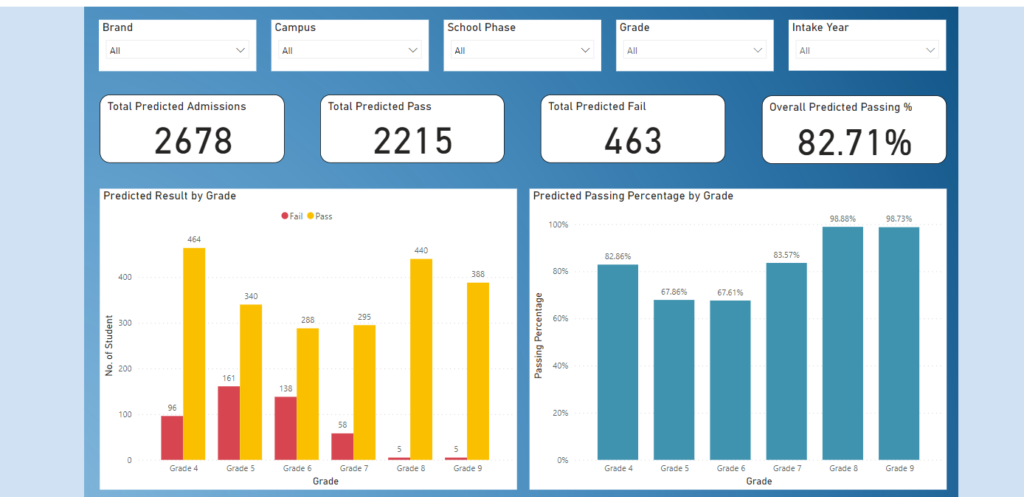
Today, predictive analysis is not only being used for bigger aspects of the education industry such as the number of admissions but it is also used in predicting student success. Student success is a key indicator in the system, all the other factors mapped to it are taken under consideration in advanced predictive analytics tools to ensure business longevity and performance as a whole. 

Bid adieu to human errors

Traditionally data collection, collation, and analysis were done manually but the process is now redundant due to two major reasons. First, organizations had to dedicate resources primarily to this job and it was time-intensive and costly. Secondly, human intervention is prone to errors that may result in data discrepancies. Thus predictive analysis is a more viable and practical solution. 

Unique Usecases of Predictive Analysis in Academia ERP Solution

Academia is an advanced ERP/SIS software that provides dedicated solutions for schools, colleges, universities, and training institutes. We offer highly configurable software solutions that can be easily customized to meet your needs. Using Academia you can manage your academic, organizational and operational tasks easily. Furthermore, the product offers you a great user experience on mobile and web platforms, it is a secure solution that allows remote working. 

As a high-end software solution, we understand the importance of predictive analysis in the modern business environment. And have utilized it to its potential to develop amazing solutions for some of the biggest institutes located globally. Connect with us to know more about Academia and how we can help you manage your institutes better. 

Here are a few use cases of predictive analysis in Academia. 

1. Predicting Student Performance

One of the biggest challenges for faculties and management is to identify students that are lagging behind. Holding examinations quarterly or half-yearly does not provide much scope for performance evaluation and improvements. 

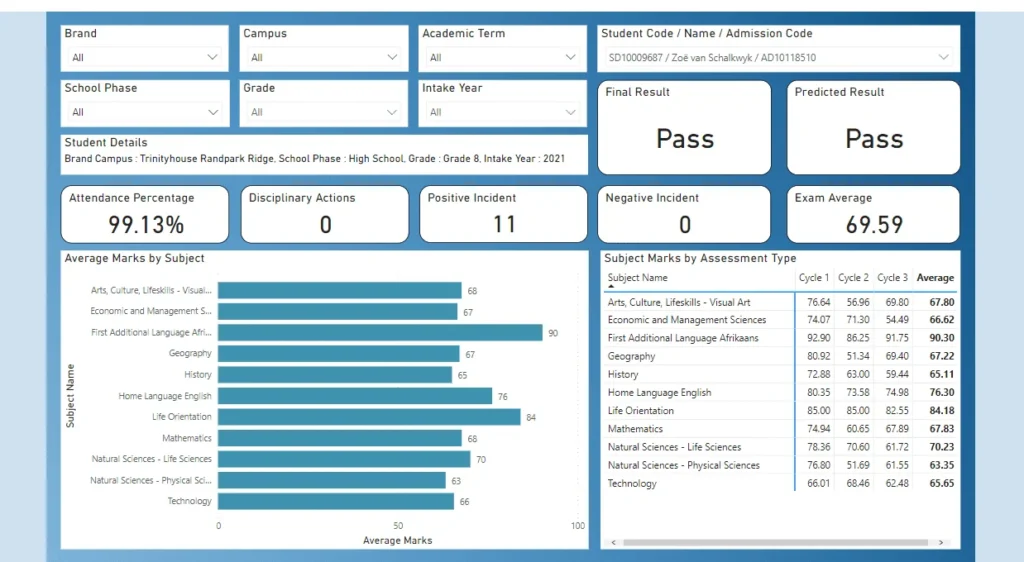
Academia ERP/SIS solution uses historical data of the students and creates a data modeling to provide you a close to accurate analysis of the student performance. Taking it a step ahead, it also helps in analyzing the performance of the class as a whole through a group analysis.

With an accuracy rate of ~90%, Academia is one of the finest education ERP solutions globally that statistically analysis a wide range of factors to provide a near-close prediction on students that may fail due to internal and external factors. The same goes for group analysis. 

Using the tool, schools, colleges, and universities can focus on student performance individually and identify the markers in the system that are causing the performance degradation in student performance. This helps them to take actions that improve student performance and drive them towards excellence. 

2. Application Conversion Prediction 

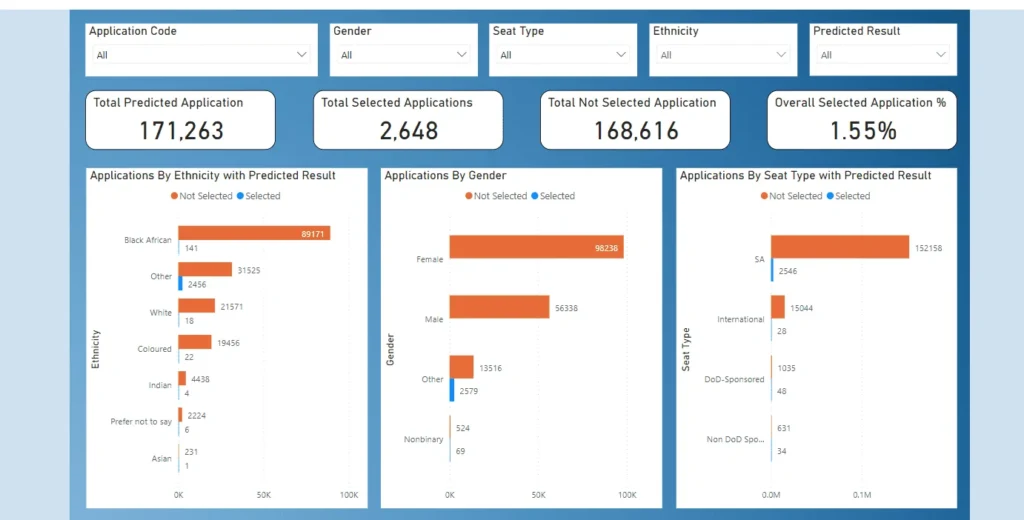
The drop rate in the stage from application to admission is a huge challenge for the education industry. With the limited available information about the students, it becomes very difficult for the organizations to identify the factors that are causing the drop rates to shoot up. 

With historical data analysis, the Academia ERP/SIS takes into account various factors to identify the major causes of the drop rates. Also, it provides useful insights and information to the counselors to guide students correctly and convert the applicants into students. The system being highly configurable, can be utilized by any institute easily to devise their own metric to identify applicants that are more likely to become a student in their organization and also fight off drop rates more efficiently. It gives them a major strategic advantage to increase their revenue for longevity.

Way forward

The growing competition in the industry requires a fast-paced solution that does not take much time but does the job in minutes and provides real-time updates along with greater data visualization. Owing to the new needs, the predictive analysis provides you the required support to manage your institutes better and support students in improving their performance. Student-side benefits such as improved transparency in the system and adaptive learning allow them to excel in their studies and increase their participation in the online and classroom learning scenarios. 

Tech-based solutions generate tons of data every day. Realizing the true potential of this data to devise meaningful strategies can help the organization in improving its market positioning. Operational and commercial decision-making can be backed with reliable data and prescribed suggestions from predictive analytical tools.

Why do the Educational Institutions in Kenya Need to Adopt Digital Transformation?

The education ecosystem in Kenya is improving at a pace, and institutions here are adopting education technology that is helping in overall growth and achievements. In 2017, the World Economic Forum rated Kenya’s education system as the strongest in the African continent. In 2018, the World Bank ranked Kenya the top African country for education outcomes.

Why is EdTech booming in Kenya?

Education in Kenya is highly valued, its literacy rate is more than four-fifths of the population and is the highest in sub-Saharan Africa. The government of Kenya has allocated sufficient resources for education management of Kenya and the promotion of digital transformation in all universities, colleges, and schools. The government is highly focused on enhancing EduTech with the use of software/tools.  It also promotes overall growth for all stakeholders in education.

Why should Institutions Adopt an ERP/SIS?

Among various technologies, an institution needs to choose a technology that can accommodate the management of all the operations in an institution. It is focused on accessibility to all the institutional tasks targeting overall growth in all aspects. An ERP/SIS can be the one. It provides automation of all the academic and administrative operations managing all the institutional tasks.

How can an ERP/SIS Help Educational Institutions?

  • Centralized Data Management

An educational institution requires high-end data management. Using an ERP/SIS you can create a centralized information database that leads to the centralization of all the academic and administrative operations associated with data. It brings ease to operations and processes through role-based data accessibility. 

  • Smooth Academic & Non-Academic Management

There are multiple academic and non-academic operations associated with institutions. An ERP/SIS makes operations smooth and brings ease to processes. It strengthens the core processes by providing integrations with other add-ons regulating all the processes on a single platform. It also smoothens and strengthens the complete functioning across departments and reduces manual intervention.

  • Improved Student Satisfaction

The modern generation of students demands everything easily accessible. An ERP/SIS helps in streamlining the entire student lifecycle. An ERP/SIS makes all the operations right from admissions, fee management, assignments, and examination, to all other institutional tasks easily attainable and flexible for students. For example, students can easily check their assignments, submit their assignments, and check their marks anytime from anywhere using the mobile application and portal, and a lot more.

  • Enhanced ROI

Every educational entity focuses on its ultimate vision which is constantly improving ROI. An efficient ERP/SIS can help by:  

  • Reducing resource mismanagement and planning
  • Improving student retention with improved student lifecycle management 
  • Reducing the cost of student acquisition
  • Providing personalized learning experience and improving student outcomes 
  • Improving productivity and decision-making

Why is Academia ERP/SIS the best choice for institutions across the world?

With the modernization of the education system in the world, institutions need to choose a robust solution. Academia can become a true companion for your institutions. It is empowering 300+ institutions, across 20 countries, and 4 continents. It is providing efficient management to all of their institutional tasks leading to improved productivity, student retention, and much more.

Your institution can be the next! Request a free demo now!

Why Should Institutions in the Philippines Adopt a Student Information System?

The education system all over the globe is being updated and institutions here are actively adopting technologies that can help in overall institutional development. The Philippines has a good education system, according to Wikipedia higher education in the Philippines has witnessed a hike of 457,629 student enrollment in 2019-2020 from 3,408,815 from 2010-2011.

The education ecosystem in the Philippines needs strong technical support that can help in optimizing overall management. A Student Information System is one of the best software for institutions to bring automation and digital transformation. 

A Brief About Philippines Education System

In the Philippines, the education system is different for every level. For example, the K-12 system is replaced with elementary schooling that’s more suited to students’ needs, and every student attends kindergarten for one year before moving to elementary school.

Likewise, the higher education system involves four to five years or up to eight years for subjects like law and medicine. Then, postgraduate education takes an additional two years or more. 

Now, let’s dive into the EdTech revolution and the need for a Student Information System in institutions there. 

Why do Institutions in the Philippines Need to Adopt Technological Support?

According to TECH COLLECTIVE, the Philippines is one of the world’s fastest-growing economies with a population of 1 million and a GDP of USD 330 billion, with a rise of 6% annually. The country is expanding rapidly, but institutions must adopt technologies that can help in creating quality education pathways leading to well-structured futures for students.

With the EdTech evolution, institutions must attain powerful technological support that can adhere to overall productivity and stakeholder satisfaction in the best possible way.

Why is a Student Information System a Smart Choice for Institutions in the Philippines?

A Student Information System (SIS) is playing a critical role for advanced institutions, it is helping institutions manage the entire student lifecycle right from the admissions, enrollment, examinations, and a lot more. It provides a single platform to automate, manage, and balance all the student’s data, and reports, along with securing important credentials.

Reasons to adopt SIS in educational institutions in the Philippines

  • Management of complete academic & administrative operations

Education institutions involve an abundance of roles and responsibilities associated with each stakeholder, and there are multitudes of academic and administrative tasks associated with admissions, enrollment, assignments, attendance, examinations, and a lot more. A School Management System automates all of these tasks and provides systematic and efficient management of the institution.

  • Analytical reports for accurate data management 

Institutions in the modern scenario demand accurate data management with smart technological support like an SIS. A Student Information System/Software provides tools like analytics and dashboards that deliver exact reports for stakeholders & render data-informed insights; that can help in the overall management of an institution.

  • Easy accessibility to any piece of information & data

There are various tasks and operations that an educational institution involves. It not always becomes easy for stakeholders to connect and access any of the information or data. A Student Information System provides easier access to any of the data & information bridging the gaps in the best possible manner.

  • Better Transparency

A Student Information System positively brings transparency to the institution, it removes all the errors, chaos, and confusion by streamlining all of the institutional tasks. It brings ultimate transparency centralizing complete management of the institution. 

Why can Academia ERP/SIS become a true companion for your institution?

As discussed above, institutions in the Philippines are investing in emerging technologies that can help in the overall development of the institution. It is the right time to opt for a Student Information System that can positively help in organizing and streamlining institutional tasks. 

Academia SIS can also help institutions in the best way, it has a presence in more than 20 countries across 4 continents and 300+ institutions. It is helping institutions incorporate automation with technological advancements. 

Various prestigious institutions from across the globe are trusting Academia, what about you? Let’s connect today, contact us now and one of our experts will get back to you!

Why School Management System for managing Admissions and Enrollment in Canada?

Canada is the second largest country in the world, right after Russia. It is a good country having a thriving economy with multiple business opportunities. Education in Canada is expanding and moving in a good direction with a strong public education system.

Institutions from across the world are moving towards a radical change and likewise in Canada, institutions are adopting EdTech solutions like Student Management or Information System. It is helping institutes automate and streamline institutional tasks right from admissions, to enrollment, examination, and more. 

How School Management System is Helping Canadian Institutions in Managing Admissions and Enrollment?

According to Wikipedia, Canadian K-12 institutions are rendering quality education to institutions, and it is delivering the highest school enrollment as per the percentage of their graduating population. 

So technologies like SMS/SIS and more are helping institutions to increase the enrollment rate and optimize the admissions process in the best manner.

What is the School Management System?

A School Management System (SMS) is software that provides complete management of all the academic and administrative activities in an institution. It manages all the tasks right from enquiry, and finances, to the completion of education. It reduces the workload of all the stakeholders along with human malfunctioning, errors, confusion, and more. It provides a complete database of each student for multiple departments, centers, and even locations.

A well-equipped and feature-rich SMS provides schools with a centralized portal and mobile application that can be accessed by anyone from anywhere at any time according to the needs and the authorities.

Why choose SMS for managing admissions and enrollment in your institution?

  • Creating a giant database of all the enquiries

Admissions are considered to be the busiest time for educational institutions, it involves a lot of documents, details, and more with a huge amount of data and information. Especially, in the enquiry process,  they involve large amounts of data like the name, address, course details, other functionalities, and various other things. 

A School Management System manages a complete database of students for all the administrative tasks, and especially for managing enquiry processes, it provides a separate analytical dashboard to check, manage, and update any data accordingly.

  • Facilitating the enrollment process

The admission process is yet another crucial task for an educational institution, it needs to be systematic and proper. The enrollment process is one of the most important processes in completing admission processes and initiates efficient attendance, form-filling & more.

The SMS automates the complete enrollment process and creates a systematic analysis of the student records, it also creates and handles students’ records & management effectively. It also designs the enrollment processes & simplifies the student entries, documents, images, certificates, and more making the process efficient and effective in the best possible way.

  • Creating an effective chain for fees & finances

Fee & finances management is also important for education institutions. A Student Management System provides complete fee management, it automates all the fee-related tasks reducing the chances of errors. It will generate diverse fee structures and receipts for complete admission & enrollment processes. 

It includes various features & functionalities like a robust mobile application that can efficiently provide multiple features for fee management. It provides students & parents with easy fee submissions, receipt generation, and more along with notifying them of the due date of fee submission and a lot more.

  • Building a strong chain of communication

A proper chain of communication is the key to success for administrators, staff, faculty, and even students in the admissions and enrollment process. Institutions must build a strong channel of communication among stakeholders.

An SMS creates and builds strong seamless contact and relationships among all the stakeholders and drives a faster mode of communication that can nurture good modes of coordination in the institution.

So, what are you up to?

Canadian institutions in the modern scenario need a splendid difference and personalized element to manage all the academic and administrative operations in the institution. It also leads the way to manage admissions and enrollment and boosts the entire admission drive in the best way. Academia SMS can help with this in unbelievable ways, want to know how? Request your demo now!

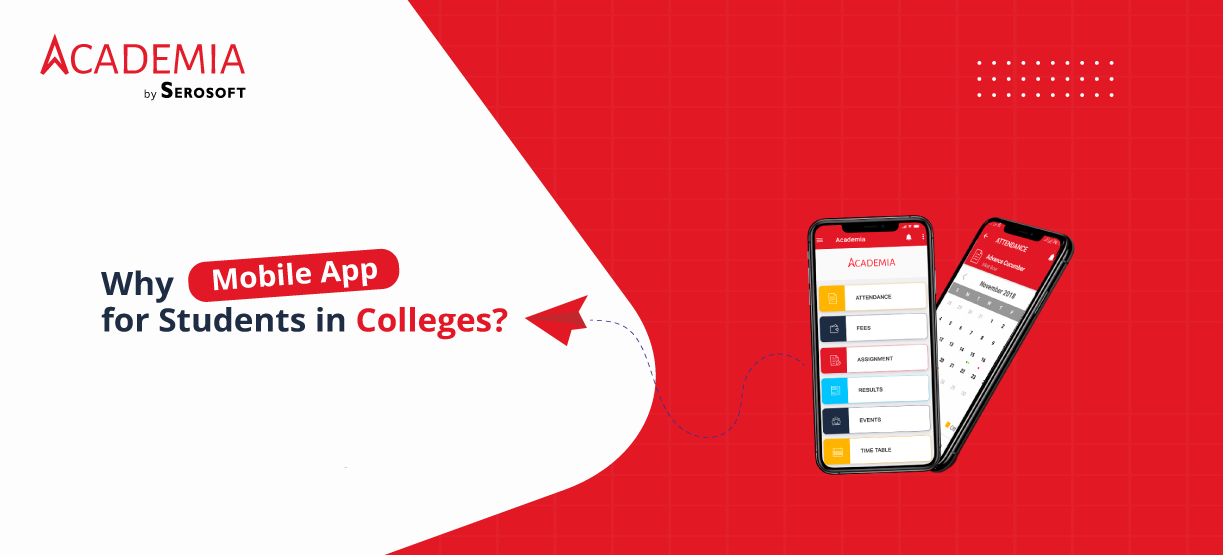
How College Mobile App Can Make Life Easier for Your Students?

With the increasing advancement in technology, students are also being technologically influenced. For this, the education sector is getting driven by smart tools and software that can help in balancing the student lifecycle. Even after the COVID-19 pandemic, institutions are adopting advanced solutions like Student Information System (SIS) to manage their academic and administrative activities in the best way.

A Student Information System streamlines the complete educational operations in the institutions, it provides a systematic arrangement for all the operations associated with a student. A robust ERP/SIS includes a mobile application that not only helps faculty and administrators but also the students making their life easier in many ways. 

How does a mobile application help students manage their day-to-day operations?

  • Instant Accessibility

The new generation of students wants everything easily accessible. They want everything at their fingertips. They want instant gratification for all the institutional tasks.

An ERP/SIS with a mobile application provides easier access to students for any of their institutional tasks. It provides all the information at a glance with easier accessibility right from admission, enrollment, program & courses, examination, and a lot more with just a single click from anywhere and everywhere. 

Students can easily access attendance, timetable, assignments, and all such things using the mobile application. 

  • Motivates Students

A handy mobile application with all the functionalities to manage students’ attendance, timetable, fee, and a lot more can ease students’ life in many ways. It motivates & empowers students on being active in managing their day-to-day tasks and also in their studies. 

A user-friendly mobile application helps students stay active, energized, and motivated for further studies. 

Also check, how the Academia ERP/SIS mobile app helped students in different institutions:

  • Connectivity among all Stakeholders

An educational institution involves multitudes of tasks from each end, like faculty, administrators, and students. A mobile application associated with software like ERP/SIS provides complete access to all the stakeholders like faculty, administrators, and students. For example, it avails students of easy assignment submission, and likewise, it avails faculty members to check and mark numbering for assignments. 

This way, it connects all the stakeholders for all the operations, providing instant solutions and satisfaction. It also includes connecting students and faculty members with features like real-time notifications, database updates, notifications, chatbot integration, and many more. 

  • Personalization

As discussed above, students of this generation need everything quick, easy, and personalized. A feature-rich mobile application provides complete accessibility and personalization to students. It regulates the easier flow of data, information, and updates among students and other stakeholders, and the best feature of this is it provides different user interfaces to each stakeholder according to their needs and authorization motivating personalization and ease in all manners.

Conclusion

With the regular advancements in education, it is a must for institutions to provide utmost ease to students. Technologies like ERP/SIS provide complete management of all academic and administrative operations. It provides an ease to all the stakeholders by automating all tasks and makes it accessible on the portal and the mobile application. 

What are your thoughts on the use of mobile applications for students and faculty members? Let’s discuss it in detail, contact us now, and one of our experts will get back to you soon.

How College Mobile App Can Make Life Easier for Your Students?

With the increasing advancement in technology, students are also being technologically influenced. For this, the education sector is getting driven by smart tools and software that can help in balancing the student lifecycle. Even after the COVID-19 pandemic, institutions are adopting advanced solutions like Student Information System (SIS) to manage their academic and administrative activities in the best way.

A Student Information System streamlines the complete educational operations in the institutions, it provides a systematic arrangement for all the operations associated with a student. A robust ERP/SIS includes a mobile application that not only helps faculty and administrators but also the students making their life easier in many ways. 

How does a mobile application help students manage their day-to-day operations?

  • Instant Accessibility

The new generation of students wants everything easily accessible. They want everything at their fingertips. They want instant gratification for all the institutional tasks.

An ERP/SIS with a mobile application provides easier access to students for any of their institutional tasks. It provides all the information at a glance with easier accessibility right from admission, enrollment, program & courses, examination, and a lot more with just a single click from anywhere and everywhere. 

Students can easily access attendance, timetable, assignments, and all such things using the mobile application. 

  • Motivates Students

A handy mobile application with all the functionalities to manage students’ attendance, timetable, fee, and a lot more can ease students’ life in many ways. It motivates & empowers students on being active in managing their day-to-day tasks and also in their studies. 

A user-friendly mobile application helps students stay active, energized, and motivated for further studies.

Also check, how the Academia ERP/SIS mobile app helped students in different institutions:

VJIM, Hyderabad

INIFD, Indore

Raisoni Group of Institutions, Nagpur 

  • Connectivity among all Stakeholders

An educational institution involves multitudes of tasks from each end, like faculty, administrators, and students. A mobile application associated with software like ERP/SIS provides complete access to all the stakeholders like faculty, administrators, and students. For example, it avails students of easy assignment submission, and likewise, it avails faculty members to check and mark numbering for assignments. 

This way, it connects all the stakeholders for all the operations, providing instant solutions and satisfaction. It also includes connecting students and faculty members with features like real-time notifications, database updates, notifications, chatbot integration, and many more. 

  • Personalization

As discussed above, students of this generation need everything quick, easy, and personalized. A feature-rich mobile application provides complete accessibility and personalization to students. It regulates the easier flow of data, information, and updates among students and other stakeholders, and the best feature of this is it provides different user interfaces to each stakeholder according to their needs and authorization motivating personalization and ease in all manners.

Conclusion

With the regular advancements in education, it is a must for institutions to provide utmost ease to students. Technologies like ERP/SIS provide complete management of all academic and administrative operations. It provides an ease to all the stakeholders by automating all tasks and makes it accessible on the portal and the mobile application. 

What are your thoughts on the use of mobile applications for students and faculty members? Let’s discuss it in detail, contact us now, and one of our experts will get back to you soon.

Top EdTech Trends in the USA Market to Pay Attention to in 2023

The technology adoption in the current scenario is improving at a steady pace. It is the right time for educational institutions to adopt techniques that can help overall management. Educational institutions need to understand that it is the time when today’s needs will become tomorrow’s obsolete.

Tech adaption is going to be a decisive factor in the competition for the year and beyond. Institutions need to prepare for their digital evolution that can improve their market positioning and share. 

The USA is one of the fastest growing countries in all aspects, especially in terms of education. In recent years, EdTech in the USA is expanding exponentially and institutions across the country are adopting new technologies that can help in the overall development and growth of the institution. Let’s have a look at the top EdTech trends the USA institutions need to pick in 2023.

Top EdTech Trends the Industry should pick in 2023

  • Institutional ERP/SIS

With the growth in the education sector, institutions must ensure efficiency in all academic and administrative operations. An institutional ERP/SIS provides end-to-end automation of operations along with managing the entire student lifecycle. Automating all the processes leads to complete digital transformation of the institution making processes more transparent, smooth, and efficient. 

So with the emerging competition, institutions in the USA need to be equipped with an ERP/SIS to ensure better operational activities along with an enhanced learning experience.

  • Artificial Intelligence

Artificial intelligence is truly impacting the education world. It is helping enhance the education sector right from the classroom experience to commercial and organizational decision-making.

If implemented effectively, AI can help educational institutions strengthen the classroom experience along with improving the overall institutional experience. It helps in filling the needed gaps in learning and teaching allowing institutions to drive efficiency, and personalization, along with streamlining learning experiences.

The institutions in the USA need to leverage artificial intelligence in combination with good software/tools.

  • Gamification

Gamified lectures in an online learning setup are a huge success for improved student participation and knowledge retention. It has been implemented in all other fields and likewise in education. It is helping students improve their learning experience tremendously. It starts with the action of automating institutional tasks and also bringing enhanced learning experiences for institutions. The basic implementation of gamification can be initiated by replacing the traditional marking or grading system with the point system. It simplifies the marking processes for students in the competitive age along with reducing peer pressure to earn more marks or percentages in the examination. 

It helps faculty members and students in psychological processes that motivate learning and overall development in the best ways.

  • Focus on Student-Centered Learning

Student experience should be the biggest focus of the education industry. Institutions must adopt software/tools that support student learning in all ways. The USA in the current scenario is a hub for students from across the world. Institutions must adopt techniques like adaptive learning that provide personalized experience and help in the overall management and especially ease to students to motivate them for focused learning.

Conclusion

Institutions in the USA are adopting EdTech technologies at a pace. So it is high time for your institution to adopt or replace your old technique with a new, improved, and efficient solution. There are countless software, tools, and technologies that can become helpful but may remain a tricky and crucial job for you to choose the best one. 

We can help with this! 

Just Contact Us Now and one of our expert team will get back to you for a detailed discussion.

Revolutionize Leave Management with Academic ERP Software

The modern education ecosystem is moving towards a more flexible, agile & institutional environment and this trend has been accelerated by the arrival of new technologies. The use of leave management systems, especially ERP software for creating and managing various types of leave for faculty, students, and staff members is gaining popularity. This article will discuss how a leave management system can revolutionize your institution’s leave management process by offering features such as flexible scheduling options and real-time insights into multiple stakeholders’ activities, etc.

Advanced leave management features

There are several types of leave management features available:

Enriching faculty’s onboard experience (For New Joiners? Or onboarding to the system?

Ensure a seamless experience for new faculty.

It also helps students, faculty, and administrators in different ways. It helps students in requesting easy leaves, checking leave balance, and likewise, it helps faculty members to approve the students’ leave. It also helps faculty members to manage their leave balances and processes accordingly.

Make it easy for your students to learn about institutions’ culture and values, which will help them feel more connected to the institutional identity.

Faculty & Student Portal

The student portal allows the student to access their leave balance and details.

Students can submit leave requests by filling out a form on the portal, which is then submitted via email or SMS.

The students can apply for leave using this same portal.

Students can view their history of application and approval dates for any particular request that they have submitted through this tool.

A good leave management system can provide a lot of benefits to all stakeholders.

The right leave management system should be easy to use, flexible and scalable. It should also be affordable, integrate with other systems, and be compatible with various browsers, operating systems, mobile devices, and applications.

Conclusion

Leave management systems are critical to the success of academic institutions. Academia ERP is an education ERP that provides a leave management system that helps faculty and students in effective leave management.

Academia ERP is a comprehensive and user-friendly ERP solution that helps you manage all aspects of your institution’s operations. It provides a leave management system that helps faculty and students in effective leave management.

Leave management is a process of tracking and managing all the leaves taken by students. It helps in improving the productivity and learning experience of students.

Academia ERP software has been developed to assist faculty members and academic institutions in managing their leave. This ERP software can be used to track all the leaves taken by students and monitor their progress towards achieving their goals as well as help them maintain high productivity levels during semester breaks.

Want to learn more? Request your demo now!

Back to top