Type your keyword below

Why is Automation Important for Educational Institutions

Running an institution successfully in today’s day and age requires not just a batch of smart educators but also a technologically empowered administration. An assured way to achieve robust and advanced management in a college or school is to automate the processes. An education ERP is precisely that system that enables easy communication and information-sharing across the institution through automation.

The software is an amalgamation of various features right from recording the daily attendance to sending out performance reports to parents. An automated management system takes care of varied tasks with the least manual intervention.

Here’s are the key reasons why colleges and schools should consider automation through ERP

Increase in Productivity

Automation improves the productivity of the institute since a lot of mundane and seemingly tedious tasks that have to be conducted on a
daily basis are smoothly managed by the software. This allows the faculty to focus and dedicate more time to academics and other events of greater importance.

Parent-Teacher Transparency

The cloud-based software also enables remote parent-teacher communication. Parents can check on their children regularly to keep a tab on their activities and performance in school. Automatic SMS and emails on important events being sent to parents lead to transparency and build trust between the parents and the institution.  

Resource Sustainability

Automation to a large extent is a shift from manual to digital. This also means considerable elimination of stationery, paper, registers, and all the paraphilia associated with traditional records and data maintenance. It is, in fact, a subtle but significant step towards saving natural resources.

Recommended reading: 5 Reasons Why ERP In Education Is the Need of the Hour

Workload Efficiency

When an institute is technologically driven, a lot of daily tasks such as student and faculty attendance are handled automatically by the system. It also lets the teachers manage assignments and assign work to students faster and quicker through the portal. This relieves them from a heavy workload and brings more focus and efficiency in teaching.

Data Backup and Security

Besides making data easily accessible, automation also assures data backup, upgrade, and scalability. Since the system is cloud-based, there is no danger of data loss. This is of great advantage to institutes since they have to continuously keep a track of multiple academic and administrative records.

Recommended reading: How Automated Attendance Management System benefits Educational Institutions

What next

Automation in education is becoming an inevitable reality considering the number of benefits it offers to an institution. The biggest value-addition that automation brings is that it makes teaching more individualized by letting teachers monitor students and their performances. Students also get additional support from their educators. What’s more, 360-degree automation covers an entire student life cycle from admissions to course completion. Academia Student Information System, with 20+ modules and a configuration feature, is one of the best education ERPs out there. Check out how it’s helping to automate institutes around the globe with a free demo now.

How Automated Attendance Management System benefits Educational Institutions

Automated Attendance Management System maintains an agile technology that changes the traditional attendance processes into a smarter and more effective system. It makes attendance interesting and time saving for teachers.

Like any other sector, schools and colleges are also burdened with a huge amount of administrative work. With several managerial tasks to take care of, educators often have less time to focus on teaching. A digital solution can aid them in using their time more productively.

Attendance Management System is a solution that can help teachers with better efficiency in the classrooms.

The manual attendance system unnecessarily consumes their time. Besides this, they have to calculate attendance records for the final evaluation of students which again is a fairly manual process.

An automated attendance management system can overcome such inefficiency.

Do you know teachers can save 10-15 minutes daily in attendance with automation?

It makes attendance processes faster and reduces manual work. It also gives them a detailed report of student attendance records and saves the time-consuming calculations.


Academia Student Information System calculates attendance percentage daily with absent and leaves records. 

Here are the technologies used in an attendance management system:

Biometric Integration


Biometric Integration is fast becoming the most reliable and accurate attendance method in schools/colleges. It saves time, efforts and makes attendance processes efficient. As it is a fingerprint-based system there is rarely any chance of proxy or fake attendance.

The fingerprints of students are saved in the biometric system in the beginning and that data is integrated with an education ERP.  After that students just have to place their fingers on the machine to confirm their attendance.

RFID

Apart from biometric, some institutes prefer this technology for automating the attendance system. RFID of  Radio Frequency Identification as the name suggests records attendance through radio waves. It has a unique ID number for each student given on a smart card and can record attendance within seconds. It is also capable of reading several cards at once.

Students just have to pass through an RFID and reader where attendance gets marked and data automatically transferred to an integrated Education ERP.

Faculty Portal

The faculty portal is an online platform offered by a Student Information System for teachers. It not only helps connect teachers and students but also allows teachers to manage attendance, time table, assignment distribution and more.

For instance, if a student is on a leave, it appears based on the specific leave he/she has opted for, and if the student is busy in other curricular activities; teachers can mark them accordingly, thus avoiding confusion. In case of an uninformed absence, an automated SMS/notification is sent to the respective parent/guardian so that they can be aware of the whereabouts of their child.

Academia ERP can save 20% time spent on administrative tasks, and keep your data secure with cloud-enabled technology. Want to know how? Talk to our expert now. Click here to book a free demo.

Image source: freepik.com

How a College Management System can Benefit an Institution

A college management system is a cloud-based software that helps in managing the entire administrative and management processes in a higher educational institution. All of it is digital, automated and data-driven. Some of the notable things that a college management system handles include student enrollment, pre, and post-admission processes, students, faculty, exam schedules, assignments, logistics, and library of the institution.  

In this constantly evolving landscape of education and technology, a college management system offers an institution a competitive edge as well as ensures rapid advancement and success. 

Here are some key benefits of the college management software.

Complete Automation

Of the variety of tasks that constitute college management, most are manual and require physical collation of papers, data, information and so on. However, switching to a college management system helps in removing all these time-consuming and at times trivial tasks to ensure that there are better resource planning and management. In fact, Academia ERP offers 360-degree automation covering all aspects of administration.

Recommended reading: 7 Key Benefits of a Student Management System

Reduced manual intervention also minimizes errors in data and allows the faculty and management more time for other initiatives. Automation allows you to generate several reports from time to time as well on a real-time basis.  

Data Security

Data privacy is a legit concern in today’s world where all our information is stored online. Educational data security can be a challenge for both principals and administrators considering the probable risk of data corruption and loss.

Academia, being a cloud-based ERP, offers a one-stop solution for all these issues. It also offers data access to the respective users only based on rights and authority given to him/her by the concerned administrator.

For instance, a student can use the portal to access only limited data concerning his/her academics, while the teacher can oversee more details, thus filtering it appropriately and eliminating any possibility of data misplacement or manipulation.

Seamless Communication

In addition to learning, a college offers a range of opportunities to students in the form of activities and events. And to facilitate their update and reach to the thousands of students, using a college management system is the most convenient approach.

Recommended reading: 5 Technologies that. are Remodeling Higher Education

Even within the academic framework, students are easily and digitally able to access all the details regarding their curriculum along with information on assignments, assessments, and attendance.

An additional advantage is that all of this can be accessed remotely by both students and teachers through their portals on a mobile application. 

Comprehensive Reporting and Analysis

Every college has a myriad of information about their departments and students but not many are able to drive it for impactful insights. This, in turn, affects the decision-making and hampers the growth of the school. 

An important advantage of the college management system software is that it offers data in the form of statistics that can be analyzed quickly for relevant conclusions. The data is also updated on a real-time basis and is error-free thus eliminating any room for inaccuracy.

Recommended reading: Top Functionalities of an Education ERP Software

The reporting can be used to include almost all the divisions in a college including student and faculty performance, attendance records, logistics and accommodation, events and activities, and so on.

Check out how Academia College Management System offers all of this and more with a free demo now!

Image source: freepik.com

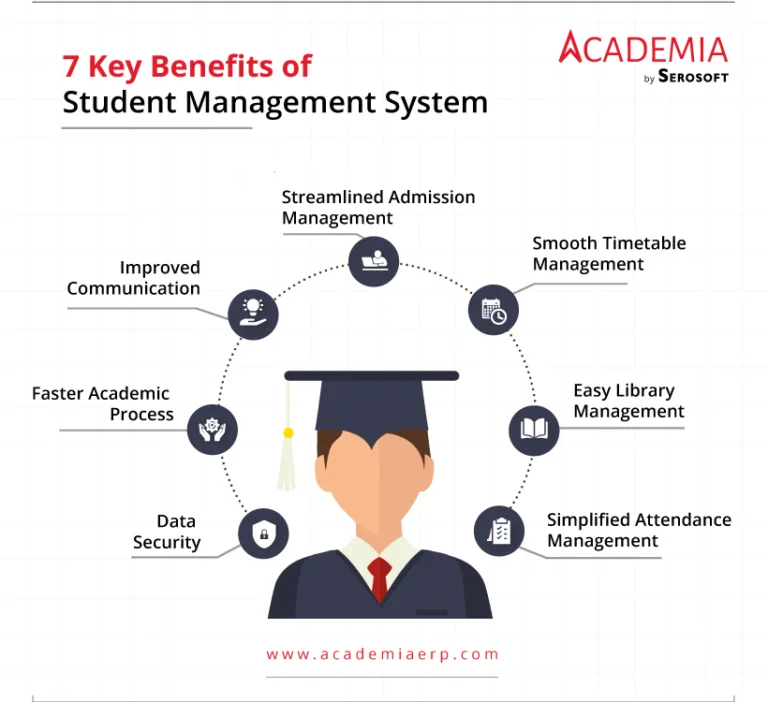
7 Key Benefits of a Student Management System

Educational institutions involve a lot of data that needs to be managed properly and systematically. It is important to streamline and manage the complete student data, and various educational institutions invest in high-performance student information systems (SIS). There are various Student Management System Benefits that we will discuss in this blog.

The cloud-based software helps in storing and organizing various student-related data in a proper and centralized manner so that it can be easily accessed, edited, and updated when they are needed. 

To understand it more properly let’s discuss some of the key benefits of using a student information system:

  • Manages Student Information

A student profile management system manages all the information related to student’s attendance, assignments, academic reports, curriculum details, project details, exam-related information, skills and achievements, medical history, address, fee, and accounts-related data easily and efficiently leading to simple and effective management for the institution. 

  • Increases productivity

It is important to choose a good and effective SIS that can help boost the productivity of your institution. An effective SIS leads to increased speed and efficiency that helps in maintaining effective records and an increased data accuracy involving lesser time helping administration and staff to focus on other important and productive tasks for the institution.

  • Streamlines all the operations 

In most cases, a student management system provides complete access to all the operations equipped with a dashboard that makes easier tracking of what needs to be done, who will do it, and what work needs to be done. The best part of all this is you can attain any of the student’s, faculty’s, or administrator’s information any time on a single screen within just a few clicks. It streamlines the complete academic and administrative operations of the institute making everything simple and efficient in every manner. 

It manages all your important work that is highlighted. It also improves all the tasks that are important for high productivity focusing on student’s growth. It also indicates that you can grow as an institution having complete control in just one system. 

  • Improved Communication

It is always known that every student has a different interaction level, but no matter how friendly the atmosphere in your school is, some students require special attention related to all the academic and administrative operations. A student management system comes hand-in-hand helping faculties to improve their communication properly and systematically. 

There are various reasons for which students might hesitate to discuss with faculties and administrators like fee submission, exam-related queries, etc. So having a student profile management system will be easy to communicate for students with whomever they want for any operation like fee, exam management, timetable management, and any other thing. 

  • Reduces Paperwork 

Student Management System helps institutions to manage personal records easily, it keeps complete track of student data – reducing paperwork. There are various things for which students need to manage a lot of documents like admission forms, student records, financial aid paperwork, etc. so by having an automated student system in place, students get the opportunity to access all the data easily and efficiently from anywhere and anytime along using the mobile app. 

  • Centralized access to everyone

Old were the days when parents always got their child’s information only on parents teachers meet. Using a student app parents can access any information like activities, assignments, attendance, and other relevant information. 

  • Date Security 

In an educational institution, it is quite important to secure student’s information in any case, the manual intervention involves a lot of errors along with a lot of time involvement

The traditional methods of storing documents are also prone to risks of data loss. It can be by physical damage, theft, or an accident. 

With the use of student management software, administrators can minimize that risk to the lowest. All the data is saved on the server which is encrypted with security and only a user with login credentials can access it.

So, institutions should opt for a student management system that provides data security keeping all the data security along with providing real-time access whenever required. The software provides multiple automatic backups of data to make sure you do not end up losing your valuable files.


Wrapping Up 

With the increased demand for online systems, educational institutions need to opt for a system that is student-friendly and can fulfill all the needs of students. Hope you liked this article and understood the Student Management System benefits that can help your institute and its students to focus more on productivity, and having efficient management of all the academic and administrative tasks in the institution. 

It allows institutions to focus on other productive activities rather than managing the regular student’s documentation and management as they are possible with just a few clicks. 

So what are you waiting for, choose the best student management system for your institution, and if you are interested in seeking the best system, do contact us now and we will explain to you how Academia can help institutions seek growth, productivity, and success. So do call us to know. 

Check out our exclusive Gartner research report on Top 10 Strategic Technologies Impacting Higher Education:


How Educational Institutions Save Time and Money with Automation

An age that swears by ambition and competition, the 21st century has also offered us varied tools to ensure that the fight is fierce! The digital revolution (also known as the 3rd Industrial Revolution ) is helping us make the best use of time & money in creating a better as well as a faster world. In the last 4 to 5 years, it has significantly penetrated the education industry too. Various EdTech solutions such as the Student Information System, Learning Management System, etc are playing an important role in efficiently managing the campus administration.

The main reason for this software becoming a favorite of the education industry is that they help in effective resource management to subsequently ensure student success.

Education ERP: An intelligent way of managing your institute

Here are the 5 ways automation can help in saving time and money:

Prompt Decision Making

If you are heading an institution or a particular department, decision-making is certainly a part of your daily calendar. It takes a huge amount of time to go through stacks of files that have data and references for you to arrive at a conclusion.

What if you can access all these details at the touch of a button without having to go through the pile for papers? Wouldn’t it’ll save you precious time?


Education ERP gives you the power to access all the details whenever you want. Student records (class-wise, course wise, year wise), employee records, ongoing courses and much more. It provides neat reports that help you in the quick analysis, which ultimately results in faster decision making.

Reduced stationery costs

According to an article on Edutopia, around $25,000/year is spent on paper alone by a school with a capacity of 100 teachers in the US. Not to forget other costs including printing and stationery.  

The education industry relies heavily on paper and stationery. While it can’t end it completely, it can definitely be minimized. With Education ERP such as Academia SIS, institutes can save up to 22% in printing and mailing costs. Being a cloud-based system, you can share documents with students, parents, and teachers on their portal or email address to save paper costs. Hard copies are redundant as all the data is securely saved on the cloud. This is an effective way to save a lot more than you can imagine.

Recommended reading: Technology in schools: What are the opportunities and challenges?

Reduction in academic reporting time

Education ERP has an integrated excel sheet tool, with this you can upload and download all the data, anytime you want. It saves your time in manual inputs to make academic reports. All data entered can be converted into excel sheets as and when needed.

For example, if you are running a campaign for admission, you can track enquiry, create data sheets in real-time and share them with other staff members. Not just this, you can also check the expense reports, target achieved and so on.

Faster turnaround time

When you are able to make decisions faster and save time in mundane administrative tasks the turnaround time of management processes is automatically shorter, helping you do more with less.

Digital transformation with ERP reduces paperwork, streamlines processes and makes work simpler that in turn speeds up the overall management. The information flow becomes smooth, transparent and it keeps everyone from multiple departments in the loop that aids in faster and more efficient task performance. Moreover, it also minimizes errors and removes data duplicity to get rid of rework in the process.

Automation resulting in High ROI

The primary focus of an educational institution is to offer quality education with world-class management, however, the quality and credibility of an institution do not depend only upon its faculty, but also its capital. 

Recommended reading: How a Student Information System Can Ease Your Pain

For any organization, the return on investment is a crucial factor to run any institution. It depicts the success of the entity. The education industry spends millions of dollars on quality education. 

An efficient solution to control and manage your capital is with the digital transformation of your institute. Using technology for your day to day tasks can seem expensive in the beginning, but in the long run, it helps in achieving high ROI.

Know more about how ERP System can help in ROI

Are you a smart educator who wants to use technology to save time and money in management? Try a free demo now!

Image source: freepik.com

5 Reasons Why Your School Needs An ERP Software

ERP or Enterprise Resource Planning is usually defined as software that aids in managing processes in an organization. Used extensively by business houses, schools, and colleges across the world have also been actively implementing it for their everyday management over the last few years. 

School ERP essentially assists in planning and managing the processes and functions of a school.  This includes a range of things from admissions and onboarding to assessments and student tracking. 

Considering the efficiency and resource management that ERP brings to an educational institute, the software is a significant revolution in management. Imagine eliminating the tedious tasks of managing student records and data manually, writing frequent mails for information sharing, and investing considerable time and resources in consolidating numbers. 

ERP makes all of this possible through automation!

Here are some of the key benefits of School ERP


  • Enhanced and Easy communication

School management software helps teachers connect with their students even remotely and beyond the class and school timings. It is particularly convenient for educators to assign tasks to students through the software. 

What’s more, even parents can access them and stay aware of their child’s studies and progress. This also helps save considerable time even while ensuring that the communication is smooth and direct. Keeping the parents constantly in the loop and allowing them access to their child’s day-to-day tasks is also a great step toward building their trust in the institute.

  • Better Administration

A school management process largely involves continuous administrative work that is mostly done manually. For instance maintenance of daily attendance, fee collections, event details, student assessments, and so on. 

A school ERP software manages all of this and more, resulting in an efficient administration. Precise information can be now collated on a single platform, which helps authorities access it much easier, thus aiding in faster and better administration.

  • Efficiency owing to Customization

Every institution functions differently and demands an exclusive set of working processes. A crucial aspect of school ERP is that it can be customized to suit the needs of every school out there. This allows an institute to switch to digital transformation even while assuring that the processes are efficient and convenient to the school’s daily functioning. For example, fees management which is one of the important modules within an ERP can be customized to define categories of students and their subsequent fee structure within a school.


  • Time and Resource Management

Going digital is a definite way to bring in productivity at various levels in the school – time and resource management being the primary ones. While a chunk of work is managed through ERP, the employees can now plan their schedule better and focus on additional areas of activity. 

In a school where imparting education is the primary focus, being able to save time on all the other peripheral activities and focus on the curriculum, can become a huge achievement for the school’s academic performance.

  • 360-degree automation

Digital innovation is shaping our future and education is an inevitable part of it. An ERP in education, while bringing in 360-degree automation, gives you an edge over the competition owing to its efficiency and innovativeness. And all of this while ensuring that your data is completely secure and protected. It streamlines practically the entire student cycle right from pre-admission enquiry to their graduation by monitoring different activities and linking them together for a piece of consolidated information.

Want to know more? Check out the popular school ERP software, Academia SMS with a free demo from an expert. Book now.

Top 6 Functions of Student Information System that Every Educator Should Know

A well-implemented Student Information System transforms institutional operations and empowers educators to focus on what truly matters—teaching and learning. From managing student data to enhancing communication and improving academic performance, the benefits of an SIS are undeniable.

investing in a robust SIS is no longer optional—it’s essential for institutions aiming to embrace digital transformation. Educators who understand and leverage these six key functions can drive better results for both students and the institution.

1. Student Data Management

The core function of any SIS is efficient student data management. From personal details and admission records to academic progress and health information, the system securely stores all data in one place. Educators can easily access student profiles, track performance, and make informed decisions.  Teachers can tailor their teaching strategies based on individual student needs, ensuring a more personalized learning experience.

Key Features:

  • Centralized student profiles with demographic and academic details.
  • Secure storage and easy retrieval of historical records.
  • Real-time updates for any changes in student information.

2. Attendance Tracking

Every contemporary SIS will have an attendance module. The system allows educators to intervene early if a student is frequently absent. Teachers can mark attendance within seconds, while administrators get real-time reports to identify patterns and address absenteeism. An SIS automates this process, making it efficient and accurate. 

Key Features:

  • Daily and subject-wise attendance marking.
  • Instant alerts for absenteeism.
  • Detailed attendance reports for each student.
  1. Marksheet & Assessment Management

Grading and assessment is a complex process, especially when dealing with multiple subjects and exams. An SIS simplifies this by providing integrated marksheets where teachers can enter scores, calculate final grades, and share results with students and parents. Educators can easily identify students who need extra support while parents stay informed about their child’s academic progress.

Key Features:

  • Customizable grading scales and weightage.
  • Automated report card generation.
  • Performance tracking over time.
  1. Timetable & Scheduling

A timetable can last for six months or more. Creating timetables for classes, exams, and extracurricular activities can be challenging. An SIS automates this process to ensure efficient resource allocation and conflict-free scheduling.

Key Features:

  • Automated class and exam timetables.
  • Schedule adjustments with instant notifications.
  • Resource management for classrooms and teachers.

5. Communication & Notifications

Effective communication between institutes, teachers, parents, and students is essential for student success. An SIS bridges this gap by providing multiple communication channels.  Transparent communication ensures everyone stays updated, reducing misunderstandings and enhancing collaboration.

Key Features:

  • Real-time notifications for attendance, grades, and events.
  • Two-way communication between teachers and parents.
  • Event and exam reminders.

6. Reports & Analytics

Data-driven decision-making can transform education. An SIS provides powerful reports and analytics to help educators identify strengths, weaknesses, and opportunities for improvement. Educators can make proactive decisions to ensure better learning outcomes and efficient college/university management.

Key Features:

  • Customizable reports for academics, attendance, and behavior.
  • Visual dashboards for quick insights.
  • Predictive analytics for academic performance.

Conclusion

Efficient student data management is not just about organization—it’s about empowerment. It equips educators with the tools to provide personalized learning, improves institutional efficiency, enhances communication, and drives long-term success. In an era where data drives progress, institutions prioritizing effective student information management will deliver quality education and foster institutional growth.

5 Reasons Why ERP In Education Is the Need of the Hour

Education technology is paving the way for the digital development of several institutes. Students are the most important part of this chain. 

Catching the pace of students and their tech-savvy parents is now a crucial aspect of the education industry. Quality education, modern infrastructure, and a digitized management system are some of the crucial aspects they look for in education institutions.

Following this trend, the education management system or education ERP is now becoming the need of the hour. It helps streamline and integrate the complete administration processes of institutes.

What is ERP in Education?

ERP in education, usually known as a Student Information System (SIS) is an enterprise software solution to manage the complete student life cycle. It is also integrated with multiple software programs to manage departments of educational institutions.

With the help of Education ERP, it is possible to manage complete admission processes, enable online payments, monitor student records, handle human resource management, and much more.

Check this out to know more in detail about education ERP.

Here are 5 reasons why Education ERP is the need of the hour for the education sector.

1.   Prompt decision making

Imagine you have access to all the information about your business, and you can see whatever you want whenever you want. How helpful that can be!

Now you can take decisions faster, solve product, service, or employee issues more efficiently and track your business data at the click of a button. 

Just like business enterprises, educational institutes including schools and colleges also have many processes that include not only managing students and classrooms but also all sorts of administrative activities. 

With Education Management Software, the heads of institutes can take decisions quicker than with manual reports. A key feature such as generating thousands of reports with a display of data can help an institute scale rapidly and effectively. 

2.   Integrated management

If you are from the accounting department and you want to know if a student has submitted the hostel registration fee at the time of admission, you would ideally send an email or dial a number to check with the corresponding authority for details.

Ever wondered how much time gets lost in this simple process, especially while tracking thousands of students and their records?

Whichever department you are from, this software offers you the privilege to access information, you can check all details and more without any hassle, helping the staff utilize time better.

Not just the administration, but the faculty too is able to save time in attendance records management, exam and result executions, which ultimately helps them focus more on their teaching.

3. Smooth processes

This is one of the most important benefits of ERP in education. With multiple integrations of software systems, it becomes easy to regulate all the processes on a single platform.

ERP impacts all the functions across departments and removes manual intervention as much as possible. This, in turn, makes the execution of processes smooth, leading to increased efficiency and greater control of the system.

It gives the admin the power to connect and maintain data in the most efficient and effective way. Moreover, it also helps in improving communication and ensuring transparency.

4.   Increased communication

An education institution consists of three important pillars i.e. students, teachers, and parents. To run it successfully, it is important to enable strong communication between all three of them. This helps them stay updated on the activities as well as understand their expectations from the institute.

Student Management System helps institutes execute this. With a portal that has students, teachers, and parents together, the information becomes easily accessible and shareable.

Teachers can distribute assignments and check an individual’s performance via their portal anytime they want. They can also keep records on attendance, and overall performance and help students perform better wherever they lack.

Students, on the other hand, can stay updated with events, attendance, fee details, and other circulars. Similarly, the portal can help parents access their child’s progress from time to time.   

5.   More transparency and trust

It is a fact that fair communication brings transparency among people leading to an increase in trust. If employees and other stakeholders are updated with the information on a real-time basis and informed regularly, it builds their trust and respect towards an organization. 

The same goes for educational institutions. With the help of ERP, it can easily update teachers, students, and parents with relevant information. Automatic information on exams, events, circulars, assignments, and more increases the productivity of the institute.

What is your reason to use ERP in your institute?

Want to know more about ERP? Talk to us now! 

4 Ways ERP Can Help Increase ROI for Educational Institutions

Educational institutions around the globe focus on delivering education catering to the requirements of today’s world along with providing the best-in-class academic management. Students and parents do not accept compromises in terms of quality, efficiency, and productivity.

Apart from providing quality education to students who are the building blocks of any nation, educational institutions are also an entity that incurs the cost for running the system. And any entity in today’s day and age that incurs cost need to as for return on investment or ROI.

Today’s technologically advanced world and the changing user behaviour are putting new challenges in front of educational institutions such as the emergence and adoption of online learning. So, how can educational institutions increase profitability?

The answer is straightforward: By adopting digital transformation to achieve automation of manual processes

How Automation Helps Educational Institutions?

An education management system like Academia ERP can help institutes save time and money in multiple tiers. It might seem like an additional expense, but institutions should really see it as an investment. Next, you may ask what is an education management system and how does it benefit?

In layman’s terms, it is software that automates the complete student life cycle, it helps in streamlining all the academic and administrative processes within a School, College, or University, and also helps in managing a group of institutions providing all the information at a centralized place. It increases the efficiency of operations and meets the demands of staff, students, and their guardians giving incremental ROI to institutions over the years.

Here is how an Education ERP software, improves performance, reduce expenditure, and help in increasing ROI:

  1. Digitization of academic operations: In today’s digital era, when everything is moving online and moving fast whether it is shopping, registration for passport, bank accounts, payments, etc. Students and Parents expect digital and fast services from educational institutions as well. Whether it is registering for competitive examinations, admissions till graduation everything should be available at your fingertips. This is where an ERP system can help institutions to manage the entire student life cycle digitally.An ERP solution for educational institutions not only manages all academic operations, but it also comes with many integrations like online payments, library management, RFID, etc. to connect parents, teachers, students, and institutes.Digitization of processes with ERP also saves paper, stationery, printing, and distributing costs. Also, a lot of physical space can be saved by replacing offline reports and registers with online documents. An education management software helps institutions to get digital and keep up with the needs of this era.
  2. Reduced dependency on manual tasks: In absence of automated tasks for administrative functions educator’s focus is divided, rather than imparting knowledge to students which is their main objective.Education management software can automate tasks such as attendance marking, preparing report cards, enrolling students, calculating attendance count, etc. Hence saves the time and efforts of teachers.It does not only help teachers but also manages admission processing, fee and bill payment, employee management and much more.This decreases the turnaround time and hence increases the productivity of an institute. More productivity, more credibility, resulting in more admissions.
  3. Smooth inter-departmental communication: Communication is the key to the functioning of any entity. Without proper distribution of information, decision-making would be difficult. Decision-making is impossible without the availability of correct information, and processing time can cause chaos within departments.An ERP system at educational institutes can help avoid such a situation, it makes the exchange of information easier than ever. It increases the connectivity not only within departments but also within stakeholders of institutes.All the information can be disseminated via emails, SMS, app notifications, etc. with the use of the Education ERP system.This saves printing and mailing costs for an institute that saves spending.
  4. Enhanced data accuracy: Data plays a vital role in today’s information age. It is a lot more important if we talk about educational institutions. It can be in exam result calculation, attendance records, fee collections, annual records, and whatnot. Undoubtedly it is one of the most vital tasks performed in any organization. One tiny error can lead to damaging consequences.As all the calculations and assessments are done by the ERP software, errors can be thrown out of the box. This provides accurate outputs every time. The calculation of all things such as marks, payments, fees, salaries, is possible. Ultimately, time and money will be saved.

Conclusion

The best education management software assists the institute in prompt decision-making. With customizations, an institute can use it according to its needs to increase productivity in management.

With timely decision-making, proper management, and complete automation, an institute can save time and money. That will result in increased ROI in the long run with the help of an Education ERP system.

How does ERP Software works for an Educational Institute?

ERP or Enterprise resource planning is initially used by companies such as retail, accounting, corporate governance, corporate law, etc. Big enterprises started using ERP first and now due to its positive impact on the overall productivity and increased ROI (Return on Investment), Mid Size/small companies are also started implementing ERP for the management of the organization.

ERP in the education industry is best known as the Student Information System or Education ERP. Education Institutes use ERP to manage and monitor all kinds of administrative activities. It assists in admissions, examinations, class & course management, time-table management, employee management, human resource, and many more.

What is Education ERP software?

What Education ERP can do will be better understood when you’ll understand what Education ERP is. Education ERP consists of multiple modules for departments. From admission campaign to student registration, from class management to course management, from student attendance to employee timesheet.

Everything within the campus of the institute can be managed by Education ERP. It is also known as the Campus Management System.

Education ERP also comes with integration to deal with other processes such as online payment, payroll management, learning management system, library management, and more.

Learn more about ERP in education

How does ERP Software Work for an Educational Institute?

Here are the following ways in which ERP software work for an educational institute.

1.    Admission Management

All education administrative process starts with admission. It can be selection processes, admission campaign, admission examination, etc. ERP software for an Educational Institute has a separate module to take care of all the details and processes related to admission. After the setup,  it can also manage inquiry details, inquiry follow-ups, targeted numbers of admission details, details of expenses whether the target achieved or not, etc.

2.    Examination Management

Examinations are conducted in three steps. Pre-examination processes, execution and, post-examination reporting. Student Information System can integrate all these processes. It makes it easier to collect, arrange and distribute all the information related to examinations. Room allocation, exam-center arrangement, teacher/faculty allocation and everything else can be recorded and executed via this.

It also helps in the grading system, marking, and mark sheets distribution to students. Here are the advantages of School ERP in the examination.

3.    Course and Classroom Management

After student enrolment there comes the course and classroom management. With this module, educational institutes can keep records of course they offer, which course is assigned to which student and teachers, records of multiple courses assigned to single students is also possible with.

Some Education ERP also provides provision for distance learning course management where you can manage resources related to books and other stationery details.

4.    Student Management

Student management is keeping detailed information of all the students. Their fee and bill payment record, enrolled course details, their personal details, hostel details, assessment details, attendance details, co-curricular activities and more. Teachers and students can also access this information via their respective portal.

5.    Employee Management

Just like student management, employee management keeps the details of employees. Teachers can create and maintain time-table, they can fill-in and view their details and duty they are allotted to. Their activity record is also recorded in this module.

6.    Fee & Bill Payment Management

Educational institutes handle multiple fee & bill payment processes. Thousand of book purchase details, students’ fee, examination fee, other activities payment and many more. It complex and one mistake can lead to multiple errors in the balance sheet.

Education ERP is designed to manage this process as well. It comes with integrated accounting software such as Tally to manage all accounting related tasks.

Here the benefits of Fee & Payment Management:

https://www.academiaerp.com/7-benefits-of-using-a-student-fee-management-system/

Conclusion

ERP in education is designed to smooth the academic processes in institutions. It is freeing teachers from mundane tasks and enabling them to focus on their passion for education. Not only educators, but also students, and their parents are getting benefits with Education ERP implementation in institutes. It gives them transparent and more active participation in academic activity.

What do you think, is ERP good for the education sector? Will it change education as we know it?

Back to top