Type your keyword below

What is the impact of remote schooling on software shift?

COVID-19 was successful at putting us all into a box of four concrete walls. But the human spirit has always triumphed over every challenge and this time technology has a big role in it. Education technologies during COVID-19 were a huge success, but now that the world has reopened we are not going back to the traditional ways of operations. Efficiency, transparency, and effectiveness of the education technologies have opened the long-shut eyes of the education authorities and now that they have truly tasted it, there is no going back but moving forward.
Here we are introducing you to the impact of remote learning and how it has triggered a software shift.

What is changing?
Not to miss out on the perspective, it is important to highlight that the education industry has become more open-minded about technology now. Prior to the pandemic we hardly say the shift towards education technologies and changes in traditional operating methods. Although the redundant system was inefficient and did not meet the primary goals of the education sector in most countries such as reduced cost of education, accessibility to knowledge, improved knowledge retention, and more, it continued. This is surprising as even developing countries and major industries were highly focused on digital transformation even before the pandemic.

Although delayed, the shift towards technology is now allowing institutes to perform better even in a harsh economic climate such as now. Also, teachers are now more focused on providing a personalized learning experience to the students and ensuring higher knowledge retention. The technology of today is transforming:
How schools managed their operations?
How communication becomes more efficient between various stakeholders?
How information reaches students?

Learning Tools
The market is bustling with efficient learning tools that are allowing students to boost learning even in an online learning environment. Also, technologies such as AI, ML and interactive whiteboards, etc. are providing richer learning experiences to the students, especially if they don’t comply with the traditional reading and writing learning process.
Taking communication between teachers and students to next level. Zoom alone had nearly 200 million users per day in 2020, which is more than 190 million that was reported in 2019. From an educator’s perspective, interoperable software such as Education ERP has improved their work efficiency by up to 60% through seamless integration with online learning tools.
Lastly, there are collaboration tools that make online education much more effective and allow more seamless interaction in online classrooms. It is allowing large group communication and collaboration between teachers and students, and even teachers, students, and parents.

School Management Software / School ERP
School Management Software / School ERP (Link: https://www.academiaerp.com/school-management-system/) is an advanced education ERP solution that automates critical business operations in an education institute. The smart school software runs on modern technology and architecture that increases scalability and flexibility. It also serves as a shared database for all academic, non-academic, and financial operations where it provides features to manage finance and payment management, Student Information Systems, student lifecycle management, human resource, and workflow management, resource management and implementation, and more.

Furthermore, the reduced cost of cloud-based solutions has made cloud-based education ERP a popular choice for education institutes. The efficient application is deployed over the internet and provides a different portal for users to perform tasks that are important to their work and interest. Also, there is role-based access in the system core admin portal where an administrator can define users and roles to the employees and ensures secure working over a digital platform.

Another crucial highlight of development in the education ERP sector is automation. As technology advances, more and more education ERP solutions are popping in the market offering process automation in tedious education operations such as finance, administration, data management, timetable creation, attendance, and more.

Fees and Bill Payments
Better internet connectivity and the availability of smartphones have allowed institutes to work more transparently and efficiently. Automated billing and finance solution solutions do not require a person to perform time-taking manual processes such as fee collection, receipt management, late fee collection, and creating no-dues for several tasks.
Also, payments done through online sources such as UPI, credit/debit cards, net banking, e-wallet, etc. are easier to track than manual payment collection. Also, online payment processing brings more transparency to the system benefiting parents and students both.

Way Forward
Education technologies have a booming market. And there are solutions specific to the needs of education institutes to meet their newfound challenges. If you are looking for a robust education ERP solution, consider Academia ERP. It is an advanced education ERP suite that comes with features to automate your operations and bring more efficiency into the system.

A rookie’s guide to choosing the best Training Management System

Shopping for technology and software may not be as easy as going to Walmart and adding things to your cart. Needless to say, the stakes are high here, and there is no scope for mistakes. You need to be right, and you need to be right the first time when choosing the best Training Management Software / Training Management ERP for your institutes.

Factors such as features, functionalities, configuration, vendor capabilities, customer support and more decide largely whether a product is fit for your institute or not. To make things more simplified for you, here is everything you must know about training management systems and how you can choose the best TMS for your institute.

What is a Training Management System – TMS? Before starting your search, you must understand what you are searching for and what you must expect.

Although training management systems have become one of the most sought-after technologies of the time, not many people know what they are and what they would actually do in their educational organization.

Simply put, training management software is a well-integrated system or an education ERP suite that is built for training institutes specifically. It has all the features and functionalities that can digitally transform all the internal and external processes.

Meaning, faster operations, powerful decision-making, increased productivity, and efficiency. But most importantly, they can get you a really-really high return on investment too, although it is subjective to choosing the right training management.

Advancements and Enhancements to the TMS The integrated system comes with a student information system allowing you to manage the student records across all the training institutes at various locations. It supports your back-office operations and also, allows various stakeholders such as trainees and trainers, and administrators to access the relevant modules and perform various tasks.

However, one of the most outstanding features of a training management system is that of data analytics. With the increased competition in the market, and the increased needs to efficiently manage your institute in terms of powerful fund management, and decision-making data analytics can be a game changer for many training institutes. It relays more transparency in the operations and allows visualization of data through integrating tools such as BI and others.

Today, training management systems have evolved and are more compatible to secure 3rd party integrations increasing the capabilities of the software ten folds. Also, cloud computing increased data management capabilities and allows faster data computing for increased productivity. Another addition to the TMS has been that of Artificial Intelligence and Machine Learning. As much as the technologies have been seen drastically changing other industry sectors, first-mover advantages can give training institutes a major push in the market.

Say “bye” to the biggest industry challenges
Mismanagement of funds
Mismanagement of human and physical resources
Productivity issues
Data security threats
Inefficiency and decentralized data

How to choose the right training management system?
Vision and Long-term Orientation The vendor must be looking forward to maintaining a long-term relationship with your institute. It is important that they have a good rapport in the market and are willing to go the extra mile for your organization to help you achieve your goals.

A vendor that is willing to get into a long-term service contract with you would benefit you in many ways. It would allow you to upgrade your software each time there is a dire need for technical evolution and support. Also, the configuration would help you in meeting your unique needs.

Organization
Every organization is different in terms of processes and hierarchy. It is essential that the software is easy to configure to match your organization structure. This means giving you multi-center capabilities, allowing you to add support for multiple languages, accepting payments through various modes, meeting regulatory requirements unique to your country, and more.

Total Cost of Ownership SaaS-based solutions are gaining immense popularity. They are efficient, cheaper, and give you more flexibility to choose the right plan as you grow. Also, the flexible architecture of the software allows you to ensure high-end security and gives you complete ownership of the product. While choosing the right solution, you must calculate all the advantages and disadvantages, and if you need to invest more money to enhance your infrastructural capabilities.

Implementation / Rollout Once the product is configured the software would be rolled out on your system. It is important that the product offers you high-end interoperability to allow easy exchange of data and information between various software for improved functionality. Testing and improvements in the product too are very important aspects of the product. There might be some initial hiccups faced by you and the team. Make sure the vendor is willing to train your staff to run the product efficiently.

Expertise You must enquire the vendor if they would be providing you with a dedicated team. It is very important as you might require regular help from the project manager and support team to ensure the product is fitting your needs and is always in top-notch condition.

Usability
One of the most important things is features and functionalities. You must list down all the important functions and operations of your institution that are most important to be digitalized. Now one by one, check if each of these requirements is met with the software or not.

In case, somethings are amiss, contact the vendor if they are willing to make those enhancements and customizations.

Considerations Here are some extra considerations. Make sure the software offers an end-to-end web interface. It should be built on reliable technology and offers high-end data management and security solutions. It should allow role-based access and centralization of data. If you are a chain of training institutes, the training institute management software should have multi-center capabilities. Also, the software must match the capacity level to guarantee the necessary quality level through the server system agreement.

Functionalities It must allow you to monitor, manage and optimize your operations. It should come with finance management tools with real-time cost tracking, profitability analysis and optimization, budget monitoring, and more.

Also, administrative tasks that are repetitive should be automated. Should give you digital solutions to most problems allowing you to focus on important aspects of the training institute. Should come with pre-built reports to offer transparency in the operations.

Wrapping Up These were some major considerations while buying a training management system. Hope this guide would help you sail easily through the selection process. Or we have another option for you. You can consider Academia Training Management System which comes with 30+ modules to manage all the operations in a training institute and gives you multi-center management capabilities. Furthermore, the product offers high-end data security, operational efficiency, centralization of data, and more.

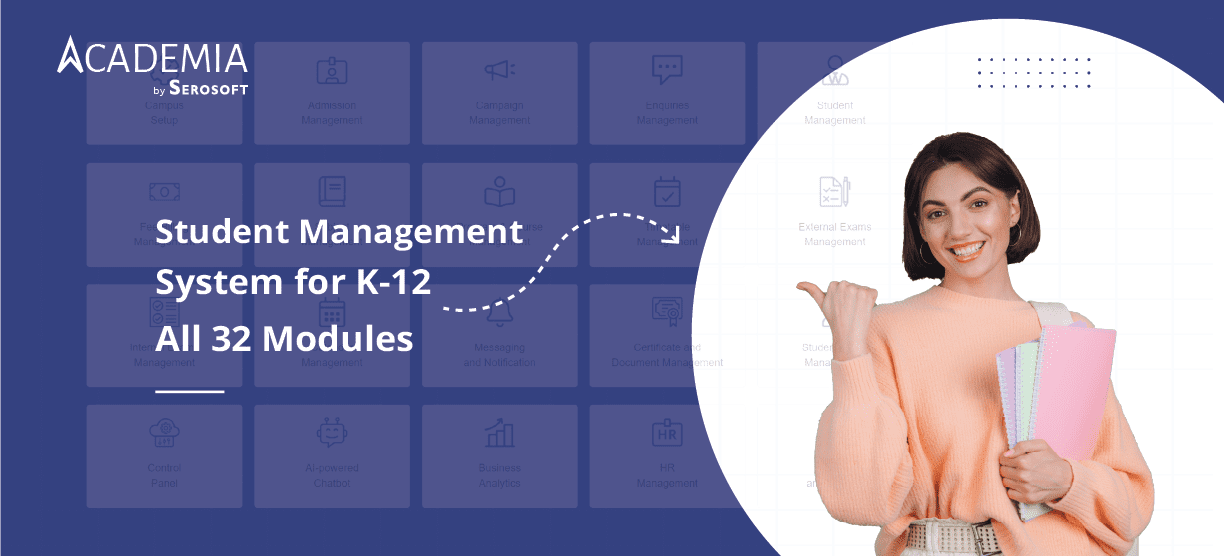
Academia Student Management System for K-12: All 32 Modules

K-12 is an American expression that is used for indicating the public-supported primary and secondary education in the USA, Afghanistan, Australia, Canada, China, Ecuador, Egypt, India, Iran, Phillippines, South Korea, and Turkey. It means student education from Kindergarten to 12th grade, which is approximately 13 years of basic education.

13 years of basic education, thousands of activities every year, and millions of bits and bytes of data that is stored somewhere on your computer or in a large bulky register. In the end, you would realize, managing the lifecycle of thousands of students learning in your organization becomes difficult, and almost impossible due to the inefficiencies found in traditional management.

Modernization of education institutes thus becomes necessary. Accountability has to increase in each department to improve the student experience and ensure higher knowledge retention for better student outcomes. Student satisfaction too is something that is not considered by many organizations as they don’t have the proper tools to render it and also calculate it. With student management software you can change that.

Introducing Academia Student Management System
Academia ERP/SIS is an education ERP suite that comes with advanced solutions to manage your internal and external operations. It has an inbuilt student management module and a data repository with a variety of features and functionalities that allow faster operations, accuracy, and transparency, making lives better for students in your institute.

All 32 Modules Explained

1.Organization Setup
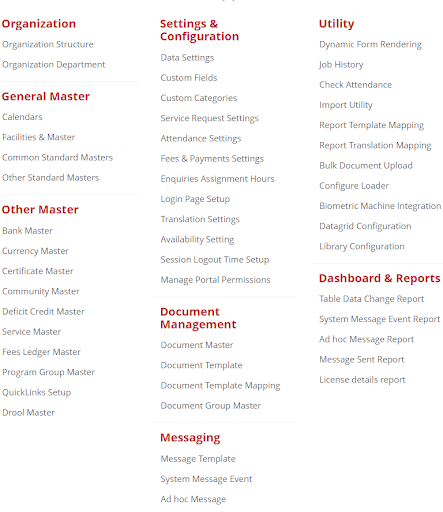
Organization setup is an important tool in your kitty that allows you to set up the software as per your organization structure. It allows you to create departments, manage calendars, add/manage resources, set up fees & payment settings, and more. It is a wholesome tool that leaves no aspect of an education organization untouched and allows end-to-end configuration for optimal working.
 

2. Campaign & Enquiries Management
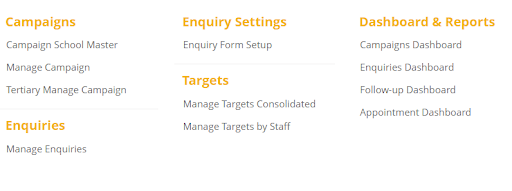
Pertaining to the pre-admission phase, you get a dedicated campaign management tool for institutes. The efficient system allows you to manage online, and offline enquires, set up enquiry forms, create reports, and get predictive analytics for the pre-admission phase of the academic year.
 

3. Admission management
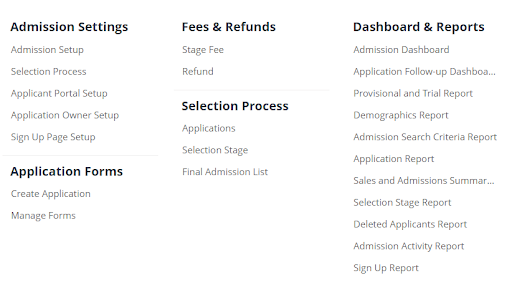
The traditional management of the admission process has many shortcomings such as missing out on important enquires and lack of communication between staff, and prospects. Battle these challenges with Academia Admission Module that helps you in streamlining all the admission-related processes and increases your admission rate significantly.

Fun Fact: Did you know, False Bay College in South Africa reported 100,000 applications in an academic year after the implementation of Academia Education ERP? Check out the full story here.
 

4. Student Module
One of the finest features of the Academia Education ERP suite, the software comes with a dedicated student web and mobile application. It has all the features and functionality that allows a student to manage their profile and other academic and non-academic operations.

It comes with advanced features such as timetable management, assignment submission, a dedicated drive to store knowledge resources, and communication tools. Also, we recently introduced “Sera” an AI-driven virtual assistant to make app browsing more user-friendly.

5. Fees Management
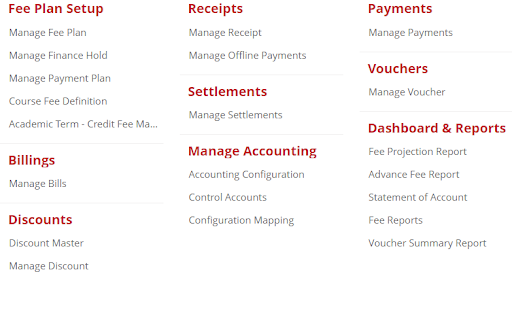
Fees and Payments is one of the modules in the Academia ERP which streamlines all the transactions happening in your organization. The advanced solution allows you to integrate it with reliable 3rd party payment gateways wherein you can accept online fee payments through credit/debit cards, UPI, net banking, and other options.

Also, the toolset allows you to manage the fee receipts much better. It digitally stores all the information about fee payments and makes it easier for you to keep records.
 

6. Program & Course Management
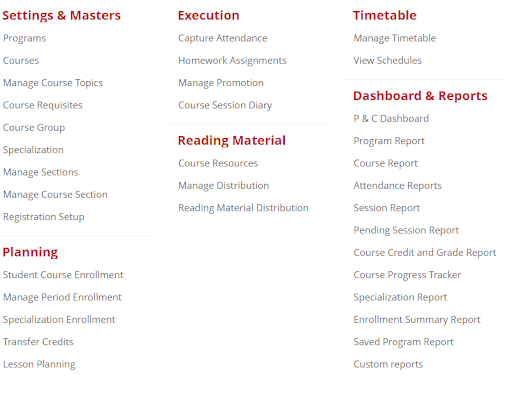
The feature-rich module is a one-stop solution for you to manage all the programs and courses in your school. It allows you to create study plans, build reading material, capture student attendance, manage timetables, and generate numerous reports on programs, courses, student engagement, student performance, etc.
 

7. Timetable Management
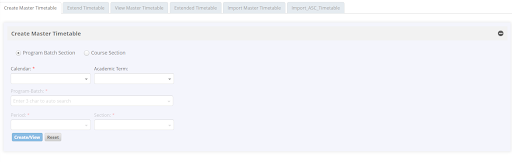
Timetable creation and management can eat hours and hours of your productive time and still not guarantee accuracy and ease. With Academia ERP, you get a dedicated timetable management functionality that allows you to manage the timetable of all the programs and courses.

It allows you to create a master timetable and an extended timetable, and manage them. Also, you can import the timetable directly to the system using a pre-built format that comes with the system.
 

8. Student Attendance Management
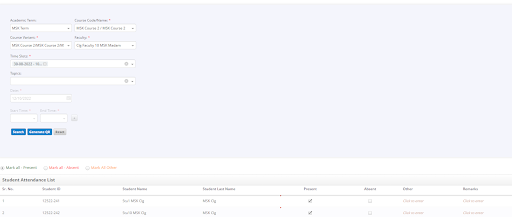
Attendance is a repetitive and regular task in all educational organizations. However, it is also taking. You have to consolidate all the attendance data at the end of the day, month and year to calculate the student attendance percentage which is a hassle for the teachers.

With a dedicated student attendance management system, you can do it with a few clicks. This advanced tool comes with reports and analytics and various features to mark student attendance easily to store on a central data repository.

Furthermore, the Academia ERP student mobile application comes with a QR code-based attendance marking system through which students can easily mark attendance. This would completely eliminate the need for teachers to do attendance marking activities on daily basis. Similarly, you can choose attendance Biometric, and RFID attendance marking system integration as well.
 

9. Discipline Module
It is important to ensure that students are on their best behavior in the institute and are diligently participating in academic and non-academic activities to ensure growth and better prospects. Hence, Academia ERP comes with a discipline module, that allows you to take disciplinary actions against students.

10. Examination and Marksheet Management
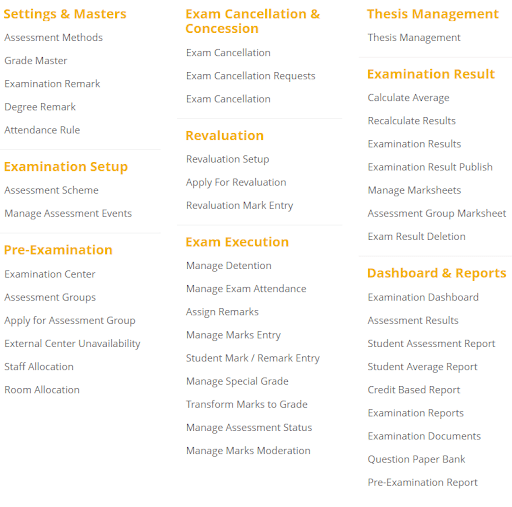
Academia ERP offers end-to-end digitalization of the student lifecycle, right from admission to examinations to alumni. Examinations are the most strenuous times of the year. Not only is it stressful for the students but the administration and teachers too are usually drowning in workload during these times. To automate and streamline this phase of the academic year we have some amazing features.

Academia ERP comes with pre-examination, examination, and post-examination features and functionality that end-to-end digitalizes the entire process. Some salient features of the module are: setting up a grading system, resource allocation, and management, fee collection, hall ticket distribution, mark entry, and reports
11 Assignment Management
A book for students and teachers both the software comes with advanced solutions to allocate assignments, define assignment groups, collect assignments, manage them, grade them, etc.

This is a two-sided feature, which comes with student-side features as well, where they get to see their classwork and assignments, and also submit assignments using the Academia ERP student mobile application.

12. Graduation management
Manage student grades, create report cards, and create a list of graduating students without any chances of data mishandling or mismanagement through Academia ERP.

13. Calendar Management
Manage employee calendar, academic calendar, and holiday calendar on the go and bring more seamlessness in the operations. No more creating calendars on paper and circulating them all across your institute. Create calendars that are well-integrated with all the departments, and also with web and mobile applications – bringing ease into the lives of students, teachers, admins, employees, etc.

14. Task management
Task management is another advanced tool that allows employees to create their own task sheet and keep a track of their day-to-day activities and tasks. This allows more transparency in the system and helps your employees to stay highly productive and organized. To take the experience a notch up, there are also dedicated reports for task tracking.

15. Security Gate Management
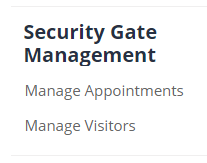
Not only data security but we also ace security at all levels. Manage your on-campus appointments, manage visitors and enjoy other features in the software that allow easy management of the security gate.
 

16. File Management
Easy management of files that allows you to secure information related to all academies at one location and perform various tasks. The efficient file management system allows you to upload files of various formats and gives you unlimited storage capacity.

17. Committee management
Manages committees in your organization and its members and activities from a dedicated dashboard without having to take reports from each person. The tool allows you to allocate coordinators and define members with the system which gives you the utmost convenience to manage all committee-related tasks, activities, and communication in one place.

18. Front desk management
A complete solution to manage all your front desk activities. The toolset allows you to check items coming in and going and trackable through item codes. Also, you can keep track of the people receiving or sending items and even bills.


19. Transport management
If you have an in-house transport service for your employees and students this tool is a must-have. The tool allows you to manage vehicle types, add stops, and manage vehicles, and routes. It also allows you to get transport reports including that on any due fees.
 

20. Resource booking management
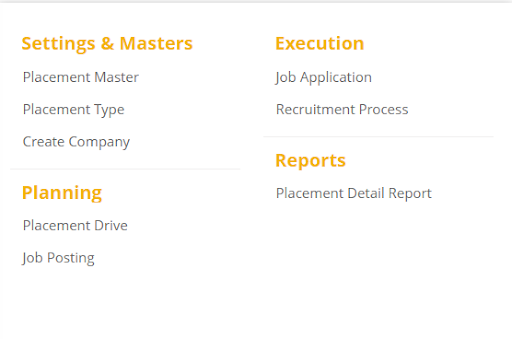
Now assigns and schedules all the resources in your organization and ensures there are no hiccups in academic and non-academic activities. The advanced tool allows you to manage equipment, labs, grounds, transport items, meeting rooms, and more.

21. Certificate and Document Management
Create certificate templates and manage important documents to allow easy management of all the certificates and documents in one place. The software allows various departments to use certification templates as per their usability for improved work efficiency.

22. Faculty Management
An end-to-end faculty management system that automates every step fo the faculty lifecycle. Right from onboarding to recruitment to workload management, the advanced tool gives you features and functionality to manage and ensure higher efficiency in faculty with useful data insights.

23. Scholarship / Sponsorship Management
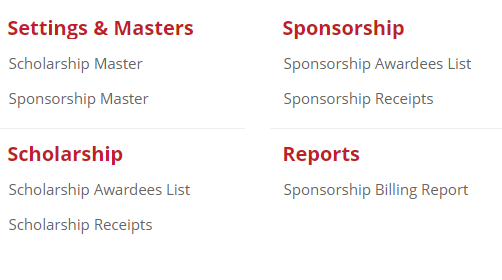
Allocate funds for outstanding students and help them economically to perform better in their education and in their careers. With this amazing tool, you would be able to allocate a specific budget for scholarship and sponsorship and manage it on the go by allocating it to the students and also generating reports.
 

24. Outcome-Based Education Management
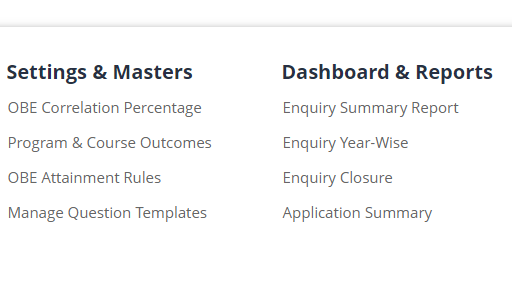
If you follow the outcome-based education theory in your education ecosystem, enjoy dedicated features and functionalities to manage the tasks around it. OBE correlation percentage setting, program and course outcome setting, a variety of reports, and more are some available features that would allow you to manage and perform all tasks for outcome-based education management.
 

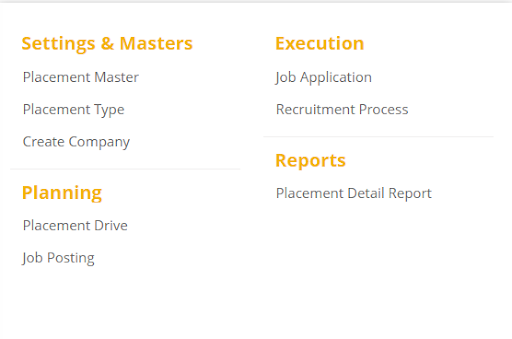
A robust placement management system that allows you to add companies, create job postings, manage job applications, monitor and manage the recruitment process and create detailed reports.
 

26. Hostel Management
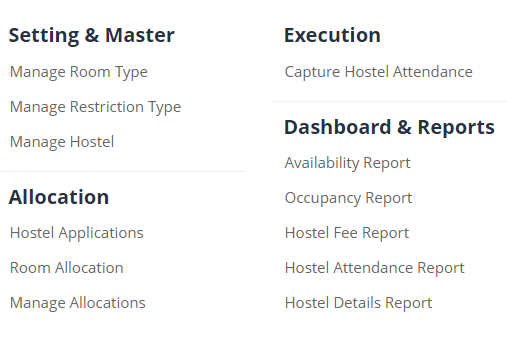
Hostel management software is designed to manage all the hostel activities like admissions, fee collection, receipt management, mess allotment, hostel stores and maintenance activities, inventory management, and more. The tool also comes with attendance marking system and a variety of reports on room availability, attendance, occupancy report, fees report, and more.
 

27. Election Management
Take your school elections online with a feature-rich election management tool. Academia ERP allows you to manage elections across all the locations and academies for various positions on the go. The digital solution comes with tools that bring transparency to the election and voting processes. This allows you to ensure school elections are centrally managed and also, fairly.

28. Thesis Management
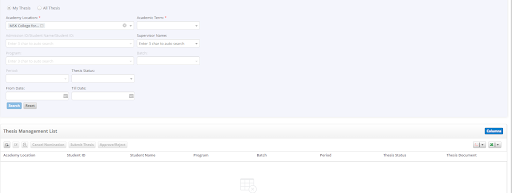
Get a feature-rich thesis management dashboard that allows you to administer, monitor, and evaluate the progress of the thesis creation, submission, and approval from a single dashboard. Furthermore, it comes with a filter system that allows you to filter-out students based on various factors.
 

29. Infirmary Management
Manage inventory, staff, infirmary beds, student health information, and more through a single dashboard.

30. Messaging and Notification
Enjoy an omnichannel messaging and notification system that allows you to communicate messages to teachers, students, and parents easily over the phone, email, and chat from official sources.

31. User role allocation and management
Manage software users easily from a single dashboard and allow and deny access to the employees based on their work profile and organizational hierarchy.

32. Analytics and Reports
Analytics and reports are one of the most outstanding features of Academia ERP. The software comes with advanced reports that give you a granular view of the processes and operations. Fueled with AI and ML these reports brings predictive analytics to your system where you get to make data-backed decisions and ensure better working between various departments and improve processes.

“1 Million User Login Information Compromised” Meta warns. How can you ensure it does not happen with your school apps?

Facebook parent company Meta is warning 1 million users that their login information may have been compromised through malicious applications. The company identified 400 android and iOS apps that were specifically designed to steal Facebook login information such as usernames and passwords.

This leaves people thinking if a top-notch company like Facebook fell prey to malicious cyberattacks, what is the chance it could not happen with smart school applications?

Given the vastness of the situation, if you are a decision-maker at your institute, it is your responsibility that the smart School Management Software (Link: https://www.academiaerp.com/school-management-system/) that you use is following high-end security protocols to protect sensitive information. To help you ward off security threats, here are some useful tips.

Tips to protect user login credentials for your School Management System or Smart School Apps?

Password Hashing You must handle consumer login information with utmost care. You must contact the vendor and understand how they are storing the sensitive information of the users. If they say, it is stored as a plaintext password, it is a red flag. Go with software that uses password hashing technology and does not reverse the encryption in any attempt of cyberattack.

Biometric Authentication Smart devices are now embedded with biometric authentication tools. If you want to take the security of your school apps a notch higher, consider biometric login.

Biometric login provides you an added security as they would only open the app through fingerprint, retina, face, or voice recognition which is not an easy task to replicate. Also, it is impossible to make breach unless the criminal is in the physical vicinity of the user.

Two-factor Authentication Two-factor authentication is a proven solution to guard the app against unauthorized logins. The powerful system would add multiple layers to the login process and if the hacker is even able to get through the first layer, there is no chance they can get through the second authentication test. This would offer a great degree of certainty about the login credential security of the students, teachers, parents, and employees.

Make sure each layer of authentication should be designed and tagged smartly. You must authenticate a user based on any unique factor, such as OTP verification through a code sent to the user over the mobile phone.

Password Hygiene Always force your users to choose a strong password, it is for their own safety. Take measures such as:
The password should not include personal information (names, phone numbers, birthdays, pet names, or any other publicly available information).
Do not allow dictionary words, proper nouns, common combinations of numbers or letters, etc.
The minimum password length should be 10 characters.
Password should be a combination of uppercase and lowercase letters.
Encourage the use of special characters in the passwords.
Suggest using a unique password for each application.

Limit Login and Password Reset Attempt Limiting the login and password reset attempts is going to be a good add-on to the security. It would top off all the measures and allow you to ensure the iron-clad security of the user account.

Also, in case of any brute force attack, you can choose to inform the user of the attempts and ensure if it were they or someone else. In case, it’s not them, they can reset the password immediately and secure the account.

Limit Session Length Session length is usually underestimated but can be a strong tool to ensure the security of your application. Never go for an indefinite length of the session. You must define a time when the account would stay logged in on the app and would automatically log out.

Wrapping Up These were some tips for you to ensure login credential security on your School Management System. If you are looking for an Education ERP provider that follows all these protocols and has an international standard for security go with the Academia ERP solution.

Education ERP for Higher Education Institutes: Saudi Arabia Edition

Enterprise Resource Planning or ERP software is an industry term for an app suite, a multi-module software that is designed to serve and support multiple business functions. An ERP solution can mean many different things based on its application in various industries. And hence, it becomes very important to map your expectations from the software with its core functionalities, and features. Today, we will discuss what ERP means for a higher education institute. 

The history of ERP solutions in Saudi Arabia 

ERP solutions are very dynamic. Not just in the features and functionality, but it has a very interesting story of its inception. It is an app suite, which constantly evolved with the changing needs of the world. It is one of the oldest solutions which is still blooming and metamorphosing as the world demands. 

It all started in the 1960s, the economy was great, and most industry sectors were expanding. This is when the manufacturing industry realized they are lacking a solution that provides inventory control. This gave birth to Material Requirement Planning-I, the first-of-its-kind software and a forefather of enterprise resource planning. With time, the software evolved and by the 1990s, it was extending its services to the areas such as Finance, Human Resources, Project Management, Engineering, and more. 

The solution was efficient in addressing the needs of various industries and streamlining their operations to offer cost-effective solutions. Although it was a risky implementation, industries continued to rely on this amazing solution. 

Looking at the product’s success in the west, many industries in Saudi Arabia too implemented the technology to achieve global expansion. The technology even disrupted the education sector and by 2007, the Saudi Arabian government started implementing ERP solutions in public and private education organizations. 

ERP in higher education 

ERP in higher education institutes is widely used by corporations. It has played a significant role in implementing a digital ecosystem that gives better scope for monitoring and administrating the institutes. It allows tracking of various operations such as human resource management, resource planning and implementation, student information management, and financial management. 

Despite the challenges of implementing ERP systems, organizations in the corporate sector have highly benefitted from the financial competitiveness they get on implementing the solution. Although, it is only a recent phenomenon to see ERP making its way to the nonprofit sector as well. The trend picked up when higher education institutes realized the benefits of using an ERP system — it made management, financial and administrative tasks very easy. 

Implementing an ERP solution in a higher education institute becomes rather difficult than its implementation in a corporate because of the unique organizational model and core processes. A higher education system supports academic growth and has a set of activities that did not initially lie in the core capabilities of an ERP solution. It is more about scheduling the learning process and advising students on their performance and engagement. Furthermore, admissions, examinations, and resource planning & implementation are very unique aspects in and of an education institute. 

Even though the implications of using an ERP system in a higher education institute and in any other organization have shown a positive effect, it is still important to address the unique aspects of an educational system to not make any mistakes in the implementation process. Also, it helps us understand how beneficial are ERP software over legacy systems and what value they bring in. 

Modules for ERP in Higher Education

Quoting from Kassel 2009 Report

“As scientific and teaching enterprises become ‘big business and universities’ throughout the world struggle to revamp or reorganize their identity within an era focused on “commercializing higher education” 

“Software vendors are increasingly viewing the education market as a lucrative “industry” potentially worth several hundred billion dollars in revenue .” 

Education ERP is a very popular technology that is here to revolutionize the internal and external operations of an education organization. It transforms the way an institute — manages, administers, and monitors. However, it is important to note that education systems around the world differ, and meanwhile, most education technologies are a good fit for institutes in Europe, and America, but they fail to successfully implement their product in the Arab world. 

It is very important that an education institute partners with a vendor that has an in-depth understanding of the higher education system. A vendor that has a very futuristic vision about the software and meets your expectations in the short and long term. It is also important that they provide constant updates to the software and roll out features that are more efficient and effective in the working of an education institute. 

In short, it is important that educational institutes are partnering with vendors that do not believe the implementation of the software in the organization was their end goal. Rather they should be innovating constantly and gaining a grip over the market with forwardism. The product should show functional efficiencies that define the processes and operations of an education organization better. 

  • Functional Requirements of a higher education institute in Saudi Arabia from ERP
S.No.  Functionality S.No.  Functionality
1.  Communication – internal & external 15.  Timetable Management
2. Staff profiling 16.  Course Resource Management
3. Student Information Management 17.  Assignment Management
4. Hostel Management 18.  Assessment 
5. Alumni Management 19.  Ad-hoc Reporting
6. Feedback System 20.  Admission Management
7. Transportation Management 21.  Payroll Management 
8. Curriculum & Lesson Planning 22.  Reports & Analytics
9. Staff & Student Attendance Management 23.  Human Resource Management
10. Performance Analysis 24.  Placement Management
11. Academic Calendar Management 25.  Asset Management
12. Examination Management 26.  Online Examinations
13. Library Management 27.  Online Education & Blended Learning
14. Fee Management 28.  Accounting


  1. Additional Requirements of a higher education institute in Saudi Arabia from an ERP 


S.No. Add. Functionality S.No. Add. Functionality
1. Integrations 5.  Customer Support
2. Interoperability 6.  Statutory Compliance
3. Configurability  7.  Cloud-based infrastructure
4. Data Security & Management 8. Scalability

Importance of Implementation Strategy

Implementation of the product is key to success. If you fail to follow the project management principles, even a great product may not be meeting your expectations. You need to understand, having a robust and feature-rich product is only a part of the dream, to make it come alive you need an implementation process that provides you more control over the product. Hence strategic software implementation is important. 

  1. Planning 
  2. Business requirements & software configuration
  3. Testing & Refinement
  4. Training & Deployment
  5. Maintenance and Enhancements

Wrapping It 

We are not denying the fact that there are a thousand education ERP solutions available on the market and each is unique in its own sense. But, it is not a competition of what is the best education ERP solution. You must stick to the goal, and define your own priorities while hunting for the right education ERP solution. 

Education organizations in Saudi Arabia have a very unique education system and they need specific academic functionalities to meet their goal. Also, it is not merely about acquiring an ERP application. It is important that the app provides you with tailored solutions to address your needs. 

I am text block. Click edit button to change this text. Lorem ipsum dolor sit amet, consectetur adipiscing elit. Ut elit tellus, luctus nec ullamcorper mattis, pulvinar dapibus leo.

The Benefits of Edtech Partnership – Education Technology (UK Edition)

Education institutes in the UK continue to adapt to education technologies in defense of the extraordinary challenges that come their way. Apart from some initial hiccups, it is remarkable how the sector has dealt with the return to classrooms to campuses in the tumultuous economic environment. 

As we move towards the end of the year, it is only relevant to inspect some of the themes that have governed the education sector all throughout the year. Along with this, if these themes are here to stay, and get a permanent place in the education landscape of the United Kingdom. 

Learning Management System

The first thing that crosses anybody’s mind while talking about education and technology is the learning management system, a.k.a, LMS. It is only fair to talk about it, especially when the world is making efforts to return to the pre-pandemic order. So, would there be any more online classes? Would there be remote learning? Well, the likely answer is the hybrid approach. Institutes in the UK have shown a keen interest in blending learning and are likely to continue with the same approach. 

Need to invest in the right technology

As the wheels of change churn, education institutes have a growing interest in other modern technologies. What seems clear is the need to invest in Education ERP solutions, cloud infrastructure, mobile applications, data security measures, and other things. 

Strategy and tools to cover up for the losses during Covid 

It is no news, COVID-19 has made the education sector highly vulnerable. Even before COVID-19, there were some big educational gaps. In COVID-19, they have widened. Students and parents are expecting education institutes to fill them as fast as they can. 

Funding 

Another challenge is to close the skill gap. It is important to ensure the country has a workforce with the right skills to contribute to the changing government’s stated goals post-Brexit. With reduced access to labor from the EU, there is no other option but to create a high-skill, high-wage economy, and thus, it has a huge budget planned for the education sector. 

The schools are lined up to get an extra £4.7 billion by 2024-25, and nearly £2 billion of new funding to help institutes recover from the effects of the pandemic. Higher education institutes too are going to be emerging from the pandemic with more cash than ever before. 

In essence

Schools and higher education institutes are ready to make their investment into education technologies and meet their modern challenges. However, they are still one step short of making that leap. 

With cash reserves planned to make the necessary investments in technology to meet the needs of the time, they also need the right vendor. 

This is where you and we come into play. We bring a globally recognized education ERP solution and are here to offer you a channel partner program to get an early-mover advantage in the market. 

With an intent to deep penetrate the UK market with our award-winning product, we are seeking professionals that have a knack for sales and project management. We are looking to partner with individuals and companies. We have 3 models in our partner program. Each one is targeted toward generating high revenue. 

Given the need of the hour, institutes in the UK can be highly benefitted from our product. If you are willing to partner with us and use this opportunity as your leverage, contact us here

Take your Student Retention Game to Next Level With Education ERP: US Edition

Student retention may not be a primary focus for many colleges, but it would shock you that 1 in 4 students in the USA is dropping out to study somewhere else or nowhere. This is a statistic from a report published by National Student Clearinghouse earlier in August this year. Approximately, the retention rate in the public-funded higher education institute is only 76.3%. 

Having said that, student retention should be a primary focus of colleges right now. Trends are being reported on a regular basis indicating the number of students dropping out of higher education institutes is going to dip lower. 

Now that an applicant has come and enrolled in one or many of your programs and courses it is time to pull up your socks and gear up for the battle of student retention with full force. To help you in your course, here is a comprehensive blog on education ERP / Student Information System (SIS) and how it can help in a significant increase in student retention. 

  • Improving communication between students, faculty, and administrative authorities

If you have assigned an advisor to your students you must ensure the communication between the student, advisor, administrative authorities and faculty is clear and seamless. Just knowing the challenges that are stopping the student to continue their education can help you evade them much faster and put resources and services to offer support throughout the student lifecycle. 

Using an education ERP / SIS solution can thus serve as a key tool to manage the feedback of the students and track the process to resolve these issues. Also, administrative and non-administrative tasks can be speeded up through education ERP / SIS for improved student experience and communication. 

  • Guide the course selection process

Proper counseling can be provided to the students by effectively managing applicant enquiries and queries. Not only is an education ERP / SIS a great tool for automating enquiry management and streamlining the admission process but with a little effort from your end, you can ensure each applicant is given the due attention and is counseled well to boost their decisioning in the course selection process. 

  • Engage students the way they want

Personalized learning is no longer a fancy word in the education industry. Many institutes are doing it and are reaping various benefits. The education industry no longer runs on the notion of ‘swim or sink’. 

Technology can be used to learn more about students’ interests, and their mode of learning, checking their performance and engagement throughout the class and ensuring they are being engaged in the way they want to learn. Using education ERP / SIS you get a powerful student performance management system where you can generate accurate reports on their engagement, performance, and participation and plan lesson plans accordingly. 

  • Supporting each step of the student journey

At every stage of the student lifecycle, a student faces different challenges. As an administrator at your institute, it is very important for you to analyze these challenges and develop strong strategies to improve the student experience. 

First of all, the employees at your institute should be very focused on the primary goals of your college. Using a traditional management approach, and redundant software requires too much manual intervention and hence have lowered productivity and efficiency. 

Using Student Management Software with a centralized database would boost the understanding of your employees across all departments. Further, the automation brought along education ERP / SIS would free them up to act on powerful strategies and achieve the shared common goal.

  • Build a placement network and manage it properly

One of the primary reasons for students to drop out of college is their financial problems or their sheer need to work. With an efficient placement network, you can manage paid and unpaid internships, jobs, and other earning opportunities for students better. 

This way, students would get relevant information to participate not only by just learning but using their hands-on experience. Finding a job opportunity would not become an added activity for them but would become highly convenient.

A good education ERP / SIS solution thus comes with a robust placement management center with all these qualities and makes things and information more readily available for the students to be benefitted. 

  • Don’t just collect data use it

The use of digital tools and software make it easier for businesses to capture data at several touch points. This makes strategizing easy. The use of education ERP / SIS and student mobile applications allows you to not just improve student experience but get real-time data about any declines in student count in any of the programs and courses. 

Also, the robust reporting system, allows you to consolidate data across various departments and identify the factors that are causing your students to drop out. Acting upon these factors would help you in improving your student retention by several folds. Also, predictive analytics and help you in forecasting student retention percentages. Any positive or negative change in the metric thus becomes easier to track and faster to act upon. 

Way Forward

In hopes that you find this blog informative and useful, you can consider taking a demo of our education ERP / Student Information System – Academia Education ERP which has all these qualities to increase your student retention. For more interesting information about education technologies, stay tuned. 

Top 5 Smart Resources for Institutions to Check While Choosing ERP/SIS

With the modernization in the education sector, education institutions around the world are choosing software technology for their overall development. ERP is also the modern choice of institution. It can automate and streamline the academic, non-academic, and administrative operations of an institution. 

But do you know what are the main features that you need to look for while choosing an ERP/SIS? If not, these 5 smart resources can help you take a deep dive into the world of education ERP/SIS and win the competition.

  • Quick Reads

If you are thinking of buying an ERP/SIS for your institution, these 5 blogs can help you learn about an ERP and how it digitally transforms your institute. 

  1. Student Lifecycle Management: AI-driven Solutions
  2. Role of Predictive Analysis in the Education Industry 
  3. Student Information Systems: The Five Best Reasons to Invest
  4. Cloud ERP vs On-premise ERP Solutions: What is right for your education institute? 
  5. Global Education Institutions – Why is it high time to implement ERP?
  • Rapid Evidence

Smart are the people that take informed choices. If you are thinking about digital transformation, choose Academia ERP, a proven solution and the first choice of 320+ education institutes around the globe. Here are a few of the reviews that can help you understand why Academia ERP/SIS is the best choice for your institution.

  1. Reviews from prestigious institutions over G2
  2. Reviews from prestigious institutions over Gartner Peer Insights
  3. Success stories from clients 
  4. Case studies 
  • Awards & Accolades

Education institutions around the world opt for technologies that can bring complete digital transformation. Check these awards and accolades that make Academia a worthy platform for educational institutions. 

  1. Awards & Accolades
  2. Media Coverage 
  • More about Education ERP/SIS

These whitepapers and reports can help you a lot if you want to gain in-depth insights into the functionalities of an ERP/SIS.

Whitepapers & product sheets 

  • All About Security

Education institutions are easy targets for hackers. Here are a few resources which will help you understand the elements and standards that are required to achieve unbreakable security in an education ERP. 

  1. GDPR Security
  2. A Checklist To Safeguard Your Institution’s Data
  3. The Top 5 Priorities for Higher Education in Cybersecurity

Wrapping Up! 

An ERP/SIS helps education institutions not only to automate and streamline their operations but also to give higher ROI, operational efficiency, and ease of monitoring and management. Want to know more? Request your demo now!

Benefits of Teaching Diversity in Education

Diversity is a primary goal of modern educational institutes. Diversity has suddenly become an important thing for education institutes, as the world becomes more aware and tolerant of the varying perspectives, views, and approaches of individuals. People are more accommodating to a variety of ideas and have become more respectful towards the apparent differences in ethnicity, gender, age, race, religion, gender identity, and more. 

In the past, institutes dreaded diversity, but not today. Students feel it is very important that institutes don’t have bias and are catering to all segments of society equally. They need to know if the institute is strengthening intercultural tolerance. Surprisingly, technology can help you create a more inclusive environment for students hailing from a variety of places, having their views, and perspectives to create a diverse environment at your institute. 

Why is teaching diversity in education important for advanced institutions?

Many educational institutions, businesses, and organizations across the world are operating on international standards and scale. Teaching diversity to students helps them become global citizens and provides exposure to different cultures, religions, and belief groups. 

There are various benefits of promoting diversity at your institute, let’s have a look at a few of them:

  • Diversity Enriches Educational Experience

Teaching cultural diversity in institutions helps in providing a wider opportunity to learn from peer groups that hail from different cultural backgrounds. This gives them an enriched learning experience and makes them more flexible towards adopting new things, sharing knowledge, improving communication, and increasing collaboration.

Various institutions are being more diverse than ever and creating experiences, perspectives, backgrounds, and beliefs. 

  • Diversity Improves learning 

Diversity helps in improving communication and provokes the feeling of brotherhood. This, in turn, results in an exchange of new ideas, beliefs, thoughts, knowledge, skills, etc. .  It brings peace and harmony to the campus and promotes a positive attitude toward learning new things. 

  • Diversity Challenges Stereotypes

The modern generation of students often gets raised around people of similar socioeconomic, racial, or cultural backgrounds. In the development process, they create several stereotypes that can be a hindrance to their growth and do not allow them to mingle with people that do not share cultural or economical commonalities. Thus, diversity can challenge their restrictive approach toward the world and help in creating a positive atmosphere among students. 

  • Diversity Helps in Leadership

With various other benefits, cultural diversity also helps in thought leadership. They also get the chance to see and experience various leadership styles along with faculty, staff, administrators, and all the stakeholders. It’s a chance to see someone from other cultures and backgrounds and even emulate them. It is also impactful for students from various communities, considering the initial qualities of students along with their leadership skills.

  • Diversity Foster Creativity

Diversity in institutions encourages solving various problems and brings in creativity. Creating collaborative groups is an excellent tool for classroom and overall institutional management. Students can also bring various perspectives that can challenge their peers to think creatively and find easy solutions to complex problems. It also provides students with the opportunity to work with a diverse group of peers along with confronting creativity in all ways.

  • Diversity in the adoption of technology

With the increased competition, it is also crucial to adopt a digital tool. It is imperative to know that innovation is needed to diversify with the ability to utilize the right digital tool that can engage, communicate, and collaborate. Along with increased opportunities, students and faculty members need a platform that can keep them connected and more focused on their end goal i.e, uninterrupted learning. 

Conclusion

Diversity in education is a crucial aspect on which modern education institutions need to focus on. Hope this blog helps you in having a better understanding of the same. Various techniques can be used to implement the same using good technological support. If you need any tech assistance we can help!

7 ways machine learning is changing the education domain

Although late but education industry has finally started to shed its old ways of operations and is embracing technology happily. There are various schools, universities, and training institutions that have completely digitalized their processes. It is a great achievement as it is a need of time, but half the players in the education industry still struggle to find the right solution or don’t have the resources planned for it. 

Since the technology domain is fast-paced, new technologies emerge regularly and tech enablers go gaga over these technologies to be utilized in the best possible ways for various industries. You would be surprised, how some industries have completely automated their processes, and artificial intelligence has grown so smart that you may not even realize when you are interacting with an AI. 

Similarly, the education sector is showing great enthusiasm in adapting to the tech buzzwords such as artificial intelligence and machine learning. Today, I want to introduce you to some of the larger aspects that can be transformed through ML. 

Machine Learning by definition

It is an advanced field of computer science where data is closely analyzed statistically and used to train an AI algorithm for performing various tasks.

Ways ML is transforming the education industry

  • Support teachers 

Machine learning mines data that is collected regularly from the web and mobile applications. Using this data you can learn a lot about the student’s behavior and devise teaching styles that are most helpful for the student. Using it teachers can also access data of all students in one place and carry out administrative tasks. It thus helps in streamlining the process and identifying the gaps in teaching and learning styles to abridge it. 

  • Predict student performance 

One of the best abilities and what makes ML a smart tool is predictive analysis. Machine learning is not just great at crunching data but also at providing useful predictions on various aspects of your institutes. It allows you to counter them with data-backed strategic decisions. In short, you can have a hint of the risk you may face in the future. 

  • Test Student 

For a long time, educationists have scrutinized the process of assessments. A stop and test assessment are not enough to evaluate the students, claim many teachers and education theorists. 

In replacement of this, AI-driven assessments are getting very popular. These assessments not only evaluate a student’s performance but deep dive into finding how a student learns. It demystifies the unique pattern of learning for the student and informs teachers and parents about it. 

  • Personalized learning 

Once the unique pattern of learning is understood by teachers they can develop unique content and use various teaching styles to provide personalized learning to the students. Also, there are various AI-infused learning devices available on the market, they use machine learning to adapt to the learning pattern and progress of the student to customize the content further. 

  • Content organization 

By identifying the weakness and strengths of the student you can develop the content accordingly. It also gives insights into the pre-found knowledge and skills in a student and utilizes it for organizing content and structuring it for faster and higher knowledge retention. 

  • Improves retention

Machine Learning offers learning analytics that allows for improving student retention rates. It helps you learn about student risks and allows you to reach out to students before they drop out to retain them and help them. 

  • Group Students and Teachers 

Based on the learning style and student profile, machine learning can help you assign students to the teachers that can be best suited for them. This advanced match-making is the perfect tool for improving student outcomes and assigning the right counselors for them

Wrapping Up 

Machine learning is becoming more and more dominant in the working of education institutes. With a little effort and the right partner in the digitalization process, you can achieve great heights with these futuristic technologies. We can be that for you. Know more about Academia ERP from our technology expert, and get a free demo here


Back to top