Type your keyword below

How Machine Learning Can Improve The Education System

Artificial intelligence (AI) and machine learning (ML) are at the heart of the digital revolution. Many industries, such as education, logistics, healthcare, and retail have begun to add emerging technologies to their game plan.

Machine learning, a subset of artificial intelligence (AI), is becoming increasingly popular and is gaining acceptance in almost every area. Machine learning is a field of inquiry devoted to understanding and building methods that ‘learn’. That is, methods that leverage data to improve performance on some sets of tasks. It is a branch of artificial intelligence. 

Machine learning is becoming increasingly important in many areas. Here, the technology will perceive the data and its structure to provide useful insights. 

Higher education needs to improve the experience of students, faculty, and staff. This can be achieved by using new technologies. It can bring about remarkable positive changes in this area. In this article, I will explore a few ways in which machine learning can help to improve the education system.

Efficient machine learning can initiate:

  • Personalization Learning Experience

The introduction of machine learning in schools transforms traditional learning methods with physical books into online learning. In addition, the teacher never has to keep records of each student. A good tech solution can deliver the concepts and set goals for each student. The purpose of this function is to help a teacher to follow and observe each student in the class. Therefore, a teacher can see and judge which methods work or which do not work well and what needs to be changed in the program to make the job easier.

  • Student Path Prediction

With the development in technology, education institutions need to choose a very good technology solution that can help in managing students’ lifecycle. Based on the daily actions of the students, it helps in recognizing their weaknesses and working on their improvements in a better way.

  • Automated Processes

Through machine learning, educational institutions can attain automation. Automation for teaching, learning, and overall institutional management can lead to improvement. It also improves student lifecycles and motivates them to complete academic and non-academic activities with ease.

  • Chatbot Integration

With the expansion of technology in the education industry. Institutions can optimize modern techniques like chatbot integration. A chatbot integrated with a mobile application and portal on its own can help all the stakeholders and enhance its usefulness.

  • Performance Feedback – students  & teachers

Not only do the machines aim to show the students’ level they also provide feedback through analysis of the data and their recent work. The machines are based on the student progress analysis program. The same procedure will apply to teachers so that a teacher can also know where to change their work. During this time, students learn about their knowledge gaps, areas where improvements are needed, and methods to get better results.

Conclusion

Machine learning is a new way to accelerate progress in the education system. This allows students to make the learning process more entertaining and challenging through AI technologies. With increasing class sizes, machine learning can help teachers pay more attention to each student. This will take our education system to a whole new level as schools introduce it into their programs. With the improvement of machine learning technology, the impact on the education system will be even greater. And we hope for a positive effect on the future of education.

Human Resource Management

Human Resource Management is Heart of any University / Institute, and it includes so many activities other than just appointing and terminating staff. In today’s scenario, these HigherEd education bodies focus on HRM for the recruitment, direction, and administration of human assets along with making the premeditated procedure for the future. Well-built HRM fosters human talent so that the employees can turn out to be even more valuable to the industry. The accountability of human resource management keeps on growing day by day. HRM includes many features such as:

  • Recruitment
  • Training
  • On-Boarding
  • Employee Relations
  • Payroll
  • Compensation
  • Safety
  • Legal
  • Communication

Human resources people in almost all the HigherEd education bodies are involved in strategic decision building and energetically contribute to managerial planning teams. Strategic planning and organizational structure are considered to be the most noteworthy part of their role. To turn out to be a leading University/Institution in themselves, medium-to-small educational bodies are supposed to think about acclimatizing to this present-day mold to achieve expansion of their aim. The capability to map for the correct labor force has by no means become more serious or more tricky in today’s scenario. Victorious implementation of planning will require prediction based on in detail investigation to recognize what potential roles will be needed in the future.

In today’s talent management system a strong business hiring strategy is required that anticipates the necessitate human capital for the education system. The talent management system is all about engaging experts, highly capable people to keep hold of them for the long in any system. This process is lope by considering their prospect expertise requirements, training and mounting employees, care, keeping them on board, motivated, etc…

HRM is all in relation to adding value to the HigherEd education system in the following ways:

Human Resource Management for HigherEd system

  • It improves output: Hiring a better class of employee is where all industry needs to focus their efficiency. HR departments is responsible for not only recruiting and interviewing the prospective applicant but also to choose out the standouts and abscond the rest. In collaboration with other Team Managers internally in any university/ colleges, HR Managers should put together a list of benefits for the employee to attract ‘Rocker’. Also, they should develop a high-quality hiring procedure with the objective of targeting the right audience that fits in the required field.
  • Trim down the expenses: It is very difficult for a HR Manager to describe different methods as précised plan, be it the feedback evaluation, the yearly pay appraisal or the growth of a fresh curriculum. As an HR professional, their key to success depends upon the understanding of the broad financial plan of an assignment. HR hold back unnecessary expenditure through mounting new techniques for trimming employees administration expenses. HRs also make sure that the competitive and sensible salary setting based on studying the employment market, employment trends and remuneration investigation based on job positions.
  • Divergence resolutions: Workplace disagreement is to some extent expected as people have diverse individualities, the standard of living and work ethic. It does not matter whether the disagreement happens involving employees or an employee and somebody in the organization, HRs is the one who can give a hand to both parties evenly not choosing individuals sides and solve the matter.
  • Employee satisfaction: HR Managers are typically charged with the accountability of influencing employee happiness. They determine what the fundamental causes are for employee dissatisfaction and then they tackle those matters and encourage their staff members with creative elucidations.
  • Advancement in employee performance: HR teams works on performance appraisal systems which helps them to track employee performance reviews on an annual basis. This helps the individual employee to analyze in which field they are lacking and can work on the same for the betterment of both organization & oneself.
  • Training and development: HR departments organize needs assessments for employees to determine the type of proficiency training and employee development programmes that are required for enhancement and Add-on experience.

Hence HR Management is vital tool for HigherEd education system, with our experience we have seen
universities & colleges are comfortable to their present system. Academia ERP offers seamless integration with third-party HRMS.

Follow the link for a Free Demo: Click Here

Artificial Intelligence in Education: Benefits, Use Cases & Trends

Advances in the development of artificial intelligence are spreading at incredible speeds around the world, creating incredible hype that raises our expectations. In this article, we have compiled some ways to use artificial intelligence in education.

Automated classification

Automated Qualification is an AI-based specialized computer program that simulates a teacher’s behavior to assign grades to essays written in a pedagogical setting. They can evaluate the students’ knowledge, analyze their answers, give feedback and create individual training plans.

The intermediate interval of training

Overhaul of knowledge if you forget that it is an effective pedagogical and technological solution. Using artificial intelligence, one can know when you probably forgot something and it is recommended that you review it. It only takes a few revisions to make sure that the information is now stored in your memory for many years.

Feedback loops for teachers

The feedback, the assessment of the teachers by the students, has a history that goes back a century. Despite the shift from paper to online surveys, little or no progress has been made in the field of commenting. Assessment of lessons by students is often the most valuable source of information.

With modern technologies such as AI-based discussion robots, machine learning, and natural language processing, there are many interesting ways to improve the quality of the comments.

How Academia ERP Enables Artificial Intelligence in Education

A chatbot can gather opinions through a dialogue interface, like a real interviewer, but with some work that a person requires. A conversation can be adapted to the answers and personality of the student. A chatbot can even find the reasons for this or that opinion. It can also filter out personal insults and obscene expressions that are sometimes present in teachers’ qualifications.

Virtual moderators

Students were intrigued by new assistant teacher Mr. Academia, who responded quickly and accurately to student requests. The students did not know, however, that Mr. Academia true identity was actually a computer equipped with an AI system. Such virtual moderators can be very useful in education.

Campus Chat

The online discussion page can answer questions on any questions a student needs to know about life on campus. How to find the next conference room, how to apply for the next semester, how to do homework, find a parking space, or address a teacher: these are the questions that AI ChatBots’ online discussion campus can answer

Personalized learning

Personalized learning refers to a variety of educational programs that optimize the pace of learning and the educational approach for each student’s needs. The experience is tailored to the learning preferences and specific interests of the different students. Artificial intelligence can adapt to the pace of individual learning and can offer ever more complex tasks to speed up learning. As a result, slow, fast students can continue learning at their own pace.

Adaptive learning

Adaptive learning is perhaps one of the most promising applications of artificial intelligence in education. It is assumed that artificial intelligence in schools can track each student’s progress and adjust the course, or inform the teacher about material that a student has difficulty understanding. In this sense, some intelligent tutoring systems should also be mentioned.

Monitoring

Distance learning, the driving force of modern high-tech training, involves conducting remote examinations. How can we do this to make sure a student does not cheat? AI-based protection systems come to the rescue. The supervision or supervision test is a mechanism to ensure the authenticity of the person to be carried out and to prevent that trap from being present by a supervisor during the test.

Capture and personalization of the data

Using the geolocation data and our previous searches, AI can now offer us the ideal coffee nearby or, for example, create a route to the store closest to your favorite comics. The same technology can be applied if we study a grammatical rule based solely on examples of the sphere that interests us with all educational content appropriate for us.

Student Information System: Empowering Institutions

The Student Information System is an ecological system that helps the institutes get rid of distributed data. This all is in single software which includes initial documentation from inquiry management, and student registration, till students get passed out of the college / University. This software will help you in running all day-to-day college activities without difficulty. College can easily send alerts or different sorts of information via SMS or email to parents and students. Information generated includes results, attendance records, assignments, notices related to different cultural activities, seminars, corporate events, Placements, etc…

 Student Management System helps in many ways such as:

  1. Authentic time reports: Long ago manual reports technology was used in institutions. These days, the management can do the whole lot on ERP, which in itself is an inbuilt mechanism for generating reports. Many styles of actual time assessment can be generated from such software in the form of different excel reports.
  2. Paperlessness: Automation of process leads to reduced usage of paper which ultimately helps in saving time and money.
  3. Data Security: SIS provides a high level of data security in terms of protecting data from unauthorized access and data corruption throughout its life cycle.
  4. Improved quality of interaction: With the help of SIS interaction between Students – Faculty, Student – Management, Management – Parents, Intra college Faculties, Administrator became more transparent.
  5. Growing productivity: The proper use of ERP software program will boom the productivity of University / Colleges to a large volume.

Hence, the Student Information Software is a boon to the education industry. With limited and constrained options to satisfy the current generation, let us start working towards a better tomorrow with the ease of SIS in a click away

A quick guide to choose the right education management solution for your institution

Let’s get familiar with the step by step process of reaching the right education management solution for automating your institute:

There are probably a few challenges that could be faced by you, while you would start to consider automation for your institute. These are as follows-

1. Report Generation: Creating and managing reports is one of the most tedious tasks for an institute. Accuracy cannot be compromised during the generation of reports since all the critical decisions are made over it. But by keeping it manual, there are several compromises one has to makeover it.
2. Data Management: Data loss is another situation that needs more emphasis. Due to the manual processing, there’s always misplacement or loss of the data and the required data goes missing.
3. Lack of coordination: Coordination among internal stakeholders is mandatory for better productivity but some tasks such as keeping people in the loop, regular follow-ups, long approval flows, etc make it very hectic. It also affects the timeline of the tasks.
4. Attendance Management: Attendance of both staff and students is a huge task to handle altogether. Keeping track of it and updating people about it manually is almost impossible for larger institutions.
5. Finances Management: Fees collection and management of compensations, damages, petty cash, refunds, etc are very critical to keep the institute going.

Here are some great suggestions on how you can meet the challenges by adopting the best-fit education management solution:

A quick guide to choose the right education management solution for your institution-academia erp

a. The right fit solution: A software that suits your institute perfectly should be chosen. It will depend on the requirements, the problems faced in various departments, the size of the institute, etc. Considering all these factors will help you choose the right education management solution.
b. Training: Training sessions for staff is another important process that should be undergone for using the ERP software the right way so that the use of the solution can be materialized.
c. Time- saving: Automation obviously saves a lot of time and money as well. The tasks are done automatically with the software and the staff just has to keep track of the day-to-day tasks with very fewer efforts. The lowest manual intervention will help you invest your manpower in some more important tasks than managing the data.
d. Simplification: Attention to every task can be eliminated because the software possesses the perfect algorithms to complete the task the right way. Hence rechecking the calculations, the listing of students, fee management, due dates -all can all done by the software itself.
e. Security: Security is pretty big of a concern that can be taken care of by providing accessibility to the right staff members only. The software allows the security check and login customizations according to the requirements of the institute.
f. Reliability: The reliability of education management solution is the most important challenge an institute can face, one can go through the old testimonies for the software, its usages, past experiences, and the popularity for shortlisting.

Are you unable to find the right solution because of the following factors?

a. Budget & cost: Education technologies always involve great cost, and of course it is varied by the size of the institution and its type. You will have to find the right balance of budget and customs requirements.
b. After-sales support: After the implementation, support is the basic requirement for the institute since these types of technologies require very effective support systems for smooth working. A good Support team along with the right software will be of great help in long run.
c. Internet issues and the computer skills of the staff: New processes need to be added to train the staff so that the institute could reach the exact level of efficiency which is expected from education ERP systems.
d. Customization: Every institute is one of its types, the institutes have their own process and ideas for management, therefore it is very important to create a customized system that could suit the Institute requirements very well.

Academia is the right solution to overcome challenges and success in managing your institute. We provide systems with the right cost that fits your pocket and benefits you enormously once implemented. Academia provides the best support in the industry. (Look at the client testimonials, how: https://www.academiaerp.com/clients/ ). We provide training programs off-site and on-site as per the institute’s requirements.

Modern trends of education and technology in a sustainable future

Stemming from one of the pillars of the United Nations 2030 Agenda for Sustainable Development, quality education has taken a central stage. The agenda talks about equitable quality education that promotes lifelong learning opportunities along with inclusiveness. The overall goal is to connect the general trends affecting education in the information age. 

But why do you think sustainable development is talking so much about quality education? Shouldn’t it focus on the environment and the relationship between human development and its effect on nature? Well, after long research it was established that sustainable development cannot survive without social and cultural reforms and education plays an important role in building newer perspectives. Hence, sustainability cannot thrive without needling itself in the fabric of education. 

But to execute a change on a global scale is challenging. Education is one of the oldest industries and since digitalization has not fully penetrated into the working of education institutes it requires a major shift in the focus. As a result, the entire world is changing its policies. 

Furthermore, lifelong learning is centrally aligned with the concept. This global reform aims at being more agile in its approach. This global thought leadership has brought in trends of changes that we would like to discuss today.  

  • Information Technology 

Communication, connectivity, collaboration, transparency, and so many other things are amiss still in many educational organizations. The reason is their dependency on redundant methods of administration, management, and execution of academic activities. To counter that, education technologies are hustling to make technology and solutions cheaper. 

With a major focus on making technology user-friendly, technology partners are researching the industry to understand the digital literacy of the population in focus. Solutions for all the stakeholders in the ecosystem – Students, Faculty, Administrators, and Parents are available easily in the market. 

Edtech, digital learning, learning management systems, ERP, and other trending technologies have become an integral part of many institutes. Artificial Intelligence, Augmented Reality, Machine Learning, BigData, and Business Intelligence are being used to improve knowledge retention, student experience, student retention, and better student outcomes. Directly and indirectly, institutes are enjoying ample benefits from these technologies. 

But most of all global policymakers are aiming at digitalization because it gives them an opportunity to bring the world together and propagate the best practices for achieving sustainability goals. 

  • Change in aims and objectives

From implicit to explicit, the focus on skills has increased massively. It is not just a benefit for the students that are immediately “hire-ready” on passing their exams but it is in the interest of the world too. The more skill-based education is provided to the students along with their responsibilities to a sustainable future, the better outcomes are going to be achieved in the near future and future. 

Policymakers are ensuring professional responsibilities along with creative, strategic, and analytical thinking are taught to the students to build a better future. They want people to think of things in terms of the world, not just individual gains and losses. Promoting the participation of youngsters in achieving these goals is ensured through increased access to knowledge, availability of knowledge material in contemporary formats, and increasing collaboration and open communications through free forums and communities.

  • Education sustainability

Till now we have talked about the use of education to achieve sustainability goals. Now we should talk about educational sustainabilities. Educational ecologies are frameworks that are brought in place to promote education sustainability. It is a major shift in the current education curriculum. The ecologies provide an in-depth change in the content to improve the context of learning and align it with global goals. 

Furthermore, these ecologies are not just focused on classroom education at schools and universities, it also aims to penetrate training institutes and alternative education sources. Leaving no stone unturned, policymakers are focusing on all the prominent media and the changing infrastructure of the schools, colleges, universities, and training institutes to digital. 

Wrapping Up 

Education plays a crucial role in the lives of people. It nurtures inclusiveness and promotes shared goals that the world focuses to meet. When we talk about sustainable development, a lot of changes have to be done, not only in terms of policy and processes but also in terms of social, economic, and cultural reforms. To attain this education has changed drastically. And thus modern trends have been introduced to drive the education industry towards meeting better goals. 

Benefits of Library Management Systems for Institutions

Libraries are an irreplaceable part of any institute. However, managing your libraries is not an easy task. Called the brains of any institute, the thousands of books in your school or college need technology-driven management. Why? Here is how the library management system helps your education organization. 

Why implement a Library management system

  • The ultimate solution for all

A library management system helps all the stakeholders in the organization. Be it librarian, faculty, student, or even the management – the high-end software allows you to view the books in the library, students that have issued them, and when it is due. Also, it allows you to identify missing books in the library and manage new stock.

  • Improved Transparency

An ERP solution integrated with a library management system allows you to ensure more transparency in the process. It doesn’t require librarians to bury their heads into the log book to map which book is taken by which faculty or student. It is an easy system where you get detailed information on every resource easily and that too in a few clicks. 

  • Accessibility 

Remote capabilities allow the admin or the librarian to access the application on their mobile phones. This gives them great flexibility to work remotely and allows them to access data and perform tasks anytime and from anywhere. Also, this increases their productivity by several folds. 

  • Analytics

Integrated analytics helps in easy report generation. Creating reports manually is not just time intensive but also prone to many human errors. This may cost the education organization to make wrong decisions while stocking up the library inventory. Accuracy with real-time updates is rendered through the high-end library management system.

  • Notification System 

Students coming and going to inquire about book availability is tiresome and they start to lose interest fast. With an easy notification system, you can send out notifications to the students that have raised inquiry tickets about the books in the library and inform them on mobile phones with in-app notifications, SMS, emails, etc., as per your preference and convenience. 

How does Academia ERP help in efficient Library Management?

Academia ERP is a feature-rich solution for education organizations. In its wide variety of features and functionalities, it also offers you a feature-rich library management system that is highly customizable as per your institute’s requirements. Here are a few things that the Academia ERP library management system can do for you: 

  • Manage books/periodicals/journals/CD-DVD and other media records
  • Manage available books and issued books records with RFID/barcode integration
  • Generate library cards for students, faculties, and books
  • Issue/receive library items to and from students/faculties

Want to learn more about Academia an

d how it can bring effective library management to your institution? Talk to our product experts for a Free Demo. Book Now!

Impact Of Globalization In The Indian Education Sector

Education is the backbone of any nation. It helps the population develop itself and attain skills to represent the nation in a global job market. This is a very big reason why nations around the world make large investments in the education sector. Apart from its apparent role in improving the financial status of people, education has a multi-faceted approach to transforming the lives of people. 

Indian Education System

The education ecosystem of India has come a long way from gurukuls to modern educational institutes. We can definitely say that globalization has a big role to play in it. For centuries globalization has led to the progress of the world. It has changed the way we travel, trade, migrate, spread information and cultural norms, disseminate knowledge, and more. 


Needless to say, the Indian education system we see today is an amalgamation of decades and decades of globalization. Today, the Indian education system is composed of three components – Primary education, Secondary education, and Higher education. 

In the current scenario as well, the Indian education system is changing with the impact of globalization, liberalization, and privatization. This exchange is helping it become competitive and evolve in all spheres. This includes conquering the three biggest challenges of the Indian education system – expansion, excellence, and inclusion. Also, globalization has led to a shift in focus from traditional and cultural education to more emphasis on scientific and technological education. 

Impact of Globalization on Indian Education

It is an undeniable fact that countries that were emerging from poverty and weak economic structure had a great reliance on the private sector for providing education. This has led to some degree of commercialization of the education sector, thus making it an industry. 

With this, globalization is giving way to a free market philosophy, and that too explicitly. Commercialization of the sector has led to a spike in specialized institutes offering skill-based education. In view of globalization, many universities and colleges have started to up their education offerings – beating government institutions. This did increase the interest of students to study in private institutes. However, once the institutions start self-financing, there are no breaks or government provisions available to benchmark the prices they are putting on the courses. Meanwhile, the government struggles to keep up the quality of education and make education affordable. 

In this disparity, education becomes more accessible to the top layer of society, ignoring the need to uplift the social and economic status of people from all walks of life. As the job market becomes more narrow and precise about the skills it entertains, the polarization between the elite and non-elite becomes more and more apparent. 

Growing competition for seats

Meanwhile, there are entry barriers for the non-elite in the private institutions imposed due to the price factor; the number of available elite institutes adds up to another. There are very few globally accredited or recognized institutions, and hence there is very high competition among students for each seat. This has resulted in students looking for education opportunities abroad. 

Furthermore, universities and institutions abroad see India as a great market opportunity. They are likely to bank up the long-standing issues in the education sector and want to partner with Indian universities to increase their profits. 

Other challenges 

One of the biggest problems with the education sector in India is the mindset itself. The nation seems to still work on the principle of producing workers and industrial laborers. In short, they do not focus on knowledge workers but rather are happy with their image of being service providers. For India to combat the race of globalization, they need to change its viewpoint and make some informed decisions about changing its curriculum. They must keep evolving their curriculum to match the market. 

Some of the other challenges imposed by the globalization of education are: 

  • Faculty shortage
  • Quality of education 
  • Incentive structure

Talk to our education ERP product experts

Outcome Based Education

How Education ERP Enables Proactive Campus Management

“Doing the best at this moment puts you in the best place for the next moment.”

The education sector is a very huge sector like any other large industries where data-driven decision-making is critical yet important. Education ERP software like Academia is important to ensure a transparent system of flow of data which shall boost the process of decision making.

Academia provides integrated, flexible, comprehensive and scalable Education ERP system for universities, colleges, schools and training institutes that serve as the foundation for creating and delivering accurate, reliable info across your educational institution. Since all the institutions have different needs and challenges, Academia helps you automate the whole system resulting in data-driven (Available through our dashboards and reports) decision making.

ERP Implementation in Institutions brings together the knowledge necessary for making analytical decisions, taking beyond the reporting of historical data and giving you the power to look ahead using predictive analytics. A leading-edge Education ERP software helps you understand trends to facilitate overall planning and intervene where trends need further attention.

Besides such benefits of an ERP there are furthermore which can be listed:how an ERP makes Education Proactive - academia erp - education management software

  • Improved communication & collaboration among stakeholders can be done: The increased communication helps the institutions to get feedback and give critical information in time.
  • ERP increases efficiency: Educational ERP helps to ease down day-to-day activities to improve processes by automating it.
  • Parents, teachers & students can easily share real-time data through various modes and help each other to improve the overall educational structure ensuring accurate decision making.
  • Information is streamlined and improved on the idea of sharing valuable data.
  • Reporting is inbuilt in ERP: Reporting is altogether a different tool available in education automation software which can help teachers to easily generate reports for students and parents to see and evaluate.
  • Analytical capabilities are also built within the ERP: Institution can take advantage of the analytics to generate reports which in turn can help them to make quick and accurate decisions.
  • Information is accessible at all times: Relevant information such as dashboards and reports can be accessed anytime, anywhere using the browser, mobile or any other terminal.

Technology has played a super awesome role in education to make it proactive. Let’s see how?

ERP solutions provide a complete centralized control panel which can be used to improve the daily work-flow of any institutes. It also helps in the administrative process and management handling with automated approach. Information sharing also becomes easy with one-click data storage and retrieval.

To become successful, collaboration is the key. With ERP solution, everyone can easily collaborate and help make the system a better place. Report generation is automated and there is no need to spend hours after hours to generate reports for students and other causes.

Educational ERP software is now becoming mainstream in the education sector. The main reason for the change in demand is how schools and colleges are becoming complex day by day. More data is flowing through the organization and it is always a good idea to keep track of the data and make good decisions based on the data which can easily be done through an automated system one like Academia ERP.

Embracing the Future: Student Information Systems in 2030

In recent years, education has expanded beyond just imparting factual knowledge. Modern education emphasizes problem-solving, creativity, collaboration, and emotional intelligence. It also focuses on values, ethics, and diverse perspectives so the students are better prepared to navigate the world effectively.

As educational methodologies evolve, so should the technology that supports them. By 2030, Student Information Systems (SIS) will not just manage student data but actively contribute to holistic learning experiences. These systems will integrate advanced technologies like artificial intelligence (AI), machine learning, and blockchain to transform the operations of educational institutions.

Key Features By 2030

Student Information Systems of the future will be more than just administrative tools. They will empower educators to deliver personalized, data-driven instruction while fostering student success. Institutions that embrace these advancements are most likely to create more inclusive, efficient, and engaging learning environments. 

  • Automated Administrative Processes: Broadly speaking, SIS platforms already automate routine administrative tasks such as admissions, fee collection, timetable generation, and report card creation. This automation reduces paperwork, saves time, and minimizes errors. Advanced SIS platforms are set to include integrated communication tools to facilitate seamless interaction among students, teachers, and parents. AI-driven chatbots will provide instant responses to common queries, reducing administrative workload.
  • Personalized Learning Paths: Finland’s education policy is a prime example of this global trend. The Finnish education system allows students to select their learning path based on their skills and preferences. Similarly, the future of international education will revolve around analyzing student performance, preferences, and strengths to create customized learning paths. Students will receive tailored resources and assignments to ensure they progress at their own pace.
     
  • Real-Time Analytics and Insights: Educators and administrators will benefit from real-time dashboards. These dashboards offer insights into student engagement, attendance, and academic progress. Predictive analytics will identify students who need additional support to enable timely intervention. These insights will extend beyond academics to a holistic understanding of each student, including social and emotional well-being indicators. Institutes can leverage these analytics to design more effective curricula, allocate resources efficiently, and improve overall institutional performance.
  • Seamless Integration with EdTech Tools: Future SIS platforms will seamlessly integrate with popular educational apps, virtual learning environments, and content platforms. This integration will reduce administrative burdens by streamlining the teaching and learning experience. SIS will create a cohesive learning environment for teachers to assign tasks, share resources, and track progress within a unified platform. At the same time, students would be able to access all their learning materials without switching between multiple apps. Moreover, integration with video conferencing tools and digital assessment platforms will further enhance virtual and hybrid learning models. Institutes will also benefit from interoperability standards that allow different systems to communicate effectively and ensure a smooth flow of information across platforms.
  • Improved Communication and Collaboration: Advanced SIS platforms will include integrated communication tools, facilitating seamless interaction among students, teachers, and parents. Collaborative project spaces and discussion forums will further enhance the learning experience. These platforms will ensure all stakeholders stay informed by supporting real-time messaging, video calls, and automated notifications for important updates. Additionally, AI-driven chatbots will respond instantly to common queries to reduce administrative workload. Institutions will also benefit from multilingual communication features to promote inclusivity for diverse communities.

Conclusion

The future of education is dynamic, and with the right technology, institutions can navigate this transformation with confidence. Embracing next-generation SIS platforms will not only streamline operations but also enrich the educational journey for students worldwide. As we stand on the cusp of this technological revolution, one question remains: Are educational institutions ready to embrace the full potential of these innovations and redefine learning for future generations?

Modern Technological Tools That can Improve Classroom Experience

Educational institutions in today’s time need a power booster that can essentially help them in shaping complete institutional operations effectively along with making the classroom experience enhanced and better. Educational institutions need to maintain their level by choosing a modern classroom technology that can help in increasing the experience of the classroom making them more modern and technologically upgraded.  

Various technologies can help institutions to meet all the technical aspects of having smooth, consistent, and transparent management in the institution. There are various designed tools for educational institutions that can help teachers, staff, and students in day-to-day tasks like daily attendance, timetable management, managing academic and administrative tasks like and most importantly in enhancing the student and modern classroom technology.

Let’s discuss some of the points that can help institutions attain classroom technology trends: 

  • Virtual Reality and its effects on modern learning

Virtual reality is one of the most important and basic uses of modern technology in classroom teaching, it provides a next-level experience for higher education classrooms giving a lot of potential for immersive learning. 

Education relies on appropriate learning activities in a simulated environment, it provides a safe, interactive, and engaging, it helps in expanding properly. 

Virtual reality helps faculty to teach students, providing them experience destinations from across the world in the same classroom. This leads to enhancing students’ learning providing them a different experience from any aspect. 

  • Audiovisual presentation for better understanding

Old were the days when manual interventions of teaching and learning in institutions led to improper understanding among students and faculty. In the modern world, various technologies promote the audio-visual presentation of lessons through which students can understand more properly and learn accordingly. 

  • Tech-upgraded digitally smart blackboard to enhance learning

Blackboards are considered as one of the oldest and best ways of teaching and learning in any educational institution. But with the enhanced technology in this sector and uses of modern technology in classroom teaching blackboards are also now digitally smart and are helpful in modern education. Teachers can operate a whiteboard, allowing a person to write on them with real or digital markers. 

  • An efficient and robust ERP for completing academic and administrative operations 

ERP for higher education institutions is one of the best technological tools that increase the experience for modern classroom technology, an efficient and robust ERP manages all the academic and administrative tasks like examinations management, fee management, admission management, library management, and all other tasks removing manual interventions of the institutions by bringing automation and digital transformation in best ways. Institutions must choose a very good ERP solution like Academia. It is one of the best ERP/SIS solutions that focuses on improving the overall experience of the institution and the classroom in the best way. 

  • Artificial intelligence to let the students aware of the modern world

Artificial intelligence (AI) is considered a key driver of growth and innovation across every sector and the education sector is one of them. While AI-powered solutions have been in the Edtech space for some time, it helps in the learning and teaching experience of students in the best prospects, evolving better benefits for students and faculty. AI ultimately automates and streamlines the education process, providing access to the right courses, improving communication skills, it also gives a deep impact on their educational journey. 

  • Effects of Cross-lifecycle CRM on the modern classroom

Educational institutions often hold a false perception about CRM that it can only manage transactions between different departments, Gartner says “Student cross-life-cycle CRM is a deployment that creates a campuswide, 360-degree view of students across their entire life cycle in the institution”. A CRM can be considered as one of the most advanced technological tools that can help educational institutions manage and enhance student life experience in the best way.

What Gartner report states about Top Technology Trends Impacting Higher Education?

In this extremely competitive world, educational institutions must opt for technological tools that can enhance the learning experience of students along with classroom technology trends. According to Gartner, higher education CIOs should weigh recommendations in light of these trends as they shape their IT strategy and priorities. Check this blog on Top Technology Trends Impacting Higher Education in 2021 to know what Gartner has to say about this. 

Download Exclusive Gartner Reports Brought to You by Serosoft (Academia):

Gartner research reportConclusion

So, what do you think about making your institution’s classrooms tech-friendly and more advanced? Do you already have some of the above tools executed in your institution? Let’s discuss more! Contact us now! 

Impact of Privatization on India’s Education Sector

Education plays an important role in our lives. It shapes and molds us to take on the challenges and opportunities coming our way and prepares us for life itself. Education defines our employability, income, standard of living, social status, and professional life. Hence, the demand for education in the world will always be high. 

Unfortunately, when the demand for education in post-independence India rose, the state and central governments lacked the resources to meet it. It lacked funds, resources, infrastructure, and teachers, which increased the cost of education, making it a luxury for people from different walks of life. And hence, the government encouraged individuals and organizations to establish colleges and deemed universities, resulting in the rise of many self-financed arts and science, engineering, and medical colleges. 

This helped in meeting the growing demand for education, and also the availability of education institutes increased the demand further, causing the institute to apply for additional seats to meet the ever-increasing demand for education. However, there are both negative and positive impacts of the privatization of the Indian education sector. 

How is the privatization of the Indian education sector impacting society? 

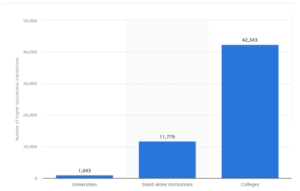
In a 2022 report by Statista, it was drawn that as of 2020, there were 1043 universities, 11,779 stand-alone institutes, and 42,343 colleges in India. 

Statistics published in LiveMint also suggest that the share of unaided private education institutes to the total number of education institutes has raised from 42.6% to 78.6% between 2001 to 2020. More than half of the institutes in India are privately owned and financed by private individuals. 

Positive Impact of Privatisation in the Indian Education Sector

In an over-populated country like India, privatization has helped reduce the gap between resources and made education accessible to all. A provider of education is a government responsibility, and a primary goal is to build a skillful population; without the availability of private higher education institutes, the government would have failed miserably at it.  

Also, since education requires more and more investment which may evade the fiscal power of the government, having private players in the industry helps them meet the growing demand for education and a variety of programs and courses. Economically speaking, privatization in the education sector of India has made a positive impact. 

Some of the few positives are: 

  • Increased accessibility of education even in the remotest locations. 
  • Decreased financial burden on state and central government. 
  • Generation of employment and income opportunities to educate youth. 
  • Teaching skills that are highly demanded in the current job market. 

Negative Impact of Privatisation in the Indian Education Sector

Although the privatization of the Indian education sector has relieved the government of its spending in the education sector, and the same cannot be said for the population. About 33.5% of respondents in the research responded privatization increased the cost of higher education. 

Private institutes are found to charge different fees to increase their income. Adding to the cause is systemic corruption in the government, allowing providing institutes to increase their fees, making higher education more and more unreachable to the poor and middle-income population. 

Quality of education is also under question, as most private education institutes are found to employ unqualified, inexperienced people based on caste, religion, and region. Inproficiencies such as poor language, subject, and character are very common in private institutes. 

Some of the few negatives are 

  • Poor infrastructure facilities lack basic amenities such as clean drinking water, hygienic toilets, labs, hostel, dormitories, libraries, etc.
  • Turned education into a business and profit-making commercial good in a materialistically-driven society. 
  • Turned education into a restless service, wherein exams, classes, and tests are held during holidays. Assignments and projects are an addition to the quality of education but a customary process. 
  • Cramming, assignments, and test writing do not give way to innovation and lifelong learning. 
  • Bad academic environment due to lack of support and cooperation from the management, staff, non-teaching staff, and subordinates.  
  • Partiality towards the students and favoritism are common in private education institutes. 

Concluding

There are both positives and negatives to privatization in the Indian education sector. The government’s initiative to promote privatization in higher education has helped increase access to education and was an economically viable option. But quality cannot be compromised in any way. It is important for the government to make strict rules about the infrastructure, facilities, staff, environment, accountability, results, and curriculum to ensure students get access to quality education and are growing vocationally, socially, mentally, and skill-wise.

Take a free demo session now!

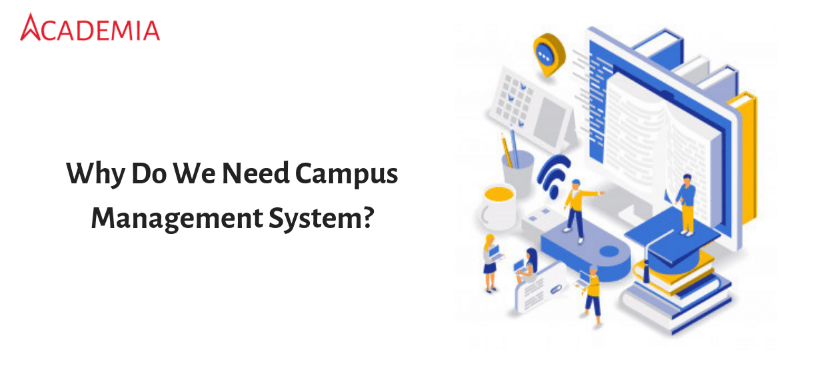
Why Campus Management Systems Matter in Higher Education

Growth and expansion in the technology domain are positively impacting the education industry. It is allowing colleges to become more sensitive toward the needs of the student and increase their outreach to improve profitability. 

In this blog, we would be discussing the role of college/campus management software and why you must consider getting one for your university. 

Campus management system

Rather than seeing tech adaptation as a choice, it is important to make it mandatory. The reason is the low efficiency, and opaqueness found in the system. Education being one of the oldest sectors, it is still governed in the traditional ways, meanwhile, other industries are thriving through technological innovations. After COVID-19, the perception towards technology has changed and now more and more institutes are adapting to it. 

Campus management software is an advanced technology toolset that allows you to digitally transform your college. It allows the monitoring and management of all internal and external tasks digitally through web and mobile applications. 

This allows you to improve transparency in the operations and improve efficiency across the college. Similarly, we cannot ignore the ease it brings to the lives of students and faculty. With dedicated web and mobile applications, they can perform academic and non-academic tasks easily. 

Significance of Campus Management Software in a College

A campus management system vigorously transforms all the operations and processes in your college. The main objective of Campus ERP software is to make operations speedy and bring down operational costs significantly. 

The software is loaded with features and functionalities that bring automation and transparency to all operations, be it – admissions, attendance, examinations, resource management, fees and receipt management, or even student record management. 

Some of the most significant features of the software solution are: 

  • A centralized database of student information

This allows easy sharing of student information in academic and administrative departments to perform various operations. The efficient database gives real-time updates if there is any change in the information and boosts decision-making. 

  • User-friendly and needs the least training

Although technology is usually confused as something complicated, these advanced technology tools are highly user-friendly. The modern solutions guide a user throughout the application and communicate to them at every point with in-app notifications to uncomplicate digital operations. 

Also, AI-driven chatbots, multi-language tools, and other solutions help a user shorten the learning curve and familiarize themselves with the software faster.

  • No communication gaps

Communication gaps between parents and teachers are huge. People cannot wait for a monthly or bi-monthly meeting to know the progress of their children. With parent mobile applications and dedicated parent web portals, there can be direct and faster communication between the two stakeholders. 

Also, communication is omnichannel. Meaning, you can communicate through SMS, in-app chat options, emails, etc. 

  • Profits and higher return on investment

Besides providing you with qualitative results, the software solution is a proven solution to reduce the cost of operations. This helps you in gaining more profit and improved return on investments. 

Concluding

College ERP software is one of the best things to happen to universities. Given the challenges after COVID-19, you can easily plan for countermeasures and execute profitable strategies to revive your business in the market. 

Education Is Wisdom And Wisdom Is Required To Modernize Education

Education is one of the greatest needs of the day. An upgraded and student-friendly curriculum which is also closely connected with the practical needs of the day is indispensable for the survival of the fittest.

The scenario of education has broadened in the past few years. Now…..it is no longer confined to the four walls of the classroom or for that matter four walls of the school itself. The education has evolved from the primitive times beyond leaps and bounds. From the era of Gurukul to the current era of international schools, education has gone through different phases of revolution. When we talk in the context of India, the transformation is quite evident. We earlier had only state-boards, ICSE and CBSE boards. Gradually the idea of public schools set in. The Gurukul evolved into day cum boarding schools where students experienced overall and holistic development. Globalization entered into the education industry as well. Foreign exchange programs, the Cambridge board, and the International Baccalaureate bridged the gap that existed on account of cultural differences. Education is another term for integration, an integration of thoughts, morals, cultures, and passions thereby making the world a better place to live in.

Education Modernization through ERP

Change as they say is the law of nature and henceforth this law is equally applicable to academics and education. It is for this reason that it has changed significantly with the change in time. The idea of education is not to make the students book smart thereby enabling them to earn a living but to make them street smart thereby preparing them to fit for life.

In the thoughts of Robert Frost, “vocation and avocation must be combined”. Vocation refers to the job and avocation is the hobby. The present-day education system intends to do the same. It enables the student to identify their latent potentials and passion for which they have a flair culminating them to integrate those passions into professions, which is what we call vocational education.

Being educated and being literate are two different things, although literacy being a part of education. When one gets literate, he safeguards himself, whereas when one gets educated, he safeguards others thriving in the same society. Education is a dynamic phenomenon where stagnation must never set in if we want to evolve over time. Modernization and up gradation are two accompaniments of education without which the academics would perish.

The success of any major phenomenon is evaluated in terms of the quality of output it generates. The same happens in education too. The number of students that have been successful in their endeavors has been consistently on a rise. So many new avenues of professions have been generated. One major branch for say engineering has emerged into so many branches further and the same has happened with other professions too. This is what we call specialization and it has created a buffet of professions where one makes his own choice. This is how education has helped and fostered the young generation to make wise choices. Education is wisdom and wisdom is required to modernize education.

5 Benefits of Adaptive Learning in Education | Academia by Serosoft

Adaptive learning is benefiting schools across India, being able to acclimate scholastic work to a student’s needs is highly effective. Technology is ever amending, as a result, adaptive learning principles are built into learning ecosystems to sanction students to gain from personalized learning at the point of need.

Here’re the top 5 benefits adaptive learning can bring…

5 benefits of adaptive learning in education - school erp

Students are more engaged – through learning technology, students learning experience is a lot fuller, for example, a student may be accessing their maths homework they may be struggling with a particular question. Through adaptive learning, students will be given more personalized content to avail them prosper, keeping them engaged.

Students can have authentic-time feedback – utilizing adaptive learning betokens students will get the feedback they require when they require it.

Sizably voluminous Data for Edifiers – utilizing cognition analytics, edifiers can understand more about the challenges the student is facing.

Reduces risks of students giving up – given the clever algorithms that are built into adaptive learning, students will be provided with learning resources to fortify them through the curriculum reducing the chances of them falling out.

Open resources – utilizing adaptive technologies – edifiers can embed learning resources such as Open Inculcative Resources for students to utilize. These are free resources that are available, and approved, by the school to fortify edifying and learning.

5 Signs You’re #ReadyforAdaptive

  • You’ve optically discerned prodigious variation in your students’ level of preparation for your course

You ken how this goes: your students are all at different calibers and you have to edify to the middle. What if you didn’t have to do that anymore? How much better would the cognition outcomes be?

Classroom materials with adaptive technology can provide extra support to the students who need it and sanction those who are progressing to advance at their own pace. You get to do what you do best: inspire a love of learning in each and every student.

  • You’re rushing afore spring break or at the terminus of the term to ascertain you cover all the material for your class

There is so much material to cover in a short duration and you can’t presage how expeditiously your students will grasp each concept. You may spend an abundance of time manually differentiating content and tailoring edifications to your students’ cognizance. And while you can act as a content curator and facilitate learning, as this utilizable piece from Faculty Focus explicates, technology avails you to do this efficiently.

Adaptive learning products, by definition, acclimate content for each student. This preserves your time so that you can genuinely edify, inspire, and avail your students to achieve mastery.

  • Your students are not as engaged as you require them to be

It likely has nothing to do with you. Perhaps your students aren’t prepared, are frustrated, or need extra support to understand your edification. (There’s an incipient study that examines an implement that measures the soundwaves of your classroom to better understand the amount of active learning.)

One of the benefits of adaptive technology is its facility to increment student engagement. Because an adaptive product utilizes an algorithm to accommodate edifications that meet students where they are, they become more engaged and yarer to focus.

  • You’re often surprised by the classes’ performance

Ever edify a class and the participation is great, students appear engaged and consummate their homework conventionally, but when they get to the exam, an astronomically immense number of students do poorly?

You’re not a mind-reader. By the time you assess the class, it might be too tardy to avail them where they are struggling.

Colleges are commencing to link data to sundry convivial and psychological factors to understand and further the likelihood of student prosperity. At a classroom level, learning technology that provides you detailed analytics about your students’ progress and erudition gaps can avail you tailor edifications in authentic time.

  • You have a plethora of prosperity when you work with a student one-on-one but can’t scale that experience to your entire classroom

If you could give each of your students your undivided attention, they would be far more liable to prosper. But, alas, you’re only one person and that’s just not sustainable.

The #1 advantage of an adaptive product is that it sanctions each student to get that one-on-one ordinant dictation that they require and that you opt to provide. This liberates you up to fixate on what you dote most about edifying.

Flipped Classroom Model: Benefits and Best Practices

In layman’s term, a flipped classroom refers to taking out the class from the classrooms. Flipped classrooms are recognized by students watching online lectures, collaborating in online discussions and carrying out research at home, unlike traditional classrooms where dependency exists on teachers or instructors.

Flipped classroom shifts the mode of instruction to a learner-centric model in which each of the topics covered in the classes are explored in depth thereby creating meaningful learner insights by leveraging technologies such as online videos to ‘deliver content’ outside of the classrooms.

In a flipped classroom, there exist many forms of content delivery. Teachers or Instructors can prepare and post the video lessons to deliver quality content to students. This helps students with convenient access to lessons any time, any place. Thus, helping in cutting down the investment of educational institutions in setting up an infrastructure.

classroom management with modern educational technology with academia erp

Having said this, it becomes all the more important for institutes to understand the benefits provided by the flipped classroom. Some of the key benefits of the flipped classroom are highlighted below.

  • The flipped classroom provides a more application-based approach for students when compared with the traditional classroom set up (i.e. hands-on and problem-solving activities)
  • Provides an ease of communication process between student-teacher, student-student with no location constraints
  • Video sessions/lectures can be easily recorded. Students have the luxury of seeing it with replays, can pause and replay it in case of any doubts. With features of video editing, the teachers/instructors can customize the lectures based on the student’s requirements
  • For small educational institutions facing budget constraints, a flipped classroom can be a boon for them. As this concept provides a great value at a minimal cost
  • Teachers/Instructors can help students during their assigned class time without an additional burden. They can coordinate with students/learners to guide them on the best path forward. Students can receive the help from faculties for various activities. Also, with this concept, teachers find it much easier to rectify students queries and problems occurring during the course of learning

Also, there are always two sides of the coins. With benefits, there do exist some cons and limitations of this concept. Some of which are highlighted below:

  • For students/learners, there always exists a ‘digital divide’. As some students will have 24*7 days access to online lectures/videos and some being able to access not more than an hour on a daily basis. This is due to that fact that not all students come from the same socio-economic background
  • It is highly possible that some students who are prone to the traditional form of learning may fall apart in competing with their peers as they are not prepared for the independent learning
  • Teachers/Instructors had to put in extra time and efforts for making the content and videos apart from their scheduled working hours. This, in turn, makes some of the teachers resistant to take up this concept

To sum it up, the flipped classroom is a concept which needs to be given a thought by the educational institutes and more important for the budget sensitive educational institutes to give a serious thought to it.

Why ERP Software Became a Compelling Necessity for Education System?

Obviously, it had to be. In this growing world and on the edge of the internet, automation is more of a necessity than a luxury. Its pretty much clear that imparting of education has also evolved in a matter of years, definitely for better. Ease of communication, the speed of the internet, and automation provided by ERP have been a big part of this. Let’s discuss further over it that how these essentials elements are helping create a difference in the world and specifically in education sector all over the world.

why erp-how education erp benefits-how to choose erp for your institute-best factors of ERPManagement has always been a complex task. Technology can improve institutional management to help deliver a better learning experience to students. The perfect ERP solution can simplify and improvise the process. Here are some ways in which one might benefit and a look at some of the potential challenges.

1. Centralization

One of the best factors of ERP is that it will help you create centralization of the information of overall institute or university. Access to data of overall institute at one single place brings inefficiency. Institutes have started shifting towards this kind of management systems. Education ERP software makes it possible to maintain and share all the stored data across various departments easily. Information can also be updated in real time by faculties, students, or institute staff members, and can be accessed from anywhere. In addition to that, information can be managed more securely with an enterprise software since it allows institutes to provide controlled access to stored information person to person according to their designations. Education ERPs can also help you centralize the management of data for resources like your institute’s library, accounting etc.

2. Resource Management

Managing resources for institutes and universities is a big task to be handled which can be easily done by ERP solutions. It can allow you to track all the utilities available in the institute and therefore keep a real-time overview on it. Most institutes report that by using Educations ERPs the functionality of task gets optimizes. Not only this, but the automated generated reports give a clear and transparent view of resources and hence will help in management really well.

3. Simplified Accessibility

A common platform for all students and faculties to share assignments, task etc and submission as well. Declaration of results can also be done through this platform which helps in the ease of mobile access. It can further make tasks such as student admission, fee payment, course enrolments and registrations faster and less cumbersome. A side bonus is that by eliminating a lot of the paperwork that is involved, institutes are cutting down on mailing costs. And finally, many educational ERP software support online payments making an institution’s accounting more organized and streamlined.

However, it is difficult for institutes to transform their manual processes to complete automation but honestly, that is what is needed for an institute to succeed as of now. These ERPs are definitely a big and thoughtful investment but surely should be chosen.
Get a free demo by clicking here ERP Software Demo.

How Student Registration Software Simplifies Admission Process?

Admissions, The most primary and important task for any institution! True? Every institution always looks forward to bringing the best and brightest students according to their fixed requirements. It is the time when institutions need to do various tasks that ultimately are responsible to bring the right candidates, and thus educational institutions put their utmost efforts to perform the admission process effectively. Do you want to make the admission process more simpler and effective in your institution? If so then student registration software can be one of the best options for you. 

What step does your institution take to complete an error-free, effective, and efficient admission process?

Management, as they say, is the art of getting work done tactically through the efforts of other people. Management is universal and all-pervasive. However, it has an extremely critical role when it comes to the Education sector. The education sector has expanded leaps and bounds. With the booming population, this sector is gaining grounds both for the students and for academicians. When it comes to managing an educational institute there are several complexities and vagaries that the educational institution has to face.

Let’s discuss how admission management can reduce various roles and responsibilities by changing the overall functioning of admissions in institutions.

Why should you opt for a student registration and admissions management system?

The student registration and admission management system is something that helps the colleges and schools to manage the overall process simply and efficiently. If you are looking forward to an automated, simple, and less time-consuming admission process, then a student registration and admission management system is the only best option you can opt for. Check out the below reasons to understand more about it.

Reasons to choose a student registration software:

  • Automation 

Institutions opting for student registration software and admission management systems can access a simple and automated version of their workings, using it you will not need to spend time collecting the forms, sorting them, and not even documenting the forms. The student registration software can do all the processes easily and effectively. Automation of the process will also help in finding and sending the acknowledgments, and making receipts as per the requirement.

  • Error-free and simple process 

Suppose a school is still following the traditional method for admission and a student filled incorrect information in the form, in this case, the management can never able rectify the error in any case, they just have the option of rejecting the admission of the student or calling the student to rectify the error, but if the same school is having a student registration software, the system will alert the student or his parents about the incorrect information or blank space. It not only helps in making the process error-free but also makes it much simpler and easy to access. 

  • Time-saving process 

Student registration and admission management system can help the institution, as well as the students/parents, save a lot of time. Students/parents will not need to wait queuing for long to collect and submit their admission forms, meanwhile, the management will also get the opportunity to complete all the processes with just a few clicks.

  • Reduces mental stress

Admission season is one of the most important time for any educational institution, so at this time the management and faculties put all their efforts to manage the admission process, but in all this, the management and faculties have to face various kinds of issues due to the long and complicated traditional education system resulting in mental stress for them, it directly affects the process bringing various errors and chaos.

Although, if your institute owns a student registration and admission management system they can automate the complete process simply and systematically reducing the paperwork and ultimately the mental stress of the manpower of your institution. 

  • User friendly 

Using an online admission process you get a bunch of advantages that we have discussed above, but most importantly a student registration and admission management system is user-friendly that eventually helps in making the complete admission process simple, effective, and worthy.

Why is Academia’s student registration and admission management system the best choice for you?

The student registration and admission management system designed by Academia is completely made to simplify and automate the entire admission process, it includes all the aspects that you just need to follow a smooth and proper admission process in your organization. Your institution can manage the smooth functioning of student admission forms, student fee receipts, scholarship receipts, managing the details of students for the long run, creating a unique username for the student, automation of attendance after the admission, batch allotment, proper records of academic years, and many more. 

Sounds interesting! Book a free demo now to learn more about the student information system by Academia from our team of experts. 

Back to top