Type your keyword below

SIS & LMS: What’s the difference?

In the modern scenario, the education ecosystem is expanding exponentially and educational institutions need to choose a technology that can bring differentiation, making all the operations systematic and efficient. But having varieties of EdTech tools and technologies institutions often gets confused among their usages and their meanings. 

Do you know the difference between SIS and LMS? Both these systems serve distinct purposes but record similar data to help teachers and administrators along with managing day to day operations. 

What is the Student Information System (SIS)?

A Student Information System is software that allows institutions to manage student data and information efficiently. It provides functionalities for all the academic and administrative operations like admission, enrollment, examinations, fee management, attendance record management, program and courses, and all the operations related to faculty and student life cycle. 

What is a Learning Management System (LMS)?

A Learning Management System (LMS) is software to empower learning and development in institutions. It helps in the documentation and delivery of all the courses, training programs, and learning and development programs of an institution. It promotes e-learning and teaching processes, automating and directing the processes. 

What is the difference between SIS and LMS?

Both LMS and SIS own administrative management functionalities, but none of them can replace each other’s functionalities to help the institution. Let’s discuss what are the differences between the two:

SIS LMS
1. The SIS helps universities, colleges, or schools to manage their academic and administrative operations in regards to students, faculty members, and the authorities. 1. The LMS enables the faculty to improve their relationship with the students in terms of learning and teaching.
2. It stores, manages and automates each process of the management. 2. It is used for the management of course resources – basically to enhance the classroom experience.
3. It deals with student admissions. 3. It deals with the knowledge and talents of prospective students.
4. It provides student enrollment and keeps program and course option choices. 4. It manages and enrolls classroom administration for students.
5. It handles examinations, assessments, grades, and academic progression. 5. It handles authorship for course materials.
6. It manages rewards, scholarships, qualifications, certificates, and graduations. 6. It handles the syllabus and certifications for each student in the class.
7. It provides complete financial aid for students and faculty members. 7. It does not always include financial aid for students to check.

Wrapping Up!

Hope you got a strong understanding of the differentiation between SIS and LMS. The SIS is a way you are thinking to manage all the academic and administrative operations of your institution effectively and efficiently. An LMS will function as an online classroom to manage your training if you provide lots of e-learning and corporate training. The SIS and LMS can work hand in hand to provide effective management leading to the growth and success of the institution. 

Want to know more? Let’s discuss it in more detail having more clarity for the same, contact us now!


5 things to keep in mind while buying a SIS

The COVID-19 pandemic disrupted the functioning of educational institutions worldwide. To continue the pace of learning and teaching, institutions have adopted various technologies like LMS, ERP, SIS, and various others.

There are various complications that institutions have faced while going digital during the pandemic, the academic and administrative tasks were affected and so were the learning and teaching methods. Institutions that have opted for Student Information System got the opportunity to manage and run everything smoothly & effectively. With the increasing times, institutions must adopt SIS to have better and more focused management in the institution having the best SIS. So, let’s discuss things to keep in mind while buying an SIS. 

Things to keep in mind while buying an SIS

A student information system is one of the most important and helpful technologies for modern educational institutions. Becoming the core of institutions, it can manage all the academic and administrative operations focusing on complete automation and digital transformation of institutions, but with the increasing technology usage, innovation, and automation, institutions must keep some necessary things in mind. Let’s discuss some of them.

  • Top functionalities and feature-rich SIS Software 

This is one top-most thing that you need to look for in a Student Information System, it should have all the fundamental functionalities for Universities, colleges, and schools. It is necessary to check the major features such as the efficiency of portals, mobile apps, and other technology tools provided. It should also need to be feature-rich in all senses leading to overall growth and opportunities for the institution.  

  • Flexible and adaptable (Configurability)

Institutions need to opt for Student Information Student (SIS) that provides huge scalability leading to adaptability. It should provide easy customization according to the needs of the institutions. It avails scheduling of students’ performance, standards-based grading requirements, and complete modification of the user interface. Institutions need to be able to create and consolidate any type of screen, page, and field in single or multiple groups of institutions to collect any type of data and information easily. 

  • Interoperability 

Interoperability for educational institutions is one of the important factors that allow the exchange and use of information systematically providing synchronization of all parts. It is considered as a component that attempts and addresses all the needs of institutions such as duplicate information in different areas and systems resulting in cooperation, development, integration, and the rendering of all the academic and administrative operations easily and efficiently. So the SIS you choose must need to have high scaling capabilities related to interoperability. 

  • Improved security & support 

Buying a cloud-based technology like ERP/SIS for your institution directly helps in keeping the system safe and managing your data security along with providing continuous support for all the tasks. An SIS having the right security mechanisms, and support customizations can help in improving on-premises and online academic and administrative support for institutions. 

A robust and securely improved SIS provides complete tech support to encourage overall growth in the institution. 

  • Business intelligence

Every organization needs business intelligence, whether it is a small business venture, a hospital, a small shop, or an educational institution. The institutions must opt for technology that helps acquire all the business intelligence from systematic academic and administrative management and cost-saving leading to high ROI, growth, and opportunities. In this technological world, automation and digital transformation of the institution can be considered as a good start for initiating business intelligence. So, it becomes important that you must choose an SIS that can lead to complete business intelligence in the best ways. 

  • Workflow coordination 

There are multiple departments in the institution, including various operations from admission, enrollment, assessments, examination, results, and a lot of others. Having manual intervention institutional management often faces a lack of workflow coordination that can be erased by having a Student Information System. A feature-rich and flexible student information system can help create efficient workflow coordination among internal and external departments of the institution. 

Hope you got to understand how a good, flexible, and efficient ERP system is important for your institution. There are various ERP vendors available but it is a bit difficult to find a good one that can help in accomplishing the above-discussed objectives. Academia is one of the best, leading, and cutting-edge student information systems that are focused to bring automation in every single operation of the institution. 

What’s Next! 

So, what are your opinions about buying a student information system, what are the features that you must think can be in your system? Let’s discuss it now! Contact us now or Request Demo!

Download Exclusive Gartner Reports Brought to You by Serosoft (Academia):

Role of Student Enrollment Management System in Higher Education Institutions

Configuration of Enrollment Rules

Use the enrollment management system to configure the entire admission process. This includes defining admission criteria, selection process, admission stages, stage fees, important documents, seat number & seat type, and more. 

Once configured, the system would behave as per your set rules and would ensure the process is followed. Also, many steps in the process would be automated and would require minimal to no manual intervention. 

Enquiry Management

Set up an online enquiry form on your website, centrally manage each enquiry on the enrollment software, assign enquiries to users, schedule follow-ups, convert enquiries to applications, close enquires, reopen enquiries, generate reports on enquiries, follow-ups, enrollment, admissions, etc., and do much more with one single tool. 

Online Application

Use the software to set up custom application forms for various programs, courses, and batches. As per your pre-defined criteria, applications can automatically be rejected and all you get is qualified applications to work with. 

Real-time Application Tracking

Track applications at any stage of the application process and assist your prospects better. The software provides you with a real-time report on the status of every application and helps you take better decisions. The software also comes with in-built features to take actions for any application such as — promoting to the next stage, collecting form fees, collecting stage fees, rejecting applications, releasing offer letters, and more. 

Merit List Generation

The enrollment management software streamlines the process of document verification, promoting applicants to the next admission stage, consolidating data and creating a merit list for various rounds, and finally generating a master list of students that are to be sent an offer letter. 

Download Exclusive Gartner Reports Brought to You by Serosoft (Academia):


Lead Management Integration

An enrollment management system is efficient in tracking enrollment enquiries from multiple sources. You can also use the software to run and manage campaigns over various channels, track ad spends, and calculate impact by generating reports on enquiries, enrollments, admissions, and follow-ups. 

Also, robust application and enquiry management software helps in the seamless management of the lead and guides an applicant throughout the lead pipeline for easy conversion and improved enrollment rate. 

Unlocking the Potential: Experiential Learning in Education Automation – Advantages and Disadvantages

In today’s dynamic educational landscape, the demand for effective learning resources is paramount. Explore the advantages and disadvantages of experiential learning, a method vital for institutions leveraging education automation, and education ERP solutions. Let’s delve into the intricacies of this transformative approach.

Understanding Experiential Learning

Experiential learning, centered around hands-on experiences, propels students to learn by doing. This process, combining self-initiative and self-assessment, is amplified by hands-on technology and innovation. In both traditional classrooms and online learning environments, students and teachers benefit significantly from experiential learning opportunities.

Advantages of Experiential Learning:

  • 1. Real-world Experiences:

              • Students engage with data and concepts through hands-on tasks, fostering a deeper understanding and retention of information.

  • 2. Creativity Unleashed:

              • Encourages creative problem-solving, equipping students with innovative solutions to real-world challenges.

  • 3. Accelerated Learning:

              • Implementation of learning points creates a lasting impact, developing problem-solving and decision-making skills.

  • 4. Theory-Practice Integration:

              • Merges theory and practice, providing students with opportunities to apply knowledge in real-world scenarios.

  • 5. Learning from Mistakes:

              • Embraces the value of errors, allowing students to iterate and refine their approaches, turning mistakes into valuable learning experiences.

  • 6. Career-oriented Focus:

              • Guides students towards their future careers by aligning learning activities with real-world experiences and activities.

  • 7. Communication Skills Enhancement:

              • Fosters teamwork and collaboration, bridging communication gaps and promoting effective communication skills.

  • 8. Visible Accomplishments:

              • Promotes a feedback loop that accelerates learning, enabling students to see tangible improvements in a short span.

Disadvantages of Experiential Learning:

  • 1. Patience and Guidance Required:

              • Demands patience and guidance as students experiment with various methods, requiring time for results to manifest.

  • 2. Decentralized Process:

              • Considered a decentralized process, as students access and submit assignments online, limiting faculty access through traditional modes.


Conclusion:

Embrace the power of experiential learning with online tools and technologies, revolutionizing knowledge acquisition and skill development. If you’re considering implementing experiential learning activities in your institution, Academia ERP offers a suite of tools, including a student information system, enterprise resource planning, and more. Contact us now for further information and personalized assistance. Your journey toward transformative education begins here!

Contact us now to explore how Academia’s suite of tools can enhance your institution’s educational experience and seamlessly integrate experiential learning into your curriculum. Take the first step towards a transformative educational journey!

A Guide To Choice Based Credit System

The education ecosystem is changing rapidly, there are various changes and one of them includes a Choice Based Credit System (CBCS). This grading system changes the traditional teaching-learning system in India. 

To maximize skill-based education & enhance student learning outcomes in terms of their grades as well as skills, the National Education Policy has made some crucial changes in the traditional teaching-learning system in India. The right to choose subjects & the multidisciplinary education approach are the best takeaways. 

Do you know what a choice-based credit system is and how it can help higher education institutions? Let’s discuss it in this blog:

What is a Choice-Based Credit System?

The CBCS is a University Grants Commission (UGC) initiative and promotes the liberalization of the current conventional higher education models. With a student-based approach to learning or acquiring higher education, the CNCS allows students or learners the flexibility to choose their course from a list of elective, core, and soft skill courses.

A credit system for higher education measures different parameters like –

  • Student performance
  • Learning outcomes
  • Entrepreneurship skills
  • Contact hours
  • Innovation
  • Creativity & talent

UGC has categorized the groups as

  • Core Course – Core courses are there every semester and students have to compulsorily study the core or the main subject to meet the requirement of the program of that particular discipline.
  • Elective Course – Here, the student can choose any paper
  1.   Discipline-Specific Elective Course
  2. Generic Elective
  3. Project
  4. Ability Enhancement Courses
  5. Skill Enhancement Courses
  • Foundation Course
  1. Compulsory Foundation
  2. Elective Foundation
  3. CBCS moves away from numerical marking to grading semester-wise with two semesters in a year where students’ performances are evaluated and grading is done subject-wise.
  4. The CBCS works in compliance with other grading systems of institutes, all over the world.
  5. Different evaluation methods are followed, based on the suitability of the course approved by various legislative bodies.
  6. UGC recommends Letter Grades and Point Grade Systems to be applied
  7. Letter Grades are based on a student’s marks or percentage from his/her course
  8. Grade Point Systems are where marks are converted into grades based upon a fixed period.

What are the Features of CBCS?

Having multiple features of the Choice Based Credit System (CBCS), let’s discuss a few of them:

  • It is one of the best features as credits can be transferred if the student changes his/her branch of study
  • It has changed numerical marking to grading
  • It positively stigmatized the criteria of failing students
  • It facilitates student mobility
  • It provides potential assess to faculty members for student’s performance
  • It promotes easy course evaluation and is accessed to provide an effective and balanced result.

How Does CBCS Work?

The CBCS in higher education works on the simple principle of the choice being in students’ hands. Higher education institutions provide subject options to students, with a CBCS, students can choose subjects according to their choices and the credits needed for a particular semester. 

The students can attend any of the needed classes obtaining credits to pass any semester. 

A CBCS owns the following elements:

  • Semesters

In any educational institution, assessments are done semester-wise. A student progresses based on the courses taken rather than time like three years for science, arts, commerce, or four years for engineering, etc. The CBCS format provides flexibility in creating the curriculum and assigning credits based on the course section and patterns of learning and teaching. 

  • Credit system

Each course is assigned with a fixed credit. When a student passes a course, he gets the recognition of credit which is based on a course. If a student enrolls in a single course in a semester, he does not have to repeat that course later. 

  • Credit transfer

There are various ways for a student to cope with the study load and with a CBCS pattern he owns the freedom to study fewer courses, earn fewer credits and compensate for the next semester. 

  • Comprehensive continuous assessment

It provides a continuous evaluation of the student to the faculty members and also to the student himself. 

  • Grading

CBCS includes grading in a 10-point grading system. 

It includes

O (Outstanding): 10 

A+ (Excellent):9 

A (Very Good): 8

B+ (Good): 7

B (Above Average): 6

C (Average): 5

P (Pass): 4

F (Fail): 0

Ab (Absent): 0

Core Advantages of CBCS that Academia Modules Includes:

  • The student has a choice of inter/multidisciplinary courses:

With Academia, the students can select their inter/multidisciplinary courses in just a few clicks using the program and courses modules. Academia provides easier access to all stakeholders in the institutions starting from the faculty members, students, and parents for selecting, scheduling and finalizing the courses and subjects likewise. 

  • It promotes group work, research, examination, and assignments 

Using Academia modules like examination, assignments, and others, institutions get the authority to work effectively, research, and manage examination-related tasks and assignments, and more easily and efficiently at all levels like faculty members, students, and parents. 

  • Students progress at their pace

Students are the most important stakeholders of any institution, it is important to provide them with the best and Academia provides them with all the student databases provisioning, storing, and organizing all the student-related data and information. It can easily access, edit, or update data if needed.

Conclusion 

The implementation of the student-centric CBCS system is beneficial for institutes. Academia ERP, which provides the most reliable and trusted solutions to educational institutes, has inbuilt functionality to support the rollout of the CBCS for educational campuses.

How Higher Educational Institutions (HEIs) are set to transform due to NEP 2020?

The National Education Policy of 2020 is a revolutionary step taken by the Indian government. The policy is envisaged to change the current working of Higher Education Institutes in India and allows students to choose multiple disciplines as per their preference at every stage. 

Higher education in India is widespread. It is partially digitalized and has responsibly transformed the country into a knowledge hub and made it a knowledge economy. 

The National Education Policy (NEP) 2020 is based on five fundamental pillars – access, equity, quality, affordability, and accountability. It is designed to change the current education system

with high-quality knowledge resources and skill-based education.  It also primarily focuses on integrity and promotes equality in participation in varied disciplines, irrespective of what social and economic background they hail from.

What is the New National Education Policy?

Through this new education policy, the government of India aims at bringing more than 2 crore students into proper learning. It is projected that this crucial step would allow the government to achieve 100% GER (Gross Enrollment Ratio) in preschool, secondary, and higher education institutions by the end of 2030. 

These attempts are to prepare India to become a “global Knowledge Superpower”, by making the education ecosystem of India more flexible, holistic, and multi-disciplinary in line with the global skill demand. 

Let’s look at the major reforms the NEP 2020 is set to bring in for HEIs in India –

  1. Opens entry for large education institutions

As mentioned earlier, one goal of NEP 2020 is to increase the Gross Enrolment Ratio in higher education in India, including vocational education from 26.3 percent in 2018 to 50 percent by 2035. As per the NEP, 3.5 crore new seats will be added to higher education institutions. The NEP proposed multi-disciplinary, holistic undergraduate education. The Policy is focused on supporting skill education and streamlining educational planning, administration, and management at all levels.

The primary focus of NEP 2020 in Indian higher education is to transform HEIs into 

(a) Research-Intensive Universities (RUs)

(b) Teaching Universities (TUs)

(c) Autonomous Degree-granting Colleges (ACs)

This goal has to be achieved by 2040. 

According to reports, India needs an additional 1500 HEIs to encourage and accommodate more students. The policy proposes the setting up of large and foreign universities. It seeks to promote India as a global destination for quality and affordable education. It will allow high-performing Indian universities to set up campuses abroad while allowing ‘select’ universities in the top 100 in the world to operate in India. This would promote healthy competition among Indian HEIs. 

  1. Promotes Liberal & Flexible Education

NEP 2020 is designed to generate interest among students in the specialized area of research. This will lead to discoveries and acknowledge the importance of invention and scientific outcomes.

Arts and Science streams will not be separated strictly, as well as curricular  & extracurricular activities and vocational & academic qualifications. This is meant to promote a holistic and very versatile learning environment that will nurture open-mindedness and build well-rounded individuals. 

A revolutionary introduction in the Indian context is the freedom for learners to learn at their convenience. The new policy gives flexibility to students to choose from a variety of subjects and move out with a certificate, diploma, or full degree, depending on the number of years spent on the course. It gives students multiple entry and exit points in degree programs, which further encourages lifelong learning philosophy. 

An Academic Bank of Credit will be introduced which will store the academic credits of students earned from different HEIs digitally and these credits will be counted towards the final degree earned.

The policy has also asked HEIs to do away with high-stake examinations and bring in a continuous and comprehensive evaluation system. 

This reform is meant to help the students to nurture their creativity and critical thinking by motivating them to follow their passion in their chosen field. This will completely change the business models of HEIs in the future, along with their curriculum and delivery methods. Technology will be the integral support that will help in this seamless shift. 

  1. Eases Regulatory Structure

According to NEP 2020, there would be one common regulator for all HEIs in India -National Higher Education Regulatory Authority (NHERA). By eliminating the multiple, overlapping regulators, NHERA will create various verticals and cater to different disciplines and simplify degrees or diplomas. This change will ease the regulatory burden of HEIs and will allow them to focus more on their core role of imparting knowledge. The single regulatory system would provide autonomy to HEIs, which is crucial to innovations in education.  

Initiating a New Education Policy in 2022: Key Highlights

  • The policy emphasizes providing quality and affordable education to all students between 3-18 years of age group all over the country.
  • It also focuses on using technology in education to make it more accessible and effective.
  • The focus should be on online learning to ensure the highest quality education for students. As part of the new system, e-learning will be expanded to include online courses, which will allow students to study from anywhere and at any time.
  • It also promotes holistic and multidisciplinary education replacing rote learning.
  • The curriculum in India has been updated to incorporate more concepts and vocational education.
  • The policy seeks to provide vocational and technical education to students so that they are equipped to enter the workforce.
  • This policy introduces a new 5+3+3+4 education structure replacing the current 10+2 system.
  • The policy aims to increase the Gross Enrolment Ratio in higher education to 50% by 2035.
  • According to NEP, learning should be holistic, joyful, stress-free, and a lifelong process.

Conclusion

A change in the Indian higher education system was long overdue, and NEP 2020 marks a bold move away from the long-standing and established rote and herd learning practices in India. 

While the NEP 2020 aims at improving the operative environment for HEIs across India, it reveals the government’s intent to restrict the commercialization of higher education in India.

The NEP reforms introduced in the Higher Education System are set to result in – 

  • Institutional restructuring and consolidation
  • A holistic education eliminating rote learning
  • Internationalization
  • Teachers training
  • Professional education
  • High-quality research
  • Quality universities and colleges

Changes in the overall ecosystem will bring new challenges for educational institutions, staying updated with the latest developments can help educational institutions to address these challenges. For this, a higher education ERP or SIS can help institutions bring digital transformation and automation, you can also schedule a demo now!
A Checklist To Safeguard Your Institution’s Data

Today, data protection is one of the biggest challenges in the education sector with institutions being prone to vulnerabilities and frequently falling victim to massive data breaches. However, a checklist to safeguard data can help improve the overall security and prevent incidents of major data breaches from compromising their reputation.

Higher educational institutions and Schools are data treasure-troves as they often collect and process personal and confidential information about their prospective and enrolled students, alumni and staff. From personally sensitive information like addresses, health records and payment information, these institutions often run extensive networks across different campuses, with thousands of students and staff accessing their online portals through different devices at any time of the day or night. Hence, educational institutions are at high risk of having their data breached. In 2019 itself, Stanford University, education software developer Pearson and Georgia Tech have all suffered data breaches, with Georgia Tech alone having 1.3 million of their records exposed.

While educational institutions are required to take active measures to safeguard their data from unauthorized access, here is a checklist of how Academia can help institutions to protect their data and records.

– High scalability

Scalability in an ERP software is very crucial as it manages an institution’s growth by streamlining operational performance and maximizing productivity. Academia ERP (SIS/SMS/TMS) is highly scalable and can handle the increasing volume of data and the requirement of securely adding new users. The software is a robust solution meeting every expectation of a growing institute or chain of institutes.

This scalability offered by Academia solutions is beneficial for an institution as it allows the institute to focus on its growth and not the challenges associated including compromising on the security while handling huge volumes of sensitive and confidential data.

– Superior flexibility

Academia ERP(SIS/SMS/TMS) can be customised and configured as per the taxonomy of the institute. This allows for a personal touch to the terminology making it easier to interpret and allows even a non-technical person to operate the software easily without relying on technical help. The configuration features could also help to add extra functionalities as needed.

This superior flexibility from Academia makes an institute technologically advanced, future-ready and self-reliant. Academia SIS offers complete and detailed campus management solutions that improve an institution’s productivity, workflow efficiency and boost high ROI by streamlining administrative processes with automation. Academia’s MIS is highly configurable and scalable, aiding institutional growth. It provides data analytics with detailed reports for every department as required. 

The ease of use and familiarity of taxonomy results in lower incidents of human error, one of the major causes of security lapses.

– Diverse Reporting 

The diverse reporting in Academia ERP(SIS/SMS/TMS) offers dashboards for the administrators and for a range of user roles, which is extremely helpful to disseminate information faster from the existing data. It also offers visual aids with graphical representation like pie charts and bar graphs with consolidated data. With diverse reporting, it is easier to find student details year wise, their academic performances, extra-curricular activities, and all other activities. This helps in optimising time and resources while ensuring that reports are seamless and easily accessible in the most secure way. 

Academia’s diverse reporting helps to make more informed and data-driven decisions in the quickest and most hassle-free way. There is no time wasted in going through uncountable files for little details. It is a crucial tool to gain powerful insights into student data smartly and safely. 

– Cloud Enabled 

Cloud computing has become an essential aid for universities, colleges and schools for content delivery, communication and collaboration. The need for servers, storage and software have become essential to share resources, software and information, to computers and other devices.

Cloud computing also dramatically reduces the time, money and infrastructure that educational institutions need to reach out to new markets. The institutions achieve efficiency in operations with centralised control with students becoming more engaged with the available options and teachers focussing more on learner requirements instead of mundane admin tasks.

Academia’s products are cloud based, which helps to reduce risk and enhances data security. The cloud security not only helps the IT teams to recognise and remove risks in the system, but also enables them to create consistent security policies in all the branches of the institution.

Conclusion:

Finally, with the number of cyber attacks on the rise, data security has become a prime concern for educational institutes. Academia ERP software are built to work around huge volumes of data which are easily accessible by those who require to use them, yet with the tightest security possible. There are multi layers and types of information security control to combat abuses and breaches of security, at every level. To know more and learn about how Academia’s customised ERP solutions keep your data safe, among other benefits, please book a demo by clicking on ERP software for educational institutions.

Online only universities in UK – Technology to the rescue

As universities in the UK shut down due to COVID 19 in March, students had to move online to attend live-streamed lectures and swap practical group work for remote assignments. In an attempt to deal with dwindling scholarships, travel restrictions and redefined visa rules, many prestigious universities have moved their courses online. Here is a look at how universities are adapting to a new norm, while using technology for remote learning.

With the pandemic calling for social distancing, it is likely to disrupt normal life for a long time to come. Hence, universities in the UK have shifted to offering online only classes. Leading the pack in the shift to online courses is the prestigious University of Cambridge, which will begin their online only academic year 2020-2021 from October 6. The university announced that it will move its entire course online for the 2020-21 academic year, scheduled to begin on October 6.

The University of Manchester has moved online for the upcoming autumn term with Cardiff University also moving most of its classes online after the summer break. Despite moving online and not being able to offer the intercultural experience that international students seek, it is also believed that top universities like Oxbridge etc will likely be able to attract and retain international students with the UK University degree tag.

In the last few months, there has been totally unexpected changes in the world which should be looked upon as an opportunity for universities to adopt people-centred technology and bring in digital transformation. Today, it can be safely said that the universities meeting this challenge will be the ones to thrive in the future. These universities need to adapt and expand their digital platforms to offer what students really want. The next step would include collaborating with tech companies to create affordable modular online course options, accessible to all.

Universities moving online will have to compete with new formats, including coding bootcamps like Le Wagon, Codeworks and Northcoders which offer quicker, cheaper courses in subjects like web development and data science with in-built industry connections. However, moving online also comes at a cost, Hence, universities in the UK will make sure their investment in digital transformation will be for the long term, especially when they had been lagging behind universities from other countries for years.

Modular Courses

The success of online learning has been experienced with institutes such as The Open University. In recent years, universities like Oxford, Imperial and UCL have also started experimenting with free MOOCS (Massive Open Online Courses) through FutureLearn with a paid upgrade option. These courses have proved to be highly popular with their affordability and accessibility and a degree from an internationally recognised University.

For online courses, the focus today has been moving towards modular courses or even short courses that can be availed from home, to match career choices. Here, technology makes these courses available with excellent existing programmes. For example, Zoom or Microsoft Teams platforms are being used to record sessions and provide apt online support for students. Workshopping technology like the whiteboard tool Miro is a great visual way of showing work. Augmented Reality which already existed in the gaming industry is being adapted to play a part in more practical courses.

Modular learning programmes allowing to pick and mix from different courses is likely to be the model going ahead with students having their virtual shopping baskets filled with the best modules according to their needs instead of signing up for a degree or a higher education programme irrelevant to them. 

Going ahead

The growth and adoption of education technology started even before COVID 19 with global edtech investments reaching US$18.66 billion in 2019 and the overall market for online education projected to reach $350 Billion by 2025. But with COVID 19, there will be a rapid rise in usage of online technology whether it was in language apps, virtual tutoring, video conferencing tools, or online learning software.

Practically, it may look like the future of UK universities is in mixing online curriculum and offline experiences, which is known as blended learning. This will enable social distancing on campus and enhance the experience of studying. Interestingly, some innovative UK universities such as the University of East Anglia (UEA) already offered blended learning even before COVID 19. 

With a consortium of 10 universities led by Coventry recently awarded £3.7m to develop partly online postgraduate conversion courses in artificial intelligence and data science, a lot of universities are taking the online route. The pandemic kickstarted a lifelong online learning agenda which will also skill up employees whose jobs will become automated in the future.

Finally, elite universities will have the advantage of their name and reputation to continue trading on, but for many other universities that bring in students because of location or for a specific course, the future depends on identifying other differentiators to bring in students. Future learning will hence be more about the quality of the learning experience and how geared up universities are to teach remotely in an innovative way using various technologies. 

To get the full benefit of online classes, there is a specific need to go beyond just replicating the physical class through video capabilities and instead, using different collaboration tools and engagement methods which promote inclusion, personalisation and intelligence. With an abundance of ready to use content available across different digital media to enable capability building and meet targeted challenges, Universities will need to use well-designed digital tools for sharing knowledge and support information. The role of technology in online learning will have to be explored to its full potential.

7 Emerging Technologies that are Reshaping Education

In the field of education, emerging technologies are revolutionizing the learning process for students by enhancing the way students, teachers and institutions work. Technology has changed the world and cutting-edge technologies  are reshaping education in innovative and unimaginable ways. Students are getting the opportunities and unique experiences they need and deserve as emerging technologies promise to deliver exciting new resources for learners.

Let us take a closer look at the seven emerging technologies that are earmarked to make major waves and reshape education.

1. Augmented Reality & Virtual Reality

Mixed Reality and Simulations are pathbreaking experiences for learners and teachers too. AR, considered as one of the best emerging technologies in the world, can be used by educators in innovative ways to make lessons interesting and interactive. AR is useful in overlaying interactive digital elements to give real time experience and for promoting skills like creativity, critical thinking analysis and problem solving. AR promises to help learners capture their dreams and imaginations and take learning to the next level.

Virtual Reality, the next big thing in education, enhances student learning and engagement by cutting across all barriers and immersing students in what they are learning and helping them to process information better.

learning and helping them to process information better.

2. Artificial Intelligence

Artificial Intelligence (AI) in education is already transforming the way curricula are implemented in schools, with innovations that would have been impossible a few years back. AI applications have made the academic world more convenient and personalized. One of the key impacts of AI from kindergarten to graduate school is the different levels of individualized learning with adaptive learning programs, games and software, where students can work at their own pace.

AI aims to reshape education by supporting the sharing of first-person perspectives which will be useful for students research. From artificially generated content to image recognition and smart tagging systems, AI is also automating basic activities like grading homework and tests as it takes up a lot of time for teachers. While human grading may not be fully replaced, AI can help in providing detailed analysis of student performance in exams, and help in grading to a certain extent.

AI has resulted in automation of administrative jobs, saving time for educators.

3. 5G Technology

5G is the fifth generation of wireless technology which promises high speed and low latency wireless technology. 5G is meant to change the way educational institutions interact with much quicker downloads and increased efficiency and expanding the scope of connected devices and technology within the classroom.

Some universities have started implementing IoT integration for higher education where lectures and discussions on specialized topics can be conducted through virtual reality experiences. Seamless connectivity will bring in better engagement which will be a big boon for international students, along with faster downloads of files and resources and more powerful networks. 

Interestingly, 5G was supposed to be launched in India in 2020 and would have been extremely beneficial for students learning from home during the COVID-19 pandemic. However, things didn’t go as planned and the launch has been pushed to mid 2021.

4. Internet of Things

The Internet of Things (IoT) has tremendous potential to create smarter and connected schools and is already impacting the education sector by making learning simpler, faster and safer. IoT can save energy and lighting, and sensors across the campus can track traffic and the strategic positioning of security features like lighting would help students and visitors too.. IoT can help break the usual barriers to education like language, location or certain disabilities, besides helping everyone with bottom-line solutions.

5. Adaptive Learning

The Adaptive learning technology provides learning activities to students, based on their needs and learning style and behavior. It helps students with unique learning paths that are based entirely on their interests and learning ability. 

It can play a huge role in the educational system as it uses computer algorithms to orchestrate the interaction with the learner. Although this technology originated from AI, it actively caters with individualized resources and top learning activities to take care of the special needs of a learner.

6. Learning Analytics

When it comes to the process of learning for students, it needs efficient tracking and analyzing to understand results better. This is essential to bring about improvement which is a very important factor in education to improve the learning experience of every student. The learning analytics technology helps teachers to better record the learning rate and behavior of students so that teachers can provide targeted improvements to courses.

7. Blockchain

The Blockchain technology which has changed every industry dynamically, can prove to be very useful in the education sector as well. It is especially useful to collaborate around distributed information in a database. Blockchain can help in examination management, verifying student credentials, verifying certificates, managing life-long learning records etc. Besides effective analyzing and tracking, it can help teachers provide targeted improvement for courses and help students deliver enhanced results.

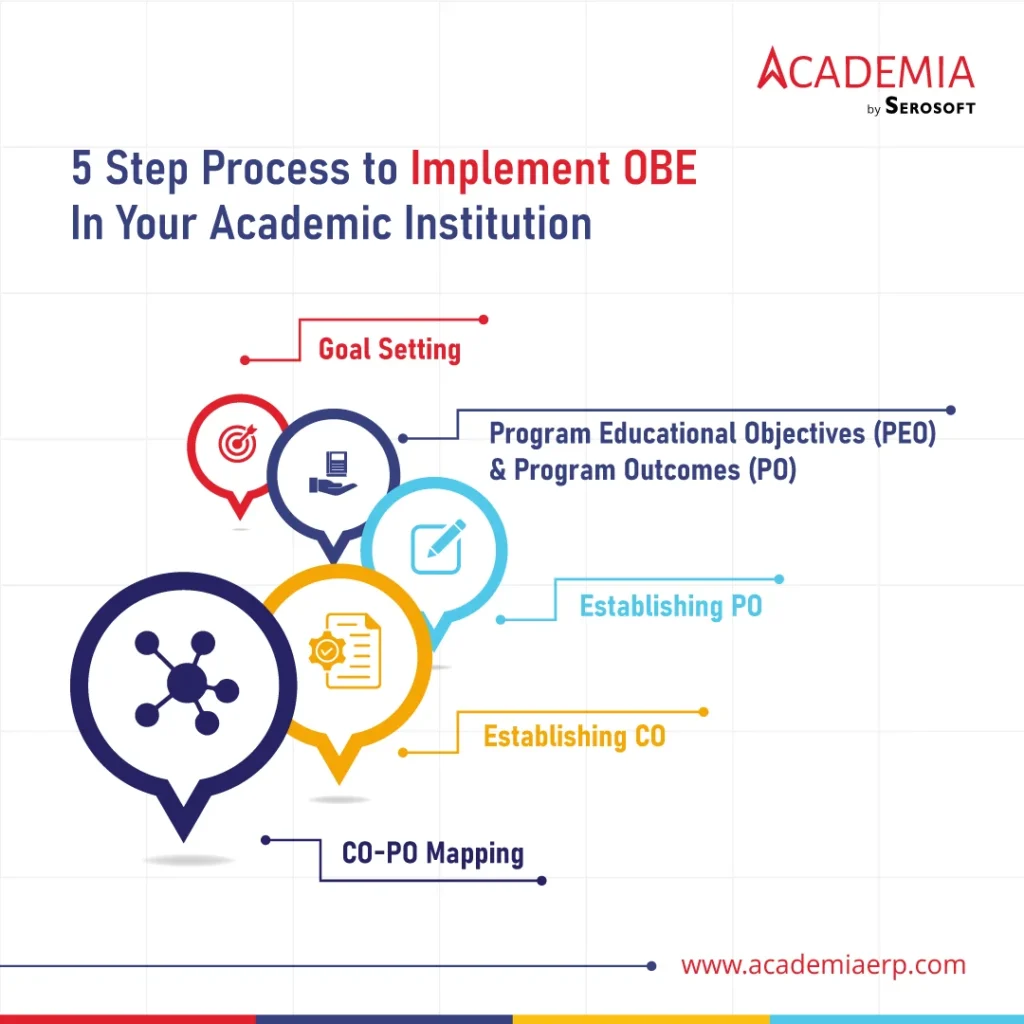
5 Step Process to Implement OBE In Your Academic Institution

Outcome-based education or OBE is the latest development in the education industry. It is a type of education delivery model that focuses on mapping, measuring, and achieving pre-determined educational goals. It prioritizes student learning and development by nurturing the pre-existing skills in students to help them grow in their professional and personal life. 

Clearly, it is a major leap from the existing education delivery model where a lot of time and effort is spent on scoring good marks in examinations rather than skill development and knowledge acquisition. OBE thus can help you change that, and provide a definite solution for the increasing problems such as unemployment, skill alignment as per the global market standards, and more. 

If you are thinking about implementing OBE in your education institute, here are some tips to successfully implement it, and ensure better student outcomes.


Outcome-based Education Process – Step By Step OBE Implementation

  • Goal Setting 

First and foremost, it is imperative to set short-term and long-term goals for individual students in terms of learning outcomes, personal growth, skill development, and institute overall performance. Institutes can follow the given steps to define vision and mission department-wise. 

  • Start by brainstorming with experts and experienced faculty of various departments
  • Speak with industry professionals and alumni batches
  • Analyse the opinion and define a solid plan of action 

Once the vision and mission are clear, the institute needs to focus on teaching and learning processes.

  • Program and Education Objective and Program Outcomes

Program Educational Objectives help teachers define the expected outcomes for the students once they graduate, this includes academic and behavioral aspects both that are absolutely necessary to excel in their career. 

  • The vision and mission set in the first step should be central to the action plan.
  • Experienced faculty members and the heads of various departments must draft and share it across their respective departments. 
  • The draft and processes need to be implemented and discussed thoroughly for gaining the approval of authorities. You can iterate the draft to prepare a final draft. 
  • Once the final draft is ready after taking all the considerations of people involved in the implementation process, it is presented to Program Assessment Committee so that it can further be forwarded to Departmental Advisory Board. 
  • The Departmental Advisory Board reviews the points mentioned in the draft and sends them to the Board of Studies & Academic Council for final approval. Once the approval comes in, the draft is taken as a guide to design a fresh curriculum for the students to grow personally and professionally. 
  • Institutions need to analyze the student learning outcomes periodically to identify the learning gaps and rectify them. It is usually focused on Professional Skill Development, Problem-Solving Skills, Industry-Specific Skill Development & Creative Enhancement. 
  • Establishing Program Outcomes 

POs or Program Outcomes are defined as the objective achieved at the end of the specialization or discipline. These attributes are defined while a student is undergoing education and determined when they get a degree. 

Here is a step-by-step approach to establishing the POs for the institution. 

  • The Program Coordinator consults with the senior faculty to prepare a draft for program outcomes. 
  • The Coordinator speaks with alumni, industry experts, and various employers to understand the skill requirement and new trends in the industry. On analyzing the views, a synthesized version of the draft is created and sent to the Program Assessment Committee. 
  • The Program Assessment Committee reviews the draft and sends it to the Department of Advisory Board to get the final approval from them. 
  • Department Advisory Board makes the final decision by moderating the draft.
12 Graduate attributes mentioned By the National Accreditation Board In Their Guidelines to attain POs successfully
PO1 Knowledge PO7 Environment
PO2 Problem Analysis Capability PO8 Ethics of Individuals
PO3 Development & Designing of System PO9 Teamwork & Individual Contribution
PO4 Analyze & Solve Complex Problems PO10 Communication
PO5 Use of Latest Tools & Devices PO11 Finance & Management of Project
PO6 Society’s Responsibilities PO12 Life-long Learner
  • Establishing the Course Outcomes

Course Outcomes are different than Program Outcomes. The objective of CO or Course Outcome is to define the objectives that are achieved at the end of a semester/year. It is basically the outcome that is achieved in theory and practical lessons concluded at the end of the year or semester.

  • CO-PO Mapping Process

To thoroughly analyze if a student has successfully achieved the goals set at the beginning of the process, it is important to map Course Outcomes with Program Outcomes. To do that, follow these steps: 

  • Specify and obtain the course outcomes
  • Map COs with POs
  • Set an appropriate weightage for the CO assessment
  • Measure the COs through assessment given to students
  • COs & POs attainment calculation needs to be done. 

Concluding

Outcome-based Education can help you stand out in the education market and offer a quality education. But for that to happen you must have a great implementation strategy on your hands. Use the above-mentioned steps to achieve successful implementation of OBE. To assist you in your course toward redefining education consider an ERP solution that offers process streamlining, simplified processes, better results, easy CO-PO mapping, and more. Explore the Academia ERP OBE module here. 

Back to top