
Webinar Alert: What Nobody Tells You About AI in Higher Education | Thursday | 8th Oct 26

X

Type your keyword below

Student Information System in UAE: How Universities Manage Student Data and Administration

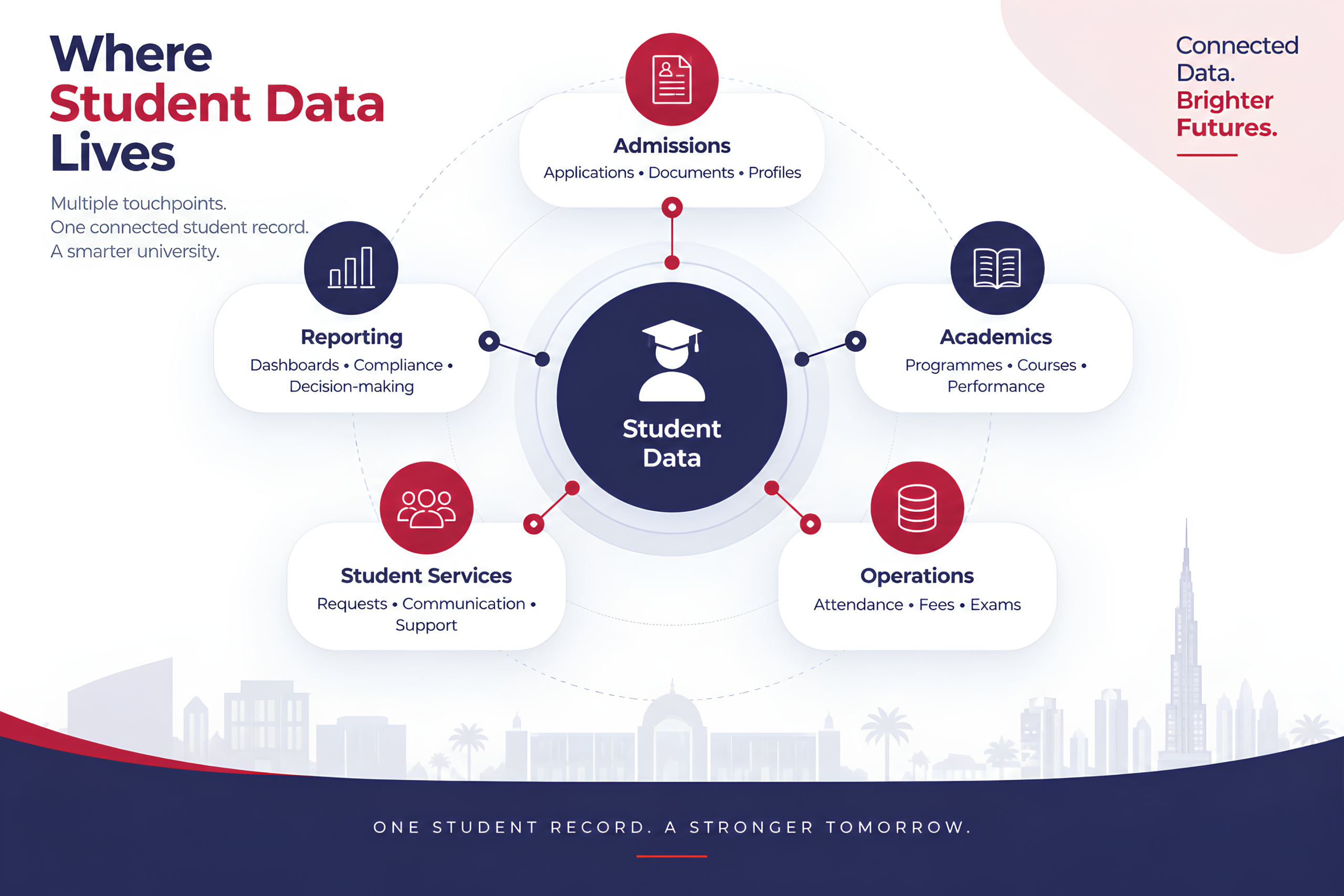
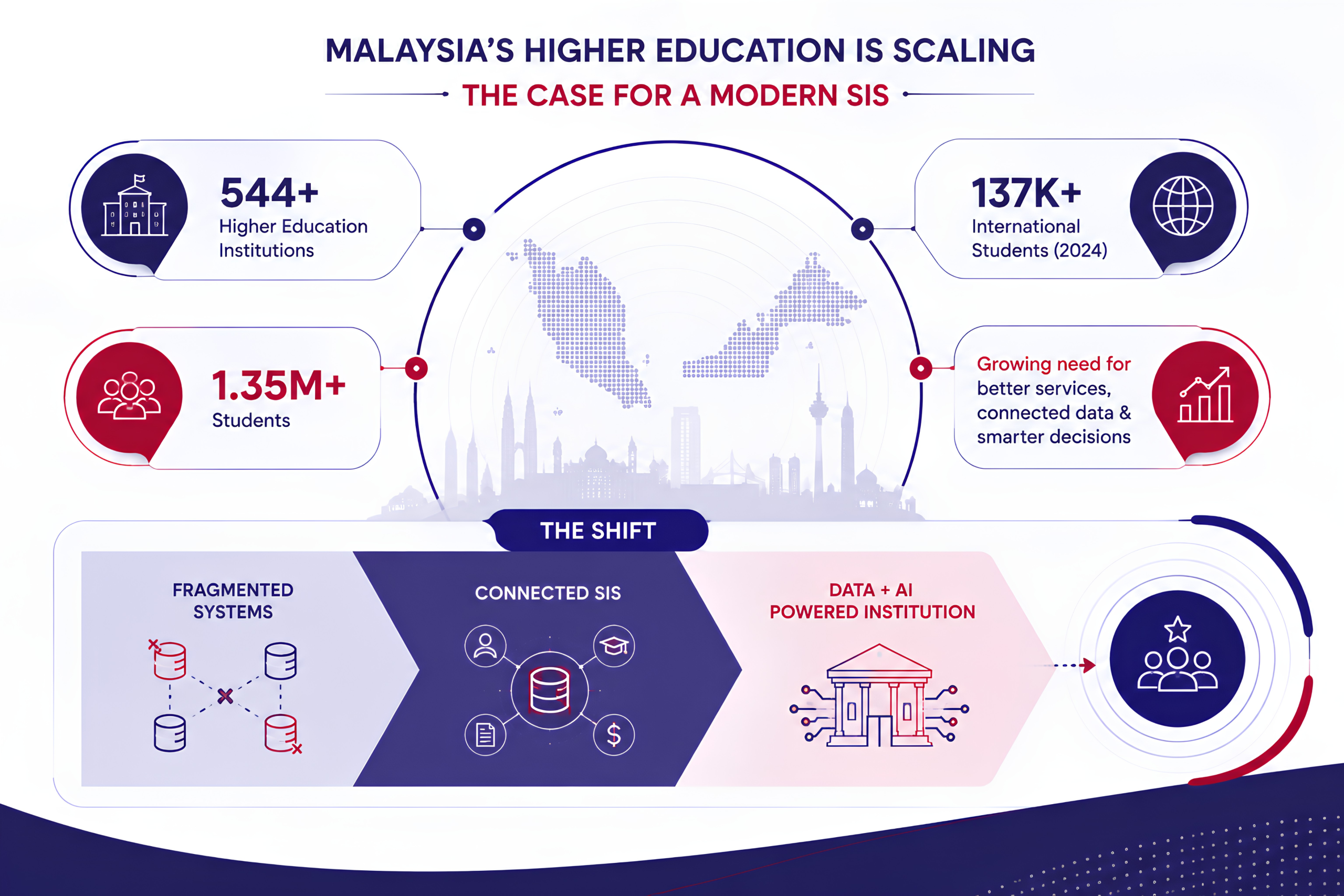
UAE universities are moving toward a more connected, data-driven model of higher education. Admissions, enrolment, academics, attendance, fees, examinations, student services, and institutional reporting increasingly depend on accurate information moving across multiple systems.

This makes the Student Information System (SIS) more than an administrative platform. A modern SIS can help universities connect student data, automate workflows, improve self-service, strengthen reporting, and give decision-makers a clearer view of institutional performance.

The UAE’s higher education ecosystem is already moving in this direction. In January 2026, the Ministry of Higher Education and Scientific Research (MoHESR) announced electronic data integration with 54 UAE higher education institutions, reflecting the growing importance of connected higher-education data.

For universities, the question is no longer simply whether student information should be digitised. It is how effectively that information can be connected, managed, analysed, and turned into action.

Why Is UAE Higher Education Becoming More Data-Driven?

UAE higher education is becoming increasingly digital, with institutions expected to deliver efficient services while managing growing volumes of academic and administrative information.

What happens when a student joins a university? Their journey may involve an admissions officer reviewing an application, a faculty member tracking academic progress, a finance team recording payments, and a student services team responding to requests. Each interaction creates another piece of information about the same student.

Behind the scenes, universities have to keep all of these pieces connected across admissions, student records, academic programmes, attendance, assessments, finance, communication, and student support. At the same time, institutional leaders and regulators need reliable data to understand what is happening across the university, from student performance and enrolment trends to quality assurance and strategic planning.

The challenge is making sure that everyone is looking at the same story, not different versions of it.

This creates a clear requirement: student data cannot remain trapped in disconnected systems or departmental databases.

The 2025 EDUCAUSE Horizon Report: Data and Analytics Edition reinforces this broader shift, identifying data and analytics as a critical foundation for institutional strategy, decision-making, and student success in higher education.

A connected SIS provides the foundation for bringing these processes together while giving authorised users access to the information they need.

Why Are UAE Universities Managing More Student Data Than Ever?

A university student record can contain far more than basic personal information.

It may include:

  • Applications and admission documents
  • Student profiles and enrolment information
  • Programmes, courses and credits
  • Attendance and academic performance
  • Assessments and examination results
  • Fee and payment information
  • Requests, approvals and student services
  • Communication and engagement records
  • Graduation and alumni information

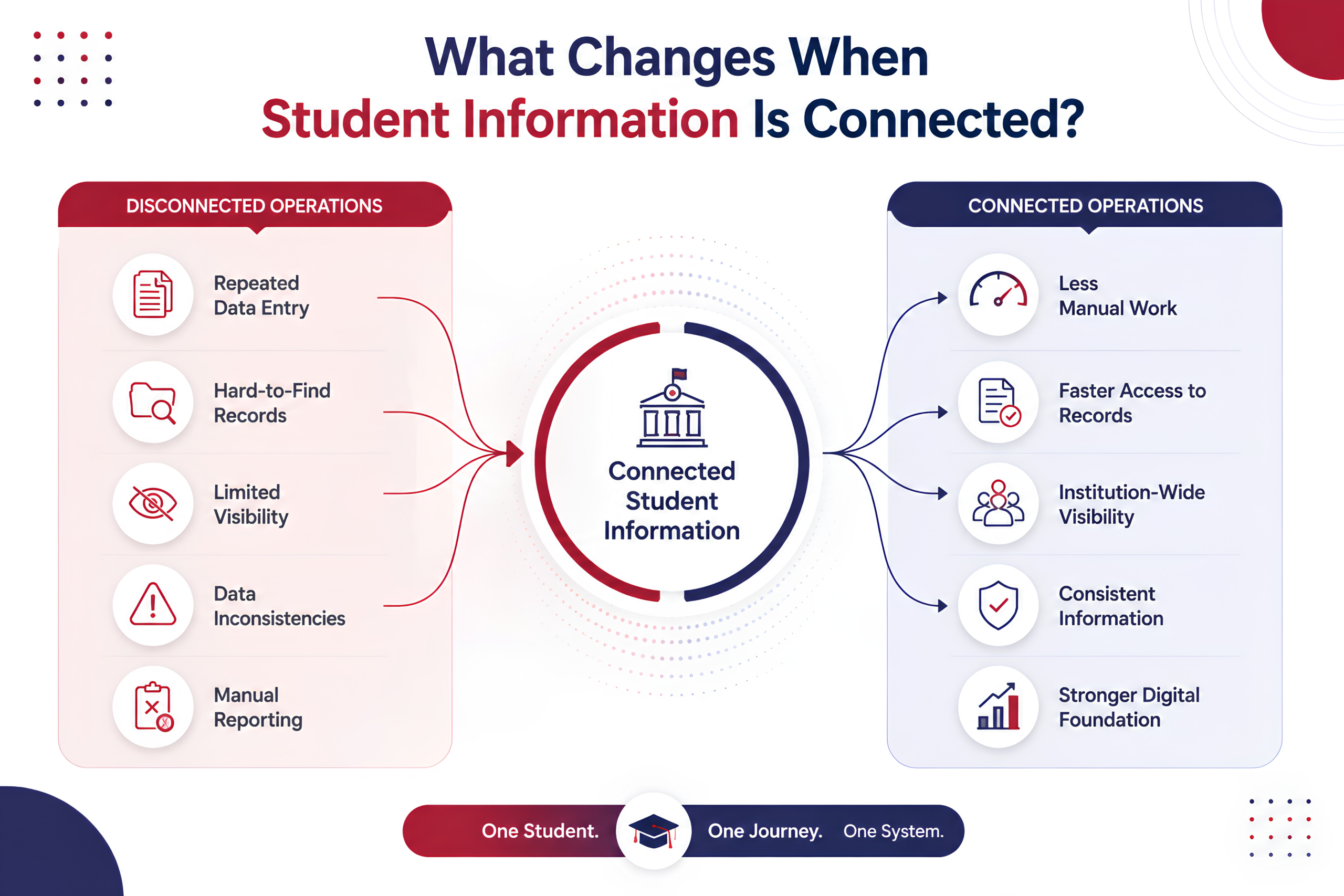
When universities manage this information independently, they can face duplicate records, manual reconciliation, delayed reporting, and inconsistent information.

The challenge is therefore not simply how much data a university has, but whether that data remains accurate and useful as it moves through the institution.

Where Does Student Data Go in a UAE University?

Student data moves through multiple departments and decision points throughout the university.

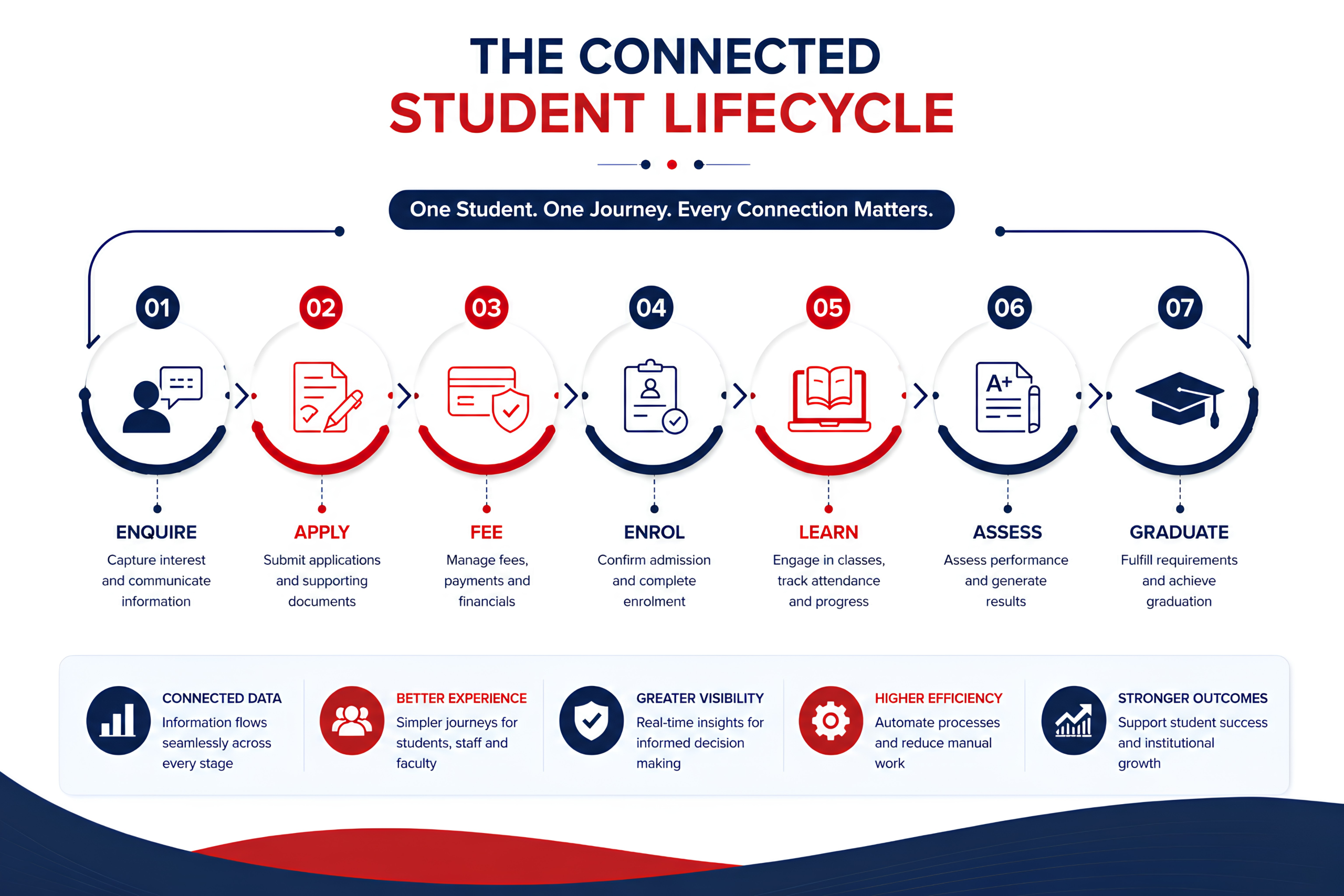
A student’s relationship with a university rarely begins on the first day of class. It might start with a simple enquiry: What programmes are available? How do I apply?

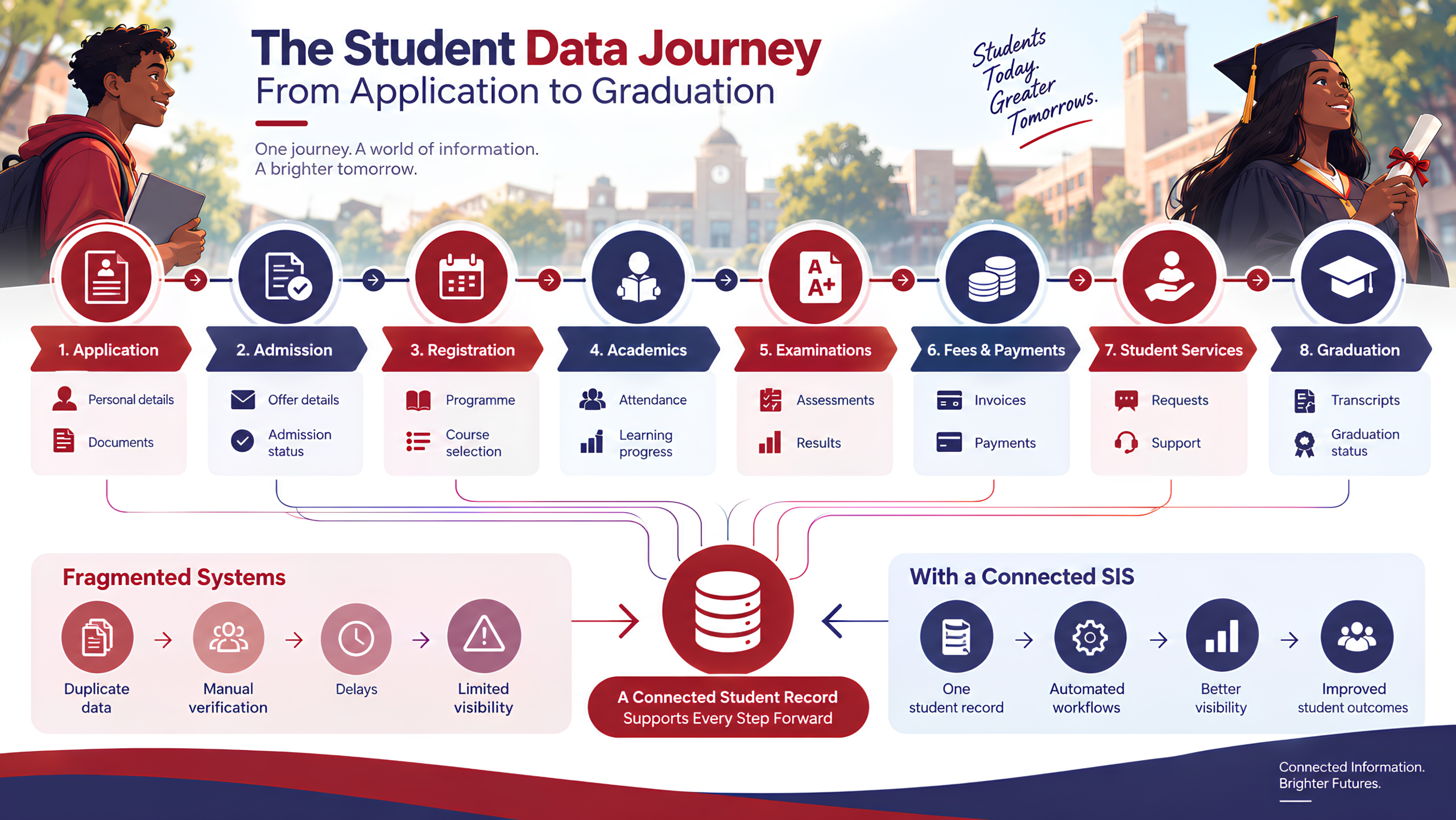
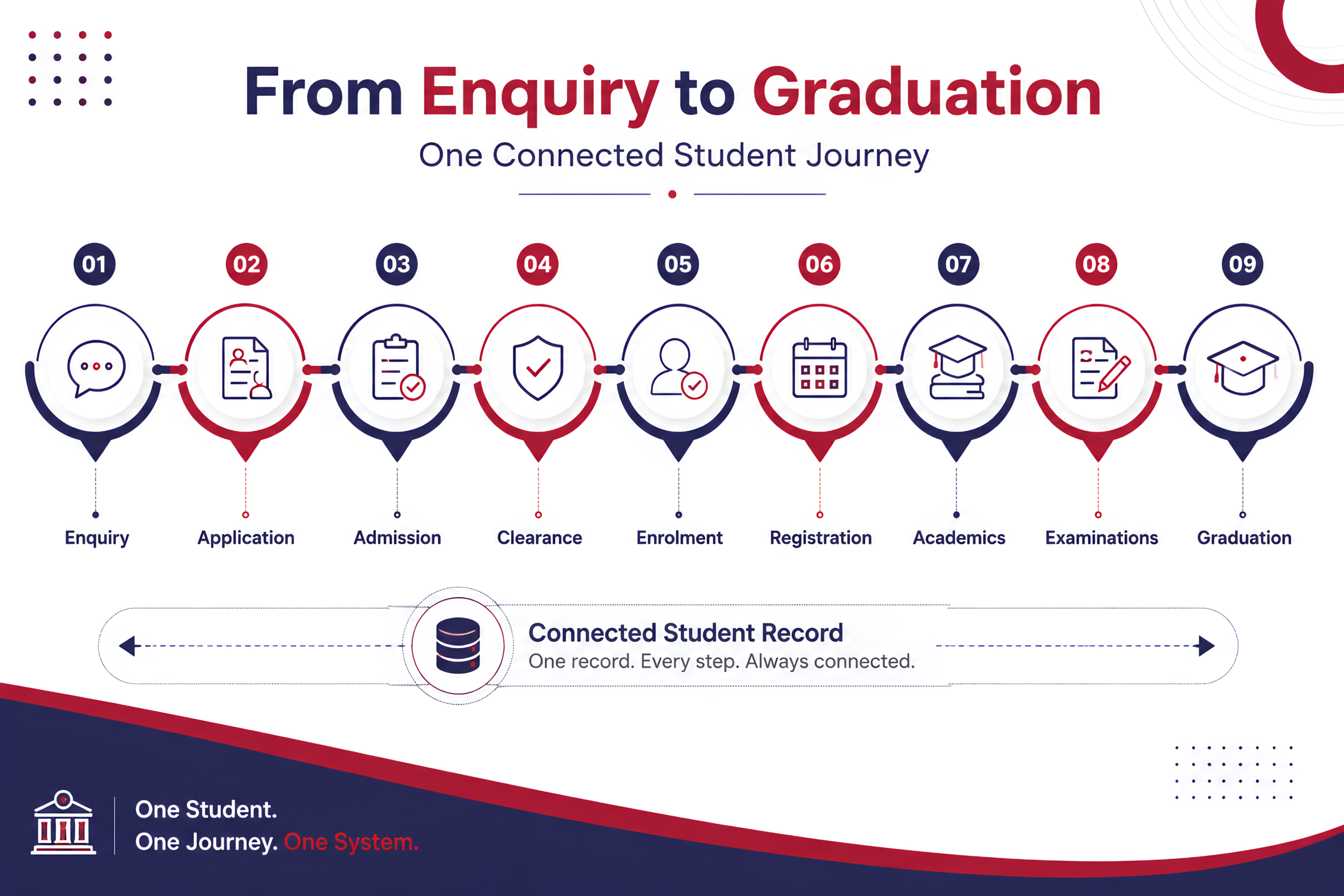
From there, the journey unfolds: an application is submitted, admission is processed, enrolment is completed, classes begin, attendance is recorded, assessments take place, fees are paid, and student services step in whenever support is needed. Eventually, that same journey leads to graduation.

At every stage, new information is created and passed from one team to another. The real challenge is ensuring that the student’s story stays connected as it moves across the university.

When these stages operate in silos, the same student may end up having multiple records across different departments. A modern SIS helps bring those pieces together, creating a shared institutional record that follows the student from their first enquiry to graduation.

The problem occurs when each stage operates independently.

For example, admissions may maintain one version of a student’s information while another department manually enters the same information into its own system. A finance team may need to reconcile payment information separately, while academic staff may rely on another application for performance data.

modern SIS

A modern SIS creates a shared institutional record, allowing information to move between connected processes instead of being repeatedly captured.

This matters because better data continuity can mean fewer errors, faster administration, and more reliable institutional reporting.

Why Does Fragmented Student Data Create Problems for UAE Universities?

Fragmented data creates operational friction.

When systems do not communicate effectively, staff may spend significant time searching for information, checking records, correcting inconsistencies, or moving data between applications.

The impact can include:

Slower administration: Manual processes can delay approvals, updates and reporting.

Duplicate data entry: Staff may need to enter the same information across multiple systems.

Poor visibility: Leaders may struggle to obtain a complete view of enrolment, performance, attendance or progression.

Inconsistent records: Different departments may work with different versions of student information.

Limited student self-service: Students may need to contact staff for information that could otherwise be available digitally.

Academia’s recent UAE-focused SIS analysis highlights the same underlying issue: universities may have multiple systems for admissions, academics, finance, LMS and student services, but still lack a unified institutional view when those systems operate in silos.

The result is a university that has plenty of data but cannot always turn it into timely insight.

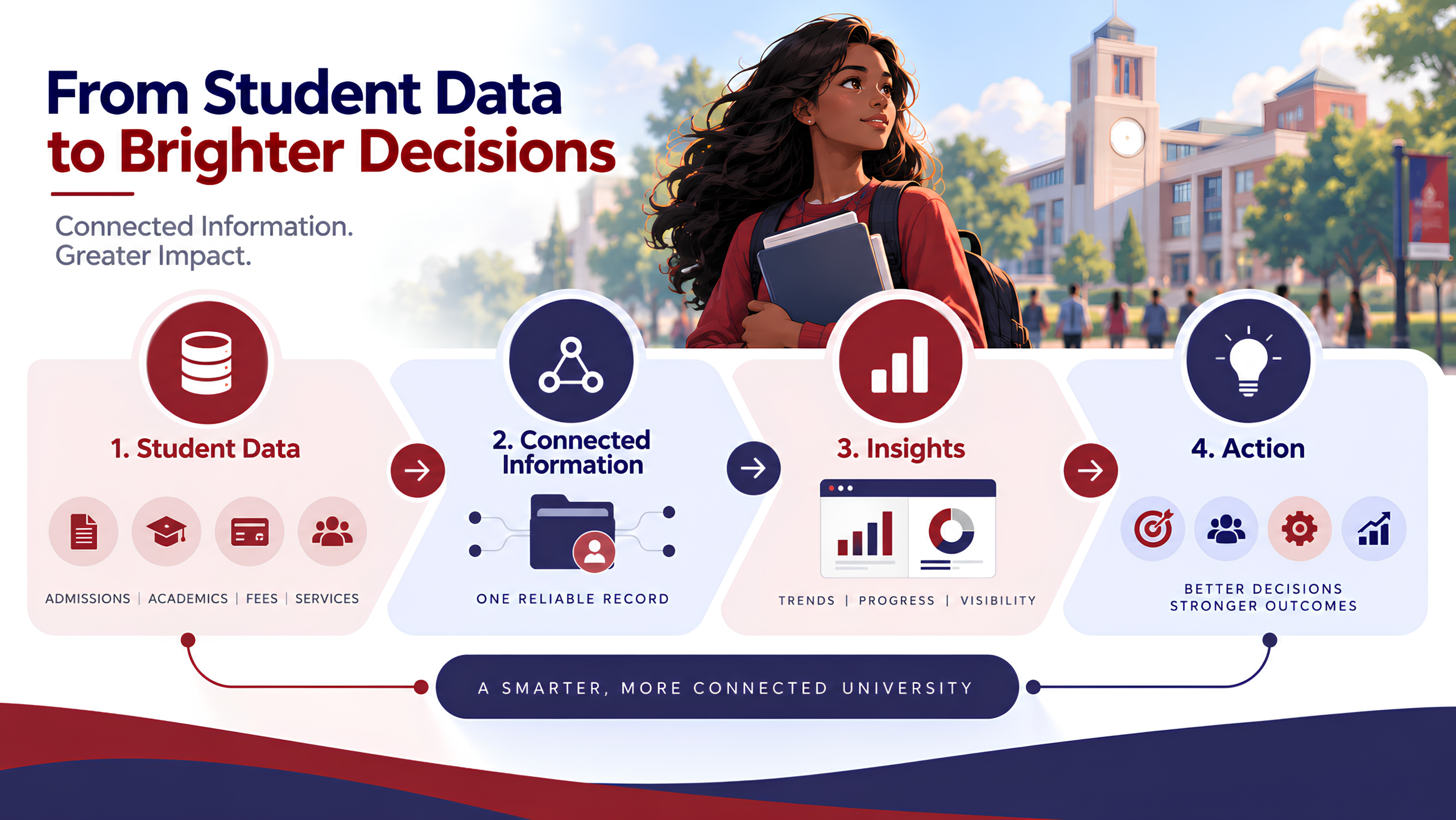
How Does Student Data Flow Through a Modern University?

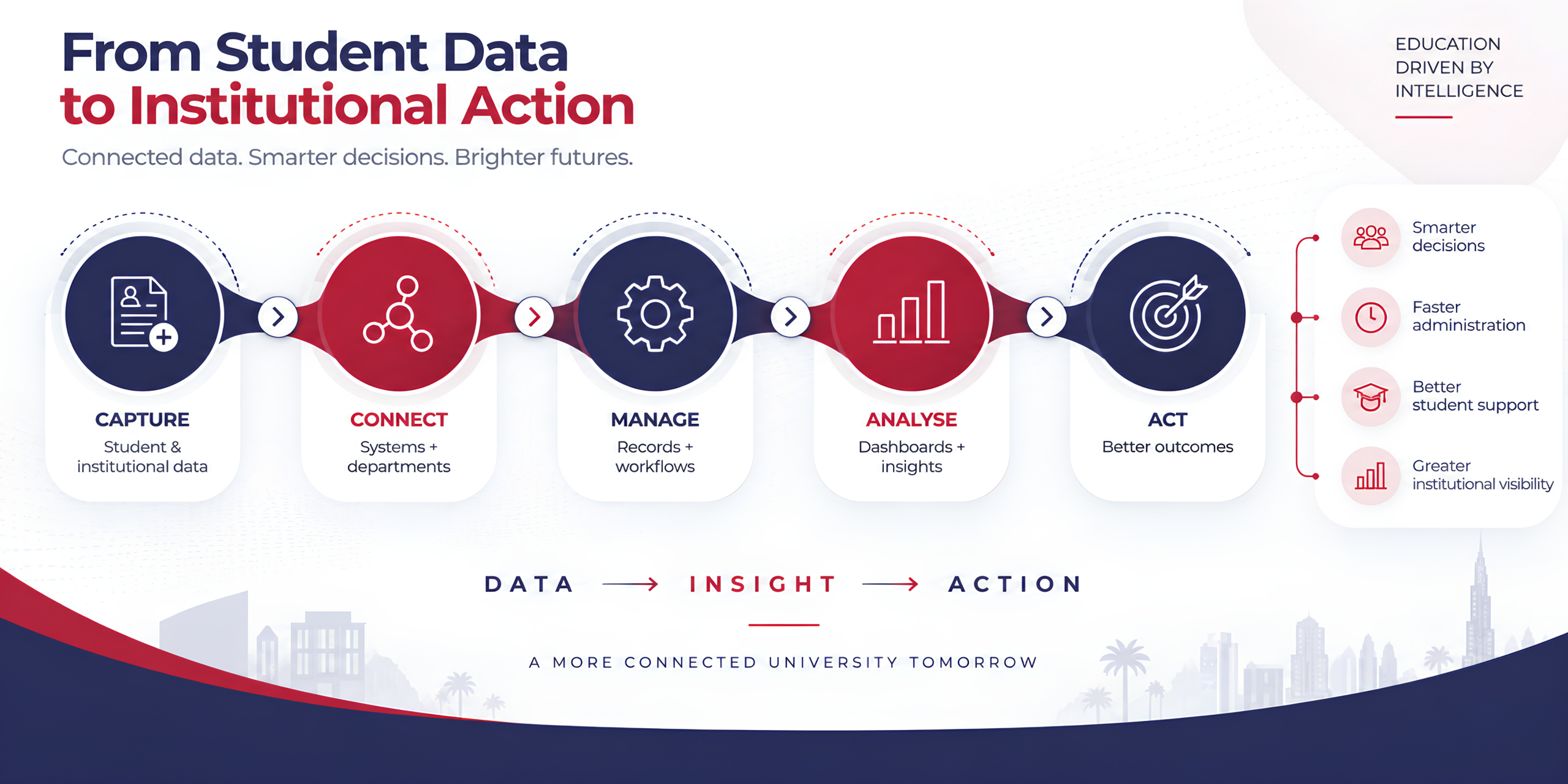
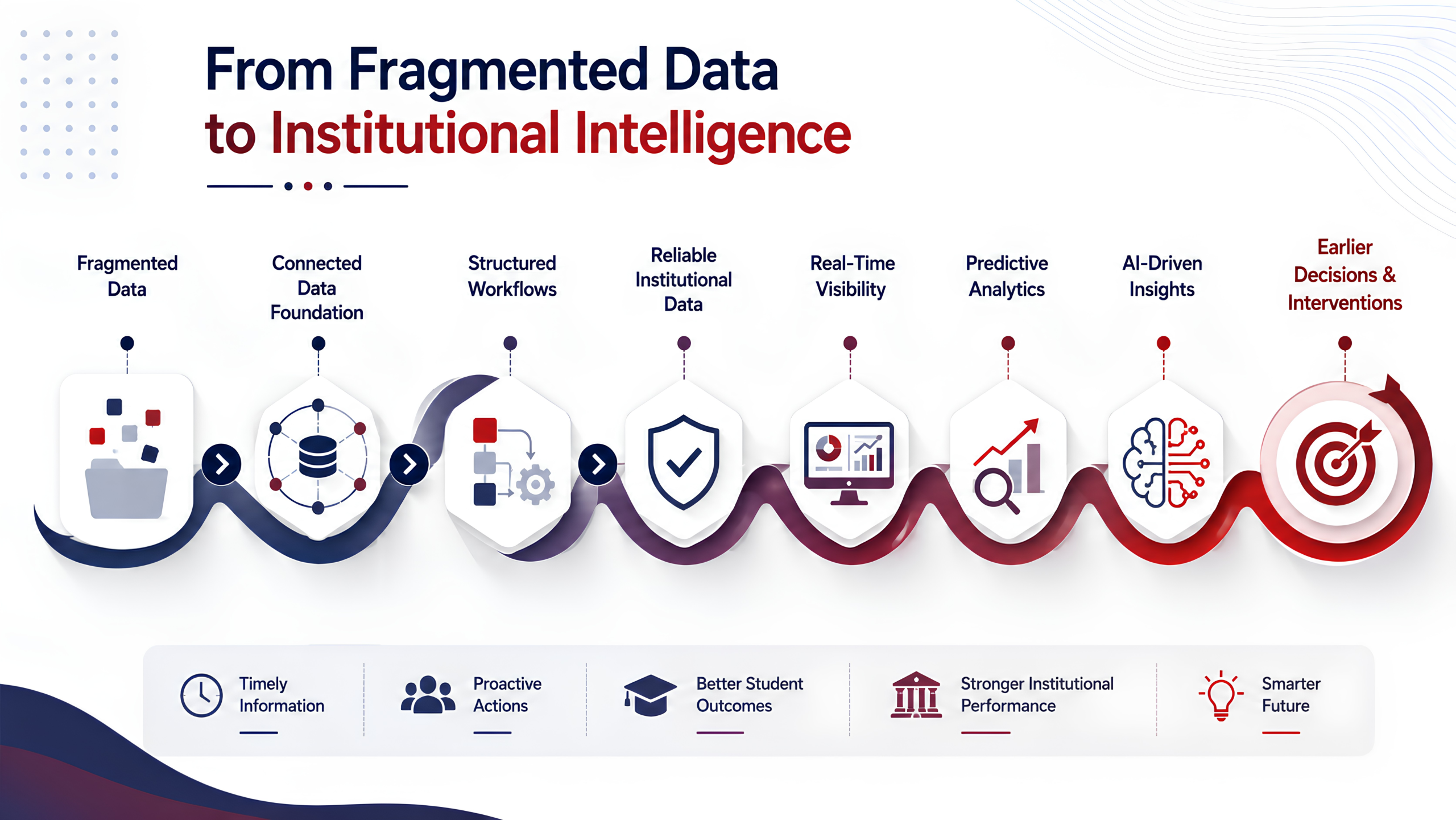
A modern approach can be understood through five connected stages:

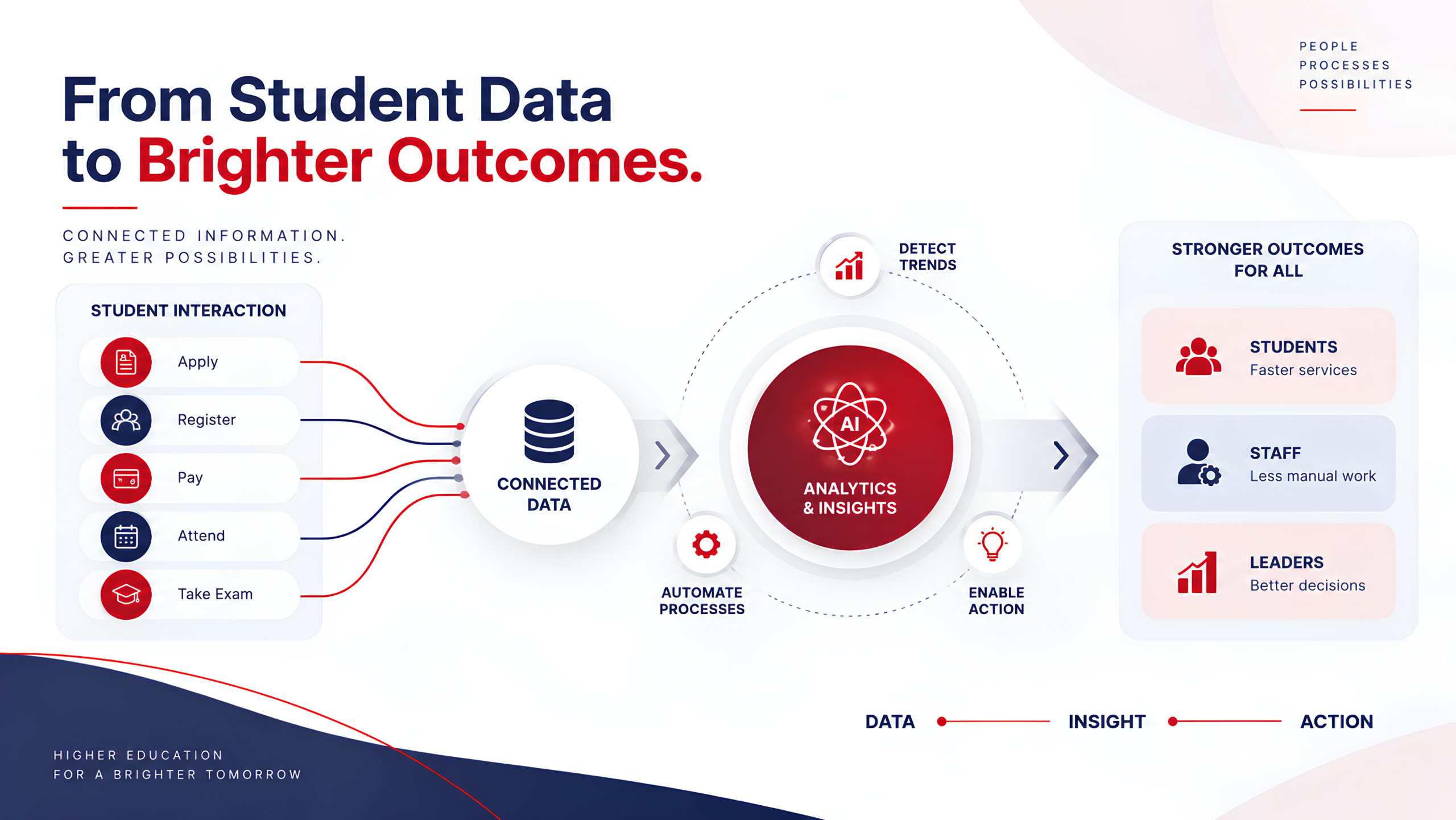
Capture → Connect → Manage → Analyse → Act

Capture: Student information enters the institution through applications, admissions, documents, enrolment, academic records, attendance, fees, assessments and service requests.

Connect: Information is linked across processes so that updates made in one area can support related workflows elsewhere.

Manage: The university maintains structured records, workflows, permissions, approvals and communication across the student journey.

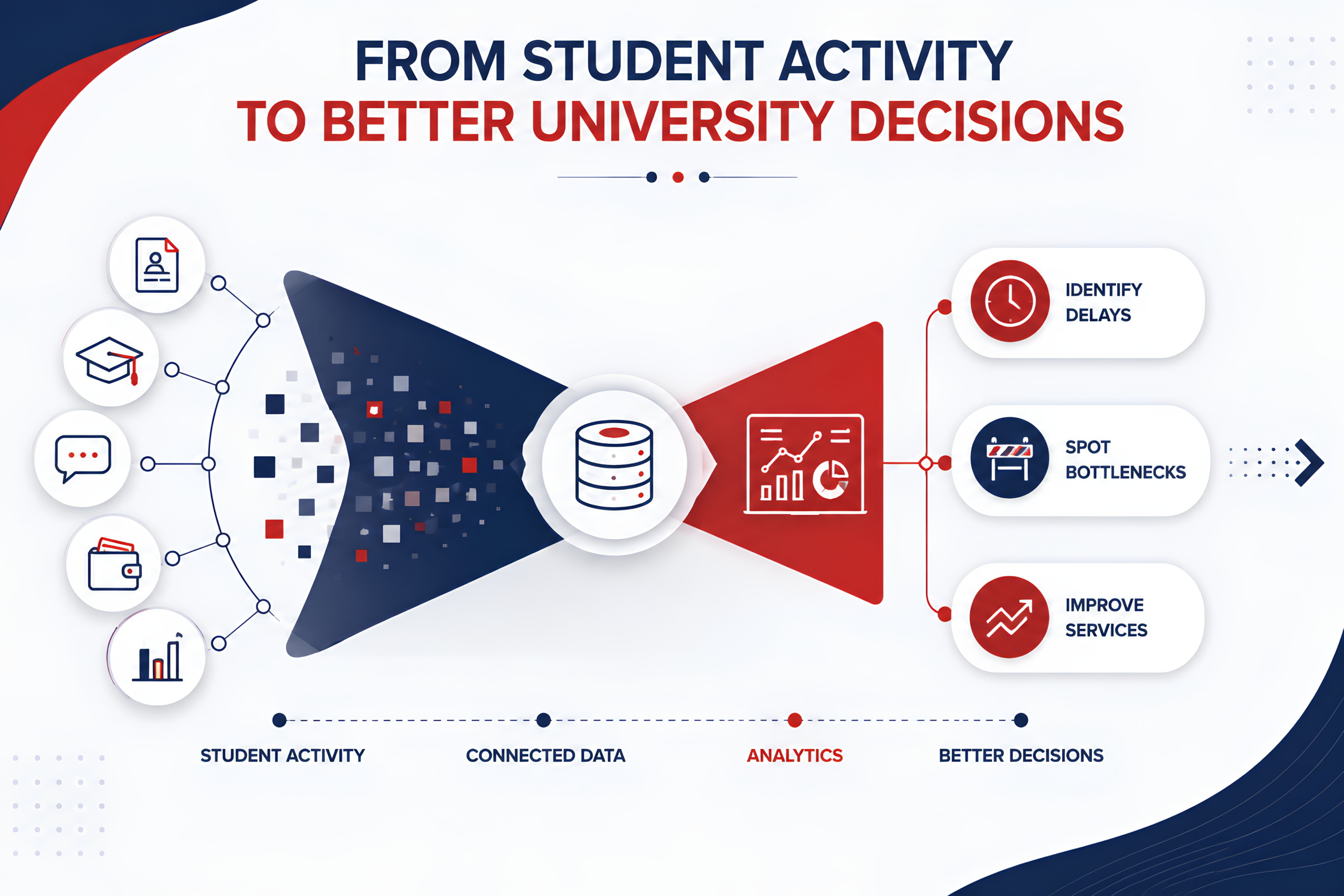
Analyse: Institutional data can be transformed into dashboards, reports and insights covering areas such as enrolment, attendance, performance, progression and financial activity.

Act: Staff and leaders use those insights to identify issues, improve processes and make informed decisions.

This model changes the role of student data. Instead of being something universities simply store, data becomes an institutional resource that can support better decisions and better student services.

The 2025 EDUCAUSE Horizon Report similarly emphasises the importance of building strong data foundations and using analytics to create more efficient, agile and impactful institutions.

What Role Does an SIS Play in University Administration?

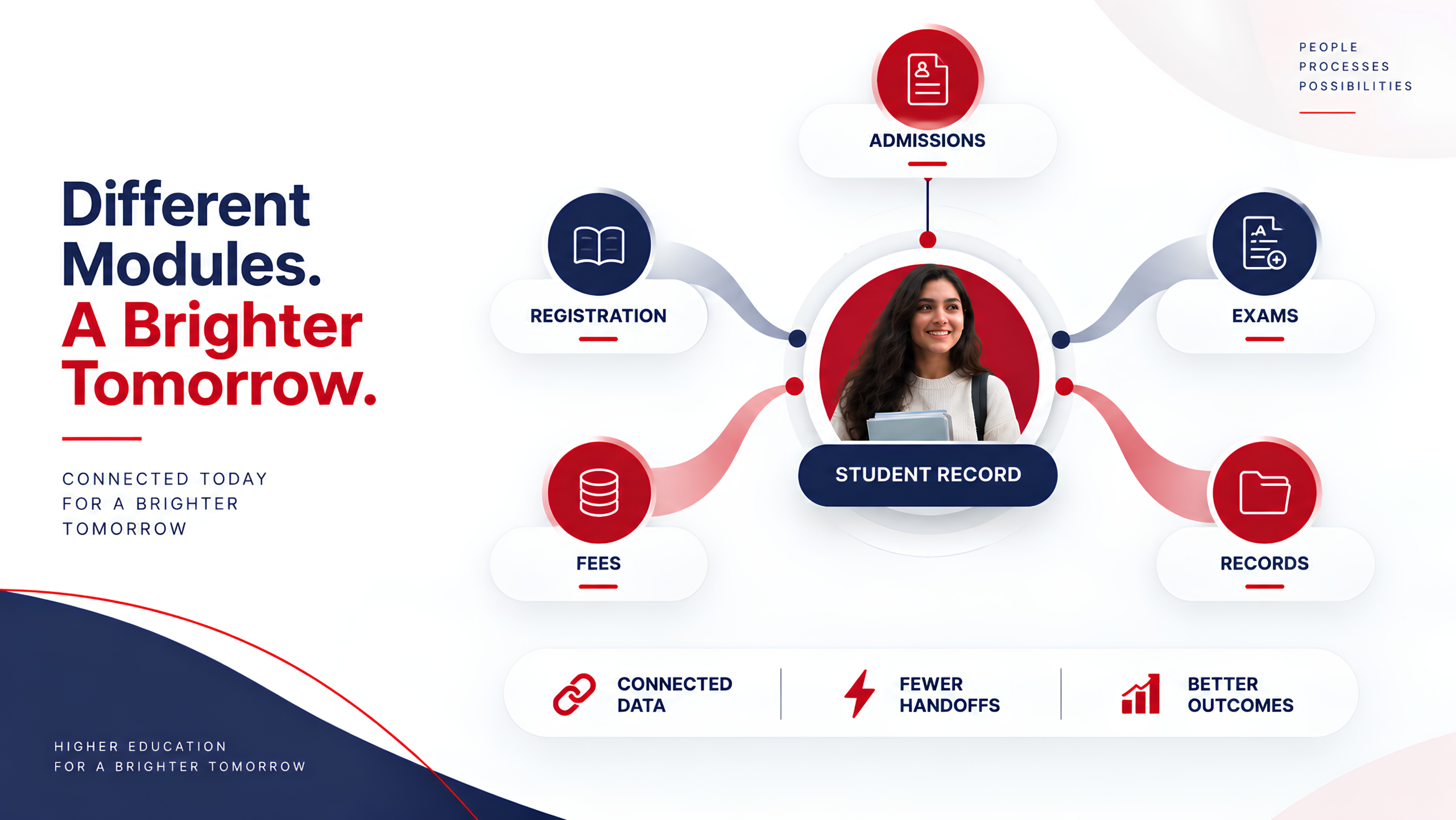
A modern SIS acts as a central operational layer for student-related processes.

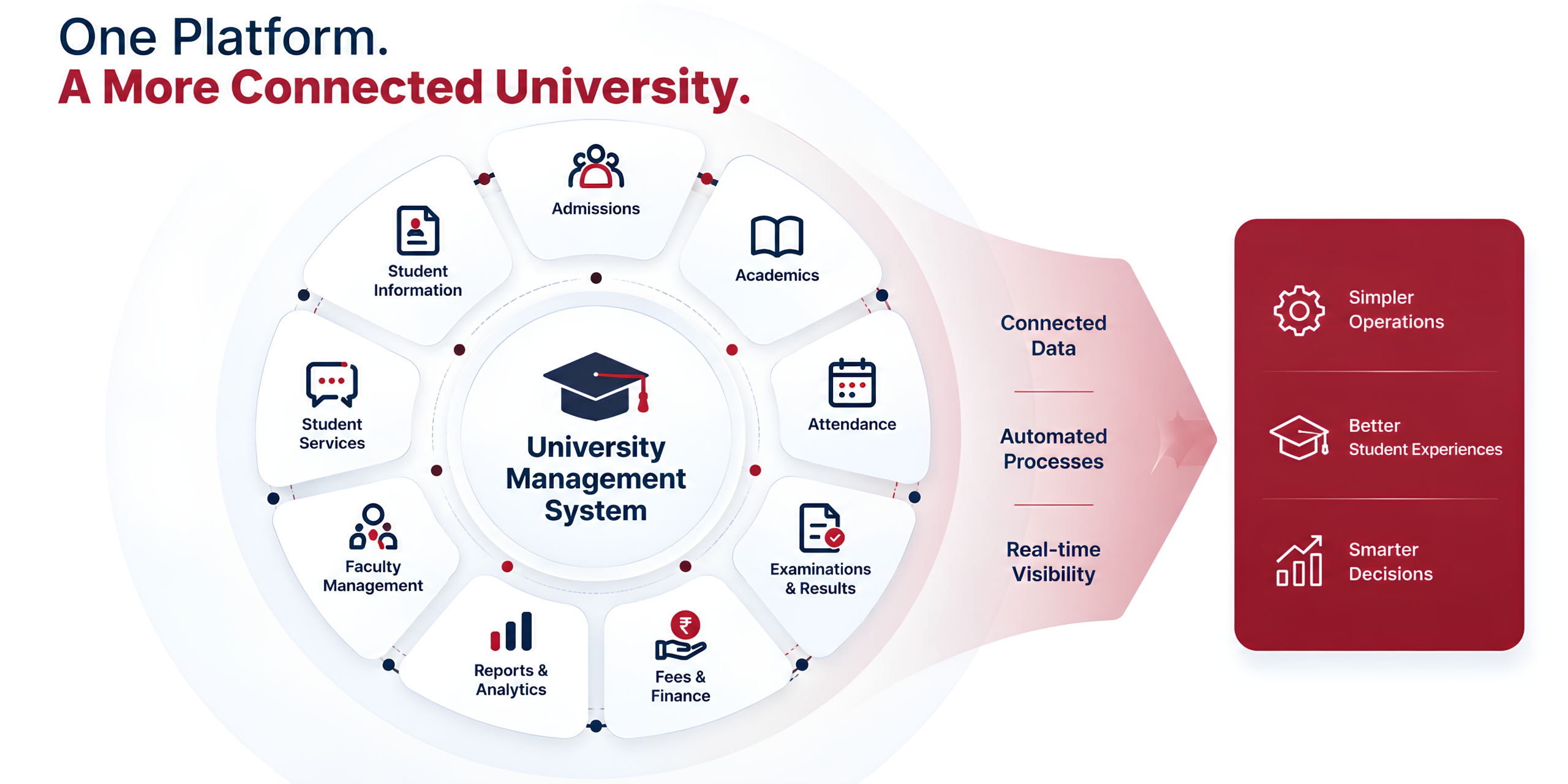
It can bring together admissions, academics, attendance, examinations, fees, student services, communication and reporting within connected workflows.

This can help universities:

  • Reduce repetitive administrative work
  • Standardise processes
  • Improve data accuracy
  • Automate approvals and notifications
  • Provide real-time visibility
  • Strengthen reporting
  • Support multi-campus operations
  • Improve coordination between departments

The value is therefore not just automation. It is creating a more connected operating environment for the institution.

How Can an SIS Improve the Student Experience in the UAE?

Students increasingly expect university services to be accessible, responsive and digital.

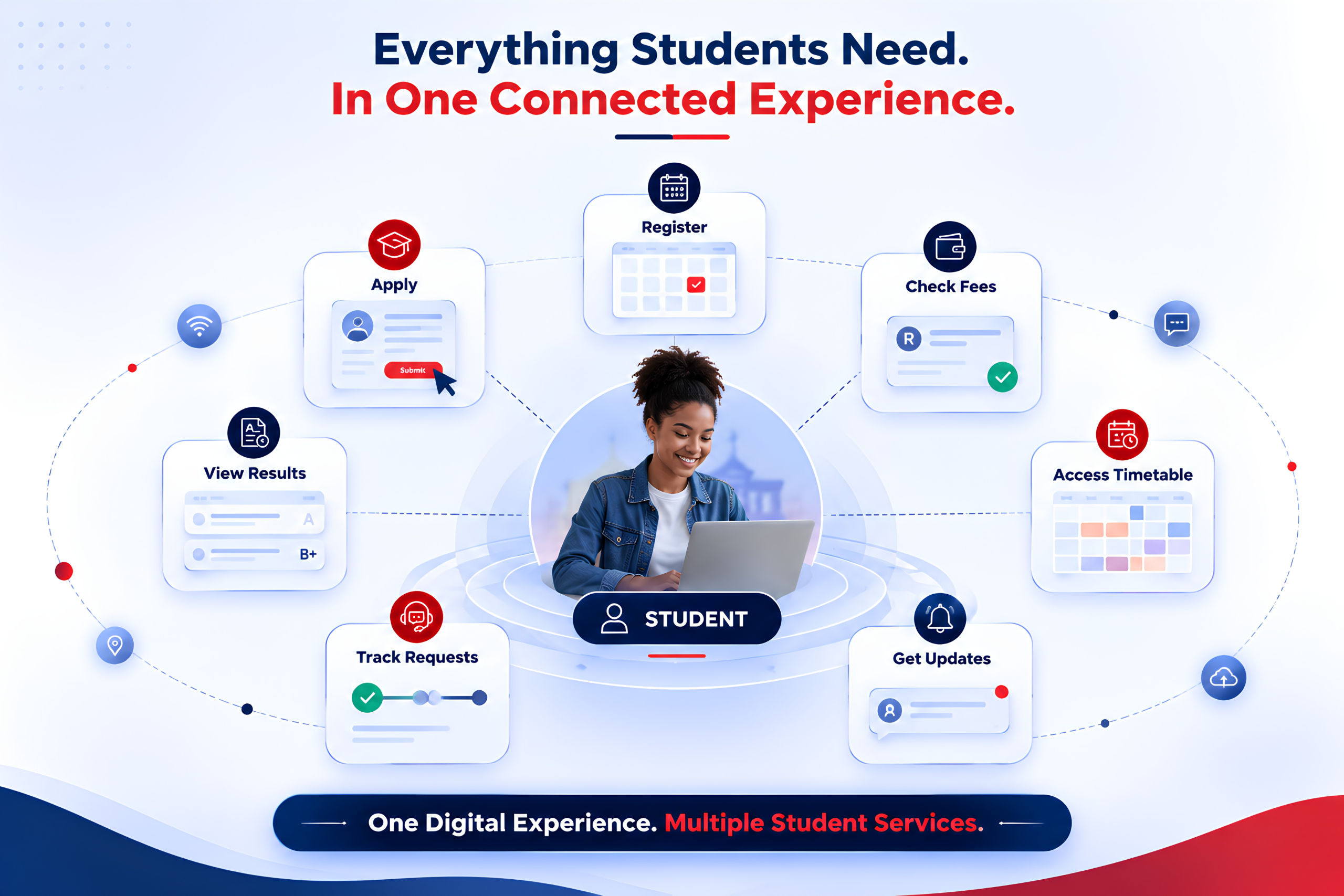
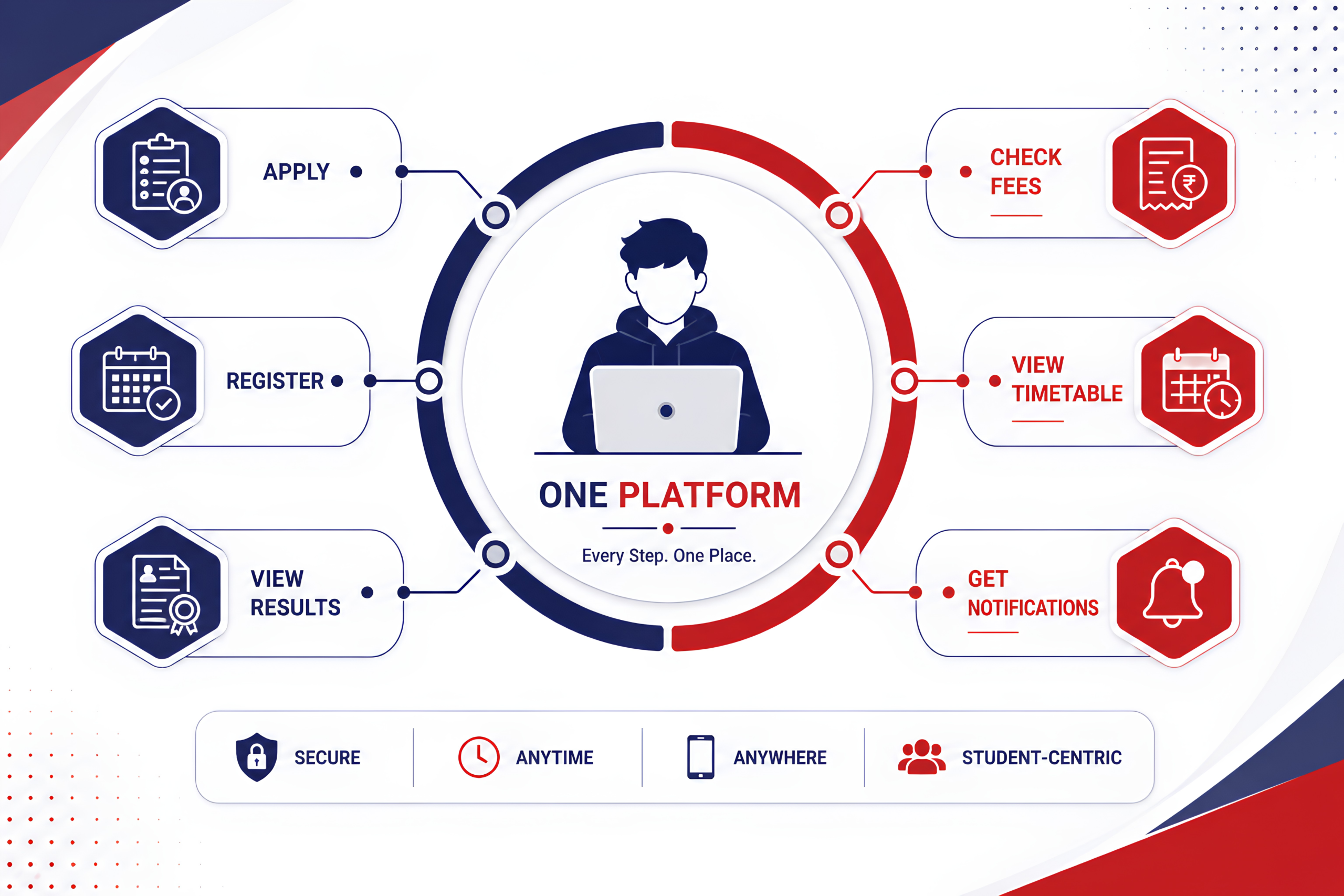
A modern SIS can support this through portals and mobile experiences that allow students to access information such as attendance, fees, examination schedules, results, timetables, notifications and academic information without depending entirely on administrative staff.

This creates a more self-service model.

For universities, this can reduce routine enquiries while allowing staff to focus on complex cases and higher-value student support.

This direction also aligns with the wider global movement toward more digitally enabled higher education. A 2025 UNESCO global survey found that nearly two-thirds of surveyed higher education institutions either already had guidance for AI use or were developing it, reflecting the growing need for institutions to establish structured approaches to emerging technologies.

Why Are Integration and Interoperability Important for UAE Universities?

An SIS cannot operate effectively in isolation.

Universities typically depend on multiple technologies for areas such as learning management, finance, identity management, communication, payments, reporting and other institutional services.

Integration allows these systems to exchange information instead of creating isolated data environments.

For UAE universities, interoperability can support:

  • Consistent student records
  • Reduced manual data transfers
  • Faster workflows
  • Better reporting
  • Connected digital services
  • Improved institutional visibility

The UAE’s wider move toward electronic higher-education data integration reinforces the importance of this connected approach.

A strong SIS should therefore be evaluated not only by what it does internally, but by how effectively it connects with the wider university technology ecosystem.

How Can UAE Universities Use Data and AI for Better Decision-Making?

Once institutional data is connected, analytics can provide a much clearer view of what is happening across the university.

Leaders can examine trends in enrolment, academic performance, attendance, progression, fees and student engagement.

AI can take this further by identifying patterns, supporting predictive analysis, enabling natural-language reporting and helping staff access insights more efficiently.

Academia’s SIS expert research makes an important distinction: the value of AI is not simply adding AI features, but connecting institutional data, reducing manual effort and turning information into useful intelligence. It also highlights the importance of practical AI use cases, governance, security and higher-education expertise.

higher-education ERP

Academia’s broader analysis of AI-powered SIS platforms similarly positions AI as a way to move from static data management toward institutional intelligence, where information can be analysed across departments and transformed into actionable insight.

The objective is not to replace institutional decision-making. It is to give people better information at the point where decisions need to be made.

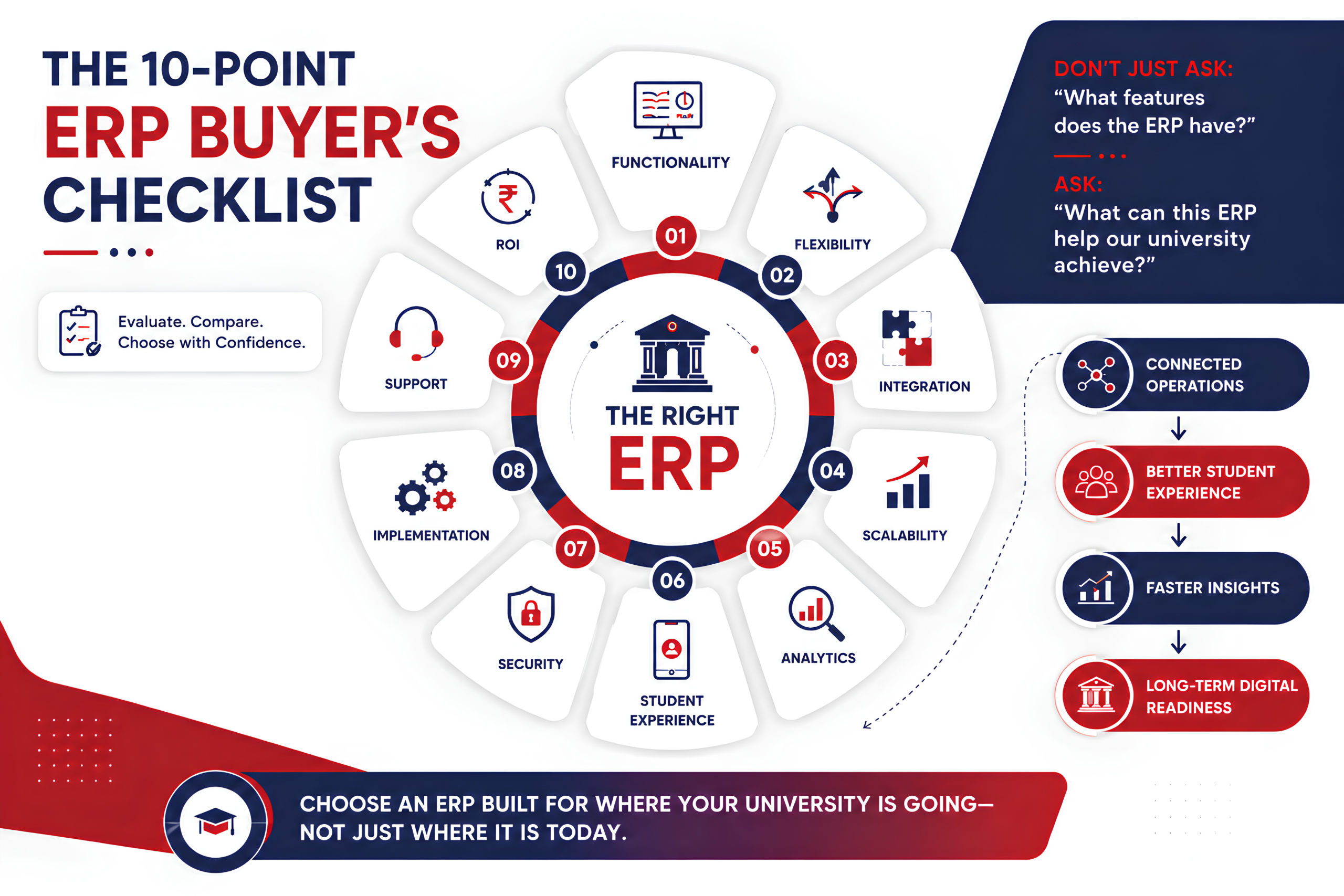
What Should UAE Universities Look for in a Modern SIS?

Universities should evaluate an SIS based on its ability to support both today’s operations and future digital transformation.

Capability Why It Matters
Centralised student data Creates a consistent institutional record
Workflow automation Reduces manual administrative work
Integration Connects the wider technology ecosystem
Analytics Turns data into actionable insight
AI capabilities Supports faster and smarter decisions
Self-service Improves student accessibility
Security and access controls Protects sensitive information
Scalability Supports institutional growth
Configurability Adapts to institutional requirements
Mobile accessibility Enables services beyond the desktop

The strongest SIS is not necessarily the one with the longest feature list. It is the one that can connect institutional processes and deliver measurable operational value.

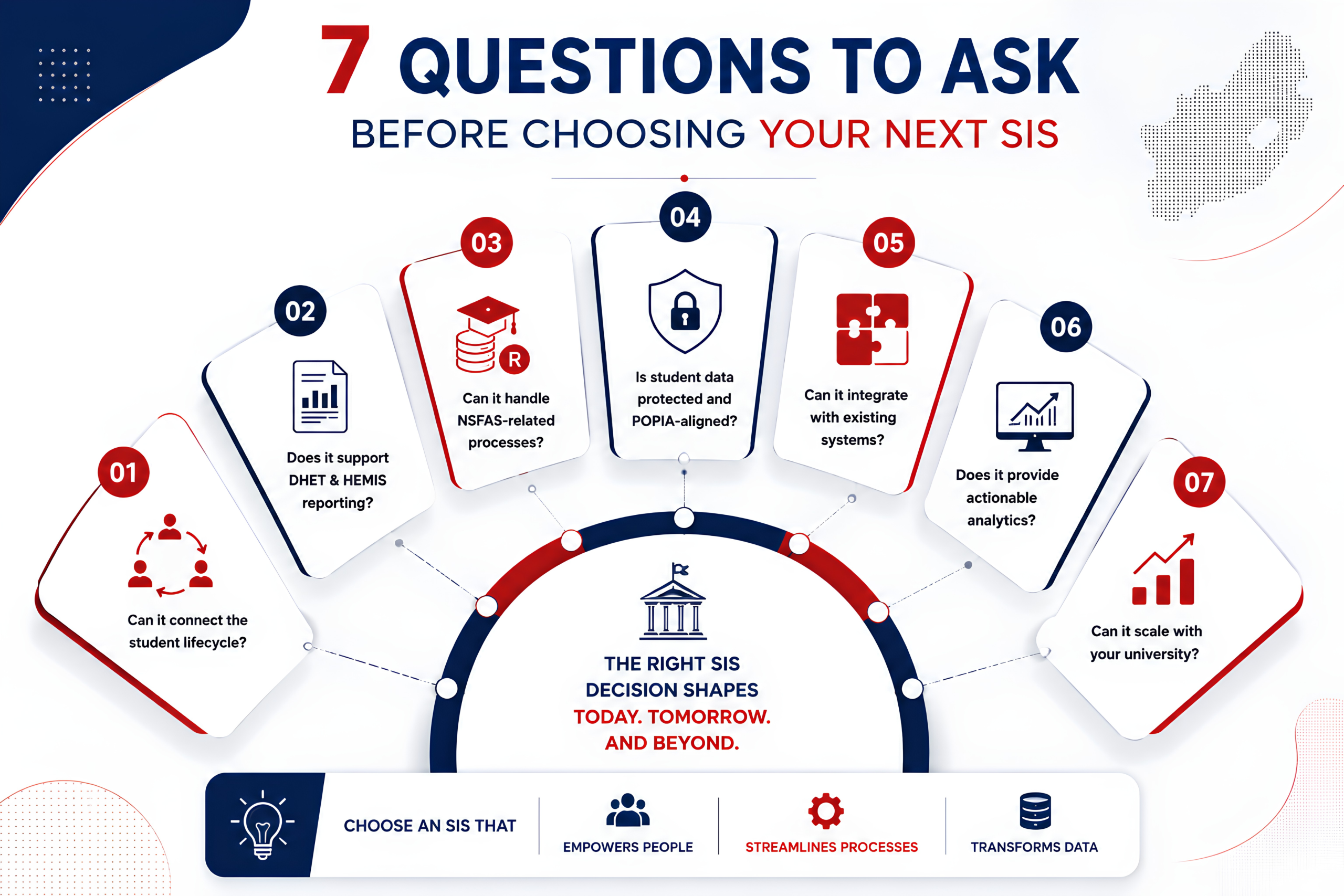
How Should UAE Universities Evaluate an SIS Vendor?

Before selecting a vendor, universities should look beyond demonstrations and feature checklists.

They should ask:

  • Can the platform support our academic structures?
  • How will existing student data be migrated?
  • Which systems can it integrate with?
  • How configurable are workflows?
  • What analytics and reporting are available?
  • How are security and access controls managed?
  • What student self-service capabilities are included?
  • Can the platform scale across campuses?
  • What implementation and post-go-live support is provided?
  • Can the vendor demonstrate our actual workflows?

A vendor should ultimately demonstrate how the platform solves institutional problems, not simply how many features it contains.

How Can Academia Help UAE Universities Manage Student Data?

Academia provides a connected higher-education technology platform designed to bring core student and institutional processes together.

Its SIS supports areas including admissions, academics, attendance, examinations, fees, student services, communication, analytics and portals, while integration capabilities help connect the platform with the wider institutional ecosystem.

Academia’s approach also places strong emphasis on AI-powered analytics and connected institutional intelligence. Its recent AI-focused guidance highlights 400+ AI-powered reports alongside a connected SIS and Education ERP ecosystem, helping institutions move from manually compiling information toward accessing useful insights more efficiently.

For university leaders, this creates an opportunity to move from fragmented administration toward a more connected operating model where information is captured once, connected across processes, analysed intelligently and used to improve outcomes.

The goal is not simply to implement another software system. It is to create a stronger digital foundation for managing students, administration and institutional growth.

What Is the Future of Student Data Management in UAE Universities?

The future of UAE higher education will depend increasingly on connected data, digital services, interoperability and intelligent decision-making.

As universities become more data-driven, an SIS will increasingly serve as an institutional foundation rather than a back-office database.

The institutions best positioned for this future will be those that can connect their data, simplify administration, give students greater self-service, and turn information into actionable insight.

Ready to Build a More Connected University?

The right SIS can help your university move beyond fragmented records and manual administration toward connected data, smarter workflows, better student experiences and more informed decisions.

Explore how Academia can help your institution modernise student information management and build a more connected higher-education ecosystem.

Request a personalised demo of Academia SIS today.

FAQs

What is a Student Information System in UAE universities?

A Student Information System is a digital platform used to manage student information and related academic and administrative processes, including admissions, enrolment, academics, attendance, examinations, fees and student services.

Why do UAE universities need a modern SIS?

A modern SIS helps universities connect student data, automate processes, improve reporting, support self-service and provide better visibility across academic and administrative operations.

What should universities consider when choosing an SIS?

Universities should consider integration, scalability, security, configurability, analytics, AI capabilities, reporting, student self-service, implementation support and total long-term value.

Can an SIS integrate with other university systems?

Yes. A modern SIS should support interoperability with relevant institutional systems so information can move between applications without unnecessary manual data entry.

How can AI improve student data management?

AI can help universities analyse large volumes of institutional data, identify patterns, support predictive insights, simplify reporting and provide intelligent assistance for staff and students.

How does an SIS reduce data fragmentation?

It can provide a centralised student record while connecting relevant institutional systems, reducing duplicate data entry and manual information transfers.

How Can Student Information Systems Improve the Student Experience From Admission to Graduation?

From the moment students apply to the day they graduate, every interaction shapes their experience. Yet behind the scenes, these interactions often span separate departments, portals and administrative processes. A Student Information System (SIS) can bring admissions, registration, fees, academics, examinations and student support together, while automation and AI in higher education can reduce repetitive work and help institutions respond more proactively to student needs. This blog looks at how SIS technology can improve the student experience at each stage of the higher-education journey, from the first application to graduation.

For universities, the impact goes beyond simply making administration digital. SIS can reduce unnecessary student queries, minimise repeated submission of information, improve access to academic and administrative updates, and give staff better visibility into student needs. By the end of this article, higher-education leaders will understand where student friction occurs, how SIS and AI can address it, what measurable improvements can look like, and how real institutions are using connected workflows to create a more responsive student experience.

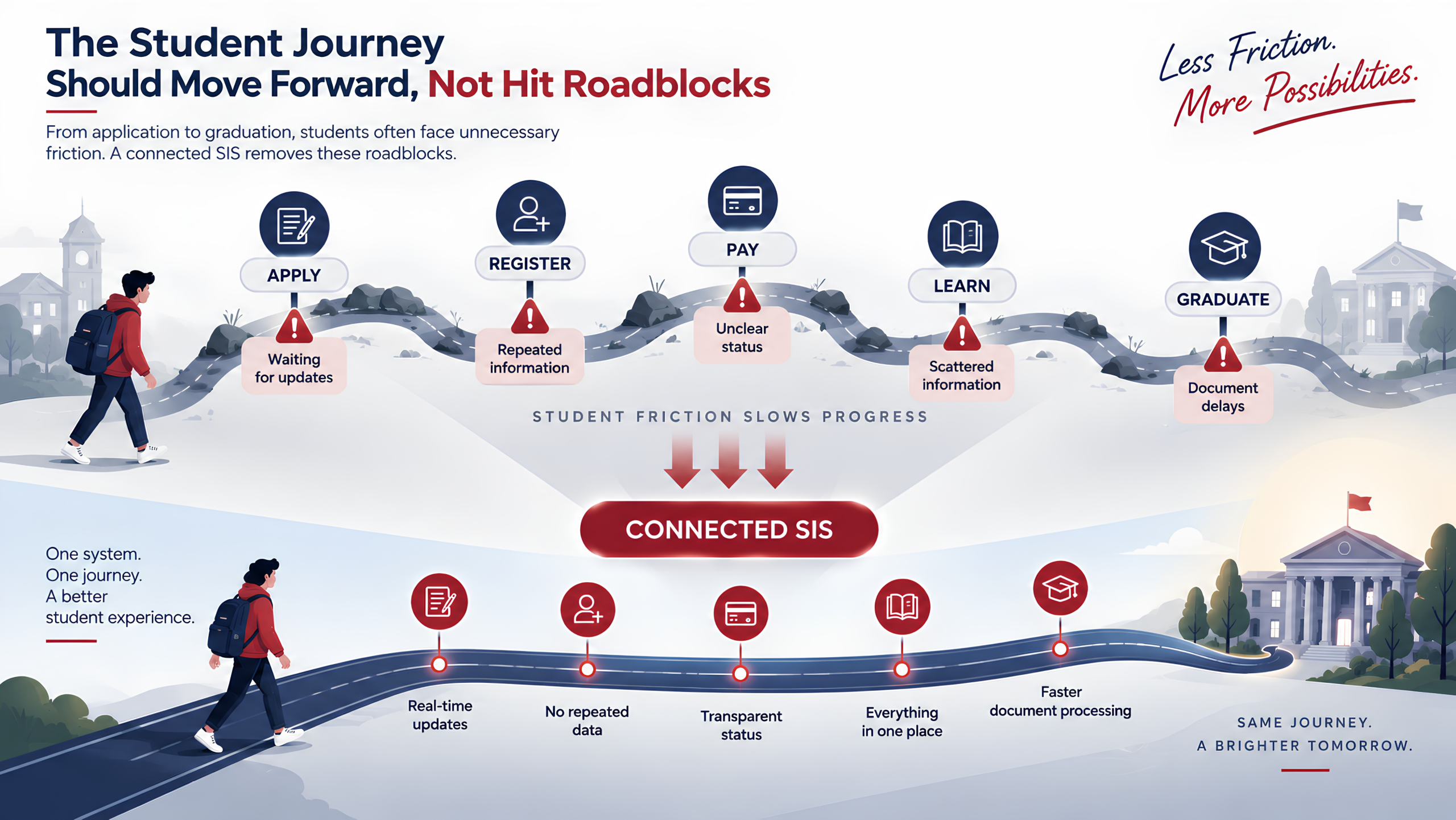
Imagine a student who has just received an admission offer. They need to register for courses, confirm their fee status, check their timetable and understand which documents are still required. Instead of finding everything in one place, they receive separate emails, visit different portals and contact different departments. None of these problems is academic, but together they shape how that student experiences the university.

Why Does the Student Experience Begin Before the Student Enters the Classroom?

A student’s experience begins with their first interaction with the institution.

They upload documents, complete an application and wait. Later, they may receive an email asking for information they believe they already submitted. After receiving an offer, they may be directed to another process for registration and a different department for fees.

Each interaction creates friction.


student journey

This is why student experience in higher education cannot be separated from administration. A well-designed SIS can connect information and workflows behind the scenes, making the university feel like one institution rather than a collection of separate departments.

Every administrative interaction is part of the student experience.

How Can an SIS Improve the Admission and Onboarding Experience?

For a prospective student, admission should feel like a clear journey rather than a collection of administrative tasks.

A SIS can bring together:

Application → Documents → Decision → Offer → Acceptance → Registration

Students can receive clearer status updates while staff work from the same application information instead of transferring details between spreadsheets, emails and separate databases.

For example, when an application is complete but the admission decision is pending, students should be able to see the status and next step without repeatedly contacting admissions.

What appears to be a small improvement becomes significant when thousands of applicants are involved.

What Happens When Students Don’t Have to Repeat the Same Information?

One of the most overlooked sources of student frustration is repetition.

A student may enter their programme, contact information and qualifications during admission and then be asked for the same details during registration or fee processing.

SIS creates a single student record. Once information has been appropriately captured and verified, authorised departments can use it rather than recreating it.

This also creates a stronger foundation for AI. AI-powered insights are only useful when the underlying institutional data is reliable and connected.

How Can AI and SIS Technology Improve the Higher Education Experience?

AI is increasingly becoming part of higher education’s digital environment.

Jisc’s 2024/25 Digital Experience Insights survey found that 34% of students reported using AI tools as part of their learning, while 23% said their institution had provided access to AI platforms. The survey included 15,398 higher-education students across 30 UK providers.

For SIS, the opportunity goes beyond classroom AI.

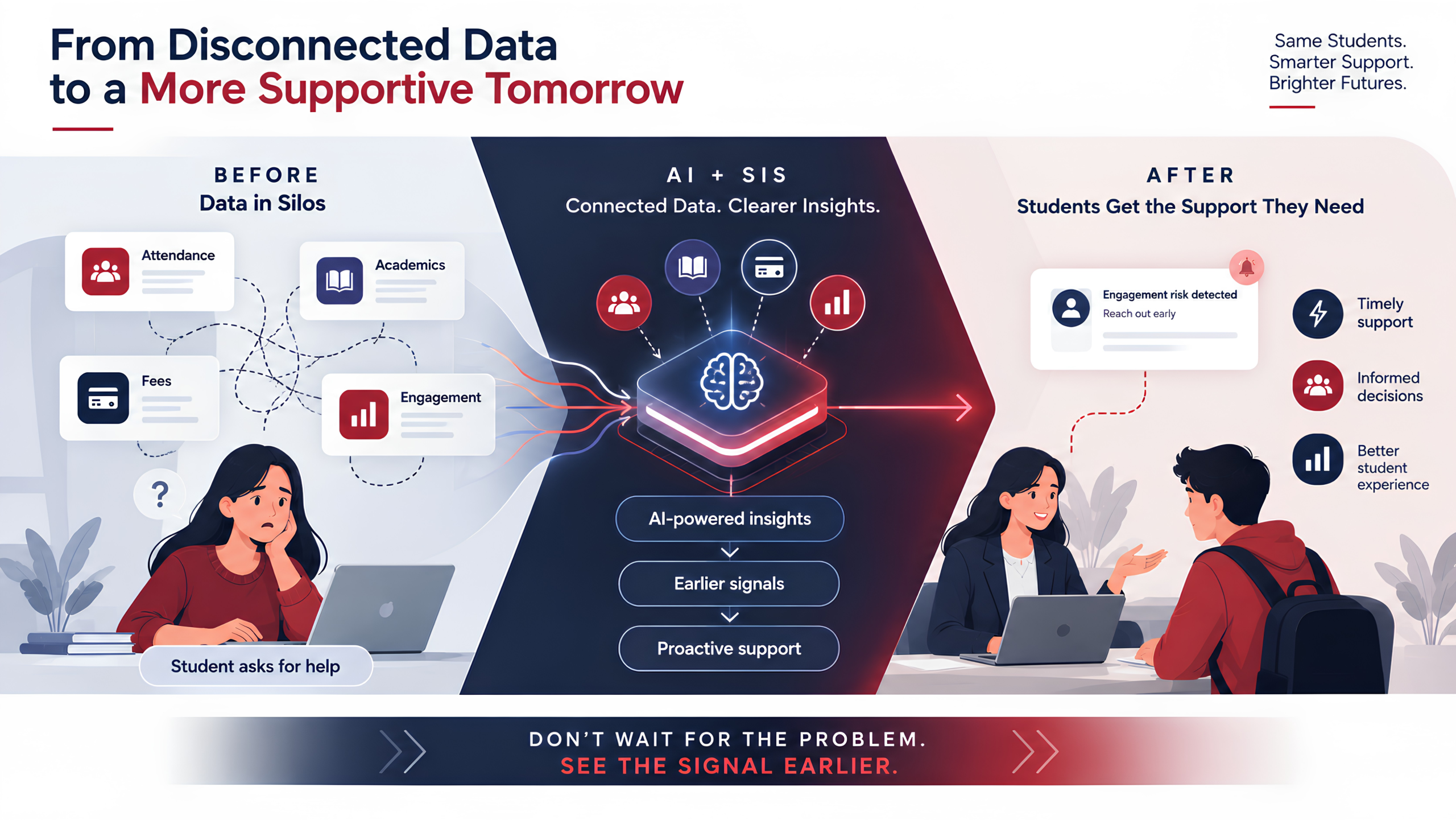
AI can help institutions analyse patterns across admissions, attendance, academic performance and engagement. For example, if a student’s attendance is falling while assessments are being missed, connected data and AI-supported analytics can help authorised staff identify the pattern earlier.

AI should not replace human support. It can help universities identify where human support is needed.

How Can an SIS Make Student Support More Proactive?

Traditional support often follows this pattern:

Student has a problem → Student contacts university → Staff investigates → Support begins.

Connected data can support a more proactive approach:

Relevant signals appear → Staff identify the situation → Appropriate support begins.

For example, attendance, academic progress and outstanding administrative requirements may exist in different systems. When they remain disconnected, each department sees only part of the student’s situation.

An integrated SIS can give authorised staff a broader view, helping them make informed decisions and respond earlier.

What Does Recent Higher Education Research Say About Student Experience?

Salesforce’s 2025 Connected Education Report found that the proportion of surveyed students describing their university experience as “great” increased from 16% in 2021 to 44% in 2025. The report also highlights expectations around quicker responses, personalised admissions and better student support.

This highlights an important point: students do not necessarily judge digital transformation by how sophisticated the underlying software is.

They experience it through simple questions:

Can I find my information?

Was my question answered quickly?

Do I need to submit the same document again?

Technology becomes valuable when it improves these everyday moments.

What Can Universities Learn From CECOS College London’s SIS Experience?

A real-world example comes from CECOS College London.

According to Academia’s published case study, the institution digitised areas including attendance, student records, fees, examinations and academic progress. Academia reports a 70% increase in productivity for the student attendance-marking process, along with reduced student queries related to attendance records and faster departmental reporting.

Students may not care that attendance marking became more productive. What they experience is more practical: fewer discrepancies, easier access to records and faster resolution when something needs clarification.

Operational efficiency becomes student experience when students feel its benefit.

How Can SIS Workflows Remove Friction for Students?

The National Institute of Securities Markets (NISM) is another notable example. 

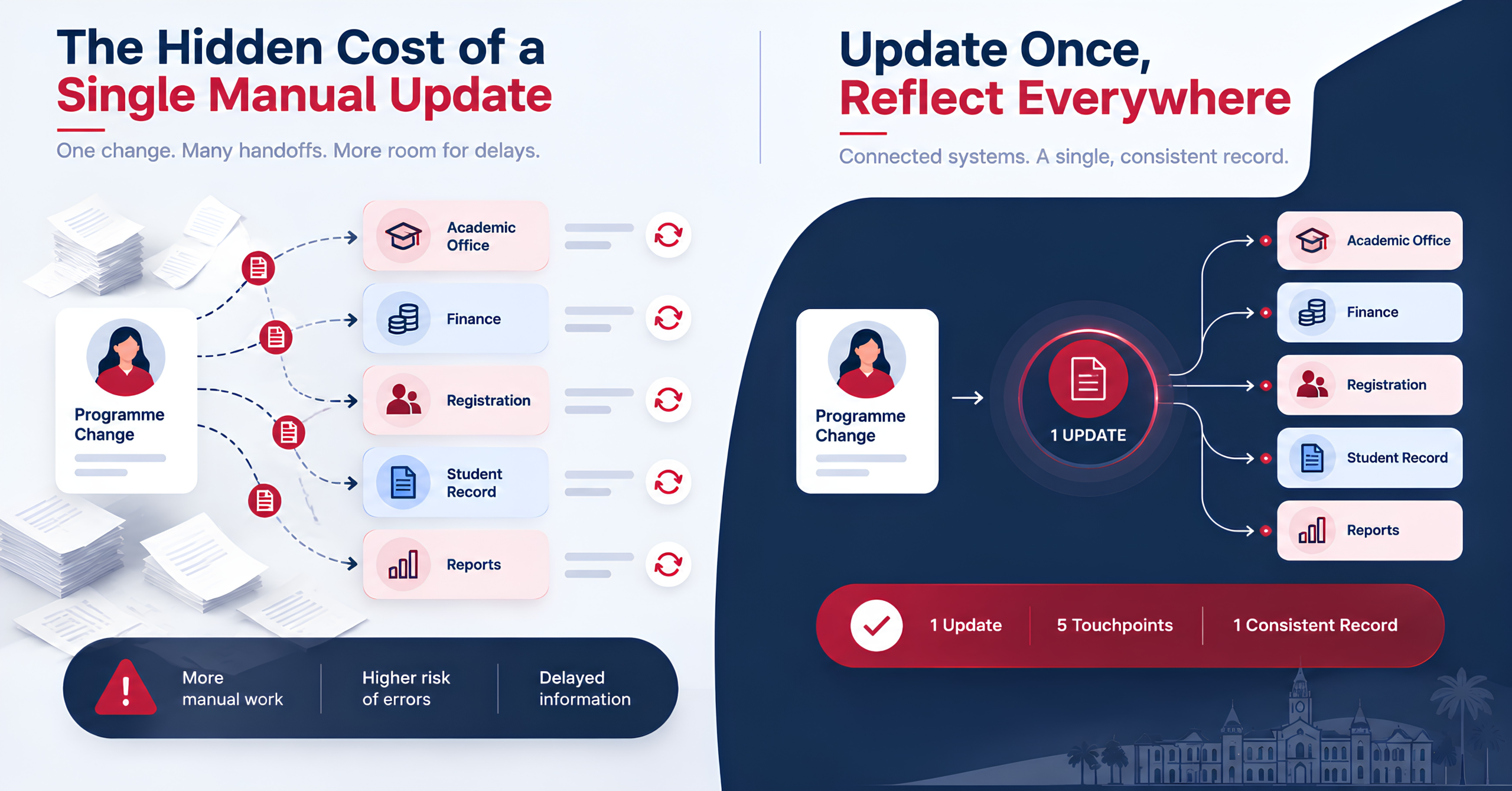
Academia’s published case study describes previously disconnected academic and administrative workflows that created issues around admissions, fees and programme changes. With centralised workflows, a programme change can automatically cancel the previous invoice and apply the relevant new one, while semester-specific credit calculations can also be handled within the workflow.

Consider the student perspective.

Changing a programme is already an important academic decision. The student should not also have to worry about whether the old invoice remains active or whether their academic credits have been updated correctly.

An integrated SIS allows the university’s administrative processes to respond to the student’s change.

One student action can trigger the right institutional actions.

How Can AI Support Students From Admission to Graduation?

AI can add another layer of intelligence to a SIS.

During admissions, it can support data analysis and identify patterns. During the academic journey, analytics can help institutions understand attendance, performance and engagement. Later, connected data can support progression, graduation planning and institutional reporting.


AI-Powered SIS

The more important question for universities is not:

“Does this SIS have AI?”

It is:

“What can AI help us understand or improve across the student lifecycle?”

That shifts AI from a feature to an institutional capability.

How Does an SIS Support Students Through Examinations and Graduation?

The student journey doesn’t stop after registration.

Students move through:

Academics → Attendance → Examinations → Results → Graduation

When these processes are disconnected, students can encounter new administrative friction at every stage.

An integrated SIS maintains continuity across the student’s record, allowing authorised users to access relevant information without rebuilding it each time the student reaches a new stage.

This is particularly important at graduation. Delays in results, transcripts or graduation documentation can overshadow an otherwise positive student experience.

What Should Universities Measure to Know Whether SIS Is Improving Student Experience?

Universities should not measure an SIS only by how many modules have been implemented.

They should measure the friction students experience.

Useful indicators include:

Application processing time
Registration turnaround
Student support queries
Record correction rates
Attendance-related enquiries
Time taken to resolve administrative issues

For example, if attendance has been automated but students still contact staff because records are unclear, the technology has not solved the entire problem.

The real question is:

Did the student’s experience become easier?

What Should Universities Look for in a Modern Student Information System?

A modern Student Information System should connect the major stages of the student lifecycle rather than operate as a collection of isolated modules.

Universities should evaluate its ability to support admissions, registration, academics, attendance, examinations, fees, student services and graduation, along with automation, analytics, integrations and responsible AI capabilities.

A useful way to evaluate an SIS is to test a real student journey:

Application → Admission → Registration → Fees → Academics → Examinations → Graduation

Then ask:

How many times does staff need to manually recreate or update that student’s information?

That question can reveal more about the practical value of an SIS than a long feature list.

How Can an SIS Create One Connected Student Experience?

Students experience the university as one institution, not as a collection of separate departments. 

Admissions, finance, academics, examinations and student services may have different responsibilities internally, but from the student’s perspective they are all part of the same journey.

A modern Student Information System for higher education can connect these experiences so information follows the student, routine processes require less manual intervention, and staff can focus on situations that genuinely need human judgement. AI can add another layer by helping institutions turn connected data into insights and more proactive support.

The goal isn’t simply to digitise university administration.

It is to make the journey from admission to graduation more connected, responsive and student-centred.

Want to see how a modern SIS can connect your student lifecycle?

Request Demo with Academia

Frequently Asked Questions

How does a Student Information System improve student experience?

An SIS can connect admissions, registration, academics, fees, examinations and student services, reducing repeated data entry and making information easier for students and staff to access.

How can AI improve the student experience in higher education?

AI can support analytics, personalised communication and earlier identification of potential support needs, with appropriate human oversight.

What are the benefits of an SIS for higher education institutions?

A SIS can improve administrative efficiency, data consistency, workflow visibility, reporting and continuity across the student lifecycle.

Can an SIS support the complete student lifecycle?

Yes. A comprehensive SIS can support the journey from admission and registration through academics, examinations and graduation.

How does an SIS reduce administrative work?

By connecting workflows and reusing verified information, an SIS can reduce repetitive data entry, manual follow-ups and duplicate records.

Why is connected data important for AI in higher education?

AI depends on reliable data. When student information is fragmented across disconnected systems, generating useful insights becomes more difficult. An integrated SIS provides a stronger foundation for analytics and AI-supported decision-making.

What Are the Best Student Information Systems for Ghanaian Universities in 2026? Academia vs Legacy SIS

Ghanaian universities are managing more student data, academic processes and digital interactions than ever before.

Admissions, registration, academics, examinations, fees and student services all generate information that institutions need to manage accurately and access quickly. When these processes operate across disconnected systems, universities can spend more time moving and reconciling information than actually using it.

That is why choosing a Student Information System (SIS) in 2026 is no longer simply an IT decision.

It is a decision about how effectively a university can manage its student lifecycle, support staff, serve students and use institutional data.

For Ghanaian universities evaluating their next SIS, the key question is not:

“Which system has the most features?”

It is:

“Which system can support the university we want to become?”

Why Are Ghanaian Universities Rethinking Their Student Information Systems?

Every student interaction creates information.

An applicant submits documents. An admitted student registers for courses. A student attends classes, completes assessments, makes payments and eventually graduates.

When information from these activities sits across separate systems and spreadsheets, universities can face:

  • Duplicate student records
  • Repetitive data entry
  • Manual reconciliation
  • Delayed reporting
  • Limited visibility
  • Difficult integrations
  • Slower student services

As universities grow, these challenges become harder to manage.

A modern SIS should therefore do more than maintain student records. It should create a connected digital foundation for the complete student lifecycle.

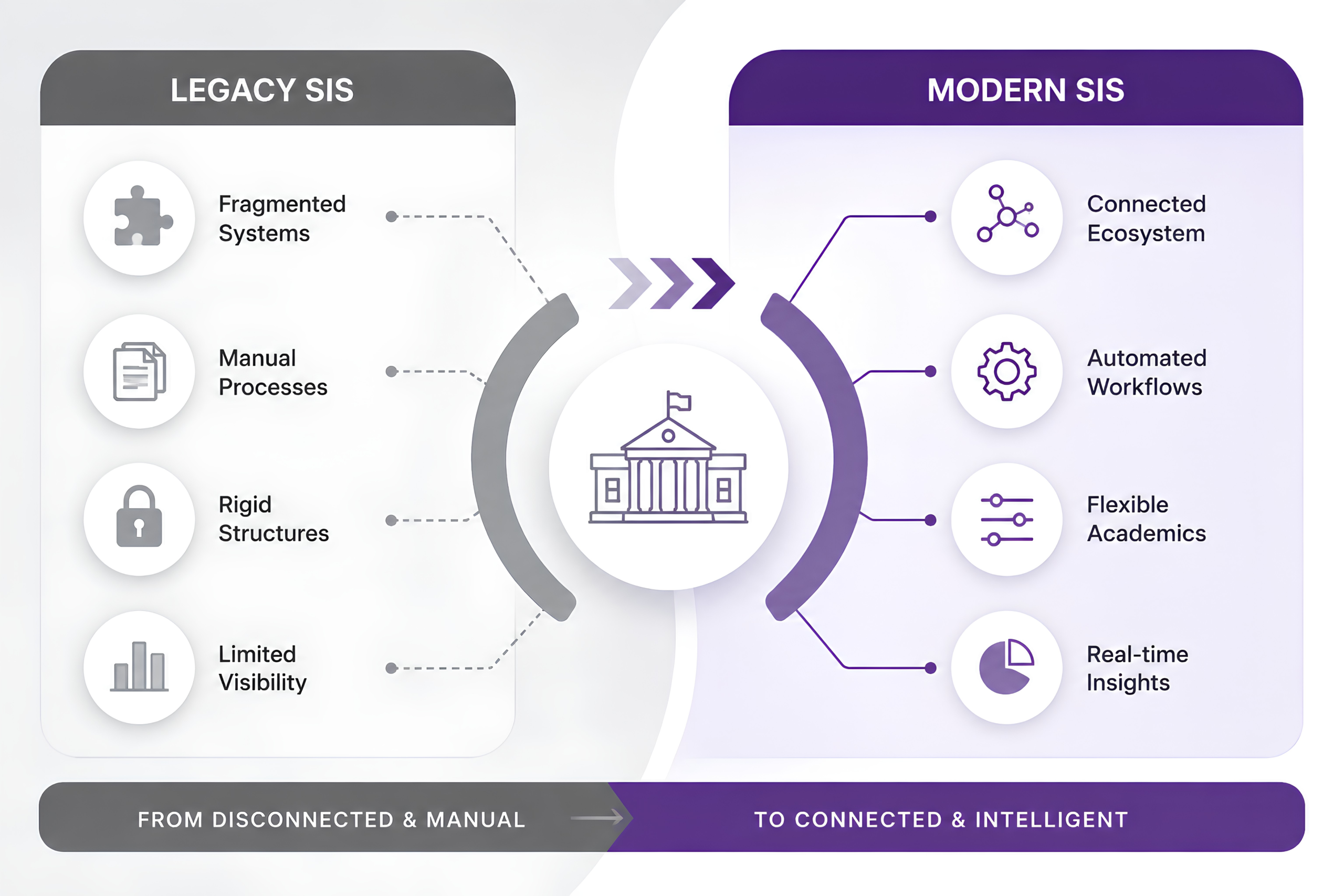
What Is the Difference Between a Legacy SIS and a Modern SIS?

The difference is not simply that one system is older than the other.

A legacy SIS may continue to perform essential administrative functions. However, problems arise when it becomes difficult to integrate, customise, scale or connect with other university systems.

A modern SIS is built around connected processes, accessible data and digital experiences.


Capability Legacy SIS Modern SIS
Student records Record-focused Connected student information
Admissions Process-based Connected to enrolment
Workflows Manual or rigid Automated and configurable
Reporting Manual exports Real-time analytics
Integration Often complex Designed for connected ecosystems
Student experience Administration-focused Digital self-service
Scalability Can become restrictive Built for growth
AI Limited or separate Analytics and AI capabilities

The difference can be summarised simply:

Legacy SIS: “What was recorded?”

Modern SIS: “What is happening, and what should we do next?”

How Is Academia Different From a Legacy SIS?

A university does not operate through isolated departments.

Admissions affects enrolment. Academic information affects progression. Finance depends on accurate student records. Examinations depend on registration and academic data. Student services need relevant information throughout the lifecycle.

According to Academia’s research, a modern SIS should therefore connect institutional processes rather than simply digitise them individually. Its SIS brings together academic and administrative operations with capabilities including automation, analytics, real-time tracking, role-based access and integrations.

The objective is to create a more unified information environment rather than adding another disconnected system.

What Should Ghanaian Universities Look for in an SIS in 2026?

1. End-to-End Student Lifecycle Management

A strong SIS should support the journey from:

Enquiry → Application → Admission → Registration → Fees → Academics → Examinations → Graduation

The real value comes from connecting these stages.

When an applicant becomes an enrolled student, relevant information should not have to be manually recreated across departments.

2. Centralised Student Data

Universities need a reliable student record that authorised users can access according to their roles.

Instead of admissions, academics and finance maintaining separate versions of information, a connected SIS can provide a stronger institutional source of truth.

This gives universities a clearer path from:

Data → Information → Insight

3. Workflow Automation

Admissions approvals, document verification, registration, notifications and student requests can involve repetitive administrative work.

A modern SIS should automate appropriate steps while keeping human decision-making where it matters.

The objective is not simply to reduce manual work. It is to make processes faster, more consistent and easier to manage.

4. Integration With Existing Systems

Universities rarely operate on a single platform. They may already use an LMS, finance system, payment gateway, communication tools and other applications.

A new SIS should therefore work with the existing technology environment.

Universities should ask:

  • Can it integrate with our LMS?
  • Can it connect with finance and payment systems?
  • Can information move securely between platforms?
  • Can new integrations be added as requirements change?

A strong SIS should become the connective layer, not another technology silo.

5. Analytics and AI-Powered Insights

Universities generate large volumes of data, but data is only valuable when it can support better decisions.

Leadership may want to understand enrolment trends. Academic teams may need student performance insights. Finance teams may need visibility into outstanding payments. Modern SIS platforms can bring analytics closer to these everyday decisions.

According to Academia’s expertise, connected data and real-time insights can help institutions improve visibility and make more informed decisions across university operations.

This need for better use of data is also reflected at the national level. The Ghana Statistical Service’s National Education Report draws on administrative education data to identify patterns and trends and highlights how such data can support informed decision-making, targeted interventions and resource allocation. For universities, this reinforces the importance of having student and institutional data that is accurate, connected and readily accessible.

The important point is that AI should be built on reliable institutional data rather than treated as a standalone feature. When the underlying data is connected and consistently maintained, AI-powered analytics can provide greater value for planning, monitoring and decision-making.

6. Student Self-Service

Students increasingly expect to complete routine university activities digitally.

A modern SIS should make it easier to:

  • Access academic information
  • View attendance
  • Check examination information
  • View fees
  • Receive notifications
  • Submit requests
  • Access timetables and results

Better self-service can improve convenience for students while reducing repetitive enquiries for staff. It also gives students greater visibility into their own academic journey, allowing them to access relevant information without depending on manual assistance for every routine interaction.

When Should a Ghanaian University Consider Replacing Its Legacy SIS?

A university does not need to replace a system simply because it is old.

The stronger question is whether the existing system is restricting institutional performance.

Warning signs include:

  • Heavy reliance on spreadsheets
  • Repeated data entry
  • Slow report preparation
  • Difficult system integrations
  • Limited student self-service
  • Fragmented academic and administrative information
  • Difficulty supporting new programmes or growth

If several of these problems exist, the issue may no longer be individual processes.

It may be the technology foundation supporting those processes.

How Should Universities Compare Academia With a Legacy SIS?

The right comparison is not simply new versus old.

Universities should compare both options against their actual operational and strategic requirements.

Evaluation Area Legacy SIS Academia SIS
Student lifecycle May depend on separate systems Connected lifecycle approach
Automation Often limited Configurable workflows
Data visibility Department-focused Role-based access
Reporting Manual or static Real-time analytics
Integration Can require workarounds Integration capabilities
Student access Varies Web and mobile access
Scalability Can become restrictive Designed for evolving needs
AI Often limited AI-enabled capabilities

This does not mean every legacy SIS is automatically unsuitable.

The right choice depends on the university’s infrastructure, requirements, student population and long-term digital strategy.

The key is choosing a system that solves today’s challenges without creating tomorrow’s limitations.

How Should Ghanaian Universities Evaluate an SIS Vendor?

A vendor demonstration should not be treated as a product tour.

Universities should ask vendors to demonstrate real scenarios:

Admissions: How does an applicant move from enquiry to admission?

Registration: How are academic rules and approvals managed?

Student records: How can authorised staff access information across the lifecycle?

Reporting: How quickly can leadership access institutional insights?

Integration: How will existing systems connect?

Migration: How will historical student data be transferred and validated?

Scalability: Can the platform support new programmes and growing student numbers?

Security: How are access, privacy and audit requirements managed?

According to Academia, universities should evaluate an SIS not only on its current functionality but also on its ability to evolve with changing institutional requirements. Scalability, configurability, integrations, automation and analytics should therefore be considered alongside core student management capabilities.

Why Is the SIS Decision Bigger Than an IT Upgrade?

An SIS touches almost every major function of a university.

The registrar needs reliable records. Admissions needs efficient application management. Academic teams need progression visibility. Finance needs accurate student information. Students need convenient services. Leadership needs reliable insights.

When these requirements are connected through one digital environment, the university can operate with greater consistency.

That is why universities should not simply ask:

“Can this system digitise our existing processes?”

They should ask:

“Can this system help us improve how the university operates?”

How Can Academia Support Ghanaian Universities?

Academia by Serosoft provides a Student Information System designed to connect academic and administrative operations across the student lifecycle.

Its capabilities span areas including admissions, academics, attendance, examinations, fees, student services, analytics, reporting and integrations.

The platform is designed to help institutions centralise information, automate workflows, improve student self-service and gain greater visibility across university operations.

For Ghanaian universities, this creates an opportunity to move beyond simply replacing an outdated database.

It means building a more connected environment where:

Student data is accessible.

Workflows are automated.

Systems are integrated.

Insights are easier to access.

Students receive better digital services.

Leadership gains greater visibility.

What Is the Future of Student Information Systems in Ghana?

The future of SIS technology is not about adding another software layer.

It is about creating a stronger digital foundation for the entire institution.

The progression is:

Legacy SIS → Connected SIS → Data-driven SIS → AI-enabled institution

For Ghanaian universities, the best SIS in 2026 may therefore not be the one with the longest feature list.

It may be the one that can connect today’s operations while preparing the institution for tomorrow’s demands.

A modern SIS should not simply record the student’s journey.

It should help the university understand, manage and improve that journey.

Ready to Move Beyond Your Legacy SIS?

If your university is still dealing with fragmented student data, manual workflows, difficult integrations or limited visibility, it may be time to see what a modern SIS can change.

See how Academia can connect your student lifecycle, automate university operations and create a stronger foundation for data-driven decision-making.

Book a Personalised Academia SIS Demo

Frequently Asked Questions

1. What is the best Student Information System for Ghanaian universities in 2026?

The best SIS depends on the university’s requirements, academic structure, technology environment and digital transformation goals. Universities should evaluate lifecycle management, automation, integration, analytics, security, scalability and student experience.

2. What Are the Key Differences Between Modern and Legacy SIS Platforms? 

A legacy SIS may primarily focus on maintaining student records and established processes. A modern SIS connects student data, workflows, integrations, analytics and student-facing services across the complete lifecycle.

3. Why should a Ghanaian university replace its legacy SIS?

Replacement may be worth considering when fragmented data, manual processes, difficult integrations, slow reporting, or limited student self-service restrict university operations and growth.

4. Can a modern SIS integrate with existing university systems?

Yes. Integration is an important consideration because universities typically rely on multiple platforms, including LMS, finance, payment and communication systems.

5. Can an SIS support AI and predictive analytics?

Modern SIS platforms can use AI and analytics to support reporting, forecasting and decision-making. However, meaningful AI insights depend on reliable and connected institutional data.

6. What should universities consider before selecting an SIS?

Universities should evaluate student lifecycle coverage, configurability, automation, integrations, analytics, security, student self-service, scalability, implementation support and long-term adaptability.

What Makes a Great Student Information System? These Features Every University Should Prioritise

A Student Information System (SIS) is often described as the technology behind student records, admissions and academic administration. But for modern universities, that definition is no longer enough.

Students expect faster, simpler digital services. Faculty need timely access to academic information. Administrators need connected workflows instead of spreadsheets and repetitive data entry. And university leaders need reliable information to make decisions about enrolment, progression, resources and institutional performance.

The result is a fundamental shift in what universities should expect from an SIS.

A great SIS should not simply store student information. It should connect the student lifecycle, automate routine work, make institutional data more actionable and give every stakeholder a better way to interact with the university.

So, what separates a genuinely effective SIS from a system that simply checks the basic requirements?

What Should a Great Student Information System Do?

The best SIS platforms are built around a simple principle: student information should move with the student, not get trapped in departmental systems.

From enquiry and application to enrolment, academics, attendance, examinations, fees, student services and graduation, every stage creates information that can be valuable to another part of the institution.

A strong SIS should help universities:

  • Connect the complete student lifecycle
  • Reduce manual administrative work
  • Centralise student information
  • Support flexible academic structures
  • Automate repetitive workflows
  • Improve student self-service
  • Provide real-time institutional visibility
  • Integrate with existing systems
  • Support secure data management
  • Scale as the institution grows

The goal is not simply to have more technology. It is to have technology that makes the university work better.

Why Is a Connected Student Lifecycle Important?

A university may have separate systems for admissions, academics, finance, examinations, attendance and student services. The problem begins when these systems do not communicate effectively.

A student may submit information during admission, provide the same information again during registration and encounter another disconnected process when accessing finance or examination services.


Student Lifecycle

A connected SIS creates a different experience:

Enquiry → Admission → Fees Enrolment → Academics → Attendance → Assessment → Graduation

Information can move through these stages while authorised users access the information relevant to their role.

According to Academia’s research, a modern SIS should be viewed as an institutional platform rather than simply a student database. Connecting academic, administrative and student-facing processes can give universities greater visibility across the student lifecycle while reducing unnecessary duplication.

Which SIS Features Should Universities Prioritise?

Not every SIS feature has the same strategic value. Universities should focus on capabilities that solve real operational challenges and remain useful as institutional requirements evolve.

1. Centralised Student Information

At the foundation of every effective SIS is a reliable student record.

Universities should be able to manage personal details, academic history, programme information, enrolment status, documents and other relevant records within a structured environment.

This creates a single source of truth, reducing conflicting information across departments and the need for staff to manually reconcile records.

2. End-to-End Admissions and Enrolment

Admissions should not exist as an isolated process.

A modern SIS should connect enquiries, applications, document submission, evaluation, admission decisions and enrolment with the student’s ongoing institutional record.

This creates a smoother transition from prospective student to enrolled student, while reducing repetitive data entry and improving visibility into applications and enrolment activity.

3. Flexible Academic Management

Universities are constantly changing. New programmes are introduced, curricula evolve, credit structures change, and institutions adopt new academic pathways.

A rigid SIS can turn every change into a technology problem.

A strong platform should support configurable programmes, courses, curricula, academic rules, credits, registration and progression without requiring extensive redevelopment whenever the institution changes its academic model.

From Academia’s perspective, flexibility is one of the most important characteristics of a future-ready SIS. The platform should adapt to the institution’s academic structure rather than forcing the institution to work around its technology.

4. Automated Workflows

University employees spend significant time managing approvals, checking information, sending reminders and moving requests between departments.

Workflow automation can support areas such as:

  • Admissions approvals
  • Course registration
  • Academic requests
  • Document verification
  • Fee processes
  • Examination workflows
  • Student services
  • Notifications and approvals

The benefit is not automation for its own sake. It is giving staff more time to focus on work that requires human judgement.

Why Should an SIS Include Real-Time Analytics?

Universities generate enormous amounts of information every day. But having data and being able to use it are two different things.

University leaders may want to know:

  • How are enrolments changing?
  • Which programmes are growing?
  • Where are students struggling academically?
  • How are outstanding fees changing?
  • Where are operational bottlenecks emerging?

If answering these questions requires manually collecting spreadsheets from multiple departments, the information may already be outdated.

A modern SIS should provide dashboards, reports and analytics that turn institutional data into usable insight.

The value is moving from:

“What happened?” → “What is happening?” → “What should we do next?”

How Can an SIS Improve the Student Experience?

Students rarely think in terms of university departments. They simply expect the university to work.

They want to apply, register, check their timetable, view attendance, access results, make payments and receive important updates without navigating disconnected processes.

This makes student-facing functionality an essential part of a modern SIS.

A strong platform should provide convenient digital access to relevant services through web and mobile channels. When students can access information themselves, universities can also reduce unnecessary enquiries and administrative workload.

The result is a shift from administration-first technology to student-centred technology.

How Important Is Integration in an SIS?

No university operates entirely within one platform.

Institutions may already use an LMS, finance applications, payment gateways, identity systems, communication tools and other specialised applications.

Replacing everything simply because a university is implementing a new SIS is rarely practical.

Instead, the SIS should be able to work with the technology the institution already uses.

Universities should ask:

  • Can the SIS integrate with our LMS?
  • Can it connect with finance and payment systems?
  • Can existing applications continue to operate?
  • Can data move securely between systems?
  • Can integrations scale as the technology ecosystem grows?

A strong SIS should become the connective layer, rather than another isolated application.

What Security Features Should Universities Expect From an SIS?

Student information can include personal, academic and financial data, making security a core SIS requirement.

Universities should look for capabilities such as:

  • Role-based access
  • Secure authentication
  • Controlled data access
  • Audit trails
  • Secure data transmission
  • Data backup and recovery
  • Appropriate privacy controls

Security, however, is not only about technology. Universities also need clear governance, policies and staff practices around how information is accessed and used.

Can a Modern SIS Scale With a University?

A system that works for a university today may not work five years from now.

Institutions grow, student numbers increase, campuses expand, and new programmes are launched. A scalable SIS should be able to support:

More students + More programmes + More campuses + More data + More integrations

without becoming increasingly difficult to manage.

Universities should therefore evaluate scalability not just in terms of infrastructure, but also academic structures, workflows, integrations and institutional growth.

How Should Universities Evaluate an SIS?

A long feature list does not necessarily mean a better SIS.

Instead of asking “How many modules does this vendor have?”, universities should ask whether the platform can solve their most important operational challenges.


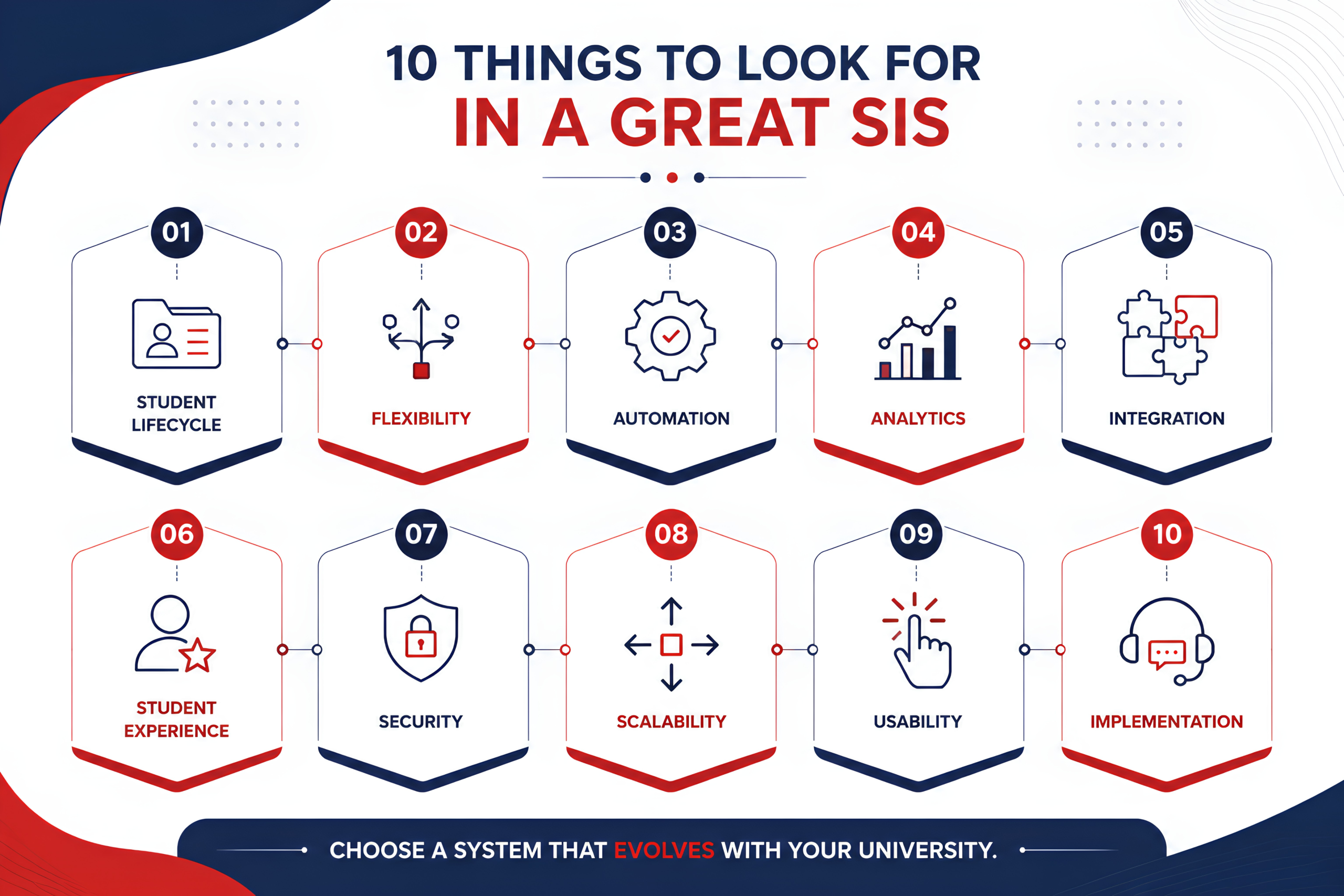
What to Evaluate Why It Matters
Student lifecycle Connects processes from admission to graduation
Academic flexibility Supports changing programmes and structures
Automation Reduces repetitive administrative work
Analytics Enables data-informed decisions
Integration Connects existing university technology
Student experience Improves digital access and self-service
Security Protects sensitive student information
Scalability Supports institutional growth
Usability Encourages adoption across stakeholders
Implementation support Helps ensure successful transformation

According to Academia’s research, universities should evaluate an SIS based not only on what it can do today, but also on how well it can evolve with the institution. A future-ready platform should support changing academic requirements, growing student populations, expanding integrations and increasingly data-driven decision-making.


Modern Student Information System

How Can Academia Support a Modern University?

Academia by Serosoft brings student lifecycle management, academic administration and institutional operations together through a unified higher education platform.

Its capabilities cover areas including admissions, academics, attendance, examinations, fees, student records, student services, analytics and reporting.

The platform is designed to help universities move away from disconnected processes towards a more integrated digital environment.

For university leaders, this means greater visibility.

For staff, it can mean fewer repetitive processes.

For students, it can mean easier access to services.

For the institution, it creates a stronger digital foundation for future growth.

The real question is therefore not whether your university needs an SIS.

It is whether your current system is helping your university move forward or holding it back.

What Is the Future of Student Information Systems?

The future of SIS technology is moving beyond record management.

Universities increasingly need platforms that combine:

Connected data + Automation + Analytics + Integration + Student experience

The transformation can be summarised simply:

From records → to intelligence

From departments → to connected processes

From manual work → to automation

From reactive administration → to proactive student support

A great SIS is ultimately not defined by how many features it has.

It is defined by how much better it helps the university operate, serve students and make decisions.

Ready to See What a Modern SIS Can Do for Your University?

Your university shouldn’t have to work around disconnected systems, manual processes and limited visibility.

See how Academia can connect your student lifecycle, automate university workflows and turn institutional data into actionable insight.

Book a Demo and explore what a more connected university experience could look like for your institution.

Frequently Asked Questions

1. What is a Student Information System?

A Student Information System is a platform used by educational institutions to manage student information and processes such as admissions, enrolment, academics, attendance, examinations, fees, records and student services.

2. What are the most important features of an SIS?

Key features include centralised student records, admissions and enrolment, academic management, workflow automation, analytics, reporting, integrations, student self-service, security and scalability.

3. Why is integration important in a Student Information System?

Integration allows an SIS to exchange information with other university systems such as LMS, finance, payment and communication platforms. This reduces data silos and repetitive data entry.

4. How can an SIS improve the student experience?

An SIS can give students digital access to services such as registration, attendance, timetables, fees, examinations, results and notifications through web and mobile channels.

5. How can universities choose the right SIS?

Universities should evaluate an SIS based on academic flexibility, lifecycle coverage, automation, analytics, integrations, security, scalability, usability, implementation support and long-term adaptability.

6. Is a modern SIS only useful for administrative teams?

No. A well-designed SIS can support students, faculty, administrators and university leadership by connecting relevant information and workflows across the institution.

How Can South African Universities Digitise Student Services with Academia SIS?

Student services are becoming one of the most visible parts of the university experience.

For students, the quality of a university’s digital services is often measured in simple moments: How quickly can I register? Can I check my fees without visiting an office? Where can I find my timetable? How easily can I access my results? Can I track an application or request without repeatedly contacting the university?

For institutions, however, delivering these experiences requires much more than putting forms online. Admissions, registration, academics, fees, attendance, examinations and student support all generate information that needs to work together.

This is where a modern Student Information System (SIS) can make a difference.

South African universities are increasingly focusing on integrated student lifecycle systems, automation and digital service delivery. For example, the Central University of Technology’s current student academic lifecycle project aims to integrate and automate processes from application and admission through progression, registration and graduation.

The opportunity is clear: digitise the service, connect the data and make the student journey easier.

Why Are South African Universities Digitising Student Services?

Traditional student services often depend on a combination of departmental systems, emails, spreadsheets, paper-based processes and in-person interactions.

This can create friction for both students and staff.

A student may need to contact one department about registration, another about fees and another about academic records. Staff, meanwhile, may have to search across different systems before they can provide a complete answer.

The challenge is therefore not simply to digitise individual services.

It is to connect them.

A modern SIS can bring together:

Admissions → Registration → Fees → Academics → Attendance → Examinations → Student Services → Graduation

This gives students a more consistent digital experience while providing staff with better access to the information they need.

What Student Services Can Be Digitised Through an SIS?

A modern SIS can support a wide range of student-facing and administrative processes.

These can include:

  • Online applications and admissions
  • Student registration
  • Course and programme management
  • Timetables
  • Attendance
  • Examination services
  • Results and academic records
  • Fee information and payments
  • Scholarships and financial support
  • Student requests and approvals
  • Communication and notifications
  • Graduation processes

The important point is that these services should not operate as disconnected digital islands.

When they are connected through a common student record, information can move more efficiently between processes.

According to Academia’s research, the objective of a modern SIS is to unify academic and administrative workflows on a single digital platform, helping institutions centralise data, automate operations and improve student experience.

How Can a Connected SIS Improve the Student Experience?

Students do not see the university as a collection of departments.

They see it as one institution.

If a student changes a programme, for example, relevant information may need to be reflected across registration, academic records, fees and other services. When systems are disconnected, the student may have to repeat the same request several times.

A connected SIS can reduce this friction by allowing relevant information to flow across the student lifecycle.


university erp

This can help universities provide:

Faster Access

Students can access relevant information without depending on manual responses from multiple departments.

Self-Service

Students can complete routine tasks, submit requests and access information digitally.

Consistent Information

Connected records reduce the risk of students receiving different information from different departments.

Better Communication

Automated notifications can keep students informed about applications, registration, fees, examinations and other important activities.

The result is a shift from students chasing information to information being available when students need it.

Which University Processes Should Be Automated First?

Not every process needs the same level of automation.

Universities should start with high-volume, repetitive processes where manual intervention creates the greatest delays.

These may include:

Admissions: Application processing, document verification and admission workflows.

Registration: Course registration, approvals and academic clearance.

Attendance: Digital attendance capture and academic tracking.

Examinations: Scheduling, assessment workflows and results processing.

Fees: Fee visibility, payment processes and financial information.

Student Requests: Approvals, documents and administrative requests.

Automation can reduce repetitive work while creating more consistent processes.

Academia’s South Africa offering specifically highlights automated digital workflows across areas such as admissions, academic tracking, attendance, examinations and results processing.

How Does Student Data Improve Digital Services?

Digitising a process creates value, but connecting the information behind that process creates even more.

Consider a student’s registration journey.

The university already has information about the student’s programme, academic history, fees and eligibility. If these records remain in separate systems, registration may require several manual checks.

With a connected SIS, authorised staff and digital workflows can access the relevant information within the same environment.

This can create a simpler process:

Student record → Eligibility → Registration → Approval → Confirmation

The same principle can apply across examinations, fees, attendance and student support.

The result is not simply faster administration.

It is better use of institutional data.

What Role Does Mobile and Self-Service Access Play?

Digital transformation is incomplete if students still need to rely heavily on physical offices for routine services.

A modern SIS should make relevant services accessible through convenient digital channels.

Students may need to:

  • View academic information
  • Check attendance
  • Access results
  • Register for courses
  • View fee information
  • Receive notifications
  • Submit requests
  • Track important academic activities

Academia’s platform provides mobile access for students and staff, alongside digital-first admissions and enrolment capabilities.

This can help universities move towards a self-service model, where staff focus more on complex cases, and students can manage routine activities independently.

How Can Universities Improve Staff Efficiency Through Digital Services?

Student-facing digital services can also transform the staff experience.

When students can independently access information and complete routine tasks, staff spend less time responding to repetitive enquiries.

Automation can further reduce manual coordination.

For example:

Manual process:
Student request → Email → Department review → Follow-up → Approval → Student notification

Connected process:
Student request → Digital workflow → Approval → Automated notification

This creates greater consistency while reducing unnecessary administrative effort.

A connected SIS can also give staff a clearer view of the student’s information, helping them respond without repeatedly requesting data from other departments.

How Can Analytics Improve Student Services?

Digitisation generates valuable institutional data.

Universities can use this information to understand:

  • Which services receive the most requests?
  • Where are students experiencing delays?
  • Which processes require frequent manual intervention?
  • How quickly are applications being processed?
  • Where are registration bottlenecks occurring?
  • Which student services are being used most?

Analytics can turn these observations into actionable insights.


Student Services

From Academia’s perspective, real-time insights are an important part of modern student management because they allow institutions to monitor operations and make faster, more informed decisions. Its SIS provides real-time tracking, role-based access and analytics capabilities across institutional operations.

The objective is to move beyond asking “How many requests did we process?” to understanding “Where can we improve the student experience?”

What Should South African Universities Look for in a Digital Student Services Platform?

Choosing an SIS should involve more than checking whether it has individual modules.

Universities should evaluate how well the platform connects the entire student experience.


Capability Why It Matters
Student lifecycle management Connects services from admission to graduation
Self-service Gives students easier access to routine services
Workflow automation Reduces manual processing and delays
Centralised data Creates a consistent student record
Analytics Helps identify bottlenecks and trends
Mobile access Supports convenient digital engagement
Integration Connects existing university systems
Security Protects sensitive student information
Scalability Supports growing student populations
Local requirements Supports South African academic and reporting needs

For South African institutions, local requirements are particularly important. Academia’s South Africa platform highlights capabilities around NSFAS management, NSC results integration, HEMIS and TVET MIS reporting, alongside core student lifecycle processes.

How Can Academia SIS Help South African Universities Digitise Student Services?

Academia by Serosoft provides a Student Information System designed to connect academic and administrative workflows within a unified digital environment.

For South African institutions, the platform supports the student lifecycle across admissions, academics, attendance, examinations, fees and student services, while also providing workflow automation, analytics and mobile access.

The value lies in bringing these capabilities together rather than treating every service as a separate technology project.

Universities can use the platform to:

  • Centralise student information
  • Digitise admissions and enrolment
  • Automate routine workflows
  • Improve academic tracking
  • Provide student self-service
  • Support mobile access
  • Improve institutional visibility
  • Connect existing systems
  • Support local reporting requirements

Academia’s approach is to create a connected digital environment where student information, workflows and services work together across the complete lifecycle.

That means digital transformation can become more than moving paper forms online.

It can become a way to redesign how the university serves students.

What Does the Future of Digital Student Services Look Like?

South African higher education is moving towards more connected, student-centred digital environments.

Recent institutional initiatives show that universities are looking beyond individual digital services towards integrated student lifecycle management, automation and data-driven decision-making.

The future model is not:

More portals → More passwords → More disconnected systems

It is:

One connected student journey → Integrated services → Better data → Faster decisions → Better student experience

For university leaders, this creates an important opportunity.

The question is no longer simply “Which student services can we digitise?”

It is:

“How can we connect our digital services so the entire student experience becomes simpler?”

Ready to Digitise Your Student Services?

Your students should not have to navigate disconnected systems to get simple things done.

Academia can help South African universities connect student information, automate workflows and create a more seamless digital student experience.

Explore Academia SIS and see how your institution can move towards a more connected, efficient and student-centred campus.

Frequently Asked Questions

1. What does digitising student services mean for South African universities?

Digitising student services means moving processes such as admissions, registration, fees, examinations, student requests and academic records into connected digital workflows that students and staff can access more efficiently.

2. How can an SIS improve student services?

An SIS can centralise student information, automate workflows, enable self-service, improve communication and give authorised staff better access to relevant student records.

3. Which student services can be digitised?

Universities can digitise admissions, registration, attendance, examinations, results, fees, student requests, communication and graduation-related processes through an integrated SIS.

4. Why is self-service important for university students?

Self-service allows students to access information and complete routine tasks without depending on manual assistance for every interaction. This can improve convenience while reducing repetitive administrative enquiries.

5. What should South African universities consider when choosing an SIS?

Universities should evaluate lifecycle coverage, automation, integrations, analytics, mobile access, security, scalability and support for South African requirements such as HEMIS and NSFAS-related processes.

6. Can Academia SIS integrate with existing university systems?

Yes. Academia states that its SIS can integrate with third-party and legacy platforms, allowing institutions to maintain secure data flows while modernising their student information environment.

Best Student Information Systems for Indian Universities (2026): Academia vs Legacy SIS

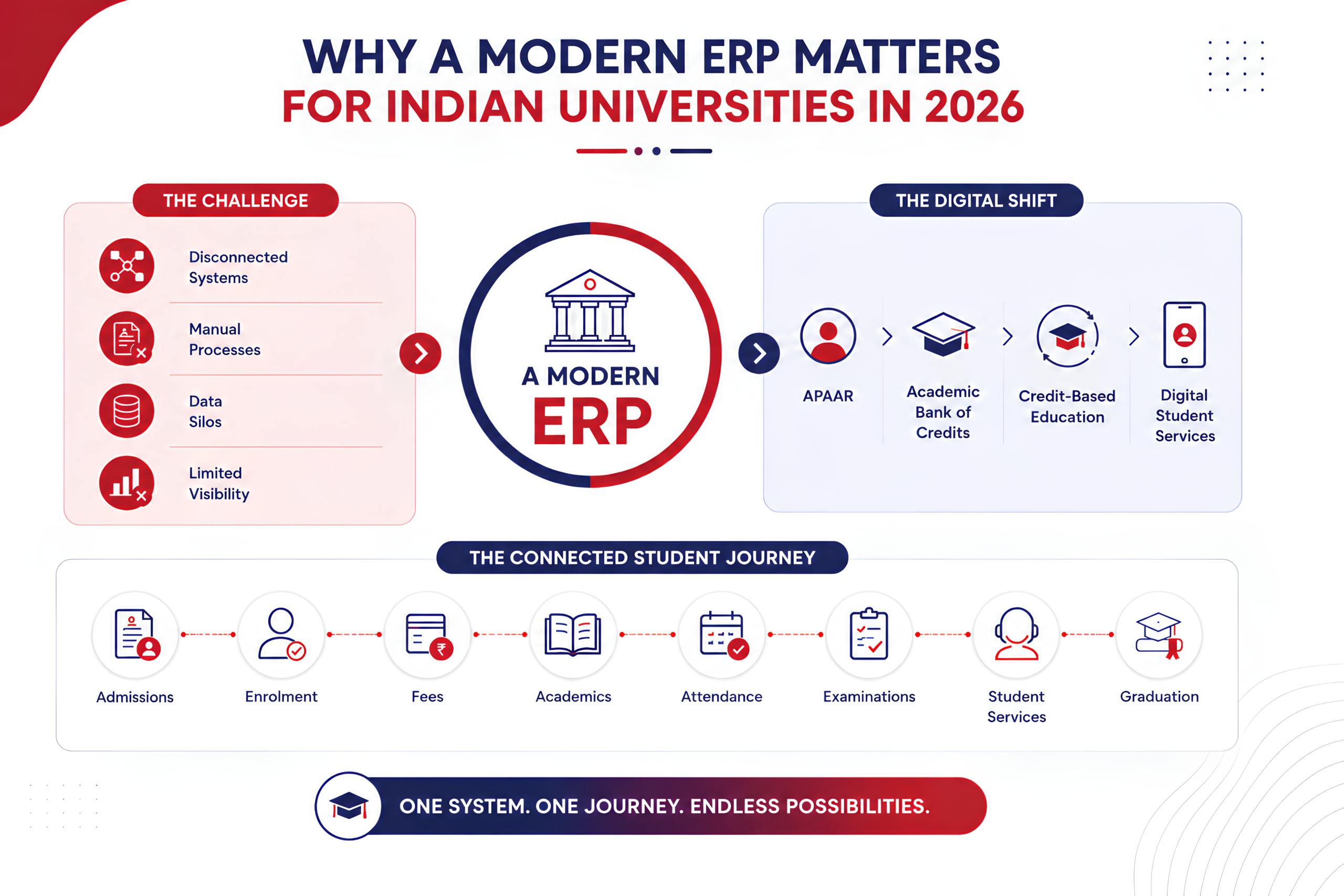
India’s higher education ecosystem is becoming increasingly digital, complex and student-centric. Universities are managing larger and more diverse student populations while adapting to changing academic structures, digital records, credit mobility and growing expectations for seamless online services.

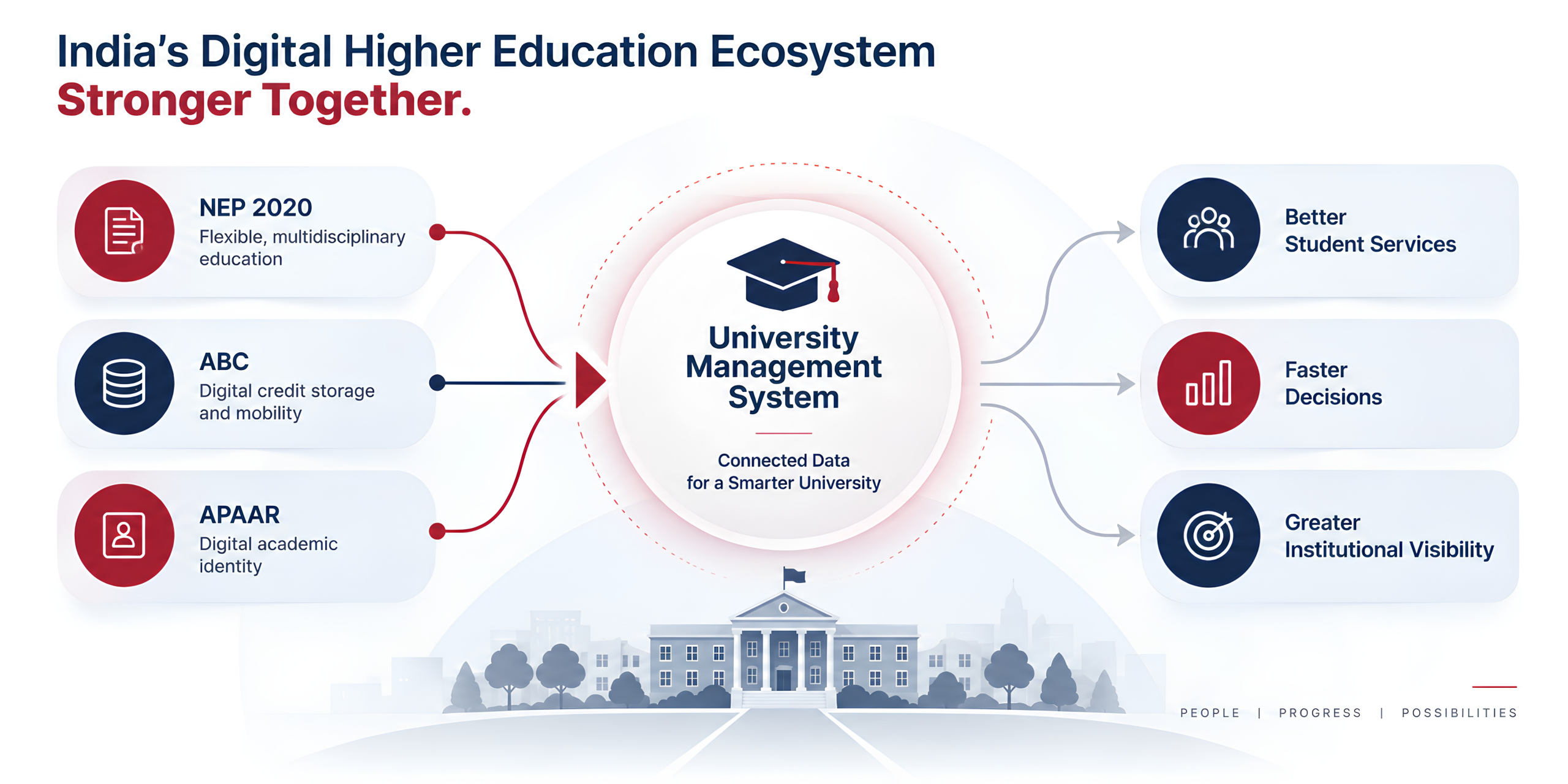
The Ministry of Education’s latest annual report notes 1,213 universities listed on the All India Survey on Higher Education portal, with 1,208 universities responding to the 2022–23 survey. Higher education is also evolving around initiatives such as NEP 2020, the Academic Bank of Credits and Automated Permanent Academic Account Registry, making connected and reliable student data increasingly important.

In this environment, a Student Information System (SIS) is no longer simply a place to store student records. It needs to connect admissions, enrolment, academics, examinations, fees, student services, reporting and institutional decision-making. The real question for universities in 2026 is whether their existing SIS can support this level of connected, digital operation.

What Are the Student Information System Challenges Facing Indian Universities?

Many universities still operate with a combination of legacy software, spreadsheets, departmental applications and manual workflows.

This can create gaps between admissions, academics, finance, examinations and student services. A student’s information may exist across several systems, requiring staff to repeatedly enter, verify or reconcile data.

Common challenges include:

  • Fragmented student records
  • Manual admission and enrolment workflows
  • Rigid academic structures
  • Difficult credit management
  • Limited real-time institutional visibility
  • Spreadsheet-dependent reporting
  • Integration challenges with newer platforms
  • Scalability issues across campuses and programmes

These challenges become more significant as Indian universities adopt more flexible academic structures under NEP 2020.

The Academic Bank of Credits ecosystem, for example, depends on timely academic-record uploads linked with APAAR IDs to support credit accumulation, transfer and redemption.

This means the SIS has an increasingly important role to play in maintaining structured, accurate and accessible academic information.

How Is Academia Different From a Legacy SIS?

The fundamental difference is not simply that one system is newer than another. It is how the system is designed to support university operations.

According to Academia, the difference between a modern SIS and a legacy system goes beyond technology. Universities need a platform that can adapt to changing academic structures, connect institutional systems and provide real-time visibility across the student lifecycle.

Legacy Vs Modern SIS

A traditional legacy SIS may primarily focus on storing records and supporting established administrative workflows. A modern SIS is expected to connect the complete student lifecycle, integrate with other systems, provide real-time visibility and adapt as institutional requirements change.

Area Legacy SIS Academia SIS
Student lifecycle Often fragmented Connected end-to-end
Academic structures Can be rigid Configurable and flexible
Integrations Often customised Designed for interoperability
Reporting Frequently dependent on data extraction Real-time analytics and reports
Automation Limited or workflow-specific Automated workflows across functions
Scalability May require extensive customisation Built for large and multi-campus institutions
Student experience Primarily administrative Digital and student-centric
Data visibility Department-focused Institution-wide

Academia’s India platform is specifically positioned around configurable academic structures, integrated workflows, real-time institutional visibility, compliance-ready reporting and scalability for large and multi-campus institutions.

What Should Indian Universities Look for in a Modern Student Information System?

Choosing an SIS in 2026 requires looking beyond the number of modules a vendor offers.

The more important question is whether the system can support the university’s academic model, regulatory environment, operational complexity and future growth.

From Academia’s perspective, flexibility is becoming one of the most important SIS requirements for Indian universities. As academic structures evolve, universities need systems that can adapt to new programmes, credit frameworks and institutional processes without extensive redevelopment. 

Flexible Academic and Credit Management

Indian universities increasingly need systems that can support multidisciplinary programmes, flexible curricula, credit-based structures, and evolving academic regulations.

A rigid SIS can make every structural change dependent on vendor customisation.

Academia supports configurable academic structures and flexible credit management, helping institutions adapt their workflows as programmes and academic policies evolve.

Connected Admissions and Enrolment

Admissions should not operate as a separate process from the student’s academic record.

A modern SIS should connect enquiries, applications, document submission, admission decisions, enrolment and subsequent academic processes.

This reduces repeated data entry and creates a stronger foundation for the student’s complete digital record.

Centralised Student Records

A university needs a reliable source of student information that authorised teams can access across departments.

Academia’s SIS centralises student data and provides role-based access, allowing academic and non-academic teams to work with relevant information while maintaining controlled access.

Real-Time Reporting and Analytics

University leadership should not have to wait for multiple departments to manually compile information before answering basic institutional questions.

Modern SIS platforms can provide dashboards and reports covering student activity, academics, finance and operations.

Academia’s India platform highlights a single source of truth, department-wise dashboards, 800+ graphical and tabular reports and accreditation and compliance reporting.

How Does NEP 2020 Change SIS Requirements for Indian Universities?

NEP 2020 has encouraged greater flexibility, multidisciplinary education and credit-based academic structures.

This has direct implications for university technology.

An SIS designed around fixed programmes and rigid academic rules may struggle to support multiple entry and exit points, flexible curricula, credit transfer and evolving programme structures.

APAAR is also designed to give students a lifelong academic identity and enable academic records and credits to be digitally stored and accessed.

Therefore, Indian universities need an SIS that can work with increasingly flexible academic models rather than forcing modern academic practices into outdated system structures.

Academia’s India solution specifically highlights digital credit transfer, modular and multidisciplinary curriculum management, centralised academic records and automated audit trails to support institutions adapting to NEP 2020.

Why Is Integration Important for Indian Universities?

A university rarely operates on one technology platform.

It may use an LMS for learning, a finance system for accounting, payment gateways for fees, examination tools, identity systems, communication platforms and other specialised applications.

If these systems cannot exchange information effectively, the SIS can become another isolated database.

Academia supports interoperability with existing systems, legacy platforms and third-party applications, allowing institutions to connect data rather than replacing every technology investment they already have.

This is particularly important for universities undertaking digital transformation in stages.

How Can a Modern SIS Improve the Student Experience?

Students increasingly expect university services to work digitally and without unnecessary repetition.

They want to apply online, complete administrative requirements, register for courses, check schedules, access results, view fees and receive important notifications without repeatedly visiting different offices.

A modern SIS can bring these services together through dedicated portals and mobile applications.

Modern SIS

Academia’s student portal and app provide access to personal information, attendance, dues, assignments, examination schedules, results, timetables and notifications.

The result is a shift from department-centred administration to a more student-centred digital experience.

How Can Academia Support Indian Universities?

Academia by Serosoft positions its SIS as a comprehensive platform for Indian higher education, combining student management with academic, administrative and institutional processes.

Its India-specific platform supports admissions, academic management, credit structures, compliance reporting, student records, examinations, analytics and mobile access.

The broader Academia SIS also includes fee management, programmes and courses, attendance, examinations and marksheets, certificates and documents, scholarships, placements, hostels, grievances, and analytics.

This broader coverage matters because universities rarely experience problems within one department alone.

The challenge often lies in the connections between departments.

Academia’s approach is to bring those processes into a more unified environment so that information can move through the student lifecycle rather than becoming trapped in departmental silos.

What Are the Benefits of Moving From a Legacy SIS to Academia?

For universities evaluating whether to modernise, the business case goes beyond replacing old software.

A modern SIS can help address several operational problems associated with legacy environments:

Less manual work: Automated workflows reduce repetitive administrative tasks.

Better data visibility: Centralised information gives authorised users a clearer institutional view.

Greater flexibility: Configurable academic structures make it easier to adapt to changing programmes and policies.

Improved integration: Interoperability allows the SIS to connect with existing university technology.

Faster decision-making: Real-time dashboards and analytics reduce dependence on manually prepared reports.

Better student services: Portals and mobile applications give students more direct access to academic and administrative services.

Academia also describes its platform as cloud-based, with configurable workflows, AI-powered analytics, dedicated portals and mobile apps, interoperability and multi-centre capabilities.

How Should Indian Universities Choose an SIS in 2026?

The best SIS is not necessarily the one with the longest feature list.

Universities should evaluate whether the platform can support their academic structure, student volume, regulatory requirements, integrations and long-term digital strategy.

According to Academia, universities should evaluate an SIS based not only on its current functionality, but also on how well it can evolve with the institution. Scalability, integration, configurability, analytics and support for changing academic requirements should all be part of the evaluation. 

Before making a decision, institutions should ask:

  • Can the system support NEP-aligned academic structures?
  • Can it manage flexible credits and programmes?
  • Can admissions and enrolment connect with academic records?
  • Can it integrate with existing LMS and finance systems?
  • Can leadership access real-time institutional information?
  • Can the platform scale across campuses?
  • Does it provide strong security and role-based access?
  • Can students access important services through web and mobile channels?
  • How easily can the university configure workflows as requirements change?
  • Does the vendor provide implementation, migration and training support?

Academia states that its implementation approach includes requirement analysis, data migration, system configuration, staff training and go-live assistance.

What Is the Future of Student Information Systems in Indian Universities?

The future of SIS in India will be shaped by connected data, flexible academics, digital credentials, AI-powered analytics and student-centric services.

APAAR is already establishing a digital academic identity that can help students access and transfer academic records across institutions.

At the institutional level, this makes the role of the SIS even more important.

Universities need a system that can connect the information generated throughout the student lifecycle while adapting to changing academic and regulatory requirements.

The shift is therefore from:

Record keeping → Connected student lifecycle

Manual reporting → Real-time institutional intelligence

Rigid structures → Flexible academic management

Departmental systems → Integrated digital campus

For Indian universities in 2026, modernising the SIS is not simply an IT upgrade. It is an opportunity to build a stronger digital foundation for academic operations, student experience and institutional growth.

Ready to Modernise Your University’s SIS?

Academia by Serosoft can help Indian universities connect admissions, academics, student records, examinations, fees, reporting and student services through a unified higher education platform.

Explore Academia SIS and book a personalised demo to see how a modern, India-ready SIS can support your university’s digital transformation.

Frequently Asked Questions

1. What is the best Student Information System for Indian universities in 2026?

The best SIS depends on the university’s academic structure, size, integrations, compliance requirements and digital strategy. A modern platform should offer flexibility, interoperability, automation, security, analytics and end-to-end student lifecycle management.

2. How is Academia different from a legacy SIS?

Academia is designed as a connected, configurable and cloud-based higher education platform, while legacy SIS platforms may rely on rigid structures, departmental processes and older integration models. Academia supports real-time analytics, interoperability, mobile access and configurable workflows.

3. Can Academia support NEP 2020 requirements?

Academia’s India platform supports flexible academic structures, digital credit transfer, modular and multidisciplinary curriculum management, centralised academic records and audit trails designed to support NEP 2020-aligned requirements.

4. Can an SIS integrate with existing university systems?

Yes. Academia states that its SIS can integrate with legacy systems, third-party platforms and departmental tools, helping universities connect existing technology rather than replacing everything.

5. Can Academia support multi-campus universities?

Yes. Academia’s India platform is designed to scale across large and multi-campus institutions, with centralised visibility and multi-centre capabilities.

6. How can a modern SIS improve the student experience?

A modern SIS can give students digital access to services such as registration, schedules, attendance, fees, assignments, examination information, results and notifications through web portals and mobile applications.

How a Ghana University Transformed Student Lifecycle Management with Academia SIS

Ghanaian universities are managing increasingly complex student journeys, from enquiries and admissions to enrolment, registration, academics, examinations, fees, records and graduation. When these processes rely on disconnected systems or manual workflows, institutions can face duplicated data, repeated administrative work, limited visibility and delays in accessing student information. A modern Student Information System (SIS) can help bring these processes together within a more connected digital environment.

The key to effective student lifecycle management is not simply digitising individual processes, but connecting them. By linking admissions, clearance, enrolment, registration, academic records, examinations, reporting and other university functions, institutions can create a continuous flow of information throughout the student journey. This can help reduce manual data handling, improve access to accurate records and give authorised staff greater visibility across institutional operations.

Academia by Serosoft supports this connected approach through its Ghana-specific SIS, bringing together admissions, academics, compliance reporting, clearance, course registration, academic records, examinations, transcripts and graduation-related workflows. For Ghanaian universities looking to modernise their student lifecycle, the focus should be on creating a scalable digital foundation that connects people, processes and information, helping institutions deliver more efficient operations and a more seamless student experience.

What Are the Key Student Lifecycle Challenges Facing Ghanaian Universities? 

Managing a student’s journey requires coordination between multiple departments.

Admissions teams handle applications and verification. Academic teams manage programmes, courses and registration. Examination teams manage assessments and results, while finance teams handle fees and payments. Records teams maintain important student information throughout the journey.

When these functions depend heavily on manual processes or disconnected systems, information can become difficult to manage consistently.

Research conducted at Ghana Communication Technology University identified several challenges within its Admissions and Records departments, including inadequate staffing, insufficient storage equipment, limited training and the absence of a policy governing student records management. The study also identified challenges around obtaining required information from students.

This highlights an important issue: student lifecycle management is not only about managing students; it is about managing the information created at every stage of their journey.

If that information is difficult to access, update or share, administrative teams can spend significant time handling information instead of supporting students.

How Can Academia Improve Admissions Management for Ghanaian Universities? 

Admissions are the starting point of the student lifecycle, making them one of the most important processes to streamline.

The university used Academia ERP to automate its admissions and enquiry process, making admissions more efficient while reducing the time and manual effort required from staff. 

This created a more structured way to manage admissions information rather than relying entirely on manual handling.

A modern admissions system can help institutions manage the journey from enquiry and application through verification, selection and enrolment. Academia’s current admissions platform supports configurable admission workflows, online applications, document collection, offer letters and applicant tracking.

For universities, this matters because information captured during admission can become the foundation of the student’s institutional record. The less information that needs to be manually re-entered later, the more connected the student journey can become.

How Can Academia Improve Access to Student Information in Ghanaian Universities? 

A student record becomes more valuable when authorised staff can access the information they need without relying on multiple disconnected sources.

Academia’s implementation helped establish a more effective student information system, improving access to institutional information and making student records more accessible through streamlined admission processes. 

This is important because student information is used across the university.

Admissions need applicant information. Academic departments need registration and programme information. Examination teams need academic records and results. Finance teams need relevant student and payment information. University leadership needs a broader view of institutional activity.

A connected SIS can bring these processes closer together, helping create a more consistent institutional view of the student.

How Can a Connected SIS Support More Than Admissions in Ghanaian Universities? 

Student lifecycle management does not end when a student is admitted.

The information created during admission continues into registration, academics, examinations, finance and graduation. This is why a university’s SIS needs to support more than a single administrative function.

Academia’s published GTUC account describes the ERP as being used across several university operations, including human resource management, hostel management, leave management and inventory management, alongside admissions.

This broader institutional approach can reduce the need for departments to operate entirely independently.

Academia’s Ghana-specific SIS now positions the platform around the complete student lifecycle, including centralised admissions, academics and compliance reporting, digitised clearance and registration workflows, academic records, results, transcripts and graduation clearance.

The key idea is simple: the student lifecycle should be connected, not managed as a series of isolated transactions.

What Does a Connected Student Lifecycle Look Like in Ghanaian Universities? 

For a Ghanaian university, a connected student lifecycle can follow a simple flow:

Enquiry → Application → Admission → Clearance → Enrolment → Registration → Academics → Examinations → Graduation

Each stage generates information that can support the next.

For example, information submitted during an application can form the basis of the student’s admission record. Admission information can then support enrolment and registration, while academic activity can feed examinations, results and progression.

When these stages are connected, the institution does not have to repeatedly recreate the same information.

from enquiry to graduation

Academia’s current Ghana platform describes this approach as a centralised institutional ecosystem, designed to reduce departmental silos and provide greater visibility across campuses.

For university administrators, this can mean fewer disconnected processes. For students, it can mean fewer repetitive interactions with different departments.

How Can Better Student Information Management Improve University Operations in Ghana? 

A connected SIS can influence university operations in several ways.

Less Manual Data Handling

When information is captured digitally and reused across connected processes, staff can spend less time repeatedly entering or reconciling the same information.

Better Access to Records

Authorised users can access relevant student information more easily, supporting faster administrative responses.
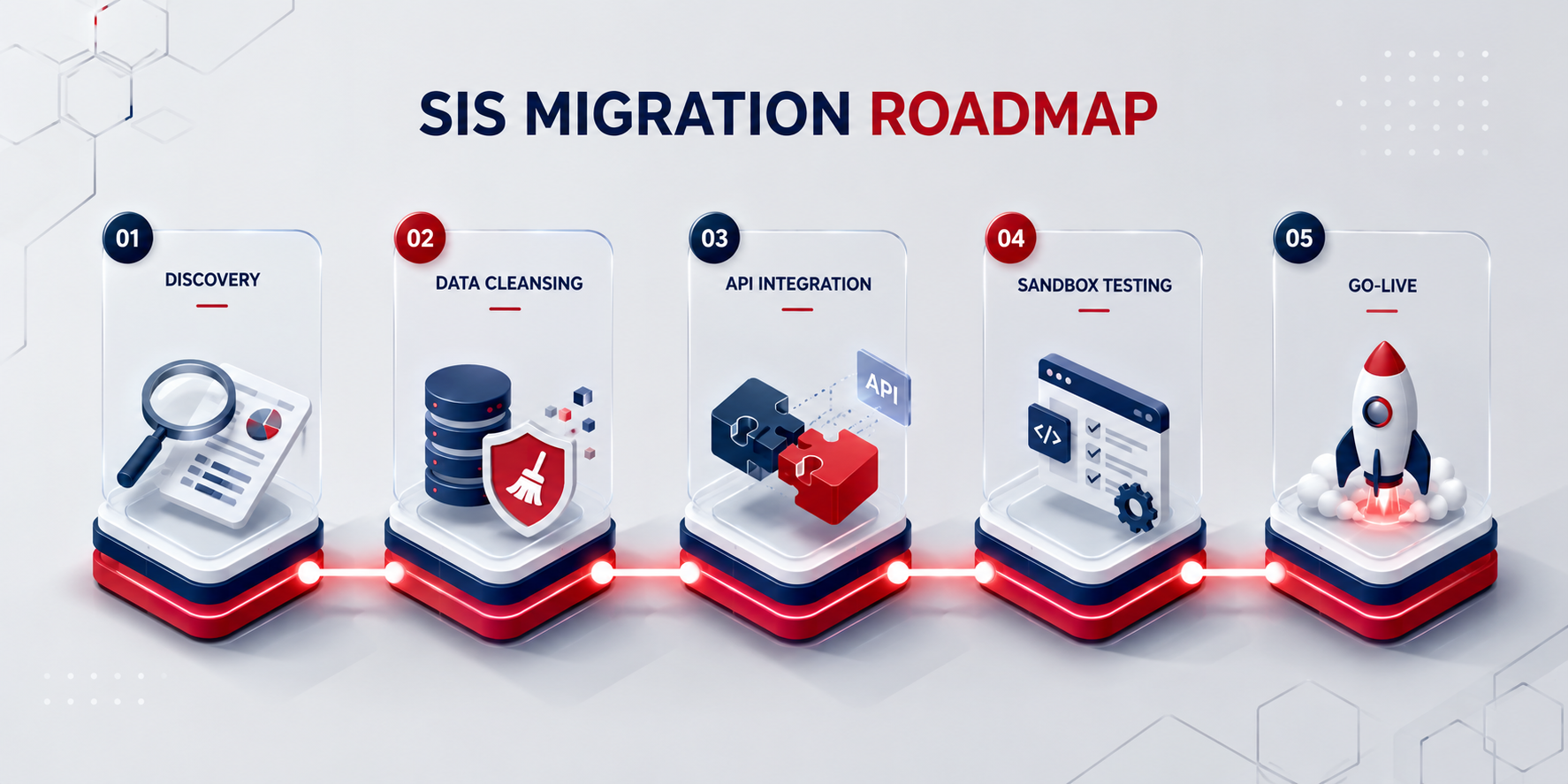
student information system

Improved Institutional Visibility

Leadership can gain a broader view of admissions, enrolment, academic activity and other institutional processes instead of relying entirely on manually consolidated information.

More Consistent Student Information

A connected system can help reduce discrepancies created when different departments maintain separate versions of student information.

Stronger Digital Foundations

Once core student information is structured and connected, universities have a stronger foundation for analytics, reporting and future digital initiatives.

Academia’s Ghana offering specifically highlights real-time institutional dashboards, structured academic records, faster result processing, transcript generation and graduation clearance as part of its approach.
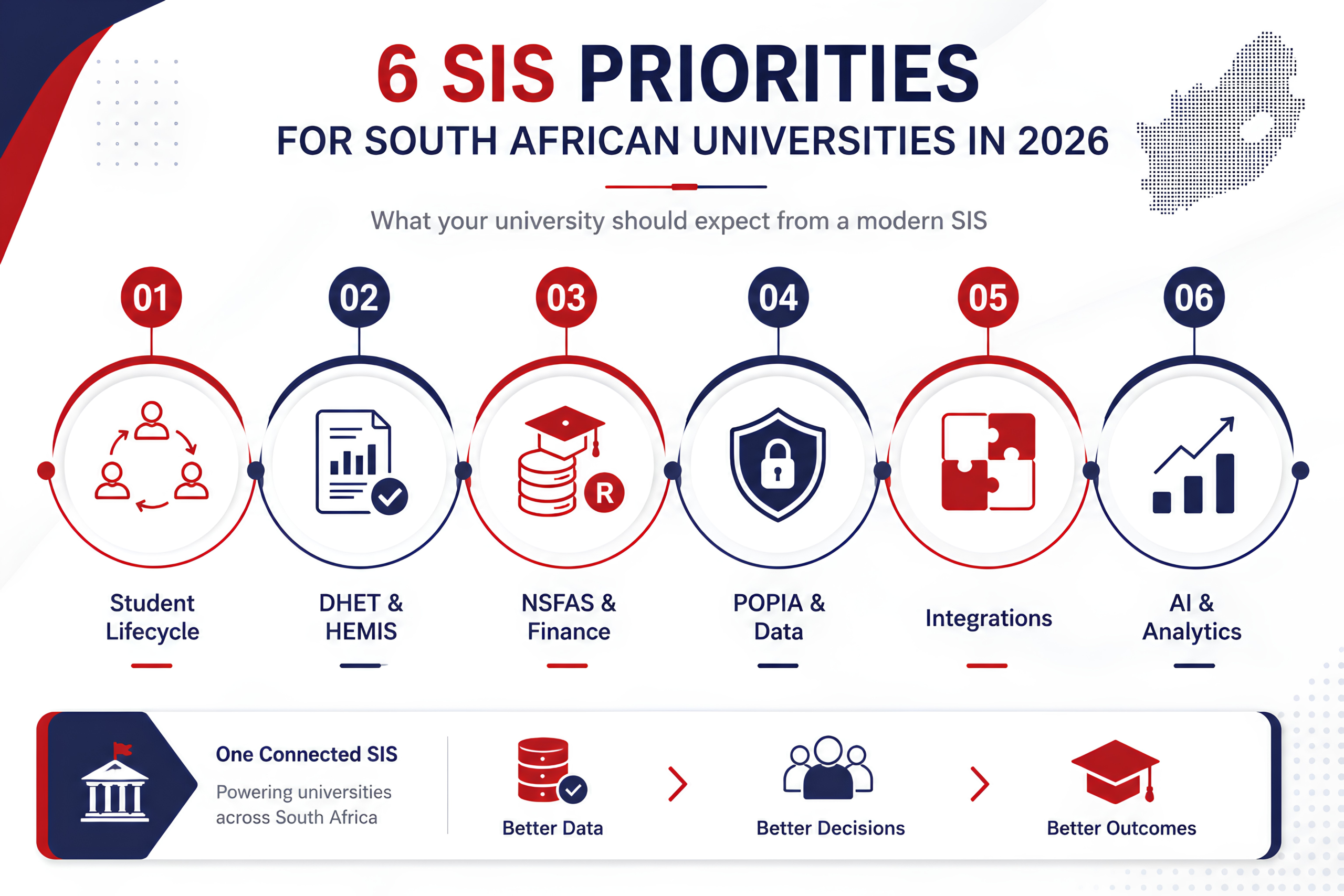
How Can Academia Support the Complete Student Lifecycle in Ghanaian Universities?

Academia by Serosoft approaches student information management as part of a broader education ERP rather than as a standalone database.

Its Ghana-specific platform brings together admissions, academics, compliance reporting, clearance, course registration, academic records, examinations, transcripts and graduation-related workflows.

Its admissions capabilities support the journey from enquiry to enrolment, while its academic capabilities cover programme and course management, assessments, examinations, results and academic performance visibility.

This approach is particularly relevant for institutions that want to move beyond simply digitising individual processes.

The objective is to create a connected environment where information can move through the student lifecycle without unnecessary duplication or manual intervention.

What Is the Future of Student Lifecycle Management for Ghanaian Universities? 

Ghana’s higher education sector is becoming increasingly digital, and universities need systems that can support both current administrative requirements and future institutional growth.

A modern ERP can help universities move from fragmented processes to a more structured and connected way of managing information. Academia’s Ghana platform supports this transformation through connected student lifecycle management, workflow automation, institutional visibility and digital academic processes. 

The future of student lifecycle management is therefore not simply about putting more university processes online.

It is about connecting those processes around the student.

When admissions, enrolment, academics, examinations, records and graduation operate as part of a connected ecosystem, universities can create a smoother experience for students while giving staff better access to the information they need.

For Ghanaian universities, the question is increasingly moving from:

“How do we digitise this process?”

to:

“How do we connect the entire student journey?”

Ready to Transform Student Lifecycle Management in Your University?

Academia by Serosoft can help universities connect admissions, enrolment, academics, examinations, student records, reporting and other institutional processes within one scalable digital environment.

Book a personalised Academia SIS demo to explore how a connected student lifecycle could work for your institution.

Frequently Asked Questions

1. How did Academia help Ghana Technology University College?

Academia’s published account states that GTUC used its ERP to automate admissions and enquiries, improve its student information system, increase information accessibility and support several university operations.

2. How can an SIS improve student lifecycle management?

An SIS can connect processes such as admissions, enrolment, registration, academics, examinations, fees and graduation, helping information move more consistently throughout the student journey.

3. Why is connected student information important?

Connected student information can reduce repeated data entry, improve access to records and give university teams a more consistent view of student activity.

4. Can Academia support admissions and enrolment?

Yes. Academia supports configurable admission workflows, online enquiries and applications, document management, offer letters and the transition from admission to enrolment.

5. Can Academia support academic and examination processes?

Yes. Academia’s academic capabilities include programme and course management, assessments, examinations, results and academic performance tracking.

6. Is Academia designed for Ghanaian universities?

Academia has a Ghana-specific SIS offering that addresses areas including admissions, academics, compliance reporting, clearance, registration, academic records, results, transcripts and graduation workflows.

How to Migrate from a Legacy Student Information System Without Disrupting Operations in Malaysia

Upgrading a campus core shouldn’t feel like open-heart surgery. This guide provides Malaysian Higher Education Providers (HEPs), both Public Universities (IPTA) and Private Higher Education Institutions (IPTS), with a practical blueprint to move away from an outdated Student Information System to a modern, cloud-based SIS without losing a single day of operations. As institutions work to meet the Ministry of Higher Education (MOHE) Digitalisation Action Plan, hanging onto fragile on-premise servers is simply too risky.

Here, we tackle the big migration worries head-on, from data corruption and MQA compliance headaches to Personal Data Protection Act (PDPA) rules, and outline an agile, 5-step roadmap: Discovery, Automated Data Cleansing, API Integration, Sandbox Testing, and a Phased Go-Live. Partnering with a specialist like Academia SIS makes it possible to complete this entire transition smoothly in 3 to 6 months while keeping connections to EMGS and PTPTN completely intact.

Table of Contents

  • Why Must Malaysian Higher Education Institutions Replace Legacy SIS Platforms?
  • What Are the Primary Risks of SIS Data Migration in Malaysia?
  • What Is the Step-by-Step Roadmap for a Zero-Downtime SIS Migration?
  • How Can Universities Cleanse and Map Legacy Data Safely?
  • How Do You Maintain EdTech and National System Integrations During Migration?
  • Why Is Academia SIS the Leading Migration Partner for Malaysian Universities?
  • What Metrics Measure the Success and ROI of an SIS Migration?
  • Frequently Asked Questions (FAQs)

Why Must Malaysian Higher Education Institutions Replace Legacy SIS Platforms?

Malaysian universities and colleges need to replace legacy systems to prevent server crashes during peak enrolments, meet MOHE digital guidelines, and unlock smart tools for Outcome-Based Education (OBE) tracking.

Every admissions cycle, many Malaysian campuses face the same familiar anxiety: the course registration portal slowing to a crawl or crashing altogether under the weight of thousands of students logging in at once. On-premise servers simply aren’t built for modern traffic spikes. On top of that, maintaining custom code written a decade ago drains critical resources.

According to research by ServiceNow, maintaining legacy systems costs IT departments an average of $40,000 annually, with teams losing roughly 17 hours every week simply keeping outdated software running. This relentless maintenance burden takes a measurable toll; the 2024 EDUCAUSE IT Workforce Study highlights that over half of higher education IT professionals experience burnout due to these exact operational bottlenecks.

Moving to a modern, cloud-based campus management system changes the game. Your infrastructure scales automatically when traffic surges, and student records are protected by strong encryption that keeps you fully aligned with Malaysia’s Personal Data Protection Act (PDPA). More importantly, modern platforms give your faculty built-in predictive analytics. Instead of waiting for final exam results to spot struggling students, advisors get early alerts throughout the semester, making a tangible difference in student retention and graduation rates.

What Are the Primary Risks of SIS Data Migration in Malaysia?

The biggest risks during migration are corrupting historical academic transcripts, falling out of compliance with MQA standards, and suffering unplanned downtime during critical intake weeks.

The hesitation to migrate usually comes down to fear: what if student records get mangled during the transfer? If credit transfer histories, prerequisite chains, or grading conversions are mapped incorrectly, it isn’t just an administrative headache; it directly threatens your institutional accreditation and student trust.

Deep Dive: Managing Credit Transfers and MQA Standards Without the Chaos

Handling credit transfers under the Malaysian Qualifications Framework (MQF) is one of the trickiest parts of any migration. Translating past qualifications, whether from SPM, STPM, Matrikulasi, or external diploma programmes, into consistent CGPA calculations requires precise business logic. Legacy databases often hold decades of patchy, inconsistent records. If you simply dump that raw data into a new system without clean mapping rules, automated degree audits will miscalculate student progress, leading to graduation delays and unwanted scrutiny from the Malaysian Qualifications Agency (MQA).

What Is the Step-by-Step Roadmap for a Zero-Downtime SIS Migration? 

A seamless zero-downtime migration follows five clear stages: Discovery, Automated Cleansing, API Integration, Parallel Sandbox Testing, and a Phased Go-Live, completed in a focused 3 to 6 months.

Migrating your core SIS doesn’t have to drag on for years or bring your campus to a standstill. An agile, phased approach lets your staff get comfortable with the new platform while daily academic and administrative routines continue uninterrupted.

“Digital transformation is a series of deep and coordinated culture, workforce, and technology shifts that enable new educational and operating models and transform an institution’s operations, strategic directions, and value proposition.”

— EDUCAUSE, The Premier Higher Education Technology Association

Implementation Checklist for Higher Education Providers:

  • Step 1: Discovery & MQA Alignment: Map your existing departmental workflows, grading policies, and MQF guidelines to configure your system rules from day one.
  • Step 2: Automated Data Cleansing: Automatically remove duplicate student records and verify key details like MyKad and passport numbers.
  • Step 3: Ecosystem & API Integration: Hook up your core system with your existing LMS, finance software, and local Malaysian systems.
  • Step 4: Sandbox Testing & Parallel Running: Set up a secure staging environment where staff can test admissions, grading, and fee collections alongside your existing system with zero risk.
  • Step 5: Phased Module Go-Live: Roll out modules one by one, starting with Admissions and Recruitment before moving on to Records and Billing—to ensure a stress-free launch.

SIS Migration Roadmap

How Can Universities Cleanse and Map Legacy Data Safely?

You clean legacy data safely by automating the deduplication of student profiles, archiving old inactive records, and standardising course articulation tables before pushing data to the cloud.

Migrating messy data into a shiny new platform just gives you an expensive version of your old problems. Taking time to establish clean data hygiene upfront saves months of troubleshooting later.

  • Fix Duplicate Profiles: Merge fragmented student records using single source-of-truth identifiers like MyKad or passport numbers.
  • Archive Inactive Records Wisely: Keep current students and recent cohorts (typically the last 5 to 7 years) in your active database, while storing older historical records in secure, searchable cloud archives to stay compliant with PDPA.
  • Standardise Course Codes: Align inconsistent legacy course naming conventions into a unified schema so prerequisite checks and credit transfers run automatically without manual overrides.

Comparison Table: Legacy On-Premise SIS vs. Modern Cloud SIS for Malaysian HEPs


Evaluation Metric Legacy On-Premise SIS Modern Cloud Platform (Academia SIS)
MQA & OBE Compliance Manual spreadsheets and endless cross-checking Built-in automated calculation engines for PLO and CLO
Deployment Timeline 18 to 24 exhausting months A focused 3 to 6 months with pre-built templates
Data Security & PDPA Vulnerable to local server crashes and security gaps Enterprise-grade encryption with role-based access
National Integrations Disconnected data silos needing manual export Native API connections for EMGS and PTPTN
System Scalability Fixed server capacity; prone to intake outages Cloud-native auto-scaling prevents system crashes during peak enrolment periods

How Do You Maintain EdTech and National System Integrations During Migration?

You keep integrations seamless by choosing an API-first campus management software that links directly to your daily academic tools and statutory Malaysian reporting portals.

Your student system shouldn’t sit on an island. It needs to communicate effortlessly with the tools your lecturers, finance teams, and students use every single day:

  • Learning Management Systems (LMS): Use standard LTI protocols so class rosters, attendance, and final grade pass-backs stay in sync across Canvas, Blackboard, or Moodle.
  • Malaysian Payment Gateways: Seamlessly integrate with leading local payment gateways (such as iPay88 or Billplz) to offer students familiar payment options like FPX, JomPAY, and DuitNow, while giving your finance team automated fee reconciliation.
  • Statutory & Regulatory Portals: Keep international student visa updates flowing smoothly with Education Malaysia Global Services (EMGS) and maintain clean data pipelines for National Higher Education Fund Corporation (PTPTN) loan disbursements.

Why Is Academia SIS the Leading Migration Partner for Malaysian Universities?

Academia SIS stands out because it delivers a purpose-built higher education platform, an agile 3-to-6 month implementation timeline, and deep experience navigating Malaysian academic compliance.

At the end of the day, a successful migration comes down to who you work with. Generic enterprise software designed for corporate supply chains will always require costly workarounds to handle higher education.

Academia SIS is built specifically for universities, university colleges, and polytechnics. Our deployment team already understands the nuances of Malaysian higher education from dual-intake calendars to MQA reporting. We handle the heavy lifting of data mapping, system configuration, and API connections, giving your institution a reliable, future-ready foundation so your faculty and administrators can focus on what matters most: delivering outstanding education.

What Metrics Measure the Success and ROI of an SIS Migration? 

Institutions evaluate migration success by looking at clear, tangible wins: meeting student digital expectations, reducing administrative burnout, and driving immediate operational cost savings.

When evaluating the return on investment (ROI) for an SIS migration, university leaders see the most significant impact across three key operational areas:

  • Elevated Student Onboarding: First impressions determine long-term engagement. According to the 2nd Edition of the Salesforce Connected Student Report, students who have a seamless digital onboarding experience are 35 times more likely to report an exceptional overall university experience. A modern SIS ensures that admissions, localised online fee payments, and EMGS visa tracking operate without friction.
  • Reclaimed Administrative Productivity: By eliminating the manual data reconciliation required by legacy databases, which consumes up to 17 hours of staff time per week per ServiceNow benchmark data, institutions can redirect hundreds of hours toward direct student advising and academic support.
  • Guaranteed System Reliability: The shift to modern infrastructure is accelerating globally, with industry research showing that over 62% of educational institutions now leverage cloud-based infrastructure. Moving away from on-premise servers ensures high-concurrency stability, preventing registration crashes during peak intake windows.

Migrating to a Future-Ready Campus 

Upgrading your core campus technology is a strategic investment in your institution’s future. By choosing an agile, education-focused migration path, Malaysian universities and colleges can move beyond legacy limitations, strengthen regulatory compliance, and deliver the seamless digital experience today’s students expect.

Ready to modernise your institution? Explore how Academia can help you migrate from legacy systems to a smarter, future-ready campus.

Frequently Asked Questions (FAQs)


  • How is a dedicated higher education SIS different from a generic enterprise ERP?

    Generic ERPs are built around corporate finance, supply chains, and inventory. A dedicated higher education
    Student Information System natively handles the academic student lifecycle: admissions, module registration, credit articulation, grading schemes, Outcome-Based Education (OBE), and accreditation requirements right out of the box.
  • Can our existing Learning Management System (LMS) connect to the new platform?Yes, absolutely. Modern platforms like Academia SIS are built with open APIs, enabling smooth, real-time two-way synchronisation with platforms like Moodle, Canvas, and Blackboard.
  • How does the system handle multiple branch campuses across different states?The platform is designed with multi-campus architecture at its core. It lets you manage central policies, global finance, and institutional standards from one central dashboard while giving individual branch campuses the permissions they need for day-to-day operations.
  • Is the platform compliant with Malaysia’s Personal Data Protection Act (PDPA)?Yes. Modern cloud SIS solutions use end-to-end data encryption (both in transit and at rest), strict role-based access control (RBAC), and detailed audit logs to ensure your campus stays fully compliant with PDPA standards.
  • Will migrating to a new SIS disrupt our current academic semester?Not at all. By running systems in parallel, conducting sandbox rehearsals, and rolling out modules in phases, your campus continues normal operations on the legacy system until every new component is tested, verified, and ready.
  • How long does a typical migration take with Academia SIS?While old-school migrations used to take 18 to 24 months, Academia SIS education-first templates and structured migration workflows allow institutions to complete deployment within 3 to 6 months.

Best Student Information Systems for South African Universities (2026): Academia vs Legacy SIS

South African universities are navigating a rapidly evolving higher education environment, with growing enrolments, rising digital expectations and increasing academic, financial and regulatory demands. South Africa’s public higher education institutions recorded 1,115,580 enrolments in 2024, a 4.1% increase from 2023. At this scale, a Student Information System (SIS) is no longer just an administrative database; it is the infrastructure connecting admissions, registration, academics, examinations, fees, student services, reporting, and institutional decision-making.

The key takeaway is that choosing an SIS in 2026 should go beyond comparing features. Universities need a platform that supports end-to-end student lifecycle management, DHET and HEMIS reporting, NSFAS processes, POPIA-aligned data governance, system integration, automation, scalability, and AI-powered analytics. The right SIS should reduce fragmented workflows and manual intervention while improving data visibility, operational efficiency and the student experience.

From Academia’s perspective, the future of SIS technology is about connecting people, processes and data rather than simply digitising individual functions. Academia’s South Africa offering brings together student lifecycle management, local reporting capabilities, integrations, automation and AI-powered insights within a unified platform. Ultimately, the question for universities is not simply whether their existing SIS works, but whether it is equipped to support the next stage of growth, digital transformation and student-centric higher education in South Africa.

Why Are South African Universities Reconsidering Their SIS?

Many legacy SIS platforms were designed around a very different operating environment. They were primarily built to digitise administrative processes and maintain student records.

But today’s university needs more.

Students expect digital-first services. Staff need faster access to accurate information. Leadership teams need real-time visibility. IT departments need integrations rather than isolated applications. Finance teams need reliable student and fee data.

South African universities must also manage requirements around DHET and HEMIS reporting, NSFAS-related processes and POPIA-aligned data protection.

According to Academia, one of the biggest challenges facing institutions is not necessarily a lack of technology, but the presence of disconnected systems and fragmented workflows. From Academia’s perspective, a modern SIS should connect student lifecycle management, automation, analytics and reporting within one digital environment.

The question for universities in 2026 is therefore not simply:

“Does our SIS work?”

It is:

“Can our SIS support the university we are becoming?”

Why Are Legacy SIS Platforms a Challenge for South African Universities? 

A legacy SIS can continue functioning for years while gradually creating operational friction.

Admissions may operate separately from other student services. Academic data may need to be transferred between systems. Reporting may require manual consolidation. Staff may depend on spreadsheets to bridge information gaps, while integrations may require expensive custom development.

This creates a human integration layer where people spend time moving, checking and reconciling information that systems should ideally exchange automatically.

From Academia’s experience working with higher education institutions, the real challenge often lies in the gaps between systems rather than in individual applications themselves.

A university may have capable tools for admissions, learning, finance or communication, yet still struggle when information does not move seamlessly between them.

How Is Academia Different from a Legacy SIS? 

The fundamental difference is the architecture and philosophy behind the system.

A traditional SIS generally focuses on record management and established administrative workflows.

A modern SIS aims to create a connected digital student lifecycle.


Area Legacy SIS Academia SIS
Student lifecycle Often fragmented Connected end-to-end lifecycle
Integrations Point-to-point or customised Third-party and legacy integration
Reporting Often dependent on data extraction Real-time analytics and reporting
Automation Often limited Workflow-driven automation
Student experience Primarily administrative Digital and student-centric
Scalability May require extensive customisation Designed for institutional growth
AI capabilities Limited or external AI-powered analytics and reporting
Data visibility Often department-focused Institution-wide visibility

Academia’s approach is centred on creating a connected digital environment where academic and administrative workflows can operate together. Its South Africa offering specifically highlights automation, centralised data, NSFAS management, HEMIS and TVET MIS reporting.

What Should South African Universities Look for in a Student Information System in 2026? 

1. End-to-End Student Lifecycle Management

A modern SIS should connect the student journey from application and admission through registration, academics, examinations, fees and graduation.

According to Academia, the goal should be to connect rather than simply digitise individual processes. Its platform brings admissions, academics, examinations, fees, attendance, scholarships, grievances, placements and other student services together within one environment.

This reduces duplication and gives staff a more consistent view of student information.

2. DHET and HEMIS-Ready Reporting

South African universities cannot evaluate an SIS purely on global functionality.

Local reporting requirements matter.

Institutions should assess how effectively an SIS supports DHET and HEMIS-related processes, including data accuracy, validation and reporting.

Academia’s South Africa offering highlights support for HEMIS and TVET MIS reporting, helping institutions centralise the information required for regulatory reporting.

The objective should be to make reporting part of continuous institutional data management rather than a last-minute exercise.

3. NSFAS and Student Finance

Student funding is another important consideration for South African institutions.

Universities should assess whether an SIS can connect student financial information with relevant funding workflows, payments and account information.

According to Academia, its South African platform includes NSFAS management, providing greater visibility into applicant and student funding transactions and reporting.

From Academia’s perspective, finance should not operate as an isolated function. Connecting academic and financial information can help institutions identify discrepancies and respond to students more efficiently.

4. POPIA-Aligned Data Governance

Universities manage highly sensitive information, including identity details, academic records, financial information and student documentation.

This makes data governance an essential SIS consideration.

Universities should examine:

  • Role-based access controls
  • Data permissions
  • Audit trails
  • Security practices
  • Privacy controls
  • Data retention
  • Third-party integrations
  • Business continuity and disaster recovery

Academia’s SIS provides role-based access and cloud-based security capabilities, supporting institutions in managing information within a controlled digital environment.


South Africa SIS

5. Integration Instead of More Silos

A university rarely operates on one application.

The SIS may need to interact with an LMS, finance platform, CRM, payment gateway, identity management system and other institutional applications.real institutional scenarios.

According to Academia, its platform can integrate with third-party and legacy systems, allowing universities to modernise their SIS environment without necessarily replacing every existing application.

The question is therefore not:

“Does the SIS contain every function?”

It is:

“How effectively can it connect the systems our university already depends on?”

6. AI-Powered Analytics and Decision-Making

The next generation of SIS platforms is moving beyond storing information towards helping institutions understand it.

Academia incorporates AI-powered analytics, reports and SERA AI, alongside intelligent automation. Its platform is designed to provide institutions with faster access to information about student performance, finances and operations.

For university leaders, this creates an opportunity to move from retrospective reporting towards more proactive decision-making.

Instead of asking only:

“What happened?”

institutions can increasingly ask:

“What is changing, where is intervention required, and what should we do next?”

How Can a Modern SIS Improve the Student Experience? 

The impact of an SIS is not limited to university administrators.

Students experience institutional technology through everyday interactions such as:

  • Applying for admission
  • Registering for courses
  • Viewing academic information
  • Checking fees and payments
  • Accessing examination information
  • Raising service requests
  • Receiving notifications

From Academia’s perspective, a modern SIS should make the student journey more connected, accessible and responsive, rather than simply moving paper-based processes online.

Academia provides dedicated portals and mobile access for students and staff, helping bring academic information, fees, attendance, results and communication into a more accessible digital experience.

Which Is Better for South African Universities: Academia or a Legacy SIS? 

There is no universal answer based purely on a feature checklist.

A legacy SIS may still be appropriate if it meets current requirements, integrates effectively with surrounding systems and can evolve without high cost or complexity.

However, persistent issues such as:

  • Repeated manual data entry
  • Fragmented student information
  • Difficult integrations
  • Spreadsheet-dependent reporting
  • Limited automation
  • Slow administrative workflows
  • Poor institutional visibility
  • Scalability challenges

are strong indicators that a university should evaluate modern alternatives.

According to Academia, modernisation should not simply mean replacing old software with new software. It should mean creating a more connected institutional operating environment.

Academia brings together student lifecycle management, automation, analytics, integrations and AI-powered reporting in a unified platform designed for higher education.

How Should South African Universities Evaluate SIS Vendors in 2026? 

The strongest SIS evaluation process should go beyond a vendor’s feature list.

Universities should ask vendors to demonstrate real institutional scenarios.


Choose Your Next SIS

Admissions: Can the system manage an application through decision and enrolment without unnecessary re-entry?

Registration: Can students complete registration digitally while the institution maintains control over academic rules?

Finance: Can academic and financial information work together?

Reporting: Can leadership access reliable information without waiting for manual consolidation?

Integration: Can the SIS exchange information with existing university systems?

Data protection: How are access, security, privacy and auditability handled?

Scalability: Can the platform support growing enrolment, programmes and campuses?

According to Academia, the value of an SIS is ultimately measured by how effectively it connects people, processes and data, rather than simply by the number of modules listed in a product brochure.

What Is the Future of Student Information Systems in South African Higher Education? 

South African universities are not simply digitising existing processes. They are moving towards institutions that are more connected, data-driven and responsive.

The SIS will sit at the centre of that transformation.

The difference between a legacy system and a modern SIS is therefore not just about interface design or features. It is about whether the platform can help a university connect data, simplify operations, improve student services and make better decisions at scale.

Academia supports institutions across 32 countries and 400+ institutions globally, with a dedicated South Africa offering that addresses local requirements such as NSFAS, HEMIS and TVET MIS reporting.

For institutions still relying on fragmented or heavily customised legacy environments, 2026 may be the right time to reassess what their SIS needs to accomplish.

The real question is no longer whether your university has an SIS.

It is whether your SIS is ready for the next generation of South African higher education.

Ready to Move Beyond Your Legacy SIS? 

See how Academia by Serosoft can help your institution connect student data, automate academic operations, strengthen reporting and build a more future-ready digital campus.

Book a personalised Academia SIS demo.

Frequently Asked Questions

1. What is the best Student Information System for South African universities in 2026?

The best SIS depends on the university’s size, technology environment, reporting requirements and digital transformation goals. Universities should evaluate student lifecycle management, integrations, automation, reporting, data governance, scalability and local requirements. Academia is one modern SIS option with South Africa-specific capabilities including NSFAS management, HEMIS and TVET MIS reporting.

2. How is Academia different from a legacy SIS?

Academia is designed as a connected SIS with student lifecycle management, automation, analytics, integrations and AI-powered reporting. The key difference is its focus on connecting institutional workflows and data rather than simply maintaining student records.

3. Can Academia integrate with existing university systems?

Yes. Academia states that its SIS integrates with third-party and legacy platforms, helping institutions connect their existing technology ecosystem while modernising their core SIS.

4. Does Academia support South African higher education requirements?

Yes. Academia’s South Africa offering includes NSFAS management, NSC results integration, HEMIS and TVET MIS reporting, alongside core SIS functions.

5. Can Academia support multi-campus institutions?

Yes. Academia provides multi-centre capabilities that allow institutions to manage multiple campuses or institutions through a unified environment.

6. How can an SIS improve student experience?

A modern SIS can connect admissions, registration, fees, attendance, examinations, results and communication, reducing administrative friction and giving students easier digital access to university services.

7. Does Academia use AI?

Yes. Academia includes AI-powered analytics and reporting, intelligent automation and SERA AI to help institutions access insights and streamline routine processes.

8. Is it worth replacing a legacy SIS?

It depends on the institution. However, persistent manual work, fragmented data, integration challenges, limited automation and poor scalability are strong indicators that a university should evaluate modern SIS alternatives.

Why UAE Universities Are Replacing Legacy Student Information Systems

The UAE’s higher education sector is moving quickly.

Universities are expanding their digital capabilities, introducing AI initiatives, improving student experiences and exploring new models of learning. But behind many of these transformation plans lies a challenge that is far less visible: the core systems managing student data and university operations were often built for a very different era.

Many legacy Student Information Systems (SIS) are still capable of performing their basic functions. They can store student records, manage registrations, process grades and support administrative activities.

But that is no longer enough.

The real question facing university leaders is not whether their existing SIS still works. It is whether it can support the way their institution needs to operate today and where it wants to go next.

According to Academia by Serosoft’s experience working with higher education institutions, the need to replace a legacy SIS rarely begins with a single technology failure. It usually becomes evident when teams start building workarounds around the system.

Spreadsheets become essential for reporting. Staff manually transfer data between departments. Students use multiple portals to complete simple tasks. Integrations become complex projects. And leadership waits for reports that should already be available.

These are not isolated IT problems. They are operational problems.

Here are some of the real reasons why universities in the UAE are moving away from legacy Student Information Systems.

1. How Manual Integration Is Holding Universities Back 

One of the biggest challenges with legacy university systems is that the technology landscape has grown, but the SIS has not always evolved with it.

A modern university may use separate platforms for admissions, learning management, CRM, finance, payments, student engagement and communication. In an ideal environment, these systems exchange information seamlessly.

In reality, many institutions still depend on people to bridge the gaps.

For example, an applicant’s information may need to move from the admissions system to the SIS. A finance team may need to manually reconcile payment information. Academic departments may maintain separate records because the data they need is difficult to access from the central system.

The result is a familiar cycle: export, check, edit, upload and reconcile.

According to Academia, this is one of the clearest signs that a university’s technology architecture needs attention: when people are doing the work that systems and integrations should be doing.

This manual dependency creates more than additional workload. It increases the risk of duplicate records, inconsistent information and delays between departments.

It also makes institutional operations harder to scale.

As student numbers, programmes, campuses and services grow, the number of manual handoffs grows with them. What may have been manageable for one campus or a smaller student population can become a major operational bottleneck.

2. How Disconnected Data Limits University Decision-Making 

Most universities do not have a shortage of data.

They have student data. Admissions data. Academic data. Financial data. Attendance data. Engagement data.

The problem is that the information often exists across multiple systems.

When leadership wants to understand enrolment trends, student progression or fee collection, teams need to gather information from several sources before producing a report. Different departments may even report different numbers because they are working with different datasets or reporting periods.

This creates a serious decision-making problem.

University leaders need to answer questions such as:

  • Which programmes are experiencing declining enrolment?
  • Where are students dropping out or failing to progress?
  • How are admissions converting into actual enrolments?
  • What trends could affect future revenue?

If answering these questions requires multiple Excel files and several days of reconciliation, the university is making decisions based on delayed information.

According to Academia, the challenge is no longer simply collecting institutional data. The challenge is connecting it, trusting it and making it available when decisions need to be made.

This is particularly important as universities move towards real-time dashboards, predictive analytics and AI-driven insights.

AI cannot create meaningful institutional intelligence from fragmented or unreliable data. A university first needs a connected data foundation.

3. Why Legacy SIS Platforms Struggle to Meet Modern Student Expectations 

Today’s students expect the university experience to be digital, accessible and straightforward.

However, in many institutions, a student still needs to use different systems for registration, payments, academic information and service requests. They may also be asked to provide the same information to multiple departments.

From the university’s perspective, these appear to be separate processes.

From the student’s perspective, it is one institution.

This gap becomes more noticeable when administrative processes are fragmented.

A simple request such as updating information, requesting a document or resolving a fee-related query can involve multiple emails, departments and follow-ups. Students often have limited visibility into where their request stands or what action is required next.

Digitisation should not mean simply moving paper forms online.

The objective should be to create connected student journeys where information, workflows and services work together.

For universities in the UAE, this is especially important because of the highly international nature of the student population. Students might be joining from different countries and interacting with the institution primarily through digital channels before they even arrive on campus.

A disconnected digital experience at this stage can quickly affect how students perceive the institution.

4. Why Legacy SIS Customisation Makes Change More Difficult 

Legacy systems often become more complicated over time.

When a university first implements an SIS, customisation seems like the best solution for adapting the platform to specific academic rules, approval processes or institutional structures.

But after years of modifications, the system can become increasingly difficult to maintain.

A new requirement may need custom development. An upgrade requires extensive testing. Introducing a new integration can become expensive because of existing dependencies.

In some cases, universities become dependent on a small group of internal employees or external vendors who understand how the system has been customised.

This creates a hidden risk.

The system still functions, but changing it becomes difficult.

A modern SIS should allow institutions to configure workflows, rules and processes without constantly modifying the underlying technology.

This is particularly important for universities that are introducing new programmes, changing academic structures or expanding their operations.

When technology cannot adapt at the same speed as the institution, staff inevitably create workarounds.

And temporary workarounds have a habit of becoming permanent processes.

5. Why Traditional University Reporting Is Not Enough for Future Planning 

Traditional reporting tells universities what has already happened.

How many students enrolled? How much revenue was collected? What were last semester’s academic results?

These reports remain important. But they do not always help institutions act early enough.

Universities increasingly need to understand what happens next.

For example, identifying a student who has already withdrawn is useful for reporting. Identifying patterns that indicate a student is at risk of withdrawing allows the institution to intervene.

The same applies to admissions.

Knowing how many applications were received is valuable. Understanding where applicants are dropping off, which programmes are converting better or how current trends may affect future enrolment is far more actionable.

This is where legacy systems often show their limitations.

Many were designed primarily as transactional systems, a place to record information after something has happened. They were not necessarily designed to combine data across the student lifecycle and identify emerging patterns.

The role of the modern SIS is shifting from a system of record to a system of intelligence.

This does not mean every university needs AI for every process. It means institutions should have the ability to turn their operational data into useful insight.

6. AI Ambitions Cannot Be Built on Fragmented Systems

AI is becoming a significant part of the conversation around the future of higher education in the UAE.

Universities are exploring how AI can support student engagement, decision-making, academic operations and institutional planning.

However, there is a fundamental issue that is often overlooked.

Adding an AI tool does not automatically make a university AI-ready.

If student information is spread across disconnected systems, if data quality is inconsistent or if important workflows happen outside the core platform, AI has an incomplete picture of the institution.

Gartner research reinforces this challenge: 63% of organisations either lack or are unsure whether they have the right data management practices for AI. Gartner also predicts that through 2026, 60% of AI projects unsupported by AI-ready data will be abandoned.

DaTa Fragmentation

According to Academia, AI readiness starts long before AI implementation.

It starts with connected data, structured workflows and a reliable digital foundation.

A modern Student Information System can play an important role by bringing together information from across the student lifecycle. This creates a stronger foundation for analytics and future AI capabilities.

The goal should not be to adopt AI because it is a technology trend.

The goal should be to give institutional teams better information and help them identify issues, opportunities and patterns earlier.

7. Why Scalability Matters as Universities Expand 

A system that worked effectively for a university five or ten years ago may struggle as the institution evolves.

New campuses, programmes, partnerships and learning models introduce additional complexity.

Some legacy platforms require separate processes or configurations for each new entity. Consolidating information across campuses can become difficult. Maintaining consistency across academic and administrative processes requires increasing manual effort.

The problem is not growth itself.

It is whether the technology can grow with the institution.

Universities should not have to redesign their entire technology environment every time they introduce a new programme, campus or operating model.

A modern SIS needs to provide flexibility without creating uncontrolled customisation.

It should allow institutions to maintain central visibility while supporting the operational differences that exist across faculties, campuses and programmes.

What UAE Universities Should Look for in a Modern SIS

Replacing a legacy SIS is not simply about finding newer software.

It is an opportunity to rethink how institutional processes, data and technology should work together.

Universities should look beyond a checklist of features and consider whether a platform can support their long-term operating model.

Key capabilities include:

The right platform should not force a university to choose between standardisation and flexibility.

It should provide enough structure to create consistency while allowing the institution to adapt as its requirements change.

Conclusion: The Cost of Legacy Systems Is Often Hidden

The highest cost of a legacy Student Information System is not always visible in the technology budget.

It appears in the hours staff spend reconciling data. The spreadsheets created to compensate for reporting gaps. The delays caused by disconnected workflows. The difficulty of introducing new technology. And the frustration experienced by students and employees.

This is why UAE universities are increasingly reassessing their existing SIS.

The decision is not simply about replacing old technology.

It is about removing the operational barriers that prevent the institution from becoming more connected, data-driven and responsive.

The most important question for university leaders is not:

“Does our current SIS still work?”

It is:

“Are we changing our processes to fit the limitations of our system, or is our system helping us achieve where the university needs to go?”

The answer to that question is increasingly shaping the future of SIS transformation.

Key Takeaways

  • Legacy SIS challenges are often operational problems, not just technology problems.
  • Manual workarounds and disconnected systems create hidden costs across the university.
  • Fragmented data makes reporting slower and limits the ability to use predictive insights and AI effectively.
  • Heavy customisation can make systems difficult and expensive to change.
  • Modern universities need connected, configurable and scalable platforms that support the complete student lifecycle.
  • Replacing a legacy SIS is ultimately about building a stronger digital foundation for the university’s future.

Ready to Move Beyond Legacy Systems?

Is your current Student Information System helping your university move forward or creating more workarounds to keep operations running?

Academia by Serosoft helps higher education institutions connect the student lifecycle, streamline complex operations and build a stronger foundation for data-driven and AI-enabled transformation.

Talk to our experts to explore what a modern, connected SIS could look like for your institution.

Frequently Asked Questions

1. Why are UAE universities replacing legacy Student Information Systems?

Many universities are replacing legacy SIS platforms because older systems can struggle with fragmented data, manual processes, complex integrations, limited flexibility and changing student expectations.

2. What are the biggest problems with a legacy SIS?

Common challenges include disconnected systems, duplicate data, manual reporting, dependence on spreadsheets, expensive customisation and difficulty adapting to new institutional requirements.

3. How does a modern SIS support AI in higher education?

A modern SIS helps create a connected and reliable data foundation. This allows universities to use analytics and AI more effectively to identify patterns, support decision-making and potentially detect issues earlier.

4. When should a university consider replacing its legacy SIS?

A university should consider modernisation when staff increasingly rely on manual workarounds, reporting takes excessive time, integrations are difficult, upgrades are complex or the existing system cannot support future institutional goals.

5. What should UAE universities look for in a modern Student Information System?

Universities should look for a scalable and configurable platform that supports the complete student lifecycle, integrates with other technologies, provides reliable data and supports future analytics and AI initiatives.

Student Information Systems for Malaysian Universities: Complete Buyer’s Guide

Malaysia’s higher education sector is entering a new phase of digital transformation.

The question for universities is no longer whether they need technology. It is whether their existing systems can support a more connected, data-driven and increasingly AI-enabled institution.

Malaysia’s higher education landscape already spans 544 institutions and more than 1.35 million students, according to the Malaysia Higher Education Blueprint 2026–2035, based on data as of December 2024. Public universities accounted for 613,194 students, while private higher education institutions accounted for 639,754.

At this scale, managing admissions, student records, academic processes, examinations, fees, communication and reporting through disconnected systems can quickly become a strategic limitation.

This is where a modern Student Information System (SIS) becomes important.

But choosing an SIS is not simply about comparing feature lists. Universities need to evaluate whether a platform can connect their operations, improve institutional visibility, support compliance, integrate with existing technology and provide a foundation for future growth.

This buyer’s guide explains what Malaysian universities should look for when evaluating their next SIS.

Why Malaysian Universities Are Rethinking Their Student Information Systems

Malaysia’s higher education sector is becoming more complex.

Universities are serving larger and more diverse student populations, including significant numbers of international students. In 2024, Malaysia recorded 137,201 international students across public universities and private HEIs.

At the same time, universities are expected to provide faster services, improve student experiences, strengthen data governance and make decisions using reliable institutional data.

The Ministry of Higher Education’s Digitalisation of Higher Education Policy 2025–2030 reinforces this direction by establishing a national framework for digital transformation across Malaysian higher education.


Malaysian higher education

For universities, this changes the role of an SIS.

It can no longer be viewed simply as software for storing student records.

A modern SIS should become the operational and data backbone connecting the student journey.

What Features Should Malaysian Universities Look for in a Modern SIS? 

The right system should connect processes rather than create another layer of technology.

1. End-to-End Admissions Management

Admissions is often the first major interaction between a student and a university.

An effective SIS should support the complete admissions journey from application and document collection to evaluation, offer management, enrolment and conversion.

Look for:

  • Online applications and configurable workflows
  • Applicant document management
  • Application screening and evaluation
  • Offer and admission management
  • Automated communication
  • Application status tracking
  • Integration with CRM and payment platforms

For institutions managing domestic and international applicants, flexibility is particularly important.

2. Managing Student Data Through a Single, Centralised Record 

One of the biggest problems with fragmented university technology is duplicated information.

A student’s details may exist separately in admissions, finance, academic, examination and learning systems.

A modern SIS should establish a single source of truth for student information, allowing authorised users to access consistent data without repeatedly entering or reconciling the same information.

According to Academia’s experience working with higher education institutions, this connected approach is essential for reducing administrative duplication and giving institutions better visibility across the student lifecycle.

3. How an SIS Simplifies Academic and Curriculum Management 

Universities need more than basic student records.

The SIS should support programmes, courses, curricula, academic structures, class scheduling, registration, attendance, grades, progression and graduation requirements.

It should also be flexible enough to handle different academic structures across faculties, campuses and programmes.

For Malaysian universities operating diverse academic models, configurability can be more valuable than a rigid standard workflow.

4. How an SIS Streamlines Examination and Results Management 

Examinations are highly sensitive processes where accuracy matters.

An SIS should help institutions manage examination schedules, eligibility, assessments, marks, grading rules, results, transcripts and graduation requirements.

The objective is to reduce manual reconciliation and give academic teams better control over the assessment lifecycle.

5. How Universities Can Streamline Fee and Finance Management 

Student administration and finance cannot operate in isolation.

The SIS should connect student information with fee structures, invoices, payments, scholarships and financial holds.

This creates a more complete view of the student and reduces the need for staff to switch between disconnected systems.

Integration with payment gateways and finance/ERP systems should also be considered during evaluation.

6. How an SIS Enables Student and Staff Self-Service 

A university does not become truly digital simply because administrators use software.

Students and staff should also be able to complete routine tasks digitally.

A strong SIS should provide self-service capabilities for activities such as:

  • Course registration
  • Academic information
  • Fee and payment information
  • Requests and applications
  • Results and transcripts
  • Personal information updates
  • Communication and notifications

This reduces dependence on administrative teams while creating a faster student experience.

Why SIS Integration Should Be a Key Buying Requirement 

One of the most important questions to ask an SIS vendor is:

“How well will this system connect with the technology we already use?”

A university may already have an LMS, CRM, finance platform, payment gateway, identity-management system, library system and other specialised applications.

Replacing everything is rarely practical.

Instead, universities should select an SIS that can integrate with the existing technology ecosystem through APIs and modern integration capabilities.

As Academia frequently sees in higher education environments, the real challenge is often not the lack of individual systems, but the gaps between them.

The goal should be simple:

Students experience one connected university, even when multiple systems operate behind the scenes.

How Data, Analytics and AI Are Transforming Modern Student Information Systems 

Traditional SIS platforms largely answer:

“What happened?”

Modern platforms should help universities answer:

“What is happening, why is it happening, and what should we do next?”

This is where analytics and AI become increasingly important.

Universities should evaluate whether an SIS provides:

  • Real-time dashboards
  • Student and institutional analytics
  • Configurable reports
  • Early-warning indicators
  • Performance monitoring
  • Data-driven decision support
  • AI-assisted insights
  • Automated reporting

For example, instead of manually compiling information from different departments, university leadership should be able to access relevant indicators around enrolment, academic performance, retention and finance through a unified analytics environment.

Academia’s approach reflects this shift, with SERA AI and 400+ AI analytics designed to help institutions move from manually retrieving information towards faster, data-driven visibility.

The important point is that AI should not be treated as a decorative feature.

The better question is whether it can reduce administrative effort and improve institutional decision-making.

Why Security and Data Protection Matter When Choosing an SIS 

Universities manage highly sensitive information, including student identities, academic records and financial information.

Malaysia’s Personal Data Protection Act establishes principles covering areas such as notice and choice, disclosure, security, retention, data integrity and access.

Therefore, evaluate security before procurement, not after implementation.

Ask vendors about:

  • Role-based access controls
  • Data encryption
  • Authentication and identity management
  • Audit trails
  • Backup and disaster recovery
  • Data retention controls
  • Security monitoring
  • Hosting architecture
  • Compliance capabilities

A modern SIS should make it easier for universities to control who can access information and how that information is managed.

Cloud or On-Premise: What Should Universities Choose?

This remains one of the most common SIS buying questions.

On-premise systems can provide greater direct control over infrastructure but require universities to manage hardware, maintenance, upgrades and scalability.

Cloud-based SIS platforms can offer easier scalability, continuous updates and lower infrastructure dependency.

The right decision depends on the university’s IT strategy, security requirements, integration landscape and long-term digital roadmap.

However, universities should avoid selecting a deployment model purely because it appears cheaper initially.

The better question is:

Which model gives the university the flexibility and scalability it will need over the next 5–10 years?

The SIS Evaluation Checklist for Malaysian Universities

Before selecting a vendor, decision-makers should evaluate each platform against these questions:


Evaluation Area Questions to Ask
Student lifecycle Can it manage the journey from applicant to alumni?
Admissions Can workflows support different programmes and intakes?
Academic management Can it support complex curricula and structures?
Integration Does it offer APIs and integration capabilities?
Analytics Can leadership access institutional insights?
AI Does AI solve practical institutional problems?
Self-service Can students complete routine tasks independently?
Security How are data, access and auditability managed?
Scalability Can it support more students, programmes and campuses?
Implementation What do migration, training and support involve?
Total cost What are licensing, implementation and support costs?

The most important point is to evaluate the whole platform, not isolated features.


SIS buyer Checklist

A system may have hundreds of features and still fail to solve the university’s biggest operational problems.

What Makes Academia a Strong SIS Option for Malaysian Universities? 

For Malaysian universities looking beyond traditional SIS platforms, Academia by Serosoft offers a modern approach to student information management.

Academia is an AI-powered Student Information System and Education ERP designed to connect critical institutional processes through a unified platform.

Its capabilities span areas such as admissions, student information, academics, examinations, fees, communication, reporting and analytics.

More importantly, Academia brings AI-powered capabilities into institutional decision-making, including SERA AI and 400+ AI reports, helping universities gain faster visibility into institutional performance.

As Academia’s higher education experience demonstrates, the value of an SIS is not simply in digitising individual processes. It lies in connecting data and workflows so institutions can operate with greater visibility and less administrative friction.

Final Takeaway: Choose the SIS Your University Will Need Tomorrow

Malaysia’s higher education sector is moving into a new digital era.

The Ministry of Higher Education’s Digitalisation of Higher Education Policy 2025–2030 and the Malaysia Higher Education Blueprint 2026–2035 both reinforce the sector’s longer-term digital transformation direction.

That makes SIS selection a strategic decision.

The right platform should help universities:

  • Connect the student lifecycle
  • Reduce administrative fragmentation
  • Improve data accuracy
  • Strengthen student self-service
  • Integrate existing systems
  • Improve institutional visibility
  • Support secure data management
  • Scale with changing requirements
  • Prepare for AI-driven decision-making

The best SIS is not the one with the longest feature list. It is the one that helps your university operate as one connected institution.

If your university is reviewing its current SIS, replacing a legacy platform or planning its next phase of digital transformation, now is the right time to evaluate what your technology can and should do next.

Explore how Academia by Serosoft can help your university build a more connected, intelligent and future-ready student information ecosystem.

Frequently Asked Questions

  • What is a Student Information System (SIS)?
    An SIS is a platform that manages and connects core student and academic processes, including admissions, records, registration, examinations, fees, reporting and student services.
  • What should Malaysian universities look for in an SIS?
    Universities should prioritise student lifecycle management, integration, analytics, AI capabilities, security, scalability, self-service and ease of implementation.
  • Should Malaysian universities choose a cloud-based SIS?
    Cloud deployment can provide scalability, easier maintenance and continuous platform updates. Universities should evaluate it against their security, infrastructure and long-term technology requirements.
  • Can an SIS integrate with an existing LMS and ERP?
    Yes. A modern SIS should provide integration capabilities such as APIs to connect with LMS, ERP, CRM, payment and other institutional systems.
  • Why is AI becoming important in Student Information Systems?
    AI can help universities automate routine work, identify patterns, surface insights and support faster institutional decision-making.
  • Why consider Academia by Serosoft?
    Academia combines SIS and Education ERP capabilities with analytics and AI-powered features, including SERA AI and 400+ AI reports, helping institutions create a more connected and data-driven student information ecosystem.

Student Information Systems for Ghana Universities: A Complete Buyer’s Guide

Ghana’s higher education sector is growing, and so is the complexity of managing it.

According to Ghana’s National Development Planning Commission (NDPC), 711,695 students were enrolled across Ghana’s tertiary institutions in 2023, a 12.08% increase from 634,999 in 2022. For universities and other tertiary institutions, this continued growth means greater pressure on admissions, registration, academics, examinations, finance and student services. 

The challenge is that these processes do not always operate from one connected source of information. Admissions may use one platform. Academic departments may maintain separate records. Finance teams may work on another system. When leadership needs an institution-wide view, teams may still depend on spreadsheets and manual reconciliation.

This is why selecting the right Student Information System (SIS) is becoming an important institutional decision for universities in Ghana. But choosing an SIS should not be about finding the platform with the longest list of features.

By the end of this guide, university leaders will have a clearer basis for assessing whether their current systems support growth and for making a more informed SIS investment decision.

The outcome is not simply a better understanding of SIS technology, but greater clarity on what a university truly needs from its next system. The guide brings together the key considerations that shape a successful SIS decision, from eliminating fragmented processes and connecting student data to improving institutional visibility, supporting scalability and building a stronger foundation for analytics and AI. Ultimately, it helps shift the conversation from simply choosing software to making a strategic technology decision that can support the university’s long-term growth and digital transformation. 

The more important question is:

Can the system support the university’s current complexity while providing the flexibility, scalability and data foundation needed for the future?

Why Ghanaian Universities Need to Rethink Student Information Management

Every stage of the student lifecycle generates data.

From application and admission to registration, course selection, examinations, fee payments and graduation, universities manage thousands of interactions every academic year.

When this information is spread across disconnected systems, institutions can face duplicate records, repeated data entry, registration delays, inconsistent information and limited visibility into student progress.

For Ghanaian institutions, the challenge is part of a wider digital transformation journey. Research on digital transformation in Ghanaian higher education has highlighted differences in ICT adoption, access and implementation across institutions. The lesson is clear: introducing technology alone is not enough. Institutions also need systems that can connect processes and support better use of data.

A modern SIS can provide that foundation by creating a more connected view of student information across departments.

Instead of simply digitising individual processes, universities have an opportunity to rethink how information moves across the institution.

What Should a Modern SIS Actually Do?

A Student Information System should manage more than student records.

It should connect the processes that define the complete student journey:

Applicant → Admitted Student → Registered Student → Active Learner → Graduate

A modern platform can bring together admissions, registration, programme and course management, academic records, examinations, student finance, student services, workflow automation and reporting.

However, Ghanaian universities should look beyond individual modules.

The real value lies in how these processes work together.


student information system

For example, when an applicant becomes an enrolled student, does relevant information move automatically into the next stage? Can registration rules reflect academic eligibility and institutional policies? Can university leaders access reliable information without requesting separate reports from multiple departments?

According to Academia, this connected approach is one of the most important considerations when evaluating an SIS. A university does not simply need more digital tools; it needs a system where data can move across the student lifecycle without creating new silos.

Legacy System vs Basic SIS vs Modern AI-Powered SIS

Evaluation Area Legacy or Fragmented Systems Basic SIS Modern AI-Powered SIS
Student data Spread across systems Centralised core records Unified student lifecycle
Reporting Manual and spreadsheet-heavy Standard reports Real-time and predictive insights
Automation Limited Basic workflows Configurable end-to-end workflows
Integration Difficult Selected integrations Connected, API-led ecosystem
Decision-making Reactive Operational visibility Data-driven and predictive
Scalability Can become restrictive Supports moderate growth Built for institutional growth

The difference is significant.

A legacy system primarily records transactions. A basic SIS digitises core processes. A modern platform should go further by connecting information, automating workflows and helping institutions use data more effectively.

This direction is also reflected in Gartner’s research on Higher Education SaaS Student Information Systems, which highlights the growing importance of cloud-based platforms while recognising that institutions continue to face challenges around legacy processes, budgets and cross-functional collaboration.

For universities in Ghana, the objective should not simply be replacing old software. It should be choosing a platform that supports how the institution wants to operate in the future.

The Key SIS Challenges Ghanaian Universities Should Evaluate

Supporting Growth Without Adding Complexity

An SIS should not only work for the university’s current student population.

As programmes, faculties and enrolment grow, the platform should be able to scale without creating additional administrative complexity. Universities should consider whether the system can support new programmes, campuses and changing institutional requirements over time.

Supporting Academic and Institutional Flexibility

Every university has its own course structures, grading systems, progression rules and registration policies.

A rigid system can quickly become a limitation when every academic change requires extensive vendor intervention.

The right SIS should provide sufficient configurability to support institutional requirements while maintaining consistency and governance.

Connecting Admissions, Registration and Finance

Students do not experience the university as separate departments.

They expect one connected journey.

An effective SIS should reduce unnecessary data entry and allow relevant information to move between admissions, registration, academics and finance according to institutional rules. This is particularly important during high-volume registration periods, when disconnected systems can create delays for students and staff.

Where a Modern SIS Creates Real Institutional Value

The real value of an SIS is not simply in storing data. It is in helping institutions use that data.

Admissions teams may need to understand application volumes, conversion rates and programme demand. Academic leaders may need visibility into student progression and examination outcomes. Finance teams need accurate information on payments and outstanding balances.

University leadership needs the bigger picture.

This is where reporting becomes critical.

Academia provides 800+ standard operational reports and AI-powered analytics, helping institutions access insights across key areas of administration, academics, enrolment and finance.

For example, institutions can analyse enrolment trends, identify students who may require intervention and monitor financial patterns.

According to Academia, the real purpose of institutional reporting is not to generate more reports. It is to reduce the time between asking an important institutional question and getting a reliable answer.

For universities still dependent on manually compiled spreadsheets, this can represent a significant shift in how decisions are made.

Don’t Just Buy an SIS. Build a Data Foundation.

Technology alone does not solve fragmented administration.

The foundation is data.

If admissions, academics, examinations and finance maintain different versions of student information, universities will continue to spend time reconciling records even after investing in new technology.

Before selecting an SIS, institutions should therefore ask:

Can we see the complete student journey from one reliable source of information?

According to Academia’s experience in higher education technology, this is where many digital transformation initiatives begin. Universities often focus on individual processes first, but long-term value comes from connecting the underlying data.

This becomes even more important as institutions adopt analytics and AI.


AI-Powered SIS

Gartner’s higher education technology research has also consistently highlighted the importance of improving digital experiences and building stronger technology foundations. For universities, better experiences for students and staff depend on systems that can share accurate information across the institution.

A strong data foundation allows universities to move beyond basic reporting and towards deeper analysis of enrolment, progression and institutional performance.

AI in Student Information Systems: Look Beyond the Buzzword

AI is becoming an increasingly important part of higher education technology.

But universities should not choose an SIS simply because it is labelled “AI-powered”.

The better question is:

What institutional problem does the AI actually solve?

Useful applications can include faster report generation, identifying enrolment patterns, detecting potential student risks, forecasting financial trends and automating repetitive administrative tasks.

However, AI is only as useful as the data behind it.

If institutional information is fragmented or unreliable, AI cannot solve the underlying problem.

According to Academia, AI should therefore be viewed as the next layer of an effective SIS, not a replacement for strong data management. The institution first needs connected, reliable information. AI can then help turn that information into faster insights and more informed decisions.

For Ghanaian universities, the opportunity is not to adopt AI because it is a trend. It is to use it where it can genuinely reduce administrative effort and improve institutional decision-making.

How Ghanaian Universities Should Compare SIS Vendors

Comparing vendors should go beyond a feature-by-feature checklist.

A stronger approach is to evaluate each platform against real institutional scenarios.

Ask vendors to demonstrate how an applicant moves from application to enrolment. See how registration rules are managed. Understand how academic leaders can access programme-level information and how historical data will be migrated and validated.

Reporting should also be tested during the evaluation process.

Rather than asking whether a platform “has reports,” universities should ask to see how quickly leadership can access enrolment trends, student progression or fee information.

Gartner’s evaluation of Higher Education SaaS SIS providers also provides a useful principle: universities should assess both a vendor’s ability to meet current requirements and its capacity to support future needs.

The best demonstration is not the one with the most features.

It is the one that shows how the system can solve the university’s actual challenges.

The Right SIS Is an Institutional Decision, Not Just an IT Decision

An SIS affects almost every part of a university.

That means the decision should involve more than the IT department. Academic leadership, registrars, admissions, finance, student services and senior management should all contribute to defining institutional requirements.

The objective should not be to digitise existing silos.

It should be to create a more connected way of operating.

The right SIS can reduce repetitive administration, improve institutional visibility and create a stronger foundation for future digital initiatives.

The wrong one may simply make fragmented processes digital.

Academia’s Approach to Student Information Management

Academia by Serosoft is designed around the idea of managing the complete student lifecycle on one connected platform.

From admissions and enrolment to academics, examinations, finance, student services and analytics, the platform helps institutions bring critical processes and student information together.

With 800+ standard operational reports and 400+ AI and predictive reports, Academia also helps institutions move beyond basic record management towards more informed, data-driven decision-making.

For Ghanaian universities, the objective is not simply to replace a legacy system.

It is to build a scalable digital foundation that can support institutional growth and evolving student expectations.

Looking for a Future-Ready SIS for Your University?

Choosing a Student Information System is an opportunity to rethink how information supports the entire university.

The right platform should work for today’s requirements while giving the institution the flexibility to grow, connect systems, improve reporting and adopt new technologies.

For Ghanaian universities planning their next stage of digital transformation, the question is no longer simply:

“Do we need an SIS?”

It is:

“Do we have the right digital foundation to support where our university is going next?”

Explore how Academia by Serosoft can help your university build a connected, scalable and data-driven student management ecosystem.

Frequently Asked Questions

1. What should universities in Ghana consider when buying an SIS?

Universities should evaluate scalability, configurability, integration capabilities, reporting, data security, implementation support and the platform’s ability to manage the complete student lifecycle.

2. Why is reporting important in a Student Information System?

Reporting gives admissions, academic, finance and leadership teams access to relevant institutional information and helps reduce dependency on manually compiled spreadsheets.

3. How can AI improve university administration?

AI can help institutions identify patterns, generate insights, forecast trends and automate repetitive tasks. Its effectiveness, however, depends on having reliable and connected data.

4. How should a university compare SIS vendors?

Universities should evaluate vendors using real institutional scenarios, including admissions, registration, reporting, integration and data migration, rather than relying only on feature lists.

5. Why should an SIS decision involve multiple departments?

An SIS affects admissions, academics, finance, examinations, student services and leadership. Involving key stakeholders helps ensure the platform supports institution-wide requirements.

How AI Is Transforming Student Information System Migration and Adoption

Summary:
AI is transforming Student Information System (SIS) migration by helping institutions manage one of the most complex aspects of digital transformation: moving data, processes, and people to a new digital environment. AI can support data discovery, cleansing, deduplication, intelligent mapping, migration testing, and risk detection before go-live. It can also improve adoption through role-based training, conversational support, usage analysis, and continuous post-implementation optimisation.

However, AI alone cannot guarantee a successful migration. Institutions still need reliable data, strong governance, human validation, secure integrations, and effective change management. The greatest value comes from using AI to simplify legacy processes rather than replicating existing inefficiencies.

With a unified SIS, intelligent reporting, and AI-powered insights, Academia by Serosoft can help institutions build a stronger digital foundation and turn SIS migration into a long-term transformation journey.

Why SIS Migration Is Entering an AI Era

Replacing a Student Information System is one of the most complex digital transformation initiatives a higher education institution can undertake.

An SIS connects admissions, academics, examinations, finance, student services, faculty, and reporting. Over time, these functions accumulate years of data, customised workflows, integrations, spreadsheets, and workarounds. When an institution modernises its SIS, it must decide not only what data to move, but also which processes should move forward.

AI is changing how institutions approach this challenge.

Research from Gartner found that 63% of organisations either lack or are unsure whether they have the right data management practices for AI. For higher education institutions, this highlights a critical reality: fragmented or poorly governed data can affect both SIS migration and future AI initiatives.

AI can help institutions analyse complexity at scale, identify inconsistencies, support validation, and improve the user experience during adoption. The goal is not to automate the entire migration, but to make the journey more informed and efficient.

Why SIS Migration Is Challenging Today

SIS migration is difficult because institutional technology environments have become increasingly complex.

Many universities operate with legacy applications, departmental databases, spreadsheets, learning platforms, and finance systems. Data may follow different formats across departments, while workflows may have evolved around the limitations of older technology.

The challenge therefore extends beyond data transfer. Institutions must address data quality, process redesign, integrations, governance, and user adoption.

A migration cannot be considered successful simply because records appear correctly in a new database. The new system must also support better workflows and become part of everyday institutional operations.

What Does AI Change in the SIS Migration Process?

AI can support the migration journey from the earliest discovery stage through post-go-live optimisation.

Traditional projects often rely heavily on manual data reviews, spreadsheet-based mapping, rule-based validation, and generic training. AI can help identify patterns, anomalies, and exceptions more efficiently, allowing institutional teams to focus on decisions that require their expertise.

AI-Powered Data Discovery

Before migration begins, institutions need to understand what data exists and where it resides.

AI can analyse multiple datasets to identify relationships, missing information, inconsistencies, and potential dependencies. This can help teams prioritise high-risk areas instead of manually reviewing every record.

Data Cleansing and Deduplication

Legacy systems often contain duplicate or incomplete records.

AI-assisted matching can identify records that may refer to the same student despite differences in spelling, formatting, or missing details. It can also flag unusual values and inconsistencies for review.

This can reduce repetitive effort while keeping institutional teams responsible for validating critical records.


SIS Migration

Intelligent Data Mapping

Legacy data structures rarely align perfectly with a modern SIS.

Different programme codes, student statuses, grading models, and field definitions must be mapped to the new environment. AI can support this process by identifying relationships between datasets and suggesting potential mappings based on patterns and context.

This can help implementation teams identify inconsistencies earlier and accelerate mapping activities.

Migration Testing and Validation

Moving data is only one part of migration. Institutions must confirm that records, integrations, and workflows perform as expected.

AI can support anomaly detection by flagging unusual discrepancies, such as unexpected changes in student numbers, missing academic histories, or inconsistent financial information. Teams can then focus testing efforts on potential exceptions and high-risk areas.

Process Migration and Workflow Optimisation

A new SIS should not automatically inherit every process from the old one.

Migration provides an opportunity to review approval steps, repetitive tasks, and workarounds that may no longer be necessary. AI and workflow analytics can help identify bottlenecks and areas where automation or process redesign could improve efficiency.

The objective should be to simplify operations, not simply move old inefficiencies into a modern platform.

AI-Driven User Training

Different users need different levels of support.

Admissions teams, faculty members, registrars, and finance staff interact with an SIS in different ways. AI can support more role-specific learning by providing relevant guidance based on a user’s responsibilities and questions.

This makes training more continuous and practical rather than treating it as a one-time activity before go-live.

Conversational Support During Adoption

Users often need help while completing an unfamiliar task.

AI-powered conversational assistance can enable users to ask questions in natural language and receive relevant guidance without searching through lengthy manuals or waiting for support teams.

This creates an additional layer of self-service support, particularly for institutions managing large and diverse user groups.

Predicting Adoption Challenges

A system can be live without being fully adopted.

Usage patterns can reveal where users abandon workflows, which features remain underutilised, and what support requests occur repeatedly. AI can analyse these signals to identify areas where additional training or process improvement may be needed.

This allows institutions to address friction before it becomes a long-term workaround.

Post-Implementation Optimisation

Migration should not end at go-live.

As users interact with the new SIS, institutions gain insights into workflow efficiency, adoption patterns, and changing requirements. AI and analytics can help turn these insights into continuous improvement.

This enables the SIS to evolve alongside changing student expectations, regulations, and institutional priorities.

Traditional SIS Migration vs AI-Assisted SIS Migration

Traditional SIS Migration AI-Assisted SIS Migration
Manual data discovery Pattern-based data analysis
Record-by-record cleansing AI-supported anomaly detection
Spreadsheet-heavy mapping Intelligent mapping assistance
Static testing cycles Continuous exception identification
Replication of existing workflows Workflow optimisation opportunities
Generic user training Role-specific guidance
Reactive support Early identification of adoption gaps
Go-live as the endpoint Continuous optimisation


AI does not eliminate human involvement. Its value lies in reducing repetitive work and helping institutional teams focus on validation, governance, and strategic decisions.

What Should Institutions Consider Before Using AI for SIS Migration?

AI should strengthen a well-designed migration strategy, not replace one.

The first requirement is data readiness. Gartner predicts that through 2026, 60% of AI projects unsupported by AI-ready data will be abandoned, underlining the importance of data quality and governance.

Institutions must also consider:

  • Privacy and security: Student and institutional data must remain protected.
  • Human oversight: Critical migration decisions require validation.
  • Integration readiness: AI tools must work within the wider technology ecosystem.
  • Responsible AI: Clear governance is needed for how AI is used and monitored.
  • Change management: Users need support to adopt new processes.

Technology alone cannot create transformation. AI works best when supported by reliable data, clear governance, and institutional readiness.

A Practical Framework for AI-Enabled SIS Migration and Adoption

Step 1: Assess the Current Environment

Identify data sources, systems, integrations, dependencies, and process challenges.

Step 2: Define What Should Move

Determine which data, reports, and workflows should be migrated, retired, or redesigned.

Step 3: Prepare and Govern Data

Establish data ownership, quality standards, validation rules, and governance requirements.

Step 4: Use AI to Support Migration Activities

Apply AI where it can support data discovery, cleansing, mapping, and anomaly detection, while maintaining appropriate human validation.

Step 5: Test and Validate Before Implementation 

Test data, integrations, workflows, security, and critical user journeys.

Step 6: Prepare and Support Users

Combine role-specific training with contextual and conversational support.

Step 7: Monitor and Optimise

Track adoption, workflow friction, and recurring issues to continuously improve the SIS.


7 Steps to an AI-Enabled SIS Migration

How Academia by Serosoft Supports a Smarter SIS Transformation

The value of SIS transformation lies in building a connected foundation for the entire student lifecycle, not simply replacing one system with another.

Academia by Serosoft brings together key institutional processes, including admissions, academics, examinations, student services, finance, and other operational workflows, within a unified digital ecosystem. This can help institutions reduce fragmentation and create more consistent data across functions.

Strong data also enables stronger institutional intelligence. Academia provides 800+ standard operational reports and 400+ AI-powered reports, helping institutions access insights across their operations and move beyond manual report creation.

With AI capabilities such as SERA AI, institutions can further explore more intuitive ways to interact with and derive insights from institutional data.

The focus, however, extends beyond implementation. A scalable SIS should support institutions as their programmes, processes, regulations, and student expectations continue to evolve.

Conclusion: From SIS Migration to Intelligent Institutional Transformation

AI is transforming SIS migration by making data discovery more intelligent, validation more proactive, training more contextual, and adoption easier to monitor.

But AI is not a substitute for the fundamentals of successful transformation. Institutions still need clean data, strong governance, redesigned processes, and meaningful user engagement.

The real opportunity is to combine these foundations with intelligent technology.

A successful SIS migration should therefore be measured by more than whether data was transferred successfully. It should ask whether the institution now has better information, more efficient processes, stronger adoption, and a connected foundation for future growth.

The question is no longer simply, “How do we move to a new SIS?”

It is, “How can we use this transition to build a smarter institution?”

Ready to Make Your SIS Migration More Intelligent?

Academia by Serosoft helps higher education institutions build a connected, scalable, and AI-ready digital ecosystem. By unifying institutional processes and data, Academia enables institutions to approach SIS migration as an opportunity to simplify operations, strengthen decision-making, and support long-term digital transformation.

Connect with our experts to explore your SIS transformation journey.

Frequently Asked Questions

How can AI help with Student Information System migration?

AI can support data discovery, duplicate detection, cleansing, mapping, validation, and risk identification, helping institutions manage migration complexity more efficiently.

Can AI automatically clean and map student data?

AI can assist with data cleansing and mapping, but critical institutional decisions should still be validated by authorised teams to ensure accuracy, compliance, and proper governance.

What are the biggest risks of using AI in SIS migration?

Key risks include poor data quality, privacy concerns, incorrect AI recommendations, weak governance, and overreliance on automation.

How can institutions improve SIS adoption?

Institutions can improve adoption through role-specific training, contextual user support, early stakeholder involvement, usage monitoring, and continuous workflow improvement.

What should universities do before migrating to a new SIS?

Before migration, universities should assess their systems and data, identify integrations, establish governance, review existing workflows, define migration priorities, and prepare users for change.

Best Student Information Systems for Malaysian Universities (2026): Academia vs Legacy SIS

Summary

Choosing the best Student Information System (SIS) for a Malaysian university in 2026 is no longer just about managing student records, admissions or enrolment.

Malaysia’s higher education sector is moving towards a more digitally connected, data-driven and internationally competitive future. The Ministry of Higher Education’s Digitalisation of Higher Education Action Plan 2025–2030 sets out a direction for improving digital maturity, operational efficiency and data-driven decision-making across higher education institutions.

For universities, this changes how technology should be evaluated. The question is not simply whether an existing system can manage day-to-day operations. It is whether the system can connect institutional data, streamline processes and support the university as its requirements evolve.

This article compares Academia SIS with traditional legacy SIS platforms and explores what Malaysian universities should prioritise when selecting technology for the future.

Why Malaysian Universities Are Rethinking Their Student Information Systems

Malaysia’s higher education landscape is diverse. Institutions manage different programme structures, multiple intakes, domestic and international students, academic processes, examinations, fees and student services.

At the same time, Malaysia is strengthening both the digitalisation and internationalisation of higher education. MoHE’s Digitalisation of Higher Education Action Plan 2025–2030 is designed to help institutions improve digital maturity and operational efficiency, while the Malaysia Higher Education Internationalisation Policy 2025–2030 reflects the country’s ambition to strengthen its position as a global higher education hub.

This creates an important question:

Can a legacy SIS designed primarily to record transactions support a university that increasingly needs connected data, automation and faster decision-making?

Many institutions already use digital systems. However, digital does not always mean connected.

Admissions may operate through one platform, academics through another, while finance, examinations and student services rely on separate applications. Staff then spend time moving information between systems, reconciling spreadsheets and preparing reports before the data becomes useful.

For Malaysian universities, digital transformation is therefore about more than replacing paper-based processes. It is about building an institutional environment where information can move more efficiently across departments and support better decisions.

What Is the Best Student Information System for Malaysian Universities?

The best Student Information System should support the complete student lifecycle while adapting to the operational realities of Malaysian higher education.

Admissions, enrolment, academics, examinations, fees and student records remain essential. However, universities increasingly need these functions to work together.

Institutional leaders need answers to questions such as:

  • Which programmes are experiencing changes in admissions or enrolment?
  • Which students may need timely intervention?
  • Where are administrative bottlenecks occurring?
  • Can leadership access reliable information without waiting for multiple reports?
  • Can the system adapt when programmes, processes or institutional requirements change?

A legacy SIS may manage individual administrative tasks effectively. The challenge begins when answering a simple institutional question requires multiple data exports and manual reconciliation.

The best SIS should help Malaysian universities move from managing isolated processes to managing a connected institution.

Academia SIS vs Legacy SIS: What Is the Real Difference?

The key difference is not simply that one system is newer. It is how effectively institutional processes and information work together.

Capability Legacy SIS Academia SIS
Student data Often spread across systems Connected institutional environment
Reporting Manual exports and reconciliation Centralised reporting and analytics
Automation Individual administrative tasks Connected workflows
Integration Separate or point-to-point systems Wider interoperability
Scalability Can become difficult to maintain Supports evolving institutional needs
Decision-making Primarily historical reporting Faster access to insights

Universities do not operate in isolated departments.

Admissions influences enrolment planning. Academic information affects student progression. Finance, examinations and student services all depend on accurate and accessible information.

When these functions operate through disconnected systems, institutions can spend more time reconciling information than using it.

For Malaysian universities pursuing greater digital maturity, this distinction becomes increasingly important.

Legacy SIS Vs Academia SIS

The Hidden Cost of Legacy SIS Platforms

Legacy systems are not necessarily failing systems. Many continue to manage essential university operations successfully.

The problem is that a system can still work operationally while becoming strategically limiting.

Data Exists, but It Is Difficult to Use

A university may have years of student, academic and financial information. Yet if that data is spread across multiple platforms, obtaining a complete institutional picture can require significant manual effort.

Data availability is not the same as data intelligence.

Malaysia’s Digitalisation of Higher Education Action Plan 2025–2030 places data-driven decision-making and improved operational efficiency at the centre of the sector’s digital transformation.

For universities, this means institutional data must be more than stored. It must be accessible, connected and useful when decisions need to be made.

Manual Work Continues Despite Digitisation

Online forms can still require manual approvals. Digital reports can still require spreadsheet consolidation. Staff may continue entering or verifying the same information across different applications.

The result is digitisation without meaningful transformation.

As Malaysian institutions move towards higher levels of digital maturity, automation should focus on reducing administrative friction and enabling staff to spend more time on higher-value work.

Customisation Can Become Technical Debt

As programmes, institutional processes and technology requirements evolve, heavily customised legacy systems can become increasingly difficult to change.

Every new programme, workflow or reporting requirement can potentially become another IT project.

For institutions operating in a changing higher education environment, technology should support evolution rather than make change increasingly difficult.

What Should Malaysian Universities Look for in an SIS?

1. End-to-End Student Lifecycle Management

The SIS should support the key stages of the student journey from admissions and enrolment through academics, examinations, finance and student services.

More importantly, information should move meaningfully across these functions.

This is particularly important for institutions managing diverse programmes, multiple intakes and increasingly varied student journeys.

2. Connected Campus Management System

An effective campus management system requires more than individual modules.

Universities need connected processes that provide visibility across academic and administrative operations. The SIS should help reduce data silos rather than create another one.

A connected foundation can also make it easier for institutions to integrate the wider technology ecosystem as digital requirements evolve.

Campus Management System

3. Automation That Reduces Administrative Friction

Automation should focus on outcomes.

Can workflows reduce repetitive work? Can approvals be streamlined? Can staff access the information they need without constantly moving between systems?

The best automation creates capacity for higher-value work and improves the overall experience for students and staff.

4. Scalability and Integration

Malaysian universities may introduce new programmes, expand campuses, attract more international students or adopt new learning and engagement technologies.

The SIS should be able to adapt.

Integration is equally important. Universities increasingly operate through an ecosystem of learning platforms, finance systems, CRM platforms and other technologies. A modern SIS should support this ecosystem rather than become another disconnected application.

5. Analytics and AI Readiness

AI without connected and reliable institutional data has limited value.

This is why universities should look beyond individual AI features and evaluate whether their technology provides a strong foundation for analytics, reporting and future AI-powered decision-making.

Malaysia’s higher education digitalisation strategy reinforces the importance of building institutions that are more digitally mature and capable of using data to support better outcomes.

The question is not simply whether an SIS offers AI today.

It is whether the university has the data foundation required to use emerging technologies meaningfully tomorrow.

Why Academia SIS is a Strong Alternative to Legacy SIS Platforms

Academia SIS takes a connected approach to higher education and campus management.

Rather than treating admissions, academics, examinations, finance and student services as completely separate functions, the platform brings key institutional processes together within one environment.

This is not simply about replacing an old interface with a newer one.

The potential outcome is a university that is easier to operate, easier to understand and better equipped to respond to change.

Academia’s perspective is informed by its work across 400+ educational institutions in 32 countries, supporting more than 1 million learners and educators.

For Malaysian universities, this experience is relevant as institutions manage growing operational complexity while adapting to changing digital and internationalisation priorities.

From Fragmented Data to Institutional Intelligence

Academia SIS helps institutions create a connected foundation for institutional data and decision-making.

Its AI capabilities include SERA AI and 400+ AI-powered reports, helping institutions access information and insights more efficiently.

The important shift is from spending significant time preparing reports to spending more time understanding what the information means and deciding what to do next.

For Malaysian universities building towards a more data-driven future, this can support stronger institutional visibility and faster access to information.

From System Maintenance to Institutional Scalability

Technology should be evaluated not only by the number of functions it offers, but by how effectively it supports an institution as complexity increases.

With 18 years in the education industry, 2,000+ person-years of experience and 40+ modules, Academia is designed to support different institutional requirements without forcing universities to continuously add disconnected systems.

For a growing Malaysian university, this can provide greater flexibility as programmes, student populations, campuses and operational requirements evolve.

The Future of Student Information Systems in Malaysia

The Student Information System of the future will not simply store more information.

It will make institutional data easier to connect, understand and act upon.

Malaysia’s higher education direction is increasingly focused on digital maturity, operational efficiency, data-driven decision-making and stronger international positioning.

For universities, this means SIS decisions should be viewed as part of a wider institutional strategy.

The systems selected today will influence how easily institutions can:

  • Connect academic and administrative data
  • Reduce manual processes
  • Support evolving institutional requirements
  • Integrate new technologies
  • Improve institutional visibility
  • Build a stronger foundation for analytics and AI

The competitive advantage will increasingly come not from collecting more data, but from connecting the right data and making it useful when decisions need to be made.

Conclusion

The debate between Academia SIS and legacy SIS platforms is ultimately about more than technology.

Legacy systems were built to help universities manage information. Modern Malaysian institutions increasingly need systems that help them connect information, automate processes and turn data into meaningful action.

As Malaysia continues to advance its higher education digitalisation and internationalisation agenda, universities will need technology that can support not only today’s administrative requirements but also future expectations around data, interoperability, automation and AI.

For Malaysian universities, choosing the right Student Information System can influence admissions & enrolment, campus management, institutional reporting and long-term growth.

Academia SIS can support that shift by bringing key processes, data and institutional intelligence together through one connected platform.

The question is no longer simply:

“Does our current SIS still work?”

It is:

“Is it helping our institution achieve what comes next?”

Ready to Move Beyond Legacy SIS Limitations?

Explore how Academia SIS can help your university connect campus operations, streamline admissions and enrolment, improve institutional visibility and build a stronger foundation for future growth.

Request Demo | Speak with an SIS Expert

Frequently Asked Questions

What is the best Student Information System for Malaysian universities?

The best SIS should support the complete student lifecycle while providing connected data, automation, scalability, integration, campus management and analytics capabilities.

Why should a university replace a legacy SIS?

Replacement should be considered when disconnected data, manual processes, difficult reporting or limited scalability begin to restrict operational efficiency and institutional growth.

What is the difference between Academia SIS and a legacy SIS?

Legacy SIS platforms may manage individual records and transactions effectively but can become fragmented as technology requirements grow. Academia SIS is designed to connect institutional processes and data across key university functions.

Can Academia SIS support growing Malaysian universities?

Yes. Academia is designed to support evolving institutional requirements through connected SIS, ERP and campus management capabilities.

Cloud vs. On-Premise Student Information Systems: The 2026 Guide for Universities

Key Takeaways


  • Time for an Upgrade: Old, on-premise systems can no longer handle modern university needs, making cloud systems the standard for 2026.
  • Lower Upfront Costs: Cloud systems use a predictable monthly subscription model instead of forcing universities to buy expensive physical servers.
  • No More Registration Crashes: Cloud systems automatically add computing power during busy times, ensuring the system stays online when thousands of students log in at once.
  • Stronger Data Security: Major cloud providers offer advanced cybersecurity and automatic backups that a local campus IT team cannot easily build or afford on their own.
  • Ready for AI and Analytics: The cloud provides the massive computing power needed to run AI tools that help universities track student success and improve retention.
  • An All-in-One Platform: Academia by Serosoft is a cloud-based system made specifically for higher education to connect all student data in one easy-to-use place.

loud vs. On-Premise Student Information Systems: The 2026 Guide for Universities

Why are legacy Student Information Systems struggling in 2026?

Legacy systems struggle in 2026 because they lack the flexibility and scalability required to handle peak user traffic, modern integrations, and advanced data analytics.

In higher education, the Student Information System (SIS) is the core operational system that manages the entire student lifecycle, from admissions and financial aid to course registration and alumni relations. Historically, universities relied on legacy systems hosted on physical servers within their own campus data centres.

However, today, these legacy systems are increasingly struggling to meet the expectations of modern university operations. During peak operational periods, such as registration or grading deadlines, thousands of concurrent users may access the system. Legacy architectures often struggle to handle these traffic spikes, resulting in system timeouts, slow response times, and a degraded student experience. Furthermore, as universities face increasing pressure to improve student retention, strengthen cybersecurity, and make greater use of data and AI, the limitations of older technology are becoming clearer.

What is an On-Premises Student Information System?

An on-premises SIS is a deployment model where the university purchases, hosts, and maintains the software on its own physical servers within a campus data centre.

  • How it works: The university’s internal IT department is entirely responsible for hardware procurement, software installation, security patching, infrastructure maintenance, and disaster recovery.
  • Infrastructure investment: Universities must plan and pay for server capacity, storage, networking, data-centre cooling facilities, and eventual hardware replacement.
  • IT responsibility: The institution retains direct, physical control over its infrastructure, but it also carries the heavy operational responsibility for keeping that environment secure, available, and up to date. 

What is a Cloud-Native Student Information System? 

A Cloud SIS is a system hosted off-campus on remote servers managed by a third-party vendor and accessed by the university via a web browser on a subscription basis.


  • How it works: In a SaaS (Software as a Service) model, the cloud provider manages the underlying infrastructure, system maintenance, security updates, and software upgrades.
  • The Agility Advantage: Universities can access the software without owning and maintaining the underlying hardware. Cloud infrastructure provides greater flexibility to scale instantly as system demand changes.
  • Future readiness: A modern cloud-native SIS provides the foundation for API integrations, analytics, process automation, and emerging AI capabilities.

How do Cloud and On-Premise SIS compare? 

Cloud SIS offers superior scalability, lower upfront costs, and vendor-managed maintenance, whereas on-premise SIS requires massive capital investment and heavy manual IT upkeep.

When evaluating these systems, universities need to consider more than just core functionality. Cost, scalability, maintenance, security, and IT resource requirements all influence the long-term value of an SIS.


Feature/Metric On-Premise SIS Cloud-Native SIS
Cost Structure Higher upfront investment in hardware, infrastructure, and licences Recurring subscription/service-based costs
Scalability Requires purchasing additional infrastructure capacity Greater flexibility to auto-scale resources
Maintenance Managed primarily by internal university IT Largely managed by the software provider
Deployment Time Requires infrastructure preparation and physical installation Faster infrastructure provisioning
Software Updates Planned, tested, and managed by the institution Typically managed and rolled out by the provider
Security Local firewalls and physical campus security Enterprise-grade encryption and automated threat detection
IT Resources Greater infrastructure management requirements Reduced infrastructure management burden

Which SIS handles peak registration periods better?

A cloud SIS handles peak registration significantly better because it can automatically scale computing resources up and down based on immediate traffic demands.

With an on-premises SIS, capacity is strictly limited by the physical infrastructure available to the institution. To support peak demand, universities must provision sufficient computing capacity in advance. This results in infrastructure that sits underutilised for much of the academic year.

A cloud SIS provides greater elasticity; depending on the application’s architecture, additional computing resources are automatically provisioned as demand increases, and then reduced when normal usage resumes. In 2026, when students expect digital services to remain perfectly responsive during critical periods, this flexibility is a massive advantage.

Are Cloud Student Information Systems more secure than On-Premise?

Yes, cloud systems are generally more secure because major providers invest billions in enterprise-grade encryption and automated threat detection that individual universities cannot replicate.

Historically, universities preferred the perceived control of on-premises servers. However, maintaining a secure local infrastructure requires ongoing, expensive investments in access controls, security updates, 24/7 monitoring, and physical security.

Cloud providers offer enterprise-grade infrastructure, automated security monitoring, redundancy, and managed services at a massive scale.

Why is a Cloud SIS important for a data-driven campus?

Cloud architecture provides the massive, on-demand computing power necessary to run predictive analytics and AI-enabled student success programs at scale.

In 2026, the university SIS is a central source of institutional data that supports analytics, student success initiatives, and AI-enabled decision-making. Universities can use information, such as admissions activity, academic performance, and student engagement, to identify patterns and support early interventions.

A modern cloud environment gives universities access to the massive computing resources and integration capabilities required for advanced analytics, without forcing them to build that infrastructure in their own data centres.

How does an SIS choice affect university IT staff?

On-premise systems drain IT resources with routine hardware maintenance, while cloud systems free up staff to focus on strategic campus initiatives.

University system administrators manage hardware, replace failed components, apply manual security patches, and troubleshoot infrastructure issues for on-premise setups. Migrating to the cloud SIS shifts much of this underlying infrastructure management to the provider. This allows university IT professionals to focus more on high-value, strategic initiatives, including API integrations, data and analytics, digital student services, process automation, and cybersecurity governance.

What is the Total Cost of Ownership (TCO) difference?

On-premises systems require massive upfront capital expenditures (CAPEX), while cloud systems rely on predictable, recurring operational expenditures (OPEX).

An on-premises SIS requires universities to invest heavily upfront in servers, networking equipment, storage, and software licences. The costs extend well beyond hardware; institutions must also account for electricity, physical space, maintenance contracts, upgrades, and the IT resources required to manage the environment.

Cloud systems generally operate on an Operational Expenditure (OPEX) model. Universities pay a recurring subscription fee rather than purchasing and maintaining the underlying infrastructure. This makes expenditure more predictable and reduces the need for periodic hardware investments. A meaningful TCO assessment should evaluate the full lifecycle cost of each option, including implementation, maintenance, security, and internal IT resources.

How is the Return on Investment (ROI) measured for a cloud SIS?

ROI is measured not just in IT savings, but through improved student retention, faster admission cycles, and increased staff productivity.

While TCO focuses on what the system costs, ROI focuses on the value it generates. A cloud SIS delivers strong ROI by automating manual administrative tasks, which allows staff to process admissions faster and capture more enrollments. Furthermore, by providing real-time data analytics, cloud systems allow universities to identify at-risk students early. Even a minor improvement in student retention rates can offset the cost of the software by preserving tuition revenue that would have otherwise been lost.

When is the right time for university leaders to make a decision to upgrade?

The tipping point occurs when maintaining the legacy system costs more in time, missed enrollment targets, and security risks than implementing a new solution.

Leadership should strongly consider a transition if the university is approaching a costly hardware refresh cycle or a major contract renewal for an ageing system. Other critical triggers include an increase in student complaints regarding digital experiences, an inability to integrate modern tools (like advanced Learning Management Systems or AI chatbots), or failing cybersecurity audits. Delaying the decision often compounds these technical debts.

What does the migration and implementation process look like?

A successful cloud migration is a phased process that prioritises data cleansing, stakeholder training, and careful change management over a simple “lift and shift.”

Implementation is rarely instantaneous. It begins with a comprehensive audit of existing data and workflows. Universities must clean their legacy data before migrating it to avoid transferring old errors into a new system. Following configuration and extensive testing, the SIS implementation phase requires dedicated staff training. The most successful universities treat SIS migration not merely as an IT project, but as a campus-wide cultural shift, ensuring that end-users understand how the new system makes their daily jobs easier.

Why choose Academia by Serosoft for higher education?

Academia by Serosoft is a purpose-built, cloud-native higher education ERP that unifies the entire student lifecycle and eliminates departmental data silos.

Institutions need a system designed around the complexities of modern higher education. Academia is a comprehensive, cloud-based Higher Education SIS designed specifically for universities and colleges.

  • Unified Student Lifecycle Management: Academia supports workflows from enquiries and admissions through course management, fee management, academic administration, graduation, and alumni engagement.
  • Elimination of Data Silos: A centralised cloud platform ensures that authorised teams across admissions, finance, and the registrar’s office work with connected, up-to-date information.
  • API-First Ecosystem: Academia easily integrates with campus technologies such as Learning Management Systems (LMS) and financial applications, creating a fully connected digital campus.

Academia ERP

Conclusion

For modern universities, relying on ageing, server-heavy infrastructure is no longer a viable long-term strategy. The transition from an on-premise to a cloud-native Student Information System represents a fundamental shift toward institutional agility, security, and student success. While the migration process requires careful planning and change management, the resulting benefits-elimination of registration crashes, predictable OPEX costs, robust data security, and the ability to leverage AI, far outweigh the challenges. By choosing a purpose-built cloud solution like Academia by Serosoft, higher education leaders can confidently secure a scalable, future-proof technology foundation that serves both their staff and their students for decades to come.

Frequently Asked Questions (FAQs)

Will we lose control of our data if we move to a cloud SIS?

No. While the vendor manages the infrastructure and software maintenance, the university retains complete ownership and control over its data. Reputable cloud providers adhere to strict data privacy regulations (such as GDPR or FERPA) and provide robust access management tools.

How long does a typical migration to a cloud SIS take?

Implementation timelines vary based on the size of the institution and the complexity of its data. However, a comprehensive migration typically takes anywhere from 6 to 12 months, which includes data cleansing, system configuration, testing, and staff training.

Does moving to the cloud mean our IT department will shrink?

No. A cloud migration changes thefocus of your IT department, not its necessity. Instead of spending time swapping out servers or running manual backups, your IT staff can focus on strategic projects like integrating campus apps, improving cybersecurity policies, and building advanced data analytics dashboards.

Can a cloud SIS be customised to fit our university’s unique workflows?

Yes. While legacy on-premise systems often required heavy, hard-coded modifications that made upgrading difficult, modern cloud SIS platforms use highly configurable, low-code/no-code environments. This allows administrators to tailor workflows, forms, and reporting to their specific needs without altering the core software.

How easily does a cloud SIS integrate with our existing campus systems like our LMS?

Modern cloud SIS platforms are built with an “API-first” architecture. This means they are designed specifically to communicate securely and seamlessly with other modern software. Integrating with your Learning Management System (LMS), accounting software, or CRM is generally much smoother and more reliable compared to bridging connections with older legacy systems.

What Should Universities Look for in an AI-Powered Student Information System?

Universities in 2026 are generating more data than ever, but turning that data into useful answers is still slow; information sits siloed across departments, reports require manual compilation, and leadership often sees insights only after an opportunity or problem has already emerged. EDUCAUSE research confirms this: 58% of higher education institutions cite operational efficiency as a key driver for data modernisation, and 51% point to siloed data as a major obstacle. This is why traditional Student Information Systems, while still essential for admissions, enrolment, academics, examinations and fees, are no longer sufficient on their own.

The best AI-powered SIS is not the one with the most AI features; it’s the one that connects institutional data, reduces manual effort, and turns information into action. When evaluating an AI-powered SIS, universities should look for connected data across departments, practical AI use cases (not just a chatbot bolted onto an old system), intelligent automation, strong governance and security, scalability, and genuine higher education expertise.

Academia by Serosoft delivers this through a connected SIS and Education ERP ecosystem, powered by SERA AI and 400+ AI-powered reports helping institutions move from “Do we need AI?” to “Can our Student Information System turn institutional data into useful intelligence?”

Why Traditional Student Information Systems Are No Longer Enough

Universities today operate in a far more complex environment than they did a decade ago.

They manage multiple programmes, campuses, student journeys, regulatory requirements and stakeholder expectations. At the same time, students expect faster responses and seamless digital experiences.

Yet many institutions continue to work with disconnected processes.

Admissions data may be kept separate from academic data. Finance may operate through another system. Reports may require information to be extracted, combined and verified manually.

This creates three major challenges.

1. Universities Have Data but Lack Immediate Visibility

A university may have all the information it needs, but that information is not always easy to access.

A simple question about enrolment trends, programme performance or student activity may require multiple reports and coordination between departments.

The 2025 EDUCAUSE Horizon Report on Data and Analytics highlights the growing importance of data and analytics in helping higher education institutions strengthen decision-making and institutional strategy.

The challenge is not collecting more information.

It is making existing information easier to understand and use.

How an AI-Powered SIS Can Help

AI-powered reporting and analytics can help authorised users interact with institutional data more efficiently.

Instead of manually searching through dashboards or requesting a report for every question, users can access relevant insights faster. This can reduce reporting bottlenecks and help decision-makers focus on interpreting information rather than simply finding it.

The value of AI, therefore, begins with accessibility.

Repetitive Administration Is Taking Time Away From Higher-Value Work

University administration involves a large number of routine processes.

Teams generate reports, search for records, respond to recurring queries, update information and follow up on workflows every day.

While these activities are essential, they can consume a significant amount of administrative capacity.

Research from EDUCAUSE on the impact of AI on work in higher education identified automating repetitive processes, reducing administrative burdens and analysing large datasets as some of the most promising opportunities for AI.

This is where an AI-powered SIS can move beyond experimentation and create practical value.

Reduce Repetitive Work with Intelligent Automation 

Intelligent automation can simplify repetitive workflows and reduce the effort required to access and process information.

For example, AI can support faster report generation, information discovery and data analysis, while automation can help streamline routine institutional processes.

The objective is not to remove human involvement from university operations.

It is to reduce unnecessary manual effort so that teams can spend more time on student support, planning and decision-making.

Universities Need to Respond Before Problems Become Larger

Traditional reports often explain what has already happened.

By the time data is collected, compiled, analysed and presented, an admission trend, academic concern or operational issue may already have developed further.

Universities increasingly need technology that helps them identify patterns and access relevant information while there is still time to respond.

This does not mean AI should make decisions for institutions.


AI-Powered SIS

University leaders and administrators still require context, expertise and judgement.

However, an intelligent SIS can make relevant information easier to identify, helping institutions move from a purely reactive approach towards a more proactive one.

How an AI-Powered SIS Enables Better Institutional Visibility 

When institutional data is connected, AI and analytics can help users explore patterns across different functions.

Instead of looking at each department in isolation, universities can build a broader understanding of institutional activity across the student lifecycle.

This is particularly important for growing universities, multi-campus institutions and organisations managing increasingly complex operations.

AI Readiness Depends on More Than AI Features

One of the biggest mistakes universities can make is evaluating an AI-powered SIS based only on a list of features.

The 2025 EDUCAUSE AI Landscape Study found that higher education institutions continue to experience significant differences in AI readiness, influenced by factors such as resources, staffing, leadership and data infrastructure.

This highlights an important reality.

A university can adopt several AI tools and still struggle to create meaningful value from them.

If data remains fragmented, processes are disconnected and governance is unclear, AI can add another layer of complexity rather than solving an existing problem.

Similarly, UNESCO’s research into AI adoption in higher education has highlighted the importance of institutional guidance and responsible implementation as AI use expands.

The best AI-powered SIS should therefore provide more than intelligent functionality.

It should sit on a strong foundation of connected data, defined workflows, security and institutional governance.

A Quick Checklist for Evaluating an AI-Powered SIS


What to Evaluate Why It Matters
Connected institutional data AI insights are more useful when information is not trapped in departmental silos.
Practical AI use cases Features should solve real challenges such as reporting delays, repetitive work or limited visibility.
Ease of access Authorised users should be able to access relevant insights without unnecessary technical dependency.
Automation capabilities The system should reduce repetitive administrative effort across everyday workflows.
Data governance and security Universities need clear control over access, permissions and responsible data use.
Scalability The SIS should support new programmes, campuses, students and evolving institutional needs.
Higher education expertise The platform should understand the complexity of university processes and student journeys.

The strongest option is not necessarily the one that promises the most AI capabilities.

It is the one that can demonstrate how those capabilities solve specific institutional problems.

Where Does Academia SIS Fit Into the AI-Powered SIS Landscape?

Academia approaches AI as part of a broader connected university ecosystem.

The foundation is its Student Information System and Education ERP, which brings together key institutional processes across the student lifecycle. This includes areas such as admissions, academics, examinations, finance and administration.

This connected approach matters because AI is only as useful as the information available to it.

When institutional processes operate as isolated systems, generating a complete picture can require significant manual effort. By bringing key workflows together, universities can create a stronger foundation for data accessibility and intelligent decision-making.

Academia’s AI capabilities, including SERA AI and 400+ AI-powered reports, are designed to help users access institutional information and insights more efficiently.

The focus is not simply on adding AI to an existing workflow.

It is on helping reduce the gap between institutional data and the people who need to use it.

For example, university teams regularly need answers about admissions, academics, operations and institutional performance. Traditionally, answering these questions may involve navigating multiple reports or relying on technical teams for support.

AI-powered reporting can make this process faster and more accessible.

This approach can help universities shift from spending time collecting information towards spending more time understanding and acting on it.

What Should Universities Ask Before Choosing an AI-Powered SIS?

The technology demonstration is important, but the questions asked before it are even more important.

Universities should begin with their own challenges.

Are teams struggling with disconnected data?

Is reporting taking too long?

Are administrative teams overloaded with repetitive processes?

Do leaders have timely visibility into institutional performance?A useful approach is to compare the current situation with the intended outcome.

Is the existing technology environment capable of supporting future growth?


University need an AI-Powered SIS

Once these challenges are clear, universities can evaluate whether an AI-powered SIS provides meaningful solutions.

A useful approach is to compare the current situation with the intended outcome.


Current Challenge What Universities Should Look For
Data scattered across systems A connected platform that creates a unified institutional data environment
Time-consuming manual reporting AI-assisted reporting and easier access to relevant insights
Repetitive administrative work Intelligent automation and streamlined workflows
Limited visibility for decision-makers Analytics that support faster exploration of institutional information
Reactive decision-making Easier access to patterns and trends that require attention
Growing institutional complexity A scalable SIS capable of evolving with the university

The purpose of this evaluation is not to find the most advanced-looking AI.

It is to find technology that can solve the problems preventing the university from operating at its full potential.

The Best AI-Powered SIS Makes the University More Intelligent

AI is likely to become an increasingly important part of higher education technology.

However, the future of the Student Information System is not simply about adding more AI tools.

It is about creating a more intelligent way to manage university operations.

The strongest AI-powered SIS platforms will help institutions connect information, reduce unnecessary administrative effort and make insights more accessible.

They will support university teams rather than create additional complexity.

For institutions evaluating AI-powered Student Information Systems in 2026, the decision should therefore go beyond asking whether a platform has AI.

The more important questions are:

Is the data connected?

Can users access meaningful information faster?

Does AI solve a genuine institutional challenge?

Can the platform evolve as the university evolves?

The answers to these questions will help institutions move beyond AI as a trend and towards AI as a practical capability.

Academia represents one approach to this future by combining connected SIS and Education ERP capabilities with AI-powered reporting and analytics. For universities, the opportunity is not simply to digitise more processes, but to create a technology foundation that makes those processes and the data behind them more intelligent.

What an AI-Powered SIS Could Enable for Your University

Every university has different challenges, structures and priorities.

The right technology decision should begin with understanding those requirements before choosing a solution.

Explore how Academia can help your institution connect processes, simplify access to institutional data and build a stronger foundation for AI-powered decision-making.

Request Demo | Speak with an SIS Expert

Frequently Asked Questions

What is an AI-powered Student Information System?

An AI-powered Student Information System combines core SIS capabilities with artificial intelligence, automation and analytics to help universities access information faster, reduce repetitive work and support better decision-making.

How can AI improve university administration?

AI can help simplify reporting, automate repetitive processes, analyse large volumes of institutional information and make relevant insights easier for authorised users to access.

What should universities look for in an AI-powered SIS?

Universities should evaluate connected data, practical AI use cases, automation, scalability, governance, security and how well the platform supports their long-term institutional strategy.

How does Academia use AI?

Academia combines its Student Information System and Education ERP with AI capabilities such as SERA AI and 400+ AI-powered reports to help institutions access and analyse information more efficiently.

Is connected data important for AI-powered university systems?

Yes. AI can be significantly more useful when it can work with reliable, connected institutional data rather than isolated information across disconnected systems.

How Indian Universities Accelerated Digital Transformation with Academia ERP

Indian universities are under pressure to simplify complex operations, improve student experiences and prepare for an AI-driven future. Yet disconnected systems, fragmented data, repeated manual processes and rigid technology continue to slow digital transformation.

Universities are managing growing student populations, evolving academic structures and rising expectations for seamless digital experiences. Yet many institutions continue to struggle with disconnected systems, repeated data entry, fragmented reporting and technology that cannot easily adapt to changing requirements.

By connecting critical areas such as admissions, academics, examinations, finance and student services, universities can reduce unnecessary data movement, improve visibility across the student journey and enable faster access to the information needed for decision-making. With a unified ecosystem supported by SERA AI and 400+ AI-powered reports, the outcome is not simply a more digital university, but a more connected, efficient and future-ready institution where technology supports growth, informed decision-making and continuous change.

Are Disconnected Systems Slowing Down Your University’s Growth?

Indian higher education is becoming more complex. Universities are managing multiple programmes, departments, campuses and student touchpoints while also being expected to deliver faster services and better experiences. However, many institutions face a fundamental challenge: their operations may be digital, but they are not truly connected.

Admissions may operate on one platform, academics on another, while examinations, finance and student services rely on separate systems, spreadsheets or manual processes. These systems may have been introduced to solve specific departmental requirements, but over time they can create a fragmented technology environment.

As the university grows, the challenge becomes harder to manage. Information has to move between systems, teams may maintain separate records, and staff can spend valuable time checking whether data in one platform matches information stored elsewhere.

Digital transformation, therefore, should not begin with the question, “What new system do we need?” The more important question is, “Why aren’t our existing systems and processes working together?”

This is where a connected digital ecosystem becomes critical. Instead of adding another standalone solution, universities can rethink how information, processes and people work together across the institution.


Digital Transformation

Is Your Digital Foundation Holding You Back?

The following checklist can help institutions identify whether fragmented processes are creating barriers to digital transformation:


What Is Happening at Your University? What It Could Be Signalling
Teams repeatedly enter the same student information Systems and workflows may not be adequately connected
Reports require manual consolidation from multiple sources Institutional data may be fragmented
Students use different portals for different services The student journey may be disconnected
Staff rely heavily on spreadsheets outside core systems Important workflows may still be manual
New programmes require new tools or workarounds Technology may be limiting scalability
Leaders wait days or weeks for critical reports Data may not be accessible when decisions are needed

If several of these challenges sound familiar, the issue may not be the absence of technology. It may be the absence of a connected digital foundation.

How Much Time Is Your Team Spending Moving Data Between Systems?

Manual work does not always appear to be a major institutional problem. It can look like a spreadsheet maintained by one department, a routine email sent between teams or information entered again into another system.

However, these small tasks can add up across an entire university.

An admissions team may collect student information that later needs to be entered into an academic system. Finance teams may maintain separate records. Departments may request information from one another, while administrators spend time transferring, verifying and reconciling data.

The cost is not only time. Manual handoffs can increase the risk of inconsistent information and create dependencies on individuals who know where specific data is stored or how a particular process works.

Digital transformation should reduce these unnecessary handoffs. When relevant workflows are connected, information can move across the student lifecycle instead of being repeatedly transferred between disconnected systems. This allows teams to spend less time managing data and more time focusing on the work that requires their expertise.

Can Your University See the Complete Student Journey in One Place?

A student’s relationship with a university does not happen within a single department. It begins with an enquiry or application and continues through admissions, registration, academics, examinations, fee payments, student services and graduation.

However, when each stage operates independently, institutions may struggle to create a complete view of the student journey. Students can also experience the consequences through repeated information requests, multiple portals and delays caused by disconnected departmental processes.

This is becoming increasingly important as expectations around digital experiences continue to rise. Students expect university interactions to be accessible, responsive and easy to navigate.

A connected Student Information System can help address this challenge by bringing critical stages of the student lifecycle together. Information captured at one stage can support relevant processes at the next, reducing unnecessary duplication and improving visibility across departments.

The objective is not simply to digitise individual student interactions. It is to make the overall journey feel more connected.

Are Your Leaders Waiting for Reports Instead of Acting on Data-Driven Insights? 

Universities generate enormous volumes of information through applications, enrolments, attendance, academic performance, examinations, finance and student interactions.

The problem is rarely a lack of data.

The problem is how long it takes to turn that data into useful insight.

When information is spread across multiple systems, preparing reports can require teams to collect data from different departments, validate records and reconcile inconsistencies. By the time decision-makers receive the information, the opportunity to act may already have changed.

This creates an important shift in how universities should think about reporting. Institutional leaders do not simply need more reports. They need faster access to relevant information when decisions need to be made.

A connected data environment can help reduce the effort required to access institutional insights. Instead of treating reporting as a separate, manual exercise, universities can create stronger links between the systems generating information and the people who need to use it.

You Have Institutional Data. But Can Your Teams Ask Questions and Get the Answers They Need? 

Accessing reports is only one part of the challenge. Traditional reporting often requires users to know where the information exists, which report to open and how to interpret the data.

But what if the process could begin with a question?

This is where AI is changing expectations around institutional intelligence. Universities are increasingly exploring how AI can make information easier to access and analyse. However, AI is only as effective as the digital and data foundation supporting it. Fragmented systems can lead to fragmented insights.

A connected ecosystem creates a stronger foundation for AI-powered capabilities.

With SERA AI, Academia helps make institutional information more accessible and easier to interact with. Combined with 400+ AI-powered reports, universities can explore critical information and gain visibility across different areas of institutional operations.

The value is not simply in generating reports faster. It is about reducing the distance between an institutional question and the insight required to answer it.

Is Your Technology Ready to Support the University You Are Becoming? 

Digital transformation should not only solve today’s operational challenges. It should prepare the institution for what comes next.

Indian universities are evolving. Academic structures are becoming more flexible, multidisciplinary programmes are expanding, and institutions are managing new campuses, delivery models and student expectations.

Technology that cannot adapt can quickly become a barrier to growth.

This is why universities must look beyond whether an ERP can manage admissions, academics or examinations today. The more important question is whether the platform can continue to support the institution as its requirements evolve.

A scalable and connected digital ecosystem allows universities to build on a common foundation rather than introducing a new tool every time a new requirement emerges.

The goal is to ensure that technology supports institutional change instead of making change more difficult.

Digital Transformation Starts with Understanding Your Institution 

Every university works differently.

That is why successful digital transformation cannot begin with a generic list of features or a standard product demonstration. It must begin with understanding the institution itself, its academic structure, operational challenges, existing technology environment, priorities and long-term vision.

This is where Academia brings its experience as a higher education technology partner.

Academia’s approach to transformation starts with discovery. Before focusing on technology, the conversation focuses on understanding what matters to the institution and identifying the challenges that may be preventing its processes from working as one connected ecosystem.

The objective is not to force a university to change the way it operates simply to fit the software. It is to understand where processes can be simplified, connected and strengthened through the right digital foundation.

With experience supporting higher education institutions, Academia understands that transformation is not about deploying the maximum number of modules. It is about solving the problems that prevent an institution from operating efficiently and preparing it for future change.

How Academia ERP Helps Universities Solve These Challenges

Academia ERP brings critical university processes together within a unified digital ecosystem. From admissions and student management to academics, examinations, finance and student services, connected workflows can help reduce unnecessary duplication and improve visibility across the institution.

For administrators, this can mean less manual coordination and fewer disconnected processes. For departments, it can create more consistent access to relevant information. For students, it can support smoother interactions throughout their journey.

For institutional leaders, the connected foundation also creates stronger opportunities to access and use data.


AI-Ready University


Academia extends this ecosystem through AI-powered capabilities, including
SERA AI and 400+ AI-powered reports. Together, connected workflows, unified institutional data and accessible intelligence can help universities move towards faster and more informed decision-making.

The outcome is not simply a university with more technology.

It is a university where technology works together.

Your University Needs Digital Transformation. The Real Question Is How 

Digital transformation is already reshaping Indian higher education. The real question is whether your current technology is helping your university move forward or quietly making every new initiative more difficult.

Disconnected systems can be managed. Manual processes can be worked around. Fragmented data can be reconciled.

But as institutional complexity grows, these workarounds become increasingly difficult to sustain.

The universities best prepared for the future will not necessarily be those with the largest number of digital tools. They will be those with a connected foundation capable of bringing together people, processes, data and future innovation.

What Could a Connected University Look Like? 

Every institution has different challenges. That is why the conversation should begin with yours.

Explore how Academia ERP can help connect admissions, academics, examinations, finance and student services within a unified ecosystem while giving your teams access to AI-powered intelligence through SERA AI and 400+ AI-powered reports.

Book a personalised demo to discover where disconnected systems may be slowing your institution down and how Academia can help you build a more connected, efficient and future-ready university.

Frequently Asked Questions

What is digital transformation in Indian universities?

Digital transformation involves using connected technology, data and digital workflows to improve institutional operations, student experiences and decision-making.

Why do disconnected systems create challenges for universities?

Disconnected systems can lead to repeated data entry, manual information transfers, inconsistent records and limited visibility across departments.

How does Academia ERP support digital transformation?

Academia ERP connects key processes across admissions, student management, academics, examinations, finance and student services within a unified digital ecosystem.

What is SERA AI?

SERA AI is Academia’s AI-powered capability designed to help institutions access and interact with institutional information more efficiently.

What are Academia’s 400+ AI-powered reports?

Academia provides 400+ AI-powered reports that help institutions explore critical data and gain faster visibility across different areas of university operations.

How can a university start its digital transformation journey?

The first step is identifying where disconnected systems, manual processes and fragmented data are creating challenges. A personalised discussion can then help determine how a connected ERP can address those specific institutional requirements.

Before Choosing an SIS: Questions Every University Should Ask

Summary: Choosing a Student Information System is a long-term institutional decision. The right questions can help universities look beyond product demonstrations and feature lists to evaluate whether a platform can support their processes, data, people and future strategy. This guide explores the critical questions university leaders should ask around institutional fit, data, integration, implementation, security, AI, vendor partnership and long-term value while also examining how Academia by Serosoft approaches these challenges.

A modern interface, an impressive product demonstration and a long list of features can make several platforms appear equally capable.

But an SIS is not a tool that a university will use for one department or one project.

It sits at the centre of institutional operations, connecting admissions, academics, student records, examinations, finance, student services and reporting. The wrong decision can create years of additional complexity. The right one can provide a stronger foundation for a more connected, data-informed institution.

This is particularly important at a time when higher education institutions are reassessing how technology, data and AI support institutional strategy. EDUCAUSE’s 2025 research identifies the data-empowered institution as a major priority and highlights the challenges institutions face with fragmented data, legacy technology and disconnected systems.

So, before asking:

“Which SIS has the best features?”

Universities should start by asking better questions.

What Does Your University Need from a New SIS? 

The first question should not be about the vendor.

It should be about the university.

Many institutions begin an SIS evaluation because the existing platform is outdated. But “outdated” can mean different things. One university may be struggling with manual processes. Another may have reliable core functionality but poor reporting. A third may be dealing with disconnected systems and duplicate data.

Without clearly defining the problem, the procurement process can quickly become a comparison of feature lists rather than a search for the right solution.

Before approaching vendors, universities should identify where their current environment creates friction. This could include slow admissions processes, repeated data entry, limited visibility across departments or difficulty adapting the system when institutional requirements change.

The goal is to move from:

“We need a new SIS.”

To:

“These are the institutional problems our new SIS must solve.”

That distinction can significantly improve every stage of the evaluation process.

Will the SIS Fit the Way Our University Actually Operates?

No two universities operate in the same way.

Academic structures, programmes, approval processes, campuses and student journeys can all differ. A system may look impressive during a demonstration but still create difficulties if the institution has to change every process to fit the software.

This does not mean a university should demand unlimited customisation.

In fact, excessive custom development can create its own problems around upgrades, maintenance and long-term complexity. The better question is whether the platform offers the right balance between standardisation and configurability.


SIS Decision Framework

University teams should ask vendors to demonstrate how the SIS handles their actual scenarios rather than generic examples.

For instance:

  • How are institution-specific workflows configured?
  • Can academic rules be adapted?
  • How easily can processes evolve?
  • Which changes can the university manage independently?

The strongest SIS should support institutional flexibility without becoming a completely customised product that is difficult to maintain.

How Will Your University’s Data Connect Across Systems? 

Data is one of the most important questions in any SIS decision, yet it is often treated as an implementation issue to solve later.

That can be a mistake.

The EDUCAUSE 2025 QuickPoll on data modernisation found that institutions continue to struggle with siloed data and legacy environments that make it difficult to gain a unified view of institutional performance.

Before selecting an SIS, universities should understand their current data landscape.

What information needs to be migrated? How reliable is that information? Which systems will remain in place? And how will information move between the SIS and the wider institutional ecosystem?

The question is not simply whether a vendor can “migrate data.”

It is whether the university has a clear strategy for creating reliable, connected information after implementation.

At Academia, we see the SIS as more than a repository of student records. Its real value increases when information can move across processes and provide a more connected institutional view.

Can the SIS Work with the Technology We Already Have?

A university rarely operates with a single technology platform.

Learning management systems, finance software, payment solutions, identity management tools and communication platforms may all form part of the existing environment.

This makes integration a critical question.

A new SIS should not simply replace one silo with another.

Universities should ask how the platform connects with existing systems, what integration capabilities are available and how easily new applications can be added in the future.

This is particularly important because institutional technology requirements will continue to change. The integrations required today may not be the integrations required five years from now.

Drawing on Academia’s experience in higher education technology, a connected technology ecosystem should be part of the institutional vision from the beginning, not something considered after the SIS has already been implemented. 

Who Needs to Be Involved in the Decision?

An SIS affects almost every part of a university.

Yet technology decisions can sometimes be led by a limited group, with other stakeholders becoming involved only when implementation begins.

That approach can create gaps between what the system is expected to deliver and what different teams actually need.

The procurement process should involve the people who understand admissions, academics, student services, finance, IT, data governance and institutional leadership.

This becomes even more important when evaluating emerging technologies. EDUCAUSE’s 2025 research on AI-related procurement found that technology, cybersecurity and data privacy teams were commonly involved, while teaching and learning professionals were less consistently represented.

The lesson extends beyond AI.

A successful SIS decision requires both technical and operational perspectives. The people responsible for using the system every day should help define what success looks like.

How Will We Know Whether the Implementation Is Successful?

Buying the software is only the beginning.

An SIS implementation can involve data migration, process redesign, integrations, testing, staff training and change management. Universities should therefore ask vendors about implementation with the same level of scrutiny used during product evaluation.

Important questions include:

  • What does the implementation process look like?
  • How will existing data be validated and migrated?
  • What responsibilities sit with the university and what responsibilities sit with the vendor?
  • How will users be trained?
  • What support is available after go-live?

Universities should also define success before implementation begins.

Is success measured by going live on time? By reducing manual work? By improving reporting? Or by creating a better experience for students and staff?

The answer should be more meaningful than simply:

“The system is live.”

A successful implementation should create measurable improvements in how the institution operates.

Can We Get the Information We Need Without Creating Another Manual Process?

Reporting deserves its own question because nearly every SIS vendor will say that its platform provides reports.

The real difference lies in how accessible, relevant and actionable that information is.

If university teams still need to export data from multiple systems and manually combine spreadsheets before leadership can understand what is happening, the institution has not fully solved the reporting challenge.

EDUCAUSE’s data modernisation research shows that institutions are increasingly investing in modern data environments to improve decision-making and address operational inefficiencies.

Universities should therefore ask vendors to demonstrate reporting using realistic institutional scenarios.

Can users access information quickly? Are reports configurable? Can leaders move from high-level trends into underlying data? And how much technical support is required to create a new report?

At Academia, reporting is designed to go beyond static information. With institutional analytics and 400+ AI reports, the focus is on helping universities access information more quickly and turn data into more meaningful insights.

Is the System Ready for How AI Will Change Higher Education?

AI is now part of the higher education technology conversation. But universities should avoid making an SIS decision simply because a platform uses the term “AI-powered.”

The more important question is:

“What practical value does AI provide, and how is it governed?”

UNESCO’s 2025 survey found that 19% of participating higher education institutions already had formal AI policies, while another 42% were developing guidance. The findings underline the fact that AI adoption is increasingly being accompanied by questions around governance and responsible use.

Universities should ask vendors what AI capabilities actually do, what data they use and what controls exist around their use.

At Academia, this includes SERA AI and AI-powered reporting capabilities designed around higher education use cases. The objective is not simply to add AI to existing processes, but to make institutional information easier to explore and use.

What Happens After the Contract Is Signed?

An SIS is not a short-term purchase.

The university will depend on the vendor for support, upgrades, product development and, potentially, new capabilities for many years.

According to Academia’s higher education technology experts, one of the biggest mistakes institutions can make is evaluating an SIS only for what it can deliver at the point of purchase. Higher education requirements evolve, and the technology partner must be able to evolve alongside the institution. This is why a vendor’s understanding of higher education, product vision and long-term approach to institutional transformation should be evaluated alongside the platform itself. 

This makes the vendor relationship as important as the platform itself.

Universities should understand the provider’s roadmap and ask how often the platform evolves. They should also evaluate the vendor’s higher education expertise and ability to support the institution after implementation.

A useful question is:

“Are we buying software, or are we choosing a long-term technology partner?”

The answer can influence the university’s experience long after the original procurement process is over.

How Can Academia by Serosoft Support Universities Evaluating an SIS?

Academia by Serosoft is an AI-powered Student Information System and Education ERP designed to support the complete student lifecycle.

The platform brings together key institutional processes, including admissions, academics, examinations, fees, student services and institutional reporting, while supporting configurable workflows and integration with the wider technology ecosystem.

Through capabilities such as AI-powered analytics, 400+ AI reports and SERA AI, Academia also helps institutions move beyond simply storing information towards using institutional data more effectively.

For universities evaluating an SIS, the focus should ultimately be on whether the platform can support both today’s operational requirements and tomorrow’s institutional ambitions.

Are We Choosing for Today or Preparing for Tomorrow?

A university can compare dozens of features and still miss the most important consideration.

Will this system remain relevant as the institution changes?

Higher education is operating in an environment shaped by changing student expectations, evolving technology, growing use of AI and increasing pressure to make better use of institutional data. EDUCAUSE’s research on institutional resilience similarly identifies adaptability, data fluency and interconnectedness as important characteristics for institutions navigating uncertainty and change.


Student information system

The right SIS should therefore not only support the university’s current processes.

It should provide enough flexibility to support what comes next.

Conclusion

Choosing a Student Information System should begin with questions, not product demonstrations.

The most important questions are often not about whether a platform has a particular feature. They are about institutional fit, connected data, integration, reporting, implementation, AI governance and the long-term vendor relationship.

A strong SIS decision requires universities to look beyond what a platform can do today and consider how it will support the institution as processes, technology and expectations evolve.

Because ultimately, the question is not:

“Which SIS looks best during the demo?”

It is:

“Which SIS gives our university the strongest foundation for what comes next?”

Frequently Asked Questions

What is the most important question to ask before choosing an SIS?

Universities should first identify the institutional problems they are trying to solve. This creates clearer evaluation criteria and prevents the selection process from becoming only a comparison of features.

Who should be involved in selecting a university SIS?

The evaluation should include stakeholders from IT, admissions, academics, student services, finance, data governance and institutional leadership. The people who will use or depend on the system should help define requirements.

What should universities ask about SIS implementation?

Universities should ask about data migration, implementation responsibilities, timelines, training, integrations, testing and post-go-live support. They should also define how implementation success will be measured.

Should AI influence an SIS purchasing decision?

AI can be an important consideration, but universities should evaluate practical use cases, data governance, transparency and institutional oversight rather than selecting a platform based only on AI claims.

How can Academia by Serosoft support universities?

Academia provides an AI-powered Student Information System and Education ERP that supports the complete student lifecycle, configurable workflows, integrations, institutional reporting, AI-powered analytics, and SERA AI.

Back to top