Type your keyword below

How Higher Educational Institutions (HEIs) are set to transform due to NEP 2020?

The National Education Policy of 2020 is a revolutionary step taken by the Indian government. The policy is envisaged to change the current working of Higher Education Institutes in India and allows students to choose multiple disciplines as per their preference at every stage. 

Higher education in India is widespread. It is partially digitalized and has responsibly transformed the country into a knowledge hub and made it a knowledge economy. 

The National Education Policy (NEP) 2020 is based on five fundamental pillars – access, equity, quality, affordability, and accountability. It is designed to change the current education system

with high-quality knowledge resources and skill-based education.  It also primarily focuses on integrity and promotes equality in participation in varied disciplines, irrespective of what social and economic background they hail from.

What is the New National Education Policy?

Through this new education policy, the government of India aims at bringing more than 2 crore students into proper learning. It is projected that this crucial step would allow the government to achieve 100% GER (Gross Enrollment Ratio) in preschool, secondary, and higher education institutions by the end of 2030. 

These attempts are to prepare India to become a “global Knowledge Superpower”, by making the education ecosystem of India more flexible, holistic, and multi-disciplinary in line with the global skill demand. 

Let’s look at the major reforms the NEP 2020 is set to bring in for HEIs in India –

  1. Opens entry for large education institutions

As mentioned earlier, one goal of NEP 2020 is to increase the Gross Enrolment Ratio in higher education in India, including vocational education from 26.3 percent in 2018 to 50 percent by 2035. As per the NEP, 3.5 crore new seats will be added to higher education institutions. The NEP proposed multi-disciplinary, holistic undergraduate education. The Policy is focused on supporting skill education and streamlining educational planning, administration, and management at all levels.

The primary focus of NEP 2020 in Indian higher education is to transform HEIs into 

(a) Research-Intensive Universities (RUs)

(b) Teaching Universities (TUs)

(c) Autonomous Degree-granting Colleges (ACs)

This goal has to be achieved by 2040. 

According to reports, India needs an additional 1500 HEIs to encourage and accommodate more students. The policy proposes the setting up of large and foreign universities. It seeks to promote India as a global destination for quality and affordable education. It will allow high-performing Indian universities to set up campuses abroad while allowing ‘select’ universities in the top 100 in the world to operate in India. This would promote healthy competition among Indian HEIs. 

  1. Promotes Liberal & Flexible Education

NEP 2020 is designed to generate interest among students in the specialized area of research. This will lead to discoveries and acknowledge the importance of invention and scientific outcomes.

Arts and Science streams will not be separated strictly, as well as curricular  & extracurricular activities and vocational & academic qualifications. This is meant to promote a holistic and very versatile learning environment that will nurture open-mindedness and build well-rounded individuals. 

A revolutionary introduction in the Indian context is the freedom for learners to learn at their convenience. The new policy gives flexibility to students to choose from a variety of subjects and move out with a certificate, diploma, or full degree, depending on the number of years spent on the course. It gives students multiple entry and exit points in degree programs, which further encourages lifelong learning philosophy. 

An Academic Bank of Credit will be introduced which will store the academic credits of students earned from different HEIs digitally and these credits will be counted towards the final degree earned.

The policy has also asked HEIs to do away with high-stake examinations and bring in a continuous and comprehensive evaluation system. 

This reform is meant to help the students to nurture their creativity and critical thinking by motivating them to follow their passion in their chosen field. This will completely change the business models of HEIs in the future, along with their curriculum and delivery methods. Technology will be the integral support that will help in this seamless shift. 

  1. Eases Regulatory Structure

According to NEP 2020, there would be one common regulator for all HEIs in India -National Higher Education Regulatory Authority (NHERA). By eliminating the multiple, overlapping regulators, NHERA will create various verticals and cater to different disciplines and simplify degrees or diplomas. This change will ease the regulatory burden of HEIs and will allow them to focus more on their core role of imparting knowledge. The single regulatory system would provide autonomy to HEIs, which is crucial to innovations in education.  

Initiating a New Education Policy in 2022: Key Highlights

  • The policy emphasizes providing quality and affordable education to all students between 3-18 years of age group all over the country.
  • It also focuses on using technology in education to make it more accessible and effective.
  • The focus should be on online learning to ensure the highest quality education for students. As part of the new system, e-learning will be expanded to include online courses, which will allow students to study from anywhere and at any time.
  • It also promotes holistic and multidisciplinary education replacing rote learning.
  • The curriculum in India has been updated to incorporate more concepts and vocational education.
  • The policy seeks to provide vocational and technical education to students so that they are equipped to enter the workforce.
  • This policy introduces a new 5+3+3+4 education structure replacing the current 10+2 system.
  • The policy aims to increase the Gross Enrolment Ratio in higher education to 50% by 2035.
  • According to NEP, learning should be holistic, joyful, stress-free, and a lifelong process.

Conclusion

A change in the Indian higher education system was long overdue, and NEP 2020 marks a bold move away from the long-standing and established rote and herd learning practices in India. 

While the NEP 2020 aims at improving the operative environment for HEIs across India, it reveals the government’s intent to restrict the commercialization of higher education in India.

The NEP reforms introduced in the Higher Education System are set to result in – 

  • Institutional restructuring and consolidation
  • A holistic education eliminating rote learning
  • Internationalization
  • Teachers training
  • Professional education
  • High-quality research
  • Quality universities and colleges

Changes in the overall ecosystem will bring new challenges for educational institutions, staying updated with the latest developments can help educational institutions to address these challenges. For this, a higher education ERP or SIS can help institutions bring digital transformation and automation, you can also schedule a demo now!


Key 4 Advantages of Implementing a Student Record Management System in Educational Institutions

Understanding Student Record Management and its Benefits 

The primary benefit of utilizing a student record management system is that educational institutions can effectively track students’ data. This includes records such as fees, exams, hostels, and transportation, all provided by the institutions.

As an administrator, you can access this data and more using a unique student ID number. Students can also access their data anytime through their portal and mobile app.

The student record management system is a component of the Student Information System (SIS), which oversees the complete student lifecycle from admission to alumni management.

This software enables your staff to go paperless and reduces manual work. There is no longer a need to spend hours typing student and other data into numerous Excel sheets. Instead, you can organize the information in a simple and accessible format. This allows you to retrieve data within seconds, something that would not be possible without such a system in place.

Here are the main benefits of implementing student record management in your educational institution:

Enhanced Administration – A student data management system greatly improves administrative tasks by integrating all departments into a single platform. It reduces the manual effort of data entry by automatically transferring data from one entry to another. In advanced student information systems, it can generate multiple reports effortlessly. Overall, it simplifies administrative processes and promotes digital management.

Streamlined Time-table Management – With a student information system, you gain better control over operational aspects, including timetable management. Previously, creating timetables consumed a significant amount of time that could have been allocated to more productive activities. However, with the system’s timetable management feature, you can schedule classes, and meetings, assign teachers, manage substitute teachers, ad-hoc classes, and other tasks automatically, without any hassle.

Student-centric Environment – These systems allow users to track every aspect of students’ activities, such as performance in extracurricular activities and sports. In an age where nurturing students’ true potential is prioritized over creating robots, this technology proves to be invaluable.

Seamless Data Flow – Ensuring convenient data access for all stakeholders is crucial for running a successful institution. In addition to students and management teams, teachers and parents can also access these systems. The system provides auto-generated credentials (user ID and password) with privilege control, enabling all relevant parties to utilize the system. Teachers can better manage their classes, track student attendance and assignments, and monitor other assigned tasks through these systems.

Moreover, modern student record management systems come equipped with robust dashboards and analytics, offering an intuitive way to track completed and pending work. With all the necessary information presented on a single screen, you gain a comprehensive overview of the overall data. This streamlined workflow enhances productivity and allows your organization to thrive with minimal effort.

Conclusion 

Implementing student database management software enables you to reduce expenses while increasing efficiency. The benefits include cost-effective maintenance of various services, reduction in the number of personnel required for institute management, and the automation of administrative operations. This liberates educational institutions from mundane tasks, granting them the freedom to focus on creating a better learning environment.

If you seek freedom from monotonous work and aim to build a superior institution, Academia is the solution you need. Explore the features with a free demo of Academia ERP.


How Education Management Software Can Help Educators to Step into the Future

With the incursion of technology in our daily lives, we have started to depend on technologies for our work. It helps us in all the fields by manual efforts, reducing costs, paperwork, etc., and allows us to focus on the core problems. Education Management Software is the greatest management tool for all the sectors that perform various sets of activities and want efficient & cost-effective management.

The days are gone when educational institutions were limited to teachers and students. Today, the education sector has grown into a giant industry that requires extensive interdepartmental collaboration even for minor tasks. This, in turn, has resulted in a need for better management and administration of resources. Nowadays the education sector around the world is transforming digitally. And here comes the Education Management Software in the picture.

What is Education Management Software?

It is a software solution that helps to manage the complete student life cycle from admission to course completion. It gives a centralized platform to educators, staff members to control, monitor, and manage the day to day tasks in a seamless manner. The software comes up with defined modules for each administrative department. The modules are customizable and configurable according to the needs of the institution. It offers interoperability to manage operations such as Learning Management System, Course Management, Data Management, etc. It empowers institutions by enabling digital transformation and allows them to focus on student and institutional development.

Here are the benefits of using Education Management Software:

  • Improved Enrollment Rate

Education leaders can leverage the automation with educational ERP to boost student enrollment rate in their institute. Whether it is higher education or K12, both have a hectic schedule of the difficulties in the decision-making policies, hence, sometimes they get troubles checking in with the enrollment rate of the students. To remove these situations, it is required to implement an advanced software that can eliminate the burden from various mundane activities and brings proper admission management. Educational management software automates the paperwork, digitizes the academic operations, simplifies the complex administrative operation, and enables the institution to focus on increasing the enrollment of the students.

  • Cost-effective

Cost-effectiveness is one of the crucial advantages of Education Management Software implementation. The Educational Software down the paperwork, manual tasks involved in the fundamental methods of campus administration such as the student enrollment process, collection of the fee, examination management, payroll, admission, and other activities to reduce the number of man-hours, leading to the cost-saving. The expenditure saved can be used for other developmental educational purposes.

  • Efficiency & Productivity

The educational management system helps administrators of educational institutes enhance their productivity and eliminate the time & effort required to manage the educational institution. It allows them to accurately organize institution data efficiently. It saves teachers time from mundane activities such as; attendance marking, record management, paperwork, etc. Due to minimizing paperwork and more time towards goals, the Education ERP software enhances the productivity of teachers as well as staff. 

  • Better Decision Management

Education management software fastens the complete operations of institutional management to the next level. All you need to spend time and wait for the implementation of the Education ERP software and you are all set for better, faster, and smarter management of your institution like never before. The enrollment process of the upcoming batch of students or creating customized fee reports or generating marksheet reports will be done in minutes. This system provides faster access to information about the students, admissions, reporting, timetables, employees, examinations, financials, fees, etc. It helps the administrators and educators to analyze various aspects of the institution better that lead to growth planning. Advanced data management also enhances well-informed decision-making through well-strategic data analysis.

  • Enhanced Experience 

A smart Student Management Software puts an end to man-hours of cumbersome resource databases. The software can easily keep track of real-time resource usage and inventory, enabling you to optimize operations, control, and monitor all activities running in your institution. The workload due to the manual resource is eliminated as the teachers need to be technology-driven. This will lead them to work upon the ERP system and send out the information to the students and parents over the system within a few clicks. It reduces the workload and saves ample time, which can be utilized for some other work.

Conclusion

Education management software has offered many more benefits such as online classes, hostel management, library management, employee management, HR management, etc. With the right education ERP software, your institution can have all these benefits. Moreover, it enables you to aim towards the main objective of your organization. 

Academia Education Management Software brings digital transformation in educational institutions of all sizes whether universities, colleges and schools, or training institutes. It is benefitting more than 600K learners & educators around the world. You can be one of the benefactors too. Learn how Academia works for educators with a free demo. Book NOW!

A Checklist To Safeguard Your Institution’s Data

Today, data protection is one of the biggest challenges in the education sector with institutions being prone to vulnerabilities and frequently falling victim to massive data breaches. However, a checklist to safeguard data can help improve the overall security and prevent incidents of major data breaches from compromising their reputation.

Higher educational institutions and Schools are data treasure-troves as they often collect and process personal and confidential information about their prospective and enrolled students, alumni and staff. From personally sensitive information like addresses, health records and payment information, these institutions often run extensive networks across different campuses, with thousands of students and staff accessing their online portals through different devices at any time of the day or night. Hence, educational institutions are at high risk of having their data breached. In 2019 itself, Stanford University, education software developer Pearson and Georgia Tech have all suffered data breaches, with Georgia Tech alone having 1.3 million of their records exposed.

While educational institutions are required to take active measures to safeguard their data from unauthorized access, here is a checklist of how Academia can help institutions to protect their data and records.

– High scalability

Scalability in an ERP software is very crucial as it manages an institution’s growth by streamlining operational performance and maximizing productivity. Academia ERP (SIS/SMS/TMS) is highly scalable and can handle the increasing volume of data and the requirement of securely adding new users. The software is a robust solution meeting every expectation of a growing institute or chain of institutes.

This scalability offered by Academia solutions is beneficial for an institution as it allows the institute to focus on its growth and not the challenges associated including compromising on the security while handling huge volumes of sensitive and confidential data.

– Superior flexibility

Academia ERP(SIS/SMS/TMS) can be customised and configured as per the taxonomy of the institute. This allows for a personal touch to the terminology making it easier to interpret and allows even a non-technical person to operate the software easily without relying on technical help. The configuration features could also help to add extra functionalities as needed.

This superior flexibility from Academia makes an institute technologically advanced, future-ready and self-reliant. Academia SIS offers complete and detailed campus management solutions that improve an institution’s productivity, workflow efficiency and boost high ROI by streamlining administrative processes with automation. Academia’s MIS is highly configurable and scalable, aiding institutional growth. It provides data analytics with detailed reports for every department as required. 

The ease of use and familiarity of taxonomy results in lower incidents of human error, one of the major causes of security lapses.

– Diverse Reporting 

The diverse reporting in Academia ERP(SIS/SMS/TMS) offers dashboards for the administrators and for a range of user roles, which is extremely helpful to disseminate information faster from the existing data. It also offers visual aids with graphical representation like pie charts and bar graphs with consolidated data. With diverse reporting, it is easier to find student details year wise, their academic performances, extra-curricular activities, and all other activities. This helps in optimising time and resources while ensuring that reports are seamless and easily accessible in the most secure way. 

Academia’s diverse reporting helps to make more informed and data-driven decisions in the quickest and most hassle-free way. There is no time wasted in going through uncountable files for little details. It is a crucial tool to gain powerful insights into student data smartly and safely. 

– Cloud Enabled 

Cloud computing has become an essential aid for universities, colleges and schools for content delivery, communication and collaboration. The need for servers, storage and software have become essential to share resources, software and information, to computers and other devices.

Cloud computing also dramatically reduces the time, money and infrastructure that educational institutions need to reach out to new markets. The institutions achieve efficiency in operations with centralised control with students becoming more engaged with the available options and teachers focussing more on learner requirements instead of mundane admin tasks.

Academia’s products are cloud based, which helps to reduce risk and enhances data security. The cloud security not only helps the IT teams to recognise and remove risks in the system, but also enables them to create consistent security policies in all the branches of the institution.

Conclusion:

Finally, with the number of cyber attacks on the rise, data security has become a prime concern for educational institutes. Academia ERP software are built to work around huge volumes of data which are easily accessible by those who require to use them, yet with the tightest security possible. There are multi layers and types of information security control to combat abuses and breaches of security, at every level. To know more and learn about how Academia’s customised ERP solutions keep your data safe, among other benefits, please book a demo by clicking on ERP software for educational institutions.

6 Advantages of Implementing School ERP

Learning management systems are gaining a lot of popularity in the school domain. But the biggest mistake that schools do is to stop there and not undergo a complete digital transformation. With LMS you have made a great move, but is it enough? What about the tasks that you have to perform on daily basis? Or how about taking the student experience a notch up? Or improving communication between teachers and parents? 

We are blasting you with all these questions because in this digital age it is very important to ponder on your processes and increase your efficiency. Competitive as the education industry has always been, digital transformation is edging toward you and you need to adapt fast. 

On the same lines, we would like to introduce you to a robust school management system. It is an app suite that allows you to perform, manage and monitor your administrative, academic, and non-academic activities on the go. You can go for either a license-based software or a modern cloud-based solution. It comes with dedicated solutions for faculty, students, admins, and super admins. Also, you can set up an applicant portal for streamlining the admission process.


Here are some benefits of using a school ERP/management solution: 

Benefits of using a School Management System 

  • Increase productivity 

High productivity is hard to achieve because various factors weigh people down while they aim to perform well. These can be doing repetitive, regular tasks, unavailability of data to take faster decisions, useless dependency on people for minute things, delays in response, and other factors. 

School management software helps you solve it. You can automate some of the repetitive tasks, use a centralized information system to increase cohesive working and performing tasks faster, and data-driven operations for increased efficiency and accuracy. 

  • Student-Teacher Collaboration

We believe and have a strong faith in the education system. But there are gaps in it that cannot be ignored. Student growth, performance, and outcomes are not metrics that should be ignored. You must thrive towards improving your system, and your policies to accommodate the needs of modern students. 

School management software comes with a variety of academic reports that allow teachers to improve their strategies and increase student outcomes. It allows them to take a different approach because they have unlocked the doors to improve student performance individually and as a class. 

  • Paperless working

The world is moving towards sustainability and you too can embrace it. And you would agree to the fact that keeping records on paper is hectic and costly. With a school management system, you can keep your student records online. It is a secure system that is much better than keeping paper records which are very difficult to manage. 

  • Accessibility 

No more flipping of bulky files and mapping the enrollment no. to the records for small information. Go for a centralized student information system, integrated with the School ERP that allows easy and quick access to any data you are looking for and supports all operations. 

  • Transparency 

A school management system is not just a convenient tool for you and the teacher. Think about app-based solutions through which parents can track student activities, homework, performance, and participation. This transparency is what assures the parents their children are in good hands. 

  • Communication

Most school management systems come with omnichannel communication sources, including emails, chat, push notifications, and more. Communication becomes cheap and easy. Also, you can go for WhatsApp integration. 

Wrapping Up

These were the 6 benefits of implementing a school ERP solution at your school. If you have any more queries about the School Management System, please connect with our ERP expert. Also, take a look at Academia SMS (School Management System), a dedicated solution for schools that gives you all these advantages and more. 

Online only universities in UK – Technology to the rescue

As universities in the UK shut down due to COVID 19 in March, students had to move online to attend live-streamed lectures and swap practical group work for remote assignments. In an attempt to deal with dwindling scholarships, travel restrictions and redefined visa rules, many prestigious universities have moved their courses online. Here is a look at how universities are adapting to a new norm, while using technology for remote learning.

With the pandemic calling for social distancing, it is likely to disrupt normal life for a long time to come. Hence, universities in the UK have shifted to offering online only classes. Leading the pack in the shift to online courses is the prestigious University of Cambridge, which will begin their online only academic year 2020-2021 from October 6. The university announced that it will move its entire course online for the 2020-21 academic year, scheduled to begin on October 6.

The University of Manchester has moved online for the upcoming autumn term with Cardiff University also moving most of its classes online after the summer break. Despite moving online and not being able to offer the intercultural experience that international students seek, it is also believed that top universities like Oxbridge etc will likely be able to attract and retain international students with the UK University degree tag.

In the last few months, there has been totally unexpected changes in the world which should be looked upon as an opportunity for universities to adopt people-centred technology and bring in digital transformation. Today, it can be safely said that the universities meeting this challenge will be the ones to thrive in the future. These universities need to adapt and expand their digital platforms to offer what students really want. The next step would include collaborating with tech companies to create affordable modular online course options, accessible to all.

Universities moving online will have to compete with new formats, including coding bootcamps like Le Wagon, Codeworks and Northcoders which offer quicker, cheaper courses in subjects like web development and data science with in-built industry connections. However, moving online also comes at a cost, Hence, universities in the UK will make sure their investment in digital transformation will be for the long term, especially when they had been lagging behind universities from other countries for years.

Modular Courses

The success of online learning has been experienced with institutes such as The Open University. In recent years, universities like Oxford, Imperial and UCL have also started experimenting with free MOOCS (Massive Open Online Courses) through FutureLearn with a paid upgrade option. These courses have proved to be highly popular with their affordability and accessibility and a degree from an internationally recognised University.

For online courses, the focus today has been moving towards modular courses or even short courses that can be availed from home, to match career choices. Here, technology makes these courses available with excellent existing programmes. For example, Zoom or Microsoft Teams platforms are being used to record sessions and provide apt online support for students. Workshopping technology like the whiteboard tool Miro is a great visual way of showing work. Augmented Reality which already existed in the gaming industry is being adapted to play a part in more practical courses.

Modular learning programmes allowing to pick and mix from different courses is likely to be the model going ahead with students having their virtual shopping baskets filled with the best modules according to their needs instead of signing up for a degree or a higher education programme irrelevant to them. 

Going ahead

The growth and adoption of education technology started even before COVID 19 with global edtech investments reaching US$18.66 billion in 2019 and the overall market for online education projected to reach $350 Billion by 2025. But with COVID 19, there will be a rapid rise in usage of online technology whether it was in language apps, virtual tutoring, video conferencing tools, or online learning software.

Practically, it may look like the future of UK universities is in mixing online curriculum and offline experiences, which is known as blended learning. This will enable social distancing on campus and enhance the experience of studying. Interestingly, some innovative UK universities such as the University of East Anglia (UEA) already offered blended learning even before COVID 19. 

With a consortium of 10 universities led by Coventry recently awarded £3.7m to develop partly online postgraduate conversion courses in artificial intelligence and data science, a lot of universities are taking the online route. The pandemic kickstarted a lifelong online learning agenda which will also skill up employees whose jobs will become automated in the future.

Finally, elite universities will have the advantage of their name and reputation to continue trading on, but for many other universities that bring in students because of location or for a specific course, the future depends on identifying other differentiators to bring in students. Future learning will hence be more about the quality of the learning experience and how geared up universities are to teach remotely in an innovative way using various technologies. 

To get the full benefit of online classes, there is a specific need to go beyond just replicating the physical class through video capabilities and instead, using different collaboration tools and engagement methods which promote inclusion, personalisation and intelligence. With an abundance of ready to use content available across different digital media to enable capability building and meet targeted challenges, Universities will need to use well-designed digital tools for sharing knowledge and support information. The role of technology in online learning will have to be explored to its full potential.

7 Emerging Technologies that are Reshaping Education

In the field of education, emerging technologies are revolutionizing the learning process for students by enhancing the way students, teachers and institutions work. Technology has changed the world and cutting-edge technologies  are reshaping education in innovative and unimaginable ways. Students are getting the opportunities and unique experiences they need and deserve as emerging technologies promise to deliver exciting new resources for learners.

Let us take a closer look at the seven emerging technologies that are earmarked to make major waves and reshape education.

1. Augmented Reality & Virtual Reality

Mixed Reality and Simulations are pathbreaking experiences for learners and teachers too. AR, considered as one of the best emerging technologies in the world, can be used by educators in innovative ways to make lessons interesting and interactive. AR is useful in overlaying interactive digital elements to give real time experience and for promoting skills like creativity, critical thinking analysis and problem solving. AR promises to help learners capture their dreams and imaginations and take learning to the next level.

Virtual Reality, the next big thing in education, enhances student learning and engagement by cutting across all barriers and immersing students in what they are learning and helping them to process information better.

learning and helping them to process information better.

2. Artificial Intelligence

Artificial Intelligence (AI) in education is already transforming the way curricula are implemented in schools, with innovations that would have been impossible a few years back. AI applications have made the academic world more convenient and personalized. One of the key impacts of AI from kindergarten to graduate school is the different levels of individualized learning with adaptive learning programs, games and software, where students can work at their own pace.

AI aims to reshape education by supporting the sharing of first-person perspectives which will be useful for students research. From artificially generated content to image recognition and smart tagging systems, AI is also automating basic activities like grading homework and tests as it takes up a lot of time for teachers. While human grading may not be fully replaced, AI can help in providing detailed analysis of student performance in exams, and help in grading to a certain extent.

AI has resulted in automation of administrative jobs, saving time for educators.

3. 5G Technology

5G is the fifth generation of wireless technology which promises high speed and low latency wireless technology. 5G is meant to change the way educational institutions interact with much quicker downloads and increased efficiency and expanding the scope of connected devices and technology within the classroom.

Some universities have started implementing IoT integration for higher education where lectures and discussions on specialized topics can be conducted through virtual reality experiences. Seamless connectivity will bring in better engagement which will be a big boon for international students, along with faster downloads of files and resources and more powerful networks. 

Interestingly, 5G was supposed to be launched in India in 2020 and would have been extremely beneficial for students learning from home during the COVID-19 pandemic. However, things didn’t go as planned and the launch has been pushed to mid 2021.

4. Internet of Things

The Internet of Things (IoT) has tremendous potential to create smarter and connected schools and is already impacting the education sector by making learning simpler, faster and safer. IoT can save energy and lighting, and sensors across the campus can track traffic and the strategic positioning of security features like lighting would help students and visitors too.. IoT can help break the usual barriers to education like language, location or certain disabilities, besides helping everyone with bottom-line solutions.

5. Adaptive Learning

The Adaptive learning technology provides learning activities to students, based on their needs and learning style and behavior. It helps students with unique learning paths that are based entirely on their interests and learning ability. 

It can play a huge role in the educational system as it uses computer algorithms to orchestrate the interaction with the learner. Although this technology originated from AI, it actively caters with individualized resources and top learning activities to take care of the special needs of a learner.

6. Learning Analytics

When it comes to the process of learning for students, it needs efficient tracking and analyzing to understand results better. This is essential to bring about improvement which is a very important factor in education to improve the learning experience of every student. The learning analytics technology helps teachers to better record the learning rate and behavior of students so that teachers can provide targeted improvements to courses.

7. Blockchain

The Blockchain technology which has changed every industry dynamically, can prove to be very useful in the education sector as well. It is especially useful to collaborate around distributed information in a database. Blockchain can help in examination management, verifying student credentials, verifying certificates, managing life-long learning records etc. Besides effective analyzing and tracking, it can help teachers provide targeted improvement for courses and help students deliver enhanced results.

Blended Learning in the Education Sector: The Need of the Hour

Today the educational landscape is changing. The pandemic has opened the gate to think beyond the traditional learning & teaching methods. Teachers are adapting to new technologies as digital transformation becomes more convenient and necessary than ever before.

With the imminent reopening of schools and higher education institutions are planning to use a mixture of online learning and traditional teaching where students will come to schools for a few days a week. Hence, the concept of blended learning is leaping in the education world.

Even before the advent of the internet, correspondence education, and independent learning through distance education programs were prevalent. As digital platforms have become more accessible to purchase and implement, there has been more inclination towards mixing conventional and modern learning that could benefit students.

If it weren’t for technology, it wouldn’t be possible for educators to keep the education running even for a short period. Traditional teaching, online learning, online classes, and hybrid classes are all mediums for knowledge transfer and enable students to master in given subjects. These terms are becoming a part of 21st-century learning when talking about education, and blended learning is one popular concept among educators.

What is blended learning? 

There has been much confusion to find the meaning of blended learning. You can find many definitions for it. To sum up all the definitions of B-Learning, it is “enhancing teaching with the help of digital platforms and online educational content.”

Blended learning is one form of hybrid learning that uses multiple digital resources to expand the classroom approach. Hybrid learning does it in two-parts, separate sessions of face-to-face instruction and online sessions. In blended learning, both systems are integrated along with digital modalities to create a coherent and yet varied learning environment.

What is the difference between blended learning & hybrid learning?

Most of the time blended learning and hybrid learning are used interchangeably. It is similar if we see the broad spectrum but there is a subtle difference between them. Hybrid learning is a holistic approach that focuses mainly on enhancing learning experiences for students. As the name suggests, it is the combination of various methods of learning methods whether it is offline, online, distance learning, etc. It replaced most of the physical communication between teachers and students with online interactions. Whereas blended learning is an explicit combination of offline and online approaches of instructions. It is a perfect blend of online instruction and offline communication among learners & instructors.

What are the types of blended learning?

Blended learning has many types according to the usage and techniques such as; Remote Blended Learning, Flipped Classroom, Mastery-Based Blended Learning. But it is broadly classified into two categories, as synchronous learning and asynchronous learning.

In synchronous learning, groups of people connect with coaches/ instructors, and real-time discussion is similar to offline classes. It provides a sense of community and encourages them in more collaborative learning. Whereas in asynchronous learning, educational content is delivered to students. It is more like a distance learning program. It is more flexible and allows students to learn according to their pace. 

What is the objective of blended learning?

There is no doubt that technology aids learning, fuels the ultimate objective of education i.e., Knowledge Transfer and supports learners in a holistic learning environment. Blended learning is a combination of traditional and modern approaches that become convenient for teachers to adapt to new technologies with the conventional method’s backup. 

Blended learning enhances access to education and maximizes flexibility. A blended learning model meets students wherever they are by delivering content in a self-directed, digital format.


What are the methods of blended learning?

As it is all about flexibility, blended learning comes with numbers that educators are using nowadays.

One of the most famous ones is known as a flipped classroom. A flipped classroom is a teaching method that works in reverse i.e., from students to teachers. It is where teachers have questions that they share with students in advance. The responses from students help capture where the teachers will need to focus their guidance in a discussion. This way, they can target instructions in a way that is most effective for learners.

For example, a teacher might provide students with a discussion topic or question before class and ask for feedback via email or perhaps a shared online document. The teacher reviews the responses before class and uses that information to more intentionally direct the live discussion. Here student input comes first, with the activity coming second, the opposite to traditional learning, where the instructor will first facilitate discussion and then solicit feedback in response.

Just-in-time learning is another method. This is where teachers use class time for active learning and remove passive activities that students could do on their own, such as reviewing the syllabus.

It could also involve video tutorials and digital activities targeted for students to complete at their own pace. It allows teachers to focus classroom time entirely to hone in on confusion or lead group work or other collaborative activities.

Implementing more robust coaching and advising models are also an essential strategy for blended learning. Personalized, face-to-face support meets students’ expectations and allows to build rapport between instructors & learners intentionally. It creates a sense of accountability driven by the customized nature of the instructor-learner relationship.

What are the advantages and disadvantages of blended learning?

A significant benefit of blended learning is flexibility for students; the ability to control the pace. It also creates space for reflective thought for students. Digital resources are generally readily available unless there are budget issues.

But some fundamental issues create obstacles for penetration of blended learning. Unfortunately, ready access to high-speed internet isn’t a given for everyone, even for families with the internet in their home. Similarly, parents with a full-time job might need to prioritize it using the bandwidth. Moreover, having several siblings in the house who all need to stream video for school assignments at the same time, and a mobile hotspot won’t be sufficient.

One way to combat this is to incorporate blended learning activities that don’t just involve bumping someone in front of a screen but encouraging experiential learning or offline, more reflective, or independent tasks.

How Education ERP facilitates blended learning?

Education ERP is a management information system for educational institutions that helps educators to manage all administrative tasks through a single platform. It also improves communication among all the stakeholders thereby enhancing the overall student experience.

Solutions such as Academia ERP are integrated with a learning management system that enables institutions to facilitate education digitally. It also aids communication between teachers & students beyond campuses that makes learning more student-centric that is the ultimate goal of blended learning. 

In concluding note

Due to the outbreak of the pandemic, education leaders are bound to implement technology in educational institutions. The new normal of the post-COVID world of education will be inbuilt with EdTech to maintain institutional continuity. Ultimately, all learning methods are designed so that teachers can focus on the vital component of their role; student-focused education. That’s what learners need the most. Providing the content is laying the foundation, but working with learners to enhance their knowledge with that content is the key.

Blended learning allows teachers and students to work more cohesively by using all available resources in multiple ways to enhance learning and ultimately to help students find the method of learning that benefits them the most.

6 Reasons to Use Admission Management System in the Next Academic Session

Make the admission process simple, seamless, and efficient with an automated admission management system

Though the admission season remains for a limited period it takes a toll on academic staff and creates a lot of challenges. It becomes more difficult when institutions do all the administrative work manually. It takes a significant amount of time and effort from admission form sales to student registration. Considering the current situation when the COVID-19 pandemic caused a screeching halt in the entire world. now achieving the admission targets will become even tougher. Without the implementation of an online admission management system, institutes will have no other option than to wait for reopening.

With the help of the admission management system, all these problems cease to null and the admission process becomes super simple, and effective and reduces the paperwork significantly.

  • Social Distancing & Safety

The impact of the corona is going to stay for a while. We all have to find a way to live with it by keeping each other and ourselves safe and sound. Social distancing is one of the best ways to render the spread of viruses. But we can’t stop working. Can we? That’s why educational institutions should have methods to maintain institutional continuity.

Academia Student Information System offers a holistic admission management system that allows institutions to kick in online admission so that students don’t have to come to institutions or talk to someone. They can simply go to the website and apply for admission and keep the track of their application via the applicant portal. The admin responsible for managing the student admission process can work on the software anytime anywhere.

  • Productive hours bank

With the smart usage of technology, it becomes quite easy to manage all of the work in an effective time frame. Today, we live in an era where time is the essence of everything. With the admission management system, the staff gets to save a significant amount of time that can be utilized in other productive hours.

Academia ERP offers inquiry management, campaign management, and other record management features. You can easily manage every step of the process and keep track of it. It also offers Y-O-Y tracking by which you can compare your target from previous years and analyze what works for you. It helps you to generate online reports without any fuss and that reduces time investment in manual tasks and gains productive hours that can be used in other fruitful work.

  • Paper-less Solution

Nobody likes to go through piles of paperwork. Not only is it time-consuming but it is mundane and tedious. In the fast-paced work environment, there is no place for sloth movement. Nowadays everyone is going digital to ensure less paperwork and more productive work.

Academia ensures the 360-digital transformation of educational institutions. From e-receipt of fees, invoices, and administrative reports, complete automation of day-to-day activities. The records of fees are easily shareable with students and parents. Scholarship and sponsorship candidates can check the details on their portal and the fee is easily transferable online.

  • Seamless admission tracking 

Manual admission requires endless phone calls by parents and students for all kinds of questions looking for updates and information for admission processes, updates on the application status, registration date, updates, and more. It creates hassles for students, parents, and admissions officers.

However, with the Education ERP system communication with parents and students becomes super convenient. With Academia Applicant Portal, they can check the application status, fee requisite, offer letter, and all the updates. Once the application is accepted, the application portal turns into a student portal and students/parents can check all the information, of course, attendance, fee, scholarship, etc.

  • Superior parents experience 

Nowadays, both parents are working professionals. They have a scarcity of time and resources. They don’t want to come to the institute, stand in the long queue, fill out the form and wait for updates. They expect today’s educational institutions to be advanced and agile.

Using admission management can help schools and higher education to fulfill their expectations. Administrators can send automated SMS/email via the software. With the use of Apps and Parent Portal, they can do all the processes from the comfort of their workplace or home. The Education ERP makes sure that admission can be done anytime from anywhere, without any complexity.

  • Multiple academy control

Many institutions have multiple academies at various locations. And it becomes difficult to align the admission process, reports, and records in all the academies. It also creates a non-uniform experience for students and parents and thereby decreases the brand value or experience of the institution.

With an online admission process, you can control all the academies from one platform irrespective of their location. You can easily link them together, and access the information whenever you want. It also helps to understand the performance of each institution, compare them with each other, and analyze where improvements are required. It brings a smoother workflow across all the locations and helps in institutional development.

In the end

To sum up, the admissions management system is a necessity not a luxury anymore. Schools and Higher Education Institutions have to empower their admission process with automation and bring seamless and efficacious administrative processes.

Want to improve the admission rate in the upcoming session? Know how Academia SIS is helping 220+ institutions to boost student enrollment in our Free Demo. Book Now!

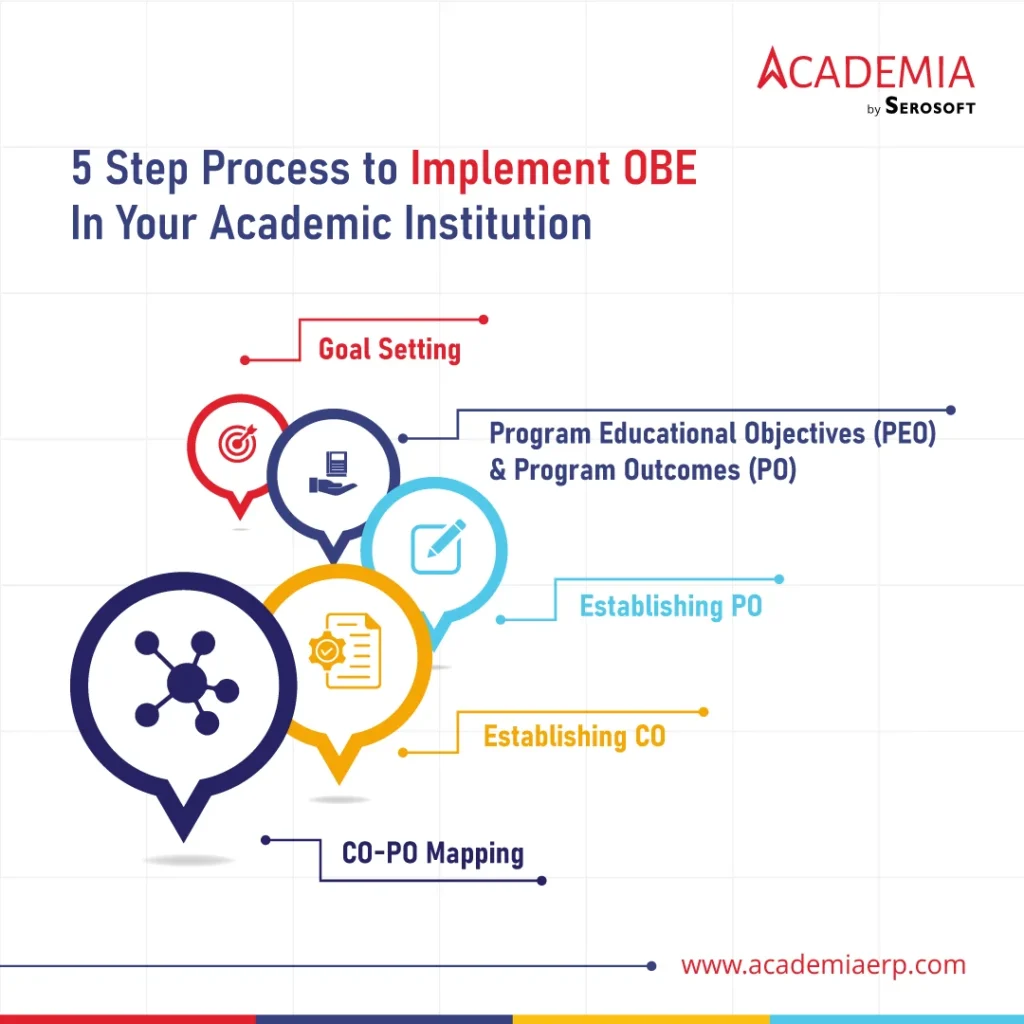
5 Step Process to Implement OBE In Your Academic Institution

Outcome-based education or OBE is the latest development in the education industry. It is a type of education delivery model that focuses on mapping, measuring, and achieving pre-determined educational goals. It prioritizes student learning and development by nurturing the pre-existing skills in students to help them grow in their professional and personal life. 

Clearly, it is a major leap from the existing education delivery model where a lot of time and effort is spent on scoring good marks in examinations rather than skill development and knowledge acquisition. OBE thus can help you change that, and provide a definite solution for the increasing problems such as unemployment, skill alignment as per the global market standards, and more. 

If you are thinking about implementing OBE in your education institute, here are some tips to successfully implement it, and ensure better student outcomes.


Outcome-based Education Process – Step By Step OBE Implementation

  • Goal Setting 

First and foremost, it is imperative to set short-term and long-term goals for individual students in terms of learning outcomes, personal growth, skill development, and institute overall performance. Institutes can follow the given steps to define vision and mission department-wise. 

  • Start by brainstorming with experts and experienced faculty of various departments
  • Speak with industry professionals and alumni batches
  • Analyse the opinion and define a solid plan of action 

Once the vision and mission are clear, the institute needs to focus on teaching and learning processes.

  • Program and Education Objective and Program Outcomes

Program Educational Objectives help teachers define the expected outcomes for the students once they graduate, this includes academic and behavioral aspects both that are absolutely necessary to excel in their career. 

  • The vision and mission set in the first step should be central to the action plan.
  • Experienced faculty members and the heads of various departments must draft and share it across their respective departments. 
  • The draft and processes need to be implemented and discussed thoroughly for gaining the approval of authorities. You can iterate the draft to prepare a final draft. 
  • Once the final draft is ready after taking all the considerations of people involved in the implementation process, it is presented to Program Assessment Committee so that it can further be forwarded to Departmental Advisory Board. 
  • The Departmental Advisory Board reviews the points mentioned in the draft and sends them to the Board of Studies & Academic Council for final approval. Once the approval comes in, the draft is taken as a guide to design a fresh curriculum for the students to grow personally and professionally. 
  • Institutions need to analyze the student learning outcomes periodically to identify the learning gaps and rectify them. It is usually focused on Professional Skill Development, Problem-Solving Skills, Industry-Specific Skill Development & Creative Enhancement. 
  • Establishing Program Outcomes 

POs or Program Outcomes are defined as the objective achieved at the end of the specialization or discipline. These attributes are defined while a student is undergoing education and determined when they get a degree. 

Here is a step-by-step approach to establishing the POs for the institution. 

  • The Program Coordinator consults with the senior faculty to prepare a draft for program outcomes. 
  • The Coordinator speaks with alumni, industry experts, and various employers to understand the skill requirement and new trends in the industry. On analyzing the views, a synthesized version of the draft is created and sent to the Program Assessment Committee. 
  • The Program Assessment Committee reviews the draft and sends it to the Department of Advisory Board to get the final approval from them. 
  • Department Advisory Board makes the final decision by moderating the draft.
12 Graduate attributes mentioned By the National Accreditation Board In Their Guidelines to attain POs successfully
PO1 Knowledge PO7 Environment
PO2 Problem Analysis Capability PO8 Ethics of Individuals
PO3 Development & Designing of System PO9 Teamwork & Individual Contribution
PO4 Analyze & Solve Complex Problems PO10 Communication
PO5 Use of Latest Tools & Devices PO11 Finance & Management of Project
PO6 Society’s Responsibilities PO12 Life-long Learner
  • Establishing the Course Outcomes

Course Outcomes are different than Program Outcomes. The objective of CO or Course Outcome is to define the objectives that are achieved at the end of a semester/year. It is basically the outcome that is achieved in theory and practical lessons concluded at the end of the year or semester.

  • CO-PO Mapping Process

To thoroughly analyze if a student has successfully achieved the goals set at the beginning of the process, it is important to map Course Outcomes with Program Outcomes. To do that, follow these steps: 

  • Specify and obtain the course outcomes
  • Map COs with POs
  • Set an appropriate weightage for the CO assessment
  • Measure the COs through assessment given to students
  • COs & POs attainment calculation needs to be done. 

Concluding

Outcome-based Education can help you stand out in the education market and offer a quality education. But for that to happen you must have a great implementation strategy on your hands. Use the above-mentioned steps to achieve successful implementation of OBE. To assist you in your course toward redefining education consider an ERP solution that offers process streamlining, simplified processes, better results, easy CO-PO mapping, and more. Explore the Academia ERP OBE module here. 

Back to top