Type your keyword below

Why Interoperability is Important in Education ERP and Why do we need it?

Have you listened to the increasingly widespread term “interoperability” all around in the education trend? Maybe, but do you know what it is and what its benefits are, and why it is important to have in your institution? It is often seen that today institutions choose technology and then make adjustments with the existing workflows and systems to implement it. Having interoperability in education ERP, institutions no longer need to make any changes in the current workflows, technologies, or systems, as technologies can not work on silos these days, they need integration to form and create a greater experience and here interoperability works better. Let’s discuss it in this blog post to conclude why it is important, why institutions should choose an ERP having interoperability in education ERP. 

What is interoperability? 

Interoperability is the capability of having two or more information systems that are allowed to exchange and use information systematically providing synchronization of all parts. 

Looking into deeper interoperability is a component and a very important term for institutions. It attempts and addresses all the needs of institutions such as duplicate information in different areas or systems, lack of cohesion, the existence of various systems that provide different works. So interoperability focuses to erase all these errors bringing control and efficiency among the institutions. 

It results in cooperation, development, integration, and the rendering of all the academic and administrative operations in the best possible way. 

Why is interoperability important?

As of now, you may have understood the meaning of interoperability, now let’s jump over to understand the importance of interoperability in education ERP. Interoperability most importantly facilitates the exchange of information, like if you have a library management system in your institute than having an ERP like Academia you can make it more powerful to provide the best experience for students and faculties by having a single source of truth and reducing data redundancy between the two systems. 

Some of the advantages of interoperability include:

  • Adaptability:

This is one of the best advantages of interoperability, various systems that take in the information, connect and distribute that information automatically and flexibly. 

  • Data Cohesion:

It provides a proper and systematic arrangement of all the information that is managed effectively and controlled by all parties. 

  • Increased growth:

It is one of the most important advantages, it provides all availability of information associated with the value chain. So faculties and students get the opportunity to operate cohesively throughout the entire academic and administrative process ensuring the information is available and accessible by all to all systems. 

How does an ERP provide you with complete interoperability?

Education ERP or Student Information System provides the complete operational arrangement of all activities in an educational institution. Having interoperability an ERP system can provide a technological platform that can operate multiple integrations of systems using one landscape providing the desired results to faculties and students. 

Academia a one-stop solution for all your needs

Academia provides one of the best robust, feature-rich, analytics-equipped, and user-friendly ERP systems and Student Information systems built on a cutting-edge and flexible architecture- that enables educational institutions to automate & streamline their functions and all the processes for learning and administration. 

In terms of providing interoperability, Academia understanding today’s rapidly evolving technological landscape provides SIS/SMS that can be integrated with 3rd party systems to ensure greater value to institutions, management, and faculties.  Looking deeper into it, Academia ERP provides comprehensive integration with educational systems such as Learning Management System (LMS) example Moodle, Library Management System such as Koha, Finance and Accounting Systems like Tally, Sage, and many other tools and systems like LimeSurvey, PowerBI, Microsoft teams, etc. Learn more about the interoperability offered by Academia ERP.

It has developed an extensive team that helps institutions successfully integrate and score business applications and services, through a variety of ways like pre-built connectors/plug-ins, web services, integration platforms- that can be customized according to customer’s business requirements, technical environment, and budget. 

Conclusion 

Institutions that are seeking complete digital transformation need interoperability as an important feature. Hope this article helped you in understanding interoperability and its advantages and most importantly how necessary it is for an educational ERP to have interoperability. So if you are curious to know more about it, Academia can help you with this, we are just one call or message away to discuss and interact with you. Contact us today. 

Check out our exclusive Gartner research report on Top 10 Strategic Technologies Impacting Higher Education:

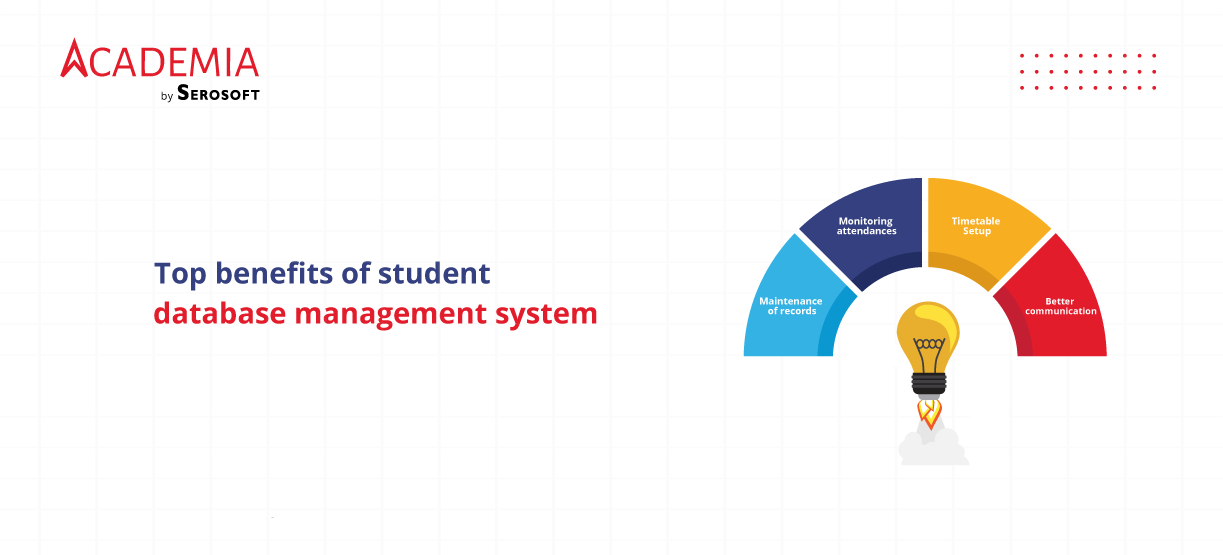
 

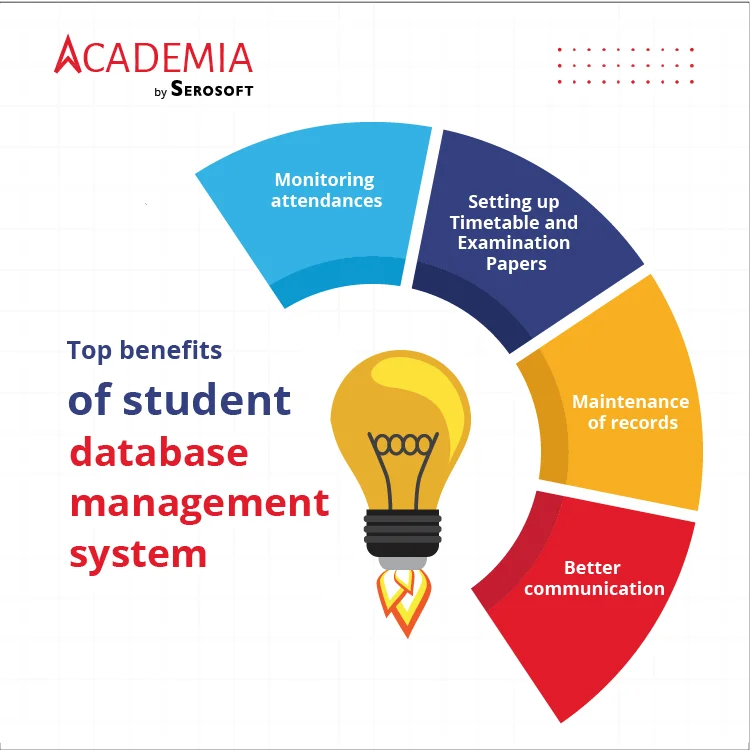
Top 13 Reasons Institutions Should Use Student Database Management Software

Educational institutions involve a huge amount of data of students for managing school affairs systematically. To streamline the process of managing student data, a lot of institutions are thinking about school management databases. It helps you to store and organize student-related data in a proper and centralized manner so that you can easily access, edit, or update data if needed. 

  • Manages complete student information

A school management database deals with all the information related to students’ attendance, assignments, academic reports, curriculum details, project details, exam management, grades, achievements, medical history, addresses, accounts, and many more things. It also helps faculties to reach all the student data easily and effectively. 

  • Streamlined coordination and communication

The school database management system helps for better coordinating and remembering all the events and activities that are going to be held in the school in the upcoming days or weeks. It provides a proper look at the data on a single screen and helps to highlight and remember the important information. This helps institutions in better productivity and growth. 

It also allows institutions to circulate easier communication between students, faculties, faculties-parents, and student-faculties and even allows for the school alumni to stay connected with each other. 

Instead of relying on the diary system, a school database management system can send instant updates to the faculties on school events, attendance, and even disciplinary issues over email or SMS. students can also communicate with each other and with their teachers on the discussion boards to clear their doubts and collaborate over assignments. 

The school database management system takes care of the admission process as well. The complete management system accesses the registration process, admission approval, document uploading, test and interview schedules, and much more. The way of managing academic processes is changing, people are attracted to an effective admission system that can provide ease to faculties, students, and parents. 

It also helps students and faculty to fill out the application conveniently reducing long queues to get an application form or to get their admission-related queries and get an application form or to get their admission-related queries answered easily. 

“Admissions are no longer difficult now, they are easier than ever before. 

  • Reduces paperwork 

A school database system helps students manage students’ data automatically, reducing the paperwork and providing effective digital tracking of student data. All the documentation like admission forms, student records, financial aid, paperwork, and all other data can be managed effectively. It also provides proper security of all the records managing and securing the data for future reference to access whenever they are required which is quite complex with paperwork. 

A school database system stores each data properly providing real-time tracking of all the documents with just a few clicks. 

  • Trustworthy and secure 

The school database management system is the most secured and reliable source, it provides a hundred times more security than manually stored information. Student database software helps in storing all the information using a cloud-based server. It also provides multiple automatic backups of essential data to make sure you do not lose your valuable data. Most importantly, it prevents software from getting hacked by any competitor or other cyber suspect. 

  • Proper and efficient attendance management 

The school database management system includes tools that help faculties maintain quick records of student’s attendance. The software provides student attendance management features that require students to check and scan their fingerprints and enter or leave the classroom and school premises. The software also takes care of the attendance of students, which includes half-days, late coming, etc., without any kind of manual intervention. 

It also reduces the faculty’s workload from the monotonous task of taking attendance of each student by calling his\her name. It also allows faculties to directly check the summary of the presence and absence of the students digitally. The most interesting part is this software allows administrators to keep track of faculty’s attendance along with providing them with a quick calculation of their leaves and adjustments. 

  • Transport management 

A student database management system provides easy access to the transportation system of the institute. It manages the complete transportation requirements right from tracking the vehicle to managing and monitoring the salary, working hours, and other tasks of drivers and other helpers in the vehicles. The software provides easy access to parents and faculties to track their kids using the mobile application keeping them updated about the kid. 

  • Timetable management

The school database management system also provides a better school and class management. Timetable creation is considered the most critical thing that involves a lot of time, it also becomes difficult to circulate the timetable among the students as a minor error by a student or faculty can create a lot of confusion, and even in some cases, it can spoil student’s future if the student not downs wrong time table. 

So the school database management system helps with a timetable management feature that helps in scheduling the classes properly. It helps institutions to meet the requirements of different education boards. The tool also enables users to make changes to a timetable as per their convenience along with providing the timetable to students on their mobile app that can be accessed anywhere and everywhere. 

For more information, check out this video about how Student Information Systems Benefiting Educationalists Worldwide:

Bottom Line:

Hope the article helped you to understand more!

So if you are thinking of optimizing these benefits of a school management system in your institute, Academia SMS can be the best option for you. It provides the best system that helps institutions to manage all the academic and administrative operations of an institute. 

So don’t just be an average competitor of other institutes but be a growth seeker focusing on student’s growth and secured future. Contact us today. 

Unlocking the Potential: Experiential Learning in Education Automation – Advantages and Disadvantages

In today’s dynamic educational landscape, the demand for effective learning resources is paramount. Explore the advantages and disadvantages of experiential learning, a method vital for institutions leveraging education automation, and education ERP solutions. Let’s delve into the intricacies of this transformative approach.

Understanding Experiential Learning

Experiential learning, centered around hands-on experiences, propels students to learn by doing. This process, combining self-initiative and self-assessment, is amplified by hands-on technology and innovation. In both traditional classrooms and online learning environments, students and teachers benefit significantly from experiential learning opportunities.

Advantages of Experiential Learning:

  • 1. Real-world Experiences:

              • Students engage with data and concepts through hands-on tasks, fostering a deeper understanding and retention of information.

  • 2. Creativity Unleashed:

              • Encourages creative problem-solving, equipping students with innovative solutions to real-world challenges.

  • 3. Accelerated Learning:

              • Implementation of learning points creates a lasting impact, developing problem-solving and decision-making skills.

  • 4. Theory-Practice Integration:

              • Merges theory and practice, providing students with opportunities to apply knowledge in real-world scenarios.

  • 5. Learning from Mistakes:

              • Embraces the value of errors, allowing students to iterate and refine their approaches, turning mistakes into valuable learning experiences.

  • 6. Career-oriented Focus:

              • Guides students towards their future careers by aligning learning activities with real-world experiences and activities.

  • 7. Communication Skills Enhancement:

              • Fosters teamwork and collaboration, bridging communication gaps and promoting effective communication skills.

  • 8. Visible Accomplishments:

              • Promotes a feedback loop that accelerates learning, enabling students to see tangible improvements in a short span.

Disadvantages of Experiential Learning:

  • 1. Patience and Guidance Required:

              • Demands patience and guidance as students experiment with various methods, requiring time for results to manifest.

  • 2. Decentralized Process:

              • Considered a decentralized process, as students access and submit assignments online, limiting faculty access through traditional modes.


Conclusion:

Embrace the power of experiential learning with online tools and technologies, revolutionizing knowledge acquisition and skill development. If you’re considering implementing experiential learning activities in your institution, Academia ERP offers a suite of tools, including a student information system, enterprise resource planning, and more. Contact us now for further information and personalized assistance. Your journey toward transformative education begins here!

Contact us now to explore how Academia’s suite of tools can enhance your institution’s educational experience and seamlessly integrate experiential learning into your curriculum. Take the first step towards a transformative educational journey!

Frequently Asked Questions About Education Management Information System

As the institutions are seeking technology to opt for digital transformation and automation, various questions occur in mind like which Education Management Information System to choose, how does it work, and what is the process of implementing it, and various others.  So let’s discuss some of the important questions in this blog.

Education Management Information System FAQs:

  1. What is an Education Management Information System? This is one of the basic questions that institutions must know about if they are focusing to have a big and positive technological impact. An education management information system software allows the management to have the institution’s complete academic and administrative operations bringing digital transformation and automation to the institution.
  2. How can an EMIS manage academic and administrative operations? An EMIS helps educational institutions to manage the complete academic and administrative operations systematically, e.g. if we talk about the admission process EMIS will simplify it by removing the long queue process for generation and submission, making it completely digital and mobile-friendly for students and faculties as well. If it is a fee-related operation, an EMIS can make it systematic by generating fee receipts and all other operations of the institution.
  3. How to Choose an EMIS for my institution and which is the best EMIS in the market right now? There are various EMIS solutions available in the market, but it is important to choose the right one that can help to ease out the institutional tasks along with saving the cost. After proper research and having a demo with the software and its company, you must select an EMIS software after proper research and having a demo with the software and its company. You can also select Academia, it is an award-winning and leading educational ERP software solution that provides robust, scalable, and flexible software that can accomplish all the academic and administrative operations of the institution. Please refer to our blog post on Choosing the Best Management Information System for Your Educational Institution for more details and exact steps.
  4. What are the basic changes that I will need to bring after having an EMIS in my institution?The answer to this question is quite simple, opting for an EMIS (Education Management Information System) like Academia will completely transform your institution digitally. It will provide a new way of operating institutional tasks with automation. It will change the complete day-to-day activities of your institution, reducing the manpower, decreasing the chances of errors, reducing the overall cost, and making everything conceptualized and clear.
  5. Do we need to get training before implementing EMIS in our institute? Yes definitely, before implementing anything in any sector, it is important to understand it properly and the same applies to the education management information system. To have a successful implementation of it in your institute, you must need to have a proper understanding of it. Academia has a team of highly qualified and experienced professionals who will provide you complete knowledge and training about the EMIS software. The team is so polite and humble that they will never leave you in confusion about anything. You can ask them anytime even after the first 3 months or more of implementing the software.
  6. What needs to be involved in the ERP implementation process? An Education Management Information System implementation involves installing the software, moving your data over to the institute’s system, configuring your users & the processes, and also training the users on the software. Choosing the right partner for implementing your ERP system is almost as important as selecting the right software like Academia. The right software company will arrange the whole implementation process for your institution making it clear, simple, and systematic.
  7. Is the EMIS software costly? No not at all, the Education Management Information System by Academia is designed in such a way that it manages the complete operations of the institution by reducing the manpower, paper, and time, it also arranges things in a single system, saving data. All the operations are managed properly and directly save cost, making the software cost-effective. Academia provides a cost-effective system that institutions can implement and save a lot of costs and earn revenue.
  8. What are the advantages of using mobile apps for students? Academia SIS is designed to meet the needs of administrators, faculty members, and students as well. The students in the institution get the authority to mark attendance easily along with providing real-time access to parents and faculties to track their child’s attendance, with this, they can even pay the fees from anywhere at any time using the mobile app. Generation of hall tickets and mark sheets for the examination is also possible using the mobile app. So to conclude, it is an app for students and faculty as well.

Conclusion

Academia education management information system offers comprehensive and detailed services that improve institutional productivity, workflow efficiency and boost high  ROI by streamlining administrative processes with automation. Hope the above questions helped to resolve your basic queries related to the EMIS, if you have any other questions or queries related to it our team will be glad to resolve them. Do contact us now.

Student Lifecycle Management with a Modern SIS

Student success is always considered as the top priority for any institution, students always are considered as the base of any educational institution. So various works are associated with students right from their admission process to the completion of their education.

Previously, all the tasks related to student success were dependent on a lot of manual work that included organizing marketing activities for universities to attract fresh prospects, track their interests, nurture them through continuous engagement, these are just some of the things that come under student lifecycle management. 

Do you know about the student life cycle? Let’s discuss it to have a better understanding of student success and organizational management. 

What is the Student Life Cycle?

A student life cycle is a data-driven and holistic approach that focuses on the entire student journey right from the inquiry for admission to alumni to ensure student success in real-time. 

You can efficiently manage your institution’s complete student life cycle by having a Student Information System (SIS) that triggers to deliver high-quality learning experiences. It provides fully customizable, flexible, and scalable solutions to manage efficient and effective services. 

A student information system can enable you to manage and create quick & easy-to-use student profile information, the inquiry process, enrollment for admission, link to enroll, schedule, transcript, and degree evaluation, and share records with faculties, and administrators. 

It also can track student performance from his first-class to his last class in the university that is course completion, managing information across the entire student lifecycle to advance students.

The complete life cycle of student in an institutions includes the following factors:

  • Inquiry for admission 

It is one of the most primary and essential tasks that institutions have to make proper and systematic, inquiry is the first step that students do to know about the institution in which they are going to take admission. You need to manage the database of prospective applicants and inquiries. Academia SIS provides easy access to manage a database of prospective students/applicants, it can also follow up on inquires, convert online inquiries to applications when needed. Analyze the inquiry management system using the source dashboards and reports. 

  • Admission process 

Once the inquiry is done, students choose to take admissions in the institution, manually it is a lengthy process for students as well as for management also. It involves long admission form filling and submission, enrollment and verification of students, and various other things. Having an online system like an ERP helps the management and students manage the complete process easily and effectively without any stress and time-consuming process. Academia SIS provides you the following benefits making it a simple and systematic process:

  • Systematic creation of admission applications. 
  • You can provide an online application form facility on the institute’s website that is easily accessible to students and their guardians. 
  • It is easy to manage application form acceptance and generate an offer letter for that as well. 
  • You can convert online applications to admissions easily. 
  • You can track and check the records of student registration information. 
  • Generation of detailed reports on applicants at each stage with their status and ranks. 
  • Fee Structure 

Managing fee records in institutions is difficult to do manually. There are various fee structures, patterns, various departments, and n-numbers of students; it requires effort to keep track of everything and access the exact details required. The process becomes time-consuming with a lack of flexibility, transparency for parents, and students.  

It becomes an easy and smooth process having a fee management system that handles all the fee-related tasks. Having an ERP like Academia you will get the following features to manage fee operations:

  • It will be easier to create multiple fee plans to use across the institute. 
  • You will be able to manage the fee plan at the time of the course enrollment for each student. 
  • Manage refunds and cheque bounce issues along with duplicate receipt issues. 
  • Generate sponsored invoicing & student invoicing. 
  • You can manage security rights by adding, modifying, deleting, and exporting fee structures according to your needs.
  • Program and course selection 

There are various courses and programs offered by institutions, each student needs to select the desired program or course. This process takes a lot of time and effort, sometimes it becomes a more difficult, complicated, and time-consuming process for the management, finding previous data creates more chaos and complications. Academia provides a special program and course module which makes program and course selection easy and systematic in the following ways:

  • You can create and manage programs and courses that are offered and run in the institute. 
  • It is up to the management to create the list of courses and students associated along with the enrollment, you can also define the credits, hours, and sections for the programs according to the needs. 
  • It is also easy to map programs and courses concerning the sessions. 
  • Define and create student advisers and program coordinators. 

Having a program and course module can become easy for institutions to manage and run the complete process. 

  • Timetable 

It is also one of the most important factors in the student life cycle that institutions need to focus on to make it simpler for them as well as for the students. Manually this process includes a lot of glitches, it also becomes difficult for students to access the timetable manually on time. Let’s walk through in detail to look at how an education ERP can help with timetable management.

  • Using Academia you can generate details for attendance via time-table integration.
  • Mark attendance of students, program, and section-wise.
  • Provide functionality for attendance-based exam detention with the integration of attendance management and examination modules.
  • Provide attendance reports including program-wise attendance for faculty and students.
  • Attendance record 

Attendance is one of the most necessary components of administrative processes in educational institutions. Proper attendance brings success for students as well as for the institute. It is always seen that poor attendance affects the quality of education and deters the students’ performance. Just think about the scenario in which you will get an attendance management system that can keep track of attendance along with academic performance.  Academia attendance management system provides you with the  following features to manage attendance in your institution:

  • Generate session details for attendance via integration with the timetable. 
  • Mark section-wise attendance to the students.
  • Attendance-based exam detention by integrating attendance management with the examination module. 
  • Generate attendance reports including program-wise and faculty-wise attendance.
  • Integrate with biometric-based student class attendance solution (optional).
  • Examinations 

Examinations have always been a crucial part of academic assessments, it needs to be conducted smoothly for student success and organizational success. The examination officers need to manage the complete and conduct the examinations. An examination management system can help the institutions reduce the burden, making it a right to make an ideal student life cycle model. It includes the following features:

  • Prepare and manage pre-examinations processes.
  • Manage exam notifications to send to student/parent/faculty portals.
  • Manage exam programs and student registration.
  • Manage student detention based on fee/attendance record.
  • Record student performance remarks and marks.
  • Generate hall ticket and design exam schedule.
  • Manage exam day processes including student exam attendance.
  • Evaluate and manage different marking heads i.e. mid-term, viva, and final semester.
  • Manage the marking schemes including grade, percentage, GPA, and CGPA.
  • Prepare results, transcripts and generate reports for result analysis.
  • Alumni Management

It is often considered that after completing the studies students no longer need to be in touch with the institutions, but it is also one of the most important parts of student life cycle stages it is considered as alumni management in which institutions keep all the data and records of each student from the admission to their ending day of university/college/school. So just imagine the situation in which a 10 years old student of your institution needs his documents for admission, it will be so exhausting to find it manually where lakhs of files and documents are there, it will become a time-consuming and chaotic process. 

Having an ERP like Academia, you can access all the data in just a few clicks, isn’t it amazing, all the data of each student will be saved right from the admission to the ending day of his studies. 

Closing Notes:

An institution’s success depends on student life cycle success. It is high time for institutions to seek digital transformation having best-in-class technology and ERP solutions to improve the student service and gain a competitive edge. Having a Student Information System or an ERP makes it easier for institutions to manage student life cycles without any risks and chaos. 

Academia provides highly flexible, scalable, and robust ERP solutions to manage and improve student relationships throughout his whole journey in the organization. It provides quick & easy to use tools and technologies that increase straight student retention rates managing complete student life cycle stages. 

There are many more features that Academia provides to institutions, like organization setup, campaign management, front desk management, messaging and notifications, assignment management, security gate management, and many more. So if you are looking forward to providing a better experience to your students intending university student life cycle, feel free to contact us, we will provide you a free demo of each module to have a better understanding of it. For more information check out the website now. 

Check out how Academia fulfilled TSM’s requirements for specific flow designed for ATKT examination management & mark sheet generation.

Difference between Digitization, Digitalization, and Digital Transformation

The COVID-19 pandemic has embraced digital technologies to keep the learning continued and improving. Educational institutions have opted for various technologies that helped them manage resources, improve safety, and increase effectiveness.  

With the emerging technologies, institutions often get confused between digitization, digitalization, and digital transformation. So in this blog, let’s discuss these three terms and concepts closely along with their values in the context of education. 

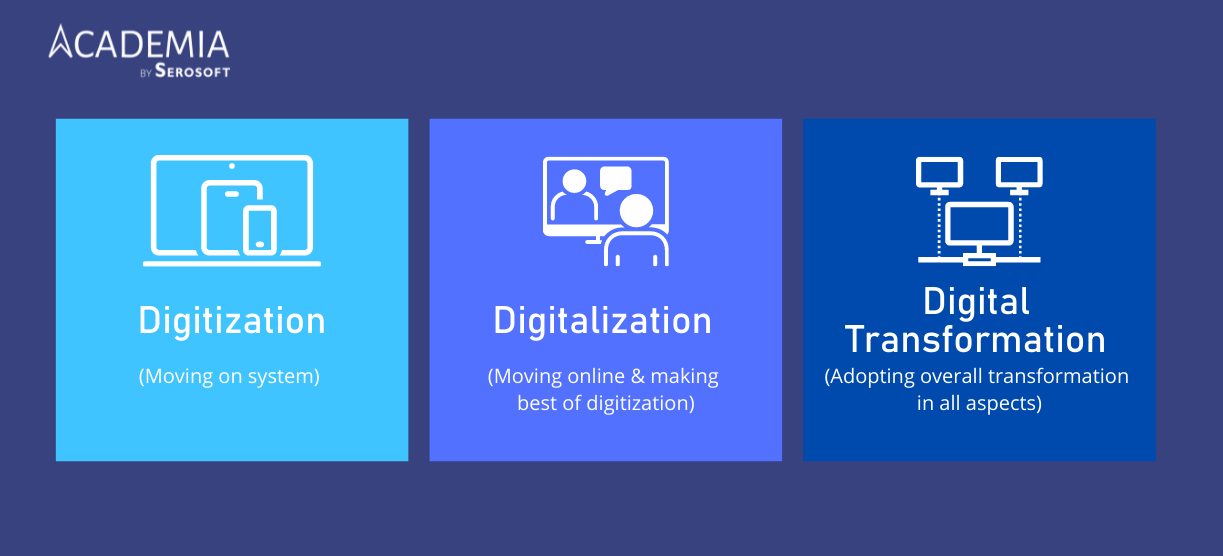
What is digitization?

Digitization in education is the process of converting information from a physical source to a digital one. It directly helps in converting non-digital documents into digital representations that are automatable according to the workflows. Digitization also enables processes to create business value accessed anywhere, anytime. It also lays the foundation for businesses’ use cases that leverage the data.

Examples of digitization include scanning a paper document and saving it on a computer’s hard drive as a digital document, choosing Excel spreadsheets from paper formats, and more. 

What is digitalization?

In a broader sense, digitization and digitalization are closely associated. They are often considered the same terms, but looking deeper into it, both are different, having different meanings and values. Digitalization means making the best of digitized resources and work. It more often helps in connecting through digital technologies to improve overall efficiency along with creating a digital culture at its core.

One of the common examples of digitalization includes converting Excel spreadsheets, documents, and more to the cloud. Through this, institutions can work in a structured environment where the documents can be shared and accessed among stakeholders according to their needs.

What is digital transformation?

Digital transformation is the complete transformation of activities, operations, processes, products, and functionalities leveraging opportunities of digital technologies. It includes both the terms digitization & digitalization. 

Institutions in the modern age can choose digital transformation aiming for efficiency, productivity, and new monetization opportunities. It can help institutions to bring new-age learning to all prospects. 

One of the common examples and benefits of digital transformation is moving the data of admission or any other operation from a Google tool into software like ERP that can analyze the data. 

The main benefit of digital transformation for educational institutions is to provide ease, productivity, and growth through all the academic & administrative operations for all the stakeholders associated with the institution.


The Difference between digitization, digitalization, and digital transformation

Digitization, digitalization, and digital transformation are co-related terms and help educational institutions achieve automation. Meanwhile, it is crucial to understand that digital transformation is the broadest term that involves both digitization and digitalization. 

According to Gartner, digitalization and digital transformation have a growing impact with enhanced expectations from students, staff, and faculty. 

Digital transformation helps in automating complete functioning & transforming manual functioning into three processes: first digitized, second, digitalized, and last yet the most important digital transformation. 

Various technologies like ERP/SIS, help educational institutions automate all their operations, and activities, and opt for digital transformation leading to unstoppable success and achievements. 

Conclusion 

So at which stage your institution stands – digitization, digitalization, or digital transformation? Nevertheless, institutions must understand that if your institution has opted for digitization, it is nothing but a step ahead of manual intervention. With the enhancing EdTech opportunities, institutions should need to choose digital transformation with advanced software like ERP/SIS. 

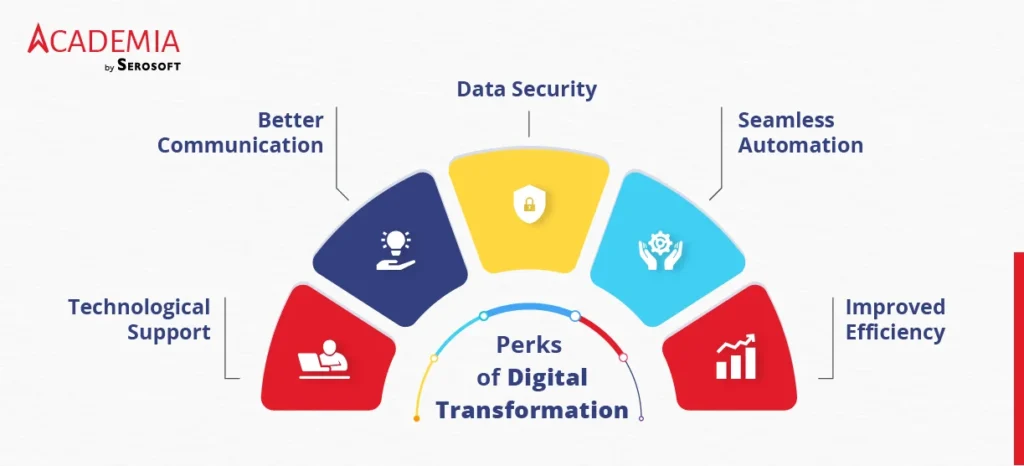
Academia ERP/SIS provides absolute digital transformation to all the academic & administrative operations of your institution. The key aspects of digital transformation for your institution include:

  • The digital transformation of complete manual processes even from paper, documents, or Google tools. 
  • Interoperability with other software and systems for seamless workflow and management. 
  • Multi-center capability for managing multiple locations & campuses with ease. 
  • Mobile application for easy access from anywhere and anytime for any stakeholder. 
  • Boost productivity and ROI. 

So, what are you waiting for? Seek digital transformation now! Just fill out the form and one of our experts will get to you as soon as possible. 

Achieving IT Governance through a University Information System

In recent times, there has been a consistent focus on how IT supports good governance in HEI (Higher Education Institutions). With technology rapidly changing and competition rising, HEI’s good IT governance is increasingly being achieved with a capable University Information System.

For HEI (Higher Education Institutions) where technological infrastructure consists of different kinds of applications and platforms, academic systems, cloud applications, and diverse technologies, IT is an essential factor that supports the growth and sustainability of the institution. All these different technologies used to support the research, teaching, and administrative processes need a very efficient IT governance framework. 

An IT governance framework is made of structures, processes, and relational mechanisms with each mechanism having a specific function and when implemented, it should positively impact the institute. At the same time, the process to identify the right mechanism for a specific context is a tough and complex one. 

Today, IT plays a critical role in every aspect of a university from researching and teaching to administration. IT is helping educational institutions achieve their goals and objectives. Also, communications and IT provide increasing opportunities to boost an institution’s effectiveness and efficiency. Hence, investment in IT, and how, when, and where it will be made, is an important part of an institute’s strategy to grow.

IT governance covers everything related to technology, including:

  • All technology, applications, and services used by the university
  • IT resource management 
  • IT project management 
  • Information security 
  • IT policies and standards 
  • IT risk management 

Today, implementing an IT governance system at universities has become a necessity and it helps to-

  • Define who is responsible for IT strategic planning and decision-making
  • Identify how to leverage technologies for greater innovation and collaboration among students, faculty, and staff
  • Create a strong IT strategy and line it up with the university’s global strategy
  • Save costs in IT investment because of project management and prioritisation of investments
  • Reduce IT risks with adequate management
  • With the right indicators have the evaluation and monitoring of IT-based processes and services
  • Accomplish regulatory compliance, implement international standards and obtain quality certification relating to IT governance more easily
  • Achieve a return value on investments made, with cost savings, global internal organisation improvement, more user satisfaction, improved corporate image, and outreach

A university management system is specifically designed for every stakeholder from Chancellors, Directors, Principals to administrators and staff to automate complex procedures and manage day-to-day operations. With a good university management information system, there is a lot of benefit for students and the university, including better academic delivery, work efficiency, and improved student achievement. With the education landscape going through steady changes, universities must have an innovative university information system. 

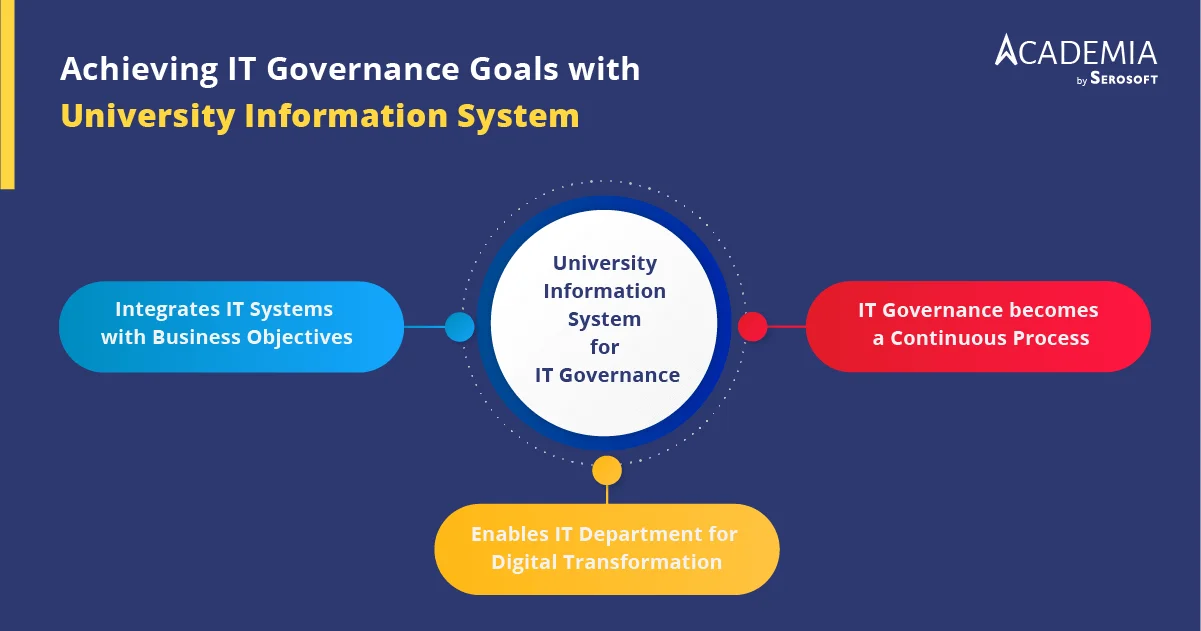
There are 3 reasons why a University Information System is crucial for a university to achieve IT Governance goals: 

  1. The system ensures that IT governance becomes an ongoing process, which is critical to the success of the initiative.
  2. It integrates IT systems with business objectives.
  3. It changes the perspective of the IT department as a service provider and elevates it to enable transformation at a human, social and intellectual level.


Some of the key advantages of deploying a university management information system are:

  • Seamless management of all in-house activities
  • Offline & online examination management
  • Onsite, online, offline service support anytime
  • Role-based login access for data security
  • Monitoring & accurate information analysis
  • User-friendly solution for ease of navigation 
  • Reduction of manpower and cost savings
  • Centralised online admissions
  • Improved transparency in result processing or procurement. 
  • Better efficiency with faster processes and central data repository
  • Better accountability
  • Easy to assemble, process, and record information quickly
  • Integrates all stakeholders for an improved level of comfort

Academia ERP offers a robust and comprehensive University Information System customised to provide automation solutions to digitise administrative operations. With decades of experience, Academia has been successfully converting manual processes into digital ones.

Academia is a practical cloud-based university management information software that can be accessed across campuses and academic and non-academic departments which are integrated with everyday activities. Academia’s transparent and user-friendly ERP helps to connect students and teachers and eliminates the mismanagement of data. The data is secured with security tools and encrypted passwords and there is the quick automatic backup of data that is easily retrievable.

Academia also offers 27×7 offline and online support to fix any technical bugs that may arise, and help in the smooth functioning of the ERP.

To learn more about Academia’s empowering University Information System, please get in touch for a free demo. 

https://www.academiaerp.com/request-demo 

Online Examination System: 10 Tips for Student Assessment

As today’s time is critical, families, faculties, and students are learning at home, it is important to follow and monitor their activities with online examinations and student assessments. Teachers and parents will need to use efficient tools to discuss and meet the students, along with this it is also important to check whether the students are performing progressively or not.

For all this, it is important to keep a check on each student. By having an understanding of individual students, you can determine what interventions and pathways will be supporting their learning journey. And just after having proper knowledge about each student’s journey, with proper – tools such as the Academia Examination Management Module you can determine how to equip and support the entire student population with effective, united, and well-timed programming with a track record of their achievement.


Let’s discuss some of the key factors for understanding properly about student assessment with online examinations:

  1. Non-Intellectual Factor Determination 

It is important to check the non-intellectual skills in students. This skill includes resiliency, motivation, and confidence in academic performance and social settings, this hugely impacts the student’s overall performance and assessments, meanwhile all these things are really important in the online assessment. For example, think about the students who just joined the college, the faculties might know very little about them outside the basic demographic info and their past academic history. So having known their initial factors related to intellectual and non-intellectual aspects can help in assessing them in online examinations. 

Non-intellectual skills are generally measured by having a written assessment or in a video meeting. Academia works with institutions to help them perform non-intellectual assessments every year. 

  1. Risk Analysis 

It is also important to analyze the risk level by gathering data and using it to predict things about student outcomes, campuses are better prepared to be proactive in their student interventions. This risk analysis is essential to have a smooth run of examination in this current scenario. It also helps in tracking metrics to better understand what may help to improve the student just before the examination and what he can improve every year before the assessments. 

  1. Circular and Engagement Activities 

Having the Academia Online Examination System, you can create various assessments for circular and engagement activities that you run in the whole academic session. It is always noted that students who are involved in circular and engagement activities are more likely to persist and get good results in examinations. Fun learning activities are always appreciated by the students and their parents as this helps them in more focused studies with pace. This kind of activity also helps the teachers and parents to understand the concentration and learning speeds of the students which eventually helps in getting good results. 

  1. Internal Performance and Academic Activities 

Tracking the student’s performance inside the classroom is also an essential task that institutions need to focus on.  Students’ success majorly relies on classroom engagement and performance along with the last examination assessment. 

Internal performance aspects that must be focused on:

    • Class Absence:

The student’s absence in the online class also defines his dedication towards the studies, so it is important to set criteria for student’s attendance through the Academia Attendance Management System, through this the teachers can mark the attendance that is easily accessed by the students and their parents. 

    • Monthly Assignment:

Teachers need to allot monthly assignments to students to keep them engaged and encouraged, and also check their regular processes. Academia provides a complete system to provide a lot of assignments to students and to check those assignments easily. You can provide them with a series of structured assignments in various courses that you are running. Having this the teachers can evaluate the real position of students forcing them to do more struggle for studies before their midterms. 

  1. Assessment Result 

Along with the final assessments, it’s common for campuses to survey and access the students after the result declaration. Many institutions work with check-up surveys of the first semester students to make sure that the students are satisfied with their studies and satisfied.

  1. Discussion with Students regularly 

With all the above-mentioned points, it is important to check to discuss student progress regularly with students, parents, and teachers. This helps in knowing the student’s areas of strength and areas of improvement. You can create feedback forms using Academia online examination and student assessment focusing on the collaborative success of teachers, students, and parents.

  1. Periodical Online Assessment 

While the teachers are teaching online, it is also important to check periodically whether the students are getting interested or not, so to do this, you can ask questions in the middle of the online class to check the student’s responses in your session. This can help students to focus on their studies giving you good results in exams. 

  1. Sharing experiences and incidents 

Teachers need to make an emotional connection with students, like in the current scenario of COVID-19, it is important to provide support to students to address any issues they are facing providing them with real-time help that they need. This helps the students to make a connection with the teachers and institutions along with having a good focus on studies. 

  1. Quick Results For Assessments 

It is important to provide quick results to students after the assessments. Quick results encourage the students to focus on their studies in both the cases of low marks or high marks. So using the Online Examination System, you can easily evaluate accurate and instant results for any kind of assessment or examination. 

  1. Motivate for Self Learning 

The best advantage of online learning is that students can learn anytime and anywhere according to their needs, so provide them videos and online study material that they can access easily, this will help them learn faster and grasp more. Motivate self-learning through Academia Mobile App, which can help students to check every academic and administrative activity over the phone, like the online course videos, their attendance, their fee structure, timetable, examination arrangement, and all other things.

Conclusion 

Online learning is considered the best way of learning even in the post COVID world by the experts, it is helping the students to learn and grasp things easily, and meanwhile, it also helps the institutions to manage their academic and administrative operations easily and efficiently. Various Academia modules can help you increase the productivity of your institute bringing success and achievements. So don’t wait for any time, book your demo now to know more.

How to reduce the burden of the examination officer at an Institute

Examinations have always been a crucial part of academic assessments. Exams require to be conducted smoothly and it depends on the examination officer to establish the processes. The examination officers play a key role in educational institutes in the administration, management, and conducting of examinations. The exam office staff also supports the teaching staff and the students and is overburdened with responsibilities.

To understand the severe workload examination officers carry, it is important to understand the role of the examination officer or manager, broadly.

  1. Liaising with internal and external stakeholders
  2. Keeping abreast of examination changes each academic year
  3. Managing invigilators by training and updating on rules and regulation changes annually
  4. Updating examination-related policies
  5. Managing the examination entry process
  6. Managing the examination preparation process – creating timetables, seating plans, securely storing confidential examination materials; administering the internal assessment, etc.
  7. Supporting the access arrangements process
  8. Managing examination days from starting an examination, dealing with emergencies, to ending the examination and dispatching the examination scripts
  9. Contingency planning
  10. Managing examination results
  11. Dealing with requests and administering post-results services
  12. Issuing examination certificates

An automated system can take care of all the hassles related to examination management while saving on time and manual effort. It keeps track of every detail accurately such as admin details, student details, and faculty details. It is also equipped to generate attendance reports and marks.

These systems are designed to manage access permissions for users so there is no misuse and mismanagement of legal and official data by unauthorized users.

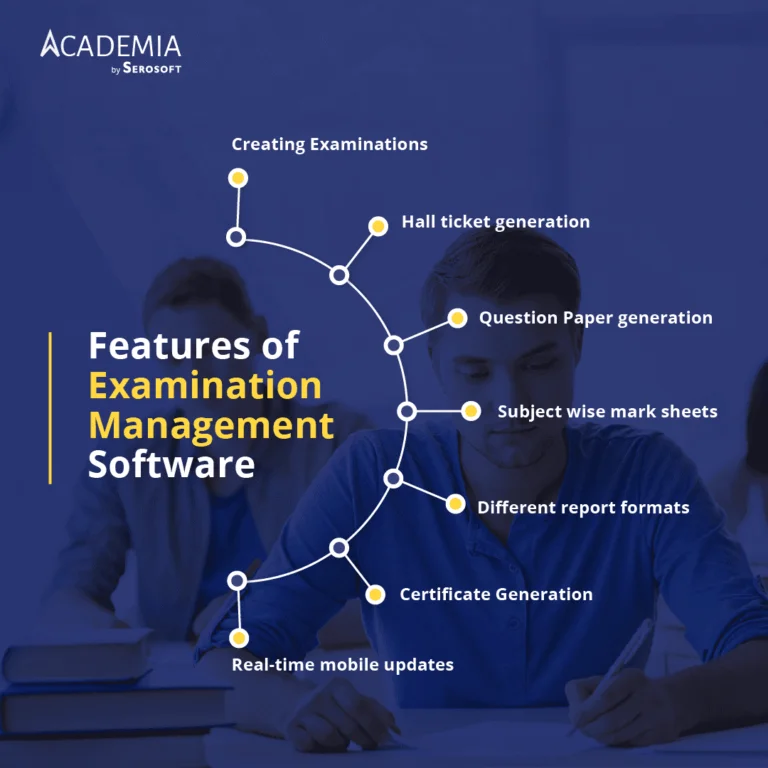
An Examination Management Software has some inbuilt features like –

  • Creating Examinations
  • Hall ticket generation
  • Question Paper generation
  • Subject wise mark sheets
  • Different report formats
  • Certificate Generation
  • Real-time mobile updates

An automated examination management system is a robust and scalable solution and is increasingly being opted for a very important reason – the benefit of lessening the burden for examination officers. Some of the topmost benefits are –

Time-Saving

With manual exams taking an enormous amount of time for activities such as creating and printing exam papers and answer sheets, preparing a list of teachers and assigning tasks to them, managing student records, allocating rooms, and much more.

This entire process is time-consuming and mentally daunting. With a student examination system, these activities can be streamlined and executed effortlessly saving a lot of time and effort for the examination officer.

Streamlined Process

Examination officers are under the immense pressure of conducting exams safely, without the risk of malpractices. Sometimes even with digitisation of exams, there could be malpractices and fraudulent activities which could lead to serious issues and spoil the institute’s reputation. An effective online exam management system with a centralised storage of student data including photographs and personal details can help examination officers and staff to cross-check the data on the exam day and conduct a fair examination.

Accuracy of Results

Exam results are a crucial component that helps students secure admissions to higher studies or kickstart a career. Therefore, there is a tremendous responsibility to release the results on time without errors. With an exam management system, answer sheets can be accessed easily and mark calculated precisely in no time. With the marks stored in a centralised database, the marks can either be sent to students online or displayed publicly online or on notice boards.

The Exam Management module in Academia ERP is an excellent automation system that has been designed to make the examination process smooth, efficient, and also paper-free. The exam management portal helps to automate the entire examination process from pre-exam preparations like receipt of enrollment forms and examination forms, exam timetable, grading criteria, handling logistics, allocating invigilators and processing of results, and printing of certificates and statistical reports.

The examination module takes care of all the required forms to be filled up to register for exams. Since the module is connected to the student database, it retrieves all necessary student information whenever the student name/Id/enrolment, etc is entered.

Academia’s examination module, which is part of an award-winning comprehensive educational ERP, provides easy and effective management of examinations at the institute –

Some of its benefits are –

  • Automates processes for exams at all the stages
  • Saves time and energy for the staff
  • Reduces duplication of work and makes it error-free
  • Generates student’s progress report which helps to improve learning outcomes
  • Eliminates manual forms and has paper-less processes
  • Simplifies exam processes making them easy and transparent

To sum up, an effective examination management software can take the burden off examination officers by creating and organising student-related paper records by automating the process. It saves the effort and time of the examination officer’s staff. resources and thus helps in remarkable cost savings.


Technology and Automation in Education

Nowadays, the situation is demanding digital transformation for all industries and education is the most important sector that is seeking digital transformation, automation in education has various benefits for the management, admin staff, administration, and students. 

Just think about how your institution can grow and how the students will get more time to study and learn with the spacious time that your institution is spending in the academic and administrative tasks just from the admission process to the examination process. Automation in Education can make everything simple and easier for them. 

Now let’s understand how technology can change the education sector in tremendous ways:

How technology plays an important role in education?

Technology is changing the overall ways of working and opening new doors of innovation and creation for the world, almost all industries are making their way to opt for online and technical things that can help them in growing more. It has a specific role to be played in the education sector, having a tech hand you can incorporate to aid and enhance the overall education experience. 

Technology has made it possible for the administration to handle the overall academic and administrative tasks easily and efficiently, it also has made it easier for the students to have individual learning than group learning instead of online classes they can get any of the required data anytime and anywhere according to their convenience, it ultimately results in more output creation than other things. 

What is Automation?

Automation is a method or technique of operating and controlling a single or different process, its core focus is to minimize the manual work in repetitive tasks, and it helps the teachers, faculties, and admin to focus more on the proper teaching and learning process of the students. 

Looking at the aspects of students, automation helps in optimizing the time along with helping them to learn whenever they want, whatever they want, and however, they want.

How can you access code-free automation?

It is often one of the most common challenges for the school administrations, as not the faculties, admin staff, and management knows about coding, so it becomes difficult for them to grasp the coding process. But most of the automation in education processes involves no code and they work the same way to eliminate the manual process of the organization. 

The organization opting for the automated systems just requires some basic training that can help them to understand and execute the automated system.

Processes that need automation in an institution:

  • Course Registration and Pre-admission 

Through automation it becomes very easy for institutions to register the courses and also to complete the admission process thoroughly, they do not need to distribute forms for admissions, collect them, and not even register them manually for individual courses, all these things process out automatically without any data glitches and problems, so bringing automation in education you can make the admission process easier to manage without any error. 

  • Student Shortlisting 

Automation makes it easy to select students, there are various ways to shortlist students based on various criteria like EQ, IQ, etc. Students who apply and perform well based on your criteria can be eligible for admission, with a dashboard and list marking all the details. So in simple words, automation makes it easy to shortlist eligible and interested candidates. 

  • Student Grading and Assessment

When it comes to grading the students, faculties follow a manual and lengthy process of filling forms and report cards to mark the grades, meanwhile, automation helps them to do all these tasks simply and efficiently marking the grades with just one single click for particular students after having the quizzes, tests, projects, or any other form of assessment. This process even helps the students to get faster feedback to work forward for their next assignments. 

  • Attendance Record 

Through automation in education, you can manage all the small and big tasks of the academy and administration, one of them are to mark attendance, so with automation, you will need to take even a little bit of stress about registers and notebooks to manage the attendance, digital attendance will automatically record the date and time for each student with your one click, you will also have a systematic and updated data to check any attendance presence for any day. 

  • Administrative Tasks 

There are so many tasks in an institution to manage, administration, accounts, marketing, and a lot more. Imagine you can have access to all this information in just one click, seeming interesting? With automation, you can manage all the tasks eliminating the physical work and bringing efficiency, agility, and transparency to all the administrative operations. Just think how things will become easy for you to have Report Cards, Certificates, Payslips, and various other things in a single hand along with capturing them for a lifetime eliminating the files eaten by spiders and termites. 

  • Scheduling the Classes

In the manual and offline world, schools take the examination in the middle, and at the end of the year, it becomes a time-consuming process, just think of the situation that how automation can make the process easy for you by organizing the whole process automatically, the interaction between student and teachers can be quite easier and through as teachers can make the online papers easily and can check them using automated system meanwhile students can also study hard with any time available online courses, they will also get the opportunity to collect the hall ticket online instead of going to the school/college occupying their study time. All this can directly and straightforwardly impact the growth of the student and the organization.

  • Audit Report and Compliance 

Schools and colleges are the platforms that use and teach utmost regulations and discipline to students. All the things here need perfection and compliance. So using automation you can manage all the audits systematically without any paperwork. Automation in education helps in managing the complete system of accounting, auditing, and compliance. 

Conclusion 

There are numerous benefits of automation in education, it allows the administration and faculties to focus on their main motive which is the growth of students and the organization. 

Academia is one of the best platforms that provide thought-leading, flexibility, high scalability, and comprehensive services to institutions that are focusing on the great growth of their students’ organization along with driving efficiency, productivity, and transparency. s

So what are you thinking about?  Opt for automation in your institution to transform the complete work experience and output generation completely. So contact us now and book your free demo to learn more about how you can leverage automation through Academia in your institution.

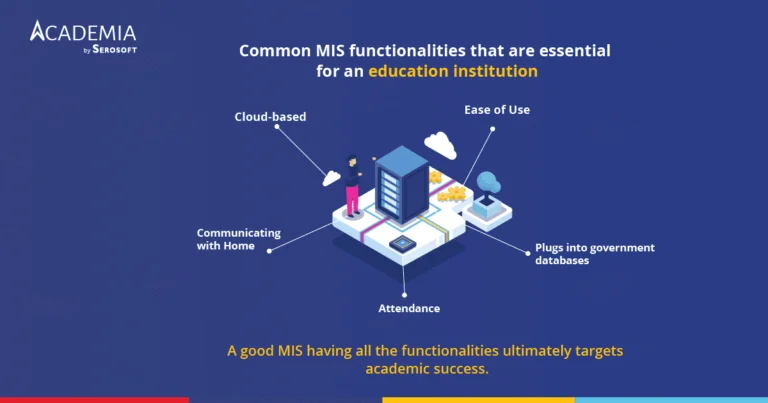
5 Steps to Select the Best Management Information System (MIS) for Your Educational Institution

‘Data’ a single word to describe the whole educational institution’s scenario, whether academic or administrative, right? Every segment of an educational institution needs to store data starting from student information, financial records, examination data, and various others. Every single piece of data in the institution owns its importance whether your institution is big or small. Let’s discuss how an education management information system can fulfill all these needs managing and properly storing all the student data.

Various boards like NAAC and NBA encourage institutions that keep accurate and systematic data that is easily accessible. It dignifies the transparency of all the activities and operations. 

Various institutions are looking for flawless distribution of data, resources, and services that can be beneficial for students, teachers, and the management. So with the increasing demands in the education sector, a good Education Management Information System can provide institutions with the needed progress moving their path towards success. 

What is a Management Information System (MIS)?

Management Information System is a self-understood term. It is a storehouse of all the data that can restore, gather, organize, and store student data processes and analyze it generating various reports from it. 

MIS in the broader term monitors the overall performance of the education events that are offered by the institute managing the distribution and allocation of all the educational resources. It also manages, plans, and strategizes the whole work processes to execute the education system smoothly. Meanwhile, it is important to note that MIS played a very significant role to help educational institutions to synchronize data properly and to grow simultaneously. 

Looking over today’s scenario various higher education institutions are looking forward to implementing various education management solutions that can help them to align all academic and administrative processes to provide a better student experience.


Steps to Choose the Right MIS for your Educational Institution 

The Education Management Information System helps manage the entire education system, so it is very important to follow all the essential steps that can direct towards choosing the right system. Let’s discuss some of the essential steps for the same. 

Here are the steps for choosing the right Education Management Information System (MIS):

  • Collecting information from various MIS sources 

It is the basic and most important step that is needed to take while selecting an MIS for your institute, the MIS you choose must provide all the information to the concerned users in your organization enabling them to conduct their different tasks and activities more efficiently.

  • Deciding for a better MIS source 

Decisions of administration are largely governed by the data insights that suggest student behavior. Opting for manual interlinking of data and finding various relationships is quite difficult. 

Meanwhile, using Powerful BI like education management and information systems can help to track and manage all the data easily and efficiently. 

An MIS is built after detailed market analysis, it includes the timely needs of various institutions and accompanying features that could help the organization’s services get a global insight. It directly or indirectly gives a new perspective that could focus and accelerate new growth & student success. 

  • Enabling planning and policies 

After finalizing an MIS, it is important to check with the plans and policies of the MIS that are necessary to address objectively identified issues, you will also need to set quantified targets, and realistically estimate the resources that are required to implement plans and policies in your institution. 

  • Check how the MIS you are choosing is helping you in your day-to-day operations

The MIS you select must contribute to improving the efficiency of day-to-day operations of the complete education system in your institution, it is also essential that it should provide relevant and reliable information as and when required storing it properly. 

  • Identification and selection of priorities where MIS is required 

After deciding upon the importance and need of MIS, it is important to identify and select the priorities where MIS is required, let’s say you have 3 branches of your institution so it is important to decide that whether you want to implement MIS on all 3 of the branches and all the sections of your institutions. 

What Should You Expect From an MIS?

Management information systems for education are mainly helpful to check and track student behavior. It stores important data such as student data, examination records, hostel, library, and all other kinds of student information. 

Using MIS an institution can store proper and systematic information of the student that is impossible in manual or real-time insights, it indirectly helps the institution to have a better and timely decision making providing more scope and growth for the future of the student. 

Having varieties of MIS available, you still can choose the best MIS that is Academia MIS. It is a reliable, reputed, and successful education management system used globally.

How Academia can provide you with the best Management Information System?

We at Academia believe that automation and streamline services can bring digital transformation in institutions and using Academia MIS you can add systematic arrangement, centralization, and smooth flow of data in student, faculty, and administration logins. Along with this, we at Academia are focused to work on a mission of digitally transforming institutions to provide growth and success. We believe that by using technology you can conquer your goals and targeted outcomes for your institution. 

Conclusion 

All kind of education institution needs a user-friendly and efficient MIS system that can help them to manage and store all the data in the right direction and can increase the efficiency of student success, university, college, school or, any kind of educational institution can opt for education management information system by Academia to track the data that eventually will lead to better institution management. 

5 Higher Education IT trends in 2021

Like other industries, higher education too got severely hit by the pandemic of 2020. Classes moved to online and hybrid environments, budgets got squeezed and higher education IT needs evolved dramatically.

Educational institutions all over the world are looking at IT infrastructure to prioritise and provide the high-quality experience that students expect. While the remote and hybrid modes of learning will be the way education will move in the immediate future, delivering efficient and flexible IT solutions will be the primary focus for institutions. The year ahead will be a pivotal one for technology in higher education and it is crucial for institutions to invest in the right solutions to reach the next level.

With institutions ready to take the best path forward, here are five IT trends in higher education to look forward to in 2021.

  1. More demand for Advanced Learning Management Systems: Even before the pandemic, online learning was on the rise, but it was limited to a few institutions. With Covid 19, learning environments were upended and institutions rapidly evolved. Higher education IT played a crucial role in making sure that classes continued virtually, and the staff was able to work remotely.

    Institutions are bringing on sophisticated systems making learning experiences in future virtual semesters more collaborative and interactive. There will be a rise in sophisticated video conferencing platforms, Augmented Reality, and Virtual Reality. With traditional enrolment decreasing, IT will also support digital marketing, customer relationship management (CRM), and analytics.

  2. More Robust Networks to Come: An increasing number of students will rely on laptops and mobile devices to do their coursework. Hence, it is important for universities and colleges to upgrade network infrastructure to manage the additional traffic. There will be network optimization tools and services employed to ensure broadband equity.Outdoor wi-fi will be a common feature with parking lots and other outdoor locations having wireless access. The aim is for students and faculty to be able to connect to the network from anywhere on the campus and off it too.
  3. New Ways of Remote Assessment: One of the biggest challenges COVID-19 has created is remote assessments. There have been serious privacy concerns raised by online proctoring services and it is crucial to have strategies to prevent dishonesty in remote assessments. However, with online learning here to stay, there will be a rise in alternative ways of appearing for exams. The coming year will present numerous ways of remote assessments, in place of virtual exams, which will be satisfactory to both students and institutions. Instructors will be able to create assessments where students will have to interact more with the material and use resources for further research, to gain deeper learning.
  4. Adoption of IoT: The Internet of Things is set to bring about revolutionary changes to education. With IoT devices getting cost-effective, they will be used widely and effectively in the higher education segment.IoT will help with digital attendance using biometric, tracking student location, or even keeping a tab on the consumption of electricity in the campuses as it can detect the human presence in the class and can switch on or off electricity as required. IoT can track the total time taken by students for completing a particular assignment which can provide useful insights and can be compared with class performance.
  5. Radical business model transformation: With downward pressure on tuitions and rising operating costs, higher education business models are being reconsidered. Institutions are looking at integrated education models that merge undergraduate education with higher-level research. This is meant to benefit the institution financially and boost growth through sponsored research by driving the development and adoption of the new financial and business models. This is also critical to reduce operating costs while increasing efficiencies by focusing on research and academic operations.

Conclusion

Institutions will need to decide on business models that are scalable, cost-effective, and accessible to take care of the needs of this decade and beyond. Higher educational institutions will be seeking innovative solutions to meet the challenges ahead.

Academia, as a leading provider of higher education ERP software, is at the forefront of designing solutions to meet each and every new challenge in the year ahead. For a detailed demo on how you could prepare yourself to move ahead, get in touch at https://www.academiaerp.com/request-demo/


University ERP Budgeting Guide: Costs & Best Practices

The successful implementation of any ERP for university management is based on the budgeting for it. It needs proper financial research and feasibility analysis related to it that eventually decides the cost and budgeting. Preparing for an ERP implementation budget for your university is not an easier task, it needs the same mind shuffling as you will need for any other project. You will need to learn several things about ERP budgeting for university management. So let’s discuss the budgeting of ERP in this blog.

It’s often a topic of discussion on what amount should the University invest in acquiring a University Management ERP System. It is usually a herculean task among the finance and IT teams of Universities in planning for a successful ERP implementation. Budget is usually the first parameter that a university’s management ponders upon while deciding to buy an ERP package. Let’s look at some of the important factors to discuss before finalizing the ERP. 

Factors Affecting the Budgeting of ERP for University Management:

  • Deployment model 

Deciding for a budget to opt for ERP you must take into consideration how you want to deploy it in your university like on-premise or Cloud ERP or any other. There are benefits of each deployment model. With all this, you need to check the price of the ERP model for your institute according to the formation model that you have chosen, the maintenance cost for every year is an additional factor. 

  • Licensing process

The licensing process depends on the formation model that you choose, there are two main categories for licensing, subscription or software as a service (SaaS) and on-premise license. Both methods include different patterns of the cost that you must understand after having a free demo with the university management ERP implementation team. You need to understand the hardware, database, and middleware software, etc. before proceeding further. 

  • Numbers of branches of the university 

The size of your institute, the number of branches it has, the functions and responsibilities, and of course structural considerations of your institute play an important role while deciding the budgeting of the ERP for university management. 

Whether you have just one university or several branches for it, you will require some users for a license that can control the ERP at every end, meanwhile, it is up to you to share the access with partners, suppliers, and extended users. 

  • Applications and special modules 

The university management needs to decide about the specific applications or feature sets that you must expect from your ERP, it is one of the most important factors for the evaluation phase of the ERP.

Looking for the functional area, the project team checks the challenges that the university is facing and which modules of ERP are more important for them to improve the overall process that can bring positive change.

So when setting a budget for university management ERP, the chosen applications and modules affect the costing.

  • Development and Customization 

After finalizing the application and modules of the ERP, you need to focus on the development and customization that you think are important for your institute, for example, if you are thinking to have a customized feature in the fees module that can keep the fees of especially disabled students in a different section than the budgeting for the ERP will include extra charges for the same.

  • Training for the ERP System

It is also important to understand completely about the ERP system to implement it in the future, so after deciding all the things the ERP implementation team will provide you a proper training program so that you and other users can understand it properly to get the best returns of the ERP system.

It involves a proper training program of the new or upgraded ERP system for the university, so while setting up the ERP budget, it must consider the pricing of the training courses, educational materials, and other useful things that can develop the training more effectively. 

  • Support and maintenance 

Having an ERP for your university, you will need maintenance of it from the ERP implementation and support team. So while setting up the budget it is necessary to calculate the cost of support and maintenance, in some cases it costs annually and it gets included with the overall pricing of the ERP system. 

  • Scalability of the ERP system 

While thinking about having an ERP system for your university make sure to consider whether it supports the current technological aspects and whether it will support the upcoming new trends in technology providing you continued growth and success. It is also important to check whether the ERP system will help in planning for the future growth of your organization. 

Conclusion 

So with the understanding of the above points, you must have known about the budgeting factors of a university management ERP. Academia ERP system will not only help in simplifying the overall management process systematically but also will open the doors of success and new achievements. Discuss today with us to collaborate as we are happy to join hands with a university that focuses to drive change and bring digital transformation.


If budgets are tight, Academia ERP offers you allthe bells and whistles when compared to other well-known ERP systems at a fraction of the cost.

Academia ERP: Software as a Service (SaaS) Model

The annual license is also known as the subscription or software as a service (SaaS) fees which are billed annually. Annual per-user-per-year fees are all-inclusive of the yearly license, technical support, software maintenance throughout the year. The subscription fees will decrease with more users, usually on a tiered basis.

The benefit of SaaS licenses are:

  • The license fees are spread evenly over the life of the contract.
  • Low upfront costs – only implementation services and first-year annual license.
  • Annual licenses are purchased out of an Institute’s operational budget which can be easier to access than an
  • Institute’s capital budget.
  • License Model

This is the original enterprise software licensing model. In the perpetual model of licensing, the client makes an upfront, one-time purchase of the Academia, and then the client owns the software.

With a perpetual license, the client usually has to decide on the number of licenses (generally linked to the number of students) the client needs upfront. The cost per license will decrease with more licenses, usually on a tiered basis. The major benefit of perpetual licenses is that client has to pay just once and they are set to use Academia forever. The client then will only have to pay a fixed AMC each year.

Benefits of Analytics and Reports for Educational Institutions

Analytics and reports help in discovering, interpreting, and communicating through patterns in data and using tools that can empower educational institutions. 

Looking into analytics in the context of education can significantly transform the way of working by enabling new ways for prospecting students, increasing student enrollment, improving student retention and completion rates, along boosting faculty productivity and research. Analytics can enhance teachers’ performance and higher management along with giving a deep understanding to students. There are various benefits of using analytics and reporting in day to day operations of any educational institution, let’s discuss some of the benefits of using analytics and reporting for educational institutions.

Benefits of Incorporating the Analytics and Reporting for Educational Institutions:

1. Understanding and recognizing the demographics and behavior: Through advanced analytics, any institution can seek transformation along with understanding and recognizing constant demographic trends and behavior in pursuing administrative services. Let’s take an example of community colleges. These institutions include students who balance work along with their education. So with this type of student, the college authority needs to maintain records more conveniently to understand and recognize the demographics at any time. 

2. Optimizing the use of resources:

By implementing an analytics and reporting engine you can optimize and achieve your desired targets in a better way. Like organizations that opt for a well-designed and systematic analytical system can capture, manage, share, and store their information online easily, and if any problem arises you can de-escalate any of your problems easily.

3. Recruitment of students: Higher education institutions, schools, or even any educational institution often face various complications following traditional recruitment modes. Having proper analytics and reporting, it can become easier to recruit students in a more systematic way.  Let’s say an organization XYZ, is using a predictive model to define which applicants are most likely to be the best fit for the institution if they are admitted. It will help the administration to find the best candidates. There are various other services for students that can be improved using an analytics system.

4. Helping the students to learn things more properly: Institutions having analytics and reporting systems can provide proper and systematic learning to the students, as having the power of modern educational systems enables faculties to get more insights related to the student’s performance – providing abundant opportunities to grab and learn. Students get the chance to learn according to their pace and convenience, courses and facilities remain just one click away from them to help them anytime.

5. Creating data transparency: In institutions, there are various things that you can not access any time with the traditional system, but having a systemic analytical process, you will get the opportunity to access anything at any time creating data transparency for all like faculties, students, and management.Having data transparency through analytics, institutions will be able to take a snapshot of how students are engaged and how well they are performing, the management can also check the efficiency of faculties and how excellent teaching is taking place. Using advanced analytics, institutions can maintain a clear and clarified data transparency that can be accessed anytime by any authoritative person.

6. Demonstrating higher education efficiency: Analytics is one of the most important aspects of higher education, it can be used to maximize strategic outcomes. Institutions can use analytics to provide more efficient and effective interventions that will result in increased success and persistence.Having analytics in your institution is just the beginning, it further helps in managing several tasks and solving tough problems easily. People at higher education institutions just need some energy to work on the insights from the data along with enabling analysis of the data. Implementation of analytics requires several changes in the institutional culture, policy, and processes, but after implementation, it improves overall efficiency along with strengthening the institutional wants along with pushing further to manage all areas of the institution that need improvement.

7. Improving administrative services: Analytics and reporting can help in improving administrative services if you are having a systematic approach and an ERP system you can manage entire campus operations and complete administrative services like student admission, student enrollment, recruitment of faculties, examination management, and many more things in effective and efficient ways. Through advanced analytics, institutions can improve and strengthen their internal administrative capabilities. Analytics and reporting help the institutions to transform operations effectively. 

8. Minimizing the cost of education: There are ways in which analytics can help you save the cost of education institutes opting for a proper education management system have an arrangement of a systematic teaching and learning program for teachers as well as students, which even helps the management in saving cost ultimately affecting the cost of education for students as well. 

How can institutions seek development with a systematic analytics system?

Analytics and reporting engine has been established now in every area and activity, using it in your organization you can manage several tasks simply and efficiently. With systematic analytics, you can provide insights into students’ and faculty’s behavior along with understanding their use of data. Institutions can attempt and improve their overall experience through implementing analytics and reporting engines or in simpler words having an education management system. 

Conclusion 

So, do analytics and report engines sound interesting and useful to you? If yes, then Academia allows educational institutions to focus on their entire administrative tasks and assist in all the internal and external activities through analytics and reporting.

Tips to choose the best Student Management Software

Student Management Software, with its unique characteristics, is hugely popular in the educational sector and has helped innumerable schools and higher educational institutes. From proficiently maintaining and updating student data to analysing and creating reports, the software has helped change the way educational institutes operate. However, it is extremely important to get the right SIS to meet the requirements of an institute.

The end goal of every educational institution is to enhance the performance of the students. This is done using competent analytic tools to analyse the performance of each student. According to the results obtained, effective and corrective measures are taken to help them perform better and reach their potential. 

Student Information System (SIS) helps institutions manage every single detail about students in a holistic, organized, and cost-effective way. It eliminates the need for faculty members or other staff to spend a lot of time compiling student data and allows them to focus on the students and their performance enhancement.

An SIS helps to manage efficiently the huge amount of data an institute generates. It maintains a student’s life cycle and helps teachers to track assignments, tasks, performance, attendance and leaves, academic planning, activities, timetable, and exams. This student database management software enables data to be accessed from anywhere by students, teachers, and other stakeholders and helps them make informed decisions.

In the present dynamic educational scenario, the requirements of education campuses are changing. A proficient and productive student management system software will leverage the best of technology and allow faculties and staff to track all kinds of student-related data.

Let us look at some of the features and capabilities to look out for while choosing the RIGHT Student Management Software:

  1. Maintenance of Student Records

With the right SIS, the huge amount of information generated for every student is efficiently updated on the student data management software, ready to be used as and when required. Updated report cards can be issued effortlessly, student’s transcripts managed, and any kind of information obtained on the go. The ideal SIS should help to effortlessly track a student’s progress with the help of various analytic tools and dashboards, along with various types of filters. 

  1. Cloud-Based ERP

It is crucial to have a cloud-based education ERP that is customisable and flexible that will be suitable for all kinds of institutions with varying requisites. Cloud-based software does not require the institute to appoint any engineering staff to oversee it, making it almost maintenance-free and cost-effective. In a cloud-based ERP, the limited/no hardware required on campus is maintained by the software vendor.

  1. Online Admissions & Registration

An efficient SIS enables students to apply and register online for admissions. The students get timely notifications and emails informing them about admission processes taking place online. The data can be customised by the administration allowing themselves to be transparent in their allotment process while keeping confidential data secure. Students also have the facility to keep track of their applications.

  1. Online Fee Payment

The right SIS provides a secure fee payment platform for educational institutes. An ideal student management system will enable fees to be paid online by parents and students through any mode of payment ensuring hassle-free and error-free fee payment without any of the staff getting burdened. Automated receipt notifications are sent keeping the transaction transparent and secure or reminder SMS alerts are sent for pending payments. 

  1. Seamless Communication

A good SIS makes communication effective, transparent, and quick. It ensures communication between administration, faculty, students, and parents are fast and reliable, allowing any member to reach out to anyone at any time with just a few clicks while keeping the information exchanged private and safe.

  1. Analytics tools and Dashboard

A good set of analytical tools help the management to make decisions quickly. Organized data is an asset when it is required to be processed in different ways according to different requirements. An SIS helps in presenting the data in a simpler, easier, and coherent form and the various filters help to sort further sort the data according to the users’ specific needs.

  1. Mobile App

A well-built SIS enables access through a mobile phone which tremendously helps to take care of all communication needs. With packed schedules, it becomes convenient for teachers, the administration, and students to do away with offline mails and notices and communicate quickly and easily.

  1. Organised with Reduced Paperwork

SIS software is designed exclusively for academic institutions and helps educational campuses to streamline and manage all tasks involved in student administration. It saves time and reduces paperwork considerably by digitising processes.

Academia SIS is trusted by some of the leading educational institutes in India and abroad. Academia solutions have a track record of being reliable and compliant. With decades of experience and expertise in working with various institutes, Academia understands that every institute works differently, and hence the requirements are also different. 

Academia offers customised Student Management Software which is developed to meet the specific needs of an institute keeping in mind the administration, teachers, and students.

Call us for a detailed demo on Academia SIS.

Interdisciplinary Universities: Need of the Hour

As the world evolves, it has become necessary for education to keep pace. Interdisciplinary courses are allowing for more context-specific programmes, and preparing students better for the future. While it has become crucial for universities to become interdisciplinary and universities are moving in that direction, technology is the vital tool that is making it all come together.

 In the new dynamic world of education, the significance of interdisciplinary studies is being recognised by the industry, and universities are switching over and developing their own programmes. Interdisciplinary studies is a complete package that allows multiple disciplines to be combined. It allows students the advantage of learning by making connections between concepts and ideas across different disciplinary boundaries. This makes it possible for students to apply the knowledge gained in one discipline to another discipline and enhance the learning experience. Interdisciplinary studies benefit academics too, as research councils shy away from funding research in a single discipline. They look for broader views and sharper insights that come from the combination of different disciplines defining new territory, for the purpose of allotting research funds. 

The need for interdisciplinary studies

Today, more and more universities are offering interdisciplinary degrees as the challenges the world is facing or will be facing in the future, are inter-related and cannot be solved by single-domain expertise. These problems or challenges need an understanding of the bigger picture and need expertise across domains to be utilized in order to get solved.  

To optimise interdisciplinary teaching and learning, it is important for professionals from different departments to work together towards a common purpose. These interactions allow new knowledge construction and a deeper understanding of ideas.

Benefits of interdisciplinary studies for students

  • Students are greatly motivated as they get a chance to pursue topics that are interesting to them. The content is more often than not rooted in life experiences, which gives students a real purpose to learn and relate to real life.
  • Students explore topics more deeply by comparing and contrasting, which enhances and develops critical thinking skills.
  • Interdisciplinary studies can be great for students with specific interests that cannot be met through a traditional degree.
  • Sometimes, between the traditional disciplines, there could lie some worthwhile topics of research.
  • Interdisciplinary studies can make graduates more sought-after in the workforce. A lot of interdisciplinary studies graduates have a range of skills suited and required for employment in a particular position.
  • Creative thinkers can thrive with interdisciplinary studies as it allows them to explore and make connections between different ideas, methods, and ways of thinking. Instead of being passive recipients of knowledge, students of interdisciplinary studies become active contributors to the learning process.

NEP 2020 calls for interdisciplinary studies

In India, the newly introduced NEP 2020 is set to revolutionise education, while advocating interdisciplinary studies. The primary focus of NEP 2020 in Indian higher education is to transform HEIs into large multidisciplinary universities, colleges, and HEI clusters, with 3,000 or more students each. The policy foresees all existing HEIs to evolve into three categories of multidisciplinary institutions by 2040 –

  1. a)     Research-Intensive Universities (RUs)
  2. b)     Teaching Universities (TUs)
  3. c)     Autonomous Degree-granting Colleges (ACs)

NEP 2020 is designed to generate interest among students in the specialised area of research which will lead to new discoveries. It is meant to develop a versatile learning system, with the freedom for students to learn at their convenience which will create open-minded and well-rounded individuals. With an end to high stake examinations and allowing a student to choose different subjects and move out at any exit point, the system will motivate students to follow their passion in their chosen field.

Conclusion

The shift to interdisciplinary studies, will completely change the business models of universities in the future, along with their curriculum and delivery methods. The changes in the overall ecosystem will bring new challenges for universities. All through, technology is the integral support that will help in this seamless shift. 

With a majority of universities set to offer interdisciplinary studies programmes, it has become even more crucial to have the right ERP from a reliable and experienced company. Academia provides University ERP, which equips universities to transition to an interdisciplinary model. Schedule a demo with us to learn more.

A Guide To Choice Based Credit System

The education ecosystem is changing rapidly, there are various changes and one of them includes a Choice Based Credit System (CBCS). This grading system changes the traditional teaching-learning system in India. 

To maximize skill-based education & enhance student learning outcomes in terms of their grades as well as skills, the National Education Policy has made some crucial changes in the traditional teaching-learning system in India. The right to choose subjects & the multidisciplinary education approach are the best takeaways. 

Do you know what a choice-based credit system is and how it can help higher education institutions? Let’s discuss it in this blog:

What is a Choice-Based Credit System?

The CBCS is a University Grants Commission (UGC) initiative and promotes the liberalization of the current conventional higher education models. With a student-based approach to learning or acquiring higher education, the CNCS allows students or learners the flexibility to choose their course from a list of elective, core, and soft skill courses.

A credit system for higher education measures different parameters like –

  • Student performance
  • Learning outcomes
  • Entrepreneurship skills
  • Contact hours
  • Innovation
  • Creativity & talent

UGC has categorized the groups as

  • Core Course – Core courses are there every semester and students have to compulsorily study the core or the main subject to meet the requirement of the program of that particular discipline.
  • Elective Course – Here, the student can choose any paper
  1.   Discipline-Specific Elective Course
  2. Generic Elective
  3. Project
  4. Ability Enhancement Courses
  5. Skill Enhancement Courses
  • Foundation Course
  1. Compulsory Foundation
  2. Elective Foundation
  3. CBCS moves away from numerical marking to grading semester-wise with two semesters in a year where students’ performances are evaluated and grading is done subject-wise.
  4. The CBCS works in compliance with other grading systems of institutes, all over the world.
  5. Different evaluation methods are followed, based on the suitability of the course approved by various legislative bodies.
  6. UGC recommends Letter Grades and Point Grade Systems to be applied
  7. Letter Grades are based on a student’s marks or percentage from his/her course
  8. Grade Point Systems are where marks are converted into grades based upon a fixed period.

What are the Features of CBCS?

Having multiple features of the Choice Based Credit System (CBCS), let’s discuss a few of them:

  • It is one of the best features as credits can be transferred if the student changes his/her branch of study
  • It has changed numerical marking to grading
  • It positively stigmatized the criteria of failing students
  • It facilitates student mobility
  • It provides potential assess to faculty members for student’s performance
  • It promotes easy course evaluation and is accessed to provide an effective and balanced result.

How Does CBCS Work?

The CBCS in higher education works on the simple principle of the choice being in students’ hands. Higher education institutions provide subject options to students, with a CBCS, students can choose subjects according to their choices and the credits needed for a particular semester. 

The students can attend any of the needed classes obtaining credits to pass any semester. 

A CBCS owns the following elements:

  • Semesters

In any educational institution, assessments are done semester-wise. A student progresses based on the courses taken rather than time like three years for science, arts, commerce, or four years for engineering, etc. The CBCS format provides flexibility in creating the curriculum and assigning credits based on the course section and patterns of learning and teaching. 

  • Credit system

Each course is assigned with a fixed credit. When a student passes a course, he gets the recognition of credit which is based on a course. If a student enrolls in a single course in a semester, he does not have to repeat that course later. 

  • Credit transfer

There are various ways for a student to cope with the study load and with a CBCS pattern he owns the freedom to study fewer courses, earn fewer credits and compensate for the next semester. 

  • Comprehensive continuous assessment

It provides a continuous evaluation of the student to the faculty members and also to the student himself. 

  • Grading

CBCS includes grading in a 10-point grading system. 

It includes

O (Outstanding): 10 

A+ (Excellent):9 

A (Very Good): 8

B+ (Good): 7

B (Above Average): 6

C (Average): 5

P (Pass): 4

F (Fail): 0

Ab (Absent): 0

Core Advantages of CBCS that Academia Modules Includes:

  • The student has a choice of inter/multidisciplinary courses:

With Academia, the students can select their inter/multidisciplinary courses in just a few clicks using the program and courses modules. Academia provides easier access to all stakeholders in the institutions starting from the faculty members, students, and parents for selecting, scheduling and finalizing the courses and subjects likewise. 

  • It promotes group work, research, examination, and assignments 

Using Academia modules like examination, assignments, and others, institutions get the authority to work effectively, research, and manage examination-related tasks and assignments, and more easily and efficiently at all levels like faculty members, students, and parents. 

  • Students progress at their pace

Students are the most important stakeholders of any institution, it is important to provide them with the best and Academia provides them with all the student databases provisioning, storing, and organizing all the student-related data and information. It can easily access, edit, or update data if needed.

Conclusion 

The implementation of the student-centric CBCS system is beneficial for institutes. Academia ERP, which provides the most reliable and trusted solutions to educational institutes, has inbuilt functionality to support the rollout of the CBCS for educational campuses.

How Higher Educational Institutions (HEIs) are set to transform due to NEP 2020?

The National Education Policy of 2020 is a revolutionary step taken by the Indian government. The policy is envisaged to change the current working of Higher Education Institutes in India and allows students to choose multiple disciplines as per their preference at every stage. 

Higher education in India is widespread. It is partially digitalized and has responsibly transformed the country into a knowledge hub and made it a knowledge economy. 

The National Education Policy (NEP) 2020 is based on five fundamental pillars – access, equity, quality, affordability, and accountability. It is designed to change the current education system

with high-quality knowledge resources and skill-based education.  It also primarily focuses on integrity and promotes equality in participation in varied disciplines, irrespective of what social and economic background they hail from.

What is the New National Education Policy?

Through this new education policy, the government of India aims at bringing more than 2 crore students into proper learning. It is projected that this crucial step would allow the government to achieve 100% GER (Gross Enrollment Ratio) in preschool, secondary, and higher education institutions by the end of 2030. 

These attempts are to prepare India to become a “global Knowledge Superpower”, by making the education ecosystem of India more flexible, holistic, and multi-disciplinary in line with the global skill demand. 

Let’s look at the major reforms the NEP 2020 is set to bring in for HEIs in India –

  1. Opens entry for large education institutions

As mentioned earlier, one goal of NEP 2020 is to increase the Gross Enrolment Ratio in higher education in India, including vocational education from 26.3 percent in 2018 to 50 percent by 2035. As per the NEP, 3.5 crore new seats will be added to higher education institutions. The NEP proposed multi-disciplinary, holistic undergraduate education. The Policy is focused on supporting skill education and streamlining educational planning, administration, and management at all levels.

The primary focus of NEP 2020 in Indian higher education is to transform HEIs into 

(a) Research-Intensive Universities (RUs)

(b) Teaching Universities (TUs)

(c) Autonomous Degree-granting Colleges (ACs)

This goal has to be achieved by 2040. 

According to reports, India needs an additional 1500 HEIs to encourage and accommodate more students. The policy proposes the setting up of large and foreign universities. It seeks to promote India as a global destination for quality and affordable education. It will allow high-performing Indian universities to set up campuses abroad while allowing ‘select’ universities in the top 100 in the world to operate in India. This would promote healthy competition among Indian HEIs. 

  1. Promotes Liberal & Flexible Education

NEP 2020 is designed to generate interest among students in the specialized area of research. This will lead to discoveries and acknowledge the importance of invention and scientific outcomes.

Arts and Science streams will not be separated strictly, as well as curricular  & extracurricular activities and vocational & academic qualifications. This is meant to promote a holistic and very versatile learning environment that will nurture open-mindedness and build well-rounded individuals. 

A revolutionary introduction in the Indian context is the freedom for learners to learn at their convenience. The new policy gives flexibility to students to choose from a variety of subjects and move out with a certificate, diploma, or full degree, depending on the number of years spent on the course. It gives students multiple entry and exit points in degree programs, which further encourages lifelong learning philosophy. 

An Academic Bank of Credit will be introduced which will store the academic credits of students earned from different HEIs digitally and these credits will be counted towards the final degree earned.

The policy has also asked HEIs to do away with high-stake examinations and bring in a continuous and comprehensive evaluation system. 

This reform is meant to help the students to nurture their creativity and critical thinking by motivating them to follow their passion in their chosen field. This will completely change the business models of HEIs in the future, along with their curriculum and delivery methods. Technology will be the integral support that will help in this seamless shift. 

  1. Eases Regulatory Structure

According to NEP 2020, there would be one common regulator for all HEIs in India -National Higher Education Regulatory Authority (NHERA). By eliminating the multiple, overlapping regulators, NHERA will create various verticals and cater to different disciplines and simplify degrees or diplomas. This change will ease the regulatory burden of HEIs and will allow them to focus more on their core role of imparting knowledge. The single regulatory system would provide autonomy to HEIs, which is crucial to innovations in education.  

Initiating a New Education Policy in 2022: Key Highlights

  • The policy emphasizes providing quality and affordable education to all students between 3-18 years of age group all over the country.
  • It also focuses on using technology in education to make it more accessible and effective.
  • The focus should be on online learning to ensure the highest quality education for students. As part of the new system, e-learning will be expanded to include online courses, which will allow students to study from anywhere and at any time.
  • It also promotes holistic and multidisciplinary education replacing rote learning.
  • The curriculum in India has been updated to incorporate more concepts and vocational education.
  • The policy seeks to provide vocational and technical education to students so that they are equipped to enter the workforce.
  • This policy introduces a new 5+3+3+4 education structure replacing the current 10+2 system.
  • The policy aims to increase the Gross Enrolment Ratio in higher education to 50% by 2035.
  • According to NEP, learning should be holistic, joyful, stress-free, and a lifelong process.

Conclusion

A change in the Indian higher education system was long overdue, and NEP 2020 marks a bold move away from the long-standing and established rote and herd learning practices in India. 

While the NEP 2020 aims at improving the operative environment for HEIs across India, it reveals the government’s intent to restrict the commercialization of higher education in India.

The NEP reforms introduced in the Higher Education System are set to result in – 

  • Institutional restructuring and consolidation
  • A holistic education eliminating rote learning
  • Internationalization
  • Teachers training
  • Professional education
  • High-quality research
  • Quality universities and colleges

Changes in the overall ecosystem will bring new challenges for educational institutions, staying updated with the latest developments can help educational institutions to address these challenges. For this, a higher education ERP or SIS can help institutions bring digital transformation and automation, you can also schedule a demo now!

Back to top