Type your keyword below

National Curriculum Framework (NCF 2005) | Transforming Future

Navigate through the intricacies of the National Curriculum Framework 2005 (NCF) and introduce more quality in education with technology-driven solutions. Learn how ERP can help the government, semi-government and private schools in India come in line with NCF 2005, and ensure the overall development of a student in the K-12 segment.

What is National Curriculum Framework (NCF 2005)

National Curriculum Framework is an initiative that tends to change the approach of schools to education in the K-12 segment by replacing the traditional text-book centric strategy to focus on learning outcomes that drive the curriculum for courses. 

The policy defines clear outcomes expected to be achieved by a student at the end of their course. It introduces Outcome-based Education or Standard-based Education reform design in the schools of India. 

Characteristics of National Curriculum Framework (NCF 2005)

  • Promotes 360-degree development of a student, including – academic, emotional, and physical. 
  • Promotes intellectual development of a student by providing varied opportunities. 
  • Promotes a conducive learning environment to ensure quality education and encourages participation across various activities. 
  • Promotes creative thinking and skill development by facilitating different activities and provides liberty of expression to individuals within the class. 
  • Promotes multicultural attributes to ensure no student is discriminated against based on caste, religion, or social status. 

Objectives of National Curriculum Framework

The National Curriculum Framework of 2005 focuses on quality, accessibility, and equity. 

  • Introduction of new concepts in the curriculum without increasing the syllabus.
  • Making quality education accessible to students without any discrimination. 
  • Curricular practices should be in alignment with secularism, social justice, and quality. 
  • Strengthening the national education ecosystem in society. 

Guiding Principle of National Curriculum Framework

NCF 2005 brings some major reforms into the curriculum. It is more centralized to the need of the time and does not encourage just textbook knowledge. It brings more flexibility in curriculum development and encourages institutes to open new paradigms to the students. It promotes skill development and skill alignment in accordance with the global job market. 

  • Connecting learning with real-life examples outside education.
  • Ensuring different learning approaches rather than rote methods.
  • Enhancement of curriculum to offer knowledge and experience beyond textbooks.
  • Improvement of the examination method
  • Enhancing overriding identity informed by concerns within the democratic polity of the country. 

Challenges in implementing National Curriculum Framework 2005 in Institutes

The National Curriculum Framework works on the principle that it sees a child as a natural learner who learns from his own experience. However, the ground reality hits it hard. Many schools in India still operate on the traditional methods of teaching putting the child under a lot of pressure to attain good marks in examinations rather than developing intellectual and creative skillsets. This results in a classroom scenario where the child becomes a passive learner and only works on memorization of facts and information to produce good results in examination. 

Furthermore, institutes face a major challenge in embodying NCF 2005 due to the following reasons: 

  • Lack of Supervisory Staff: 

Introducing Outcome-based Education is a real challenge in the Indian education system because of the severe crunch in the supervisory staff. Objective-based learning takes more than just the teaching staff. A lot of people are involved in the process of defining the program objectives and course outcomes and analyzing the performance of the students to mark if the objectives are achieved. This multi-layered system thus requires supervisory staff. (Learn more about OBE in this informative blog)

  • Increased Workload on Teachers

Lack of technology and extreme dependence on traditional methods of teaching, and administration has led to a never-ending workload on teachers. This is a possible reason for reduced productivity and performance in teachers and time and time again it has popped as a critical issue in front of government authorities in India. 

Furthermore, National Curriculum Framework emphasizes providing a diverse learning environment to a child to evoke the natural learner in itself. But lack of infrastructure does not provide much for the child and hampers the learning process as the environment is not conducive to learning.

  • Less Emphasis on Co-scholastic Activities

The emphasis on emotional and creative development in NCF cannot be fully realized without co-scholastic activities. In a study by The News, 70% of principals approved of co-scholastic activities in the school and confirmed its effects such as improved self-confidence, self-control, sportsmanship, solidarity, teamwork, competitiveness, and health. 

The same study also indicates that half of the schools lacked the infrastructure to provide co-scholastic activities in a school. Averagely, 60% of the total time in a school is spent on academic subjects. 

  • Over Emphasis on Numbers

In school, there is a dominance of the number system, schools do not have any concern with learning rather their main concern is to produce scores which further helps institutes to get more admissions. Parents tend to pressure children to get more marks in the examination rather than in learning and development. This is in contrast with the objectives of NCF. 

How Academia ERP helps in the successful implementation of NCF 2005

Academia ERP is a 35+ module School Management System. It helps you in streamlining operations and improves staff productivity by several folds. The unique attributes of the product include automation of institute tasks, improved multi-level reporting, and high configurability. Here are a few ways in which it can help you implement NCF successfully in your institute. 

  • OBE Module 

Academia ERP comes with an in-built OBE module that helps you in managing your curriculum for Outcome-based Education better. Using the software you can define program objectives, course outcomes, perform assessments, do CO-PO mapping, and more. It is a feature-rich module that supports all operations pertaining to outcome-based education in an institute. 

  • Reduced dependency on human resources

The product can handle thousands of operations at the same time and brings automation to processes. It means, your staff does not have to worry about the time-intensive manual operations to administer your institute. Rather they can focus on providing quality education and participate in a variety of activities to make OBE successful in the institute. 

  • Program & Course Management

Program and course management is another great module in the product where it allows administrators to track syllabus, manage student attendance, track student performance, collect assignments, allocate resources to students/classes/departments, and do a variety of other tasks. It is a highly efficient tool that helps teachers to lesson planning, digitally manage day-to-day academic activities, and more. 

  • Timetable Management

Time management becomes necessary when it comes to the successful implementation of OBE. Since NCF emphasizes on 360-degree development of a child, it means allocating resources to provide a varied and conditioned learning environment to students on regular basis to ensure intellectual and creative development of a student. 

Timetable management thus provides administrative a digital tool to manage teachers, resources, and co-scholastic activities for each class and department error-free. This helps in periodizing the sessions and efficiently managing them in case of the unavailability of resources and teachers to provide substitutes and ensure an unhindered learning experience. 

Wrapping Up 

NCF is a revolution in the education sector of India. However, for it to successfully transform the sector there need to be some fundamental changes in the way things function and process. This includes better management of courses and curriculum, improved infrastructure, periodic student performance tracking, better student handholding, provision of resources for making learning more conducive and varied, and more. 

If you are interested in learning more about NCF and how Academia ERP can help you in the successful implementation of it in your school speak with our technical expert. 
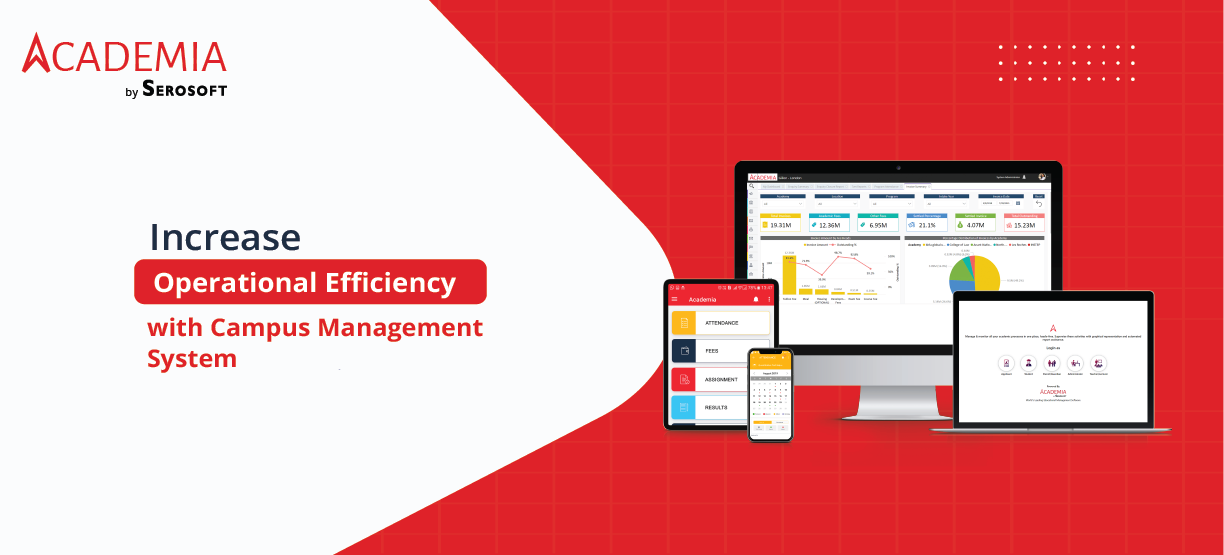
Campus Management System: How to Increase Educational Institution Efficiency?

The competition among higher education institutes is increasing day by day. Colleges and universities are at each other’s throats to capture the attention of the best minds and engage them to become a student in their institutes. However, engaging an applicant and retaining them all throughout the student lifecycle would take more than a sprawling campus and a large population of existing students. 

Modern-day students are tech-savvy and they prioritize experience over everything else. It is important that you cater to them a top-notch learning environment based on data-backed decisioning, rather than take actions based on a shallow understanding of the needs of the students. 

Unfortunately, this cannot be fully realized with the traditional methods of operations. Technology-driven solutions can help you increase accountability in your academic and administrative staff and provide solutions to improve departmental functioning. If you are aiming to have quality lead generation from your enrollment campaigns and want to continue high student retention, you need Campus ERP that supports efficient student lifecycle management and other institute operations digitally. 

Centralized Campus Management System for Colleges

Centralized Campus Management System is a cloud-based education ERP solution for institutes of all types and sizes. It supports multi-premise institute management, and interoperability. It enables automation and improves operational efficiency and multi-level reporting. Simply put, the software helps you in the central management of the college and departments while supporting the functions of all stakeholders. 

Using a campus management system for admission management, examination management, student information management, employee information management, timetable management, resource planning, and management, fee & finance management, and more. It helps you in digitalizing administrative tasks and improves student management. 


Advanced Campus Management By Academia ERP – Centrally Manage Colleges, Group of Institutes, and Universities. 

– Student Lifecycle Management

– Student Information Management

– Campus Administration

– 100% Automation of all operations


6 ways in which Campus ERP improves operational efficiency

  • Organize Administrative Work

College staff has responsibilities of carrying out several duties simultaneously. This automatically affects their productivity and impacts the quality of operations. Moreover, there is a lot of dependency between departments which causes a lag in operations. There are several repetitive tasks that are needed to be done on daily basis. This eats up a lot of productive time and stops the staff to focus on their core responsibilities. 

Campus management software helps in automating most operations in an institute. The centralized database keeps a log of operations and provides real-time data for improved reporting at all levels. Furthermore, it comes with in-built features and functionalities to manage seasonal activities such as admissions, examinations, financial reporting, and account management, etc. 

Using the software can help optimize administrative processes and boost decision-making. It also increases the usability of data as modern ERP systems support interoperability between software systems creating a unified ecosystem for improved functioning. From record creation to management to automating operations and monitoring, a Campus ERP solution can improve the administrative capabilities of a college or university by several folds.

  • Automated Admission Process

Admissions are one of the most important phases in an academic year. However, they are highly mismanaged due to inadequate planning, and poor execution. It is prone to human errors and procedural delays. Irrespective of the years of experience and expertise administrative staff displays, it is normal to encounter challenges in seamlessly managing and executing admissions. 

Campus ERP solution comes with built-in enquiry management software that captures and allocates enquiries automatically from multiple sources. It makes enquiry management easy and provides features to digitally manage the admission process for individual students. The in-built error-detection and conflict system reduces the chances of human errors and ensures accuracy in data management. 

The system also improves communication between prospects, applicants, and administrative staff. This is done through its efficient omnichannel communication toolkit. It allows you to interact and communicate crucial information to applicants over calls, SMS, emails, WhatsApp, etc. The system also sends out automated updates when there is any change in their application status.

The in-built filter system improves student selection. The system maps student applications with course enrollment criteria. On detecting any conflict between the application and the terms & conditions for enrollment it automatically rejects the applicant and reduces the workload of employees. 

  • Student Management

Student information management systems are becoming very popular in the higher education segment. It helps you centrally manage a data repository containing, personal, financial, and academic information of the students. Centralization of information increases the usability of data by several folds. The system also comes with an auto-update feature that streamlines the examination schedule, student marks, subject schedules, curriculum details, and individual reports. 

Besides, the student management module within the system integrated with the ERP solution enables easy access to the college administration and teaching staff. In addition, the students and their parents can check the details as well. 

  • Examination Management & Execution

A college can efficiently manage and execute online and offline examinations through campus management systems. The software system comes with a plethora of features and functionalities for pre-examination, examination, and post-examination management and execution. The software can also be integrated with a learning management system where the data gets automatically synced between the two systems reducing the task of the administrative team. Apart from that, you can publish results online over the student portal. 

  • Online Fee Payment

Financial management with campus ERP becomes fairly easy. You can integrate the software with 3rd party payment gateway and enable online fee payments. Using it you can start accepting fee payments through debit/credit cards, e-wallets, UPI, net banking, etc.

Furthermore, the software provides you with real-time data on fee records, and pending payments and also sends out alerts to parents and students. It also automatically calculates the late fee as per the configuration. The number of reports that come in-built into the software also provides daily, weekly, and monthly reports on fee collection and other financial records making reporting easy. 

  • Staff Management

The program and course module help in the allocation of academic staff to the classes and assures error-free management of the timetable. The software comes with an in-built, staff, teacher, and infrastructure conflict system that allows you to prepare timetables more accurately. This provides you with higher transparency in the operations and you don’t have to worry about the non-availability of staff, teachers, substitutes, or infrastructure. 

Wrapping Up

Campus management systems can benefit you in a number of ways. Digital transformation is the key to improved management of your college and ensuring your staff is at the top of the game to offer the best experience to your students. Increased efficiency, productivity, and improved experience – learn more about the Academia campus management system and how it can benefit your college to have higher profitability. Academia ERP can help you with Campus ERP Implementation faster than others, connect with us.

How Education ERP can help Colleges Combat Enrollment Crisis?

Colleges and universities are combating declining enrollment rates and precarious financial situations. As the institutes struggle to devise strategies that are suitable for dealing with this looming demographic cliff, one thing is well understood – legacy software needs to go out and new-age modern systems need to come in. 

Learn how in the age of declining enrollment rates, higher education institutes can find solace and definite solution in modern systems such as Education ERP to maximize enrollment and ROI. 

Education ERP for improved Student Recruitment & Retention

One of the best ways to avert the situation is by effectively managing the admission phase in your college or university. Attract the right students, engage them throughout the admission phase, support them throughout the academic year, and retain them. And investing in a modern ERP specifically designed for higher education institutes can help you in this course. 

Modern ERP can help Recruit Right Student To Your Campus

An ERP for higher education comes with an in-built Human Capital Management System and Finance Management System that is centrally mapped with the student database. The modern systems are also equipped with rich analytics features and help colleges and universities to gain insights into the type of program that is most preferred by the student population. Using this, an institute is able to plan more seats in these programs, offer a more wholesome curriculum, invest in more resources, and higher better faculty to attract students. This can be a great pull for the students and can help an institute to increase enrollment in the programs that are most profitable. This can be a very impactful recruitment strategy. 

Modern ERP can help institutes attract Students that are a right fit

A student needs to be academically as well as culturally attached to the college or university to apply and enroll itself. Hence, modern ERP solutions can help an institute to reach out and attract students that are a right fit for their campus. 

Tools such as personalized messaging, push notifications, multi-media messaging, and automated responses for faster query resolution can work wonders in attracting and engaging students. 

Also, modern software is equipped with a Scholarship Management tool that can help you in segregating deserving candidates from the thousands of applications and provide financial assistance and aid to the right students. With modern ERP built for colleges and universities, you can simplify scholarship distribution, reimbursement, and other financially complicated processes. This would further help you retain your students better and provide a channel for you to have a sustainable revenue stream. 

Modern ERP can help attract new students

One of the latest trends seen in the education industry is that of the growing number of non-traditional, older-generation students. 

The older students tend to be more inclined towards learning and are more career focuses. They usually have responsibilities such as full-time jobs or families to look after and hence they usually go to colleges and universities that provides flexible degree and credentialing programs that can help them gain high-paying career. 

ERP for higher education can enable students to effectively offer hybrid learning options alongside competency-based education programs, micro-credentialing and badging programs. The types of education that provide the fastest pathway to employment for these learners can serve profitable for your institute. 

Modern ERP for retaining existing students 

Engaging applicants is not a 100% assurance of a sustainable revenue stream. You need to constantly keep students engaged to combat the enrollment crisis. It is important that you retain students and increase your attrition rate. According to a study by Education Data, 40% of students that enroll in an undergrad program drop out and these dropout rates are higher for non-traditional students. 

ERP for higher education can help you devise and execute a student retention strategy. Using in-built data analytics and predictive modeling you can identify students at risk and provide institutions with the tools necessary to intervene early. 

Through early intervention, you can engage a student and avert the situation in which a student drops out.  

Wrapping Up 

Modern ERP gives campuses many tools to help attract and retain students. But it also helps institutes to manage their processes and operations better and ensure a better experience of their students not just academically but overall. Modern ERP enables students to better engage, advise and empower the learners. It supports small to big operations and frees up your staff and faculty to solely focus on the growth of students and assist them throughout the student lifecycle. 

It promotes transparent communication and improves decision-making through data. It provides better options to personalize education and manage programs and courses. Modern Education ERP solutions built for colleges and universities are very successful in attracting, engaging and retaining students.

Student Information Systems reduce the amount of time spent on mundane tasks. How does that work?

Many education institutes have adopted new ways of teaching and learning, powered by modern technology. But what about student record management? Here is how the student information system reduces the management of administrative and academic records and can increase the productivity of staff by 70% (Read CECOS Collge, London Case study). 

What is a student information management system? 

A Student Information Management System or Student Information System (SIS) is a software application used for collecting and managing student data. SIS serves as a centralized data repository to support key academic and administrative processes organization-wide by providing access to real-time information to the departments. 

Continuous improvements in technology and the availability of high-end resources have boosted the functional capabilities of SIS. It is now used to automate a number of daily tasks and increases employee productivity by several folds. Since it is an electronically managed and maintained database, access to information is very fast, and economically viable than traditional sources. 

It can be used for any educational organization, be it a school, college, university, or training institute. Institutes can manage student data throughout the student lifecycle using SIS.  

Important Features and Functionalities in a Student Information System (SIS)

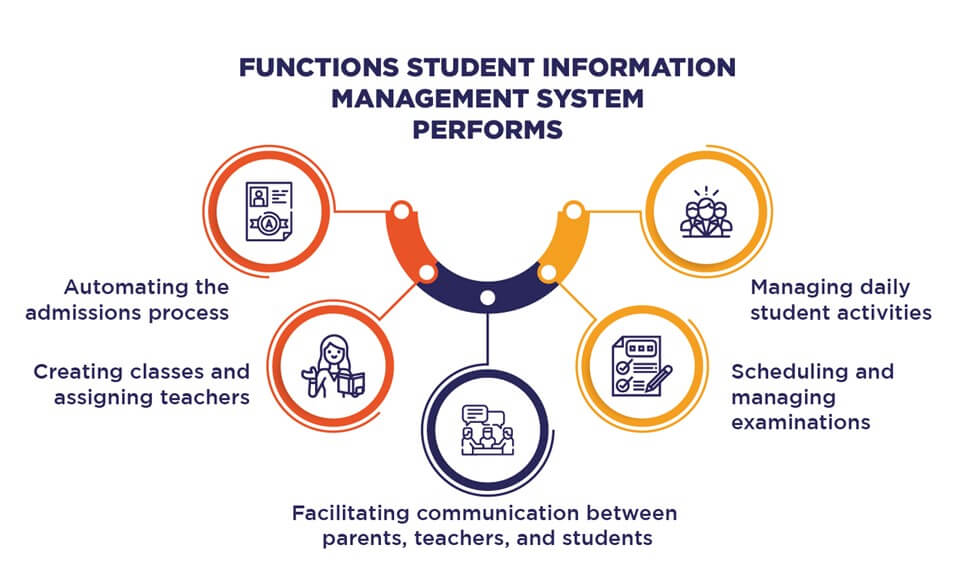
  • Automating Admission Process

With the help of this system, the admissions team and admins can automate a variety of operations in the admissions process. Once the data is stored of an applicant in the system, the information can be used for – applicant engagement, tracking the admission process, queries, and communicating messages on a large and individual scale. The system can also be used to send acceptance or rejection letters to the students and communicate any other important information.

  • Programs & Courses Management and Assigning Teachers

Easily create classes, assign teachers, manage courses, do lesson planning, etc., digitally. Student information systems are usually packaged within ERP software for education institutes. This means, not only do you get the features to manage student information but the information stored within SIS can be securely shared across various in-built modules and power digital operations using ERP in full capacity. 

The student information system records the course enrollment information and subject choices. Using this admins can digitally manage teachers, timetables, classes, resources, etc. 

You can also use the software to configure optional subject choices, program paths, course paths, fee structure, examination structure, grading method, and other related elements. 

  • Managing Daily Student Activities

Education ERP solution maps all sorts of academic, financial, and administrative records to the student ID in the student information system. This means a faculty or the administrator can pull student records for attendance, examination, health, fee, discipline, and more anytime as authorized by the super admin. 

This provides a better opportunity to manage the student lifecycle, and make decisions that are best for the student’s success. The student information system software eliminates the manual work of administrative and academic staff. 

Not only, does the software serve as a tool to manage and record the student data of a variety of things, but it also tracks the communication between staff and students, notices released to the student, actions are taken to discipline the student, and more. 

  • Scheduling and managing examination

Examination management and execution becomes very easy. The software provides specific tools and functionalities to manage and execute the examination phase with utmost success. Right from examination notification to form-fills to exam execution and result publication, the software provides all the necessary tools and functionalities to manage the examination phase successfully over a digital platform. 

  • Timetable Management and Lesson Planning

The system makes it easy for an administrator to track and check the available teachers on particular data and most importantly, whether the course syllabus for a subject is completed on time or not.

It helps an administrator adjust their human resource for optimal functioning with fewer resources. It also allows it to check the calendar, manage timetables for multiple classes,  manage national holidays, and schedule tests and exams as per the available information. 

  • Facilitating Communication between Parents, Teachers, and Students

Student Information Management System can facilitate communication between parents, teachers, and students. Since, the system stores all the contact information of all three stakeholders in an online database, it can be used to share important information, notifications, and news to them regarding ongoing and upcoming school activities. Parents can check the student’s progress and performance in real-time and request to connect with teachers to participate and involve in their ward’s education.

Conclusion

From the above list, you can see that student information system software is highly efficient in pivoting the regular and tedious everyday academic activities and automating these processes end-to-end. It can help you free up your resources and utilize them for more important tasks and operations in the institute. It improves efficiency and transparency in the operations and eliminates the common problems faced by teachers, staff, and students to bring more meaning to the operations.

So, what are you waiting for? Contact our ERP expert today to learn more about Academia SIS (Student Information System) and reap the above-mentioned benefits. 

Academia ERP for Pre-Admission Management from Start to Finish

Are you searching for pre-admission software that allows you to record all inquiries before admission starts? If it is a yes, you are in luck. 

Academia ERP is a digital transformation solution for schools, colleges, universities, and training institutes. The efficient software comes with 35+ modules, including pre-admissions and admissions. 

The pre-admission module in Academia ERP helps you streamline admission enquires and manage them on the go. The product offers you high-end functional capabilities to manage all the activities of the admission phase and improves your enrollment rate and applicant experience through a plethora of available features. It also makes reporting incredibly easy. Here is everything you need to know about the pre-admission software/module of Academia ERP. 

  • Enquiry Form Set-up

The pre-admission module in Academia ERP allows students to apply for admissions through your website. Admins can add custom form fields to the application form to suit your institute’s needs. 

Admin can access applications received from various custom applications and inquiry forms in a centralized location. Admin can also take various actions pertaining to applications and use the custom application fields to track or search any particular applicant or enquirer. 

  • Campaign Management

If you use multiple platforms to run ads for admissions, campaign management is a highly valued feature in the Academia ERP pre-admission module. The feature allows you to assign the ad responsibilities to people, add ad budget, manage its spending and track its result.

You can use the feature for digital and traditional both platforms. The tool helps you identify what are the most profitable channels for your institute and not waste your money on the platforms which are nonyielding. Hence, it is not only a good tool in the kitty to manage campaigns but also to track the finances and the results of your ad campaigns. 

  1. Enquiry Management

With built-in CRM capabilities inquiry management feature of Academia ERP can help you in end-to-end management of all your enquires. It allows admins to assign applications/inquiries to people in the department, track progress, edit, or view the form in detail and generate several reports. 

Admins can see how many enquires were converted to applications and admissions, from what channels these inquiries come, what was the experience of the enquirer with the institute, and other factors. It also includes omnichannel communication – allowing you to send emails, push notifications, WhatsApp messages, SMS, etc., to enquirers to respond to their queries or share any crucial information. 

  • Dashboards & Reports

The system consolidates the data present in a centralized database to provide you with accurate reports and visually-stunning graphical representations. The tool makes automatic reports without any manual intervention when prompted. Since highly configurable, you can customize the reports easily as well. Create reports on campaigns, inquiries, follow-ups, appointments, conversions, etc., easily using the tool. 

Wrapping Up

Admission phase in any education organization consists of two segments. First, pre-admissions, which is more or less preparedness of any institute to capture as many applicants as they can and attract good candidates to study in their institute. And second, the admission execution. Academia ERP consists of both these qualities in one single software along with 35+ other modules. Learn more about the product and know how we can help you undergo digital transformation. 

Data-informed decision-making to transform the student experience in 2023

Teachers and schools have long collected data, that is usually unused. What many institutes fail to understand is – they are sitting on a goldmine. Unlike a few years ago, technology now is more efficient and provides opportunities to use data and analytics for improved teaching. 

Using data, teachers can track student progress in real-time, compare their progress in minutes with historical academic records, provide a personalized learning experience, differentiate between instructions for improved results, and have an insight on students that might just need a little more push. Data-driven decision-making in education can prove transformative for students and teachers both. 

Use data analytics to fight long-standing issues

Globally, education systems are now addressing the inequalities in education. There are significant gaps present between the achievements of students from low-income households to that from high-income households. The increasing wealth disparity is one of the biggest contributors to the increasing number of children that are deprived of equal opportunities in education. 

By analyzing data, educational researchers can understand the role of nutrition, parental involvement, pre-K programs, and other factors to fill these achievement gaps. Data provides granular reports to assess the positive and negative effects of interventions and policies on student outcomes and key learning milestones. 

Use data to improve teaching practices

Data in general can benefit all the departments in an institute, especially the academic staff. Teachers can use the data to reflect on their teaching practices. Traditionally, teachers use only one approach to engage students in learning activities. However, there are researches available that indicate the effect of teaching methodology may vary from person to person. 

Hence, it is imperative for the teacher to provide personalized learning experiences to students for increased student outcomes. Using data, teachers can daily observe, make inferences, and adjust their teaching methodology according to the needs of the students. 

Use data to optimize administration

Administrators can use data to learn more about students’ participation and behavior in the classroom. Processes like these can help catch the students that are likely to fall through the cracks and handhold. Data analytics provide precise insights into the gaps present in the curriculum coverage and help administrators better align of curriculum across departments and grades. 

Understand what data cannot do

Data analytics is an involving field in technology and it has a long way to go. Even though what you are experiencing right now through data is simply a scene out of a sci-fi movie, there are some big limitations to the technology. The key to finding the right answer through data lies within the data set. The more appropriate the data set is the more precise results it drives. 

Keep an eye on the trends

Many factors outside of a teacher’s control come into play that can influence student success. For example, the family life of the student might impact their academic performance in the institute. Hence, a teacher that is well known for these issues can provide better guidance to the student and work out a plan to ensure the growth and success of the student. 

Data can help a teacher analyze a student’s behavior based on their attentiveness in class, attendance in the class, punctuality, assignment submissions, and involvement in extracurricular activities.  Request Demo Now

Improve Student Recruitment Quality and Applicant Experience with Academia ERP

Enquiry management is one of the biggest concerns of education institutes during the admission phase. It becomes a big hassle for administrators to track each application and assist thousands of applicants all along the individual admission cycles. What most institutes miss seeing is the amount of agitation that grows in parents and applicants while hustling with your operational inefficiencies. This can directly be linked to the dipping admissions rate at your institute.

To put an end to this for good, you can try Academia Education ERP with an in-built enquiry management system. Here is everything that you must know about it.

Academia ERP Enquiry Management System

Academia is a school, college, university, and training institute management software that offers process automation of all institute operations. It helps an institute manage and monitor academic and administrative activities in an institute.

It is a 35+ module Education ERP software that comes with dedicated pre-admission and admission capabilities. The pre-admission module exhibits an in-built enquiry management system.

Academia ERP’s enquiry management system helps in tracking an enquirer’s detail and communicating solutions of the enquiries. The system is laced with a communication toolkit that inspires an omnichannel communication approach with applicants and parents.

The solution automatically sends the status of various selection stages via email, SMS, and Whatsapp to the applicants. Institutes can also send custom emails, SMS, or Whatsapp messages to share information with prospects. The system tracks the communication and keeps a central log of the phase in which the enquiry currently is. You can use the software to assign, close, and track all the enquiries that are happening in your institute.

Academia ERP can help institutes take quick follow-ups and manage their admission enquiries better.

Eliminates spreadsheets from the system

If you are still struggling with  spreadsheets and manual entries to organize admission enquiries, Academia ERP is a perfect solution for you. Use the efficient ERP solution to centralize all your enquiries and manage them on the go. The enquiry management system would help you log and organize your admission prospects better. You would have a real-time update on the process and track the enquiry from anywhere and anytime to assist the applicant.

Features of the Student Enquiry Management System

The list of features Academia ERP offers is as follows:-

  1. Easy enquiry form setup
  2. Easy enquiry registration
  3. Easy enquiry assignment
  4. Easy follow-ups through reminders
  5. Easy record management of old queries
  6. Time-saving and reliable solution
  7. Access to data and opportunities.

Wrapping Up

Admissions would soon be knocking on your institute doors. Are you planning to break the barrier and go digital? If it is a yes, talk to our ERP expert to learn a range of solutions built to meet your institute’s needs. Besides Enquiry Management our solutions come with other key modules like Admission Management, Course Management, Fee Management, Hostel Management, Exam Management etc.

Contact us today for any queries on ERP for schools, ERP for higher education institutions, and ERP for training management institutions

Get these 3 competitive advantages by using Cloud ERP for Higher-Ed

Colleges and universities fight each day to compete with the decreasing pool of faculty, staff, and students. It is important to address academic competition that exists between colleges and universities to ensure a secure future for the organization. 

Cloud ERP systems can help institutions digitally transform and evolve to ensure a higher admission rate, student retention rate, improved employee experience, and other relative metrics of success in the education ecosystem. Most of all it allows an organization to address the changing social and economic standards of education to gain a competitive edge. And hence, technology becomes important to discuss and deploy. 

Technology provides a big competitive advantage to institutions. What most organizations fail to understand is, students and staff are technologically-evolved people. Technology is no longer a privilege but is now ingrained in everything a person does on a daily basis. 

Institutions that are still using outdated technology, or manually-intensive processes fail to engage their students and staff, and hence lose out to the competition. In the same context, we are here to discuss the three ways cloud ERP solutions provide you a major advantage in competition. 

3 Competitive Advantages of using Cloud ERP in higher education institutions 

  • Reallocate Resources

In many cases, the most competitive colleges appear to be those that have more money to spend on marketing and on the facilities at their institutions. Since smaller organizations rely solely on the tuition fee of the students, staying competitive becomes difficult. A cloud ERP can help institutions do both. 

Cloud-based campus management solutions comprise a variety of tools and features that help in better governance of an institute. They comprise admission management, attendance management, examination management, financial management, and other functionalities to improve the governance of the institute. They also automate various operations of the organization to free up the human resource to put to use in the areas where human intervention is most required. 

This blog may interest you:

Cloud ERP vs On-premise ERP Solutions: What is right for your education institute? 

Click here to learn more.

  • Hire and retain faculty and staff

For colleges and universities, being competitive is as much about enabling student success as it is about promoting internal growth and employee satisfaction. Hiring and retaining good faculty and staff also directly impacts the retention rate of students. 

Unfortunately, the manual work, traditional processes, tangled operations, and tiring routine activities demotivate faculty and staff to stay in the sector, given most qualified candidates are leaving the education sector to seek high-paying jobs in other sectors. 

Using a cloud ERP solution can help an organization retain its staff by offering an engaging experience in its institute. Modern ERP can help institutes save money on operating costs and invest it in the  faculty. Secondly, technology and cloud ERP solutions support academic and administrative processes in an institute to improve work experience in the organization. 

  • Recruit and retain best-fit students

Student retention rate is an important factor in evaluative criteria used to rank colleges, and universities locally and nationally. And since students consider ranks when applying at any institute, you need to strategize to draw students to campus and retain them. 

Modern cloud ERP solutions help colleges to recruit and retain students that are academically and culturally more aligned with the organization, hence making retention easier. Also, admission management, examination, student performance management, and analysis are some of the effective ways to improve the student experience at your institute while ensuring higher retention rates.

Conclusion:

Competition between colleges and universities never ceases to exist. But if you are willing to upgrade your institute to have a greater competitive advantage consider digital transformation through cloud ERP for colleges and universities. The handy tool end-to-end automates the processes in the institute and allows easier management and monitoring of the institute. It positively affects the working and experience of all stakeholders to ensure a higher retention rate. Reduced operational cost, efforts, and time are some other benefits of choosing a college ERP solution.

School Management System Trends in 2023 to watch out

Stay abreast with these school management trends and capitalize on their benefits. Here are 4 themes in education technology for the education sector that are likely to evolve and develop in 2023. 

  • Cloud Technology

Cloud-based school management systems are more scalable and efficient. They give you access to data from anywhere and anytime and secure it through end-to-end encryption. 

Using a cloud-based School Management System would allow education authorities to utilize data to its full potential and stay flexible in operations. Data management, real-time updates, and cross-platform usability of data can be increased through cloud-based education ERP solutions. 

  • Effective and timely analysis

Access from anywhere and anytime does not mean compromising data security. With a strict focus on GDPR compliance, and the use of modern data protection strategies school management software such as Academia ERP provide guaranteed security to the personal and financial data of students, parents, staff, and organization. 

Authorized users can securely access information to perform a variety of operations digitally. This includes getting granular reports on admissions, attendance, finances, student performance, resource allocation, maintenance, etc. The system updates the information in real-time and improves decisioning significantly. 

  • Integrated systems

Easily integrated school management systems would be very popular in 2023. Right now, a school may be using a number of educational technologies in the ecosystem. The problem arises when they work in silos and do not share a centralized data repository to function in a unified manner. 

Hence, modern school management software is likely to resolve it by offering a greater degree of integration. School management systems would become a centralized database, a unified platform that to and fro share the data with authorized users and tools to provide a wholesome work experience and improve communication, and data usability while reducing operational time. Check out complete Academia ERP integration options.

  • Automation

Automation is going to take a centre stage this year. There are tens of activities that tie up your resources in routine tasks every day – hampering their efficiency and productivity. With automation, you can pivot these tasks to technology and allow your resource to contribute towards the betterment of students and schools. Also, this significantly reduces your operational cost and time. 

Are you ready?

If your current school management software misses any or all of these features it is time you think about change. Connect with our ERP experts and learn how Academia ERP can help you utilize modern technology trends and improve your institute’s functioning. 


Five reasons to use paperless admissions at your school

Technology is advancing at the speed of light. However, most K-12 schools still use massive amounts of paper in their day-to-day operations. 

It is estimated that a school uses up to 2000 papers per day, which adds up to 360,000 papers over the course of 180 school days. 

The number easily goes up to cause a major dent in the productivity and efficiency of a school during admissions. Not only is admission one of the most labor-intensive processes but it is infamous for eating up a large chunk of a school’s resources and funds. 

As the days between you and the next admission cycle close, as an admission director in India, you must start thinking about changing your methods. One way to do it, using education ERP software to end-to-end digitalize your admission process and go truly paperless. 

 5 Reasons to have paperless admissions at your school

  • Go paperless and cut costs

Education institutes in India are already battling overstretched funds. Needless to say, every penny counts and you need a sure-shot solution that can increase your admission rates and reduce your operational cost. 

Education ERP solutions come with an admission module, which allows you to digitalize your pre-admission and admission phase. You can use the toolset to manage campaigns, and inquiries, covert inquiries to applications, receive online payments and manage receipts, manage multi-staged admission processes, and so much more. It also comes with highly-configurable reports that can provide you with real-time insights on a number of requirements, conversion rates, admission rates, demographic reports, campaign spends, and more. 

Right from receiving an application to releasing admission results to enrollment an education ERP with an in-built admission management system can help you digitalize the process end-to-end. Hence, significantly reducing the cost spent on paper-bound operations. 

  • Save time and space

Working with papers is hugely time-consuming. They are hard to organize, eat up a lot of space, and make it very difficult to find any key information at the right time. 

When you have an education ERP, you can easily retrieve information about any applicant in seconds, and assist your applicants better. This not only accentuates the experience of an applicant with your school but also increases your admission rates. You don’t have to manage the bulky files at all and worry about keeping them safe and organized. The software sorts things out for you and gives you an enormous amount of cloud space to store information securely. 

  • Improve Security

If you are storing confidential information in form of papers, you are risking your privacy. Go for education ERP software that follows GDPR compliance and provides end-to-end encryption of information. They are more secure and provide role-based access to information along with multi-layer security. 

All this would ensure that only authorized person is able to access the information. Login would require users to undergo multiple layers of authentication and user verification, and most of all the information is stored securely in the cloud, hedged from a range of cyberattacks. 

  • Keep track

You may not be able to track who has accessed documents as papers but when it is digitized you have complete control. Track who has viewed, accessed, changed, or restored and saved documents with education ERP. the advanced solution keeps a log of all the actions that are taken using the application and allows you to avoid data duplication and ensure data security. 

  • Sustainability 

If the ‘Go Green’ agenda is still on paper in your institute, education ERP can help you realize it. Embrace sustainability and work towards going eco-friendly by digitalizing institute processes. 

On average a school produces 22 Kg of waste per year, which is large and generated from paper. As an admission director, you can significantly reduce it by embracing paperless operations and supporting a great cause. 

Wrapping Up 

Here are 5 reasons to go paperless in the admission process through School Management System/School ERP. But it is only the start, learn how each process at your institute can be digitalized to help you reduce your paper expenses by 95%. Connect with our ERP expert today. 

Admission Management Software for Chain of Schools in India

Technology has tweaked how we interact with the world. And as technology continues to disrupt the education sector, it is only practical to seek ways to transform the most crucial times of an academic year – admissions. 

Changing Admission Discourse: Traditional Vs. Academia Approach

From how students seek admission to your institute to how you manage your admission process, things are changing rapidly. Technology has managed to pull off the impossible – it has unified the most scattered operation of an education institute. Multiple stakeholders are involved in the admission process, and each department works in silos. Result – mismanagement, human errors, delayed processes, tangled operations, and so much more.

The situation is direr for chains of schools in India as most organizations are yet to adopt technology. Modern education technologies such as education ERP and Student Information System help an institute unify the data across all departments organization-wide. They have specific features to manage the pre-admission and admission phases in a school or group of schools. This helps super admins to manage and monitor the admission process across all their centers.

Furthermore, using technologies such as ML, AL, and Business Intelligence allows institutes to not go by hunch but make informed decisions while admitting any applicant into the institute and efficiently battle increasing dropout rates. 

Introducing Comprehensive App Suite for Admission Management

ERP with CRM features 

Up until now, not only did the various departments in education institute work in silos; most software were following the same suit. Unifying the data was nearly impossible for the education institutes, as most worked on old technologies. But modern technology systems are built to render a unified experience. 

Furthermore, since education ERP software serves as a centralized database, having in-built features to manage various operations is only practical. This helps an education organization put all the business intelligence to use. 

Efficient education ERP solutions such as Academia ERP now come with in-built features of Customer Relationship Management, such as:

  • Enquiry Management
  • Marketing Automation
  • Strategic Remarketing
  • Campaign Management
  • Lead Management 
  • Lead Nurturing
  • Omnichannel Communication
  • Pipeline & Admission Process Management
  • Applicant Support
  • User Management
  • Reports & Analytics
  • WhatsApp Business Integration

Pre-admission 

Pre-admissions are the most ignored phases of an academic year. We need to understand the importance of preparedness. The better we strategize to take on the challenges of the admission phase, the more likely are our chances of winning better prospects and applicants.

Academia ERP brings you a plethora of features for the pre-admission phase. Right from setting up an online application page to setting up marketing campaigns, we do it all. The efficient software helps you in centralizing the enquires from all the market channels and helps in the systematic management of leads. You can use the software to filter leads for follow-up, attend to applicant inquiries, track your spending on marketing channels, and manage appointments with prospects. 

  • Application Manager
  • Advanced Form Builder
  • Student Admission Portal
  • Payment Manager 
  • Query Management System 
  • Reports & Analytics

Admissions

Automation is one of the best things that has happened to many industries. It is convenient, cheap, and reduces time, cost and effort significantly. In the admission process, Academia ERP automates most of the admission-related tasks and operations. This includes token fee collection, appointment slot booking, evaluation scheduling, notifying applicants, providing real-time updates to the applicants on their application status, and much more. Some of the salient features of the Academia ERP admissions module are:

  • Admission Settings
  • Application Creation
  • Form Management
  • Selection Process Setup
  • Final Admission List Generation
  • Reports & Analytics


Communication

Seamless communication between various stakeholders in the education ecosystem (internal & external) alone can take the applicant’s experience several notches high. In fact, it also plays a key role in ensuring higher admission rates. At Academia, we ensure seamless communication by unifying all the modes of communication at one single dashboard. 

Meaning whether you want to connect or notify an applicant over email, phone, SMS, WhatsApp, or any other leading communication mode – you get to do it from a single dashboard. 

To reduce efforts, there are bulk messaging options as well. Recently, we have incorporated Multimedia Messaging as well to make communication more creative, engaging, and eye-catchy. Following are some modes of communication we offer in the standard solution, you can also connect with our ERP experts to learn about other integrations. 

  • Email
  • Chat
  • WhatsApp 
  • In-App Calling 
  • SMS
  • Push Notifications

Dedicated Applicant Portal

One of the most important parts of automating admissions is the applicant portal. Using the portal, applicants can apply to the desired courses, track the progress of their application, connect with the support team, pay fees and manage receipts and get real-time updates on the portal through push notifications. In the times such as COVID-19, when commute was halted online applicant portals have worked wonders for many institutes. For dire times such as the pandemic and to evolve from the traditional shell, it is important for institutes to have both digital and traditional processes for admissions. 

Academia ERP applicant portal consists of the following features:

  • Applicant Registration
  • Inquiry and Admission Form
  • Declaration and Assessment
  • Fees and Receipts
  • Support 

Wrapping Up 

Education ERP software with dedicated features to manage admission can reduce the need for having multiple software for managing admission operations. Solutions such as Academia ERP offers a multi-faceted approach to institute management. It comes with a variety of features to seamlessly manage the pre-admissions and admissions phase of an academic year. The multi-center capabilities allow you to manage an unlimited number of academies you have across the globe. Most of all it helps you amplify the applicant experience. It provides timely updates to the applicant, updates information in real-time, personalizes your communication with the applicant, and helps manage thousands of enquires you get during the admissions phase. For more information about Academia ERP and how it can help you increase your admission rate, connect with our ERP experts here. 

Manage School Branches using Academia multi-school management system

Education institutions around the world are evolving from their traditional image and are emerging as big businesses. Some of the best names in the education industry have followed the concept of running their organization as a business and then moving on to become a center of learning. And if you ask us, there is nothing wrong with it. A profitable education system earns good money, which is further invested into facilities, affording the best teachers, providing for extracurricular activities, etc., thus ensuring the overall development of a student. 

Once this theory tests out, education organizations start to branch out. They open their academies in multiple locations and ensure more students are getting access to quality education. However, there is one problem that is very commonly seen with institutes branching out. They lose control and find it incredibly difficult to manage and monitor multiple branches. 

This is where multi-school management systems come into play. 

Multi-school management system

A multi-school management system is an ideal solution for education institutes with multiple branches spread across different geographical locations. The software gives more control to the administrators and allows them to have a 360-degree view of all their branches on a single platform. 

These are efficient and robust web applications that can be accessed over a browser and come with a super administrative portal. It provides super admin, and rights to access information, and perform tasks for multiple academies from a single platform for which they are authorized. These apps are also highly secure and efficient to handle bulk queries at the same time, rendering a high-end user experience. 

  • Fundamental difference between School Management System and Multi-School Management System 

The fundamental difference is in efficiency. If you are an institute that is already using a school management system, you must ask yourself – would you go on buying new subscriptions to the software each time you open a new branch? 

It is economically non-viable and very difficult to manage. Most of all, it would put the data into silos, where a super admin does not get the benefit of accessing data to make important decisions. Hence, if you are thinking about branching out, it is time to switch to school management software with multi-center capabilities. 

  • Helps maintain hierarchy and improves reporting

Typically, if your school organization has started to branch out, it is likely that you would set up a central administration team. This team is responsible for monitoring and managing academic and non-academic operations in all the academy locations. 

A multi-school management system thus allows you to assign roles and responsibilities to this central team. You can manage their access to data, and assign them rights for the assigned school branch. You can also choose to provide selective access to manage security and synergize hierarchy within the software that reflects your organization. 

    • Financial management 

Schools rely on the timely collection of fees to fund their operations. Also, it is very important to track the overhead expenses and increase transparency in financial operations. A lot of schools lose out on money because there is no way to digitally track their experience. This causes discrepancies while financial reporting and account management. 

A multi-school management system offers tools to digitally manage financial accounts and transactions. It also comes with dashboards and reports to monitor and administer the financial tasks of all the academies they are authorized for. Also, they get real-time updates on fee submissions, pending payments, automatically send out fee reminders to students and parents, centrally manage fee receipts, and more. 

  • Centralized Monitoring

Central monitoring of all the operations is one of the biggest benefits you get with a multi-school management system. Centralized administration allows you to ensure uniformity in quality and operations across all the academies in your organization. Using software instead of relying on traditional methods of management brings more transparency to operations and increases accuracy in the reporting.

Furthermore, it is a great toolset to increase accountability and positively impact the productivity of your employees. It also improves resource planning and optimization. For example, a digital library would ensure access to knowledge resources for all the students in the organization rather than waiting for books to be available. Similarly, it reduces manual work and ensures efficient and faster working. 

  • Branch Performance Analysis

Using School Management Software with multi-center capabilities allows you to track the performance of all the branches. You can get real-time updates about admissions, attendance, student experience, student success, student performance, parent experience, student satisfaction, everyday work of the institute, and other things. This helps organization owners to take better decisions from the business point of view. 

Wrapping Up 

If you are a chain of institutes or you are thinking about branching out, it is time to think about a multi-school management system. The software product comes with a plethora of modules that efficiently manage admissions, attendance, curriculum, finances, and resources across all the academies. It comes with several reports and dashboards to improve reporting. Most of all, it ensures centralized management of all your academies and gives more control over operations, and decisions. 

If you are looking for a solution such as this, you can consider Academia SMS which is a school management software with multi-center capabilities. For more information connect with our ERP experts. 

How Academia ERP helps overcome the biggest challenges of the UAE education sector?

Technology is rapidly transforming the education sector of the UAE. In this blog, we bring you some biggest challenges of the industry and how technology can help institutes to solve them. 

Challenges faced by the education sector in UAE

  • Manually Managing Admissions

Admissions are one of the most mismanaged phases of an academic year. Almost all education institutes that are managing their admissions traditionally fail at assisting students. They are too involved in minuscule tasks that require human intervention at every step. This causes many institutes not to reach the admission rates that they contemplate or have the potential for. It also causes a big dent in the profitability of an institution. 

Handling admissions manually is a toiling task that is prone to numerous human errors. Given the rising number of students in UAE – education institutes need software solutions that can replace the traditional processes and increase efficiency, speed and results. Also, most institutes go by a hunch or admit students on a first-come, first-serve basis. This increases the chances of seeing students dropping out. What modern education institutes in UAE need are program-specific candidate analysis and admission forecast. 

  • Data Management and Security Vulnerabilities

As technology makes its way into the education industry, it has also come under the target of cyber attacks. The use of legacy software with poor infrastructure gives cracks to the cyber attackers to make a breach and steal students, teachers, and institute data. 

With the increasing number of admissions each year, education institutes need to manage data properly. They need software to replace the bulky files that are very difficult to manage and are prone to destruction. They need a practical solution that, year-on-year, efficiently manages student data. 

  • Financial Management

In one single academic year, an education institute faces bulk payments from hundreds of students on a monthly, annual, and term basis. It becomes difficult for administrators to manage finances manually. Many times, students with unpaid fees go unnoticed. Sometimes there are cases of receipt mismanagement. We can say that manually managing finances is a very difficult task, and education institutes need robust finance management software. 

  • Communication Gaps

Parents are becoming more concerned about their ward’s education. However, their professional commitments make it very difficult for them to stay in contact with teachers and administrators at the institute. 

What they need are apps and portals where they can go anytime and track their ward’s performance and participation in academic and extracurricular activities. An education ERP software is a right fit for any institute that wants to reduce this communication gap as the software collates data from multiple departments to provide reports on attendance, examination, performance, etc. 

How Academia ERP helps in solving these challenges? 

  • Cost-cutting and Labor Reduction

Academia ERP is an efficient, 30+ module app suite that helps in task automation. The product efficiently helps in reducing human intervention and end-to-end automating several tasks in an institute. It helps increase transparency in the operations to make administration easy and provides teachers and non-academic staff with a software solution to do most of their routine operations. This helps reduce the efforts and cost of operations and makes institutes more efficient and profitable. 

  • Decisions Making

In-fused with solutions such as AI, ML, Big Data, Business Intelligence, and more – Academia ERP provides you with predictive analysis and provides quantified data on business operations to make better decisions. 

The product also provides granular reports on student performance, attendance, admissions, results, student risks, etc., to help institutes make better decisions on the student end. Reports such as student performance and attendance are also shared with parents/students to ensure complete transparency between parents/students and teachers. 

  • Data in Real-time

One of the biggest qualities of the software is that of centralizing data. The product can easily be integrated with leading education technologies and serves as a centralized database. This means you have a real-time update on all the operations happening in an institute. Plus, this makes the user experience more unified. The data is no longer in silos. 

  • Go Completely Paperless

If you perform paper-bound operations, you know how much you spend annually on papers and stationery. You can completely eliminate that expense by using Academia ERP. The product is an education ERP app suite that provides end-to-end digitalization of your institute. Every operation can be done digitally; you can manage records digitally and reduce your dependency on papers to near zero. 

  • Omnichannel Communication with Stakeholders

One of the biggest challenges solved by Academia ERP is that of communication. Using Academia ERP, you get a dedicated dashboard to broadcast your messages to all the stakeholders over email, SMS, WhatsApp, Chat, Push Notification, etc. This further reduces your efforts and brings seamlessness in communication. Using the product, you can stay in touch with applicants, students, alumni, parents, and staff. Also, recently there has been a new add-on where you can share multi-media messages as well using the tool.

Wrapping Up 

Education sector in UAE can benefit from the use of technology, especially education ERP solutions. This advanced software are built on modern technology to unify the experience across various software and brings automation to the routine tasks of an institute. They are fit for schools, colleges, and universities. For more information about Academia ERP, connect with our ERP expert here. 

Role of ICT Team in Education Institute

As technology continues to create wonders in various industries, it becomes essential to discuss its impact and effectiveness. It is vital to define its role and develop implementation strategies. You need to pre-define these crucial things to ensure better results through digital transformation. Strategizing helps an organization stay prepared for any risks and stay practical while analyzing the results.

The same follows for the education industry as well. When discussing the role of ICT in our lives, how can we forget about the transformations it is making in education? The blog would help you ensure technology makes a positive difference in the lives of students, teachers, administrators, and parents. 

What is ICT? 

ICT is a commonly used acronym for Information and Communication Technology. It is an umbrella term used to describe various things that fall under the information and communication segment, like telecommunication (telephones and wireless signals), computer technology, enterprise software, middleware, audiovisuals, and mobile applications. It also covers data management, storage, transmission, and manipulation of information. For more information, you can refer to the following Wikipedia page. 

The benefits of using ICT in education

Technology has recently started to make its way into the education industry. But the good thing is some of the technologies are already tried and tested in other industries, and the education sector has a lot of available literature to learn about them. This gives the industry the required push to start building their understanding of their key challenges and practical tools that can solve them. 

Technology in the education sector opens a whole new realm of opportunities where technology penetrates learning processes, learning methodologies, resource planning, financial management, performance management, reporting, etc. 

  • Technology in the classroom

One of the best ways to put technology to use in the education sector is in teaching. Technology allows teachers to go beyond textbooks and introduce various learning tools to students. From PowerPoints to gamified learning, pedagogy has changed drastically over the last 10 years. 

  • Use of technology tools like laptops, computers, AI, VR, & AR in the classrooms
  • Use online learning tools such as learning management systems. 
  • Use of data analytics for student performance analysis. 
  • Use tools such as Google Meet and Zoom for collaboration between students, teachers, and parents. 
  • Use of tools to manage homework and assignments.
  • Use of education ERP solutions for lesson plan management, program, and course management, timetable management, attendance management, etc. 
  • Technology for Student Engagement 

To create an interactive learning environment, communication with peers and teachers of any student must be seamless. It ensures the exchange of ideas and builds a student’s interest in participating in the learning process. It helps improve student outcomes through student success. Students must be inspired to participate in academic and extracurricular activities rather than obligated. 

  • Use of technology that promotes interactions and two-way communication. 
  • Use polls, messages, and personal and group chat rooms in an online learning environment. 
  • Creating digital space for students to express their opinions and grow effectively. 


  • Technology for campus management

Before technology reached the education sector, most operations were done manually. Operations were paper-bound, and mismanagement of resources and finances was widespread. With advanced education ERP solutions, campus management can be done digitally. 

  • Use of Student information systems for student management
  • Use an attendance management system for automating attendance marking
  • Use an admission management system for pre-admission, admission, and post-admission automation. 
  • Use of finance management software 
  • Use of education ERP for resource management and planning
  • Use of software and technology for unifying experience and centralizing information 

And more. 

Wrapping Up 

Information and Communication Technology in education is here to change the experience of all the stakeholders in the system. It is helping teachers build better teaching methodologies and ensuring higher student success through student engagement tools. It allows students to increase their communication with peers and teachers and get access to a variety of knowledge resources. It will enable students to find economically viable options for continuing education. Apart from this, technology has a significant role in administration and management. It allows improved decision-making through data analytics and modern tools. 

Artificial Intelligence and Robotics: How Higher Education may Change in the US in the future?

Artificial intelligence and robotics are likely to have a significant impact on the higher education segment. Although the literature looks quite promising, there is yet some work to be done on centralizing all the studies and discovering if things are technically possible. The scope of impact is hard to grasp as we don’t know yet if implementing these two technologies is desirable, practical, and economically viable. However, many researchers use design fiction. We are basing our future speculations on the role of artificial intelligence and robotics in higher education based on their work. 

Current Scenario

Artificial intelligence and robotics have become buzzwords in the public, government, and academic sectors in the last few years. However, we are not yet ready to go into the implementation phase. The research literature is siloed, wide & deep, and very separated. For example, AI for education, learning analytics, educational data mining, etc., are separate fields.

Furthermore, using AI and robotics in the higher education segment is the ideation phase. We are still discovering how technology will participate in human decision-making. We have seen some use of the technology here and there, but we are yet to realize the full potential of the technology.

For implementing the technology, we need a wider understanding and debate to find answers to some of the biggest questions about its practical, ethical and social positioning in the market. 

At the same time, many existent bodies do review the literature and explore the challenges of implementing new technologies in the education sector. For example, a report by Reid in 2014 synthesized the change management issue of implementing technology in the classroom is highly regarded. 

Ironic enough, the industry which inspires innovation and the very platform for human development is not that open-minded about implementing technology. Especially when it comes to introducing technology and AI into the higher education segment, there is strong opposition. Many believe that technology and tools are dehumanizing the learning experience for students. Similarly, some believe technology in the education sector is a right-wing (especially in the USA) agenda to commercialize education and suppress liberal ideology. Many raise an ethical question around datafication of high education. 

There is a long list of apprehensions and many obstacles which are stopping the use of AI and robotics in the education sector. Yet, many use design fiction to stay imaginative and positive about implementing technology into the higher education segment. 

Design Fiction

Design fiction is a term used to describe a speculative space in which raising questions about a particular technology is desirable. Social and cultural assumptions are built into technologies and the potential for different technologies to help the world evolve. The space discusses the role of technology in general and how it will impact the industry and the world in the future. 

In this blog, we are discussing five design fiction that captures the potential of using AI and robotics in learning, administration, and research. This would help you have a wider view of the technologies and how these two technologies would change the higher education sector of the US by – changing staff roles, skill development, knowledge transfer, administration, etc. 

Design Fiction#1: AI & Robotics in Learning

One of the most popular application of artificial intelligence is in learning tools. AI in learning focuses on teaching students directly. It talks about Intelligent Tutoring Systems, which teach course content to students, and take a step-by-step process to personalize learning for each individual. 

Similar to this, Automatic Writing Evaluation tools, Conversational AI (chatbots),  and Adaptive Pedagogical Agents (a virtual character in the online or blending learning environment for instructional purposes). 

Design Fiction#2: Social Robots 

Social robots for learning is a physical robot for learning that supports students by interacting with them and helping with task completion. Evidence shows that learning is better with a physical entity than with a virtual agent. 

Thus, the concept of social robots is an imaginative concept of learning alongside robots. The concepts talk about robots interacting with the students and continuously learning about a student’s behavior and developing a sense of their needs. Using this, the robot can interact with the students at the right time and inspire them to do their work.

Design Fiction#3: Critical Conversation Bot

This fiction is inspired by Bayne’s 2015 description of Teacherbot. It is a chatbot developed to support a MOOC on e-learning and digital culture. The bot has no physical attribute. This fictional concept of the bot argues the role of robotics and artificial intelligence in building bots that inspire students to be critical thinkers and prompt them to think harder about their process of reading academic texts, raising questions about concepts, prompting discussions, and more. 

Design Fiction#4: Intelligent Campus App

This fiction emphasizes the direct application through tech-driven intelligent campus management. The concept is to increase the use of the Internet of Things and AI to improve campus management. This takes the current application of technology from using IoT for controlling lights and temperature to wayfinding, attendance monitoring, student experience, etc. One of the best examples of this is found in Luckin and Holmes (2017) fiction, which shows an optimistic vision towards the convenience the technology provides to students and enhances the student experience. 

Design#5: Learning analytics and datafication

The fifth fiction discusses using learning analytics and datafication in admission administration, decisioning, and ensuring retention. Chatbots can be used to assist applications through the complex processes of admission and maintain contact with them to attain higher retention. Using chatbots would be an economically viable, easy-to-implement option rather than using human resources. Gathering more data about Higher Education is seen in a positive light where it brings more transparency to increase accountability in staff and teachers towards students. 

However, using data in AI also has many issues. Security issues, ethical and legal restrictions, privacy legislation, implications of taking consent, and the right of control over one’s data are some of the biggest discussions around data usage. 

Data can be used in predictive analytics that would help institutes to find answers to some of the biggest concerns of the industry. However, there is a growing debate on how AI is trained. Currently, AI uses training data that does not represent the whole population. And hence, many draw attention to this bias. What is expected of developers is to bring more diversity. But since datafication requires standardization, we are still a long way from achieving a system that is above social, cultural, and demographic bias. 

Wrapping Up

These were some fictional designs that discuss the role of AI and robotics in the education sector. However, these have no ground existence right now and are merely an image of various researchers on how technology would change the education sector. 

Very few, but the use of AI and robotics applications have started to surface in the education sector. This includes AI-enabled chatbots, cloud-based applications that provide personalized learning, smart classroom management, etc. 

Hence, talking of the future, we should remain more hopeful. Sooner or later, there may be times when some of the things mentioned in these design fictions may come true. 

Complete Guide to Canada’s Higher Education System

The Canadian government is making some big investments in the public education sector. And statistics do confirm they are on the right path. In the past decade, the country has become a global center for people to find new job opportunities, business opportunities, education, a better quality of life, and so much more. To meet the demands of people from various parts of the world, it was very practical for the government to internationalize its education system. 

In this blog, we will be discussing the education system of Canada and why it is considered one of the best. 

Overview

Canada has a well-funded public education. It is managed provincially, and there are some aspects (very few, although) that vary from province to province. However, as the federal government oversees education, the standard remains consistently high throughout the country. 

In Canada, there are both public and private education institutions. The Canadian government spends heftily subsidizing education from kindergarten to the post-secondary level (provided by universities). It spends about 6% of its GDP on education, which is more than the average among the OECD (Organisation for Economic Co-operation and Development) countries.

Education Segmentation in Canada

Education in Canada is divided into three levels: 

  • Primary 
  • Secondary
  • Post-secondary

Primary Education 

Primary education starts at the elementary level and ends at grade 8. Students would usually start at the age of six to seven and would pass out from the primary segment at the age of 13 to 14. The school year starts in September and ends in following June. 

Education in Canada is available to all students at the age of 5. Provinces such as Quebec and Ontario provide elementary education at the age of 4 too. Depending on the provider, a student can be enrolled in Kindergarten. But that is optional. A student can directly enroll in Grade 1 as well. Since the education system changes province to province, needless to say, the age of compulsory education changes too. 

Province Age of compulsory education
Alberta 6 to 16
British Columbia 6 to 16
Manitoba 7 to 18
New Brunswick 5 to 18
Newfoundland 6 to 16
Northwest Territories 5 to 18
Nova Scotia 5 to 16
Ontario 6 to 18
Prince Edward Island 5 to 16
Quebec 6 to 16
Saskatchewan 7 to 16
Yukon 6 to 16

Secondary Education 

Secondary education or high school, in generic terms, starts at grade 9 to grade 12. A student would typically start high school at age 14 and pass out at 18. Since the education system in Canada is managed provincially, provinces such as Ontario and Quebec have a slight difference in their education system. 

In Ontario, they have a Grade 12+, and in Quebec, students attend high school until the age of 16. Students also have a choice to proceed to CEGEP, a publicly funded two-year college program where students can pursue either a university education, go for a diploma, or a vocational diploma. 

Post-Secondary Education

Canada has a vast network of colleges and universities and offers some of the best post-secondary education options worldwide. 

It has many internationally recognized programs. They are located both in urban and rural regions throughout the nation and have made education affordable and accessible to the population across the country. Degree awarded from Canadian universities is recognized worldwide and hold the weightage same as some of the most prestigious universities worldwide. 

Universities programs start from September to April or May. A college year is comprised of two semesters or terms. A student also can take classes for the third semester in the summer months. So, it entirely depends on the institute and students to start their university program in September or January. College programs can run all throughout the year, and this flexibility allows students to begin the course at any point of the year. 

Wrapping Up 

Canada has one of the highest literacy ratios. In 2015, 90% of people in Canada aged 25 to 64 were found to have completed at least high school, and 66% of people had obtained a post-secondary education credential. 

Quality and flexibility of education are two of the biggest reasons for the success of the Canadian education system. It provides the best facilities to its students for vocational and research. Provides a flexible structure, has made compulsory education for up to 16 years at least, and has been able to inculcate interest in people for education.  

The country is doing fairly well in the Primary and Secondary education segment. But it still has some deficiencies in post-secondary education. Like most countries in the world, Canada too is fighting the challenge of high dropout rates, and this can easily be mitigated through technological solutions. Learn more about education technologies such as education ERP / Student Information Systems to know how they can help in improved admission rates and student retention. 

Digital Education in Indonesia: Transforming the System

Indonesia celebrated National Technology Awakening Day in August 2022. The Ministry of education, culture, and technology participated in this event; it was a cross-departmental effort towards improving the education system of Indonesia through effective digital initiatives. The theme for this year was “Educational Transformation and Innovation through Technology.” 

The event had several highlights, including the government’s plan to go more digital-exclusive in the coming few years to make education more accessible and economically viable. 

On occasion, the Education, Culture, Research and Technology Minister Nadiem Makarim shared, 

“Thank you to the more than 1.2 million educators who have accessed and shared material on the Merdeka Mengajar [Emancipated Teaching] platform, a channel for teachers to learn, to teach and to create and support the implementation of the Merdeka Curriculum. In addition, as many as 3.2 million educators and education offices throughout Indonesia have accessed various technology platforms with a belajar.id account,”

The platform has become a learning tool for 714,000 students, 2,600 universities, 2,700 industrial partners, and 43,000 practitioners. The Ministry also released other platforms such as Rapor Pendidikan, Tanya Bos, Kampus, Merdeka, The School Activity Plan and Budget Application (ARKAS), and the School Procurement Information System (SIPLah).

 In the course of three years, the government has made several efforts to improve the digital infrastructure of the country. It worked with various educational institutes. They collaborated with principals, teachers, administrators, and lecturers to get the view of various stakeholders. The government’s aim has solely been to benefit various stakeholders in the education ecosystem. 

Today, Merdeka Curriculum and Belajar.id is impacting the lives of 1.6 million users and more than 312 thousand teachers. There are advanced teaching tools that teachers regularly use, and more than 1000 teacher communities throughout the country are relying on digital content libraries for teaching.

More than 500 colleges and more than 4000 educational institutions throughout the country are digitally equipped. However, there is a lot of scope for improvement, which requires hefty funding from government and private players to enter the market. The collaboration fund has been increased from 2 trillion to 11 trillion, which is likely to support the digital infrastructure to manage three times more users than there were in 2021.

Similarly, the government of Indonesia has an exceeding focus on improving opportunities for students. They are finding ways to make collaboration easy for the students of Indonesia. VokasiLand – a virtual reality project, is a great example of this. 

Transformation and innovation in Indonesia are all about collaboration and joint efforts of all the stakeholders. It is a holistic approach that is likely to completely change the landscape of the Indonesian education system. With technology becoming cheaper and cheaper and more accessible to people around the world, over time learning process, learning tools, learning experience, student outcomes, and so many more things are going to drastically change to cause a positive impact. 

Learn how Academia ERP is helping leading institutes in Indonesia to mitigate challenges such as increased drop rates, institute management, resource planning, financial planning and management, and more. Contact us here. 

What is Student-Centered Learning?

Now, this may come out as bizarre to you, but some of the world’s best schools have already started adopting it. Student-centered learning (SCL) is a concept in which, a student participates in the making and organizing of the content to fulfill its academic goals. The student decides what to learn, if it wants to learn, and how it learns. 

It is the direct opposite of teacher-centered approaches that have been in practice till now. It contrasts and challenges the traditional education system and implements the practices which allow students to hold the reigns of their future. There are some apprehensions in the industry. Are students mature enough to understand what is important to learn and what is not? Do we have the resources to accommodate the tools that are preferred for learning? There are a variety of basic questions. 

As someone from administration or management, it is very important to find out how effective it is and why it is important before jumping to any conclusion. In this blog, we would try to demystify things around SCL as much as possible. 

What are the factors involved in SCL? 

When we say we are giving the students control, we have to identify the aspects in which they have a say or control. Contrasting to TCL, SCL proposes a student be a leader that drives all the decisions around the learning process. It includes researching, proposing solutions, communicating ideas, and evaluating their own progress. This is everything that a teacher does in TCL. The role of teachers in SCL is that of a guide that helps put in place a process to attain the student’s goals. But still, they don’t have a say in the content, timing, or motivation as these would be controlled by the student. 

How is SCL different from Personalized Learning?

SCL and personalized learning are used interchangeably, which is not correct. In personalized learning, the reigns are still in the teacher’s hands. But in SCL, the entire scenario is altered. However, it is very easy to get confused as SCL does flaunt characteristics such as a highly personalized learning experience and openness to new teaching tools and styles as per individual preferences. 

Important features for successful implementation of SCL

  • Project-based learning 
  • Inter-disciplinary learning 
  • Assessment tool for evaluation
  • Feedback platform from Students and Parents
  • Personalized learning experience 
  • Robust IT infrastructure to support Virtual learning for flexibility

How educators must approach SCL?

As the classroom roles change with the implementation of SCL, it is important to learn how educators are coping with this change. 

Many studies are being conducted on the subject of SCL. The one that piqued my interest the most was that of the International Journal of STEM education in 2018. It talks about the identity-level shift and how educators have evolved from being content dispensers to content resources. 

Furthermore, many educators upon embracing SCL appreciated the positivity it brings to the classrooms and report its various benefits. They talk about better relationships between students & teachers, higher engagement, and tailored learning experiences. 

How is curriculum impacted in SCL?

Till now, we have seen schools have a definite curriculum and a flow in which the curriculum is taught to the students. It is a very important aspect of the education system. 

The same goes for SCL. SCL does not disregard the importance of curriculum, it just modifies. The curriculum for an SCL model is developed to pique the interest of a student as much as they would want to pursue learning in that particular course. Since it is project-based learning, it gives students a big opportunity to have a say in what they want to learn and how they want to approach the learning. 

Also, SCL proposes inter-disciplinary learning, which means a student can learn a combination of two or more academic disciplines in one activity. 

Role of teachers in SCL

There are various roles that can be obtained by a teacher in a student-centered learning environment. We are mentioning them here: 

  • Resource 

The student-centered learning environment sees teachers as knowledge resources to access knowledge. Since SCL gives huge credit to student knowledge, personal experiences, and understanding, SCL allows students to lead the classrooms and communicate their viewpoints. 

A teacher can guide these conversations, share their viewpoints, allow in-depth discussions by participating in these conversations, and build a good relationship with the student. This allows students to be benefitted from the knowledge and expertise of the teacher and work in partnership with the students. 

  • Mentor

It is very important for students to place their trust in adults, especially those that are connected with them on several levels. It helps you harness the feeling of a community at your school, and students share their bad and good experiences more openly for improvement. It also allows you to work on the aspects that are more beneficial for students. SCL gives a wide scope for it. 

  • Guide

SCL proposes teachers to be a guiding source, meaning they guide the student in the learning process and help them in overcoming these challenges. Teachers can help students understand how skills and knowledge would affect their lives in larger and smaller aspects. 

Furthermore, it gives teachers a great opportunity to nurture the students and become a part of their learning journey rather than just being a juncture in it. It gives a wider scope to understand the future goals of a student and provides them timely motivation and guidance to help achieve the goals.

Benefits of Student-Centered Learning 

Some of the biggest benefits of student-centered learning are: 

  1. Helps create a meaningful learning environment 
  2. Helps motivate students to take initiative towards learning
  3. Enjoy personalized learning
  4. Project-based learning that helps increase student engagement
  5. Improves academic performance
  6. Helps nurture a positive relationship between teachers and students
  7. Increases communication and collaboration in the classroom
  8. Increases participation of students in school activities 

Way Forward

The quantitative data on SCL shows many good traits. In a study from the Stanford Centre for Opportunity Policy in Education, it was found that students learning in the SCL environment outperformed the students studying in the traditional setup. Furthermore, there were lesser dropout rates and a higher number of graduates who applied to colleges. 

However, it should be noted that SCL comes with challenges that require educators to change their strategy to govern the classes and meet the requirements for SCL.  The challenges include the possibility of indiscipline in the classroom, increased workload due to higher classroom management, unevenness in the student participation rate, shifting students to a new environment, etc. 

These challenges are easily manageable through an advanced IT infrastructure and a more cohesive environment for students to participate in meaningful discussions. For achieving a high-end student experience and student engagement, digital transformation is necessary. It allows you to become an integral part of students learning journey and does not bind you to four-walled classrooms. Before you prep for student-centered learning, let’s finish up the groundwork together. Consider a free consultation with our ERP expert for a digital transformation at your institute, and together we can make things better for the students. 

Back to top