Type your keyword below

Global Education Institutions – Why is it the high time to implement ERP?

The use of technology is undoubtedly necessary for almost all sectors, and education is not an exception. Considering Covid’s impact, it is a crucial time for the digital transformation journey of educational institutions. Implementation of systems like ERP (Enterprise resource planning) is helping cores of institutions automate all the tasks and operations. 

According to Research And Markets,  the global education ERP market will reach $22.2 billion by 2026. Various advancements in information technology have equipped educational institutions with new innovative tools for handling their operations. Recent enhancements in information technology have equipped educational institutions with new innovative solutions for handling operations. 

Why is mid-2022 and 2023 the peak time for institutions to opt for an ERP?

The global pandemic pushed educational institutions to instantly shift gears, from adopting online learning patterns to managing complete student and faculty life cycles online. In this situation, institutions that have adopted intelligent software ERP have to accelerate growth and success in all diagonals managing efficient operations. 

Based on the current educational scenario, the educational ecosystem in the remaining 2022 and 2023 will be composed of three main models – centralized educational institutions, decentralized operations in institutions, and a hybrid learning approach. It is the right time for institutions around the globe to choose a well-integrated education ERP that can manage all the academic and administrative tasks for the growth and success of the institution. 

Why is it the right time for educational institutions across the globe to choose ERP?

The higher education ecosystem is growing exponentially. Various new institutions are being inaugurated and are on their way to achieving success using technological tools for automation. Along with it, several prestigious institutions are choosing automation and digital transformation, changing the traditional or manual form of working. It is also fair to say that higher education institutions have started utilizing technology improvements along with implementing ERP software to grow and achieve better results. 

Let’s have a look at the country-wise educational scenario – need & worth of ERP:

✅ India

According to Wikipedia, India has a publicly funded higher education system that is the third-largest in the world, next to the United States and China. Going deeper, India has a total of 1026 universities, including national and state universities. Having a huge ecosystem, institutions must choose modern techniques that can embed better learning, teaching, and of course, administration management.

“Energetic youth are the engines of development of a country; Their development should begin from their childhood.” – Narendra Modi, Prime Minister of India. 

As Indian education is taking a 360°curve, educational institutions must adopt technologies that can support the complete establishment of modern technology; an ERP can be the best one for this! 

✅ United States

The USA is considered home to the maximum number of international students. It provides a diverse range of courses for all study levels. There are nearly 4,500 higher education institutions in the US, including colleges and universities. As it is clear that the USA is always a step ahead in adopting technologies, there are still a few institutions that are using manual processes to run the institutions. 

Being a trendsetter of technologies in the world, it is a must that education institutions in the USA should choose a good ERP product to bring automation and digital transformation. 

✅ South Africa 

South Africa is also considered one of the best countries to get a quality education. This country owns reputed institutions, including universities, colleges and schools. Do you want to beat the competition and become one of the top universities in South Africa? If yes, then it is the right time to choose the best ERP system that can provide robust academic and administrative operations bringing complete automation and digital transformation to the institution.

Various institutions in Africa are growing and achieving opt for a good ERP system. Check now:

✅ Philippines

There were around 3.5 million students enrolled in higher education for the school year 2019-2020, an increase of approx 0.5 Million from the 2010-2011 student enrollment of 2.95 Million in the Philippines. Though every country has its education system, most nations would have a similar concept or equivalent qualification. The education system in the Philippines is different as it adopted a combination of influences from its colonial history. 

With the enhancing technology, institutions can find ways to simplify processes for students in all aspects bringing complete digitalization and automation to their institution. However, most of the institutions in the Philippines are on the way to opting for automation with technologies, as the education system here has been greatly influenced by the colonization of Malaysia, China, Spain, and America. 

✅ The United Kingdom

The UK is known for having one of the best education systems. According to a report by usnews.com, the UK is in 2nd position for best countries in education. It includes various prestigious universities, colleges, and schools. The best part of the education system of the UK is that most of the institutions are on the urge to opt for automation and digital transformation. 

To maintain the dignity of institutions in the country, institutions must implement a robust and feature-rich ERP. It can not only help in accomplishing all the goals and needs but will also help your institution to remain on the top just like the country’s dignity to be at the top of the education ecosystem.

✅ Indonesia 

The use of technology is enhancing in every sector and education is never an exception. Indonesia is a country that is evolving technologically with speed.

According to Unesco, Indonesia’s literacy rate is now high at around 95 percent. Its youth literacy rate is even more impressive at 99.67 percent.

To continue this, Indonesia utilizes the trend of having software and tools that can make the education ecosystem sharper, more efficient, and more effective. The year 2022-23 can be considered a revolutionizing year for adapting and implementing technologies like ERP, SIS, and LMS. A combination of these can not only help in the digital transformation of the education ecosystem but will also open gates for splendid growth and success for the institution. 

Institutions are implementing ERP to attain success and growth at the same time, check the case study now.

✅ Australia

The education ecosystem is enhancing with pace, and Australia is also becoming a place for education enhancement. The government of Australia is focusing on the digital education revolution program. It is the right time for institutions to choose a technology and implement ERP that can bring prosperity, productivity, and growth. 

According to Mckinsey and Company, Various automation technologies such as ERP, SIS, machine learning, artificial intelligence (AI), advanced robotics, and more are already transforming Australian institutions, the economy, and the entire community. Software like ERP/SIS is enormously changing and restoring the Australian economy, helping institutions manage academic and administrative tasks. 

✅ Canada 

As of 2021, there were approx. 97 universities in Canada, offering quality education to students. Each of these institutions is choosing their ways to grow and compete in the education market. With the enhancement in education, it is a must that institutions should opt for ERP as it can provide complete digital transformation to all the academic and administrative tasks of the institution. 

The digital transformation of institutions can leverage data and technology to improve and meet stakeholders’ expectations. In the current scenario of Canadian education, automation using mobile applications or web applications is a must for students, faculty, and staff. It can lead to efficient and easy completion of all tasks along with providing satisfaction to all stakeholders. 

With having an n-number of educational institutions in the world, it is a must that institutions should implement ERP for the complete digital revolution in education:

The COVID-19 pandemic has accelerated digital transformation in education as there exist nearly 1.5 billion students across the world. Meanwhile, the situation is getting back to normal, it is high time for educational institutions to attain a good ERP system and implement it in their institutions. Various countries from the APAC region, Middle east countries, and others including Ghana, Botswana, Papua New Guinea, and more are witnessing a digital revolution in education.

In which country your institution is located? Are you using a good ERP that is glorifying growth and success along with satisfying all the stakeholders? If not, then it is the right time for your institution to choose a good ERP that can fit, grow, and accomplish your institutional objectives. 

New Educational Institutions/Universities – Why do they have ERP/SIS from the start? 

After the COVID-19 pandemic, various new institutions were opened and established. Are you also one among them? If so, then it is initially important to keep a note of the current EdTech wave. Choosing the right technology that can boost overall operations from the start can become a path-breaking decision for institutions.  

Reasons why should new institutions implement ERP from the start:

  • Automation of operations from the start can reduce loads of paperwork
  • It enhances interactions and creates smooth communication channels 
  • It streamlines all academic and administrative operations from the first day
  • Boost productivity and enhances ROI from the start

Why is it necessary for established or 1-2 years old institutions to implement ERP?

Every educational institution has a different approach to managing academic and administrative tasks, but with the emerging competition, it is necessary to opt for modern trends and techniques that can ease out tasks for faculty, staff, and students. It is the right time for institutions to implement ERP that makes the flow systematic for all the operations. 

Reasons to implement ERP in your institution:

  • Free from hectic paperwork, documents, and manual sheets 
  • Simplification of student life cycle management 
  • Bridging the communication gap between stakeholders
  • Enhances ROI and productivity 

Conclusion 

Multiple educational institutions across the world are choosing ERP for managing their day-to-day operations and making them efficient. 

Academia ERP is benefitting 300+ educational institutions across 20 countries and 4 continents. Providing automation and digital transformation to multiple institutions and helping them bring more productivity, growth, and efficiency in the best possible ways. 

Academia is providing robust academic & administrative management to all the operations available in the institution right from admission, attendance, program & course selection, to examination, and all other tasks. With all this, it is also rendering customizable benefits to institutions according to the needs, for example, anonymous answer sheet checking, multiple report generation, and many more features. 

Check institutions around the globe that are getting benefited from using Academia:

So what are you waiting for? Let’s discuss now: Contact us now!

Stay tuned for more blog posts like this! 

Ten Ways to Increase Student Engagement During Admissions

For the last few years, educational institutions have started opting for technologies that play a supporting role in overall academic and administrative management. Among all other important tasks, admissions, recruitment, and enrollment are the most crucial. Institutions must opt for student engagement activities that boost admissions to the best prospects. 

Reaching the targeted student enrollment rate is not that easy. It involves new-age learning activities that are less time-consuming. According to a survey by InsideHigherEd of colleges and universities, 60% of admissions officials from community colleges and 55% of admissions officials from private bachelors colleges are concerned to complete goals for student admissions. 

Let’s have a look at ten ways to increase student engagement during admissions:

  • Efficient communication and enquiry processes 

Admissions in any education entity involve various tasks, and the first one to it is the enquiry process. It needs to be efficient with an error-free communication process. An effective communication process needs to be engaging, easy, attractive, and collaborative. 

The enquiry process needs to be quick and easy. The modern generation of students needs paced solutions. Text or video feedback are engaging ways of communicating with learners and establishing peer collaboration networks. Institutions need to understand that solutions like an ERP/SIS can automate the enquiry process making communication seamless and error-free. 

  • Involve pre-enrollment activities 

After successful enquiry completion, institutions must give a major focus on pre-enrollment activities. It directly helps in converting inquiries into admissions.  The  advanced generation of students demands pre-enrollment activities like

  • Opt technologies like portal and mobile applications to communicate with students 
  • Avail Self serve application forms 
  • Collaborate more with best-fit applicants
  • Focus on solving all the queries related to students


  • Effective pre-admission processes 

It is also one of the major steps of the whole admission process. Many universities and higher education institutions gear up in the pre-admission process to align the process systematically. But institutions must organize the students’ potential enquiries from different sources and take action instantly to convert the students into prospective students. 

The pre-admission process needs to be designed attractively and engagingly which should help in enhancing student engagement activities. 

  • Use social media to attract students 

Today’s generation is full of mobile phones, websites, and social media. They just demand easier and trending solutions for all their needs. Modern education leaders need to use social media to connect and coordinate with students. Using the power of social media, it will become easier to announce, notify, and welcome new students to the institution. 

  • Keep an up-to-date website 

A website is considered the online address of an entity. Educational institutions must have an up-to-date website with all the necessary features and functionalities. It should remain updated with all the latest information, news, and updates available to the institution. The most necessary element to this is, that in the highly competitive age, institutions need to keep the website SEO friendly and updated according to keyword search rankings. 

  • Utilization of a responsive mobile application 

Today’s advanced generation needs every information, notification, and update on their mobile phone. Institutions must use a responsive mobile application that can avail faculty, parents, and students to check, upload, and any information online. 

Also, Read Benefits of Mobile ERP Applications in the Education World
  • Reduce response time using automation 

It is beneficial for education leaders to attain automation in their institutions. Automation can result in reduced response time. It can keep all the academic and administrative tasks aligned and reduce response time for all the operations boosting overall productivity in the institution. 

  • Use of analytics dashboards

Universities, colleges, schools, and training centers involve a huge amount of data and information that needs to be stored, managed, and organized to be accessed anytime. Manual intervention in institutions makes this process a bit complicated and sometimes creates situations of data breaches. 

Automation is the best solution to this. Technologies like ERP/SIS can help education institutions with efficient analytics and dashboard. It can secure all the data and information systematically. It also provides many opportunities for better data gathering and analysis that can help faculty members and students in longer prospects. 

  • Enhance credibility in all operations 

In the new age of learning, there is huge competition among educational institutions. So to make a place in the ecosystem, it is a must that institutions should leverage technology and ways that can enhance credibility in all operations. Various technologies can improve all the operations and enhance productivity in the institution, some of them can be ERP, SIS, and LMS. It depends on educational institutions to choose the best and work accordingly for them.

  • Use multi-center capabilities for managing multiple campuses 

It is often seen that educational institutions find it difficult to manage admission operations on multiple campuses. It involves a multitude of data and information that needs to be shared effectively and efficiently. To manage student engagement and seamless data management, institutions must use the multi-center functionality features included in ERP software. It provides the benefit to manage various institutions using just one single software. 

How does Academia help institutions boost admissions and student retention efficiently?

Academia is the best solution for educational institutions, it can be your sole learning solution with all the major institution management functionalities and features. 

For Boosting Admissions: 

Academia empowers you with the feature of running different campaigns on social media, websites, and other platforms to attract new students. The easy online admission process and program selection also play a vital role here.

For Student Retention:

Academia’s powerful analytics comes to the rescue here. Analytics and reporting are powerful tools for analyzing the student retention rate. Graphs and reports can help education management to bring transparency and make the best decision for increasing the student retention rate.

Still looking to get in-depth information on boosting admissions and student retention. Request a free demo and take a complete tour of our product.

Student Admissions and Enrollment: Looking Beyond COVID-19

The COVID-19 pandemic is one of the biggest hits to many industries in the last 5-6 decades. It resulted negatively for a lot of businesses and industries, but to some good, the education sector has found a way to continue learning & teaching systematically through online platforms. It was a challenge for all higher education institutions, universities, schools, and training institutions.

Now the situation is improving and we are getting ahead of the biggest hit of the COVID-19 pandemic. It is high time that educational institutions should rethink and adopt ways for student enrollment and recruitment. It is a convenient time for institutions to pick up ways that embrace technology and help in thinking and looking beyond COVID-19. 

Impact of a pandemic on enrollment in institutions

Emerging global trends in education that are beyond COVID–19 

  • Adoption and Implementation of the right technology 

In the new age of learning, institutions will need to focus on adopting and implementing technologies that can support student attraction and recruitment functionalities. It will also help institutions to nurture all the operations in the institution. The right technology like an ERP/SIS can automate all the operations right from enquiry, admission, enrollment, and more. It results in deeper elements, smarter insights, and better outcomes.

  • Nourishing communication and coordination 

Communication is the key to any educational institutional success, institutions must adopt techniques that can engage and attract all stakeholders while admission and enrollment. It also helps in creating a seamless contact and relationship. In the current age, it is necessary to create and drive a faster mode of communication that nourishes and nurtures good modes of coordination in the institution. 

Automation can help institutions create a splendid difference and personalized learning and teaching processes. It enables you to create, visualize, and connect through the portal, mobile application, and more from anywhere and anytime. 

  • Optimizing data & use of resources 

Every educational entity involves a huge amount of data, it also becomes crucial to arrange and manage data accordingly. Aside from a proper channel of communication, it is readily important to secure data and information. In admission management, various processes, right from enquiry, admission, and enrollment, to the selection of programs and courses. Institutions should choose the right way to protect, secure, and manage data that should be approachable and accessible right away. 

FAQs 

Here are some common FAQs that were asked by authorities of higher education institutions:

  • How can admissions and enrollment become easier for modern institutions?

The answer to this question is quite easy and understandable for modern institutions. It is also necessary that institutions should choose technology like an ERP/SIS. It automates complete academic & administrative operations not just for admissions and enrollment but also for all the other operations from examination to the alumni of a student. 

  • What can be the best way to recruit students according to their interests?

The admission season is considered one of the most important seasons in any educational institution. It needs to be seamless without any data glitches and malfunctioning. So today’s time, the most convenient way to recruit students is to make processes shorter, automated, and up-to-date. It can be possible through ERP mobile applications, portals, and student-friendly software like a learning management system, and more.  

  • How can a mobile application help different stakeholders in terms of admissions?

Today’s generation relies more on mobile phones. They like the simplest way to do any of the tasks. Educational institutions must make tasks easier and more convenient for new-age students. A robust mobile application can make a systematic flow of the complete admission process that can be accessible to any of the stakeholders present in the educational institution. Staff, faculty members, and higher authorities can update all the information related to application forms, enquiry, enrollment process, etc., in one single place, and to the best, students can find, fill, and update all the data and information using a robust mobile application. 

You can also check the benefits of mobile ERP applications for higher education institutions. 

Conclusion:

Hope you liked the article and it helped you in the complete admission and enrollment process even after the COVID-19 pandemic. 

Stay tuned for the latest update!

4 Key Strategies for Effective Classroom Management

Educational institutions always focus on two functional objectives, one is to provide quality education to students with the best resources, and the second is to generate growth and ROI. In the last few years, institutions have witnessed various changes in the educational ecosystem due to the COVID-19 pandemic. It led down the workflow of institutions, but on the positive, it helped institutions create an online and hybrid model of learning and teaching. These days, institutions have started opting for technologies and tools that can help in hybrid learning and teaching models. 

Let’s discuss some of the latest classroom management strategies that can help in effective classroom management in the modern world. 

  • Choose the best technology or software 

The latest technologies can help educational institutions expand. Institutions must choose the most suitable tool for classroom management. It provides a plethora of learning and teaching patterns. It also helps in creating patterns to improve student performance and the efficiency of faculty members. 

A robust classroom management software can create better communication and teacher-student collaboration. It can help institutions create a classroom environment, development, and atmosphere.

  • Choose effective ways to engage the students

It is essential to understand the needs and demands of students. What are their interests and needs? And how does the class remain attractive to them? To this, institutions must choose effective ways to engage students, know their needs and acknowledge them accordingly. 

Creating an interactive curriculum using a classroom management system can help institutions follow a student-centered approach and engage students in learning efficiently. 

  • Discuss and communicate with the students’ 

Communication is the key to success. Faculty members need to create a strong communication bond with students. Using classroom management software, institutions can connect with students 24/7, solving their queries immediately. It motivates a healthy relationship among students and their respective faculty members. 

  • Generate feedback and work on instant response 

Generating student feedback helps in building strong relationships with young minds. They start having a secure bonding with a nurtured atmosphere that directly motivates toward learning. This results in an ideal classroom environment from both student and faculty’s points of view. 

How Academia can improve your classroom management?

Being the first choice of more than 300+ institutions around the globe, Academia ERP/SIS provides institutions with tremendous student life cycle management including their academic and classroom management to the management of their administrative tasks. It includes multiple ways like a mobile application through which a faculty can connect with students 24/7, an option to track and manage their attendance, their assignment management, and more. It also ensures a two-way communication process between students and faculty members by having a dedicated portal and application. 

Academia includes a bundle of tools and techniques to provide students and faculty members with productive and efficient classroom management. 

What’s Next! 

Hope this article helped to have a better understanding of how to manage a classroom using effective technology or software. We have a lot more to explain to you in this way, request your demo now to know more!


Higher Education Recruitment Trends to Boost Enrollment

The COVID-19 pandemic has brought new challenges to the education sector. The most important among all was for recruitment and admissions in higher education, universities, and schools. Institutions that have adopted digital technologies focusing on digitization and digital transformation found ways to manage consistent education delivery. In what ways have you opted to manage higher education recruitment and boost enrollment in your institution in the new normal?

Let’s discuss 5 higher education recruitment trends to boost enrollment this year:

  • Understand the current enrollment model – virtual enrollment 

After the pandemic, things have changed, especially for admissions to higher education. Most of the institutions have continued virtual recruitment and enrollment. The right technology that includes cloud services can help institutions speed up the enrollment and admission process easily and effectively. It is far easier, convenient, and efficient than the traditional and manual processes of admission. 

To increase the admission rate, institutions must choose technologies that can strategically process and manage high volumes of information and create an easy path for recruitment managers to reach and attain prospective students in an organized way. 

  • Role of digitization and automation in admissions 

The modern world of education needs modern elements for managing admissions and enrollment. Digitization and automation in admissions can make it easier, flexible, convenient, and cost-saving. 

Automating all the tasks and operations like changing paper forms into online enquiry forms, virtual interviews into in-person visits, and late responses on enquiries to a quick update on the mobile application can lead to a tremendous boost in student enrollment and admissions. Technologies like Student Information System, Enterprise Resource Planning, and some others can help in bringing automation, digitization, and even complete digital transformation to the institution. 

  • Enhancing ways to encourage students 

The advanced generation of students demands modern ways for any operations. They are mostly available on social media platforms. It is best for educational institutions to promote and target students on different social media platforms. There are ways through which institutions can grab the attention of students who are seeking a good institution. Using social media platforms is effective and helpful in an enormous way. 

  • Encourage completing tasks using a mobile application 

Mobile applications are the most used thing in today’s time. Educational institutions must opt for a technology that can make all the operations related to admissions and enrollment on a mobile application. Institutes can choose an ERP/SIS that provides a robust mobile application to manage the complete admission process. It can help institutions in boosting enrollment and admissions. It also encourages students to complete all the tasks like effectively submitting information and completing other tasks. 

  • Reduce response time 

Again, modern educational institutions must attain the technology and methods that students demand. Education leaders in today’s time need to understand that it is beneficial to reduce response time in every process of higher education recruitment. An effective student information system provides a complete portal to manage all the operations right from enquiry to complete admission management of a student. It also helps education leaders to pursue automated responses whenever needed in the best way. This also helps in creating emotional contact and trust among students. 

Bottom line 

In what ways have you changed your admission strategy after the pandemic? 

Do you want to be the next institution to have an expected boost in enrollment and admissions?  We have the best solution for you, just let us know your interest and we will help you out in the best possible way. 

Why an ERP is Better than a CRM for Higher Education Institutions

The modern scenario of the education ecosystem involves automation and digital transformation in institutions. Institutions are in the process of opting for the best technologies like LMS, ERP, SIS, CRM, and more. Universities, higher education, and schools today have the most daunting task to manage a strong bond with students and parents in today’s time. 

The advanced generation of students demands sharpness with pace in any task, and digital transformation is the first step to it. Do you know what is the role of ERP & CRM for higher education and how these can help education institutions and in which prospects, is it better or an ERP?  If not, then this blog is for you!

What is CRM for Higher Education?

CRM stands for Customer Relationship Management, it is software used to manage communication with students, faculty members, and other stakeholders. It includes all the information and data related to customer information i.e., name, gender, degree, age, contact information, and other important data. 

What is ERP for Higher Education?

ERP stands for Enterprise Resource Planning, it is a much broader concept than a CRM. It is a digitally-integrated software for universities, higher education, schools, and even training institutes. It automates all the key operations of the institute from admission to alumni, the student creating and strengthening the path for growth of the institution. 

What is best for your institution an ERP or A CRM in

  • Boosting academic and administrative operations

An educational institution involves a bulk of tasks in academic and administrative operations, starting from inquiry, enrollment, admission, managing fee operations, assignments, hostel management, library management, and more. The software you choose must provide a stronghold for every task in any institution. 

A CRM can only help in managing to keep control over detailed information of stakeholders details and tracking it in the best possible manner, on the other hand, a robust ERP system will lead to complete management of all the academic and administrative operations effectively and efficiently. It focuses on generating real-time results and boosts overall productivity. 

  • Tracking, storing and securing data 

In any educational institution, there includes an abundance of tasks, multiple documents, various files, updates, and a lot more stuff that needs to be tracked, stored, and secured properly. 

A CRM provides an effective platform to manage any data according to time, date, medium, and mode. It actively tracks all the information related to any student in any form. 

Looking upon an ERP system for educational institutions, it can provide complete data security and management to any type of data, information, and update. It can track, manage, store, and secure all the information with data. Whether it is library management, hostel management, transportation management, or even critical tasks of any education institution like admission, examination, finances, and fee, a robust ERP system can efficiently provide any of the students’ data and details as and when required to any stakeholder. 

  • Managing student lifecycle

A student life cycle is a data-driven and holistic approach that manages the entire student journey in an educational institution. Using a higher education CRM, institutes can track student performance and progress from any year they want to track. With all these, an ERP system facilitates complete student information management triggering to deliver high-quality learning experiences. It also provides a fully customizable, flexible, and scalable solution to manage efficient and effective services. 

  • Increasing ROI 

ROI is the most important element that any institution focuses on. Institutions must adopt software or technology that provides complete ROI management. A CRM can manage student information properly, can connect with student leads, and manage their data completely, but using an effective ERP system, institutions can manage all the operations by automating and streamlining complete operations in the institute, reducing operational costs, and targeting complete ROI development. 

  • Managing Stakeholders 

Among various stakeholders in an institution, it is important that educational institutions should adopt technologies that can support all stakeholders in managing their grievances, problems, and needs. Looking upon a CRM it can again only be able to handle general information and data needs, but an ERP system can focus on bringing complete digital transformation to institutions leading to managing all the grievances, problems, and solving needs of any stakeholders like students, parents, faculty, or even the higher authority or entity. 

An ERP or CRM, what have you decided?

Every educational institution includes multitudes of tasks, it includes various processes but it is important that institutions should choose a technology that can support the best way to just maintain a few operations but all the operations related to an educational institution. 

Top 5 Countries with the World’s Best Education Systems

Education – a system that indicates the overall methodology of a country. No matter in which country you are living in, which type of culture you are following, what’s the GDP of your country and other theories but for a powerful & bright future, your country needs to have a top education system. A country needs the latest technologies, advanced tools, and of course a well-planned curriculum for the same. 

Does your country currently come under the countries with the best education system? Let’s discuss some of the countries that own the top education systems in the world. We have considered the parameters that make the education ecosystem best, like digital transformation, automation, easy access to study material, and quality of teaching & learning. 

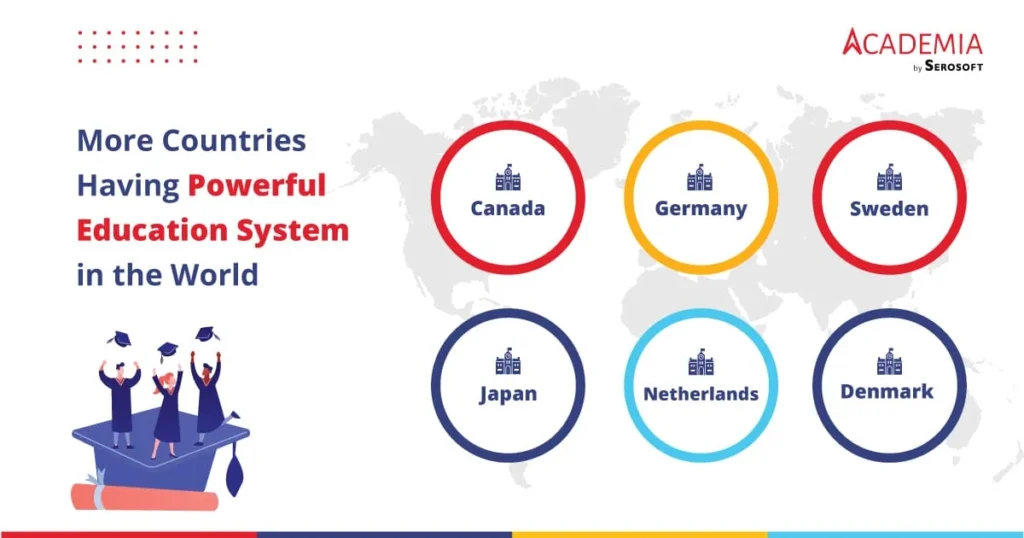
Top countries having automation in education: UK, USA, Australia, UAE, Germany, Canada, Japan, and more. 

  • The United Kingdom 

The UK is one of the leading countries when it comes to the best education system in the world. It includes some of the most famous universities that provide top-notch education systems in the world. 

It provides best-in-class education right from the primary stage of a student to the graduation, post-graduation, and doctorate degrees. The UK not only focuses on top-quality education but also promotes all the technological tools and advanced methodologies like a Student Information System and Learning Management System. 

  • The United States of America

The United States of America is also one of the best countries that provide and attract a lot of students from all over the world. The most important reason behind it is the quality of education, the expertise of faculty members, advanced technology, and of course state-of-the-art infrastructure and facilities. This includes some of the best universities in the world including Harvard University, Stanford University, and many more. The country includes the finest educational institutions that have adopted advanced tools, technologies, and methodologies to provide the best in class education in the world.

  • Australia 

Australia has been recognized in the third position for offering the best education system in the world. Having been known for providing the best education in various parameters, students often consider Australia as the best place to study and get qualified. This country is good for students who want to continue their courses in the field of technology and innovation.  There are various universities in the country that are becoming prominent names using technology, innovation, automation, and all other criteria like complete digital transformation in the institution. 

  • Finland 

Finland’s education system is also considered one of the finest in the world. It is tremendous to provide world-class teaching in having the best access to study material in subjects like mathematics, science, and also in reading. Finland is managing to perform well-providing indicators like; 

  1. Teachers to very less number of student ratio
  2. Number of passing students in primary schools/secondary school
  3. Adoption of technology and automation
  • UAE 

The United Arab Emirates has been attracting international students for the last few years. Several higher educational institutions in UAE are good enough to provide high-quality education with all the specific degrees, Master’s degrees, Doctoral degrees, and Vocational courses. All of these education systems provide great opportunities to all the students who want to get educated in the best universities/institutions in the world.

How does an ERP/SIS make the education system even more powerful?

Every country owns a different level of education depending on the needs of students, the support of technology, the policies, the techniques to manage academic and administrative operations, and various other parameters. To compete with the top education systems in the world universities/institutions need to keep a keen eye on existing and upcoming technological updates. 

Do you know how an ERP/SIS can help educational institutions maintain & manage all the academics & administrative operations in a simple, efficient, and relevant way? It supports the overall structure of the institution, automating all the operations right from the admission to the examination. A robust ERP/SIS provides consistent, robust, and effective management to the institution making it a powerful name in the delivery of quality of education. 

Read more: How Education Management Systems Are Revolutionizing Student Learning Experience

Wrapping Up 

The listing of the above countries is done on various parameters, hope you will find it relevant and insightful. Now if you are thinking about how you can make your institution strong in all aspects, let’s discuss it now! We have the best option for you that can help you in the best way. Request Your Demo Now!

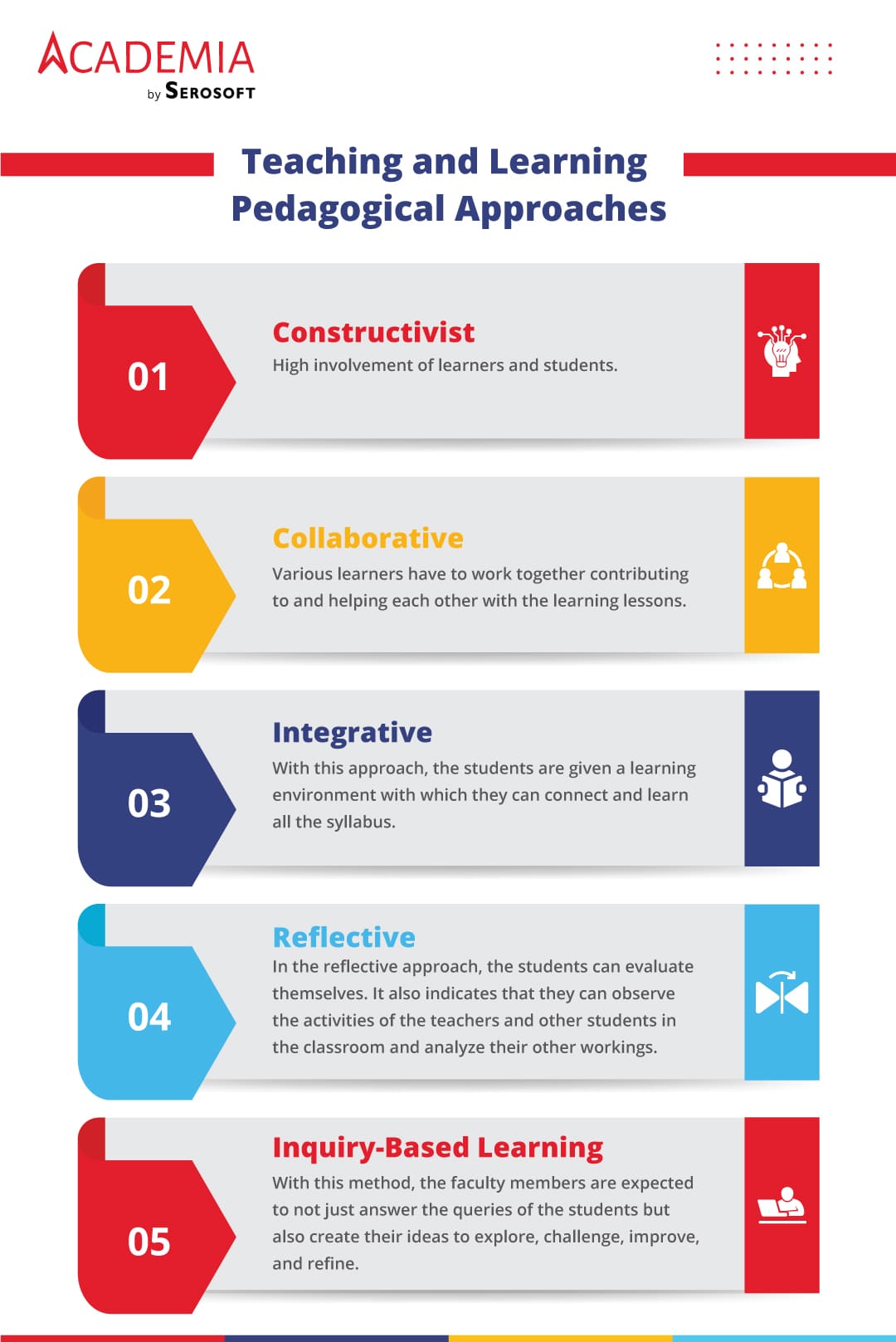
Modern Pedagogy: Driving Better Learning Outcomes

Exploring the Dynamics of Pedagogy: A Catalyst for Rapid Growth in Education

In a swiftly evolving education landscape, the importance of pedagogy cannot be overstated. As the education sector undergoes continuous enhancement each year, educators play a pivotal role in understanding and leveraging pedagogy to foster rapid growth within their institutions. But what exactly is pedagogy in education, and how does it contribute to institutional development? This discussion delves into the crucial role of pedagogy in shaping education and learning methodologies.

Deciphering Pedagogy in Education: Nurturing Learning Through Theory and Practice

Pedagogy in education embodies the intricate relationship between the theory and practice of teaching, influencing the culture and techniques of learning. It serves as the linchpin for creating and refining learning methods, skills, and attitudes among students. The primary goal of pedagogy is to empower learners with a profound understanding of subjects, equipping them to apply their knowledge in real-life situations beyond the confines of the classroom.

How Pedagogy can help faculty improve teaching?

Looking upon teaching in pedagogy, plays a vital role in advanced education delivery. It can be referred to as an understanding of how the students can learn. The teachers are also focused on presenting the syllabus to the students in a way that is necessary to the needs of students. Pedagogy also demands the right way of interaction and communication between the faculty and students along with creating a necessary impact on the students’ minds. 

Faculty members who teach advanced education to students can focus on teaching & learning pedagogy. For them, it is an approach that has optimized the larger responsibilities of faculty giving correct information to students. The faculty members get a clear understanding of how the students are doing concerning their learning and can also focus on the effective target language.


Importance of pedagogy in education:

  • Improves Quality of teaching and learning 

If implemented properly and effectively, pedagogy can help improve classroom learning and quality of teaching to show a drastic improvement. It will also help students resulting in improving their overall performance and learning, also allowing them to learn thoroughly and enhancing learning outcomes. 

  • Boosts cooperative learning atmosphere 

The concept of pedagogy in education helps in encouraging students to work together towards learning and completing all operations. This also helps in improving their perception by understanding and taking views from other students, along with adapting to the cooperative learning environment making education better and growing. 

  • Removes repetitive and monotonous learning 

Pedagogy helps students to develop objectives along with self-grooming. It also allows educational institutes to move beyond the traditional and old methods of memorization and comprehension of teaching and learning. It provides complex processes of learning through which students’ progress can be analyzed and evaluated. Along with all these, it also provides students and faculty with a different form of learning and teaching. 

  • Allows students to learn effectively 

A proper and well-thought plan for pedagogy can help students to grasp education in various ways. It creates the learning abilities of different students. Students are also allowed to take their preferred ways of learning and stick to them. 

With all this, it provides students with a better understanding of the subject, which can eventually improve all the skills, learning, and development outcomes. 

  • Enhances communication 

Communication is also one of the vital factors that make students and faculty relationships better. Institutions opting for the concept of pedagogy can help the faculty understand the student in a better way, triggering them to focus on the student’s weaknesses and guide them accordingly.

How Academia can help improve education delivery in institutions?

Academia ERP/SIS is a robust, feature-rich, analytics-equipped, user-friendly platform, built on a cutting-edge and flexible architecture. It enables educational institutions to automate & streamline their functions/processes for both learning and administration. 

In elevating education delivery within institutions, Academia ERP/SIS stands as a robust, feature-rich, and analytics-driven platform with a user-friendly interface, all structured on a cutting-edge and adaptable architecture. This platform empowers educational institutions to seamlessly automate and streamline both their learning and administrative processes. By embracing pedagogy, Academia becomes a catalyst for enhancing overall education delivery. 

Our software not only facilitates the efficient management of academic and administrative operations but also fosters an optimal environment for faculty and students to learn, communicate, and connect effectively. As we conclude, this article has provided valuable insights into the pivotal role and significance of pedagogy in education. Should you have further inquiries or suggestions, our dedicated team is ready to assist you. 

Feel free to Request Demo and explore the transformative capabilities of Academia.

7 Benefits of Using an Accounting Software in Educational Institutions

Higher education institutions, universities, and schools involve the seamless flow of finances in different departments. With the increasing advancements in education technology, school administrators must choose a technology that provides complete finance management. A cloud-based school accounting software provides all the capabilities to store and access finance and accounting data in the cloud. 

What is school accounting software?

School accounting software is a useful and worthy software for any type of educational institution across the globe. It provides complete data tracking of financial aids along with managing all finance-related tasks in an institution. 

How is school accounting software beneficial for your institution? 

There are various benefits of using school accounting software, here are a few of them:

  • Remote data access 

Using efficient accounting software, schools can get access to any kind of data from anywhere having transparency and accuracy in records, calculations, and management. It also reduces costs, increases productivity, and helps in generating revenue. 

  • Mobile application to access data from anywhere

It allows users to access any information from anywhere through the mobile application. Robust accounting software used in schools should include financial, accounting, procurement, and budgeting to check the financial status and other important information in real-time. 

  • No need for extra hardware and software 

Effective accounting software like Academia will help educational institutions to make long-term investments in hardware and software or any educational accessories. It manages complete finances (fee & payments) in just one software that can be accessed from anywhere in just one tab. 

  • Share data with anyone and anywhere 

An educational institution includes various departments, chains, and sections in which various data, information, documents, and files get exchanged. A School accounting software provides a data migration feature that allows institutions to easily exchange or import any type of data from any system, along with mapping the document easily. 

  • Increased collaboration

A productive school finance software provides seamless access, workflows, and approvals that can automate all the processes and enforces enhanced collaboration, communication, and engagement between students, departments, staff, and parents. 

  • Effective expense tracking 

It is always a critical thing to maintain expense tracking in an institution. The school accounting software provides a convenient way to store and track financial data and information correctly and effectively like investing in real-time. 

  • Easier mode of payment

School accounting system provides an easier mode of payments across multiple academies using just one single platform for admission, enrollment, library, hostel, transport, or any other academic or administrative tasks in the institution. All these processes can be possible by just using an online portal or mobile application. It is safer, quicker, and secure. 

Conclusion 

You must have got a better understanding of accounting software and its application in schools. 

Still, have doubts? No worries, we have got you covered. Let’s schedule time for further discussion! One of our experts will reach out to you to provide you with clarity on it.

Learning Beyond the Classroom: Key Facts & Benefits

In the modern world, educational institutions must opt for techniques that can promote advanced learning and teaching methods. In this COVID-19 pandemic, institutions faced various challenges and difficulties in managing the continuous flow of seamless learning and teaching. To make this better, it is necessary for institutions now to make a confined way of learning outside the classroom choosing technologies that can support the same. 

Among various strong reasons that promote learning outside the classroom program, the most important one is it enhances the student learning experience, in any case, enriching and providing students with real-life applications of theories and practicals similar to schooling. 

Technologies that can support learning outside the classroom

  • Student Information System

A student information system is a cloud-based software solution that provides complete automation of all the academic and administrative operations available in the institution. There are various operations in an educational institution that makes learning outside the classroom a bit difficult for students. In manual intervention, students and faculty need to connect to complete any operations from admission, attendance, examination, result declaration, and a lot more. 

To manage all these, a student information system provides a platform in which institutions can avail classroom as well as outside classroom learning. It provides systematic management through which students can focus on their learnings and lessons performing all other tasks like attendance, examinations, and all other related operations, simply, efficiently, and systematically. 

  • Learning Management System

A learning management system is also one of the most important software that avails seamless learning for institutions. It provides administration, documentation, tracking, reporting, and delivery of teaching and learning programs seamlessly. Using a learning management system owns various advantages, some of them are:

  1. Consistency of learning 
  2. Easy tracking & reporting
  3. Better results through engagement and gamification
  • AR/VR

In the digital world, educational institutions often need to use technologies that provide real-time and needed education. What is better than artificial intelligence and virtual reality. Artificial intelligence and virtual reality are changing the whole level of education providing students with immersive and experiential learning patterns promoting learning outside the classroom. Advances in this segment are incredible and are increasing at a larger pace. 

The use of AR/VR will bring the following benefits:

  1. Personalized learning
  2. Adaptive learning
  3. Monitoring 
  4. Capture and personalization of the data

Benefits of opting for learning outside the classroom

  • Seamless flow of learning 

With the advancement of technology, education institutions need to opt for the right technology that can prevail learning outside the classroom. Technologies like ERP, SIS, and others help educational institutions in managing all the tasks letting students move into their studies from anywhere and anytime leading towards a direct and seamless flow of learning and teaching. 

  • Better experience for students 

Students in today’s generation are different, having a modern approach for everything, they demand a quick, easier, and better way of performing any operations. It is high time for educational institutions to adopt modern techniques and ways that can help in optimizing a better learning experience. 

Learning outside the classroom provides students with greater learning experiences and opportunities. 

  • Improved ROI

Improved ROI is one of the key factors on which educational institutions mostly focus, every institution focuses on ROI improvement. Institutions that are still having manual intervention involve various extra costing from manpower to managing various documents. 

Institutions adopting technologies that can avail learning outside the classroom involves very little manpower, with less documentation, and other high-costing processes which ultimately target high ROI leading to growth and opportunities. 

What are your thoughts?

So which method are you using in your institution for delivering a good experience of learning? Have you opted for the right technology that can lead to positive outcomes for the institution along with having clarity for students about teaching and learning patterns? If you are thinking to choose one, you can also look for Academia, as it provides one of the best Student Information systems that can promote learning outside the classroom effectively by providing a systematic, robust, flexible, and efficient management of all the academic and administrative operations of the institution. 

Want to discuss the best technology for your institution? We are just a call away, contact us now and one of our best teams will get in touch with you. 

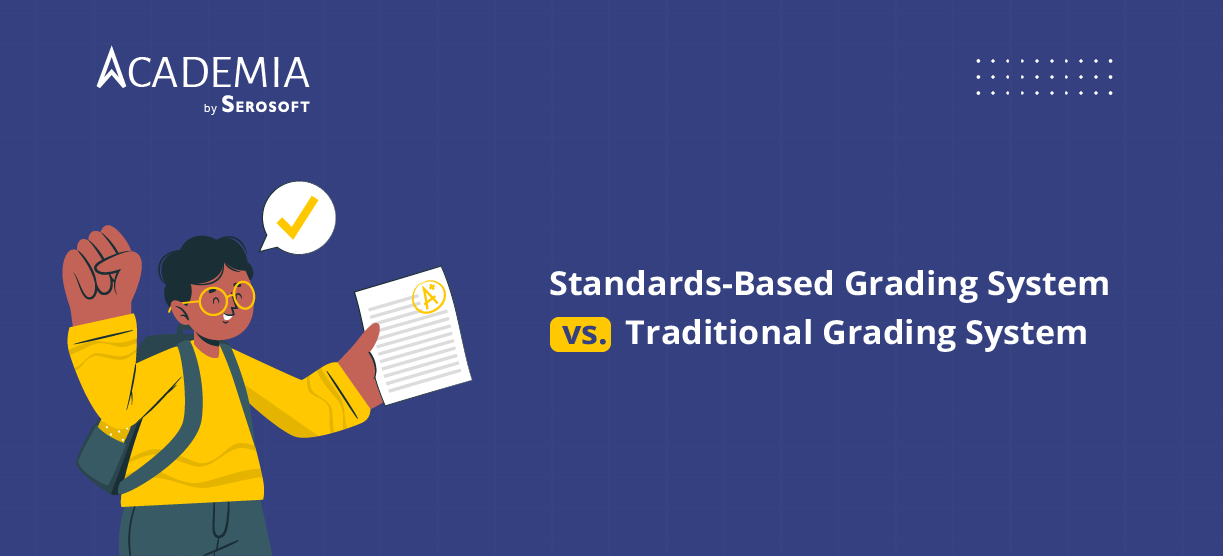
Standards-Based Grading System Vs. Traditional Grading System

Traditional grading approach only focuses on marks and goals, while standards-based grading system gives due importance to the learning progress. In a way, standards-based grading does not bind a student to show progress in a stipulated time and gain good grades. It accepts the uniqueness of each student and hand-holds them to achieve learning goals rather than grades. Here is what is standards-based grading system and how it is different from the traditional method of grading. 

What is a standards-based grading system?

Contrary to the traditional grading system, a standards-based grading system focus on measuring a student’s understanding by setting learning targets and testing the demonstration of their learning, i.e., Standards. 

The standards range from “below requirement’ to ‘mastery’, which is why it is also known as a mastery-based education system. As per a student’s performance throughout the academic year, standards can change for better or for worse. The grading system focuses on students’ learning progress and makes sure the educator, and parents can communicate about the student’s learning progress. 

Standards-based grading system widens the spectrum of assessing a student, as it largely focuses on the learning progress, and its growth and declines to help students. 

Key Differences between Standards-based Grading System and Traditional Grading System

S.no Standards-based Grading System Traditional Grading System
1 Setting learning targets to assess student’s progress. Relies on set grades/ percentages for assessments.
2 Assessment criteria given to students throughout the academic year decide is it has passed or failed.  Grades and percentages achieved by the overall assessment by a student decide if it has passed or failed. 
3 Students get multiple opportunities to improve their learning strategy, and only the latest assessments are used for grading for accuracy.  Students are assessed holistically by assignment of a single grade at the end of the term, based on theoretical assessment. 
4 Students get to know their strengths and weaknesses and thrive for better performance.  Students do not get a scope of improvement as a single grade summing their performance is implicit in their improvement areas. 

Why is standards-based grading a better assessment method? 

A standards-based grading system is a process-driven approach toward assessment rather than result-driven. The system does not bind a student to a fixed standard of intelligence and performance but rather allows them to explore their own uniqueness. Here are some other reasons, why we believe a standards-based grading system is a better method:

  1. It helps educators provide detailed feedback to the students on their learning progress. This means students get more clarity on the areas they have mastered and move on to the areas where they need to make an improvement. With detailed feedback, students’ outcomes improve remarkably. 
  2. Students and parents find it difficult to understand the grading system. It makes it hard for them to understand what factors have been taken into account, to sum up, this grade. Standards-based grading thus helps a student to know where they have gone wrong and what needs to be improved. They take ownership of their studies and work closely with teachers and guides to achieve their goals. 
  3. Standards-based learning provides an opportunity for a personalized learning experience. They can be assigned tasks and work based on their mastery level, rather than fit in a fixed box of measurement in a stipulated time.
  4. The system tests more than just the memory of a student. It challenges their existing knowledge and increases curiosity in students to learn more as the focus is on mastering something, rather than achieving a grade. 

How does a standards-based grading system help students? 

The standards-based grading is beneficial for students in all educational institutions. Here are a few benefits of it:

  • Higher engagement and motivation in students towards learning as the assessment is performance-based rather than percentage-based. 
  • Focus on mastering a concept than achieving grades for the sake of passing. 
  • Testing their knowledge and skills in real-life. It gives them a healthy approach to learning and keeps them motivated for lifelong learning. 
  • Gives students more control over their learning pace or have an idea regarding the areas on which they need to work. Students become an active part of their learning process, track their progress, and target achievement, increasing student outcomes. 

How does the Standards-based grading system benefit teachers/educators? 

Here are a few benefits it provides to the teachers/educators:

  • This increases the scope for teachers to focus on the student progress rather than holistic assessment. Teachers focus on teaching rather than grading. 
  • Teachers work towards personalizing lessons to help students better and improve mastery of the subject. Personalized lesson planning is beneficial in improving the quality of education. 
  • Increases the room for creative teaching methods and resources. It also, helps teachers to personalize the learning experiences to meet the needs of a student. 
  • Gives more understanding of a student’s learning level, areas of excellence, and areas of improvement. 

This was everything about the standards-based grading system. If you are using an ERP solution that does not have the functionality to offer grading as per standards-based assessment, you can try Academia ERP. Wherein we configure our product to meet your needs. To learn more about Academia ERP, contact our ERP experts today. 

EduAction with Arpit Badjatya – A Candid Conversation “Tea & Talk Over EdTech”

[vc_row][vc_column][vc_column_text]

“Technology is not just a tool, it can give learners a voice that they may not have had before.” 

-George Couras

The COVID- 19 pandemic has taught us about various digital parameters, especially in the education sector. It allowed us to adopt a new education model, accept new challenges of technology, and advances. 

Moderated by Mr. Arpit Badjatya, CEO & MD, Serosoft (Academia), EduAction is a series that grabbed the huge attention of vice-chancellors, principals, and other education leaders globally. It is a concept-based series that includes a candid conversation over the digital transformation journey of educational institutions. 

Also, check – Thank You Message from our CEO 

Insights to the Beginning – The First Episode 

The first episode of the series witnessed Prof. Chandrashekhar Ramanathan from IIIT  Bangalore. He has spent 25 years in the field of Information Technology in various capacities. He served on the Technical Advisory Panel of many departments for the Government of Karnataka including the Department of Education, Finance, and Center for Smart Governance. He was recognized in the list of “Top 10 Data Science academicians of India” by the Analytics India magazine for the years 2018 and 2019.

The first episode was a boom and the conversation between the two experts over tea & talk went through a lot of EdTech trends.

The highlights of the first episode are:

  • 3 biggest learning in regards to technology adoption.
  • Things to remember for successful adoption of new automation tools.
  • Factors to consider when adopting new technology.
  • How to select, compare and evaluate ERP vendors? 
  • What would classrooms look like in 2025?
  • Rapid-fire round with the guest.

Any many more questions… 

The very first episode marked a huge success among educators, education leaders, and people who aspire to education technology and its usage. 

The International Mark of EduAction with the Second Episode:

The enthusiasm with the first episode was a motivation to make it more huge with the second episode and so is the grand move of the show. This time internationally!

The second episode of the show made an embarking move to the international education market. A special guest from CECOS London – Mr. Aakif Tanveer, Director of Communications added more value to the show. He is a graduate of Imperial College London and has focused on the use of technology during his 13 years at CECOS College, London helping the college grow consistently. 

His strong emphasis on the use of technology to deliver student-centered experience has enabled CECOS to become a dominant player in the UK education sector.

The second episode has also marked a successful presence among the EdTech leaders and educationalists from across the world. 

The highlights of the second episode are:

  • Why do institutions need to focus on automation in the post-COVID world?
  • How CECOS College, London is delivering a Student-centered Experience through automation?
  • What are the major wins with automation?
  • Rapid-fire round with the guest.

And more such discussions…

We hope you have attended both the sessions and had a great experience with such expert personalities. In case you have missed the sessions, we have made them available to you. Just check the below links:

EduAction with Arpit Badjatya EP #1:

https://youtu.be/GBImKgrYE-s

Stay tuned for the next exciting episodes! 

How Data Analytics Improves the Efficiency of Educational Institutes?

The education ecosystem includes various small and medium entities like universities, colleges, schools, and training centers. It involves a huge amount of data and information that needs to be stored, managed, and organized in a way to be accessed anytime. Manual intervention in institutions makes this process a bit complicated and sometimes creates situations for breaches of confidential data. 

So how can you solve this in the modern era of education and technology? Education analytics can become the perfect solution to this. Using analytics institutions can attain a lot of opportunities for better data gathering and analysis that can help faculty members and students in the long run. 

Want to know how it is possible? Let’s discuss it in more detail:

What is the role of analytics and reporting dashboards in an educational institution?

Modern educational institutions need to understand analytics so they can attain advanced outcomes that can significantly transform the way of teaching, learning, and managing the whole institutional objectives. 

Analytics and reporting dashboards can effectively attain and engage current and prospective students, increasing student enrollment, and improving student retention and completion rates. It can help institutions achieve intended outcomes with pace and perception. 

How can analytics improve academic and administrative efficiency in an institution?

Analytics and reporting are becoming increasingly helpful for educational institutions to attain positive outcomes, it can effectively manage all the academic and administrative operations of an institution. Let’s discuss it in greater detail:


Academic Management Using Analytics 

  • Efficient admission process 

Admissions are considered one of the most important sessions which includes enquiry, registrations, enrollment, and various other tasks. Analytics can lead to proper and effective management tracking every information related to their data, finding efficient patterns, and shifting the admission process to go smoothly. 

  • Program and courses management 

Managing programs and courses in an institution is also vital, institutions must opt for tools and technologies that can help in selecting programs and courses using data analytics. Selection of the right course within the right time along with all the data makes students more focused. This improves students in the subject and indicates to whom and when specific learning content should be delivered. 

  • Effective management of fee operations 

Fee management is also one of the crucial tasks that include multiple bill payments, transactions, and more. In modern education institutions, it is important to accelerate online payments and create a systematic fee payment procedure. Data analytics with an ERP can facilitate complete fee management having multiple features including online payments, mobile notifications, and access to all other features. It can differentiate between generating receipts, canceling the transaction, creating receipts for backdating, and more. 

  • Advanced attendance management 

Attendance is considered one of the most necessary tasks for any educational institution, but with manual intervention, this process becomes critical and sometimes creates chaos and confusion among faculty members, students, and even higher authorities. An ERP integrated with data analytics can provide complete data management of attendance along with biometric integration of each student’s attendance. Graphic presentation of attendance becomes easier for all students and faculty members creating a systematic loop of daily attendance. 

  • Enhanced data security 

Data security is often the most important concern for any educational institution. Institutions should opt for tools and techniques that can provide enhanced security. What is better than an education ERP? It deals with complete data security having data analytics and system usage analysis to track all the data and information from any resource. It gives security to students and faculty members in providing and managing confidential information related to any subject matter in the institution. 

  • Complete student lifecycle management 

Students are the ultimate stakeholders of any institution and almost every operation in the institution remains associated with students. Right from admission to alumni of the student, multiple tasks need to be performed by the institution along with providing a better user experience to students. Using analytics, institutions can attain a robust student lifecycle management providing perfect catchup to exact details of students. Students also get the authority to have quick responses to their requests whether it is related to admission enquiry, examination, or any other query.

Administrative management using analytics 

  • Hostel management 

The hostel is often a section that needs separate care and involvement from the institutional authorities. Having a perfect system that can trigger automation of all the basic operations like the number of students in the hostel, the number of amenities, availability, and attendance of students, and related things. Analytics used effectively can make all these simpler and more organized. 

  • Transport management 

Another crucial activity in an educational institution is transportation! It involves a huge amount of manpower, money, and resources. Institutions need to understand that using automation they can make this process more aligned and systematic. GPS trackers and cameras are added to the analytics through which counting of each student, their bills, their attendance, and all other things can be measured and analyzed. With all these, tracking and maintenance of drivers and helpers’ activity add to the feather with students’ safety. 

  • Library management 

Libraries dole out a vital role in the education industry. It can be called the brain system of any stakeholder in the institute. With the enhancement in the digital content, it is initial to manage the catalog of the educational institutions with a scalable and reliable library management system having feature-rich analytics and reporting dashboard. It will support each requirement related to the library and its management virtually. 

How can analytics bring a differentiation to your institution?

With the emerging EdTech trends, analytics is playing a vital role in the educational ecosystem. It can help institutions achieve automation and digital transformation by opting for software like an ERP/SIS. 

Analytics can simply create differentiation in your institution creating a data log of each activity whether it is for students, faculty members, parents, or higher authorities. It can be considered a breakthrough point of success for your institution. 

Conclusion

Hope you liked the article and got to understand how data analytics improves the efficiency of educational institutes? Want to know more about analytics and reporting dashboards, contact us now, and one of the experts will get connected to you to help you with the best. 

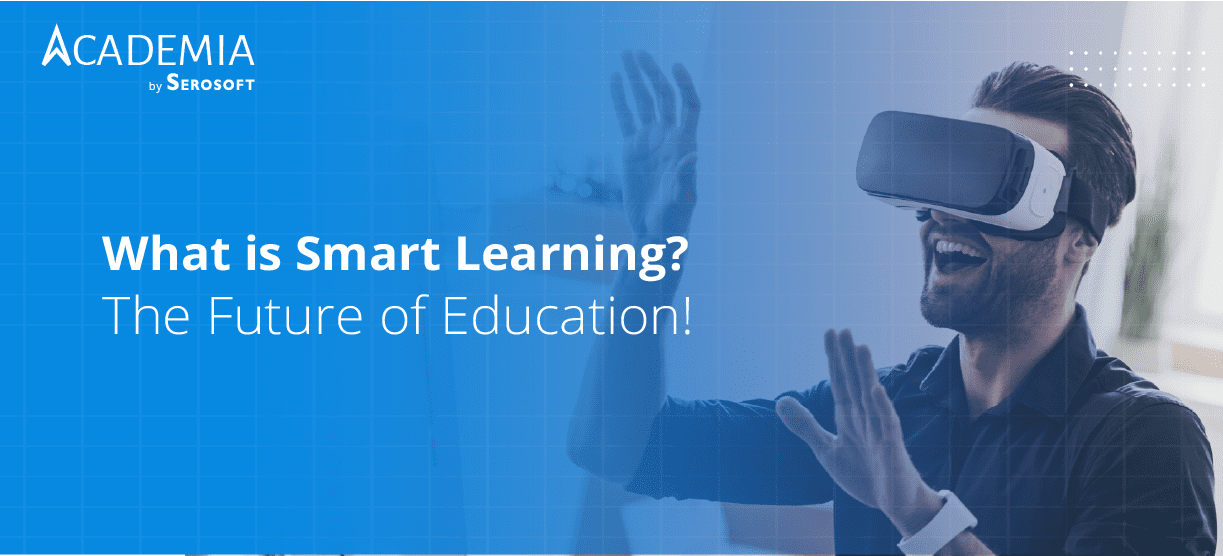
What is Smart Learning? The Future of Education!

Is your institution having the best-in-class students, faculty members, and an efficient way to run the entire academic and administrative processes? If not, then it is the right time to opt for advanced EdTech tools that can help you in delivering modern and advanced education, integrated learning experiences, and streamlined student lifecycle management. 

Smart learning is the new era of education that is helping institutions achieve great results. Do you know how you can use it and how it can become beneficial for your institution? Let’s discuss them in this blog:

What is Smart Learning?

Smart learning is a broader concept that reflects advanced technologies that are enabling faculty members and students to digest knowledge, information, and skills effectively and efficiently. New EdTech tools like ERP and SIS are marking paradigm shifts in modern learning and growth in institutions. In simpler words, smart learning triggers automation for institutions in the best form. 

Benefits of Smart Learning

  • Improved student experience 

Advanced students need advanced solutions, institutions opting for smart learning can provide a better experience to the students with convenient, secure, and personalized platforms having:

  1. Efficient admission process 
  2. Systematic examination process 
  3. Biometric attendance management 
  4. Smart learning and teaching tools 

Effective and efficient performance of all the academic and administrative operations can create a better and leading atmosphere for faculty and students, and ultimately for the students of an educational institution. 

  • Increased security 

Educational institutions involve a lot of data that needs to be managed, stored, and secured. Smart learning tools can help institutions in streamlining, managing, and organizing the complete data and information that can be accessed, edited, or updated according to their needs. 

  • Decreased operating costs

Educational institutions involve a lot of expenses in each operation, whether it is admission, examination, or result generation. But with the new and advanced EdTech tools institutions can opt for smart learning tools that can enhance revenue generation and decrease overall operating costs. 

  • Avails better-decision making 

In any organization, there is always a chain of communication that avails decision making. Manual intervention in institutions makes decision-making lengthy and sometimes creates confusion and errors. So it is the correct time for higher education institutions to choose the right technology that can avail better, quick, and aligned decision-making. 

  • Boosts goodwill 

The education sector is considered one of the most necessary niches having multiple competitors in the city, country, and across the world. Students and parents can easily get attracted to an institution that provides modern functionalities, advanced tools, and techniques, and of course, have great goodwill. So it is a must for institutions that are willing to grow and resist the competition to choose smart learning tools that can aid and boost goodwill. 

How should your institution choose smart learning?

The EdTech world is enhancing with pace, it is high time that educational institutions should adopt smart learning tools and technologies. Softwares like Student Information System (SIS), Enterprise Resource Planning (ERP), and Learning Management System (LMS) can help institutions opt for smart learning strategically. This software can effectively automate and move all the academic and administrative operations digitally improving the round development of the organization. 

What’s Next!  

Hope this blog helps you in having a better understanding of smart learning and its benefits for universities, colleges, and schools. It is a broader concept that can help institutions bring advanced management and learning opportunities for faculty members, students, and higher authorities. Want to know more about smart learning? Let’s discuss it in detail, contact us now! 

SIS & LMS: What’s the difference?

In the modern scenario, the education ecosystem is expanding exponentially and educational institutions need to choose a technology that can bring differentiation, making all the operations systematic and efficient. But having varieties of EdTech tools and technologies institutions often gets confused among their usages and their meanings. 

Do you know the difference between SIS and LMS? Both these systems serve distinct purposes but record similar data to help teachers and administrators along with managing day to day operations. 

What is the Student Information System (SIS)?

A Student Information System is software that allows institutions to manage student data and information efficiently. It provides functionalities for all the academic and administrative operations like admission, enrollment, examinations, fee management, attendance record management, program and courses, and all the operations related to faculty and student life cycle. 

What is a Learning Management System (LMS)?

A Learning Management System (LMS) is software to empower learning and development in institutions. It helps in the documentation and delivery of all the courses, training programs, and learning and development programs of an institution. It promotes e-learning and teaching processes, automating and directing the processes. 

What is the difference between SIS and LMS?

Both LMS and SIS own administrative management functionalities, but none of them can replace each other’s functionalities to help the institution. Let’s discuss what are the differences between the two:


SIS LMS
1. An SIS helps universities and colleges manage academic and administrative operations related to students, faculty, and institutional authorities. 1. An LMS helps faculty improve teaching and learning by managing interactions and learning activities with students.
2. It stores, manages, and automates student and institutional processes. 2. It manages course resources and learning materials to enhance the classroom and online learning experience.
3. It manages student admissions and related processes. 3. It supports learning activities and helps students develop knowledge and skills.
4. It manages student enrollment and maintains program and course selections. 4. It manages course enrollment, classroom activities, and student learning administration.
5. It handles examinations, assessments, grades, and academic progression. 5. It supports the creation, organization, and delivery of course materials.
6. It manages scholarships, qualifications, certificates, and graduation processes. 6. It manages course content, learning paths, assessments, and certifications.
7. It can support financial aid, student fees, and other financial processes. 7. Financial aid and student financial management are generally outside the core scope of an LMS.

Wrapping Up!

Hope you got a strong understanding of the differentiation between SIS and LMS. The SIS is a way you are thinking to manage all the academic and administrative operations of your institution effectively and efficiently. An LMS will function as an online classroom to manage your training if you provide lots of e-learning and corporate training. The SIS and LMS can work hand in hand to provide effective management leading to the growth and success of the institution. 

Want to know more? Let’s discuss it in more detail having more clarity for the same, contact us now!


5 things to keep in mind while buying a SIS

The COVID-19 pandemic disrupted the functioning of educational institutions worldwide. To continue the pace of learning and teaching, institutions have adopted various technologies like LMS, ERP, SIS, and various others.

There are various complications that institutions have faced while going digital during the pandemic, the academic and administrative tasks were affected and so were the learning and teaching methods. Institutions that have opted for Student Information System got the opportunity to manage and run everything smoothly & effectively. With the increasing times, institutions must adopt SIS to have better and more focused management in the institution having the best SIS. So, let’s discuss things to keep in mind while buying an SIS. 

Things to keep in mind while buying an SIS

A student information system is one of the most important and helpful technologies for modern educational institutions. Becoming the core of institutions, it can manage all the academic and administrative operations focusing on complete automation and digital transformation of institutions, but with the increasing technology usage, innovation, and automation, institutions must keep some necessary things in mind. Let’s discuss some of them.

  • Top functionalities and feature-rich SIS Software 

This is one top-most thing that you need to look for in a Student Information System, it should have all the fundamental functionalities for Universities, colleges, and schools. It is necessary to check the major features such as the efficiency of portals, mobile apps, and other technology tools provided. It should also need to be feature-rich in all senses leading to overall growth and opportunities for the institution.  

  • Flexible and adaptable (Configurability)

Institutions need to opt for Student Information Student (SIS) that provides huge scalability leading to adaptability. It should provide easy customization according to the needs of the institutions. It avails scheduling of students’ performance, standards-based grading requirements, and complete modification of the user interface. Institutions need to be able to create and consolidate any type of screen, page, and field in single or multiple groups of institutions to collect any type of data and information easily. 

  • Interoperability 

Interoperability for educational institutions is one of the important factors that allow the exchange and use of information systematically providing synchronization of all parts. It is considered as a component that attempts and addresses all the needs of institutions such as duplicate information in different areas and systems resulting in cooperation, development, integration, and the rendering of all the academic and administrative operations easily and efficiently. So the SIS you choose must need to have high scaling capabilities related to interoperability. 

  • Improved security & support 

Buying a cloud-based technology like ERP/SIS for your institution directly helps in keeping the system safe and managing your data security along with providing continuous support for all the tasks. An SIS having the right security mechanisms, and support customizations can help in improving on-premises and online academic and administrative support for institutions. 

A robust and securely improved SIS provides complete tech support to encourage overall growth in the institution. 

  • Business intelligence

Every organization needs business intelligence, whether it is a small business venture, a hospital, a small shop, or an educational institution. The institutions must opt for technology that helps acquire all the business intelligence from systematic academic and administrative management and cost-saving leading to high ROI, growth, and opportunities. In this technological world, automation and digital transformation of the institution can be considered as a good start for initiating business intelligence. So, it becomes important that you must choose an SIS that can lead to complete business intelligence in the best ways. 

  • Workflow coordination 

There are multiple departments in the institution, including various operations from admission, enrollment, assessments, examination, results, and a lot of others. Having manual intervention institutional management often faces a lack of workflow coordination that can be erased by having a Student Information System. A feature-rich and flexible student information system can help create efficient workflow coordination among internal and external departments of the institution. 

Hope you got to understand how a good, flexible, and efficient ERP system is important for your institution. There are various ERP vendors available but it is a bit difficult to find a good one that can help in accomplishing the above-discussed objectives. Academia is one of the best, leading, and cutting-edge student information systems that are focused to bring automation in every single operation of the institution. 

What’s Next! 

So, what are your opinions about buying a student information system, what are the features that you must think can be in your system? Let’s discuss it now! Contact us now or Request Demo!

Download Exclusive Gartner Reports Brought to You by Serosoft (Academia):

How to Use Gamification in Higher Education?

In the last few years, games have been the first choice of any age group. Boys and girls of any age are so addicted to some of the games that they always remain in front of their phones, laptops, and computers. So to make learning interesting and effective, educational institutions can adopt gamification in higher education making learning lessons more attractive and interesting instead of the old and theoretical method of reading, teaching, and learning from the books. Games have a wide appeal that derives joy from games if they are well designed and engaging. 

What do you think about using gamification in higher education? How can it enhance modern learning techniques? Let’s find out it in this blog: 

What is Gamification?

Gamification is an attempt to enhance systems, services, methodology, and activities that can be used in educational institutions and organizations to create similar experiences to those when playing games to motivate and engage students. 

How can Gamification help in Higher Education?
Gamification is a term or strategy that is used to define a process of activities and rewards to promote student engagement. It is somehow a more broadened form of experiential learning. It is a contemporary approach that properly and systematically brings education with other elements and characteristics of ethical gaming culture. 

Benefits of Using Gamification in Higher Education:

  • Motivates students and learners

Various techniques can be used in gamification in higher education. Interesting techniques used in various games with challenges and rewards help in motivating students and learners in the best prospects. 

  • Enhances student engagement 

Games have always been having a different approach for kids and teens and specifically students. Involving studies can enhance students’ engagement differently and positively. 

  • Reduces faculty burden

Gamification provides an easier way to teach and learn, it reduces faculty burden by letting students understand more quickly and properly. 

  • Improves overall learning experience 

Students must get a proper understanding of whatever is being taught to them, and all this, gamification can help a lot expand and improve the overall learning experience in a better way. 

How to use Gamification in Higher Education?

  • Gamification in Grading and Result Declaration 

Grading and Examination evaluation is one of the most important segments in any educational institution. It needs to be perfect in any sense, having manual interventions in the institutions, educational institutions opting for automation and technologies ERP and SIS can manage all the operations like attendance, admission, examination, and grading in a better and simplified manner. Along with automation, gamification can also make the grading process simpler and easier as through opting it, institutions can change the evaluating marks using the experience point system. Using which students can progress towards different levels just like games. All these processes can also start from changing the grading process in assignments and tests. 

  • Promoting Studies using Gamification 

Games have always been the first choice of students, but what if the lessons that have been taught to them include games? Students will find it interesting to learn by having fun alongside. One of the best and simpler ways to gamify the learning process in the classroom is to create and organize a quest of all the lessons that have been taught to them the whole week or month. The quest needs to be launched interestingly and more funnily that can generate the interest of students along with having a learning experience for them. The marks are given for the quest also need to be in the game format like in badges or in points that motivate students in the right direction. This is just one way as there are various techniques through which gamification can become a part of modern classrooms. 

  • Teamwork 

Teamwork in any sense always creates the right move for each individual in the team, whether it is a game from our childhood or an important decision in the parliament each involves the right perception and involvement of a team. Gamification is a classroom that promotes learning, playing, and participating together cultivating a greater learning atmosphere and inculcating the value of working together. To generate more interest in students, faculties can share rewards, points, or even power-ups that can even help in boosting morale and team spirit. 

Conclusion 

So what are your thoughts about Gamification? Are you using any technology for it? Let’s discuss it together to have better clarity about its benefits in your institution. Contact us now and we will be glad to discuss it with you.  

NBA Accreditation: Definition, Benefits, and Process

With the advancement in the education sector, the quality of education and learning is enhancing day by day, and the introduction of a new Accreditation process by the NBA in 2015 is one such change that can bring great impact in terms of quality of education & institutional practices. 

What is NBA Accreditation?

NBA, National Board of Accreditation is an accreditation agency representing India in the Washington Accord (WA). The NBA was established in 1994 and gained autonomy in the year 2010. Furthermore, it became a member of the Washington Accord in the year 2014. The main feature of the NBA is to assess the performance of higher education institutions issuing quality accreditation certificates to a specific program that complies with the quality Standards Criteria of the NBA. 

The NBA accreditation supports various programs on mission and vision statement, Programme outcomes, course outcomes, faculty contributions, students’ performance, teaching-learning process outcomes, infrastructure, and library management. 

Based on various criteria, NBA certification and accreditation support various funds, autonomous college status, deemed university status and having the authority of researching projects. 

Why is NBA Accreditation important?

Let’s say a higher education institution has NBA accreditation and carries the stamp of recognition for its education quality assurance at undergraduate, graduate, and postgraduate levels. Universities and colleges need to have NBA accreditation for as stringent NBA accreditation criteria with the purpose that they are at par with international best practices. 

Having an NBA accreditation, higher education institutions can have better clarity of data, identification, and student encouragement that can lead to enhancement of the overall institution. 

Benefits of NBA Accreditation

  • Managing quality standards 

There are various ways through which an institution can manage quality standards, with NBA accreditation it becomes quite possible to meet stringent quality standards. Academia modules provide complete management to quality standards providing the necessity of students having to conduct a detailed analysis at college admission and management process. 

It signifies the commitment to excellence, students also get benefit from the process of continuity in the improvement of quality that is a part of the NBA’s approach to promoting excellence in technical education. 

  • Encourages trust in the institution

Institutions having NBA accreditation have a compulsion to meet and maintain high standards. This also increases trust and confidence among the public promoting accountability. This helps potential students and their families to have a certain level of trust in the institution for the amount of accreditation it receives. 

  • Improves students’ performance 

The modern generation of students expects an enhanced and advanced process of learning, teaching, examination, and result generation. Academia supports NBA accredited programs and supports Outcome-Based Education OBE, which can measure students on criteria like knowledge, skills, and attitude. Also, various facilities and curriculum ensure the student gets proper placement after their studies. 

  • Helps in SWOT analysis targeting better outcomes

Having NBA accreditation institutions can do a SWOT analysis, let’s say, evaluation of their strengths, weaknesses, and opportunities/threats. Academia with its modules helps in perfect evaluation, it helps the institution understand where it currently stands and how it should move forward. 

  • Promotes fund-raising

Accreditation necessarily helps educational institutions to secure and raise funds in the best ways. With the funding increasingly linked to effective performance and outcomes, accreditation would help institutions to avail performance-linked funding and incentives. 

  • Better mobility going forward

It is always important that educational institutions create transparency and provide mobility to educational institutions, it encourages and makes possible easing out the mobility to students and professionals at all levels. 

Enabling all the features that support accreditation, Academia facilitates higher mobility to students who are pursuing higher education. 

With the rise of the advanced education ecosystem, higher education institutions in India need to adopt the accreditation process to garner the benefits of the NBA program focusing on the betterment and growth of educational institutions. 

Process of NBA Accreditation for Higher Education Institutions 

  • Online Registration

Institutions seeking NBA certification need to have an online registration as the first step. Institutions can submit the required documents with the registration form using the ‘eNBA’ portal. 

  • Details Submission 

Moving to the portal, a permanent user ID along with password credentials is generated after the payment of the nominal registration fee. Utilizing the permanent Id, institutions can submit more details like the name of the head of the institution, information related to key promoters, institution’s bank details, proposing programs along with various approval letters and regulatory authority. 

  • SAR Report Generation

After this, the institution needs to prepare a self-assessment report (SAR). This whole process is done by self-evaluation of internal work processes & activities. This is an important step to have an institute apply corrective measures and improve the way it works.

  • Analysis & Evaluation by Committee Members

After completing all the processes, this phase is considered as an important one, it involves analysis and evaluation by the committee members of all the information covering all the areas in higher education institutions.

The major criteria for NBA certification depend on various factors like education outcomes, faculty performance, and overall facilities being provided to enhance students’ growth, the main goal of NBA accreditation is to maintain quality standards in many aspects and likewise.  

Closing Notes 

With this blog, I hope you got a good understanding of NBA accreditation and its advantages for your institution. 

There are various other things that you must know about, get in touch with us and the best of our team will get back to you to make a factful and interesting discussion. Contact us today! 

Back to top