
Webinar Alert: What Nobody Tells You About AI in Higher Education | Thursday | 8th Oct 26

X

Type your keyword below

4 Reasons Why 5G is a Game Changer For the Education Sector

As the world announces to go 5G bound, every industry in the world is busy paving the way for it to be used in the segment. 5G, or fifth-generation wireless, is a new iteration in cellular technology that is said to bring great speed and responsiveness into wireless networks. This means the world is ready to go wireless in the truest sense, and virtual reality will take over. 

With so many things being said and stipulated around technology, we also have some speculations about technology usage in the education industry. 

How is 5G different from 4G? 

To start with, 5G will take the internet experience to the next level. It is on a new level, even though both 4G and 5G are wireless technologies. Latency, i.e., the delay between sending and receiving the information, is very low in 5G technology. Hence, faster delivery and seamless experience using gadgets, software, digital tools, etc. 

With an extremely low latency rate, 5G technology would allow faster educational delivery and make the user experience more immersive while using a variety of educational technologies. In comparison, a 5G cell tower can hold and support about 10 times more devices than a 4G cell tower. This will completely change the education landscape with greater bandwidth that supports superior communication over larger distances. 

How is 5G going to transform the education industry? 

Generally speaking, 5G can improve the quality of video conferencing, add haptic response capabilities, improve the immersive learning experience and allow educators to use VR and AR in the classrooms. Along with it, it would support a higher degree of personalization. Here are 4 ways in which 5G will be a game changer in the education industry. 

  • Improved interaction between teachers and students. 

If you are using any conferencing application such as Zoom or Google Meet, you are likely to experience lags and breaks in the connectivity. This negatively impacts education delivery in an online or hybrid learning environment. But with 5G, there is very little chance you would face such a problem. 

During online classes, you would not be required to wait for the program to load and reconnect, and hence would make connectivity between teachers and learners even easier. It would improve the knowledge retention of a student better in an online learning setup, would keep them engaged with the curriculum, and is likely to increase their participation. 

Similarly, students could download videos and learn material faster, and cool technology such as holograms, VR, AR, etc., can be effectively incorporated into the classrooms. 

  • It Brings in an immersive learning experience 

Although online learning in the devastating times of COVID-19 indeed became a saviour, it still had some limitations. Skill transfer, lab work, hands-on experience, and related activities were outside the scope of online learning tools. For this, extra tactile stimulation is required to offer the equivalent learning experience online as in real-life. 

With 5G, technologies such as AR and VR can provide an immersive classroom experience and allow students to explore complex concepts through zooming, pinching, and touching. Tools that can stimulate haptic responses (feeling of touch, motion, or interaction with physical objects) to introduce a variety of learning tools into the classroom other than traditional video conferencing that can increase student experience and engagement. 

  • Personalized learning experience 

The one-size-fits-all concept is ceasing in the education industry. Education authorities worldwide are realizing the power of technology and its capacity to provide highly personalized experiences to students. With 5G just around the corner, it is likely to improve personalization by creating intelligent systems. These systems would constantly analyze the student’s behavior and give near-accurate reports about his unique abilities, learning styles, preferences, and other attributes. 

Another trend that has been brought to reality with 5G technology is virtual teaching assistants. Which can assist a student in learning and provide a personalized experience as per their performance analysis and preferences. 

  • Access to knowledge and education

5G will likely democratize education. With technology, education would become more accessible and become more inclusive, and affordable. Hence, making education more equitable and accessible to the socially and economically weaker sections of society. 

Wrapping Up 

Although the true potential of the technology can only be realized once it becomes accessible to the world, these are the 4 things that are surely going to change in the education industry with 5G technology. For more interesting information such as this, stay tuned and subscribe to our newsletter. 

How Education ERP is Changing Dynamics of the Education Management

The education sector is in the advent of complete digital transformation. From online education management to MOOC (Massive open online course), e-learning, flip classroom; it is going to have a paradigm technology shift in the coming future.

Among all the education technologies, Education ERP is one that is playing a significant role in institution management. According to a study, Education ERP is going to grow 3X by 2028 with the increase of CAGR (Compound annual growth) 10.9%.

In today’s rapidly evolving electronics market, educational institutions are using education ERP solutions for managing, planning, controlling and delivering data effectively.

In this article, we’ll see how Education ERP is changing education management.

1. Digitization of complete administrative processes

An education management system integrates all the academic processes in one place and makes it easier to manage the day to day tasks. It helps to automate the entire administrative processes from admission to course completion.

It is an online student management system that makes workflow seamless, easy and efficient. It centralizes all the departments and allows staff members to communicate better and helps them to exchange information in a hassle-free manner.

2. High data storage with disaster recovery

This is one of the most prominent benefits of a web-based education management system. It is obvious that educational institutions generate a huge amount of documentation. To store and manage these documents manually is a tedious task that is also prone to physical damage.

With cloud-based campus ERP, institutes can easily store endless documents on the web with no worry about data storage capacity. Moreover, with the disaster recovery solution, you can back up the data on a remote offsite server, keep it safe from any kind of damage and recover it without any data loss.

3. Student management beyond campus boundary

What if student management is not limited to school/college timing?

An education management system is a solution that increases the connectivity between teachers and students. Students can check assignments via their portals, submit documents whenever needed, access their details, check their results, submit their fees online and do much more. Teachers with Teacher Portal, can check, remark, upload assignments work, download them for evaluation, track students’ academic records, etc.

Not only this, with the parent portal, parents can also keep track of their child’s academic activities, such as attendance details, results, remark from teachers, their achievements, etc.

4. Student-centric education management

The main objective of an educational institution is student development, giving them proper time for their complete improvement. However, due to the increasing number of academic processes, teachers and staff members have lots in their plates, therefore, it becomes difficult for them to focus on students.

Thanks to the education management system like Academia ERP, it takes the load off of trivial academic operations from teachers and allows them to invest their time in students and develop their teaching approach.

It helps institutes to build a student-centric ecosystem, which enhances student performances, improves the productivity of academic management, strengthens the credibility and thereby helps the institute to grow.

Education ERP: A tool to accelerate the growth of educational institutions

Institutions are shifting to digital transformation and implementing education ERP for managing, planning, tracking and controlling its regular task from beginning to end is the fundamental step toward that development. It is helping institutes to bring better management, efficiency, and cost-saving. It is enhancing the student experience, employee engagement, and changing the dynamics of education towards exponential growth.

Academia education management system helping more than 200 institutes worldwide to reach their higher potential. What are you waiting for?

Take the step toward a better future for your institute, shift to automation with Academia. Book a FREE demo now!

6 Major Challenges faced by Educational Institutions and how Academia ERP can help

There are thousands of operations that govern the management of your institute on an everyday basis. Needless to say, they all happen at the same time, and at times you would wish you had at least 10 heads to keep a track of everything that is happening around in your institute. 

Meanwhile, your metamorphosis is an impossible thing, let’s focus on transforming the way your institute functions. Yes, we are talking about digital transformation. 

Digital transformation is highly demanded in the education sector. The education industry around the world is undergoing some major challenges, and there is no other option but to go digital and take on these challenges. 

Here are 6 major challenges that are faced by education institutes, and how Academia Education ERP / Student Information Management System can help:

  • Automate Student Registration & Admission Process

Admission phase is one of the most mismanaged aspects of any education institute that is doing it manually. Let’s be practical, you are asking a bunch of people from your staff to manage thousands of enquiries and applications, and that too in a short time. 

The dull and repetitive procedure thus can easily to automated with Academia ERP. The product comes with pre-admission and admission execution features to make enquiry management easy for your institute and handhold every applicant to become a student in your institute. Not only, the product optimizes the process but also provides you with data analytics with predictive qualities to ensure you are choosing the right applicants that would be well fit in your culture and curriculum. 

  • Curriculum Management

It is an every-year activity and can take days. You are well aware of the hassles of designing the right curriculum. And if you have tens of courses and programs running in your institute, you can say goodbye to a whole month of your life. 

With Academia ERP, you can manage your curriculum better and allow easy structuring of the course components. For every subject, every chapter, lesson, and resource material you would be surprised how easy your life would become after you implement Academia ERP. 

  • Productive Classroom Management 

Lesson planning, student attendance, student engagement, student performance management and analysis, and so many other things. Just percolating knowledge is not the end of your responsibilities. 

Having said this, you need a well-designed product that fits well in your academic structure to perform all these tasks. You need to free up your teachers to focus on the primary goal of providing quality education and focus on their performance improvement and leave the other ad-hoc tasks to the software. Guess what is the solution for this – Academia ERP. 

  • Better parent-teacher association

If you wait for months to interact with the parents of your students you need an ERP solution right away. The world is moving towards omnichannel communication and people expect to stay in touch with these digital communication tools on the go. 

Also, parents are demanding a larger share in their ward’s academic life. You need a solution such as Academia ERP to keep in touch with the parents of the students and provide them detailed reports on a regular basis about their ward’s participation in academic and non-academic activities. 

  • Hassle-free finance management 

Keeping track of fee payments, sending payment reminders to students and parents, payment collection, updating records, managing & sharing the receipts with the payer, and resending frequent reminders to the students that have not paid are some of the most tiresome duties for your administrative staff. Also, consolidating data to prepare financial reports and tax operations may become a hassle. 

For streamlining all the finance-related activities you get a fee and finance module in the Academia ERP software that automates the task and tracks each transaction to keep a record for digital management of receipts – eliminating mismanagement completely. Also, the software sends system-generated reminders through various modes of communication. The system has in-built financial reports that allow you to consolidate data easily and generate reports faster for compliance activities. 

  • Resource Management

Resource management is the primary goal of any ERP solution. For an admin to keep track of all the resources such as inventory, hostel, mess, library, and more it becomes time-consuming. Also, the process is prone to delays and errors. To eliminate even the slightest tracking mistakes you can opt for Academia ERP. It is one of the best tools that come with a full-fledged resource management toolkit and allows easy tracking of various types of resources. 

Wrapping Up

Aside from dealing with the major challenges mentioned in the blog, the Academia ERP software assists you in the better management of your institute. It has multi-center capabilities and is a perfect enterprise-level solution for the chain of institutes as well. The product is built to streamline some of the most complex operations in an institute like – admissions, examinations, attendance management, student data management, student lifecycle management, student performance management, and more. To learn more about these features, request a live demo today. 

B-learning – Best of Traditional and Modern Education

Spare a minute to ponder the presence of technology in our lives and you will find that almost everything is connected to the digital world; directly or indirectly. Millennials and Gen-Zs can’t imagine their world without the internet. Not only does it involve their social lives but it also encapsulates their personal growth, learning, and education. 

As much as online learning is fast becoming a source of learning and knowledge, we can’t ignore the importance of the physical presence of a teacher in a student’s life. Therefore instead of shifting completely to e-learning, there is a midway and a better option known as b-learning.

What is b-learning?

B-learning also is known as Blended Learning is the combination of online and offline education. It is a mixture of face-to-face interaction learning methods along with digital courses. Therefore, it is also called hybrid learning, technology-mediated instruction, web-enhanced instruction, and mixed-mode instruction.

Blended learning came into existence with the importance of computers and the internet. Since they play a very crucial part in educational institutions and student engagement increases with them, institutions and educators are inclined towards blended learning methods. The idea is to get the right mix of the traditional methods and the digitally advanced ones.

What are the advantages of b-learning?

Personalized learning, the democratization of education and lesser expenses, are some of the benefits for students and educators of b-learning.

Let’s look at some of the major advantages.

It is more effective

Online learning with the guidance of teachers is the perfect approach for today’s generation. It increases student engagement and makes them independent to search for topics and gains updated information on their own. This also lets teachers focus more on attending to students for their individual queries.

It bridges the gap between teachers and students

Where traditional methods of education end with the last bell of the school, blended learning expands the timeline of teaching. With online platforms such as student information system which provides exclusive portals to connect teachers and students, it not only increases the communication between students and teachers but also ensures student satisfaction.

With e-platforms offering video tutorials and online communities to gain knowledge and discuss topics, are ending the geographical barrier of education. They facilitate a collaborative learning experience.

It reduces the educational expenses

Blended learning can minimize academic expenses at certain levels. Although it is debatable among some educators and education leaders, it has indeed shown cost-saving in many places. With the b-learning approach, it is possible to replace several text-books with electronic device reading. E-textbooks are not only accessible to anyone anytime but also save on the management cost.

There are software solutions in blended learning methods that can automatically fetch student data and store it in the server. This saves time in entering data manually and saves paper costs for maintaining records as well. 

Why is it important?

The 21st century is on the verge of a digital revolution. Students are independent, comfortable, and satisfied with online learning and achieving success simultaneously. But the digital world is a pool of ample information that is enough to distract them as well. This is where the role of teachers come in. With proper guidance and with the accessibility of updated information, it helps them to utilize the students’ full potential and also improve their attitude towards learning.

Academia Student Information System is setting an example in the blended learning approach space. With learning management system integration and the inbuilt parents-teachers-students portal, it is enabling educational institutions to create a balanced environment. 

Do you want to take the first step towards 21st-century education? Take a free demonstration to know more.

How Automated Attendance Management System benefits Educational Institutions

Automated Attendance Management System maintains an agile technology that changes the traditional attendance processes into a smarter and more effective system. It makes attendance interesting and time saving for teachers.

Like any other sector, schools and colleges are also burdened with a huge amount of administrative work. With several managerial tasks to take care of, educators often have less time to focus on teaching. A digital solution can aid them in using their time more productively.

Attendance Management System is a solution that can help teachers with better efficiency in the classrooms.

The manual attendance system unnecessarily consumes their time. Besides this, they have to calculate attendance records for the final evaluation of students which again is a fairly manual process.

An automated attendance management system can overcome such inefficiency.

Do you know teachers can save 10-15 minutes daily in attendance with automation?

It makes attendance processes faster and reduces manual work. It also gives them a detailed report of student attendance records and saves the time-consuming calculations.


Academia Student Information System calculates attendance percentage daily with absent and leaves records. 

Here are the technologies used in an attendance management system:

Biometric Integration


Biometric Integration is fast becoming the most reliable and accurate attendance method in schools/colleges. It saves time, efforts and makes attendance processes efficient. As it is a fingerprint-based system there is rarely any chance of proxy or fake attendance.

The fingerprints of students are saved in the biometric system in the beginning and that data is integrated with an education ERP.  After that students just have to place their fingers on the machine to confirm their attendance.

RFID

Apart from biometric, some institutes prefer this technology for automating the attendance system. RFID of  Radio Frequency Identification as the name suggests records attendance through radio waves. It has a unique ID number for each student given on a smart card and can record attendance within seconds. It is also capable of reading several cards at once.

Students just have to pass through an RFID and reader where attendance gets marked and data automatically transferred to an integrated Education ERP.

Faculty Portal

The faculty portal is an online platform offered by a Student Information System for teachers. It not only helps connect teachers and students but also allows teachers to manage attendance, time table, assignment distribution and more.

For instance, if a student is on a leave, it appears based on the specific leave he/she has opted for, and if the student is busy in other curricular activities; teachers can mark them accordingly, thus avoiding confusion. In case of an uninformed absence, an automated SMS/notification is sent to the respective parent/guardian so that they can be aware of the whereabouts of their child.

Academia ERP can save 20% time spent on administrative tasks, and keep your data secure with cloud-enabled technology. Want to know how? Talk to our expert now. Click here to book a free demo.

Image source: freepik.com

Benefits of a College Management System for Institutions

A college management system is a cloud-based software that helps in managing the entire administrative and management processes in a higher educational institution. All of it is digital, automated and data-driven. Some of the notable things that a college management system handles include student enrollment, pre, and post-admission processes, students, faculty, exam schedules, assignments, logistics, and library of the institution.  

In this constantly evolving landscape of education and technology, a college management system offers an institution a competitive edge as well as ensures rapid advancement and success. 

Here are some key benefits of the college management software.

Complete Automation

Of the variety of tasks that constitute college management, most are manual and require physical collation of papers, data, information and so on. However, switching to a college management system helps in removing all these time-consuming and at times trivial tasks to ensure that there are better resource planning and management. In fact, Academia ERP offers 360-degree automation covering all aspects of administration.

Recommended reading: 7 Key Benefits of a Student Management System

Reduced manual intervention also minimizes errors in data and allows the faculty and management more time for other initiatives. Automation allows you to generate several reports from time to time as well on a real-time basis.  

Data Security

Data privacy is a legit concern in today’s world where all our information is stored online. Educational data security can be a challenge for both principals and administrators considering the probable risk of data corruption and loss.

Academia, being a cloud-based ERP, offers a one-stop solution for all these issues. It also offers data access to the respective users only based on rights and authority given to him/her by the concerned administrator.

For instance, a student can use the portal to access only limited data concerning his/her academics, while the teacher can oversee more details, thus filtering it appropriately and eliminating any possibility of data misplacement or manipulation.

Seamless Communication

In addition to learning, a college offers a range of opportunities to students in the form of activities and events. And to facilitate their update and reach to the thousands of students, using a college management system is the most convenient approach.

Recommended reading: 5 Technologies that. are Remodeling Higher Education

Even within the academic framework, students are easily and digitally able to access all the details regarding their curriculum along with information on assignments, assessments, and attendance.

An additional advantage is that all of this can be accessed remotely by both students and teachers through their portals on a mobile application. 

Comprehensive Reporting and Analysis

Every college has a myriad of information about their departments and students but not many are able to drive it for impactful insights. This, in turn, affects the decision-making and hampers the growth of the school. 

An important advantage of the college management system software is that it offers data in the form of statistics that can be analyzed quickly for relevant conclusions. The data is also updated on a real-time basis and is error-free thus eliminating any room for inaccuracy.

The reporting can be used to include almost all the divisions in a college including student and faculty performance, attendance records, logistics and accommodation, events and activities, and so on.

Check out how Academia College Management System offers all of this and more with a free demo now!

Image source: freepik.com

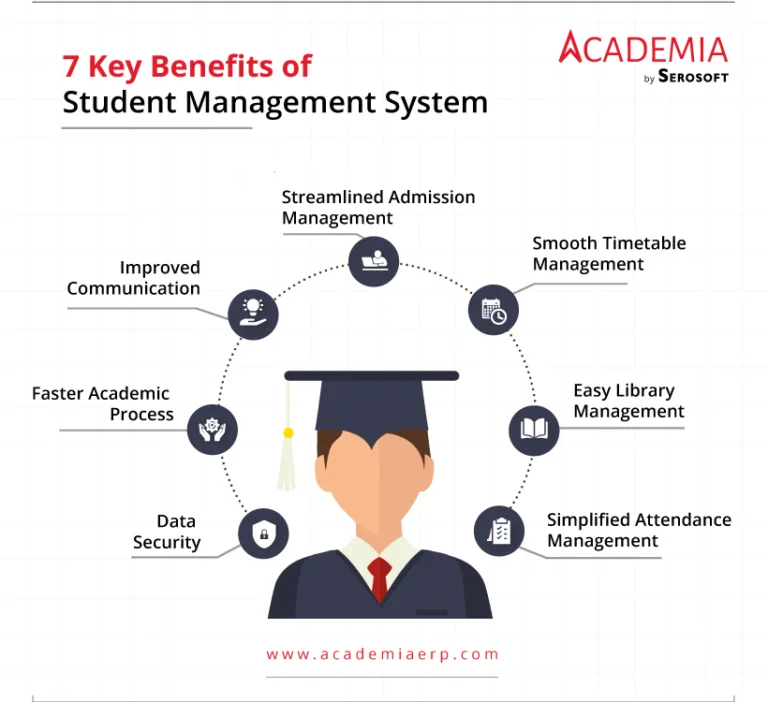
7 Key Benefits of a Student Management System

Educational institutions involve a lot of data that needs to be managed properly and systematically. It is important to streamline and manage the complete student data, and various educational institutions invest in high-performance student information systems (SIS). There are various Student Management System Benefits that we will discuss in this blog.

The cloud-based software helps in storing and organizing various student-related data in a proper and centralized manner so that it can be easily accessed, edited, and updated when they are needed. 

To understand it more properly let’s discuss some of the key benefits of using a student information system:

  • Manages Student Information

A student profile management system manages all the information related to student’s attendance, assignments, academic reports, curriculum details, project details, exam-related information, skills and achievements, medical history, address, fee, and accounts-related data easily and efficiently leading to simple and effective management for the institution. 

  • Increases productivity

It is important to choose a good and effective SIS that can help boost the productivity of your institution. An effective SIS leads to increased speed and efficiency that helps in maintaining effective records and an increased data accuracy involving lesser time helping administration and staff to focus on other important and productive tasks for the institution.


  • Streamlines all the operations 

In most cases, a student management system provides complete access to all the operations equipped with a dashboard that makes easier tracking of what needs to be done, who will do it, and what work needs to be done. The best part of all this is you can attain any of the student’s, faculty’s, or administrator’s information any time on a single screen within just a few clicks. It streamlines the complete academic and administrative operations of the institute making everything simple and efficient in every manner. 

It manages all your important work that is highlighted. It also improves all the tasks that are important for high productivity focusing on student’s growth. It also indicates that you can grow as an institution having complete control in just one system. 

  • Improved Communication

It is always known that every student has a different interaction level, but no matter how friendly the atmosphere in your school is, some students require special attention related to all the academic and administrative operations. A student management system comes hand-in-hand helping faculties to improve their communication properly and systematically. 

There are various reasons for which students might hesitate to discuss with faculties and administrators like fee submission, exam-related queries, etc. So having a student profile management system will be easy to communicate for students with whomever they want for any operation like fee, exam management, timetable management, and any other thing. 

  • Reduces Paperwork 

Student Management System helps institutions to manage personal records easily, it keeps complete track of student data – reducing paperwork. There are various things for which students need to manage a lot of documents like admission forms, student records, financial aid paperwork, etc. so by having an automated student system in place, students get the opportunity to access all the data easily and efficiently from anywhere and anytime along using the mobile app. 

  • Centralized access to everyone

Old were the days when parents always got their child’s information only on parents teachers meet. Using a student app parents can access any information like activities, assignments, attendance, and other relevant information. 

  • Date Security 

In an educational institution, it is quite important to secure student’s information in any case, the manual intervention involves a lot of errors along with a lot of time involvement

The traditional methods of storing documents are also prone to risks of data loss. It can be by physical damage, theft, or an accident. 

With the use of student management software, administrators can minimize that risk to the lowest. All the data is saved on the server which is encrypted with security and only a user with login credentials can access it.

So, institutions should opt for a student management system that provides data security keeping all the data security along with providing real-time access whenever required. The software provides multiple automatic backups of data to make sure you do not end up losing your valuable files.

Wrapping Up 

With the increased demand for online systems, educational institutions need to opt for a system that is student-friendly and can fulfill all the needs of students. Hope you liked this article and understood the Student Management System benefits that can help your institute and its students to focus more on productivity, and having efficient management of all the academic and administrative tasks in the institution. 

It allows institutions to focus on other productive activities rather than managing the regular student’s documentation and management as they are possible with just a few clicks. 

So what are you waiting for, choose the best student management system for your institution, and if you are interested in seeking the best system, do contact us now and we will explain to you how Academia can help institutions seek growth, productivity, and success. So do call us to know. 

How Educational Institutions Save Time and Money with Automation

An age that swears by ambition and competition, the 21st century has also offered us varied tools to ensure that the fight is fierce! The digital revolution (also known as the 3rd Industrial Revolution ) is helping us make the best use of time & money in creating a better as well as a faster world. In the last 4 to 5 years, it has significantly penetrated the education industry too. Various EdTech solutions such as the Student Information System, Learning Management System, etc are playing an important role in efficiently managing the campus administration.

The main reason for this software becoming a favorite of the education industry is that they help in effective resource management to subsequently ensure student success.

Education ERP: An intelligent way of managing your institute

Here are the 5 ways automation can help in saving time and money:

Prompt Decision Making

If you are heading an institution or a particular department, decision-making is certainly a part of your daily calendar. It takes a huge amount of time to go through stacks of files that have data and references for you to arrive at a conclusion.

What if you can access all these details at the touch of a button without having to go through the pile for papers? Wouldn’t it’ll save you precious time?


Education ERP gives you the power to access all the details whenever you want. Student records (class-wise, course wise, year wise), employee records, ongoing courses and much more. It provides neat reports that help you in the quick analysis, which ultimately results in faster decision making.

Reduced stationery costs

According to an article on Edutopia, around $25,000/year is spent on paper alone by a school with a capacity of 100 teachers in the US. Not to forget other costs including printing and stationery.  

The education industry relies heavily on paper and stationery. While it can’t end it completely, it can definitely be minimized. With Education ERP such as Academia SIS, institutes can save up to 22% in printing and mailing costs. Being a cloud-based system, you can share documents with students, parents, and teachers on their portal or email address to save paper costs. Hard copies are redundant as all the data is securely saved on the cloud. This is an effective way to save a lot more than you can imagine.

Reduction in academic reporting time

Education ERP has an integrated excel sheet tool, with this you can upload and download all the data, anytime you want. It saves your time in manual inputs to make academic reports. All data entered can be converted into excel sheets as and when needed.

For example, if you are running a campaign for admission, you can track enquiry, create data sheets in real-time and share them with other staff members. Not just this, you can also check the expense reports, target achieved and so on.

Faster turnaround time

When you are able to make decisions faster and save time in mundane administrative tasks the turnaround time of management processes is automatically shorter, helping you do more with less.

Digital transformation with ERP reduces paperwork, streamlines processes and makes work simpler that in turn speeds up the overall management. The information flow becomes smooth, transparent and it keeps everyone from multiple departments in the loop that aids in faster and more efficient task performance. Moreover, it also minimizes errors and removes data duplicity to get rid of rework in the process.

Automation resulting in High ROI

The primary focus of an educational institution is to offer quality education with world-class management, however, the quality and credibility of an institution do not depend only upon its faculty, but also its capital. 

Recommended reading: How a Student Information System Can Ease Your Pain

For any organization, the return on investment is a crucial factor to run any institution. It depicts the success of the entity. The education industry spends millions of dollars on quality education. 

An efficient solution to control and manage your capital is with the digital transformation of your institute. Using technology for your day to day tasks can seem expensive in the beginning, but in the long run, it helps in achieving high ROI.

Know more about how ERP System can help in ROI

Are you a smart educator who wants to use technology to save time and money in management? Try a free demo now!

Image source: freepik.com

Top 6 Functions of Student Information System that Every Educator Should Know

A well-implemented Student Information System transforms institutional operations and empowers educators to focus on what truly matters-teaching and learning. From managing student data to enhancing communication and improving academic performance, the benefits of an SIS are undeniable.

investing in a robust SIS is no longer optional-it’s essential for institutions aiming to embrace digital transformation. Educators who understand and leverage these six key functions can drive better results for both students and the institution.

1. Student Data Management

The core function of any SIS is efficient student data management. From personal details and admission records to academic progress and health information, the system securely stores all data in one place. Educators can easily access student profiles, track performance, and make informed decisions.  Teachers can tailor their teaching strategies based on individual student needs, ensuring a more personalized learning experience.

Key Features:

  • Centralized student profiles with demographic and academic details.
  • Secure storage and easy retrieval of historical records.
  • Real-time updates for any changes in student information.

2. Attendance Tracking

Every contemporary SIS will have an attendance module. The system allows educators to intervene early if a student is frequently absent. Teachers can mark attendance within seconds, while administrators get real-time reports to identify patterns and address absenteeism. An SIS automates this process, making it efficient and accurate. 

Key Features:

  • Daily and subject-wise attendance marking.
  • Instant alerts for absenteeism.
  • Detailed attendance reports for each student.
  1. Marksheet & Assessment Management

Grading and assessment is a complex process, especially when dealing with multiple subjects and exams. An SIS simplifies this by providing integrated marksheets where teachers can enter scores, calculate final grades, and share results with students and parents. Educators can easily identify students who need extra support while parents stay informed about their child’s academic progress.

Key Features:

  • Customizable grading scales and weightage.
  • Automated report card generation.
  • Performance tracking over time.
  1. Timetable & Scheduling

A timetable can last for six months or more. Creating timetables for classes, exams, and extracurricular activities can be challenging. An SIS automates this process to ensure efficient resource allocation and conflict-free scheduling.

Key Features:

  • Automated class and exam timetables.
  • Schedule adjustments with instant notifications.
  • Resource management for classrooms and teachers.

5. Communication & Notifications

Effective communication between institutes, teachers, parents, and students is essential for student success. An SIS bridges this gap by providing multiple communication channels.  Transparent communication ensures everyone stays updated, reducing misunderstandings and enhancing collaboration.

Key Features:

  • Real-time notifications for attendance, grades, and events.
  • Two-way communication between teachers and parents.
  • Event and exam reminders.

6. Reports & Analytics

Data-driven decision-making can transform education. An SIS provides powerful reports and analytics to help educators identify strengths, weaknesses, and opportunities for improvement. Educators can make proactive decisions to ensure better learning outcomes and efficient college/university management.

Key Features:

  • Customizable reports for academics, attendance, and behavior.
  • Visual dashboards for quick insights.
  • Predictive analytics for academic performance.

Conclusion

Efficient student data management is not just about organization-it’s about empowerment. It equips educators with the tools to provide personalized learning, improves institutional efficiency, enhances communication, and drives long-term success. In an era where data drives progress, institutions prioritizing effective student information management will deliver quality education and foster institutional growth.

Experiential Learning vs Conventional Learning. Which works better and why?

The concept of experiential learning has been frequently introduced lately. Nowadays, more and more schools have begun to accept this growing trend. The idea is quite simple and bypasses the typical learning process through experience or a “reflex to do”.

How does this work?

The process starts with a person performing a specific action and then sees the effect of the action in a situation. 

The second step is to understand these effects if the same measures were taken and predicted under the same circumstances. 

The third step is to understand the general principle under which the particular instance resides. When this general principle is understood, the final step is the application of the action under new circumstances.

The world is your class

It can be argued in favor of experiential learning that concepts that are difficult to understand in the classroom can be more easily accepted through real experiences. 

Studies have shown that learning in the real world can be more effective as students adapt to the real world through careful observation and generalization. With this learning experience, you can:

  1. Gain valuable experience in the field
  2. Study and learn more globally and locally
  3. Understand the importance of real-life experiences
  4. Actively participate in a dynamic environment

Conventional VS Experiential

Today, schools and organizations involved in the education sector use a variety of methods that they believe will contribute to overall development. However, there is a clear distinction in the way these procedures are carried out. 

Some are more concerned with the concept of experiential learning and individual development compared to traditional methods designed to develop each individual’s ability to meet measurable standards or the standards of an organization.

Read also: 5 Benefits of Adaptive Learning in Edification

Nevertheless, there are many differences between conventional learning and experience:

Conventional learning Experience learning
Includes direct training or teaching Includes modern ways of learning & teaching using advanced tools & software
Involves restrictions with a pre-decided frame of learning Flexible with a variety of learning patterns and techniques
Focus on just institutional growth Focus on the overall development of students along with institutional growth
Knowledge transfer from existing books and resources by faculty to students   Students and faculty can experience the lessons taught to them using artificial intelligence, virtual reality, and more.
Ex. Classroom teaching, conferences, presentations. Ex. Use of technological tools & software for enhanced growth of teaching & learning

Conclusion:

It is not surprising that the vast majority of education and training is still conventional and not experiential. This can sometimes be understandable, as the needs of an organization can be anticipated according to individual needs, both in terms of training and in terms of subsequent work. Here it can be argued that society is a little ignorant and “broken” in this regard.

It is difficult to deny the benefits of experiential learning. As, it can effectively address the personal development needs of young and old learners and improve self-esteem, self-responsibility, and maturity which are difficult to achieve with conventional and normative teaching methods.

To know more about the Student Information System, click here.

How Generation Z is Reshaping the Future of Education

The Millenials have ruled the world but the future belongs to Generation Z. This generation is the next generation of higher education students, presently attending schools. In education, the survey states that around 93% of this generation students consider technology in the classroom essential to nurture their creativity and prepare them for their future career.

Not just technology this generation believes in social learning which is not limited to geographical borders. Online learning that is available at any time, anywhere is their must-have facility. They expect on-demand services that can help them to focus them in the right direction in their career. This generation is not just limited to Instagram and Facebook story sharing but more focused and career-driven. Most of them already involved in one or another type of business or startup and therefore they need an educational institution that can add value in their skills, that can act as a catalyst for their career. And Generation Z won’t settle for less.

What is the role of an educational institution toward generation Z?

Gen Z is the generation that is not a passive learner, they are the answer finder or if they don’t find the answer they will create the answer for the curious mind. They have an ample amount of resources to enhance their knowledge, the generation where 4G and 5G internet is delivering 24*7*365 access to all over the world.

So, how educational institutions will exist in this digital generation?

There is no doubt that any technology or any amount of internet can’t replace the human touch of education and teachers but to stay “relevant” for Gen Z, education institutions need to pace up with the digital world.

Educational institutions need to increase their digital presence not only in the learning area but also in administrative management. These students are realistic, they believe in transparency and connectivity. Any institute without technologically advanced management system will lose the interest of Gen Z students. For proper management of student technology like SaaS, Student Information System with cutting edge technology is now the necessity for higher education institutions to maintain the admissions retentions of students. 

Coming to learning management system colleges and University are already on their way to increase their digital presence with online courses, video lectures, podcasts, and 24*7 teacher availability via portals. Artificial Intelligence, Virtual Reality, Augmented Reality, Machine Learning will rule the education sector for Generation G.

Educational Institutions have to show this generation that how their education process can make them stronger, more skilled and future-ready. 

How to meet the expectation of Gen Z?

This is the generation that is passing through the tragical events such as 9/11, 2008 financial recession, terrorism, and whatnot. Gen Z doesn’t live in a fantasy of the ideal world, they live in reality and they understand it. Emerging technology and self-reliance to get learning haven’t lost their faith in the education institutions and educator. In a recent survey by Deloitte The Deloitte Global Millennial Survey 2019, Gen Z has put the onus on educators for preparing workers for Industry 4.0 i.e. industries with smart factories with advanced connectivity and where whole work can be visualized to aid in decision making. 

That means the next generation of students is already putting their money on education sectors and educators, rest must be done by the educational institution. 

Now it’s the responsibility of the institution to make themselves ready to meet the expectation of the Gen Z by diving into active digital transformation, automation of the administrative system, by shifting towards a more practical approach of education and last but not the least delivering the world-class student service to help Gen Z to succeed in their future.

4 Undeniable Reasons Why Educational Institutions Should Use ERP Software

Being a part of the education industry, I need not tell you how much the meaning of education has changed over the years. It is no longer about providing education for sake of a system or law. It is about having more accountability toward building the future of the country by shaping these young minds. Equity and accessibility have become an integral part of the goal. Governments around the world have already started prepping to meet these new goals in a couple of years. 

Even though, the goals have changed the challenges have remained the same. In fact, after covid-19, they have elevated. The resources are meager and in some poor countries, educating children is not even on the list of priorities for people. They are battling to keep their families fed and are asking children to take up odd jobs. As an education organization, you too must have seen a dipping admissions rate, late arrival of government aid, and most of all students having lowered engagement in the classroom. How are you are prepping to battle them? 

One of the solutions is – Education ERP. 

What is Education ERP Software? 

Education ERP software is advanced software that helps in automating the operations in an institute and serves as a database for multiple applications put in use for the digital governance of an institute. 

4 undeniable reasons you must invest in Education ERP software

  • Reduces cost 

A report by OECD suggests that global funding for the education industry can go down by 11%. This means you must be prepared to reduce the cost of operations and spend only on the things that are absolutely necessary. 

But do you even know where you are spending currently? I know your answer. Manual processing is not only costly, but it is highly opaque. There is no transparency in the transactions and hence you may not be able to fully consolidate where you are spending currently. 

To fight that, use an ERP solution. It is an enterprise-level resource management tool that provides you with financial management and automates most tasks to reduce operational costs. 

  • Paperless operations 

This is the most cliched reason to invest in technologies but, imagine the amount of money you save by going paperless. Paper-bound operations are slow and they are very difficult to manage. They lower the productivity of the staff and you lose out on good opportunities to stay profitable in the current economic climate. Hence, switching to paperless operations is best, and ERP does it all for you. 

  • Reports and Analytics. 

Compliance agencies and regulatory bodies are prepping for changing their norms of accreditation. They need to see more accountability in administrative and academic staff toward quality education. They are demanding reports on various aspects of a student lifecycle and to stay on top of it you need – first, a database that centralizes information in one place, and second a tool that consolidates data to provide you accurate reports. 

You no longer cannot depend on the academic and non-academic staff for these reports, given you are short on resources and you have to reduce your operation cost so hiring more people is out of the question. Hence, an education ERP is a long-term solution. The data analytics feature helps you generate various reports and stay in line with compliance. 

  • Data security and management

Data security has become a central concern for education institutes. During covid-19 many institutes chose to go with the available option in the market without testing the security of the product. As a result, many students and parents are complaining of data leakage and are concerned about the security of the student in an online learning environment. 

This has led to institutes taking harsh measures and going with tools that offer higher security in the ecosystem. An education ERP solution such as Academia ERP can help you navigate through this challenge easily. We are a highly secure platform that uses various security measures to prevent any breaches.

Wrapping Up 

These were the 4 reasons to invest in education ERP software. If you need to know more about the features and functionalities, please fill out this form to request a free demo. Our technology experts would connect with you shortly. 

University ERP- Bridging The Gap Among Students, Faculties, & Parents

Communication is power, it creates a better relationship, builds trust and avoids disposal of improper information.

Even in education industry communication is very important. We are aware of the importance of connectivity and synchronization between faculties and students. But there are many more dimensions to cover to fill this communication gap.

It is prevalent that parents want to be involved in their children’s lives especially when it comes to academic performance. They want to be aware of how their kids are being taught, how they are performing, is there any behavior that needs to intervene, etc.

Not only between parents and student but communication also plays an important role between faculties and students. If a student is updated with all the lessons, assignment details, faculty’s availability and other related information; his awareness will increase and he will perform better. Same goes for faculty.

Here comes the need for a proper system that can enhance the connectivity among all the stakeholders of an institute.

What is University ERP?

University ERP is a software programme that manages all the academic processes within a university campus. It is also known with various names around the globe e.g. University Management System, Campus Management Software or Student Information System.

It manages complete student life cycle from inquiry to graduation till placement. A University Management System streamlines all academic operations with the help of many advanced features.

How a University ERP is connecting students, faculty, and parents?

A University ERP or University Management System such as Academia SIS provides an exclusive portal for parents, faculty, and students. These portals help them to see all the information they require.

University Management System Software- Academia SISWith the help of Parents Portal, parents can check the details of their children such as marks obtained, lessons taught, absentees, outstanding payments, disciplinary actions, etc. They can also track which faculty is running behind in his/her lesson plan and which one is performing better.

If parents stay aware of the performance of their children, they can take the required actions. Moreover, students perform better if their parents are aware of their academic activity.

If there are any inadequacies in performance or any other areas, parents can play their role to correct it.

Faculty with the help of Employee Portal can give assignments, homework to every student; individually or in a group which gives them the power to keep an eye on every student.

What are the benefits of University ERP?

In the olden days when our parents in college, their parents weren’t getting any academic or non-academic performance report of their children, only the mark sheet. Now the time has changed. With the help of Education ERP, parents can be aware of everything their children’s activity from beginning to end, which builds a meaningful and strong relationship among students, parents, and institutions.

Education ERP is the future

It is well known that Education Technology is going to replace all traditional and manual academic processes in the future. University ERP or Student Information System (SIS) brings the parents and institution on the same page, that ultimately leads to a healthy and successful student life cycle.

Is your university ready for an advanced management system? Take the first step and book a free demo now!!!

How a Student Information System Can Ease Your Pain

Education is a tool to create the future of not only a student but a nation. It’s a pity that least of the focus is given on the management of education operations in previous days.

But,

Like every other sector, science & technology came forward to change an old and disorganized system of education process management.

There are many software and applications that have been invented during the last few decades which are completely centralized to make education processes coherent and efficient. Student Information System, AI, ERP, IoT are some of the advanced technologies that are helping the educational institutes. Among them, SIS or Student Information System is the most favored technology among institutes for automation, scalability, and sustainability.

What is a Student Information System?

A Student Information System is an education ERP that helps higher education institutes to manage all the operations and processes in a more integrated, seamless and productive way. It manages the complete life cycle of a student from inquiry through admission to course completion including placement. It is a tool to bridge the gap between education and occupation.

SIS is a software that is customizable as per the requirement of the user. It is a source to automate and digitize the institute management system.

What challenges are faced by the education institution without SIS?

Student Information System SIS - Academia ERP

After consulting with many institutes we get to know that, there are a number of challenges faced by an education institute whether it is a stand-alone college, university or a group of institutes. The challenges they face are:

  • Administering of increasing student records.
  • Maintaining the connectivity between parents, teachers, and students.
  • Complex and time taking fee and bill payment system.
  • Delay in result and examination due to the inefficient and insufficient workforce.
  • Controlling dynamic examination data in various modes, student wise, subject wise, faculty-wise, etc.
  • Handling different departments for different logistics i.e. hostel, transportation, library, etc.

How a Student Information System is helping the institutes?

Student Information System is helping the institutes to simplify the management processes. There are various modules that come in the SIS for various tasks and the modules help in managing multiple day-to-day tasks.

Following are four benefits of using SIS in education institutes:

Integrated Solution for multiple institutes

You can manage multiple courses of multiple academies from one single web-based solution. There are modules for course setup, organization set up, etc in which admin have the power to set up data and he or she can manage everything from one portal. Apart from that, a Student Information System also provides various portals for various users as per the requirement of the institutes.

Increased Collaboration

With the help of SIS, the connectivity increases among parents, administration, management, and students. This connectivity brings the transparency of the processes that lead to trust in the organization.

More informed and quick decision

Using the Student Management System gives you the power to have an eye on every information of every department and process. This increases the ability to make any critical decisions in the least time which increases the efficiency of the organization.

Increased ROI

Return on Investment is important for an organization for motivation and growth. Student Management System is helping institutes to increase ROI via robust performance and enhanced efficiency. With the help of automation via SIS, institutes are not only able to increase efficiency but also they gain the students and parents satisfaction.

Are you wondering how SIS is making education management process streamline and efficient?

Try a free demo for more amazing features of SIS and witness the impact of technology now!!!

Click here to schedule a Free Demo: www.academiaerp.com/request-demo


5 Reasons to Choose an Admission Management System

We are living in the 21st century in the era of the third industrial revolution. Also known as the Digital Revolution, a century of computer and automation. Every industry is moving toward automation to and the education industry is not behind.

Education Technology or EdTech has become a new trend in the education industry.

As higher education is vast and the young generation is more tech-savvy, they are transforming very quickly into an EdTech synchronized system. Not just students but institutions are also shifting to automated academic and administrative operations through ERP.

Amidst cutting-edge competition, there are few EdTech tools that are transforming the higher education system.

Here are five such trends:

1. Artificial Intelligence

AI has already entered all the major sectors e.g. finance, marketing, and advertising, healthcare, law, etc. Now, many educational institutes are adopting AI in their academic and administrative process. UK-based company Third Space Learning is using AI software to improve the teaching experience of its global network of around 300 teachers.

In some institutes, AI software is installed in the classroom to guide teachers not to lose track of the topic while teaching, to maintain teaching speed for better understanding among the students.

2. Blockchain

The role of blockchain in the next technological chapter is not hidden. The adoption of bitcoin as a legit currency in various countries is one solid example of how blockchain tech is changing the system.

There are many ways blockchain technology in education can help to decentralize the higher education system. Education record and credentialing, copyright protection, course curriculum, innovative learning platform, publishing, library are a few areas where blockchain can overhaul the education experience.

3. Student Information System

Technology is knocking on your door at higher education- academia erpThe education industry runs on number of operations. To manage a student life cycle in an institution from admission to placement is not an easy task. It requires admission management, fee management, inventory management, academic management, various report generation, and much more work.
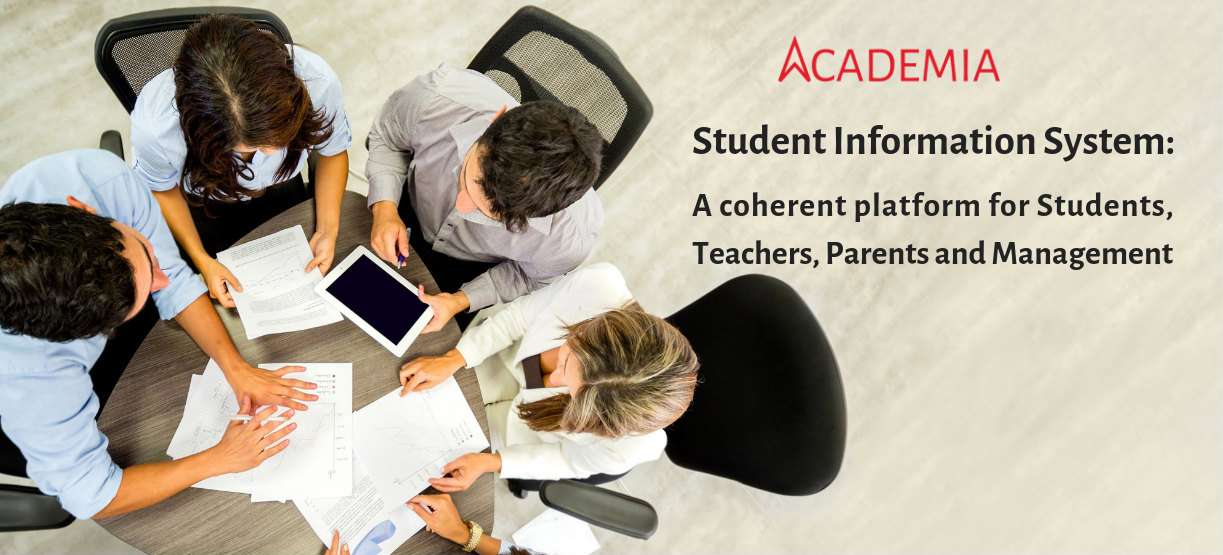

To make higher education efficient, productive, hassle-free and more centralized education software of Student Information system or SIS is introduced.

Many institutions have already adopted to Student Information System and due to quick run-around time, they are achieving a high return on investment.

4. Virtual Reality

Virtual Reality in education is also widely known as Virtual Learning Environment, which provides immense learning potential in higher education. Educators can enhance the educational experience by using VR practice in the classroom. Tech giants like Microsoft, Google have modified human-computer interaction via gadgets like Microsoft HoloLens and Google lens.

5. IoT

IoT or the Internet of Things has made the main transformation in the retail sector, healthcare, and customer services. According to the basic definition, It is defined as the proposed development of the internet in which everyday objects (other than the usual laptop, mobile, computer) have network connectivity to send and receive data and exchange information.

With the help of IoT, the education sector is availing the benefits of collaboration between students, educators, and administration. It also helps in global networking enhancement of textbooks, attendance monitor system, data collection, and better collaboration.

Why you should use these technologies in your institution?

It is not necessary to use all the tool simultaneously.  You can opt for the right EdTech based on institutional operations and processes.

To enhance the student, faculty and administration experience, for more collaborative processes and streamlined operations it is necessary to use technology in education.

Are you looking for EdTech or software to enhance the productivity of your institute?

Academia is one of the leading education management software that is an enhancer and enabler for the education sector operations. It works for schools, higher education institutions, and training institutes. Try a free demo now!!

Student Information System: Empowering Institutions

The Student Information System is an ecological system that helps the institutes get rid of distributed data. This all is in single software which includes initial documentation from inquiry management, and student registration, till students get passed out of the college / University. This software will help you in running all day-to-day college activities without difficulty. College can easily send alerts or different sorts of information via SMS or email to parents and students. Information generated includes results, attendance records, assignments, notices related to different cultural activities, seminars, corporate events, Placements, etc…

 Student Management System helps in many ways such as:

  1. Authentic time reports: Long ago manual reports technology was used in institutions. These days, the management can do the whole lot on ERP, which in itself is an inbuilt mechanism for generating reports. Many styles of actual time assessment can be generated from such software in the form of different excel reports.
  2. Paperlessness: Automation of process leads to reduced usage of paper which ultimately helps in saving time and money.
  3. Data Security: SIS provides a high level of data security in terms of protecting data from unauthorized access and data corruption throughout its life cycle.
  4. Improved quality of interaction: With the help of SIS interaction between Students – Faculty, Student – Management, Management – Parents, Intra college Faculties, Administrator became more transparent.
  5. Growing productivity: The proper use of ERP software program will boom the productivity of University / Colleges to a large volume.

Hence, the Student Information Software is a boon to the education industry. With limited and constrained options to satisfy the current generation, let us start working towards a better tomorrow with the ease of SIS in a click away

A quick guide to choose the right education management solution for your institution

Let’s get familiar with the step by step process of reaching the right education management solution for automating your institute:

There are probably a few challenges that could be faced by you, while you would start to consider automation for your institute. These are as follows-

1. Report Generation: Creating and managing reports is one of the most tedious tasks for an institute. Accuracy cannot be compromised during the generation of reports since all the critical decisions are made over it. But by keeping it manual, there are several compromises one has to makeover it.
2. Data Management: Data loss is another situation that needs more emphasis. Due to the manual processing, there’s always misplacement or loss of the data and the required data goes missing.
3. Lack of coordination: Coordination among internal stakeholders is mandatory for better productivity but some tasks such as keeping people in the loop, regular follow-ups, long approval flows, etc make it very hectic. It also affects the timeline of the tasks.
4. Attendance Management: Attendance of both staff and students is a huge task to handle altogether. Keeping track of it and updating people about it manually is almost impossible for larger institutions.
5. Finances Management: Fees collection and management of compensations, damages, petty cash, refunds, etc are very critical to keep the institute going.

Here are some great suggestions on how you can meet the challenges by adopting the best-fit education management solution:

A quick guide to choose the right education management solution for your institution-academia erp

a. The right fit solution: A software that suits your institute perfectly should be chosen. It will depend on the requirements, the problems faced in various departments, the size of the institute, etc. Considering all these factors will help you choose the right education management solution.
b. Training: Training sessions for staff is another important process that should be undergone for using the ERP software the right way so that the use of the solution can be materialized.
c. Time- saving: Automation obviously saves a lot of time and money as well. The tasks are done automatically with the software and the staff just has to keep track of the day-to-day tasks with very fewer efforts. The lowest manual intervention will help you invest your manpower in some more important tasks than managing the data.
d. Simplification: Attention to every task can be eliminated because the software possesses the perfect algorithms to complete the task the right way. Hence rechecking the calculations, the listing of students, fee management, due dates -all can all done by the software itself.
e. Security: Security is pretty big of a concern that can be taken care of by providing accessibility to the right staff members only. The software allows the security check and login customizations according to the requirements of the institute.
f. Reliability: The reliability of education management solution is the most important challenge an institute can face, one can go through the old testimonies for the software, its usages, past experiences, and the popularity for shortlisting.

Are you unable to find the right solution because of the following factors?

a. Budget & cost: Education technologies always involve great cost, and of course it is varied by the size of the institution and its type. You will have to find the right balance of budget and customs requirements.
b. After-sales support: After the implementation, support is the basic requirement for the institute since these types of technologies require very effective support systems for smooth working. A good Support team along with the right software will be of great help in long run.
c. Internet issues and the computer skills of the staff: New processes need to be added to train the staff so that the institute could reach the exact level of efficiency which is expected from education ERP systems.
d. Customization: Every institute is one of its types, the institutes have their own process and ideas for management, therefore it is very important to create a customized system that could suit the Institute requirements very well.

Academia is the right solution to overcome challenges and success in managing your institute. We provide systems with the right cost that fits your pocket and benefits you enormously once implemented. Academia provides the best support in the industry. (Look at the client testimonials, how: https://www.academiaerp.com/clients/ ). We provide training programs off-site and on-site as per the institute’s requirements.

Embracing the Future: Student Information Systems in 2030

In recent years, education has expanded beyond just imparting factual knowledge. Modern education emphasizes problem-solving, creativity, collaboration, and emotional intelligence. It also focuses on values, ethics, and diverse perspectives so the students are better prepared to navigate the world effectively.

As educational methodologies evolve, so should the technology that supports them. By 2030, Student Information Systems (SIS) will not just manage student data but actively contribute to holistic learning experiences. These systems will integrate advanced technologies like artificial intelligence (AI), machine learning, and blockchain to transform the operations of educational institutions.

Key Features By 2030

Student Information Systems of the future will be more than just administrative tools. They will empower educators to deliver personalized, data-driven instruction while fostering student success. Institutions that embrace these advancements are most likely to create more inclusive, efficient, and engaging learning environments. 

  • Automated Administrative Processes: Broadly speaking, SIS platforms already automate routine administrative tasks such as admissions, fee collection, timetable generation, and report card creation. This automation reduces paperwork, saves time, and minimizes errors. Advanced SIS platforms are set to include integrated communication tools to facilitate seamless interaction among students, teachers, and parents. AI-driven chatbots will provide instant responses to common queries, reducing administrative workload.
  • Personalized Learning Paths: Finland’s education policy is a prime example of this global trend. The Finnish education system allows students to select their learning path based on their skills and preferences. Similarly, the future of international education will revolve around analyzing student performance, preferences, and strengths to create customized learning paths. Students will receive tailored resources and assignments to ensure they progress at their own pace.
     
  • Real-Time Analytics and Insights: Educators and administrators will benefit from real-time dashboards. These dashboards offer insights into student engagement, attendance, and academic progress. Predictive analytics will identify students who need additional support to enable timely intervention. These insights will extend beyond academics to a holistic understanding of each student, including social and emotional well-being indicators. Institutes can leverage these analytics to design more effective curricula, allocate resources efficiently, and improve overall institutional performance.
  • Seamless Integration with EdTech Tools: Future SIS platforms will seamlessly integrate with popular educational apps, virtual learning environments, and content platforms. This integration will reduce administrative burdens by streamlining the teaching and learning experience. SIS will create a cohesive learning environment for teachers to assign tasks, share resources, and track progress within a unified platform. At the same time, students would be able to access all their learning materials without switching between multiple apps. Moreover, integration with video conferencing tools and digital assessment platforms will further enhance virtual and hybrid learning models. Institutes will also benefit from interoperability standards that allow different systems to communicate effectively and ensure a smooth flow of information across platforms.
  • Improved Communication and Collaboration: Advanced SIS platforms will include integrated communication tools, facilitating seamless interaction among students, teachers, and parents. Collaborative project spaces and discussion forums will further enhance the learning experience. These platforms will ensure all stakeholders stay informed by supporting real-time messaging, video calls, and automated notifications for important updates. Additionally, AI-driven chatbots will respond instantly to common queries to reduce administrative workload. Institutions will also benefit from multilingual communication features to promote inclusivity for diverse communities.

Conclusion

The future of education is dynamic, and with the right technology, institutions can navigate this transformation with confidence. Embracing next-generation SIS platforms will not only streamline operations but also enrich the educational journey for students worldwide. As we stand on the cusp of this technological revolution, one question remains: Are educational institutions ready to embrace the full potential of these innovations and redefine learning for future generations?

Back to top